-Dr Jaymin Gupta
--Dr Snehal Dandge
-Guide:
-Dr Amol Wagh
๏ฝ Malnutrition is common in about 30% of
surgical patients with Gastrointestinal disease
๏ฝ Frequently unrecognised leading to lack of
appropriate support.
๏ฝ Aim is to identify patients at risk of
malnutrition and to ensure that their
nutritional requirements are meet by the
most appropriate route and in a way that
minimises complications.
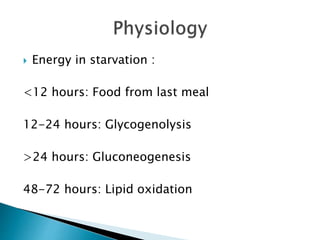
๏ฝ Energy in starvation :
<12 hours: Food from last meal
12-24 hours: Glycogenolysis
>24 hours: Gluconeogenesis
48-72 hours: Lipid oxidation
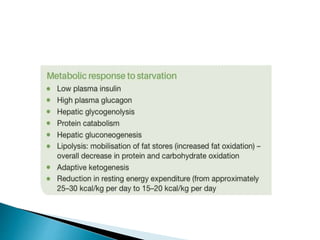
๏ฝ Another important adaptive response to
starvation is a significant reduction in the
resting energy expenditure, possibly
mediated by a decline in the conversion of
inactive T4 to active T3.
Despite these adaptive responses, there
remains an obligatory glucose requirement of
about 200 g per day even under conditions of
prolonged fasting.
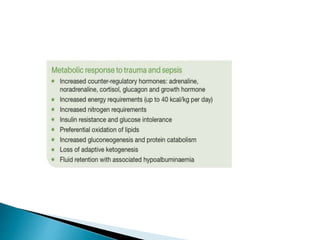
๏ฝ In contrast to simple starvation, patients with
trauma have impaired formation of Ketones
(LOSS OF ADAPTIVE KETOGENESIS).
๏ฝ Breakdown of protein to synthesis glucose
(Gluconeogenesis) cannot be prevented by
the administration of glucose.
๏ฝ BEE is 20 Kcal/kg/day
๏ฝ In case of mild sepsis : 1.4 times
severe sepsis : 1.8 times
Severe Burns : 2 times
- Although it is generally accepted that metabolic
responses to trauma and sepsis is always
associated with โ€œhypermetabolismโ€ or
โ€œhypercatabolismโ€, there is another school of
thought that these terms are ill defined and do
not indicate the need for very high energy
intakes.
๏ฝ No evidence to show that the provision of
high energy intake is associated with
amelioration of the catabolic process.
๏ฝ Permissive underfeeding in critically ill
surgical patients (Rising evidence).
๏ฝ Trends are more important than a single
biochemical value.
๏ฝ No single biochemical value that reliably
identifies malnutrition.
๏ฝ Body weight- compared with usual(for individual)
or ideal
๏ฝ UNINTENTIONAL weight loss of more than 10% of
a patientโ€™s weight in the preceding 6 months
๏ฝ BMI <15
๏ฝ Skin fold thickness โ€“ Estimates body fat
๏ฝ Mid arm circumference โ€“ Protein (Muscle stores)
All the aforementioned techniques impaired by the
presence of oedema.
๏ฝ Fat stores - Skin fold thickness, Triceps fold
thickness
๏ฝ Bioelectrical impedance analysis to estimate
intra and extracellular volumes.
๏ฝ Research methods(expensive and impractical)
-in vivo neutron activation analysis
-Isotopic labelling studies
๏ฝ Not a measure of nutritional status, particularly
in acute settings.
๏ฝ Acute changes are often assessed by Pre-
albumin, Albumin and Transferrin.
๏ฝ Better assessed by Pre-albumin (half life of 48
hours) rather than Albumin ( half life of 21 days).
๏ฝ All these metrics are useful in pre-operative
evaluation of nutritional status; use of these
values for ongoing nutritional assessment in
hospitalised or critically ill patient is
controversial.
๏ฝ Possibility of malnutrition should form part of
the workup of all patients.
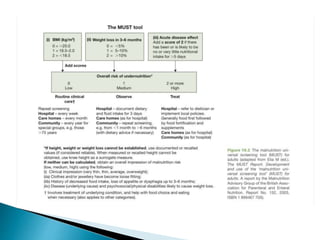
๏ฝ Malnutrition Universal Screening Tool (MUST);
a 5 step tool introduced by the British
Association of Parenteral and Enteral
nutrition.
๏ฝ Identifies adults who are malnourished or at
risk of undernutrition.
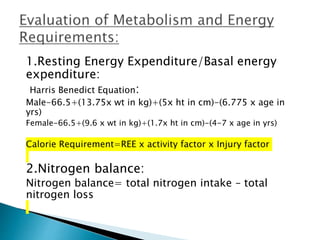
1.Resting Energy Expenditure/Basal energy
expenditure:
Harris Benedict Equation:
Male-66.5+(13.75x wt in kg)+(5x ht in cm)-(6.775 x age in
yrs)
Female-66.5+(9.6 x wt in kg)+(1.7x ht in cm)-(4-7 x age in yrs)
Calorie Requirement=REE x activity factor x Injury factor
2.Nitrogen balance:
Nitrogen balance= total nitrogen intake โ€“ total
nitrogen loss
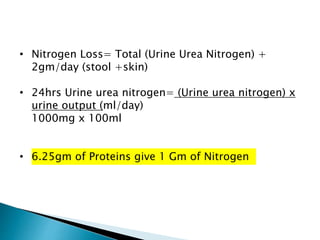
โ€ข Nitrogen Loss= Total (Urine Urea Nitrogen) +
2gm/day (stool +skin)
โ€ข 24hrs Urine urea nitrogen= (Urine urea nitrogen) x
urine output (ml/day)
1000mg x 100ml
โ€ข 6.25gm of Proteins give 1 Gm of Nitrogen
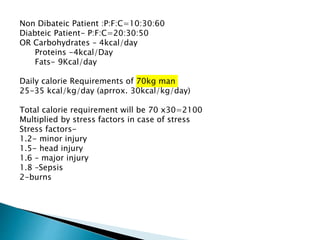
Non Dibateic Patient :P:F:C=10:30:60
Diabteic Patient- P:F:C=20:30:50
OR Carbohydrates โ€“ 4kcal/day
Proteins -4kcal/Day
Fats- 9Kcal/day
Daily calorie Requirements of 70kg man
25-35 kcal/kg/day (aprrox. 30kcal/kg/day)
Total calorie requirement will be 70 x30=2100
Multiplied by stress factors in case of stress
Stress factors-
1.2- minor injury
1.5- head injury
1.6 โ€“ major injury
1.8 โ€“Sepsis
2-burns
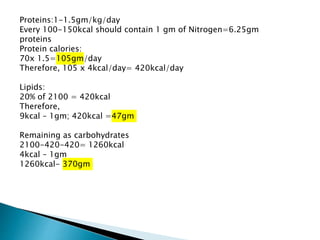
Proteins:1-1.5gm/kg/day
Every 100-150kcal should contain 1 gm of Nitrogen=6.25gm
proteins
Protein calories:
70x 1.5=105gm/day
Therefore, 105 x 4kcal/day= 420kcal/day
Lipids:
20% of 2100 = 420kcal
Therefore,
9kcal โ€“ 1gm; 420kcal =47gm
Remaining as carbohydrates
2100-420-420= 1260kcal
4kcal โ€“ 1gm
1260kcal- 370gm
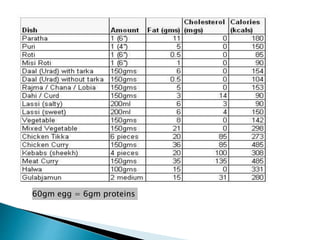
60gm egg = 6gm proteins
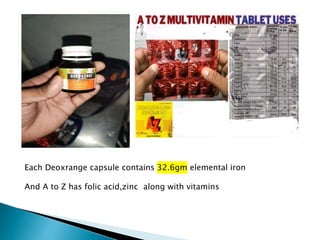
Each Deoxrange capsule contains 32.6gm elemental iron
And A to Z has folic acid,zinc along with vitamins
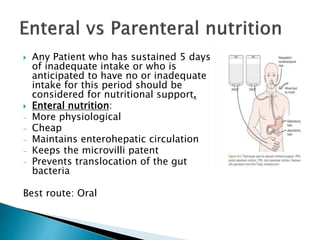
๏ฝ Any Patient who has sustained 5 days
of inadequate intake or who is
anticipated to have no or inadequate
intake for this period should be
considered for nutritional support.
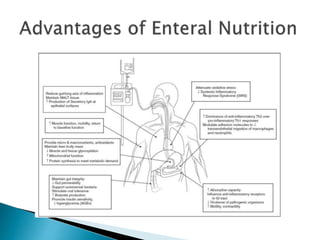
๏ฝ Enteral nutrition:
- More physiological
- Cheap
- Maintains enterohepatic circulation
- Keeps the microvilli patent
- Prevents translocation of the gut
bacteria
Best route: Oral
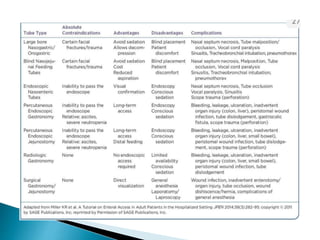
๏ฝ 2-4 weeks
Good gastric emptying: Ryles tube (NG tube)
Poor gastric emptying: Nasojejunal tube
(Freccas)
๏ฝ >4 weeks
Good gastric emptying: Feeding Gastrostomy
Poor gastric emptying: Feeding Jejunostomy
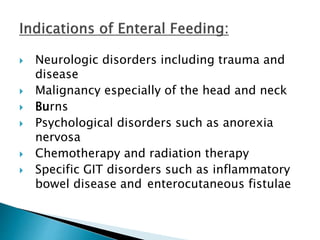
๏ฝ Neurologic disorders including trauma and
disease
๏ฝ Malignancy especially of the head and neck
๏ฝ Burns
๏ฝ Psychological disorders such as anorexia
nervosa
๏ฝ Chemotherapy and radiation therapy
๏ฝ Specific GIT disorders such as inflammatory
bowel disease and enterocutaneous fistulae
๏ฝ Bolus feedings are reserved for patients with
gastrostomy feeding tubes.
๏ฝ To reduce the risk of aspiration, the patientโ€™s
head and body should be elevated to 30 to 45
degrees during feeding and for 1 to 2 hours after
each feeding.
๏ฝ The feeding tube should be flushed with
approximately 30 ml of water after each use.
๏ฝ Continuous infusion for nasojejunal,
gastrojejunal or jejunal tubes.
๏ฝ Tube feedings:
Initially start with 20-30 ml/hour
Gradually increase as the patient can tolerate
more.
No feeds for 4-5 hours during the night (helps
to reduce aspiration rates, pneumonia)
Before every feed, first aspirate (to see if any
residual feed is left).
If >200 cc aspirate in 2 hours, feed is withheld.
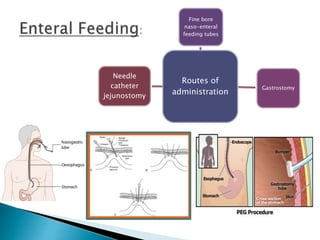
Routes of
administration
Fine bore
naso-enteral
feeding tubes
Gastrostomy
Needle
catheter
jejunostomy
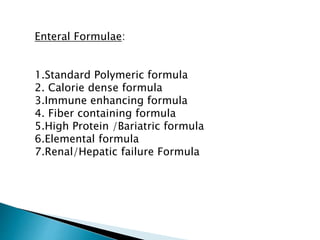
Enteral Formulae:
1.Standard Polymeric formula
2. Calorie dense formula
3.Immune enhancing formula
4. Fiber containing formula
5.High Protein /Bariatric formula
6.Elemental formula
7.Renal/Hepatic failure Formula
๏ฝ Defined as provision of all nutritional
requirements by means of the intravenous
route and without the use of the
gastrointestinal tract.
๏ฝ Indicated when energy and protein needs
cannot be met by the enteral administration
of these substrates.
๏ฝ Primary therapy:
- Efficacy shown
i. Gastrointestinal cutaneous fistula
ii. Renal failure(acute tubular necrosis)
iii. Short bowel syndrome
iv. Acute burns
v. Hepatic failure(acute decompensation
superimposed on cirrhosis)
- Efficacy not shown
i. Crohnโ€™s disease
ii. Anorexia nervosa
๏ฝ Supportive therapy
- Efficacy shown
i. Acute radiation enteritis
ii. Acute chemotherapy toxicity
iii. Prolonged ileus
iv. Weight loss primarily to major surgery
- Efficacy not shown
i. Before cardiac surgery
ii. Prolonged respiratory support
iii. Large wound losses
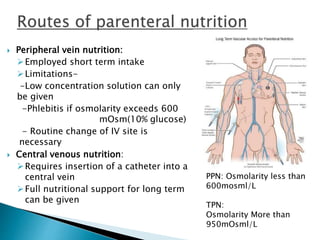
Routes of parenteral nutrition
๏ฝ Peripheral vein nutrition:
๏ƒ˜Employed short term intake
๏ƒ˜Limitations-
-Low concentration solution can only
be given
-Phlebitis if osmolarity exceeds 600
mOsm(10% glucose)
- Routine change of IV site is
necessary
๏ฝ Central venous nutrition:
๏ƒ˜Requires insertion of a catheter into a
central vein
๏ƒ˜Full nutritional support for long term
can be given
PPN: Osmolarity less than
600mosml/L
TPN:
Osmolarity More than
950mOsml/L
๏ฝ 2000 kcal/day
๏ฝ 1L/2L
๏ฝ Composition : Protein : Fat : Carbohydrate
20:30:50
TPN Solution
Parentral Nutrition:
Delivery of Nutrition in Elemental Form
Two compositions:
โ€ข 3 in 1-Available in Developing countries
(P:F:C = 10:20:70%)
โ€ข 2 in 1- Available in West (P:C=10-20%:70-
80%)
Components:
Carbohydrates: Variable concentration Dextrose
Maximum permissible Carbohydrate flow:5-7 mg/kg/hr
(Weight/Voulme of Carbohydrates โ€“ 25%)
Lipids:
Emulsion of Fish Oil and soya oil
Average dose: 500ml/week
Proteins:
In form of Essential amino acids
Normal daily requirement- 0.8 โ€“ 1 gm/kg/day
In stress โ€“ 1.5-2 gm/kg/day
In starvation- 2.5-3gm/kg/day
Calorie requirement- 30kcal/kg/day
(Atleast 20-30% should come from Proteins)
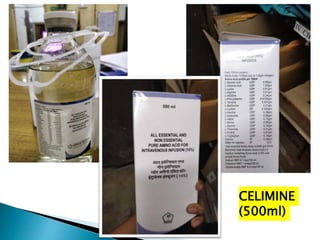
CELIMINE
(500ml)
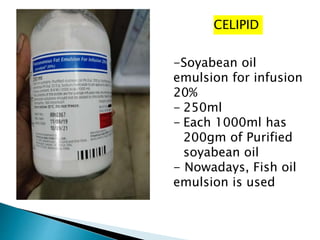
CELIPID
-Soyabean oil
emulsion for infusion
20%
- 250ml
- Each 1000ml has
200gm of Purified
soyabean oil
- Nowadays, Fish oil
emulsion is used
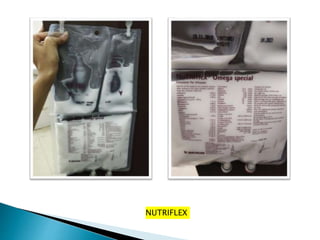
NUTRIFLEX
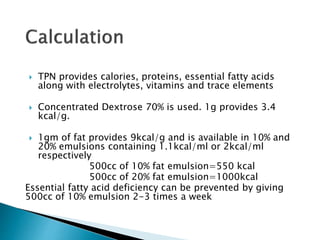
๏ฝ TPN provides calories, proteins, essential fatty acids
along with electrolytes, vitamins and trace elements
๏ฝ Concentrated Dextrose 70% is used. 1g provides 3.4
kcal/g.
๏ฝ 1gm of fat provides 9kcal/g and is available in 10% and
20% emulsions containing 1.1kcal/ml or 2kcal/ml
respectively
500cc of 10% fat emulsion=550 kcal
500cc of 20% fat emulsion=1000kcal
Essential fatty acid deficiency can be prevented by giving
500cc of 10% emulsion 2-3 times a week
๏ฝ Crystalline amino acids
500cc of 5.5% AA- 4.63g N or 28.9g of protein
500cc of 10% AA- 8.4g N or 52.5g of protein
๏ฝ Electrolytes are administered with the fluids or can be added
separately
๏ฝ Trace elements
๏ƒ˜ 0.5mg of Manganese
๏ƒ˜ 1mg of Copper
๏ƒ˜ 4mg of Zinc
๏ƒ˜ 10 microgm Chromium
๏ฝ Vitamins are added in IV fluids and Vit K is administered
intramuscularly weekly
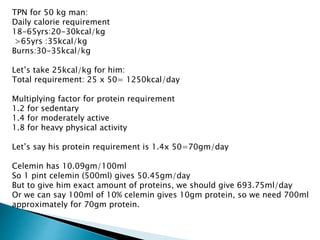
TPN for 50 kg man:
Daily calorie requirement
18-65yrs:20-30kcal/kg
>65yrs :35kcal/kg
Burns:30-35kcal/kg
Letโ€™s take 25kcal/kg for him:
Total requirement: 25 x 50= 1250kcal/day
Multiplying factor for protein requirement
1.2 for sedentary
1.4 for moderately active
1.8 for heavy physical activity
Letโ€™s say his protein requirement is 1.4x 50=70gm/day
Celemin has 10.09gm/100ml
So 1 pint celemin (500ml) gives 50.45gm/day
But to give him exact amount of proteins, we should give 693.75ml/day
Or we can say 100ml of 10% celemin gives 10gm protein, so we need 700ml
approximately for 70gm protein.
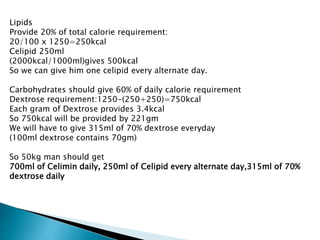
Lipids
Provide 20% of total calorie requirement:
20/100 x 1250=250kcal
Celipid 250ml
(2000kcal/1000ml)gives 500kcal
So we can give him one celipid every alternate day.
Carbohydrates should give 60% of daily calorie requirement
Dextrose requirement:1250-(250+250)=750kcal
Each gram of Dextrose provides 3.4kcal
So 750kcal will be provided by 221gm
We will have to give 315ml of 70% dextrose everyday
(100ml dextrose contains 70gm)
So 50kg man should get
700ml of Celimin daily, 250ml of Celipid every alternate day,315ml of 70%
dextrose daily
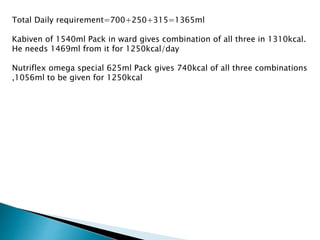
Total Daily requirement=700+250+315=1365ml
Kabiven of 1540ml Pack in ward gives combination of all three in 1310kcal.
He needs 1469ml from it for 1250kcal/day
Nutriflex omega special 625ml Pack gives 740kcal of all three combinations
,1056ml to be given for 1250kcal
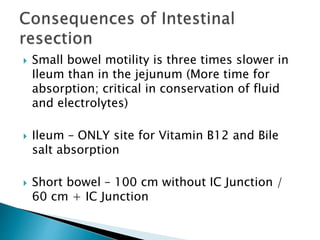
๏ฝ Small bowel motility is three times slower in
Ileum than in the jejunum (More time for
absorption; critical in conservation of fluid
and electrolytes)
๏ฝ Ileum โ€“ ONLY site for Vitamin B12 and Bile
salt absorption
๏ฝ Short bowel โ€“ 100 cm without IC Junction /
60 cm + IC Junction
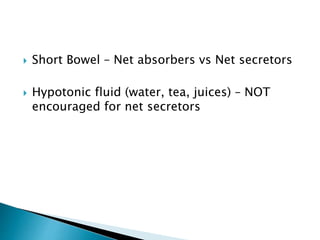
๏ฝ Short Bowel โ€“ Net absorbers vs Net secretors
๏ฝ Hypotonic fluid (water, tea, juices) โ€“ NOT
encouraged for net secretors
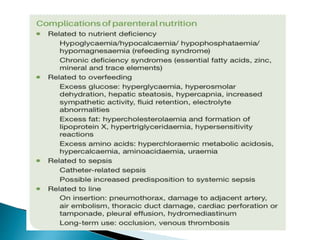
๏ฝ Severe fluid and electrolyte shifts in
malnourished patients undergoing refeeding.
๏ฝ Parenteral > Enteral
๏ฝ Predisposing factors: Alcoholics, Severe
malabsorptive states, anorexics, thiamine
deficiency, prolonged fasting.
๏ฝ Sudden shift of catabolic to anabolic state
leading to:
- Hypokalaemia
- Hypophosphataemia
- Hypomagnesemia
Predisposing to fatal Cardiac arrhthymias.
๏ฝ To prevent; commence feeds at 10
Kcal/kg/day with slow increases over 4 to 7
days.
๏ฝ EC Fistula: TPN except distal bowel fistula or
low output
๏ฝ Transplant โ€“ calorie of 30-35 Kcl/kg and 1.3
to 1.5 g/kg/day
๏ฝ IBD
- High protein, low fat and low carb diet
- Avoid meat and alcohol
๏ฝ Pancreatitis: low fat, low carb, high protein
๏ฝ Severe burns: High protein, high carb and low
fat (to offset hypermetabolism)
๏ฝ Renal failure: Low quantity, low protein, high
carb
๏ฝ Respiratory failure: Low carb (RQ<1)
๏ฝ To recap;
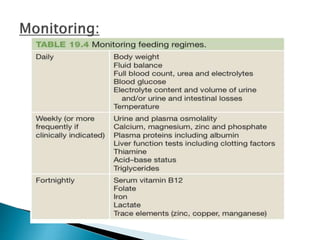
Daily weight monitoring of a patient on TPN (
>1 kg/day gain suggestive of Fluid overload)
LFT/BUN โ€“ Once weekly
Serum Electrolytes โ€“ Every 3 days
๏ฝ Surgery (โ€œsterile inflammatory responseโ€)
impacts both innate and adaptive immunity
๏ฝ Provision of immune modulating nutrients
lowers infectious risk
๏ฝ Amino Acids (Glutamine, Arginine)
๏ฝ Lipids ( Omega 3 PUFA)
๏ฝ Micronutrients ( Vitamin C, Selenium )
Nutrition in Surgery.pptx

Nutrition in Surgery.pptx

  • 1.
    -Dr Jaymin Gupta --DrSnehal Dandge -Guide: -Dr Amol Wagh
  • 2.
    ๏ฝ Malnutrition iscommon in about 30% of surgical patients with Gastrointestinal disease ๏ฝ Frequently unrecognised leading to lack of appropriate support. ๏ฝ Aim is to identify patients at risk of malnutrition and to ensure that their nutritional requirements are meet by the most appropriate route and in a way that minimises complications.
  • 3.
    ๏ฝ Energy instarvation : <12 hours: Food from last meal 12-24 hours: Glycogenolysis >24 hours: Gluconeogenesis 48-72 hours: Lipid oxidation
  • 5.
    ๏ฝ Another importantadaptive response to starvation is a significant reduction in the resting energy expenditure, possibly mediated by a decline in the conversion of inactive T4 to active T3. Despite these adaptive responses, there remains an obligatory glucose requirement of about 200 g per day even under conditions of prolonged fasting.
  • 7.
    ๏ฝ In contrastto simple starvation, patients with trauma have impaired formation of Ketones (LOSS OF ADAPTIVE KETOGENESIS). ๏ฝ Breakdown of protein to synthesis glucose (Gluconeogenesis) cannot be prevented by the administration of glucose.
  • 8.
    ๏ฝ BEE is20 Kcal/kg/day ๏ฝ In case of mild sepsis : 1.4 times severe sepsis : 1.8 times Severe Burns : 2 times - Although it is generally accepted that metabolic responses to trauma and sepsis is always associated with โ€œhypermetabolismโ€ or โ€œhypercatabolismโ€, there is another school of thought that these terms are ill defined and do not indicate the need for very high energy intakes.
  • 9.
    ๏ฝ No evidenceto show that the provision of high energy intake is associated with amelioration of the catabolic process. ๏ฝ Permissive underfeeding in critically ill surgical patients (Rising evidence).
  • 10.
    ๏ฝ Trends aremore important than a single biochemical value. ๏ฝ No single biochemical value that reliably identifies malnutrition.
  • 11.
    ๏ฝ Body weight-compared with usual(for individual) or ideal ๏ฝ UNINTENTIONAL weight loss of more than 10% of a patientโ€™s weight in the preceding 6 months ๏ฝ BMI <15 ๏ฝ Skin fold thickness โ€“ Estimates body fat ๏ฝ Mid arm circumference โ€“ Protein (Muscle stores) All the aforementioned techniques impaired by the presence of oedema.
  • 12.
    ๏ฝ Fat stores- Skin fold thickness, Triceps fold thickness ๏ฝ Bioelectrical impedance analysis to estimate intra and extracellular volumes. ๏ฝ Research methods(expensive and impractical) -in vivo neutron activation analysis -Isotopic labelling studies
  • 13.
    ๏ฝ Not ameasure of nutritional status, particularly in acute settings. ๏ฝ Acute changes are often assessed by Pre- albumin, Albumin and Transferrin. ๏ฝ Better assessed by Pre-albumin (half life of 48 hours) rather than Albumin ( half life of 21 days). ๏ฝ All these metrics are useful in pre-operative evaluation of nutritional status; use of these values for ongoing nutritional assessment in hospitalised or critically ill patient is controversial.
  • 14.
    ๏ฝ Possibility ofmalnutrition should form part of the workup of all patients. ๏ฝ Malnutrition Universal Screening Tool (MUST); a 5 step tool introduced by the British Association of Parenteral and Enteral nutrition. ๏ฝ Identifies adults who are malnourished or at risk of undernutrition.
  • 16.
    1.Resting Energy Expenditure/Basalenergy expenditure: Harris Benedict Equation: Male-66.5+(13.75x wt in kg)+(5x ht in cm)-(6.775 x age in yrs) Female-66.5+(9.6 x wt in kg)+(1.7x ht in cm)-(4-7 x age in yrs) Calorie Requirement=REE x activity factor x Injury factor 2.Nitrogen balance: Nitrogen balance= total nitrogen intake โ€“ total nitrogen loss
  • 17.
    โ€ข Nitrogen Loss=Total (Urine Urea Nitrogen) + 2gm/day (stool +skin) โ€ข 24hrs Urine urea nitrogen= (Urine urea nitrogen) x urine output (ml/day) 1000mg x 100ml โ€ข 6.25gm of Proteins give 1 Gm of Nitrogen
  • 18.
    Non Dibateic Patient:P:F:C=10:30:60 Diabteic Patient- P:F:C=20:30:50 OR Carbohydrates โ€“ 4kcal/day Proteins -4kcal/Day Fats- 9Kcal/day Daily calorie Requirements of 70kg man 25-35 kcal/kg/day (aprrox. 30kcal/kg/day) Total calorie requirement will be 70 x30=2100 Multiplied by stress factors in case of stress Stress factors- 1.2- minor injury 1.5- head injury 1.6 โ€“ major injury 1.8 โ€“Sepsis 2-burns
  • 19.
    Proteins:1-1.5gm/kg/day Every 100-150kcal shouldcontain 1 gm of Nitrogen=6.25gm proteins Protein calories: 70x 1.5=105gm/day Therefore, 105 x 4kcal/day= 420kcal/day Lipids: 20% of 2100 = 420kcal Therefore, 9kcal โ€“ 1gm; 420kcal =47gm Remaining as carbohydrates 2100-420-420= 1260kcal 4kcal โ€“ 1gm 1260kcal- 370gm
  • 20.
    60gm egg =6gm proteins
  • 23.
    Each Deoxrange capsulecontains 32.6gm elemental iron And A to Z has folic acid,zinc along with vitamins
  • 24.
    ๏ฝ Any Patientwho has sustained 5 days of inadequate intake or who is anticipated to have no or inadequate intake for this period should be considered for nutritional support. ๏ฝ Enteral nutrition: - More physiological - Cheap - Maintains enterohepatic circulation - Keeps the microvilli patent - Prevents translocation of the gut bacteria Best route: Oral
  • 25.
    ๏ฝ 2-4 weeks Goodgastric emptying: Ryles tube (NG tube) Poor gastric emptying: Nasojejunal tube (Freccas)
  • 26.
    ๏ฝ >4 weeks Goodgastric emptying: Feeding Gastrostomy Poor gastric emptying: Feeding Jejunostomy
  • 28.
    ๏ฝ Neurologic disordersincluding trauma and disease ๏ฝ Malignancy especially of the head and neck ๏ฝ Burns ๏ฝ Psychological disorders such as anorexia nervosa ๏ฝ Chemotherapy and radiation therapy ๏ฝ Specific GIT disorders such as inflammatory bowel disease and enterocutaneous fistulae
  • 29.
    ๏ฝ Bolus feedingsare reserved for patients with gastrostomy feeding tubes. ๏ฝ To reduce the risk of aspiration, the patientโ€™s head and body should be elevated to 30 to 45 degrees during feeding and for 1 to 2 hours after each feeding. ๏ฝ The feeding tube should be flushed with approximately 30 ml of water after each use. ๏ฝ Continuous infusion for nasojejunal, gastrojejunal or jejunal tubes.
  • 30.
    ๏ฝ Tube feedings: Initiallystart with 20-30 ml/hour Gradually increase as the patient can tolerate more. No feeds for 4-5 hours during the night (helps to reduce aspiration rates, pneumonia) Before every feed, first aspirate (to see if any residual feed is left). If >200 cc aspirate in 2 hours, feed is withheld.
  • 32.
    Routes of administration Fine bore naso-enteral feedingtubes Gastrostomy Needle catheter jejunostomy
  • 34.
    Enteral Formulae: 1.Standard Polymericformula 2. Calorie dense formula 3.Immune enhancing formula 4. Fiber containing formula 5.High Protein /Bariatric formula 6.Elemental formula 7.Renal/Hepatic failure Formula
  • 35.
    ๏ฝ Defined asprovision of all nutritional requirements by means of the intravenous route and without the use of the gastrointestinal tract. ๏ฝ Indicated when energy and protein needs cannot be met by the enteral administration of these substrates.
  • 36.
    ๏ฝ Primary therapy: -Efficacy shown i. Gastrointestinal cutaneous fistula ii. Renal failure(acute tubular necrosis) iii. Short bowel syndrome iv. Acute burns v. Hepatic failure(acute decompensation superimposed on cirrhosis) - Efficacy not shown i. Crohnโ€™s disease ii. Anorexia nervosa
  • 37.
    ๏ฝ Supportive therapy -Efficacy shown i. Acute radiation enteritis ii. Acute chemotherapy toxicity iii. Prolonged ileus iv. Weight loss primarily to major surgery - Efficacy not shown i. Before cardiac surgery ii. Prolonged respiratory support iii. Large wound losses
  • 38.
    Routes of parenteralnutrition ๏ฝ Peripheral vein nutrition: ๏ƒ˜Employed short term intake ๏ƒ˜Limitations- -Low concentration solution can only be given -Phlebitis if osmolarity exceeds 600 mOsm(10% glucose) - Routine change of IV site is necessary ๏ฝ Central venous nutrition: ๏ƒ˜Requires insertion of a catheter into a central vein ๏ƒ˜Full nutritional support for long term can be given PPN: Osmolarity less than 600mosml/L TPN: Osmolarity More than 950mOsml/L
  • 39.
    ๏ฝ 2000 kcal/day ๏ฝ1L/2L ๏ฝ Composition : Protein : Fat : Carbohydrate 20:30:50 TPN Solution Parentral Nutrition: Delivery of Nutrition in Elemental Form Two compositions: โ€ข 3 in 1-Available in Developing countries (P:F:C = 10:20:70%) โ€ข 2 in 1- Available in West (P:C=10-20%:70- 80%)
  • 40.
    Components: Carbohydrates: Variable concentrationDextrose Maximum permissible Carbohydrate flow:5-7 mg/kg/hr (Weight/Voulme of Carbohydrates โ€“ 25%) Lipids: Emulsion of Fish Oil and soya oil Average dose: 500ml/week Proteins: In form of Essential amino acids Normal daily requirement- 0.8 โ€“ 1 gm/kg/day In stress โ€“ 1.5-2 gm/kg/day In starvation- 2.5-3gm/kg/day Calorie requirement- 30kcal/kg/day (Atleast 20-30% should come from Proteins)
  • 41.
  • 42.
    CELIPID -Soyabean oil emulsion forinfusion 20% - 250ml - Each 1000ml has 200gm of Purified soyabean oil - Nowadays, Fish oil emulsion is used
  • 43.
  • 44.
    ๏ฝ TPN providescalories, proteins, essential fatty acids along with electrolytes, vitamins and trace elements ๏ฝ Concentrated Dextrose 70% is used. 1g provides 3.4 kcal/g. ๏ฝ 1gm of fat provides 9kcal/g and is available in 10% and 20% emulsions containing 1.1kcal/ml or 2kcal/ml respectively 500cc of 10% fat emulsion=550 kcal 500cc of 20% fat emulsion=1000kcal Essential fatty acid deficiency can be prevented by giving 500cc of 10% emulsion 2-3 times a week
  • 45.
    ๏ฝ Crystalline aminoacids 500cc of 5.5% AA- 4.63g N or 28.9g of protein 500cc of 10% AA- 8.4g N or 52.5g of protein ๏ฝ Electrolytes are administered with the fluids or can be added separately ๏ฝ Trace elements ๏ƒ˜ 0.5mg of Manganese ๏ƒ˜ 1mg of Copper ๏ƒ˜ 4mg of Zinc ๏ƒ˜ 10 microgm Chromium ๏ฝ Vitamins are added in IV fluids and Vit K is administered intramuscularly weekly
  • 46.
    TPN for 50kg man: Daily calorie requirement 18-65yrs:20-30kcal/kg >65yrs :35kcal/kg Burns:30-35kcal/kg Letโ€™s take 25kcal/kg for him: Total requirement: 25 x 50= 1250kcal/day Multiplying factor for protein requirement 1.2 for sedentary 1.4 for moderately active 1.8 for heavy physical activity Letโ€™s say his protein requirement is 1.4x 50=70gm/day Celemin has 10.09gm/100ml So 1 pint celemin (500ml) gives 50.45gm/day But to give him exact amount of proteins, we should give 693.75ml/day Or we can say 100ml of 10% celemin gives 10gm protein, so we need 700ml approximately for 70gm protein.
  • 47.
    Lipids Provide 20% oftotal calorie requirement: 20/100 x 1250=250kcal Celipid 250ml (2000kcal/1000ml)gives 500kcal So we can give him one celipid every alternate day. Carbohydrates should give 60% of daily calorie requirement Dextrose requirement:1250-(250+250)=750kcal Each gram of Dextrose provides 3.4kcal So 750kcal will be provided by 221gm We will have to give 315ml of 70% dextrose everyday (100ml dextrose contains 70gm) So 50kg man should get 700ml of Celimin daily, 250ml of Celipid every alternate day,315ml of 70% dextrose daily
  • 48.
    Total Daily requirement=700+250+315=1365ml Kabivenof 1540ml Pack in ward gives combination of all three in 1310kcal. He needs 1469ml from it for 1250kcal/day Nutriflex omega special 625ml Pack gives 740kcal of all three combinations ,1056ml to be given for 1250kcal
  • 51.
    ๏ฝ Small bowelmotility is three times slower in Ileum than in the jejunum (More time for absorption; critical in conservation of fluid and electrolytes) ๏ฝ Ileum โ€“ ONLY site for Vitamin B12 and Bile salt absorption ๏ฝ Short bowel โ€“ 100 cm without IC Junction / 60 cm + IC Junction
  • 52.
    ๏ฝ Short Bowelโ€“ Net absorbers vs Net secretors ๏ฝ Hypotonic fluid (water, tea, juices) โ€“ NOT encouraged for net secretors
  • 53.
    ๏ฝ Severe fluidand electrolyte shifts in malnourished patients undergoing refeeding. ๏ฝ Parenteral > Enteral ๏ฝ Predisposing factors: Alcoholics, Severe malabsorptive states, anorexics, thiamine deficiency, prolonged fasting.
  • 54.
    ๏ฝ Sudden shiftof catabolic to anabolic state leading to: - Hypokalaemia - Hypophosphataemia - Hypomagnesemia Predisposing to fatal Cardiac arrhthymias.
  • 55.
    ๏ฝ To prevent;commence feeds at 10 Kcal/kg/day with slow increases over 4 to 7 days.
  • 56.
    ๏ฝ EC Fistula:TPN except distal bowel fistula or low output ๏ฝ Transplant โ€“ calorie of 30-35 Kcl/kg and 1.3 to 1.5 g/kg/day ๏ฝ IBD - High protein, low fat and low carb diet - Avoid meat and alcohol
  • 57.
    ๏ฝ Pancreatitis: lowfat, low carb, high protein ๏ฝ Severe burns: High protein, high carb and low fat (to offset hypermetabolism) ๏ฝ Renal failure: Low quantity, low protein, high carb ๏ฝ Respiratory failure: Low carb (RQ<1)
  • 58.
    ๏ฝ To recap; Dailyweight monitoring of a patient on TPN ( >1 kg/day gain suggestive of Fluid overload) LFT/BUN โ€“ Once weekly Serum Electrolytes โ€“ Every 3 days
  • 59.
    ๏ฝ Surgery (โ€œsterileinflammatory responseโ€) impacts both innate and adaptive immunity ๏ฝ Provision of immune modulating nutrients lowers infectious risk ๏ฝ Amino Acids (Glutamine, Arginine) ๏ฝ Lipids ( Omega 3 PUFA) ๏ฝ Micronutrients ( Vitamin C, Selenium )