
Presenter : Dr.Asif Mian Ansari
DNB Resident
Dept. of General surgery
Max super speciality Hospital,
Mohali, Punjab
 Requirements increased during stress
 A well-nourished patient usually tolerates major surgery
better than a severely malnourished patient
 Malnutrition complicates surgical outcomes
 Surgical patient  decreased intake, increased metabolic
expenditure
 Wound healing is an anabolic state, requires high amount of
nutrients
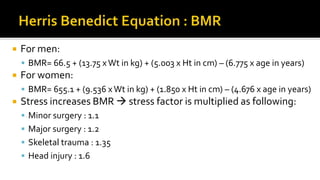
 For men:
 BMR= 66.5 + (13.75 x Wt in kg) + (5.003 x Ht in cm) – (6.775 x age in years)
 For women:
 BMR= 655.1 + (9.536 xWt in kg) + (1.850 x Ht in cm) – (4.676 x age in years)
 Stress increases BMR  stress factor is multiplied as following:
 Minor surgery : 1.1
 Major surgery : 1.2
 Skeletal trauma : 1.35
 Head injury : 1.6
 Mild infection : 1.1
 Moderate infection : 1.5
 Severe infection : 1.8
NORMAL PERSON
 Caloric intake
 25-30 kcal/kg/day
 Protein intake
 0.8-1gm/kg/day (max = 150gm/day)
 Fluid intake
 30 ml/kg/day
SURGICAL PATIENT
 Caloric intake
 Mild stress  25-30 kcal/kg/day
 Moderate stress, ICU patient  30-35
kcal/kg/day
 Severe stress, burn patient  30-40
kcal/kg/day
 Protein intake
 1-2 gm/kg/day
 Fluid intake
 Variable
 Clinical history
 Anthropometric measurements:
 IBW, BMI, Lean body mass, skinfold thicknes
 Oxygen consumption, determination of respiratory quotient
 Body composition analysis: Dual-energy x-ray absorptiometry
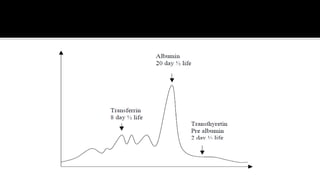
 Biochemical measurements:Albumin, transferrin, prealbumin
 Measurement of nitrogen balance
 Measurements of immunologic function
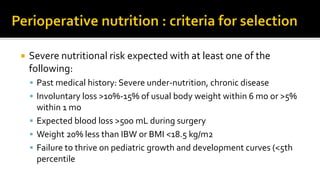
 Severe nutritional risk expected with at least one of the
following:
 Past medical history: Severe under-nutrition, chronic disease
 Involuntary loss >10%-15% of usual body weight within 6 mo or >5%
within 1 mo
 Expected blood loss >500 mL during surgery
 Weight 20% less than IBW or BMI <18.5 kg/m2
 Failure to thrive on pediatric growth and development curves (<5th
percentile
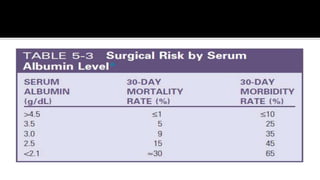
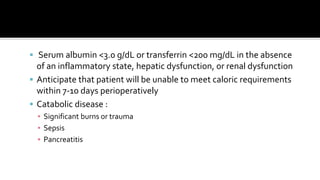
 Serum albumin <3.0 g/dL or transferrin <200 mg/dL in the absence
of an inflammatory state, hepatic dysfunction, or renal dysfunction
 Anticipate that patient will be unable to meet caloric requirements
within 7-10 days perioperatively
 Catabolic disease :
▪ Significant burns or trauma
▪ Sepsis
▪ Pancreatitis
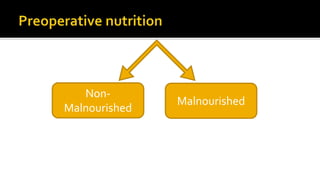
Non-
Malnourished
Malnourished
 Duration of NPO status must be diminished
 For clear liquids – 2 hours
 Carbohydrates supplementation
 Immuno-nutrition
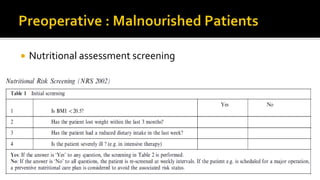
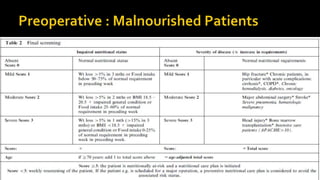
 Nutritional assessment screening
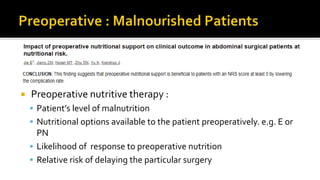
 Preoperative nutritive therapy :
 Patient’s level of malnutrition
 Nutritional options available to the patient preoperatively. e.g. E or
PN
 Likelihood of response to preoperative nutrition
 Relative risk of delaying the particular surgery
 Enteral >>>>>Parenteral
 oral route if the GI tract is fully functional & no other
contraindications
 Patients who do not have any absolute contraindication to EN
and who are expected to be unable to take adequate nutrition
orally within 24-48 hours, initiate direct EN as soon as possible
 If the enteral route is contraindicated:
 InitiateTPN within 24-48 hours in all critically ill or injured patients who
are not expected to be able to tolerate significant EN within 48-72 hours
 InitiateTPN within 24-48 hours in all patients (regardless of injury or
illness severity) who are not expected to be able to tolerate significant EN
within 3-4 days
 Consider initiating supplemental PN in any critically ill or injured patient
who can tolerate only limited enteral feeding and who is not expected to
tolerate sufficient enteral feeds to meet 60%-80% of projected protein-
caloric needs within 48-72 hours
 Administer at least 20% of the caloric and protein
requirements enterally while reaching the required goal with
additional PN
 Maintain PN until the patient is able to tolerate 75% of
calories through the enteral route, and maintain EN until the
patient is able to tolerate 75% of calories via the oral route
 Clear liquids when signs of bowel function returns
 Clear liquid diets supply fluid and electrolytes and little
stimulation of the GI tract
 Patients must have adequate swallowing functions
 Advance diet to full liquids followed by solid foods, depending
on patient’s tolerance
 Consider the patient’s disease state (e.g. diabetes)
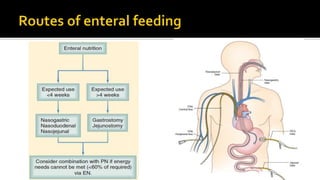
 If oral not possible enteral (tube) feeding
 Maintains GIT integrity and positive effect on immunity of
small intestine
 Enhanced utilization of nutrients
 More efficient plasma insulin response
 Easy and safety of administration
 Less cost thanTPN
 Mechanical, infectious and metabolic complications less
severe than withTPN
 Generalized peritonitis
 Shock
 Complete intestinal obstruction
 Intractable vomiting/severe diarrhoea
 Paralytic ileus
 Severe GIT bleeding
 High output fistula
 Standard formulas are sterile & nutritionally complete
 Specialty formulations may be more efficiently absorbed in
patients with short gut syndrome, severe trauma, burn, injury,
and chronic malabsorptive diarrhea
 Immune-enhancing formulas are enriched with arginine,
glutamine, nucleotides, and omega-3 fatty acids
 Gastro-intestinal :
 diarrhoea, vomiting, bloating, abdominal cramps
 Metabolic :
 glucose intolerance, excess CO2 production, electrolyte imbalances
 Mechanical :
 Blocked tube, tube dislodgement, nasopharyngeal discomfort, nasal
erosions
 Complications of surgery ( gastrostomy; jejunostomy)
 Perforation, Haemorrhage,Wound infection, Bowel obstruction/necrosis,
Stomal leakage
 Infections :
 Aspiration pneumonia, contaminated feeds - gastroenteritis
 Nutrients provided intravenously
 Components of a PN mixture include:
 Protein (Amino Acids) , carboydrates (dextrose) , Fats (Long-chain
fatty acids), sterile water, electrolytes, vitamins and trace minerals
 Used in nutritionally compromised patients
 Used when enteral nutrition is contra-indicated
 Is either primary or supportive therapy
 Before receiving PN, patients should be hemodynamically
stable and able to tolerate the fluid volume and nutrient
content
 Malnourished patient expected to be unable to eat > 5-7 days
 Patient failed enteral nutrition trial with appropriate tube
placement
 Enteral nutrition is contraindicated or severe GI dysfunction
 Paralytic ileus, mesenteric ischemia, small bowel obstruction, enteric
fistula distal to enteral access sites
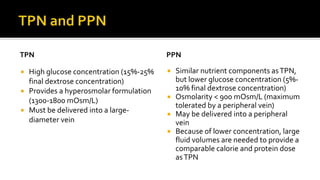
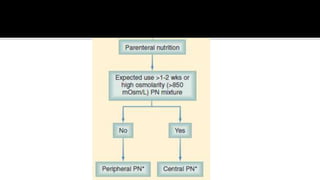
TPN
 High glucose concentration (15%-25%
final dextrose concentration)
 Provides a hyperosmolar formulation
(1300-1800 mOsm/L)
 Must be delivered into a large-
diameter vein
PPN
 Similar nutrient components asTPN,
but lower glucose concentration (5%-
10% final dextrose concentration)
 Osmolarity < 900 mOsm/L (maximum
tolerated by a peripheral vein)
 May be delivered into a peripheral
vein
 Because of lower concentration, large
fluid volumes are needed to provide a
comparable calorie and protein dose
asTPN
 IV formulations or emulsions of nutrients that are
administered in an elemental form
 Available in wide range of concentrations, including 10% to
70% dextrose, 5.2% to 20% amino acids, and 10% to 30% lipid
emulsions
 Two-in-one formulation- glucose + amino acids (daily)
 Three-in-one formulation- glucose + amino acids + lipids (once
or twice weekly)
 PN formulations can include medications such as insulin
 Total kcal = 30 x 70 kg=2100 kcal/day
 Total protein req = 1.5 x 70 = 105 g/day
 If three-in-one formulation is given then:
 20% calories should be provided by fat
 20 % of 2100 k cal = 420 kcal
 lipid req = 420 / 9 = 47 g of lipids
 Kcal by amino acids = 105 x 4 = 420 k cal
 Remaining k cal = 2100 – 420 – 420 = 1260
 Req of dextrose = 1260 / 3.4 = 370 g dextrose
 Final volumes maximally (stock )concentrated:
 Amino acids (10% stock solution) = 105 g = 1050 mL
 Dextrose (70% stock solution) = 370 g = 528 mL
 Lipids (20% stock solution) = 47 g = 235 mL
 Total volume = 1813 mL day
 Catheter related
 Central vein thrombosis, catheter embolism, haemo-pneumo thorax,
haemopericardium, air-embolism, tracheal puncture, arterial laceration, brachial
plexus injury
 Infections
 Catheter Blockage
 Metabolic :
 Hyperglycaemia, electrolyte and acid base abnormalities, trace element and
vitamin deficiencies.
 Hypo/hyper glycaemia
 Hepatic function changes:
 Cholestasis, elevated liver enzymes and hepatomegaly
 GI changes: Atrophy of intestinal mucosa
OVER FEEDING
 Hyperglycemia
 Hepatic dysfunction from fatty
infiltration
 Respiratory acidosis from increased
CO2 production
 Difficulty weaning from the ventilator
 Fluid overload
UNDER FEEDING
 Depressed ventilatory drive
 Decreased respiratory muscle
function
 Impaired immune function
 Increased infection
 Weight loss and malnutrition
Perioperative nutrition

Perioperative nutrition

  • 1.
    Presenter : Dr.AsifMian Ansari DNB Resident Dept. of General surgery Max super speciality Hospital, Mohali, Punjab
  • 2.
     Requirements increasedduring stress  A well-nourished patient usually tolerates major surgery better than a severely malnourished patient  Malnutrition complicates surgical outcomes  Surgical patient  decreased intake, increased metabolic expenditure  Wound healing is an anabolic state, requires high amount of nutrients
  • 3.
     For men: BMR= 66.5 + (13.75 x Wt in kg) + (5.003 x Ht in cm) – (6.775 x age in years)  For women:  BMR= 655.1 + (9.536 xWt in kg) + (1.850 x Ht in cm) – (4.676 x age in years)  Stress increases BMR  stress factor is multiplied as following:  Minor surgery : 1.1  Major surgery : 1.2  Skeletal trauma : 1.35  Head injury : 1.6
  • 4.
     Mild infection: 1.1  Moderate infection : 1.5  Severe infection : 1.8
  • 5.
    NORMAL PERSON  Caloricintake  25-30 kcal/kg/day  Protein intake  0.8-1gm/kg/day (max = 150gm/day)  Fluid intake  30 ml/kg/day SURGICAL PATIENT  Caloric intake  Mild stress  25-30 kcal/kg/day  Moderate stress, ICU patient  30-35 kcal/kg/day  Severe stress, burn patient  30-40 kcal/kg/day  Protein intake  1-2 gm/kg/day  Fluid intake  Variable
  • 6.
     Clinical history Anthropometric measurements:  IBW, BMI, Lean body mass, skinfold thicknes  Oxygen consumption, determination of respiratory quotient  Body composition analysis: Dual-energy x-ray absorptiometry  Biochemical measurements:Albumin, transferrin, prealbumin  Measurement of nitrogen balance  Measurements of immunologic function
  • 9.
     Severe nutritionalrisk expected with at least one of the following:  Past medical history: Severe under-nutrition, chronic disease  Involuntary loss >10%-15% of usual body weight within 6 mo or >5% within 1 mo  Expected blood loss >500 mL during surgery  Weight 20% less than IBW or BMI <18.5 kg/m2  Failure to thrive on pediatric growth and development curves (<5th percentile
  • 10.
     Serum albumin<3.0 g/dL or transferrin <200 mg/dL in the absence of an inflammatory state, hepatic dysfunction, or renal dysfunction  Anticipate that patient will be unable to meet caloric requirements within 7-10 days perioperatively  Catabolic disease : ▪ Significant burns or trauma ▪ Sepsis ▪ Pancreatitis
  • 11.
  • 12.
     Duration ofNPO status must be diminished  For clear liquids – 2 hours  Carbohydrates supplementation  Immuno-nutrition
  • 13.
  • 15.
     Preoperative nutritivetherapy :  Patient’s level of malnutrition  Nutritional options available to the patient preoperatively. e.g. E or PN  Likelihood of response to preoperative nutrition  Relative risk of delaying the particular surgery
  • 16.
     Enteral >>>>>Parenteral oral route if the GI tract is fully functional & no other contraindications  Patients who do not have any absolute contraindication to EN and who are expected to be unable to take adequate nutrition orally within 24-48 hours, initiate direct EN as soon as possible
  • 17.
     If theenteral route is contraindicated:  InitiateTPN within 24-48 hours in all critically ill or injured patients who are not expected to be able to tolerate significant EN within 48-72 hours  InitiateTPN within 24-48 hours in all patients (regardless of injury or illness severity) who are not expected to be able to tolerate significant EN within 3-4 days  Consider initiating supplemental PN in any critically ill or injured patient who can tolerate only limited enteral feeding and who is not expected to tolerate sufficient enteral feeds to meet 60%-80% of projected protein- caloric needs within 48-72 hours
  • 18.
     Administer atleast 20% of the caloric and protein requirements enterally while reaching the required goal with additional PN  Maintain PN until the patient is able to tolerate 75% of calories through the enteral route, and maintain EN until the patient is able to tolerate 75% of calories via the oral route
  • 19.
     Clear liquidswhen signs of bowel function returns  Clear liquid diets supply fluid and electrolytes and little stimulation of the GI tract  Patients must have adequate swallowing functions  Advance diet to full liquids followed by solid foods, depending on patient’s tolerance  Consider the patient’s disease state (e.g. diabetes)  If oral not possible enteral (tube) feeding
  • 20.
     Maintains GITintegrity and positive effect on immunity of small intestine  Enhanced utilization of nutrients  More efficient plasma insulin response  Easy and safety of administration  Less cost thanTPN  Mechanical, infectious and metabolic complications less severe than withTPN
  • 22.
     Generalized peritonitis Shock  Complete intestinal obstruction  Intractable vomiting/severe diarrhoea  Paralytic ileus  Severe GIT bleeding  High output fistula
  • 23.
     Standard formulasare sterile & nutritionally complete  Specialty formulations may be more efficiently absorbed in patients with short gut syndrome, severe trauma, burn, injury, and chronic malabsorptive diarrhea  Immune-enhancing formulas are enriched with arginine, glutamine, nucleotides, and omega-3 fatty acids
  • 24.
     Gastro-intestinal : diarrhoea, vomiting, bloating, abdominal cramps  Metabolic :  glucose intolerance, excess CO2 production, electrolyte imbalances  Mechanical :  Blocked tube, tube dislodgement, nasopharyngeal discomfort, nasal erosions  Complications of surgery ( gastrostomy; jejunostomy)  Perforation, Haemorrhage,Wound infection, Bowel obstruction/necrosis, Stomal leakage  Infections :  Aspiration pneumonia, contaminated feeds - gastroenteritis
  • 25.
     Nutrients providedintravenously  Components of a PN mixture include:  Protein (Amino Acids) , carboydrates (dextrose) , Fats (Long-chain fatty acids), sterile water, electrolytes, vitamins and trace minerals  Used in nutritionally compromised patients  Used when enteral nutrition is contra-indicated  Is either primary or supportive therapy  Before receiving PN, patients should be hemodynamically stable and able to tolerate the fluid volume and nutrient content
  • 26.
     Malnourished patientexpected to be unable to eat > 5-7 days  Patient failed enteral nutrition trial with appropriate tube placement  Enteral nutrition is contraindicated or severe GI dysfunction  Paralytic ileus, mesenteric ischemia, small bowel obstruction, enteric fistula distal to enteral access sites
  • 27.
    TPN  High glucoseconcentration (15%-25% final dextrose concentration)  Provides a hyperosmolar formulation (1300-1800 mOsm/L)  Must be delivered into a large- diameter vein PPN  Similar nutrient components asTPN, but lower glucose concentration (5%- 10% final dextrose concentration)  Osmolarity < 900 mOsm/L (maximum tolerated by a peripheral vein)  May be delivered into a peripheral vein  Because of lower concentration, large fluid volumes are needed to provide a comparable calorie and protein dose asTPN
  • 29.
     IV formulationsor emulsions of nutrients that are administered in an elemental form  Available in wide range of concentrations, including 10% to 70% dextrose, 5.2% to 20% amino acids, and 10% to 30% lipid emulsions  Two-in-one formulation- glucose + amino acids (daily)  Three-in-one formulation- glucose + amino acids + lipids (once or twice weekly)  PN formulations can include medications such as insulin
  • 30.
     Total kcal= 30 x 70 kg=2100 kcal/day  Total protein req = 1.5 x 70 = 105 g/day  If three-in-one formulation is given then:  20% calories should be provided by fat  20 % of 2100 k cal = 420 kcal  lipid req = 420 / 9 = 47 g of lipids  Kcal by amino acids = 105 x 4 = 420 k cal  Remaining k cal = 2100 – 420 – 420 = 1260  Req of dextrose = 1260 / 3.4 = 370 g dextrose
  • 31.
     Final volumesmaximally (stock )concentrated:  Amino acids (10% stock solution) = 105 g = 1050 mL  Dextrose (70% stock solution) = 370 g = 528 mL  Lipids (20% stock solution) = 47 g = 235 mL  Total volume = 1813 mL day
  • 32.
     Catheter related Central vein thrombosis, catheter embolism, haemo-pneumo thorax, haemopericardium, air-embolism, tracheal puncture, arterial laceration, brachial plexus injury  Infections  Catheter Blockage  Metabolic :  Hyperglycaemia, electrolyte and acid base abnormalities, trace element and vitamin deficiencies.  Hypo/hyper glycaemia  Hepatic function changes:  Cholestasis, elevated liver enzymes and hepatomegaly  GI changes: Atrophy of intestinal mucosa
  • 33.
    OVER FEEDING  Hyperglycemia Hepatic dysfunction from fatty infiltration  Respiratory acidosis from increased CO2 production  Difficulty weaning from the ventilator  Fluid overload UNDER FEEDING  Depressed ventilatory drive  Decreased respiratory muscle function  Impaired immune function  Increased infection  Weight loss and malnutrition