Nutrition in Surgery
Dr Amit Gupta
Associate Professor
Dept.of Surgery
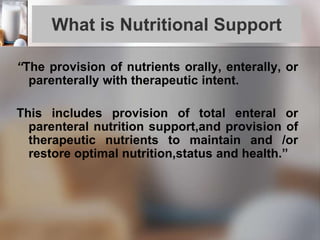
What is Nutritional Support
“The provision of nutrients orally, enterally, or
parenterally with therapeutic intent.
This includes provision of total enteral or
parenteral nutrition support,and provision of
therapeutic nutrients to maintain and /or
restore optimal nutrition,status and health.”
Who Should Get Nutritional
Support?
Patients who:
 Cannot meet nutrient requirements
 Have documented inadequate oral intake
 Have unpredictable return of GI function
 Need a prolonged period of NPO/bowel rest
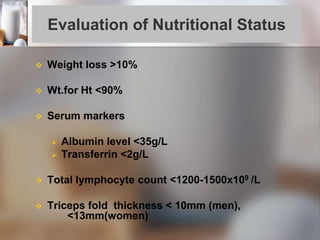
Evaluation of Nutritional Status
 Weight loss >10%
 Wt.for Ht <90%
 Serum markers
 Albumin level <35g/L
 Transferrin <2g/L
 Total lymphocyte count <1200-1500x109 /L
 Triceps fold thickness < 10mm (men),
<13mm(women)
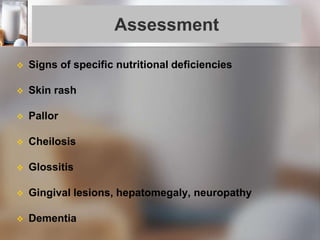
Assessment
 Signs of specific nutritional deficiencies
 Skin rash
 Pallor
 Cheilosis
 Glossitis
 Gingival lesions, hepatomegaly, neuropathy
 Dementia
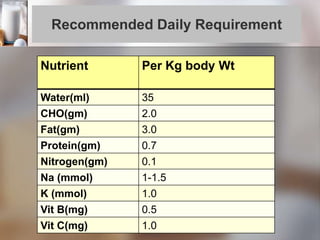
Nutrient Per Kg body Wt
Water(ml) 35
CHO(gm) 2.0
Fat(gm) 3.0
Protein(gm) 0.7
Nitrogen(gm) 0.1
Na (mmol) 1-1.5
K (mmol) 1.0
Vit B(mg) 0.5
Vit C(mg) 1.0
Recommended Daily Requirement
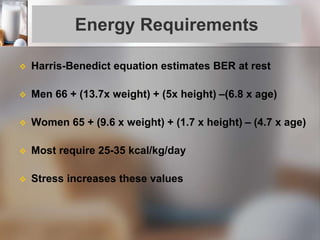
Energy Requirements
 Harris-Benedict equation estimates BER at rest
 Men 66 + (13.7x weight) + (5x height) –(6.8 x age)
 Women 65 + (9.6 x weight) + (1.7 x height) – (4.7 x age)
 Most require 25-35 kcal/kg/day
 Stress increases these values
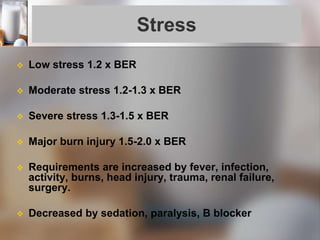
Stress
 Low stress 1.2 x BER
 Moderate stress 1.2-1.3 x BER
 Severe stress 1.3-1.5 x BER
 Major burn injury 1.5-2.0 x BER
 Requirements are increased by fever, infection,
activity, burns, head injury, trauma, renal failure,
surgery.
 Decreased by sedation, paralysis, B blocker
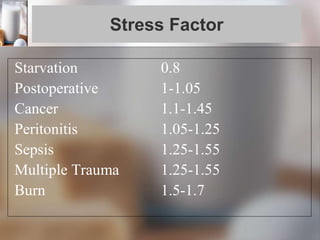
Stress Factor
Starvation 0.8
Postoperative 1-1.05
Cancer 1.1-1.45
Peritonitis 1.05-1.25
Sepsis 1.25-1.55
Multiple Trauma 1.25-1.55
Burn 1.5-1.7
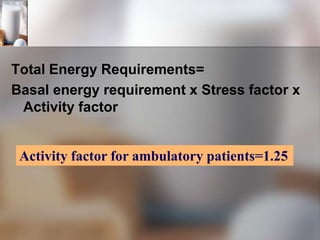
Total Energy Requirements=
Basal energy requirement x Stress factor x
Activity factor
Activity factor for ambulatory patients=1.25
Indications
 Nutrition support
 As primary therapy for a disease
 As an adjunct to primary therapy
 To treat malnutrition
 To avoid development of malnutrition from low
energy & nutrient intake or increased needs
Enteral Nutrition
• Use of formulae as oral supplements or
meal replacements when oral intake is
inadequate or contraindicated
• Delivery of nutrients via a tube into the GI
tract
Benefits of Enteral Nutrition
 Maintains gut mucosal physiology
 Preserves gut barrier function
 Promotes peristalsis
 May modulate immune response
 Inexpensive compared with parenteral nutrition
Appropriate Candidates for Tube
Feeding
 Functional GI tract
 Oral intake is inadequate
 To restore nutritional status
 To maintain nutritional status
Conditions that often Require
Enteral Nutrition
 Impaired Nutrient Digestion
 • Inability to Consume Adequate Oral Nutrition
 • Impaired Digestion, Absorption, Metabolism
 • Severe Wasting or Growth Retardation
A good determinant of safe tolerance of EN is a
GI output of less than 600 ml/24 hr (e.g,effluent
from a nasogastric tube, stoma, fistula or rectal
tube)
Complications of Enteral Nutrition
 Access Problems
 Administration Problems
 Gastrointestinal
 Metabolic
 Psychologic
Relative contraindications to
enteral feeding
 Mesenteric ischemia
 Bowel obstruction
 Sepsis
 Pancreatitis
 Fistula
 SBS
Parenteral Nutrition
TPN- indicated when GI tract is unavailable or
nonfunctional.
 Small bowel resection
 Bowel obstruction (small or large)
 Large output fistula
– below enteral feeding site
Via Central catheter due to hyperosmolarity of
the solutions
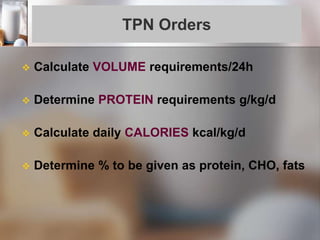
TPN Orders
 Calculate VOLUME requirements/24h
 Determine PROTEIN requirements g/kg/d
 Calculate daily CALORIES kcal/kg/d
 Determine % to be given as protein, CHO, fats
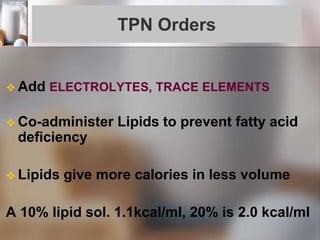
TPN Orders
 Add ELECTROLYTES, TRACE ELEMENTS
 Co-administer Lipids to prevent fatty acid
deficiency
 Lipids give more calories in less volume
A 10% lipid sol. 1.1kcal/ml, 20% is 2.0 kcal/ml
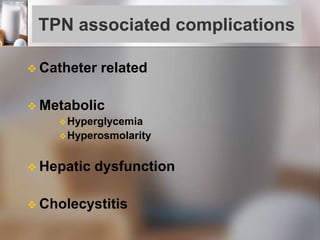
TPN associated complications
 Catheter related
 Metabolic
Hyperglycemia
Hyperosmolarity
 Hepatic dysfunction
 Cholecystitis
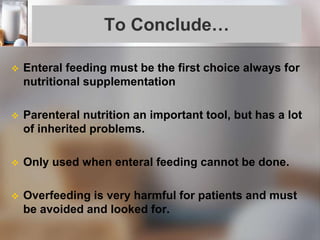
To Conclude…
 Enteral feeding must be the first choice always for
nutritional supplementation
 Parenteral nutrition an important tool, but has a lot
of inherited problems.
 Only used when enteral feeding cannot be done.
 Overfeeding is very harmful for patients and must
be avoided and looked for.

nutrition_in_surgery.ppt

  • 1.
    Nutrition in Surgery DrAmit Gupta Associate Professor Dept.of Surgery
  • 2.
    What is NutritionalSupport “The provision of nutrients orally, enterally, or parenterally with therapeutic intent. This includes provision of total enteral or parenteral nutrition support,and provision of therapeutic nutrients to maintain and /or restore optimal nutrition,status and health.”
  • 3.
    Who Should GetNutritional Support? Patients who:  Cannot meet nutrient requirements  Have documented inadequate oral intake  Have unpredictable return of GI function  Need a prolonged period of NPO/bowel rest
  • 4.
    Evaluation of NutritionalStatus  Weight loss >10%  Wt.for Ht <90%  Serum markers  Albumin level <35g/L  Transferrin <2g/L  Total lymphocyte count <1200-1500x109 /L  Triceps fold thickness < 10mm (men), <13mm(women)
  • 5.
    Assessment  Signs ofspecific nutritional deficiencies  Skin rash  Pallor  Cheilosis  Glossitis  Gingival lesions, hepatomegaly, neuropathy  Dementia
  • 6.
    Nutrient Per Kgbody Wt Water(ml) 35 CHO(gm) 2.0 Fat(gm) 3.0 Protein(gm) 0.7 Nitrogen(gm) 0.1 Na (mmol) 1-1.5 K (mmol) 1.0 Vit B(mg) 0.5 Vit C(mg) 1.0 Recommended Daily Requirement
  • 7.
    Energy Requirements  Harris-Benedictequation estimates BER at rest  Men 66 + (13.7x weight) + (5x height) –(6.8 x age)  Women 65 + (9.6 x weight) + (1.7 x height) – (4.7 x age)  Most require 25-35 kcal/kg/day  Stress increases these values
  • 8.
    Stress  Low stress1.2 x BER  Moderate stress 1.2-1.3 x BER  Severe stress 1.3-1.5 x BER  Major burn injury 1.5-2.0 x BER  Requirements are increased by fever, infection, activity, burns, head injury, trauma, renal failure, surgery.  Decreased by sedation, paralysis, B blocker
  • 9.
    Stress Factor Starvation 0.8 Postoperative1-1.05 Cancer 1.1-1.45 Peritonitis 1.05-1.25 Sepsis 1.25-1.55 Multiple Trauma 1.25-1.55 Burn 1.5-1.7
  • 10.
    Total Energy Requirements= Basalenergy requirement x Stress factor x Activity factor Activity factor for ambulatory patients=1.25
  • 11.
    Indications  Nutrition support As primary therapy for a disease  As an adjunct to primary therapy  To treat malnutrition  To avoid development of malnutrition from low energy & nutrient intake or increased needs
  • 12.
    Enteral Nutrition • Useof formulae as oral supplements or meal replacements when oral intake is inadequate or contraindicated • Delivery of nutrients via a tube into the GI tract
  • 13.
    Benefits of EnteralNutrition  Maintains gut mucosal physiology  Preserves gut barrier function  Promotes peristalsis  May modulate immune response  Inexpensive compared with parenteral nutrition
  • 14.
    Appropriate Candidates forTube Feeding  Functional GI tract  Oral intake is inadequate  To restore nutritional status  To maintain nutritional status
  • 15.
    Conditions that oftenRequire Enteral Nutrition  Impaired Nutrient Digestion  • Inability to Consume Adequate Oral Nutrition  • Impaired Digestion, Absorption, Metabolism  • Severe Wasting or Growth Retardation
  • 16.
    A good determinantof safe tolerance of EN is a GI output of less than 600 ml/24 hr (e.g,effluent from a nasogastric tube, stoma, fistula or rectal tube)
  • 17.
    Complications of EnteralNutrition  Access Problems  Administration Problems  Gastrointestinal  Metabolic  Psychologic
  • 18.
    Relative contraindications to enteralfeeding  Mesenteric ischemia  Bowel obstruction  Sepsis  Pancreatitis  Fistula  SBS
  • 19.
    Parenteral Nutrition TPN- indicatedwhen GI tract is unavailable or nonfunctional.  Small bowel resection  Bowel obstruction (small or large)  Large output fistula – below enteral feeding site Via Central catheter due to hyperosmolarity of the solutions
  • 20.
    TPN Orders  CalculateVOLUME requirements/24h  Determine PROTEIN requirements g/kg/d  Calculate daily CALORIES kcal/kg/d  Determine % to be given as protein, CHO, fats
  • 21.
    TPN Orders  AddELECTROLYTES, TRACE ELEMENTS  Co-administer Lipids to prevent fatty acid deficiency  Lipids give more calories in less volume A 10% lipid sol. 1.1kcal/ml, 20% is 2.0 kcal/ml
  • 22.
    TPN associated complications Catheter related  Metabolic Hyperglycemia Hyperosmolarity  Hepatic dysfunction  Cholecystitis
  • 23.
    To Conclude…  Enteralfeeding must be the first choice always for nutritional supplementation  Parenteral nutrition an important tool, but has a lot of inherited problems.  Only used when enteral feeding cannot be done.  Overfeeding is very harmful for patients and must be avoided and looked for.