At the end of this presentation students will be able to describe:
oThe pathophysiology & importance of nutritional support
oAims of nutritional support measures
oIndications & complications of different forms of nutritional support.
Definition
Nutritional support is an adjuvant therapy used to support the
surgical patients until they are able to sustain themselves with
adequate spontaneous nutrition by mouth.
 The principles of nutritional Support
Pre-operative nutrition is indicated in severely malnourished patients.
 Post-operative TPN is established within 5–7 days for a depleted patient and 7–
10 days for a normal patient.
 Early Enteral nutrition avoid bacterial translocation.
 Indications for nutritional intervention in surgical patients
Indications for pre-operative nutrition:
 Severe malnutrition with a physiological impairment
who cannot eat,
 in whom intake is insufficient for their needs,
in whom the gastrointestinal tract cannot be used,
and in those with accelerated losses
 Factors affect
 Poor intake (anorexia associated with illness, chronic illness, neglection),
 Malabsorption (pancreatitis, inflammatory bowel disease, following bowel resections)
 Increased requirements (malignancies, acute illness).
CARBOHYDRATE
• Provides 30-40% of calorie in a typical diet
• Storage : Liver- 70 G as glycogen - Just enough to last 12-24 hours
Muscle- 120 G glycogen - not readily available
• Essential for: RBC, WBC, bone marrow, eye , renal medulla & peripheral nerves
• Brain- normally uses glucose. Switches to fat in starvation.
• 1 Gm. = 4 kcal
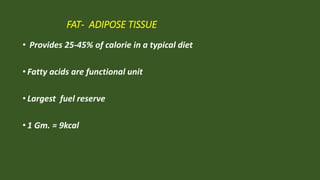
FAT- ADIPOSE TISSUE
• Provides 25-45% of calorie in a typical diet
• Fatty acids are functional unit
• Largest fuel reserve
• 1 Gm. = 9kcal
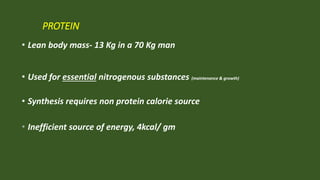
PROTEIN
• Lean body mass- 13 Kg in a 70 Kg man
• Used for essential nitrogenous substances (maintenance & growth)
• Synthesis requires non protein calorie source
• Inefficient source of energy, 4kcal/ gm
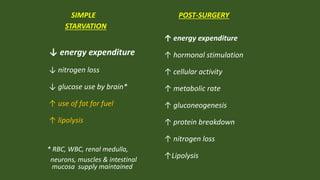
SIMPLE
STARVATION
↓ energy expenditure
↓ nitrogen loss
↓ glucose use by brain*
↑ use of fat for fuel
↑ lipolysis
* RBC, WBC, renal medulla,
neurons, muscles & intestinal
mucosa supply maintained
POST-SURGERY
↑ energy expenditure
↑ hormonal stimulation
↑ cellular activity
↑ metabolic rate
↑ gluconeogenesis
↑ protein breakdown
↑ nitrogen loss
↑Lipolysis
ADULT DAILY CALORIE REQUIREMENT= 30kcal/kg/day,
ADULT DAILY PROTEIN REQUIREMENT= 1g protein/kg/day.
Since 6.25 g of protein provide 1 g of nitrogen, the average nitrogen requirement
is approximately 12g/day.
Energy requirements in adults
 BMI 20-25= 20-25 kcal/kg/day
BMI 26-29= 15-17 kcal/kg/day
 Uncomplicated patients= 25 kcal/ kg/ day
 Complicated/ stressed pts. = 30-35 kcal/kg/day
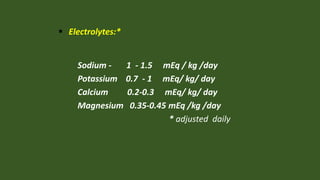
 Electrolytes:*
Sodium - 1 - 1.5 mEq / kg /day
Potassium 0.7 - 1 mEq/ kg/ day
Calcium 0.2-0.3 mEq/ kg/ day
Magnesium 0.35-0.45 mEq /kg /day
* adjusted daily
Fluid requirements
 100 ml/kg/day – first 10 kg body wt.
50 ml / kg /day- for next 10 kg
20 ml / kg /day- for each additional kg
 1 ml of water / cal. / day
 Adjust in patients :
- who cannot tolerate large volume
- additional fluid loss
- febrile or septic
 Physical assessment:
 Loss of subcutaneous fat (triceps skin fold)
 Muscle wasting (quadriceps, deltoids), Mid arm muscle circumference
 Ankle oedema,
 Sacraloedema and
 Ascites.
 Body mass index=weight/height .
Assessment of nutritional status
Specialized Nutrients in Critical Care
Include supplemental branched chain amino acids, glutamine, arginine, omega-3 fatty
acids, RNA, others
Immune-enhancing formulas may reduce infectious complications in critically ill pts but not
alter mortality
If the critically ill patient is adequately fluid resuscitated, then EN should be started within
24 to 48 hours following injury or admission to the ICU.
Early EN is associated with a reduction in infectious complications.
Hyperglycaemia (up to 200-220 mg/dl) in critically ill patients considered acceptable
Enteral nutrition
Important in maintaining gut barrier function
Administered by mouth or by a fine-bore feeding tube introduced under fluoroscopic control
or using an endoscope.
Fine tubes can also be placed into the jejunum at surgery and feeding can begin in the
recovery room after the operation is complete.
If prolonged enteral feeding is anticipated, a gastrostomy should be created, usually via the
percutaneous endoscopic route.
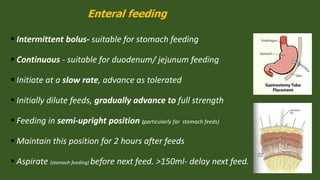
Enteral feeding
 Intermittent bolus- suitable for stomach feeding
 Continuous - suitable for duodenum/ jejunum feeding
 Initiate at a slow rate, advance as tolerated
 Initially dilute feeds, gradually advance to full strength
 Feeding in semi-upright position (particularly for stomach feeds)
 Maintain this position for 2 hours after feeds
 Aspirate (stomach feeding) before next feed. >150ml- delay next feed.
• Indications for enteral nutrition
Malnutrition with functioning gut
Post-operative feeding
Advantages of enteral feeding
 Simplicity
 Greater availability
 Lower cost
 Well tolerated
 Maintains gut integrity
 Fewer complications
Contraindications to enteral feeding
 Intestinal obstruction
 Paralytic ileus
 High output entero-cutaneous fistula
 Short bowel syndrome
 Severe acute pancreatitis
 Malabsorption
Complications of enteral feeding
 Mechanical: tracheobronchial intubation, erosion
blockage, displacement, bowel perforation
 Metabolic: Fluid/ electrolyte imbalance, hyperglycemia
Refeeding / overfeeding syndromes
 Gastrointestinal: Diarrhea, vomiting, pain
 Pulmonary: Aspiration
 Infection: Tube site
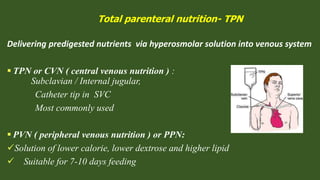
Total parenteral nutrition- TPN
Delivering predigested nutrients via hyperosmolar solution into venous system
 TPN or CVN ( central venous nutrition ) :
Subclavian / Internal jugular,
Catheter tip in SVC
Most commonly used
 PVN ( peripheral venous nutrition ) or PPN:
Solution of lower calorie, lower dextrose and higher lipid
 Suitable for 7-10 days feeding
TPN - Indications
 Non-functioning GIT
Short bowel syndrome
Intestinal fistula
Severe pancreatitis
Intractable vomiting/ diarrhea
Severe inflammatory bowel disease
Developmental anomalies
Multiple organ failure
 Sever malnutrition ( unable to take orally )
Total parenteral nutrition
Approximately 50 kcal/kg body weight per day and 0.3 g of nitrogen as amino acids per
kilogram per day is required to achieve gain in body protein.
Correct:
anaemia,
hypo-albuminaemia,
fluid and electrolyte abnormalities,
and deficits in trace metals.
TPN - Administration
 Check all laboratory values before starting
 Nutrients given as 3in1 (common) or 2+1(lipid)
 Vitamin k given separately
 Heparin & insulin can be added
 Start with 1 L , increasing to desired level as tolerated
 Monitor- CBC, electrolytes, glucose , urea, creatinine, Ca., Mg., phosphorus,
bilirubin, coagulation profile, ALP , ALT , AST
 Best managed by nutritional support team
Home TPN
 Long term nutritional support
 Majority have malignancy
 Special catheter- e.g. Hickman
 Subclavian vein through subcutaneous tunnel
 Support system
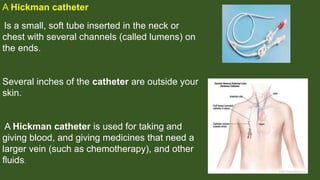
A Hickman catheter
Is a small, soft tube inserted in the neck or
chest with several channels (called lumens) on
the ends.
Several inches of the catheter are outside your
skin.
A Hickman catheter is used for taking and
giving blood, and giving medicines that need a
larger vein (such as chemotherapy), and other
fluids.
Postoperative Nutrition Support
Introduction of solid foods depends on condition of GI
Oral feeding may be delayed for first 24 – 48 hours post surgery until
return of bowel sounds, passage of flatus or soft abdomen
Traditional practice has been to progress from clear liquids, to full
liquids, to solid foods
Hypocaloric Feedings
Recommended in : Class III obesity (BMI>40)
Refeeding syndrome Severe malnutrition
Trauma patients following shock resuscitation
Hemodynamic instability
Acute respiratory distress syndrome or COPD
MODS, SIRS or sepsis
Aggressive protein provision (1.5-2.0 gm/kg/day can
compromise immune function,
delay wound healing,
exacerbate muscle wasting,
and prolong the recovery of nitrogen balance and visceral protein levels.
However, short-term hypocaloric feeding with 1-2 g of protein per kilogram per
day, in the acute phase of postoperative stress, may reduce metabolic
complications while supporting a reduction in negative nitrogen balance
THANKS

Nutritional support in surgical patients

  • 2.
    At the endof this presentation students will be able to describe: oThe pathophysiology & importance of nutritional support oAims of nutritional support measures oIndications & complications of different forms of nutritional support.
  • 3.
    Definition Nutritional support isan adjuvant therapy used to support the surgical patients until they are able to sustain themselves with adequate spontaneous nutrition by mouth.
  • 4.
     The principlesof nutritional Support Pre-operative nutrition is indicated in severely malnourished patients.  Post-operative TPN is established within 5–7 days for a depleted patient and 7– 10 days for a normal patient.  Early Enteral nutrition avoid bacterial translocation.
  • 5.
     Indications fornutritional intervention in surgical patients Indications for pre-operative nutrition:  Severe malnutrition with a physiological impairment who cannot eat,  in whom intake is insufficient for their needs, in whom the gastrointestinal tract cannot be used, and in those with accelerated losses
  • 6.
     Factors affect Poor intake (anorexia associated with illness, chronic illness, neglection),  Malabsorption (pancreatitis, inflammatory bowel disease, following bowel resections)  Increased requirements (malignancies, acute illness).
  • 8.
    CARBOHYDRATE • Provides 30-40%of calorie in a typical diet • Storage : Liver- 70 G as glycogen - Just enough to last 12-24 hours Muscle- 120 G glycogen - not readily available • Essential for: RBC, WBC, bone marrow, eye , renal medulla & peripheral nerves • Brain- normally uses glucose. Switches to fat in starvation. • 1 Gm. = 4 kcal
  • 9.
    FAT- ADIPOSE TISSUE •Provides 25-45% of calorie in a typical diet • Fatty acids are functional unit • Largest fuel reserve • 1 Gm. = 9kcal
  • 10.
    PROTEIN • Lean bodymass- 13 Kg in a 70 Kg man • Used for essential nitrogenous substances (maintenance & growth) • Synthesis requires non protein calorie source • Inefficient source of energy, 4kcal/ gm
  • 11.
    SIMPLE STARVATION ↓ energy expenditure ↓nitrogen loss ↓ glucose use by brain* ↑ use of fat for fuel ↑ lipolysis * RBC, WBC, renal medulla, neurons, muscles & intestinal mucosa supply maintained POST-SURGERY ↑ energy expenditure ↑ hormonal stimulation ↑ cellular activity ↑ metabolic rate ↑ gluconeogenesis ↑ protein breakdown ↑ nitrogen loss ↑Lipolysis
  • 12.
    ADULT DAILY CALORIEREQUIREMENT= 30kcal/kg/day, ADULT DAILY PROTEIN REQUIREMENT= 1g protein/kg/day. Since 6.25 g of protein provide 1 g of nitrogen, the average nitrogen requirement is approximately 12g/day.
  • 13.
    Energy requirements inadults  BMI 20-25= 20-25 kcal/kg/day BMI 26-29= 15-17 kcal/kg/day  Uncomplicated patients= 25 kcal/ kg/ day  Complicated/ stressed pts. = 30-35 kcal/kg/day
  • 14.
     Electrolytes:* Sodium -1 - 1.5 mEq / kg /day Potassium 0.7 - 1 mEq/ kg/ day Calcium 0.2-0.3 mEq/ kg/ day Magnesium 0.35-0.45 mEq /kg /day * adjusted daily
  • 15.
    Fluid requirements  100ml/kg/day – first 10 kg body wt. 50 ml / kg /day- for next 10 kg 20 ml / kg /day- for each additional kg  1 ml of water / cal. / day  Adjust in patients : - who cannot tolerate large volume - additional fluid loss - febrile or septic
  • 16.
     Physical assessment: Loss of subcutaneous fat (triceps skin fold)  Muscle wasting (quadriceps, deltoids), Mid arm muscle circumference  Ankle oedema,  Sacraloedema and  Ascites.  Body mass index=weight/height . Assessment of nutritional status
  • 17.
    Specialized Nutrients inCritical Care Include supplemental branched chain amino acids, glutamine, arginine, omega-3 fatty acids, RNA, others Immune-enhancing formulas may reduce infectious complications in critically ill pts but not alter mortality If the critically ill patient is adequately fluid resuscitated, then EN should be started within 24 to 48 hours following injury or admission to the ICU. Early EN is associated with a reduction in infectious complications. Hyperglycaemia (up to 200-220 mg/dl) in critically ill patients considered acceptable
  • 18.
    Enteral nutrition Important inmaintaining gut barrier function Administered by mouth or by a fine-bore feeding tube introduced under fluoroscopic control or using an endoscope. Fine tubes can also be placed into the jejunum at surgery and feeding can begin in the recovery room after the operation is complete. If prolonged enteral feeding is anticipated, a gastrostomy should be created, usually via the percutaneous endoscopic route.
  • 19.
    Enteral feeding  Intermittentbolus- suitable for stomach feeding  Continuous - suitable for duodenum/ jejunum feeding  Initiate at a slow rate, advance as tolerated  Initially dilute feeds, gradually advance to full strength  Feeding in semi-upright position (particularly for stomach feeds)  Maintain this position for 2 hours after feeds  Aspirate (stomach feeding) before next feed. >150ml- delay next feed.
  • 20.
    • Indications forenteral nutrition Malnutrition with functioning gut Post-operative feeding
  • 21.
    Advantages of enteralfeeding  Simplicity  Greater availability  Lower cost  Well tolerated  Maintains gut integrity  Fewer complications
  • 22.
    Contraindications to enteralfeeding  Intestinal obstruction  Paralytic ileus  High output entero-cutaneous fistula  Short bowel syndrome  Severe acute pancreatitis  Malabsorption
  • 23.
    Complications of enteralfeeding  Mechanical: tracheobronchial intubation, erosion blockage, displacement, bowel perforation  Metabolic: Fluid/ electrolyte imbalance, hyperglycemia Refeeding / overfeeding syndromes  Gastrointestinal: Diarrhea, vomiting, pain  Pulmonary: Aspiration  Infection: Tube site
  • 24.
    Total parenteral nutrition-TPN Delivering predigested nutrients via hyperosmolar solution into venous system  TPN or CVN ( central venous nutrition ) : Subclavian / Internal jugular, Catheter tip in SVC Most commonly used  PVN ( peripheral venous nutrition ) or PPN: Solution of lower calorie, lower dextrose and higher lipid  Suitable for 7-10 days feeding
  • 25.
    TPN - Indications Non-functioning GIT Short bowel syndrome Intestinal fistula Severe pancreatitis Intractable vomiting/ diarrhea Severe inflammatory bowel disease Developmental anomalies Multiple organ failure  Sever malnutrition ( unable to take orally )
  • 26.
    Total parenteral nutrition Approximately50 kcal/kg body weight per day and 0.3 g of nitrogen as amino acids per kilogram per day is required to achieve gain in body protein. Correct: anaemia, hypo-albuminaemia, fluid and electrolyte abnormalities, and deficits in trace metals.
  • 27.
    TPN - Administration Check all laboratory values before starting  Nutrients given as 3in1 (common) or 2+1(lipid)  Vitamin k given separately  Heparin & insulin can be added  Start with 1 L , increasing to desired level as tolerated  Monitor- CBC, electrolytes, glucose , urea, creatinine, Ca., Mg., phosphorus, bilirubin, coagulation profile, ALP , ALT , AST  Best managed by nutritional support team
  • 28.
    Home TPN  Longterm nutritional support  Majority have malignancy  Special catheter- e.g. Hickman  Subclavian vein through subcutaneous tunnel  Support system
  • 29.
    A Hickman catheter Isa small, soft tube inserted in the neck or chest with several channels (called lumens) on the ends. Several inches of the catheter are outside your skin. A Hickman catheter is used for taking and giving blood, and giving medicines that need a larger vein (such as chemotherapy), and other fluids.
  • 30.
    Postoperative Nutrition Support Introductionof solid foods depends on condition of GI Oral feeding may be delayed for first 24 – 48 hours post surgery until return of bowel sounds, passage of flatus or soft abdomen Traditional practice has been to progress from clear liquids, to full liquids, to solid foods
  • 31.
    Hypocaloric Feedings Recommended in: Class III obesity (BMI>40) Refeeding syndrome Severe malnutrition Trauma patients following shock resuscitation Hemodynamic instability Acute respiratory distress syndrome or COPD MODS, SIRS or sepsis
  • 32.
    Aggressive protein provision(1.5-2.0 gm/kg/day can compromise immune function, delay wound healing, exacerbate muscle wasting, and prolong the recovery of nitrogen balance and visceral protein levels. However, short-term hypocaloric feeding with 1-2 g of protein per kilogram per day, in the acute phase of postoperative stress, may reduce metabolic complications while supporting a reduction in negative nitrogen balance
  • 33.