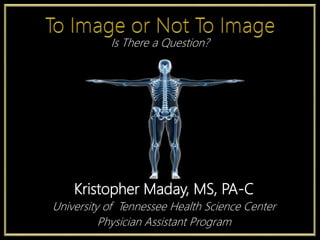
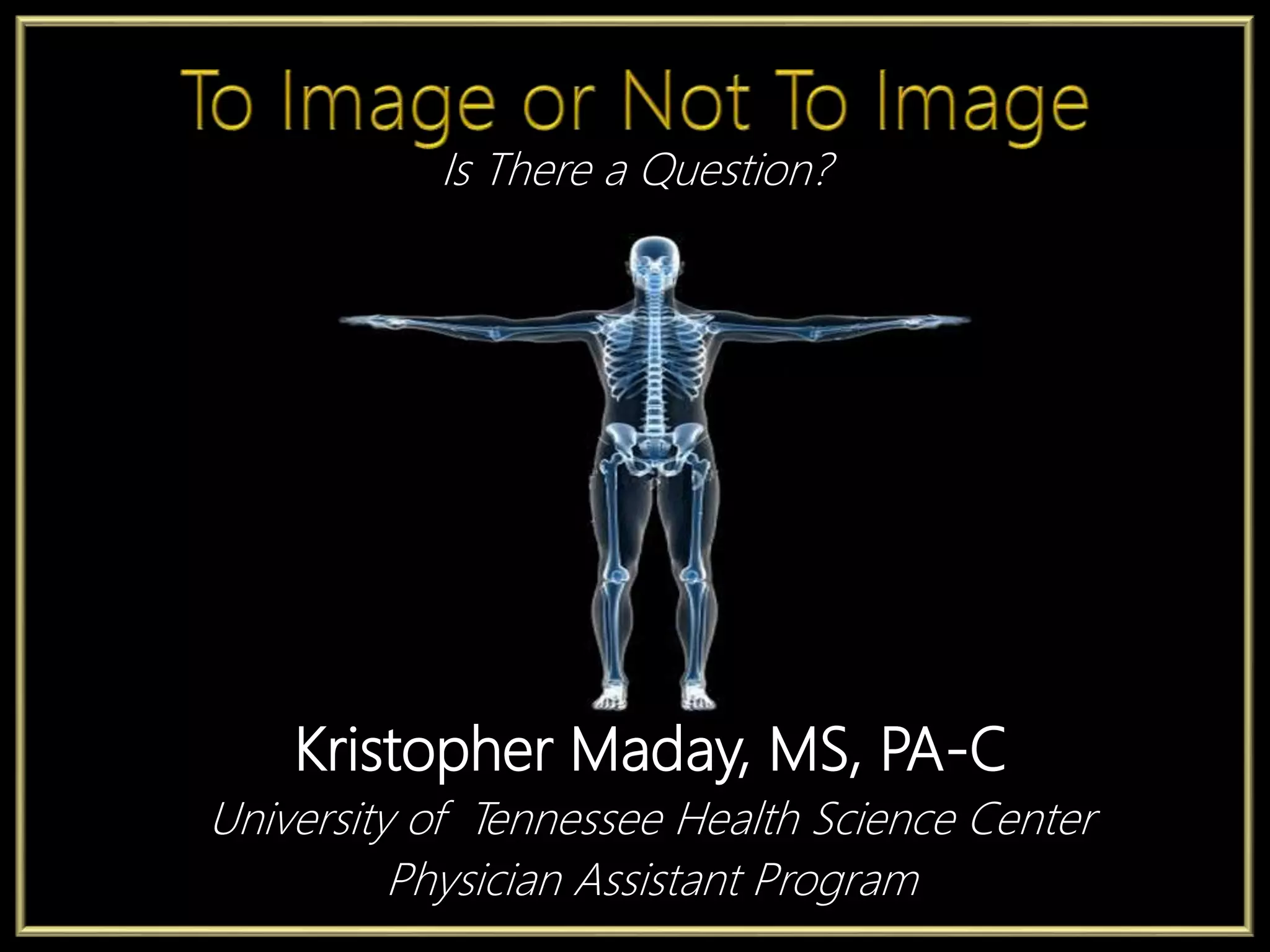
Kristopher Maday, MS, PA-C
University of Tennessee Health Science Center
Physician Assistant Program
Is There a Question?
Little, D. [DrDLittle]. (2013, December 17). [Tweet]. Retrieved https://twitter.com/DrDLittle/status/412998428755767296
We should probably CT it anyway to make sure its a duck
If it walks like a duck… and swims like a duck… and quacks like a duck…
Clinical Decision
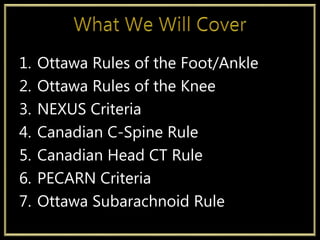
1. Ottawa Rules of the Foot/Ankle
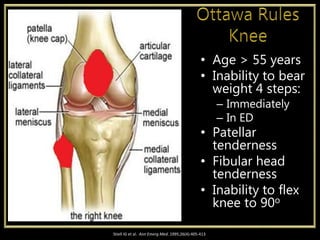
2. Ottawa Rules of the Knee
3. NEXUS Criteria
4. Canadian C-Spine Rule
5. Canadian Head CT Rule
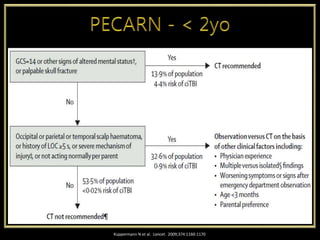
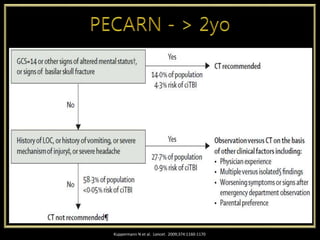
6. PECARN Criteria
7. Ottawa Subarachnoid Rule
Stiell IG et al. Ann Emerg Med. 1992;21(4):384-390.
#2
Ordered
Radiograph
In
ED
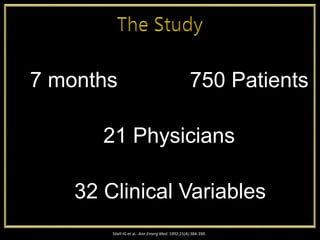
750 Patients7 months
Stiell IG et al. Ann Emerg Med. 1992;21(4):384-390.
32 Clinical Variables
21 Physicians
Stiell IG et al. Ann Emerg Med. 1992;21(4):384-390.
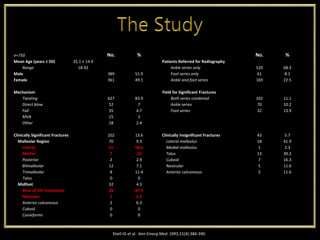
n=750 No. % No. %
Mean Age (years ± SD) 35.1 ± 14.9 Patients Referred for Radiography

Range 18-92 Ankle series only 520 68.3
Male 389 51.9 Foot series only 61 8.1
Female 361 49.1 Ankle and foot series 169 22.5
Mechanism Yield for Significant Fractures
Twisting 627 83.9 Both series combined 102 11.1
Direct blow 52 7 Ankle series 70 10.2
Fall 35 4.7 Foot series 32 13.9
MVA 15 2
Other 18 2.4
Clinically Significant Fractures 102 13.6 Clinically Insignificant Fractures 43 5.7
Malleolar Region 70 9.3 Lateral malleolus 18 41.9
Lateral 41 58.6 Medial malleolus 1 2.3
Medial 7 10 Talus 13 30.2
Posterior 2 2.9 Cuboid 7 16.3
Bilmalleolar 12 7.1 Navicular 5 11.6
Trimalleolar 8 11.4 Anterior calcaneous 5 11.6
Talus 0 0
Midfoot 32 4.3
Base of 5th metatarsal 28 87.5
Navicular 2 6.3
Anterior calcaneous 2 6.3
Cuboid 0 0
Cunieforms 0 0
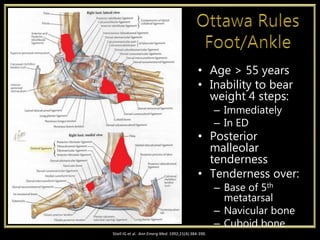
• Age > 55 years
• Inability to bear
weight 4 steps:
– Immediately
– In ED
• Posterior
malleolar
tenderness
• Tenderness over:
– Base of 5th
metatarsal
– Navicular bone
– Cuboid bone
Stiell IG et al. Ann Emerg Med. 1992;21(4):384-390.
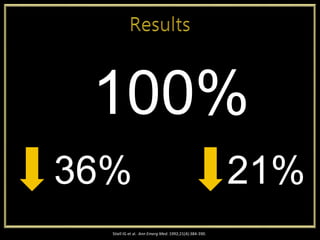
100%
36% 21%
Stiell IG et al. Ann Emerg Med. 1995;26(4):405-413
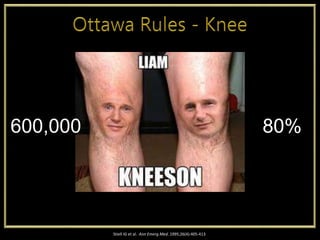
600,000 80%
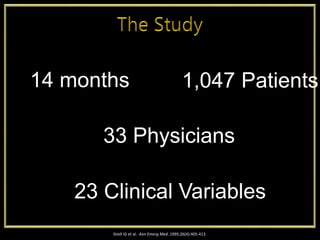
1,047 Patients14 months
23 Clinical Variables
33 Physicians
Stiell IG et al. Ann Emerg Med. 1995;26(4):405-413
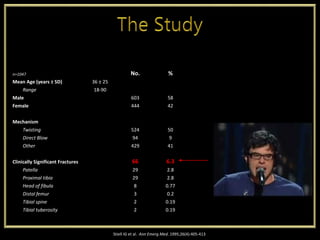
n=1047 No. %
Mean Age (years ± SD) 36 ± 25
Range 18-90
Male 603 58
Female 444 42
Mechanism
Twisting 524 50
Direct Blow 94 9
Other 429 41
Clinically Significant Fractures 66 6.3
Patella 29 2.8
Proximal tibia 29 2.8
Head of fibula 8 0.77
Distal femur 3 0.2
Tibial spine 2 0.19
Tibial tuberosity 2 0.19
Stiell IG et al. Ann Emerg Med. 1995;26(4):405-413
• Age > 55 years
• Inability to bear
weight 4 steps:
– Immediately
– In ED
• Patellar
tenderness
• Fibular head
tenderness
• Inability to flex
knee to 90o
Stiell IG et al. Ann Emerg Med. 1995;26(4):405-413
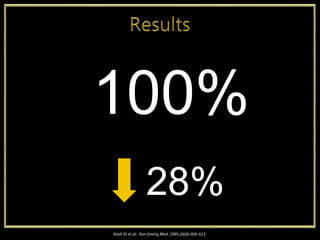
100%
28%
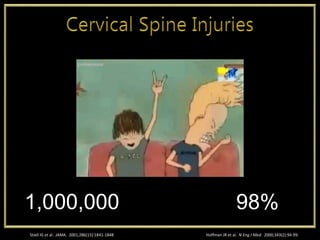
1,000,000 98%
Hoffman JR et al. N Eng J Med. 2000;343(2):94-99.Stiell IG et al. JAMA. 2001;286(15):1841-1848
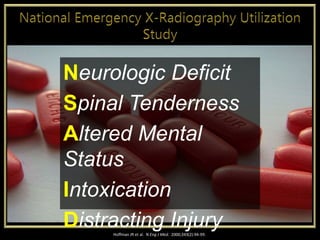
Hoffman JR et al. N Eng J Med. 2000;343(2):94-99.
Neurologic Deficit
Spinal Tenderness
Altered Mental
Status
Intoxication
Distracting Injury
Hoffman JR et al. N Eng J Med. 2000;343(2):94-99.
21 Centers
Plain films
CT
MRI
34,069 patients
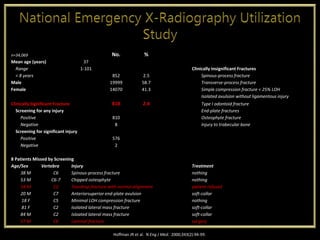
Hoffman JR et al. N Eng J Med. 2000;343(2):94-99.
n=34,069 No. %
Mean age (years) 37
Range 1-101 Clinically Insignificant Fractures
< 8 years 852 2.5 Spinous-process fracture
Male 19999 58.7 Transverse-process fracture
Female 14070 41.3 Simple compression fracture < 25% LOH
Isolated avulsion without ligamentous injury
Clinically Significant Fracture 818 2.4 Type I odontoid fracture
Screening for any injury End-plate fractures
Positive 810 Osteophyte fracture
Negative 8 Injury to trabecular bone
Screening for significant injury
Positive 576
Negative 2
8 Patients Missed by Screening
Age/Sex Vertebra Injury Treatment
38 M C6 Spinous-process fracture nothing
53 M C6-7 Chipped osteophyte nothing
54 M C2 Teardrop fracture with normal alignment patient refused
20 M C7 Anteriorsuperior end-plate avulsion soft-collar
18 F C5 Minimal LOH compression fracture nothing
81 F C2 Isolated lateral mass fracture soft-collar
84 M C2 Isloated lateral mass fracture soft-collar
57 M C6 Laminal fracture surgery
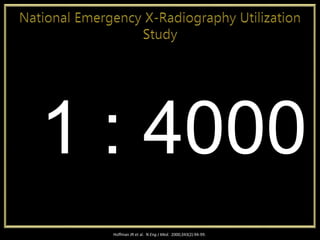
Hoffman JR et al. N Eng J Med. 2000;343(2):94-99.
1 : 4000
Stiell IG et al. JAMA. 2001;286(15):1841-1848
8924
adult
patient
s
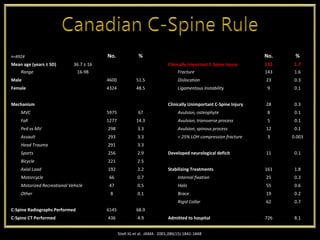
n=8924 No. % No. %
Mean age (years ± SD) 36.7 ± 16 Clinically Important C-Spine Injury 151 1.7
Range 16-98 Fracture 143 1.6
Male 4600 51.5 Dislocation 23 0.3
Female 4324 48.5 Ligamentous Instability 9 0.1
Mechanism Clinically Unimportant C-Spine Injury 28 0.3
MVC 5975 67 Avulsion, osteophyte 8 0.1
Fall 1277 14.3 Avulsion, transverse process 5 0.1
Ped vs MV 298 3.3 Avulsion, spinous process 12 0.1
Assault 293 3.3 < 25% LOH compression fracture 3 0.003
Head Trauma 291 3.3
Sports 256 2.9 Developed neurological deficit 11 0.1
Bicycle 221 2.5
Axial Load 192 2.2 Stabilizing Treatments 161 1.8
Motorcycle 66 0.7 Internal fixation 25 0.3
Motorized Recreational Vehicle 47 0.5 Halo 55 0.6
Other 8 0.1 Brace 19 0.2
Rigid Collar 62 0.7
C-Spine Radiographs Performed 6145 68.9
C-Spine CT Performed 436 4.9 Admitted to hospital 726 8.1
Stiell IG et al. JAMA. 2001;286(15):1841-1848
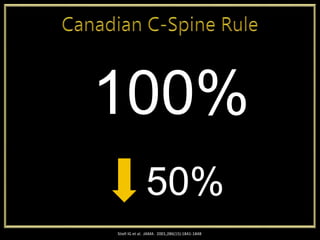
100%
50%
Stiell IG et al. JAMA. 2001;286(15):1841-1848
Stiell IG et al. Lancet. 2001;357(9266):1391-1396
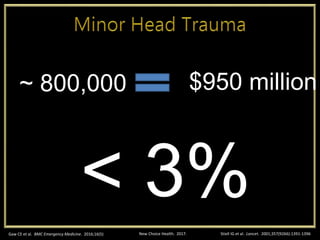
~ 800,000 $950 million
< 3%
Gaw CE et al. BMC Emergency Medicine. 2016;16(5) New Choice Health. 2017.
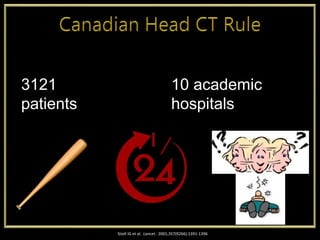
Stiell IG et al. Lancet. 2001;357(9266):1391-1396
3121
patients
10 academic
hospitals
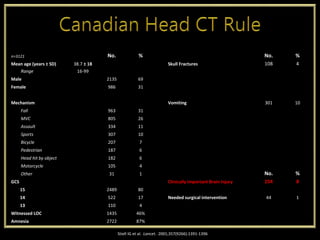
Stiell IG et al. Lancet. 2001;357(9266):1391-1396
n=3121 No. % No. %
Mean age (years ± SD) 38.7 ± 18 Skull Fractures 108 4
Range 16-99
Male 2135 69
Female 986 31
Mechanism Vomiting 301 10
Fall 963 31
MVC 805 26
Assault 334 11
Sports 307 10
Bicycle 207 7
Pedestrian 187 6
Head hit by object 182 6
Motorcycle 105 4
Other 31 1 No. %
GCS Clinically Important Brain Injury 254 8
15 2489 80
14 522 17 Needed surgical intervention 44 1
13 110 4
Witnessed LOC 1435 46%
Amnesia 2722 87%
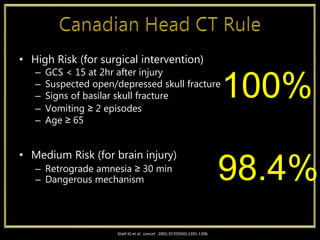
• High Risk (for surgical intervention)
– GCS < 15 at 2hr after injury
– Suspected open/depressed skull fracture
– Signs of basilar skull fracture
– Vomiting ≥ 2 episodes
– Age ≥ 65
• Medium Risk (for brain injury)
– Retrograde amnesia ≥ 30 min
– Dangerous mechanism
Stiell IG et al. Lancet. 2001;357(9266):1391-1396
100%
98.4%
Kuppermann N et al. Lancet. 2009;374:1160-1170
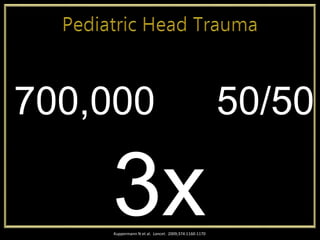
700,000 50/50
3x
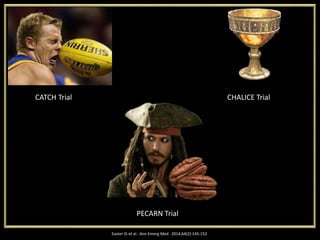
Easter JS et al. Ann Emerg Med. 2014;64(2):145-152
CATCH Trial CHALICE Trial
PECARN Trial
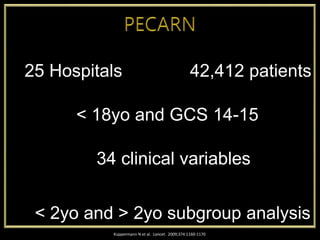
Kuppermann N et al. Lancet. 2009;374:1160-1170
25 Hospitals 42,412 patients
< 18yo and GCS 14-15
34 clinical variables
< 2yo and > 2yo subgroup analysis
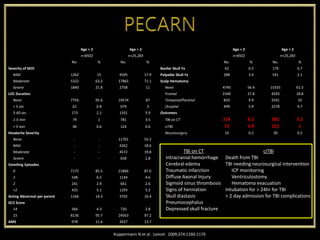
Kuppermann N et al. Lancet. 2009;374:1160-1170
Age < 2 Age > 2 Age < 2 Age > 2
n=8502 n=25,283 n=8502 n=25,283
No. % No. % No. % No. %
Severity of MOI Basilar Skull Fx 42 0.5 179 0.7
Mild 1262 15 4505 17.9 Palpable Skull Fx 288 3.4 541 2.1
Moderate 5322 63.2 17865 71.1 Scalp Hematoma
Severe 1840 21.8 2758 11 None 4745 56.4 15555 61.5
LOC Duration Frontal 2340 27.8 4593 18.8
None 7754 95.6 19574 87 Temporal/Parietal 833 9.9 2541 10
< 5 sec 61 0.8 679 3 Occpital 499 5.9 2278 9.7
5-60 sec 173 2.1 1331 5.9 Outcomes
1-5 min 79 1 781 3.5 TBI on CT 214 8.1 382 5.2
> 5 min 46 0.6 124 0.6 ciTBI 73 0.9 215 1
Headache Severity Neurosurgery 14 0.2 30 0.2
None - - 11701 55.2
Mild - - 4262 18.6
Moderate - - 4572 19.8
Severe - - 658 2.8
Vomiting Episodes
0 7175 85.5 21866 87.6
1 548 6.5 1144 4.6
2 241 2.9 661 2.6
>2 425 5.1 1293 5.2
Acting Abnormal per parent 1166 14.3 3792 16.4
GCS Score
14 366 4.3 720 2.8
15 8136 95.7 24563 97.2
AMS 978 11.6 3427 13.7
TBI on CT
Intracranial hemorrhage
Cerebral edema
Traumatic infarction
Diffuse Axonal Injury
Sigmoid sinus thrombosis
Signs of herniation
Skull diastasis
Pneumocephalus
Depressed skull fracture
ciTBI
Death from TBI
TBI needing neurosurgical intervention
ICP monitoring
Ventriculostomy
Hematoma evacuation
Intubation for > 24hr for TBI
> 2 day admission for TBI complications
Kuppermann N et al. Lancet. 2009;374:1160-1170
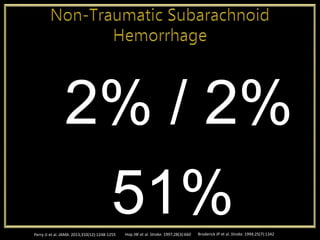
2% / 2%
51%Broderick JP et al. Stroke. 1994;25(7):1342Hop JW et al. Stroke. 1997;28(3):660Perry JJ et al. JAMA. 2013;310(12):1248-1255
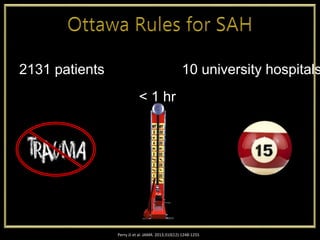
Perry JJ et al. JAMA. 2013;310(12):1248-1255
2131 patients 10 university hospitals
< 1 hr
Perry JJ et al. JAMA. 2013;310(12):1248-1255
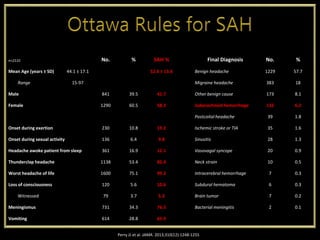
n=2131 No. % SAH % Final Diagnosis No. %
Mean Age (years ± SD) 44.1 ± 17.1 52.6 ± 13.6 Benign headache 1229 57.7
Range 15-97 Migraine headache 383 18
Male 841 39.5 41.7 Other benign cause 173 8.1
Female 1290 60.5 58.3 Subarachnoid hemorrhage 132 6.2
Postcoital headache 39 1.8
Onset during exertion 230 10.8 19.2 Ischemic stroke or TIA 35 1.6
Onset during sexual activity 136 6.4 9.8 Sinusitis 28 1.3
Headache awoke patient from sleep 361 16.9 12.1 Vasovagal syncope 20 0.9
Thunderclap headache 1138 53.4 82.4 Neck strain 10 0.5
Worst headache of life 1600 75.1 99.2 Intracerebral hemorrhage 7 0.3
Loss of consciousness 120 5.6 10.6 Subdural hematoma 6 0.3
Witnessed 79 3.7 5.3 Brain tumor 7 0.2
Meningismus 731 34.3 76.5 Bacterial meningitis 2 0.1
Vomiting 614 28.8 65.9
Perry JJ et al. JAMA. 2013;310(12):1248-1255
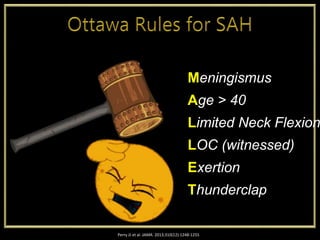
Meningismus
Age > 40
Limited Neck Flexion
LOC (witnessed)
Exertion
Thunderclap
Perry JJ et al. JAMA. 2013;310(12):1248-1255
100% 100%
But before you decide on
using
any of these rules,
you first have to determine…
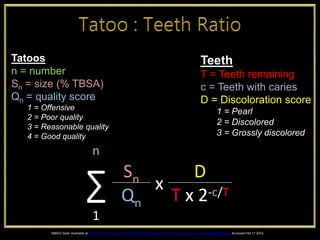
Tatoos
n = number
Sn = size (% TBSA)
Qn = quality score
1 = Offensive
2 = Poor quality
3 = Reasonable quality
4 = Good quality
Teeth
T = Teeth remaining
c = Teeth with caries
D = Discoloration score
1 = Pearl
2 = Discolored
3 = Grossly discolored
n
∑ Sn x
D
Qn T x 2-c/T
1
SMACC Gold. Available at http://www.smacc.net.au/2014/02/tattoos-to-teeth-ratio-the-evolution/#.UwMroqYdSP0.twitter. Accessed Feb 17 2014.
w w w . p a i n e p o d c a s t . c o m

Radiographic Decision Making

  • 1.
    Kristopher Maday, MS,PA-C University of Tennessee Health Science Center Physician Assistant Program Is There a Question?
  • 3.
    Little, D. [DrDLittle].(2013, December 17). [Tweet]. Retrieved https://twitter.com/DrDLittle/status/412998428755767296 We should probably CT it anyway to make sure its a duck If it walks like a duck… and swims like a duck… and quacks like a duck…
  • 5.
  • 6.
    1. Ottawa Rulesof the Foot/Ankle 2. Ottawa Rules of the Knee 3. NEXUS Criteria 4. Canadian C-Spine Rule 5. Canadian Head CT Rule 6. PECARN Criteria 7. Ottawa Subarachnoid Rule
  • 7.
    Stiell IG etal. Ann Emerg Med. 1992;21(4):384-390. #2 Ordered Radiograph In ED
  • 8.
    750 Patients7 months StiellIG et al. Ann Emerg Med. 1992;21(4):384-390. 32 Clinical Variables 21 Physicians
  • 9.
    Stiell IG etal. Ann Emerg Med. 1992;21(4):384-390. n=750 No. % No. % Mean Age (years ± SD) 35.1 ± 14.9 Patients Referred for Radiography Range 18-92 Ankle series only 520 68.3 Male 389 51.9 Foot series only 61 8.1 Female 361 49.1 Ankle and foot series 169 22.5 Mechanism Yield for Significant Fractures Twisting 627 83.9 Both series combined 102 11.1 Direct blow 52 7 Ankle series 70 10.2 Fall 35 4.7 Foot series 32 13.9 MVA 15 2 Other 18 2.4 Clinically Significant Fractures 102 13.6 Clinically Insignificant Fractures 43 5.7 Malleolar Region 70 9.3 Lateral malleolus 18 41.9 Lateral 41 58.6 Medial malleolus 1 2.3 Medial 7 10 Talus 13 30.2 Posterior 2 2.9 Cuboid 7 16.3 Bilmalleolar 12 7.1 Navicular 5 11.6 Trimalleolar 8 11.4 Anterior calcaneous 5 11.6 Talus 0 0 Midfoot 32 4.3 Base of 5th metatarsal 28 87.5 Navicular 2 6.3 Anterior calcaneous 2 6.3 Cuboid 0 0 Cunieforms 0 0
  • 10.
    • Age >55 years • Inability to bear weight 4 steps: – Immediately – In ED • Posterior malleolar tenderness • Tenderness over: – Base of 5th metatarsal – Navicular bone – Cuboid bone Stiell IG et al. Ann Emerg Med. 1992;21(4):384-390.
  • 11.
    Stiell IG etal. Ann Emerg Med. 1992;21(4):384-390. 100% 36% 21%
  • 12.
    Stiell IG etal. Ann Emerg Med. 1995;26(4):405-413 600,000 80%
  • 13.
    1,047 Patients14 months 23Clinical Variables 33 Physicians Stiell IG et al. Ann Emerg Med. 1995;26(4):405-413
  • 14.
    n=1047 No. % MeanAge (years ± SD) 36 ± 25 Range 18-90 Male 603 58 Female 444 42 Mechanism Twisting 524 50 Direct Blow 94 9 Other 429 41 Clinically Significant Fractures 66 6.3 Patella 29 2.8 Proximal tibia 29 2.8 Head of fibula 8 0.77 Distal femur 3 0.2 Tibial spine 2 0.19 Tibial tuberosity 2 0.19 Stiell IG et al. Ann Emerg Med. 1995;26(4):405-413
  • 15.
    • Age >55 years • Inability to bear weight 4 steps: – Immediately – In ED • Patellar tenderness • Fibular head tenderness • Inability to flex knee to 90o Stiell IG et al. Ann Emerg Med. 1995;26(4):405-413
  • 16.
    Stiell IG etal. Ann Emerg Med. 1995;26(4):405-413 100% 28%
  • 17.
    1,000,000 98% Hoffman JRet al. N Eng J Med. 2000;343(2):94-99.Stiell IG et al. JAMA. 2001;286(15):1841-1848
  • 19.
    Hoffman JR etal. N Eng J Med. 2000;343(2):94-99. Neurologic Deficit Spinal Tenderness Altered Mental Status Intoxication Distracting Injury
  • 20.
    Hoffman JR etal. N Eng J Med. 2000;343(2):94-99. 21 Centers Plain films CT MRI 34,069 patients
  • 21.
    Hoffman JR etal. N Eng J Med. 2000;343(2):94-99. n=34,069 No. % Mean age (years) 37 Range 1-101 Clinically Insignificant Fractures < 8 years 852 2.5 Spinous-process fracture Male 19999 58.7 Transverse-process fracture Female 14070 41.3 Simple compression fracture < 25% LOH Isolated avulsion without ligamentous injury Clinically Significant Fracture 818 2.4 Type I odontoid fracture Screening for any injury End-plate fractures Positive 810 Osteophyte fracture Negative 8 Injury to trabecular bone Screening for significant injury Positive 576 Negative 2 8 Patients Missed by Screening Age/Sex Vertebra Injury Treatment 38 M C6 Spinous-process fracture nothing 53 M C6-7 Chipped osteophyte nothing 54 M C2 Teardrop fracture with normal alignment patient refused 20 M C7 Anteriorsuperior end-plate avulsion soft-collar 18 F C5 Minimal LOH compression fracture nothing 81 F C2 Isolated lateral mass fracture soft-collar 84 M C2 Isloated lateral mass fracture soft-collar 57 M C6 Laminal fracture surgery
  • 22.
    Hoffman JR etal. N Eng J Med. 2000;343(2):94-99. 1 : 4000
  • 23.
    Stiell IG etal. JAMA. 2001;286(15):1841-1848 8924 adult patient s
  • 24.
    n=8924 No. %No. % Mean age (years ± SD) 36.7 ± 16 Clinically Important C-Spine Injury 151 1.7 Range 16-98 Fracture 143 1.6 Male 4600 51.5 Dislocation 23 0.3 Female 4324 48.5 Ligamentous Instability 9 0.1 Mechanism Clinically Unimportant C-Spine Injury 28 0.3 MVC 5975 67 Avulsion, osteophyte 8 0.1 Fall 1277 14.3 Avulsion, transverse process 5 0.1 Ped vs MV 298 3.3 Avulsion, spinous process 12 0.1 Assault 293 3.3 < 25% LOH compression fracture 3 0.003 Head Trauma 291 3.3 Sports 256 2.9 Developed neurological deficit 11 0.1 Bicycle 221 2.5 Axial Load 192 2.2 Stabilizing Treatments 161 1.8 Motorcycle 66 0.7 Internal fixation 25 0.3 Motorized Recreational Vehicle 47 0.5 Halo 55 0.6 Other 8 0.1 Brace 19 0.2 Rigid Collar 62 0.7 C-Spine Radiographs Performed 6145 68.9 C-Spine CT Performed 436 4.9 Admitted to hospital 726 8.1 Stiell IG et al. JAMA. 2001;286(15):1841-1848
  • 26.
    100% 50% Stiell IG etal. JAMA. 2001;286(15):1841-1848
  • 27.
    Stiell IG etal. Lancet. 2001;357(9266):1391-1396 ~ 800,000 $950 million < 3% Gaw CE et al. BMC Emergency Medicine. 2016;16(5) New Choice Health. 2017.
  • 28.
    Stiell IG etal. Lancet. 2001;357(9266):1391-1396 3121 patients 10 academic hospitals
  • 29.
    Stiell IG etal. Lancet. 2001;357(9266):1391-1396 n=3121 No. % No. % Mean age (years ± SD) 38.7 ± 18 Skull Fractures 108 4 Range 16-99 Male 2135 69 Female 986 31 Mechanism Vomiting 301 10 Fall 963 31 MVC 805 26 Assault 334 11 Sports 307 10 Bicycle 207 7 Pedestrian 187 6 Head hit by object 182 6 Motorcycle 105 4 Other 31 1 No. % GCS Clinically Important Brain Injury 254 8 15 2489 80 14 522 17 Needed surgical intervention 44 1 13 110 4 Witnessed LOC 1435 46% Amnesia 2722 87%
  • 30.
    • High Risk(for surgical intervention) – GCS < 15 at 2hr after injury – Suspected open/depressed skull fracture – Signs of basilar skull fracture – Vomiting ≥ 2 episodes – Age ≥ 65 • Medium Risk (for brain injury) – Retrograde amnesia ≥ 30 min – Dangerous mechanism Stiell IG et al. Lancet. 2001;357(9266):1391-1396 100% 98.4%
  • 31.
    Kuppermann N etal. Lancet. 2009;374:1160-1170 700,000 50/50 3x
  • 32.
    Easter JS etal. Ann Emerg Med. 2014;64(2):145-152 CATCH Trial CHALICE Trial PECARN Trial
  • 33.
    Kuppermann N etal. Lancet. 2009;374:1160-1170 25 Hospitals 42,412 patients < 18yo and GCS 14-15 34 clinical variables < 2yo and > 2yo subgroup analysis
  • 34.
    Kuppermann N etal. Lancet. 2009;374:1160-1170 Age < 2 Age > 2 Age < 2 Age > 2 n=8502 n=25,283 n=8502 n=25,283 No. % No. % No. % No. % Severity of MOI Basilar Skull Fx 42 0.5 179 0.7 Mild 1262 15 4505 17.9 Palpable Skull Fx 288 3.4 541 2.1 Moderate 5322 63.2 17865 71.1 Scalp Hematoma Severe 1840 21.8 2758 11 None 4745 56.4 15555 61.5 LOC Duration Frontal 2340 27.8 4593 18.8 None 7754 95.6 19574 87 Temporal/Parietal 833 9.9 2541 10 < 5 sec 61 0.8 679 3 Occpital 499 5.9 2278 9.7 5-60 sec 173 2.1 1331 5.9 Outcomes 1-5 min 79 1 781 3.5 TBI on CT 214 8.1 382 5.2 > 5 min 46 0.6 124 0.6 ciTBI 73 0.9 215 1 Headache Severity Neurosurgery 14 0.2 30 0.2 None - - 11701 55.2 Mild - - 4262 18.6 Moderate - - 4572 19.8 Severe - - 658 2.8 Vomiting Episodes 0 7175 85.5 21866 87.6 1 548 6.5 1144 4.6 2 241 2.9 661 2.6 >2 425 5.1 1293 5.2 Acting Abnormal per parent 1166 14.3 3792 16.4 GCS Score 14 366 4.3 720 2.8 15 8136 95.7 24563 97.2 AMS 978 11.6 3427 13.7 TBI on CT Intracranial hemorrhage Cerebral edema Traumatic infarction Diffuse Axonal Injury Sigmoid sinus thrombosis Signs of herniation Skull diastasis Pneumocephalus Depressed skull fracture ciTBI Death from TBI TBI needing neurosurgical intervention ICP monitoring Ventriculostomy Hematoma evacuation Intubation for > 24hr for TBI > 2 day admission for TBI complications
  • 35.
    Kuppermann N etal. Lancet. 2009;374:1160-1170
  • 36.
    Kuppermann N etal. Lancet. 2009;374:1160-1170
  • 37.
    2% / 2% 51%BroderickJP et al. Stroke. 1994;25(7):1342Hop JW et al. Stroke. 1997;28(3):660Perry JJ et al. JAMA. 2013;310(12):1248-1255
  • 38.
    Perry JJ etal. JAMA. 2013;310(12):1248-1255 2131 patients 10 university hospitals < 1 hr
  • 39.
    Perry JJ etal. JAMA. 2013;310(12):1248-1255 n=2131 No. % SAH % Final Diagnosis No. % Mean Age (years ± SD) 44.1 ± 17.1 52.6 ± 13.6 Benign headache 1229 57.7 Range 15-97 Migraine headache 383 18 Male 841 39.5 41.7 Other benign cause 173 8.1 Female 1290 60.5 58.3 Subarachnoid hemorrhage 132 6.2 Postcoital headache 39 1.8 Onset during exertion 230 10.8 19.2 Ischemic stroke or TIA 35 1.6 Onset during sexual activity 136 6.4 9.8 Sinusitis 28 1.3 Headache awoke patient from sleep 361 16.9 12.1 Vasovagal syncope 20 0.9 Thunderclap headache 1138 53.4 82.4 Neck strain 10 0.5 Worst headache of life 1600 75.1 99.2 Intracerebral hemorrhage 7 0.3 Loss of consciousness 120 5.6 10.6 Subdural hematoma 6 0.3 Witnessed 79 3.7 5.3 Brain tumor 7 0.2 Meningismus 731 34.3 76.5 Bacterial meningitis 2 0.1 Vomiting 614 28.8 65.9
  • 40.
    Perry JJ etal. JAMA. 2013;310(12):1248-1255 Meningismus Age > 40 Limited Neck Flexion LOC (witnessed) Exertion Thunderclap
  • 41.
    Perry JJ etal. JAMA. 2013;310(12):1248-1255 100% 100%
  • 42.
    But before youdecide on using any of these rules, you first have to determine…
  • 43.
    Tatoos n = number Sn= size (% TBSA) Qn = quality score 1 = Offensive 2 = Poor quality 3 = Reasonable quality 4 = Good quality Teeth T = Teeth remaining c = Teeth with caries D = Discoloration score 1 = Pearl 2 = Discolored 3 = Grossly discolored n ∑ Sn x D Qn T x 2-c/T 1 SMACC Gold. Available at http://www.smacc.net.au/2014/02/tattoos-to-teeth-ratio-the-evolution/#.UwMroqYdSP0.twitter. Accessed Feb 17 2014.
  • 44.
    w w w. p a i n e p o d c a s t . c o m

Editor's Notes

  • #5 Choosing Wisely aims to promote conversations between clinicians and patients by helping patients choose care that is: Supported by evidence Not duplicative of other tests or procedures already received Free from harm Truly necessary
  • #8 #2 order study in ED but < 15% fracture incidence
  • #9 2 different academic teaching hospitals
  • #12 100% of clinically signifcant fractures identified 36% reduction in acnkle films and 21% reduction in foot films
  • #13 600,000 patients present to the ED for knee pain and 80% of these patients have radiography
  • #14 2 different academic teaching hospitals
  • #17 100% of clinically significant fracture identified and 28% reduction in knee films
  • #18 Most common radiograph for trauma is the c-spine series Over 1,000,000 series each year with > 98% being negative
  • #20 Several smaller studies determined the 5 variables that predicted low yield of C-spine fractures
  • #21 Screened by ED physicians
  • #22 All 810 patients correctly identified prior to radiographs had at least 1 of the 5 criteria
  • #23 Overall missed rate is 1 out of 4000 patients To put it in perspective  if you ordered 65 C-spine series per year, you would miss 1 occult c-spine injury every 62 years using these rules
  • #24 Adults patients with after blunt trauma with neck pain, stable VS, and GCS 15 Evaluated 20 clinical variables
  • #26 CT > plain films
  • #27 100% sensitivity Decrease by 25-50%
  • #28 Estimated 2.3 million ED visits for minor head trauma and at $1200 per scan 950 million The US yield of CT for intracranial lesions in minor head injury is estimated to be quite low (0·7–3·7%).
  • #29 Blunt trauma, < 24hr on presentation, with LOC, AMS, or amnesia 22 patient variables
  • #32 700,000 ED visits for head trauma in US per year 50% end of getting CT and 50% of them have a GCS 14-15 CT use has tripled since 1995
  • #33 Canadian Assessment of Tomography in Childhood Head Injury Children’s Head Injury Algorithm for the Prediction of Important Clinical Events Pediatric Emergency Care Applied Research Network PECARN had highest sensitiviy and (+)LR
  • #34 Excluded trivial head trauma, penetrating trauma, known brain tumors or neurologic disorder
  • #36 98.6% sensitivity 99.9% NPV
  • #37 96.7% sensitivity 99.95% NPV
  • #38 2% of ED visits for headache  2% of these are SAH 51% mortality
  • #39 > 16yo with non-traumatic headache No previous history, no known intracranial pathology, no FND, no pailledema Assessed 19 clinical variables
  • #42 100% sensitivity and 100% NPV
  • #44 The higher the TTR, the lower risk of terminal outcome TTR ≥ 1 = indestructibility Exceptions = hipsters as they will die after taking away their microbrews or WiFi