NUTRITION IN SURGERY
Dr SUNDARPRAKASH SIVALINGAM
ASSOCIATE PROFESSOR IN SURGERY
OUTLINE
1. Overview on Basics of Nutrition
2. Importance of Nutrition in Surgical Patient
3. Nutrition Assessment
4. Nutrition Support
 Enteral
 Parenteral
1. Take Home Message
BASICS OF NUTRITION
 Nutrition is the process of providing or obtaining the
foods necessary for health and growth.
 The general indications for nutritional support in
surgery are in the prevention and treatment of under
nutrition.
Clinical Nutrition (2003) 22(3): 235–239
 Normal functioning of human body requires a balance
between nutritional intake and metabolism
 Imbalances will manifest as nutritional deficiencies or
excess
NUTRITIONAL REQUIREMENTS
 Calories provided mainly by carbohydrate and fat
 Fat = 9 kcal/ g
 Carbohydrate = 4 kcal/ g
 Protein = 4 kcal/ g
 Daily caloric requirements: 30-35kcal/kg
 Metabolic stress associated with sepsis, trauma, surgery or ventilation lead to
increase energy requirement (35-40kcal/kg/day)
Medical Nutrition Therapy Guideline (2012)
MALNUTRITION
 Malnutrition :
 condition that develops when the body does not get the right
amount of the vitamins, minerals and other nutrients it
needs to maintain healthy tissues and organ function.
 Can occur in people who are either undernourished or over-
nourished
Stratton RJ, Green CJ, Elias M. Disease-related malnutrition: an evidence-based approach to treatment. Oxon, UK: CABI Publishing;
2003 (p. 3). Retrieved on 30th December 2014, from http://espen.info/documents/ENGeneral.pdf
ESPEN Guidelines 2009
 Under nutrition:
 BMI <18kg/m2
 Weight loss >10-15% within 6 months
 Serum albumin <30g/L (with no evidence of hepatic or renal
dysfunction)
 <80% of ideal body weight
 Over nutrition:


BMI >30kg/m2
Body weight >20% from ideal body weight
BMI
Category BMI Range (kg/m)
Underweight <18.5
Normal 18.5 – 23.9
Overweight 24.0 – 26.9
Obese Class I 27.0 – 34.9
Obese Class II 35 – 40
Obese Class III > 40
COMPLICATIONOF
MALNUTRITION
Wound infection
Intraabdominal infection
Sepsis
Pneumonia
Gastrointestinal infection
Urinarytract infection
Catheterrelated infection
INFECTIOUS
Post operative bleeding
Anastomosis leakage
Impairedwound healing
Gastrointestinal obstruction/
perforation
Cardiac/renal/respiratory
dysfunction
Multiorgans failure
Prolonged recovery period
Increased need for nursing care
Increased medical cost
Prolonged hospital stay
NON INFECTIOUS
NUTRITIONAL ASSESSMENT
 History
 Physical examination
 Laboratory investigation
 Nutritional assessment score
NUTRITIONAL ASSESSMENT
History
 Presenting Complaints
 Vomiting, dysphagia, diarrhea
 Co morbidities
 Obesity, Malignancy, IBD,
 Social & Dietary History
 Socio economic background
 Intake
 Amount
NUTRITIONAL ASSESSMENT
Physical Examination
 Anthropometric Measurements
o
o
o Weight, height & BMI, IBW
Skin-fold thickness  biceps & triceps
Mid-arm circumference
 Signs ofMalnutrition
o
o
o
o
o Hair – easy pluckability
Face – nasolabial seborrhoea, angular fissures of lip
Muscle bulk – temporalis, thenar eminence, lumbricals
Skin – increased fold, hyperkeratosis, non healing ulcers
Limbs – dependant edema
IBW
= (Ht -152.4) x 0.91
+ 50 (male)/45.5 (female)
NUTRITIONAL ASSESSMENT
Laboratory
 FBC – Hemoglobin (HCMC anemia), Total Lymphocytes count
 LFT – Serum albumin
 Serum Transferrin
 Serum Prealbumin
 Others
 Nitrogen balance
 Electrolytes/BUSE/ creatinine
PATIENT
DIETICIAN
PRIMARY TEAM
INTENSIVIST
NURSING
PHARMACIST
NUTRITION SUPPORT
TEAM
MULTIDISCIPLINARY APPROACH
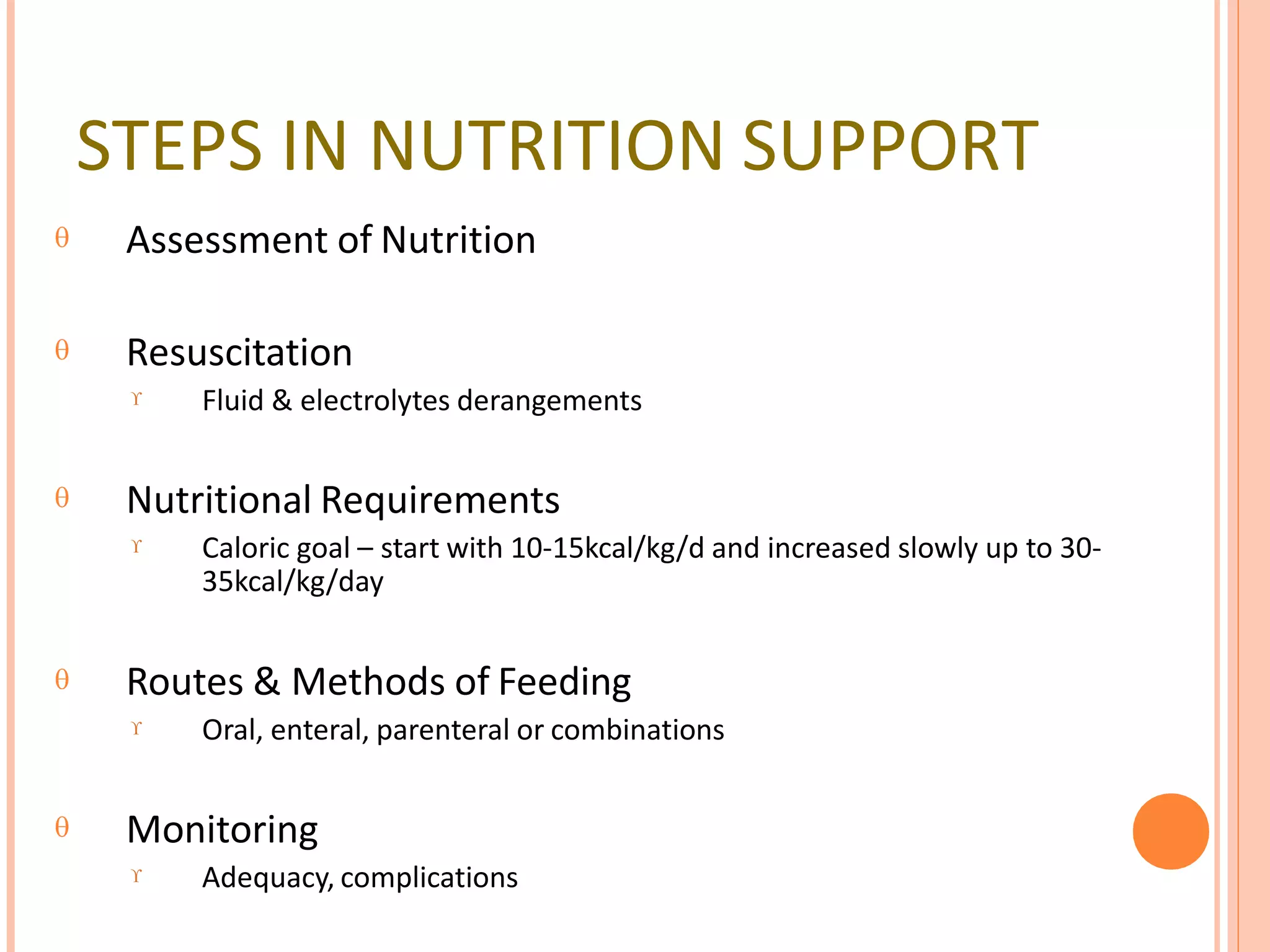
STEPS IN NUTRITION SUPPORT
 Assessment of Nutrition
 Resuscitation
 Fluid & electrolytes derangements
 Nutritional Requirements
 Caloric goal – start with 10-15kcal/kg/d and increased slowly up to 30-
35kcal/kg/day
 Routes & Methods of Feeding
 Oral, enteral, parenteral or combinations
 Monitoring
 Adequacy, complications
INITIATING NUTRITION
SUPPORT
Stu BMJ (2009) Publishing group LTD Medscape
ENTERAL NUTRITION
 Basics of enteral feeding
 Indication/Contraindication
 Enteral routes
 Feeding regime/ Types of formulas
 Complication
ENTERAL NUTRITION (EN)
 Delivery of nutrient into healthy and functioning GI tract
 Most preferred and more physiological
 Advantages
 Maintain gut mucosal integrity
 Maintain normal gut flora & pH
 Cheap & easily available
 Less complication
INDICATIONS &CONTRAINDICATIONS
•Oral intake < 50% of required
need for the previous 7-10 days
•Dysphagia or chewing problem
due to strokes, brain tumor, head
injuries
• Major burns
•Low output GIT fistulas (< 500
mls/day).
Indications Contraindications
• Mechanical obstruction of GIT
• Prolonged ileus
• Severe GI hemorrhage
• Severe diarrhea
• Intractable vomiting
• High output GIT fistula
(>500ml/day)
• Severe enterocolitis
FEEDING REGIME
FORMULAS AVAILABLE IN HTAA
COMPLICATIONS OF ENTERAL
NUTRITION
EARLY EN VS DELAYED EN
 Initiate nutritional support ( by the enteral route if possible)
without delay:
 Even in patients without obvious under nutrition, if it is
anticipated that the patient will be unable to eat for more
than 7 days
 I n patients who cannot maintain oral intake above 60% of
recommended intake for more than 10 days.
ESPEN Guidelines on Enteral Nutrition 2006
PARENTERAL FEEDING
 BASIC OF PARENTERAL FEEDING
 INDICATIONS
 CONTRAINDICATIONS
 TYPES OF PARENTERAL NUTRITION
 CALORY REQUIREMENT
 COMPLICATIONS
 MONITORING PATIENT WITH PN
BASICS OF PARENTERAL
FEEDING
 Delivery of all nutritional requirements by IV route without
the use of GIT (bypass GIT)
 Sterile liquid chemical formula
 May be delivered via :
- Central line
- Peripheral line
INDICATIONS
 GIT Malfunction
OBSTRUCTED
FISTULATED
INFLAMMED
TOO SHORT
- Ca esophagus/stomach, stricture
- post op enterocutaneous fistula, high output fistulas
- small bowel disease ex, crohn’s disease, acute severe pancreatitis
- massive resection, short gut syndrome


Pre operative : build up of malnourished patient
Failure enteral feeding to meet caloric requirement
- major polytrauma, major burns
 Cancer : complication of chemotherapy, radiotherapy
 Newborns
- GIT anomalies,NEC
PRE OPERATIVE PN
Indicated in :
 Severely undernourished patients who cannot be adequately
enterally fed
Studies have shown that :
 Inadequate oral intake of >14 days = higher mortality
 7-10 days of preoperative PN = improves postoperative outcome
in severe undernourished patient
ESPEN Guidelines of Parenteral Nutrition 2009
POST OPERATIVE PN
Indicated in:
 Undernourished patients = enteral nutrition is not feasible / not
tolerated
 Patients with postoperative complications
= impairing gastrointestinal function -> unable to receive and
absorb adequate amounts of oral/enteral feeding for at least 7 days
Post operative PN is life saving in patients with
prolonged gastrointestinal failure.
ESPEN Guidelines of Parenteral Nutrition 2009
PN IS CONTRAINDICATED IN:
 Functional and accessible GI tract
 Patient is taking orally
 Prognosis does not warrant aggressive nutrition support
(terminally ill patients)
 Risk exceeds benefit
 Patient expected to meet needs within 14 days
NUTRITION
Total Parenteral Nutrition Partial Parenteral Nutrition
Supplies all daily nutritional
requirement
Only part of the daily nutritional
requirements supplied,
supplementing oral intake ~ 50-70%
of patient’s energy needs
Central line Peripheral line
Long term support (>10 days) Short term support (10-14 days)
Hypertonic solutions with high
osmolarity
Formulation with low osmolarity
(< 900mOsm/L )
CALORY REQUIREMENT
Estimating energy requirement
( Harris- Benedict Equation)


Men BMR =66.47 + 13.7 wt + 5.0 ht - 6.76 age
Women BMR =65.5 + 9.56 wt + 1.85 ht - 4.68 age
Wt = weight in kg, ht = height in cm
BMR= Basal Metabolic Rate
 Total calorie need = BMR x Activity factor x Injury factor
for practical purpose: 30-35kcal/kg/day
FORMULAS AVAILABLE AT HTAA
 2-in-1 mixtures : glucose + protein aggregate
(Nutriflex Peri, Nutriflex Plus)
 3-in-1 mixtures : glucose + lipids + proteins
(NuTRIflex Lipid Peri, NuTRIflex Lipid Plus, Kabiven range)
MONITORING PATIENTS ON PN
Parameter Daily
Frequency
3x/week
Weekly
Glucose Initially √
Initially √
Initially √
√
Electrolytes,
FBC
Phos, Mg, BUN,
Cr, Ca
TG
Fluid- I/O √
Temperature √
T. Bili, LFT Initially √
COMPLICATIONS OF PARENTERAL
NUTRITION
Refeeding syndrome
Expansion of extracellular volume, fluid overload
Hyper/hypoglycemia
Fluid or electrolyte abnormalities
Catheter leak
Air embolism






 Catheter related sepsis
Acute
COMPLICATIONS OF PARENTERAL
NUTRITION
Late
 Metabolic bone diseases : osteoporosis
 Hepatic complications : fatty liver, liver failure, hyperammonemia
 Gallbladder complications: cholestatic jaundice
 Venous thrombosis
 Catheter related sepsis
 Vitamin and traced element deficiency
REFEEDING SYNDROME
 Metabolic complication = in severely malnourished patients
 Potentially fatal condition - may be successfully managed
- prevented if detected early
Pathophysiology
 Metabolism shifts : catabolic -> anabolic state
 Insulin is released - triggering cellular uptake of K+, PO4, Mg
 Profound depletion those electrolyte extracelullarly
-hypo PO4, hypo Mg, hypo K+, hypo Ca  multiorgan dysfunction
 PN initially delivered = maximum of 10 kcal/kg/day
= raised gradually to full needs within a week
Ways to wean off TPN
 PN may rapidly discontinued  patient tolerating tube feeding
 Reduced PN volume by 1/2 for 1-2 H before discontinued it
 minimize rebound hypoglycemia
 Enteral feeding initiated  patient’s GIT function resume
 Initiation enteral feeding  GIT function
 minimal risk of aspiration
 patient motivation.
COMBINATIONS OF ENTERAL AND PARENTERAL
FEEDING
 >60% of energy needs cannot be met via the enteral
route, e.g. in high output enterocutaneous fistulae
 partly obstructing benign or malignant gastrointestinal
lesions which do not allow enteral feeding.
ESPEN Guidelines of Parenteral Nutrition 2009
ENTERAL NUTRITION VS PARENTERAL
NUTRITION
Studies have shown that:
 There are no significant differences in mortality rate
 There are no significant differences regarding length of hospital
stay.
ESPEN Guidelines on Enteral Nutrition 2006
Enteral feeding Parenteral feeding
Lower risk infection Higher risk infection
Decreased cost Increased cost
Lower incidence
hyperglycemia
Higher incidence
hyperglycemia
TAKE HOME MESSAGES
1. Malnutrition leads to prolong stay, prolong recovery period and
increased medical cost
2. Normal caloric requirement = 30-
35kcal/kg/day Metabolic stress =35-
40kcal/kg/day
3. Use enteral feeding unless contraindicated
4. Low osmolarity PN (<900mOsm/L) given via peripheral line
5. In high risk patient to develop re feeding syndrome, we should
start with low calories
6. Parameters that required daily monitoring are glucose,
electrolytes, FBC, I/0 and temperature
REFERENCES
1. Bailey & Love’s Short Practice of Surgery 25th edition
2. Espen Congress Istanbul (2006), retrieved on 5/1/12 from
http://www.espen.org/presfile/Meier.pdf
3. ESPEN Guidelines on Enteral/Parentral Nutrition: Surgery 2006 & 2009
edition
4. Nutritional support in surgical patient by Richard J. E. Skipworth.
Kenneth C. H. Fearhon
5. Nutrition Journal homepage
6. En. Chong, Dietician HTAA
7. Miss Han, TPN Pharmacist
8. TPN Tutorial (www.rxkinetics.com/tpntutorial)
Nutrition in surgery

Nutrition in surgery

  • 1.
    NUTRITION IN SURGERY DrSUNDARPRAKASH SIVALINGAM ASSOCIATE PROFESSOR IN SURGERY
  • 2.
    OUTLINE 1. Overview onBasics of Nutrition 2. Importance of Nutrition in Surgical Patient 3. Nutrition Assessment 4. Nutrition Support  Enteral  Parenteral 1. Take Home Message
  • 3.
    BASICS OF NUTRITION Nutrition is the process of providing or obtaining the foods necessary for health and growth.  The general indications for nutritional support in surgery are in the prevention and treatment of under nutrition. Clinical Nutrition (2003) 22(3): 235–239
  • 4.
     Normal functioningof human body requires a balance between nutritional intake and metabolism  Imbalances will manifest as nutritional deficiencies or excess
  • 5.
    NUTRITIONAL REQUIREMENTS  Caloriesprovided mainly by carbohydrate and fat  Fat = 9 kcal/ g  Carbohydrate = 4 kcal/ g  Protein = 4 kcal/ g  Daily caloric requirements: 30-35kcal/kg  Metabolic stress associated with sepsis, trauma, surgery or ventilation lead to increase energy requirement (35-40kcal/kg/day) Medical Nutrition Therapy Guideline (2012)
  • 6.
    MALNUTRITION  Malnutrition : condition that develops when the body does not get the right amount of the vitamins, minerals and other nutrients it needs to maintain healthy tissues and organ function.  Can occur in people who are either undernourished or over- nourished Stratton RJ, Green CJ, Elias M. Disease-related malnutrition: an evidence-based approach to treatment. Oxon, UK: CABI Publishing; 2003 (p. 3). Retrieved on 30th December 2014, from http://espen.info/documents/ENGeneral.pdf
  • 7.
    ESPEN Guidelines 2009 Under nutrition:  BMI <18kg/m2  Weight loss >10-15% within 6 months  Serum albumin <30g/L (with no evidence of hepatic or renal dysfunction)  <80% of ideal body weight  Over nutrition:   BMI >30kg/m2 Body weight >20% from ideal body weight
  • 8.
    BMI Category BMI Range(kg/m) Underweight <18.5 Normal 18.5 – 23.9 Overweight 24.0 – 26.9 Obese Class I 27.0 – 34.9 Obese Class II 35 – 40 Obese Class III > 40
  • 9.
    COMPLICATIONOF MALNUTRITION Wound infection Intraabdominal infection Sepsis Pneumonia Gastrointestinalinfection Urinarytract infection Catheterrelated infection INFECTIOUS Post operative bleeding Anastomosis leakage Impairedwound healing Gastrointestinal obstruction/ perforation Cardiac/renal/respiratory dysfunction Multiorgans failure Prolonged recovery period Increased need for nursing care Increased medical cost Prolonged hospital stay NON INFECTIOUS
  • 10.
    NUTRITIONAL ASSESSMENT  History Physical examination  Laboratory investigation  Nutritional assessment score
  • 11.
    NUTRITIONAL ASSESSMENT History  PresentingComplaints  Vomiting, dysphagia, diarrhea  Co morbidities  Obesity, Malignancy, IBD,  Social & Dietary History  Socio economic background  Intake  Amount
  • 12.
    NUTRITIONAL ASSESSMENT Physical Examination Anthropometric Measurements o o o Weight, height & BMI, IBW Skin-fold thickness  biceps & triceps Mid-arm circumference  Signs ofMalnutrition o o o o o Hair – easy pluckability Face – nasolabial seborrhoea, angular fissures of lip Muscle bulk – temporalis, thenar eminence, lumbricals Skin – increased fold, hyperkeratosis, non healing ulcers Limbs – dependant edema IBW = (Ht -152.4) x 0.91 + 50 (male)/45.5 (female)
  • 13.
    NUTRITIONAL ASSESSMENT Laboratory  FBC– Hemoglobin (HCMC anemia), Total Lymphocytes count  LFT – Serum albumin  Serum Transferrin  Serum Prealbumin  Others  Nitrogen balance  Electrolytes/BUSE/ creatinine
  • 14.
  • 16.
    STEPS IN NUTRITIONSUPPORT  Assessment of Nutrition  Resuscitation  Fluid & electrolytes derangements  Nutritional Requirements  Caloric goal – start with 10-15kcal/kg/d and increased slowly up to 30- 35kcal/kg/day  Routes & Methods of Feeding  Oral, enteral, parenteral or combinations  Monitoring  Adequacy, complications
  • 17.
    INITIATING NUTRITION SUPPORT Stu BMJ(2009) Publishing group LTD Medscape
  • 18.
    ENTERAL NUTRITION  Basicsof enteral feeding  Indication/Contraindication  Enteral routes  Feeding regime/ Types of formulas  Complication
  • 19.
    ENTERAL NUTRITION (EN) Delivery of nutrient into healthy and functioning GI tract  Most preferred and more physiological  Advantages  Maintain gut mucosal integrity  Maintain normal gut flora & pH  Cheap & easily available  Less complication
  • 20.
    INDICATIONS &CONTRAINDICATIONS •Oral intake< 50% of required need for the previous 7-10 days •Dysphagia or chewing problem due to strokes, brain tumor, head injuries • Major burns •Low output GIT fistulas (< 500 mls/day). Indications Contraindications • Mechanical obstruction of GIT • Prolonged ileus • Severe GI hemorrhage • Severe diarrhea • Intractable vomiting • High output GIT fistula (>500ml/day) • Severe enterocolitis
  • 22.
  • 23.
  • 24.
  • 25.
    EARLY EN VSDELAYED EN  Initiate nutritional support ( by the enteral route if possible) without delay:  Even in patients without obvious under nutrition, if it is anticipated that the patient will be unable to eat for more than 7 days  I n patients who cannot maintain oral intake above 60% of recommended intake for more than 10 days. ESPEN Guidelines on Enteral Nutrition 2006
  • 26.
    PARENTERAL FEEDING  BASICOF PARENTERAL FEEDING  INDICATIONS  CONTRAINDICATIONS  TYPES OF PARENTERAL NUTRITION  CALORY REQUIREMENT  COMPLICATIONS  MONITORING PATIENT WITH PN
  • 27.
    BASICS OF PARENTERAL FEEDING Delivery of all nutritional requirements by IV route without the use of GIT (bypass GIT)  Sterile liquid chemical formula  May be delivered via : - Central line - Peripheral line
  • 28.
    INDICATIONS  GIT Malfunction OBSTRUCTED FISTULATED INFLAMMED TOOSHORT - Ca esophagus/stomach, stricture - post op enterocutaneous fistula, high output fistulas - small bowel disease ex, crohn’s disease, acute severe pancreatitis - massive resection, short gut syndrome   Pre operative : build up of malnourished patient Failure enteral feeding to meet caloric requirement - major polytrauma, major burns  Cancer : complication of chemotherapy, radiotherapy  Newborns - GIT anomalies,NEC
  • 29.
    PRE OPERATIVE PN Indicatedin :  Severely undernourished patients who cannot be adequately enterally fed Studies have shown that :  Inadequate oral intake of >14 days = higher mortality  7-10 days of preoperative PN = improves postoperative outcome in severe undernourished patient ESPEN Guidelines of Parenteral Nutrition 2009
  • 30.
    POST OPERATIVE PN Indicatedin:  Undernourished patients = enteral nutrition is not feasible / not tolerated  Patients with postoperative complications = impairing gastrointestinal function -> unable to receive and absorb adequate amounts of oral/enteral feeding for at least 7 days Post operative PN is life saving in patients with prolonged gastrointestinal failure. ESPEN Guidelines of Parenteral Nutrition 2009
  • 31.
    PN IS CONTRAINDICATEDIN:  Functional and accessible GI tract  Patient is taking orally  Prognosis does not warrant aggressive nutrition support (terminally ill patients)  Risk exceeds benefit  Patient expected to meet needs within 14 days
  • 32.
    NUTRITION Total Parenteral NutritionPartial Parenteral Nutrition Supplies all daily nutritional requirement Only part of the daily nutritional requirements supplied, supplementing oral intake ~ 50-70% of patient’s energy needs Central line Peripheral line Long term support (>10 days) Short term support (10-14 days) Hypertonic solutions with high osmolarity Formulation with low osmolarity (< 900mOsm/L )
  • 33.
    CALORY REQUIREMENT Estimating energyrequirement ( Harris- Benedict Equation)   Men BMR =66.47 + 13.7 wt + 5.0 ht - 6.76 age Women BMR =65.5 + 9.56 wt + 1.85 ht - 4.68 age Wt = weight in kg, ht = height in cm BMR= Basal Metabolic Rate  Total calorie need = BMR x Activity factor x Injury factor for practical purpose: 30-35kcal/kg/day
  • 34.
    FORMULAS AVAILABLE ATHTAA  2-in-1 mixtures : glucose + protein aggregate (Nutriflex Peri, Nutriflex Plus)  3-in-1 mixtures : glucose + lipids + proteins (NuTRIflex Lipid Peri, NuTRIflex Lipid Plus, Kabiven range)
  • 35.
    MONITORING PATIENTS ONPN Parameter Daily Frequency 3x/week Weekly Glucose Initially √ Initially √ Initially √ √ Electrolytes, FBC Phos, Mg, BUN, Cr, Ca TG Fluid- I/O √ Temperature √ T. Bili, LFT Initially √
  • 36.
    COMPLICATIONS OF PARENTERAL NUTRITION Refeedingsyndrome Expansion of extracellular volume, fluid overload Hyper/hypoglycemia Fluid or electrolyte abnormalities Catheter leak Air embolism        Catheter related sepsis Acute
  • 37.
    COMPLICATIONS OF PARENTERAL NUTRITION Late Metabolic bone diseases : osteoporosis  Hepatic complications : fatty liver, liver failure, hyperammonemia  Gallbladder complications: cholestatic jaundice  Venous thrombosis  Catheter related sepsis  Vitamin and traced element deficiency
  • 38.
    REFEEDING SYNDROME  Metaboliccomplication = in severely malnourished patients  Potentially fatal condition - may be successfully managed - prevented if detected early Pathophysiology  Metabolism shifts : catabolic -> anabolic state  Insulin is released - triggering cellular uptake of K+, PO4, Mg  Profound depletion those electrolyte extracelullarly -hypo PO4, hypo Mg, hypo K+, hypo Ca  multiorgan dysfunction  PN initially delivered = maximum of 10 kcal/kg/day = raised gradually to full needs within a week
  • 39.
    Ways to weanoff TPN  PN may rapidly discontinued  patient tolerating tube feeding  Reduced PN volume by 1/2 for 1-2 H before discontinued it  minimize rebound hypoglycemia  Enteral feeding initiated  patient’s GIT function resume  Initiation enteral feeding  GIT function  minimal risk of aspiration  patient motivation.
  • 40.
    COMBINATIONS OF ENTERALAND PARENTERAL FEEDING  >60% of energy needs cannot be met via the enteral route, e.g. in high output enterocutaneous fistulae  partly obstructing benign or malignant gastrointestinal lesions which do not allow enteral feeding. ESPEN Guidelines of Parenteral Nutrition 2009
  • 41.
    ENTERAL NUTRITION VSPARENTERAL NUTRITION Studies have shown that:  There are no significant differences in mortality rate  There are no significant differences regarding length of hospital stay. ESPEN Guidelines on Enteral Nutrition 2006 Enteral feeding Parenteral feeding Lower risk infection Higher risk infection Decreased cost Increased cost Lower incidence hyperglycemia Higher incidence hyperglycemia
  • 42.
    TAKE HOME MESSAGES 1.Malnutrition leads to prolong stay, prolong recovery period and increased medical cost 2. Normal caloric requirement = 30- 35kcal/kg/day Metabolic stress =35- 40kcal/kg/day 3. Use enteral feeding unless contraindicated 4. Low osmolarity PN (<900mOsm/L) given via peripheral line 5. In high risk patient to develop re feeding syndrome, we should start with low calories 6. Parameters that required daily monitoring are glucose, electrolytes, FBC, I/0 and temperature
  • 43.
    REFERENCES 1. Bailey &Love’s Short Practice of Surgery 25th edition 2. Espen Congress Istanbul (2006), retrieved on 5/1/12 from http://www.espen.org/presfile/Meier.pdf 3. ESPEN Guidelines on Enteral/Parentral Nutrition: Surgery 2006 & 2009 edition 4. Nutritional support in surgical patient by Richard J. E. Skipworth. Kenneth C. H. Fearhon 5. Nutrition Journal homepage 6. En. Chong, Dietician HTAA 7. Miss Han, TPN Pharmacist 8. TPN Tutorial (www.rxkinetics.com/tpntutorial)