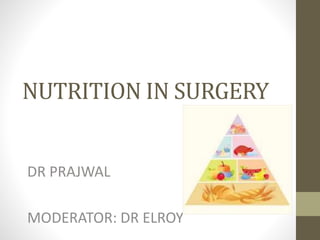
NUTRITION IN SURGERY
DR PRAJWAL
MODERATOR: DR ELROY
•Aim of nutrition support is to identify
patients at risk for malnutrition and to
meet their nutritional requirements
•Malnutrition has high risk of
complications plus mortality
Metabolic response to starvation
• Within 12 hours of fasting…
• Insulin level and Glucagon level
• Glycogenolysis (liver glycogen to glucose)
• Cori’s cycle
• > 24 hours… Gluconeogenesis in liver
• 48 – 72hrs : Lipolysis and Adaptive Ketogenesis
In trauma/ sepsis..
• Increased counterregulatory hormones
• Increased energy requirement( 15- 25% more)
• Increased nitrogen requirement
• Insulin resistance / stress induced hyperglycemia
• Preferential oxidation of lipids
• Increased gluconeogenesis / protein catabolism
• Loss of adaptive ketogenesis
• Fluid retention with hypoalbuminemia
Energy requirements
One g carbohydrate provides about 3.4 KCal,
whereas 1 g fat provides about 9 KCal.
Protein 4 KCal for each g.
An average adult needs 30--35 KCal/Kg/day
Nutritional Assessment
• Dietary History and History of weight loss
• Physical Examination:
• General appearance( emaciated, apathetic look)
• Assessment of body fat stores (Skin fold examination
over biceps and triceps, subscapular region)
• Assessment of protein stores (Muscle bellies of biceps,
triceps, supra and infraspinatus)
• Assessment of metabolic stress (indirect calorimetry ,
temp, wbc count, pulse, positive blood culture, abscess)
• Physiological fn – poor wound healing, early fatiguability,
grip strength, resp muscle fn test
• Body weight and Anthropomentry
• Laboratory tests: Serum albumin levels, Lymphocyte
count, Skin hypersensitivity tests
• THE MUST TOOL BMI, WT LOSS IN 3-6
MTHS, ACUTE DISEASE.
Nutrition support given to..
Past medical history
Involuntary loss
Blood loss >500ml
BMI < 18.5 kg/m2
Serum albumin <3 or transferrin <200mg/dl
Failure to thrive
Severe burns, trauma, sepsis, pancreatitis
NPO > 7 days
Nutritional Support
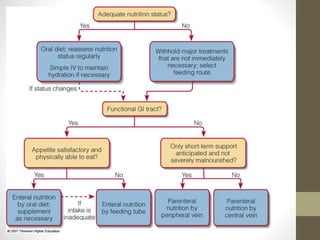
• Enteral
• Parenteral
• Daily requirement:
• Water 30- 70 ml/kg
• Calories 50 – 70 kcal/kg
• Protein 1.5- 2.0 gm/kg
• Sodium 0.9 – 1.2, Potassium 0.7-0.9 mmol/kg
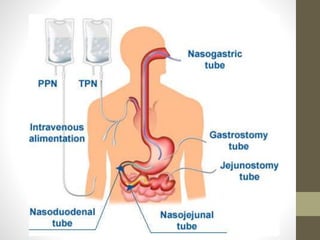
Enteral nutrition
• Oral supplements
• N/G tube feeding
• Gastrostomy tube feeding
Per-cutaneous
Open surgical / Laparoscopy
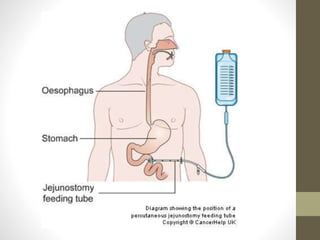
• Jejunostomy tube feeding
Laparoscopy/open surgery
Sip feeding
• Sip feeds provide 200 kcal and 2 g protein per
200ml carton
• Given in patients whose appetite is impaired
• Oral diet started at regular intervals , more
frequently. Progressive shift from oral liquid to
soft and normal diet ideally be one between 2-3
days
Tube feeding techniques
• NG TUBE , FINE BORE TUBE INSERTION
• 20-30ML administered per hr initially , gradually
increased within 2-3 days, feeding discontinued
for 4-5 hours overnight
• Aspiration is performed on regular basis, if
aspirate is more than 200ml per 2 hours, stop
feeding temporarily
Fine Bore Tube insertion
• Nasogastric tube is appropriate commonly but if
required for more than a week, then fine bore
feeding tube is preferred
• Fine bore feeding tube is made of soft
polyurethane or silicone elastomer (internal
diameter 3mm)
• It causes few gastric / esophageal erosions
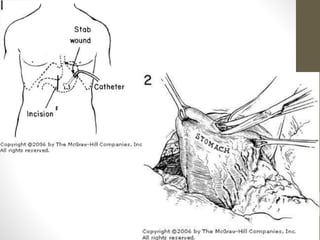
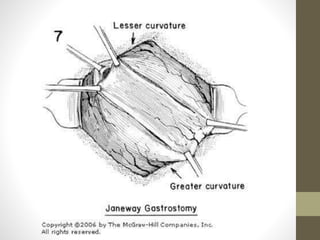
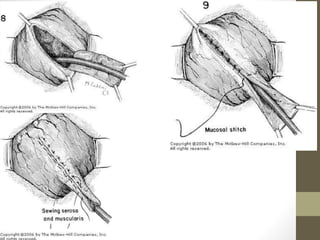
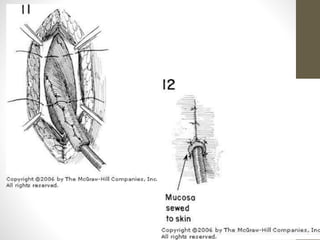
Gastrostomy
• Stamm (sero-lined) – temporary
• Janeway (mucous-lined) – permanent
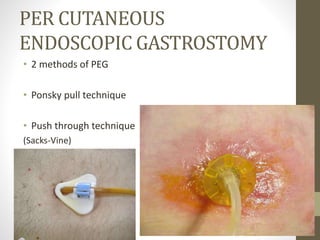
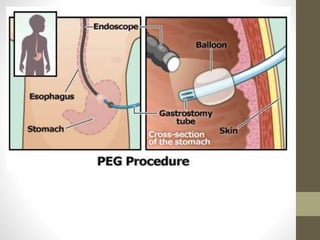
PER CUTANEOUS
ENDOSCOPIC GASTROSTOMY
• 2 methods of PEG
• Ponsky pull technique
• Push through technique
(Sacks-Vine)
Peg procedure
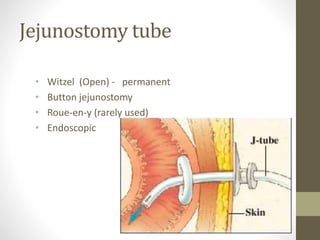
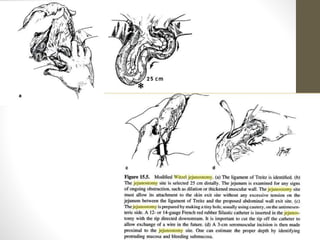
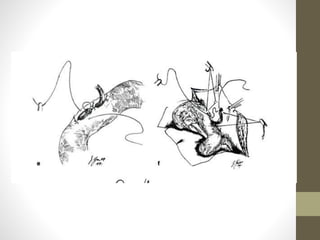
Jejunostomy tube
• Witzel (Open) - permanent
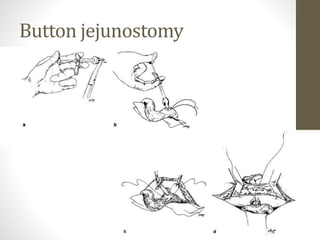
• Button jejunostomy
• Roue-en-y (rarely used)
• Endoscopic
Button jejunostomy
Complications
• Tube related:
• Malposition
• Displacement
• Blockage / Leakage / Breakage
• Erosion of skin / mucosa
• Gastrointestinal:
• Diarrhoea
• Bloating, Nausea, Vomiting
• Abdominal cramps, Aspiration
• Constipation
• Metabolic:
• Electrolyte disorder
• Vitamin, Mineral, Trace element deficiency
• Drug interactions
• Infection:
• Aspiration:
• Overloading
• Supine position/ unconscious
• Solute overloading :
• diarrhea, dehydration, electrolyte imbalance
(hypokalemia, hypomagnesemia), hyperglycemia
(hyperosmolar, nonketotic coma)
• Rarely perforation
Advantages of enteral feeds
• Preserves gut integrity
• Decreases likelihood of bacterial translocation
• Preserves immunologic function of gut
• Increased compliance with intake
• Costs less than parenteral nutrition
• Intake easily/accurately monitored
Contraindications
• Intractable vomiting/ diarrhoea
• Paralytic ileus
• GI Obstruction
• Diffuse peritonitis
• Severe GI haemorrhage, GI malabsorption
• Short bowel syndrome(<100cm)
• Severe shock
• Distal high output fistula
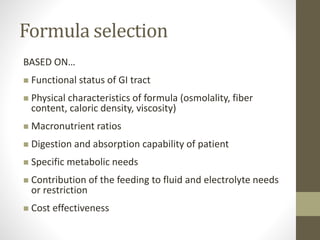
Formula selection
BASED ON…
 Functional status of GI tract
 Physical characteristics of formula (osmolality, fiber
content, caloric density, viscosity)
 Macronutrient ratios
 Digestion and absorption capability of patient
 Specific metabolic needs
 Contribution of the feeding to fluid and electrolyte needs
or restriction
 Cost effectiveness
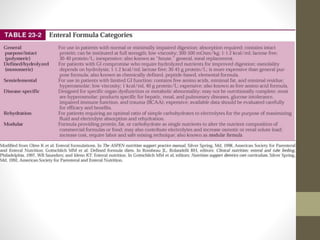
Rate and Method of Delivery
• Bolus—300 to 400 ml rapid delivery via
syringe several times daily
• Intermittent─300 to 400 ml, 20 to 30
minutes, several times/day via gravity drip
or syringe
• Cyclic—via pump usually at night
• Continuous—via gravity drip or infusion
pump
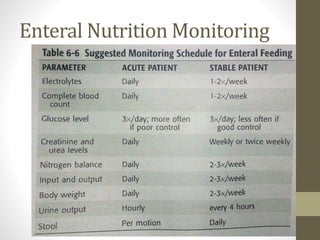
Enteral Nutrition Monitoring
Parental nutrition
• DEFINITION
• Defined as infusion of a nutrient hyperosmolar solution
containing carbohydrates, proteins, fat, and other
essential nutrients through an intravenous route
delivered via an indwelling intravenous catheter.
• Components are in elemental or “pre-digested” form
• Protein as amino acids
• CHO as dextrose
• Fat as lipid emulsion
• Electrolytes, vitamins and minerals
Peripheral parenteral nutrition
• To provide calories for <2 weeks
• Low dextrose conc (5-10%), aminoacid conc with
concentrated lipid(20%)
• Osmolarity< 900mosm/l
• Delivered into peripheral vein
Total parenteral nutrition
• High dextrose conc(50-70%)
• Aminoacids(8.5-10%)
• Osmolarity of 1000-1900mosm/l
• Catheter used : Polyurathrene or Silicon rubber
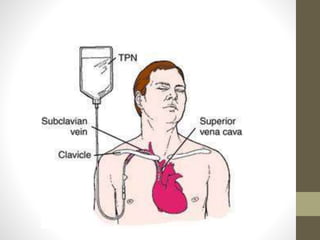
Sites for insertion
• 1) Short term central access – Infraclavicular
approach to subclavian vein
• 2) Long term central access – Tunneled catheter
into subclavian or internal jugular vein
• 3) Percutaneous inserted central catheter –
Catheter inserted into vein in antecubital area of
the arm and threaded into subclavian vein and
tip placed in sup vena cava
Delivering systems:
• 1) Multiple Bottle system: More flexible, requires proper
monitoring
Risk of improper mixing present
• 2) Three in one system: For long term cyclic or home
therapy
Duration of delivery
• Continous – Slow continous infusion,
Provides nutrition throughout the day
• Cyclic – Over period of 8 – 12 hours
(typical at night)
Advantages
• Provides nutrients when less than
2 to 3 feet of small intestine remains
• Allows nutrition support when GI
intolerance prevents oral or enteral
support
Estimating Energy
Requirements
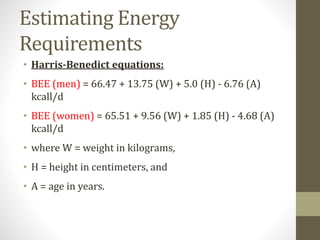
• Harris-Benedict equations:
• BEE (men) = 66.47 + 13.75 (W) + 5.0 (H) - 6.76 (A)
kcall/d
• BEE (women) = 65.51 + 9.56 (W) + 1.85 (H) - 4.68 (A)
kcall/d
• where W = weight in kilograms,
• H = height in centimeters, and
• A = age in years.
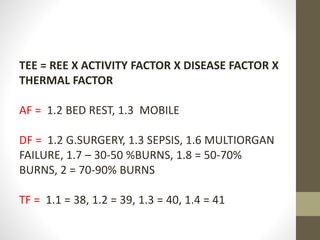
TEE = REE X ACTIVITY FACTOR X DISEASE FACTOR X
THERMAL FACTOR
AF = 1.2 BED REST, 1.3 MOBILE
DF = 1.2 G.SURGERY, 1.3 SEPSIS, 1.6 MULTIORGAN
FAILURE, 1.7 – 30-50 %BURNS, 1.8 = 50-70%
BURNS, 2 = 70-90% BURNS
TF = 1.1 = 38, 1.2 = 39, 1.3 = 40, 1.4 = 41
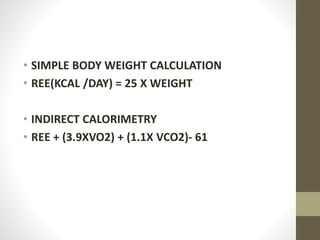
• SIMPLE BODY WEIGHT CALCULATION
• REE(KCAL /DAY) = 25 X WEIGHT
• INDIRECT CALORIMETRY
• REE + (3.9XVO2) + (1.1X VCO2)- 61
Composition of formulas
• STANDARD PARENTERAL DEXTROSE SOLUTION:
5 TO 70% CONCENTRATION, 3.4KCAL/GM
Cannot be used in patient under severe stress
Disadvantages : essential fatty acid deficiency
fatty liver
Intravenous Lipid Emulsions
• Concentrations 10% and 20%
• Parent oil Soybean or Safflower
• Osmolarity 280 - 340 mOsm/l
• Caloric content 10% = 1.1 kcal/ml
20% = 2.0 kcal/ml
Isotonic, Suitable for peripheral infusion, patient
under stress, Provide essential fatty acids and
Reduces the incidence of fatty liver
Parenteral Amino Acid Solutions
• Hypertonic solutions
• Contain essential and non-essential AA
• Variable amounts of electrolytes
• Concentrations depend on final volume
Amino acid solution
• Cheaper than albumin, readily used for protein
manufacture
• No risk of transmission of infection
Branched amino acid – beneficial in patients with liver
disease
Glutamine enriched amino acids – improve survival in
stressed & sick patients.
Arginine improves immune function.
Enriched with essential amino acids – beneficial in
patients with renal failure
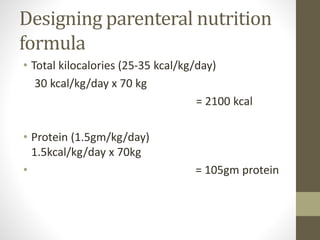
Designing parenteral nutrition
formula
• Total kilocalories (25-35 kcal/kg/day)
30 kcal/kg/day x 70 kg
= 2100 kcal
• Protein (1.5gm/kg/day)
1.5kcal/kg/day x 70kg
• = 105gm protein
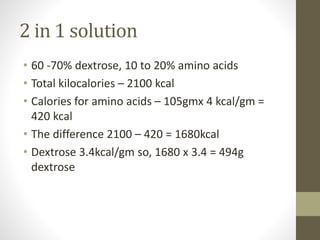
2 in 1 solution
• 60 -70% dextrose, 10 to 20% amino acids
• Total kilocalories – 2100 kcal
• Calories for amino acids – 105gmx 4 kcal/gm =
420 kcal
• The difference 2100 – 420 = 1680kcal
• Dextrose 3.4kcal/gm so, 1680 x 3.4 = 494g
dextrose
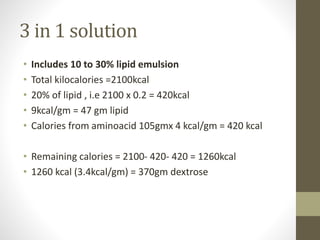
3 in 1 solution
• Includes 10 to 30% lipid emulsion
• Total kilocalories =2100kcal
• 20% of lipid , i.e 2100 x 0.2 = 420kcal
• 9kcal/gm = 47 gm lipid
• Calories from aminoacid 105gmx 4 kcal/gm = 420 kcal
• Remaining calories = 2100- 420- 420 = 1260kcal
• 1260 kcal (3.4kcal/gm) = 370gm dextrose
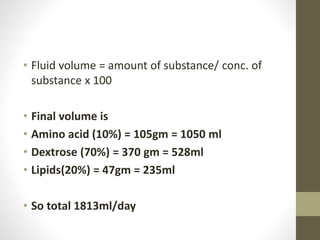
• Fluid volume = amount of substance/ conc. of
substance x 100
• Final volume is
• Amino acid (10%) = 105gm = 1050 ml
• Dextrose (70%) = 370 gm = 528ml
• Lipids(20%) = 47gm = 235ml
• So total 1813ml/day
Complications
• First 48 hours:
• MECHANICAL – MALPOSITION,
HEMOTHORAX,PNEUMOTHORAX, AIR
EMBOLISM, BLOOD LOSS, PUNCTURE OF
SUBCLAVIAN ARTERY
• METABOLIC- FLUID OVERLOAD,
HYPERGLYCEMIA,HYPOPHOSPHATEMIA,
HYPOKALEMIA, HYPOMAGNESEMIA, REFEEDING
SYNDROME
First two weeks
• MECHANICAL: CATHETER DISPLACEMENT,
CATHETER THROMBOSIS, CATHETER OCCLUSION
• METABOLIC: HYPERGLYCEMIA COMA, ACID BASE
IMBALANCE, ELECTROLYTE IMBALANCE
• INFECTION: CATHETER SITE INFECTION
1 – 2 Months
• MECHANICAL: TEAR OF CATHETER, CATHETER
THROMBOSIS, BLOOD LOSS, AIR EMBOLISM
• METABOLIC: ESSENTIAL ATTY ACID DEFICIENCY,
VITAMIN OR TRACE ELEMENT DEFICIENCY,
METABOLIC BONE DISEASE, LIVER DISEASES
• INFECTION: TUNNEL INFECTION, SEPSIS
Refeeding Syndrome
• Hypophosphatemia
• Hyperglycemia
• Fluid retention
• Cardiac arrest
• ECG changes, hypotension, arrhythmia, cardiac
arrest
• Weakness, paralysis
• Respiratory depression
• Ketoacidosis / metabolic acidosis
Prevention and Therapy
• Correct electrolyte abnormalities before
starting nutrition support
• Continue to monitor serum electrolytes after
nutrition support begins and replete
aggressively
• Initiate nutrition support at low
rate/concentration (50% of estimated
needs) and advance to goal slowly in
patients who are at high risk
Overfeeding
• Overfeeding usually results from
overestimation of caloric needs
• Clinically, increased oxygen consumption,
increased CO2 production, suppression of
leukocyte function, and increased infectious
risks
• Hyperglycemia
• Hepatic dysfunction from fatty infiltration
• Respiratory acidosis from increased CO2
production
• Difficulty weaning from the ventilator
Monitor
• No single criteria
• Chest Xray to check for placement
• Clinical monitoring – Vital signs – 4 hrly
• Weight (daily)
• Site care and dressing change
• I/o charting
• GRBS MONITORING 3 TIMES A DAY
• Daily Electrolytes (Na+, K+, Cl-)
Glucose
Acid-base status, BUN
• 2 times/week
Ca+, P, Mg
LFT, S.CREAT, ALBUMIN
• Hb,TC, INR weekly
• Urine checked for glycosuria daily
Special considerations
• Burns
• >30 PERCENT OF TBSA - SEVERE
• Provide extra 20 to 30% extra calories
• Early feeds and enteral feeds
• Anabolic agents (Recomb hgf, beta
blockers)
• Analgesics, Anxiolytics
Estimation of calories in
BURNS
Harris benedict :
Men : BEE = 66.5 +(13.75X W) + (5XH) – (6.76 X A)
Female: BEE +65.5 +(9.65 X W) + (1.85X H) – (4.68xA)
Multiply by stress factor of 1.2 – 2.0
Curreri:
16 – 59 yr: Calories = (25x w) +(40 x %bsab)
>60 yrs : Calories = (20x w) + (65x %bsab)
Short Bowel syndrome
• Massive resection of small bowel.
• Symptoms are severe if > 75 % small bowel resected
• If ileocaecal removed
• If remaining bowel is diseased with impaired absorption
• Decrease in intestinal surface area, decrease in intestinal
transit time, decrease in intestinal absorption
• Gastric acid hypersecretion
• D Lactic acidosis
• Nephrolithiasis
TREATMENT
• Immediate Post op period: Adequate replacement of IV
fluid, electrolytes with zinc and H2 receptor antagonists
• Bowel adaptation period: Enteral feeding started as
soon as possible once stool output is less than
1000ml/day. Glutamine and medium chain triglycerides
to maintain mucosal healing
• Long term treatment: Small and frequent oral feeds
started, in intact colon diet rich in complex carbohydrates
are given.
If terminal ileum resected, vitamin b12 given monthly and
in patients with d lactic acidosis – carbohydrate diet is
reduced
Gastrointestinal fistula
• Diversion of intestinal contents commonly
to skin
• Common causes: Crohns, Bowel injury,
Bowel surgery, Radiation injury
• High output fistulas: >500ml fluid loss
REFERENCES
• BAILEY AND LOVE 26 TH EDITION
• SABSITON 17TH EDITION
• S.DAS OPERATIVE SURGERY 5 TH EDITION
• PYE’S SURGICAL HANDICRAFT
• NUTRITION SUPPORT THEORY AND THERAPEUTICS- SCOTT A
SHIKORA, GEORGE L.BLAKBURN
• PRACTICAL GUIDELINES ON FLUID THERAPY 2ND EDITION
SANJAY PANDYA
• MEDSCAPE ONLINE RESOURCES

Nutrition in General Surgery

  • 1.
    NUTRITION IN SURGERY DRPRAJWAL MODERATOR: DR ELROY
  • 2.
    •Aim of nutritionsupport is to identify patients at risk for malnutrition and to meet their nutritional requirements •Malnutrition has high risk of complications plus mortality
  • 4.
    Metabolic response tostarvation • Within 12 hours of fasting… • Insulin level and Glucagon level • Glycogenolysis (liver glycogen to glucose) • Cori’s cycle • > 24 hours… Gluconeogenesis in liver • 48 – 72hrs : Lipolysis and Adaptive Ketogenesis
  • 5.
    In trauma/ sepsis.. •Increased counterregulatory hormones • Increased energy requirement( 15- 25% more) • Increased nitrogen requirement • Insulin resistance / stress induced hyperglycemia • Preferential oxidation of lipids • Increased gluconeogenesis / protein catabolism • Loss of adaptive ketogenesis • Fluid retention with hypoalbuminemia
  • 6.
    Energy requirements One gcarbohydrate provides about 3.4 KCal, whereas 1 g fat provides about 9 KCal. Protein 4 KCal for each g. An average adult needs 30--35 KCal/Kg/day
  • 7.
    Nutritional Assessment • DietaryHistory and History of weight loss • Physical Examination: • General appearance( emaciated, apathetic look) • Assessment of body fat stores (Skin fold examination over biceps and triceps, subscapular region) • Assessment of protein stores (Muscle bellies of biceps, triceps, supra and infraspinatus) • Assessment of metabolic stress (indirect calorimetry , temp, wbc count, pulse, positive blood culture, abscess) • Physiological fn – poor wound healing, early fatiguability, grip strength, resp muscle fn test
  • 8.
    • Body weightand Anthropomentry • Laboratory tests: Serum albumin levels, Lymphocyte count, Skin hypersensitivity tests • THE MUST TOOL BMI, WT LOSS IN 3-6 MTHS, ACUTE DISEASE.
  • 9.
    Nutrition support givento.. Past medical history Involuntary loss Blood loss >500ml BMI < 18.5 kg/m2 Serum albumin <3 or transferrin <200mg/dl Failure to thrive Severe burns, trauma, sepsis, pancreatitis NPO > 7 days
  • 10.
    Nutritional Support • Enteral •Parenteral • Daily requirement: • Water 30- 70 ml/kg • Calories 50 – 70 kcal/kg • Protein 1.5- 2.0 gm/kg • Sodium 0.9 – 1.2, Potassium 0.7-0.9 mmol/kg
  • 12.
    Enteral nutrition • Oralsupplements • N/G tube feeding • Gastrostomy tube feeding Per-cutaneous Open surgical / Laparoscopy • Jejunostomy tube feeding Laparoscopy/open surgery
  • 13.
    Sip feeding • Sipfeeds provide 200 kcal and 2 g protein per 200ml carton • Given in patients whose appetite is impaired • Oral diet started at regular intervals , more frequently. Progressive shift from oral liquid to soft and normal diet ideally be one between 2-3 days
  • 14.
    Tube feeding techniques •NG TUBE , FINE BORE TUBE INSERTION • 20-30ML administered per hr initially , gradually increased within 2-3 days, feeding discontinued for 4-5 hours overnight • Aspiration is performed on regular basis, if aspirate is more than 200ml per 2 hours, stop feeding temporarily
  • 15.
    Fine Bore Tubeinsertion • Nasogastric tube is appropriate commonly but if required for more than a week, then fine bore feeding tube is preferred • Fine bore feeding tube is made of soft polyurethane or silicone elastomer (internal diameter 3mm) • It causes few gastric / esophageal erosions
  • 16.
    Gastrostomy • Stamm (sero-lined)– temporary • Janeway (mucous-lined) – permanent
  • 21.
    PER CUTANEOUS ENDOSCOPIC GASTROSTOMY •2 methods of PEG • Ponsky pull technique • Push through technique (Sacks-Vine)
  • 23.
  • 24.
    Jejunostomy tube • Witzel(Open) - permanent • Button jejunostomy • Roue-en-y (rarely used) • Endoscopic
  • 28.
  • 29.
    Complications • Tube related: •Malposition • Displacement • Blockage / Leakage / Breakage • Erosion of skin / mucosa • Gastrointestinal: • Diarrhoea • Bloating, Nausea, Vomiting • Abdominal cramps, Aspiration • Constipation
  • 30.
    • Metabolic: • Electrolytedisorder • Vitamin, Mineral, Trace element deficiency • Drug interactions • Infection: • Aspiration: • Overloading • Supine position/ unconscious
  • 31.
    • Solute overloading: • diarrhea, dehydration, electrolyte imbalance (hypokalemia, hypomagnesemia), hyperglycemia (hyperosmolar, nonketotic coma) • Rarely perforation
  • 32.
    Advantages of enteralfeeds • Preserves gut integrity • Decreases likelihood of bacterial translocation • Preserves immunologic function of gut • Increased compliance with intake • Costs less than parenteral nutrition • Intake easily/accurately monitored
  • 33.
    Contraindications • Intractable vomiting/diarrhoea • Paralytic ileus • GI Obstruction • Diffuse peritonitis • Severe GI haemorrhage, GI malabsorption • Short bowel syndrome(<100cm) • Severe shock • Distal high output fistula
  • 34.
    Formula selection BASED ON… Functional status of GI tract  Physical characteristics of formula (osmolality, fiber content, caloric density, viscosity)  Macronutrient ratios  Digestion and absorption capability of patient  Specific metabolic needs  Contribution of the feeding to fluid and electrolyte needs or restriction  Cost effectiveness
  • 36.
    Rate and Methodof Delivery • Bolus—300 to 400 ml rapid delivery via syringe several times daily • Intermittent─300 to 400 ml, 20 to 30 minutes, several times/day via gravity drip or syringe • Cyclic—via pump usually at night • Continuous—via gravity drip or infusion pump
  • 37.
  • 38.
    Parental nutrition • DEFINITION •Defined as infusion of a nutrient hyperosmolar solution containing carbohydrates, proteins, fat, and other essential nutrients through an intravenous route delivered via an indwelling intravenous catheter. • Components are in elemental or “pre-digested” form • Protein as amino acids • CHO as dextrose • Fat as lipid emulsion • Electrolytes, vitamins and minerals
  • 39.
    Peripheral parenteral nutrition •To provide calories for <2 weeks • Low dextrose conc (5-10%), aminoacid conc with concentrated lipid(20%) • Osmolarity< 900mosm/l • Delivered into peripheral vein
  • 40.
    Total parenteral nutrition •High dextrose conc(50-70%) • Aminoacids(8.5-10%) • Osmolarity of 1000-1900mosm/l • Catheter used : Polyurathrene or Silicon rubber
  • 41.
    Sites for insertion •1) Short term central access – Infraclavicular approach to subclavian vein • 2) Long term central access – Tunneled catheter into subclavian or internal jugular vein • 3) Percutaneous inserted central catheter – Catheter inserted into vein in antecubital area of the arm and threaded into subclavian vein and tip placed in sup vena cava
  • 43.
    Delivering systems: • 1)Multiple Bottle system: More flexible, requires proper monitoring Risk of improper mixing present • 2) Three in one system: For long term cyclic or home therapy
  • 44.
    Duration of delivery •Continous – Slow continous infusion, Provides nutrition throughout the day • Cyclic – Over period of 8 – 12 hours (typical at night)
  • 45.
    Advantages • Provides nutrientswhen less than 2 to 3 feet of small intestine remains • Allows nutrition support when GI intolerance prevents oral or enteral support
  • 46.
    Estimating Energy Requirements • Harris-Benedictequations: • BEE (men) = 66.47 + 13.75 (W) + 5.0 (H) - 6.76 (A) kcall/d • BEE (women) = 65.51 + 9.56 (W) + 1.85 (H) - 4.68 (A) kcall/d • where W = weight in kilograms, • H = height in centimeters, and • A = age in years.
  • 47.
    TEE = REEX ACTIVITY FACTOR X DISEASE FACTOR X THERMAL FACTOR AF = 1.2 BED REST, 1.3 MOBILE DF = 1.2 G.SURGERY, 1.3 SEPSIS, 1.6 MULTIORGAN FAILURE, 1.7 – 30-50 %BURNS, 1.8 = 50-70% BURNS, 2 = 70-90% BURNS TF = 1.1 = 38, 1.2 = 39, 1.3 = 40, 1.4 = 41
  • 48.
    • SIMPLE BODYWEIGHT CALCULATION • REE(KCAL /DAY) = 25 X WEIGHT • INDIRECT CALORIMETRY • REE + (3.9XVO2) + (1.1X VCO2)- 61
  • 49.
    Composition of formulas •STANDARD PARENTERAL DEXTROSE SOLUTION: 5 TO 70% CONCENTRATION, 3.4KCAL/GM Cannot be used in patient under severe stress Disadvantages : essential fatty acid deficiency fatty liver
  • 50.
    Intravenous Lipid Emulsions •Concentrations 10% and 20% • Parent oil Soybean or Safflower • Osmolarity 280 - 340 mOsm/l • Caloric content 10% = 1.1 kcal/ml 20% = 2.0 kcal/ml Isotonic, Suitable for peripheral infusion, patient under stress, Provide essential fatty acids and Reduces the incidence of fatty liver
  • 51.
    Parenteral Amino AcidSolutions • Hypertonic solutions • Contain essential and non-essential AA • Variable amounts of electrolytes • Concentrations depend on final volume
  • 52.
    Amino acid solution •Cheaper than albumin, readily used for protein manufacture • No risk of transmission of infection Branched amino acid – beneficial in patients with liver disease Glutamine enriched amino acids – improve survival in stressed & sick patients. Arginine improves immune function. Enriched with essential amino acids – beneficial in patients with renal failure
  • 53.
    Designing parenteral nutrition formula •Total kilocalories (25-35 kcal/kg/day) 30 kcal/kg/day x 70 kg = 2100 kcal • Protein (1.5gm/kg/day) 1.5kcal/kg/day x 70kg • = 105gm protein
  • 54.
    2 in 1solution • 60 -70% dextrose, 10 to 20% amino acids • Total kilocalories – 2100 kcal • Calories for amino acids – 105gmx 4 kcal/gm = 420 kcal • The difference 2100 – 420 = 1680kcal • Dextrose 3.4kcal/gm so, 1680 x 3.4 = 494g dextrose
  • 55.
    3 in 1solution • Includes 10 to 30% lipid emulsion • Total kilocalories =2100kcal • 20% of lipid , i.e 2100 x 0.2 = 420kcal • 9kcal/gm = 47 gm lipid • Calories from aminoacid 105gmx 4 kcal/gm = 420 kcal • Remaining calories = 2100- 420- 420 = 1260kcal • 1260 kcal (3.4kcal/gm) = 370gm dextrose
  • 56.
    • Fluid volume= amount of substance/ conc. of substance x 100 • Final volume is • Amino acid (10%) = 105gm = 1050 ml • Dextrose (70%) = 370 gm = 528ml • Lipids(20%) = 47gm = 235ml • So total 1813ml/day
  • 57.
    Complications • First 48hours: • MECHANICAL – MALPOSITION, HEMOTHORAX,PNEUMOTHORAX, AIR EMBOLISM, BLOOD LOSS, PUNCTURE OF SUBCLAVIAN ARTERY • METABOLIC- FLUID OVERLOAD, HYPERGLYCEMIA,HYPOPHOSPHATEMIA, HYPOKALEMIA, HYPOMAGNESEMIA, REFEEDING SYNDROME
  • 58.
    First two weeks •MECHANICAL: CATHETER DISPLACEMENT, CATHETER THROMBOSIS, CATHETER OCCLUSION • METABOLIC: HYPERGLYCEMIA COMA, ACID BASE IMBALANCE, ELECTROLYTE IMBALANCE • INFECTION: CATHETER SITE INFECTION
  • 59.
    1 – 2Months • MECHANICAL: TEAR OF CATHETER, CATHETER THROMBOSIS, BLOOD LOSS, AIR EMBOLISM • METABOLIC: ESSENTIAL ATTY ACID DEFICIENCY, VITAMIN OR TRACE ELEMENT DEFICIENCY, METABOLIC BONE DISEASE, LIVER DISEASES • INFECTION: TUNNEL INFECTION, SEPSIS
  • 60.
    Refeeding Syndrome • Hypophosphatemia •Hyperglycemia • Fluid retention • Cardiac arrest • ECG changes, hypotension, arrhythmia, cardiac arrest • Weakness, paralysis • Respiratory depression • Ketoacidosis / metabolic acidosis
  • 61.
    Prevention and Therapy •Correct electrolyte abnormalities before starting nutrition support • Continue to monitor serum electrolytes after nutrition support begins and replete aggressively • Initiate nutrition support at low rate/concentration (50% of estimated needs) and advance to goal slowly in patients who are at high risk
  • 62.
    Overfeeding • Overfeeding usuallyresults from overestimation of caloric needs • Clinically, increased oxygen consumption, increased CO2 production, suppression of leukocyte function, and increased infectious risks • Hyperglycemia • Hepatic dysfunction from fatty infiltration • Respiratory acidosis from increased CO2 production • Difficulty weaning from the ventilator
  • 63.
    Monitor • No singlecriteria • Chest Xray to check for placement • Clinical monitoring – Vital signs – 4 hrly • Weight (daily) • Site care and dressing change • I/o charting
  • 64.
    • GRBS MONITORING3 TIMES A DAY • Daily Electrolytes (Na+, K+, Cl-) Glucose Acid-base status, BUN • 2 times/week Ca+, P, Mg LFT, S.CREAT, ALBUMIN • Hb,TC, INR weekly • Urine checked for glycosuria daily
  • 65.
    Special considerations • Burns •>30 PERCENT OF TBSA - SEVERE • Provide extra 20 to 30% extra calories • Early feeds and enteral feeds • Anabolic agents (Recomb hgf, beta blockers) • Analgesics, Anxiolytics
  • 66.
    Estimation of caloriesin BURNS Harris benedict : Men : BEE = 66.5 +(13.75X W) + (5XH) – (6.76 X A) Female: BEE +65.5 +(9.65 X W) + (1.85X H) – (4.68xA) Multiply by stress factor of 1.2 – 2.0 Curreri: 16 – 59 yr: Calories = (25x w) +(40 x %bsab) >60 yrs : Calories = (20x w) + (65x %bsab)
  • 67.
    Short Bowel syndrome •Massive resection of small bowel. • Symptoms are severe if > 75 % small bowel resected • If ileocaecal removed • If remaining bowel is diseased with impaired absorption • Decrease in intestinal surface area, decrease in intestinal transit time, decrease in intestinal absorption • Gastric acid hypersecretion • D Lactic acidosis • Nephrolithiasis
  • 68.
    TREATMENT • Immediate Postop period: Adequate replacement of IV fluid, electrolytes with zinc and H2 receptor antagonists • Bowel adaptation period: Enteral feeding started as soon as possible once stool output is less than 1000ml/day. Glutamine and medium chain triglycerides to maintain mucosal healing • Long term treatment: Small and frequent oral feeds started, in intact colon diet rich in complex carbohydrates are given. If terminal ileum resected, vitamin b12 given monthly and in patients with d lactic acidosis – carbohydrate diet is reduced
  • 69.
    Gastrointestinal fistula • Diversionof intestinal contents commonly to skin • Common causes: Crohns, Bowel injury, Bowel surgery, Radiation injury • High output fistulas: >500ml fluid loss
  • 70.
    REFERENCES • BAILEY ANDLOVE 26 TH EDITION • SABSITON 17TH EDITION • S.DAS OPERATIVE SURGERY 5 TH EDITION • PYE’S SURGICAL HANDICRAFT • NUTRITION SUPPORT THEORY AND THERAPEUTICS- SCOTT A SHIKORA, GEORGE L.BLAKBURN • PRACTICAL GUIDELINES ON FLUID THERAPY 2ND EDITION SANJAY PANDYA • MEDSCAPE ONLINE RESOURCES

Editor's Notes

  • #5 glycogen in muscle is broken down(glycogenolysis) to lactate, converted to glucose in liver (Cori’s cycle)
  • #6 INSULIN RESISTANCE DUE TO INCREASED CYTOKINES AND DECREASED GLUCOSE TRANSPORTER PROTEINS, FOLLOWING SURGERY 2 WEEKS OF INSULIN RESISTANCE WILL BE THERE,. DEGREE OF INSULIN RESISTANCE PROPORTIONAL TO MAGNITUDE OF INJURY
  • #8 RQ – 1 : carbohydrate utilization. 0.8 : pure protein oxidation 0.7 :pure fat utilization
  • #9 MALNUTRITION UNIVERSAL SCREENING TOOL
  • #11 Magnesium, calcium, chloride, phosphate, trace elements, vitamins are required
  • #13 In patients with intact GI Tract
  • #15 Overnight feed discontinued for gastric ph to return to normal and to avoid nosocomial pneumonia and aspiration
  • #17 Ideal in patients requring 4-6 weeks of feeds
  • #40 Lipids reduces osmolarity and reduces risk of thrombophlebitis To prevent thrombophlebitis – heparin 1u/ml, hydrocortisone (5mg/ml) : nsaid cream: osmolarity of 600: glycerin trinitrate patch
  • #42 Gauge 16, 8-12 inches radio-opaque catheter end at SVC Checked position with x-ray
  • #55 Lipid infusion once in 1 wk or 2 wks to prevent essential f a deficiency
  • #66 SUPERFICIAL, PARTIAL THICK, FULL THICK BURNS , rule of nine (lund browder chart), check for u.output
  • #68 Diarrhoea, hypovolemia, hypokalemia