Unit Five
Organizing ideas
and writing the outline
2
www.brainybetty.com
Teaching Plan
 I. The role of the outline
 II. Types of outlines
 III. Formats of outlines
 IV. Convention and Content of
outlines
 V. Preparing and using outline
 VI. Sample outlines
3
www.brainybetty.com
Part One The role of
the outline
 1. Definition
 An outline is an orderly plan, in
writing, showing the division and
arrangement of ideas.
4
www.brainybetty.com
Part One The role of the
outline
 2. Purpose
 To amplify the many ideas inherent
in the thesis statement and to show
their relationships, each to the
others.
5
www.brainybetty.com
Part One The role of the
outline
 3. The importance of outline
 An outline is always written before the
text of the paper.
 1) Keeps ideas firmly in mind, even if
writing the paper takes a long time,
 2) Lets you rearrange ideas without
difficultly,
 3) Shows you how parts and transitions fit
together, and
6
www.brainybetty.com
Part One The role of the
outline
 3. The importance of outline
 4) Exposes strengths and weaknesses in
time to make adjustments before
writing
 When you write the paper, you need only
follow the plan—outline you have made.
7
www.brainybetty.com
Part Two Types of the
outline
 Two types
 Preliminary outline
 Formal outline
 1. Preliminary outline (brainstorming
ideas)
 It will help organize your ideas and
shape these ideas into the paper
design.
8
www.brainybetty.com
Part Two Types of the
outline
 2. Formal Outline
 1) Definition
 It is a diagram of the design of a paper, a
bird’s eye view of its structure.
 2) Composition
 It may be composed of words and phrases,
sentences, or a combination of the two.
9
www.brainybetty.com
Part Two Types of the
outline
 2. Formal Outline
 3) Kinds of formal outline
 (1) Topic outline
 (2) Sentence outline
 (3) Paragraph outline
 (4) Combination outline
10
www.brainybetty.com
Formal Outline
 (1) Topic outline
 It is widely used because the wording is
brief.
 Some tips in writing a topic outline:
 Recall that all headings and subheadings
must be words or phrases, not sentences.
 Also, the wording within each division must
be parallel.
11
www.brainybetty.com
Topic outline
 Finally, as in any outline, remember that
a division or subdivision cannot be
divided into one part; therefore, if
there is an "A" there must be a "B," and
if there is a "1" there must be a "2."
 Example
12
www.brainybetty.com
Sentence Outline
 (2) Sentence Outline
 It presents statements as grammatically
complete sentences.
 Some tips in writing a sentence outline.
 If you have chosen to write a sentence outline,
all headings and sub-headings must be in
sentence form.
13
www.brainybetty.com
Sentence Outline
 As in any outline, remember that a division or
subdivision can not be divided into one part;
therefore, if there is an "A" there must be a "B,"
and if there is a "1" there must be a "2
 Example
14
www.brainybetty.com
Paragraph outline
 (3) Paragraph outline
 It has the same symbols as topic and
sentence outlines, but each symbol is
followed by several sentences that
make a paragraph.
15
www.brainybetty.com
 (4) Combination outline
 The main topics are sentences and the
subtopics are phrases.
 Writing a sentence for each main topic
may help you identify the central idea
unifying that portion of the thesis.
 Writing the subtopics as phrases enables
you to determine their most logical
relationship.
16
www.brainybetty.com
Part Three
Formats of outline
 Two basic formats:
 1. Number-letter sequence
 I. The two reasons for….
 A. The first reason…
 1.The women…
 a. They could…
 (1) The time..
 (a)
 i)
 ii)
 (b)
2.
B….
17
www.brainybetty.com
Part Three
Formats of outline
 Two basic formats:
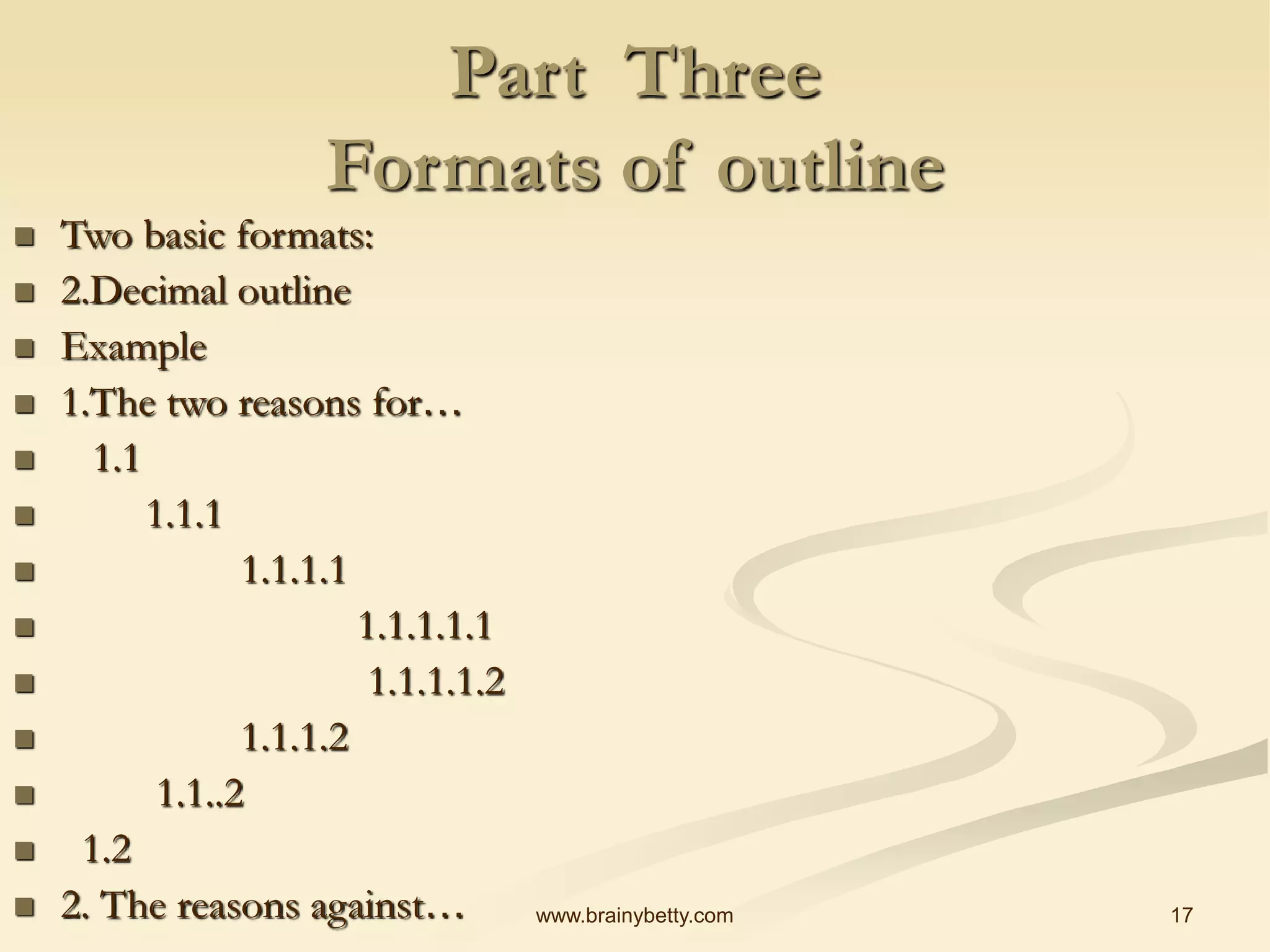
 2.Decimal outline
 Example
 1.The two reasons for…
 1.1
 1.1.1
 1.1.1.1
 1.1.1.1.1
 1.1.1.1.2
 1.1.1.2
 1.1..2
 1.2
 2. The reasons against…
18
www.brainybetty.com
Part Four
Convention and content of outline
 The most general convention of outlining is
to use a consistent form.
 1. Requirements
 1) Numbers and letters are used alternately.
 2) Symbol in an outline must always appear at
least in pairs.
 3) Every symbol in an outline is followed by a
period.
19
www.brainybetty.com
Part Four
Convention and content of outline
 1. Requirements
 4) Capitalize the first letter of the first
word after every symbol.
 5) Grammatically complete sentences
require normal sentence punctuation.
 6) All symbols of the same kind should be
in a vertical line.
 7) Begin succeeding lines of writing under
the start of the first word after a symbol.
 8) Type an outline in double spacing.
20
www.brainybetty.com
Part Four
Convention and content of outline
 2. Some guides for making the content of your outline
meaningful and therefore helpful to your writing:
 1) Every word in the outline should say something
about the content of your paper.
 2) The information for each subheading must be
directly related to, and subordinate to, the heading
under which it appears.
21
www.brainybetty.com
Part Four
Convention and content of outline
 3) Make relationships clear by using
the same symbol for ideas of equal
importance.
 4) Only principal points appear in an
outline.
22
www.brainybetty.com
Part Five
Preparing and using outline
 Using an outline can help you organize your
material and can also help you discover
connections between pieces of information
that you weren’t aware of when you first
conceived the plan of your paper.
 A working outline might be only an informal
list of topics and subtopics, which you are
thinking of covering in your paper.
23
www.brainybetty.com
Part Five
Preparing and using outline
 A final outline should enhance the organization and
coherence of your research paper.
 Outlines can be organized according to your
purposes.
 Chronology
 Cause and effect
 Defining or analyzing
 Comparing or contrasting
 Argument
24
www.brainybetty.com
Part Five
Preparing and using outline
 Useful principles for structuring a research paper :
 1.Chronology
 Explains each of the steps in a sequential ordered
process.
 Describes the significance of the research; the
problem to resolve; the result already made; the
process of the research work and the final result.
25
www.brainybetty.com
Part Five
Preparing and using outline
 2. Comparison and contrast
 --presenting the similarities or differences
between two or more things.
 3. Cause and effect
 --presenting the events or forces that produces
certain results or reporting controlled
experimentation to determine the factors
important to a particular outcome.
26
www.brainybetty.com
Part Five
Preparing and using outline
 4. Exemplification
 --often used in the thesis based on empirical
data or case study, presenting figures, tables or
numbers.
 5. Argumentation
 Five steps:
 The choice of the subject;
 The wording of the subject fit or argument
 The analysis of the subject into component parts
 The development of the argument
 The conclusion
27
www.brainybetty.com
Part Five
Preparing and using outline
 6. Analysis
 --a process of dividing a subject into its
parts and classifying them and
manifesting their respective features.
28
www.brainybetty.com
 Exercise:
 Organizing ideas and writing the outline

7236645.ppt

  • 1.
    Unit Five Organizing ideas andwriting the outline
  • 2.
    2 www.brainybetty.com Teaching Plan  I.The role of the outline  II. Types of outlines  III. Formats of outlines  IV. Convention and Content of outlines  V. Preparing and using outline  VI. Sample outlines
  • 3.
    3 www.brainybetty.com Part One Therole of the outline  1. Definition  An outline is an orderly plan, in writing, showing the division and arrangement of ideas.
  • 4.
    4 www.brainybetty.com Part One Therole of the outline  2. Purpose  To amplify the many ideas inherent in the thesis statement and to show their relationships, each to the others.
  • 5.
    5 www.brainybetty.com Part One Therole of the outline  3. The importance of outline  An outline is always written before the text of the paper.  1) Keeps ideas firmly in mind, even if writing the paper takes a long time,  2) Lets you rearrange ideas without difficultly,  3) Shows you how parts and transitions fit together, and
  • 6.
    6 www.brainybetty.com Part One Therole of the outline  3. The importance of outline  4) Exposes strengths and weaknesses in time to make adjustments before writing  When you write the paper, you need only follow the plan—outline you have made.
  • 7.
    7 www.brainybetty.com Part Two Typesof the outline  Two types  Preliminary outline  Formal outline  1. Preliminary outline (brainstorming ideas)  It will help organize your ideas and shape these ideas into the paper design.
  • 8.
    8 www.brainybetty.com Part Two Typesof the outline  2. Formal Outline  1) Definition  It is a diagram of the design of a paper, a bird’s eye view of its structure.  2) Composition  It may be composed of words and phrases, sentences, or a combination of the two.
  • 9.
    9 www.brainybetty.com Part Two Typesof the outline  2. Formal Outline  3) Kinds of formal outline  (1) Topic outline  (2) Sentence outline  (3) Paragraph outline  (4) Combination outline
  • 10.
    10 www.brainybetty.com Formal Outline  (1)Topic outline  It is widely used because the wording is brief.  Some tips in writing a topic outline:  Recall that all headings and subheadings must be words or phrases, not sentences.  Also, the wording within each division must be parallel.
  • 11.
    11 www.brainybetty.com Topic outline  Finally,as in any outline, remember that a division or subdivision cannot be divided into one part; therefore, if there is an "A" there must be a "B," and if there is a "1" there must be a "2."  Example
  • 12.
    12 www.brainybetty.com Sentence Outline  (2)Sentence Outline  It presents statements as grammatically complete sentences.  Some tips in writing a sentence outline.  If you have chosen to write a sentence outline, all headings and sub-headings must be in sentence form.
  • 13.
    13 www.brainybetty.com Sentence Outline  Asin any outline, remember that a division or subdivision can not be divided into one part; therefore, if there is an "A" there must be a "B," and if there is a "1" there must be a "2  Example
  • 14.
    14 www.brainybetty.com Paragraph outline  (3)Paragraph outline  It has the same symbols as topic and sentence outlines, but each symbol is followed by several sentences that make a paragraph.
  • 15.
    15 www.brainybetty.com  (4) Combinationoutline  The main topics are sentences and the subtopics are phrases.  Writing a sentence for each main topic may help you identify the central idea unifying that portion of the thesis.  Writing the subtopics as phrases enables you to determine their most logical relationship.
  • 16.
    16 www.brainybetty.com Part Three Formats ofoutline  Two basic formats:  1. Number-letter sequence  I. The two reasons for….  A. The first reason…  1.The women…  a. They could…  (1) The time..  (a)  i)  ii)  (b) 2. B….
  • 17.
    17 www.brainybetty.com Part Three Formats ofoutline  Two basic formats:  2.Decimal outline  Example  1.The two reasons for…  1.1  1.1.1  1.1.1.1  1.1.1.1.1  1.1.1.1.2  1.1.1.2  1.1..2  1.2  2. The reasons against…
  • 18.
    18 www.brainybetty.com Part Four Convention andcontent of outline  The most general convention of outlining is to use a consistent form.  1. Requirements  1) Numbers and letters are used alternately.  2) Symbol in an outline must always appear at least in pairs.  3) Every symbol in an outline is followed by a period.
  • 19.
    19 www.brainybetty.com Part Four Convention andcontent of outline  1. Requirements  4) Capitalize the first letter of the first word after every symbol.  5) Grammatically complete sentences require normal sentence punctuation.  6) All symbols of the same kind should be in a vertical line.  7) Begin succeeding lines of writing under the start of the first word after a symbol.  8) Type an outline in double spacing.
  • 20.
    20 www.brainybetty.com Part Four Convention andcontent of outline  2. Some guides for making the content of your outline meaningful and therefore helpful to your writing:  1) Every word in the outline should say something about the content of your paper.  2) The information for each subheading must be directly related to, and subordinate to, the heading under which it appears.
  • 21.
    21 www.brainybetty.com Part Four Convention andcontent of outline  3) Make relationships clear by using the same symbol for ideas of equal importance.  4) Only principal points appear in an outline.
  • 22.
    22 www.brainybetty.com Part Five Preparing andusing outline  Using an outline can help you organize your material and can also help you discover connections between pieces of information that you weren’t aware of when you first conceived the plan of your paper.  A working outline might be only an informal list of topics and subtopics, which you are thinking of covering in your paper.
  • 23.
    23 www.brainybetty.com Part Five Preparing andusing outline  A final outline should enhance the organization and coherence of your research paper.  Outlines can be organized according to your purposes.  Chronology  Cause and effect  Defining or analyzing  Comparing or contrasting  Argument
  • 24.
    24 www.brainybetty.com Part Five Preparing andusing outline  Useful principles for structuring a research paper :  1.Chronology  Explains each of the steps in a sequential ordered process.  Describes the significance of the research; the problem to resolve; the result already made; the process of the research work and the final result.
  • 25.
    25 www.brainybetty.com Part Five Preparing andusing outline  2. Comparison and contrast  --presenting the similarities or differences between two or more things.  3. Cause and effect  --presenting the events or forces that produces certain results or reporting controlled experimentation to determine the factors important to a particular outcome.
  • 26.
    26 www.brainybetty.com Part Five Preparing andusing outline  4. Exemplification  --often used in the thesis based on empirical data or case study, presenting figures, tables or numbers.  5. Argumentation  Five steps:  The choice of the subject;  The wording of the subject fit or argument  The analysis of the subject into component parts  The development of the argument  The conclusion
  • 27.
    27 www.brainybetty.com Part Five Preparing andusing outline  6. Analysis  --a process of dividing a subject into its parts and classifying them and manifesting their respective features.
  • 28.