Research Paper:
The Outline
Making an Outline
 Writing an outline in addition to the paper
may seem like a lot of extra work,
especially if your teacher doesn't require
one. If you take the time to think about
what you want to say and to put your ideas
into an outline, writing the actual paper will
be easier. An outline is a listing of brief
ideas that will be in the paper.
Four Main Components for Effective
Outlines
 Parallelism
 Coordination
 Subordination
 Division
Parallelism
How do I accomplish this?
 Each heading and subheading should
preserve parallel structure. If the first
heading is a noun, the second heading
should be a noun. Example:
1. Choose Desired Colleges
2. Prepare Application
 ("Choose" and "Prepare" are both verbs.)
Coordination
How do I accomplish this?
 All the information contained in Heading 1 should have
the same significance as the information contained in
Heading 2. The same goes for the subheadings (which
should be less significant than the headings). Example:
1. Visit and evaluate college campuses
2. Visit and evaluate college websites
1. Note important statistics
2. Look for interesting classes
 (Campus and websites visits are equally significant, as
are statistics and classes found on college websites.)
Subordination
How do I accomplish this?
 The information in the headings should be more
general, while the information in the
subheadings should be more specific. Example:
1. Describe an influential person in your life
1. Favorite high school teacher
2. Grandparent
 (A favorite teacher and grandparent are specific
examples of influential people.)
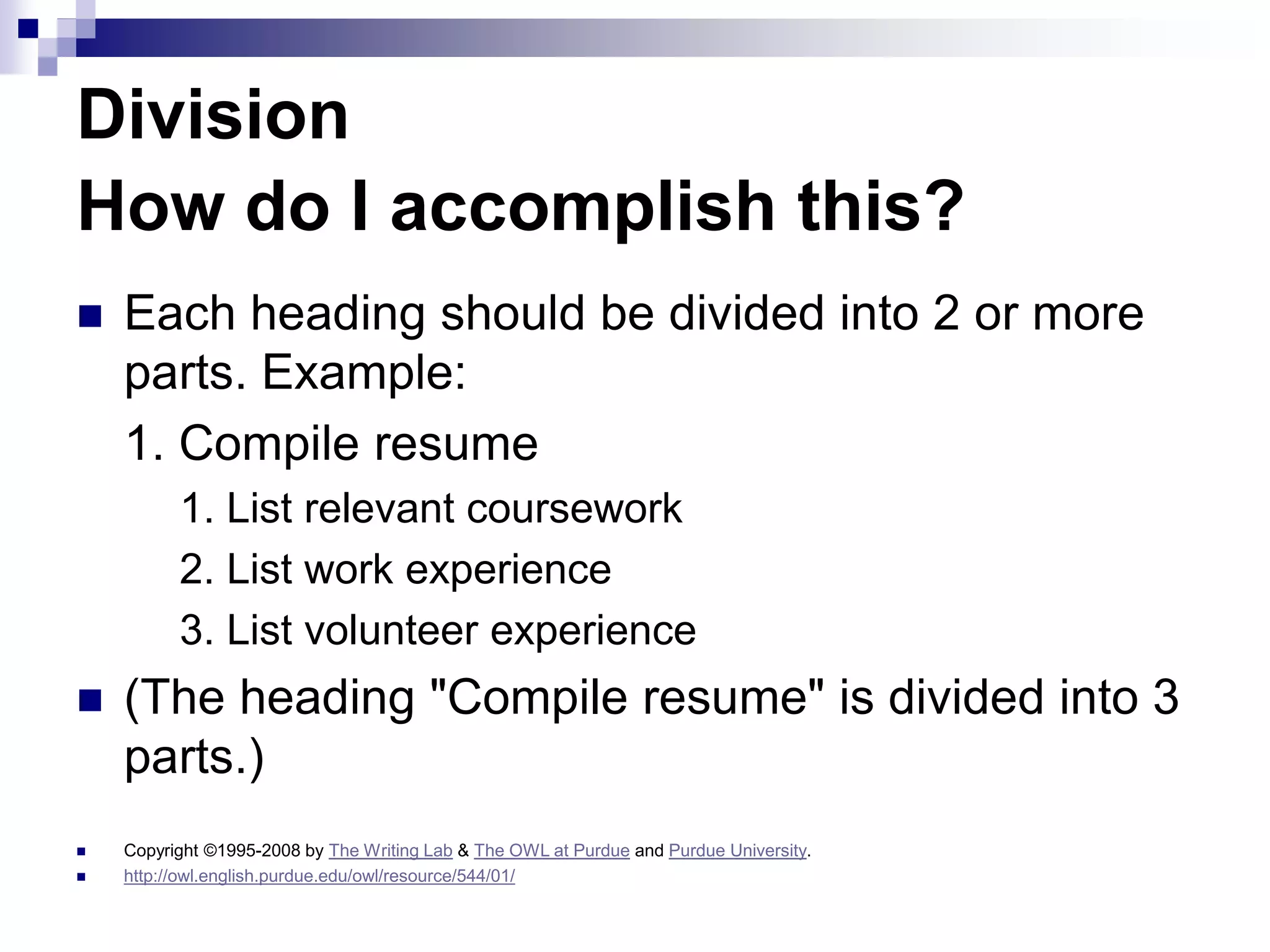
Division
How do I accomplish this?
 Each heading should be divided into 2 or more
parts. Example:
1. Compile resume
1. List relevant coursework
2. List work experience
3. List volunteer experience
 (The heading "Compile resume" is divided into 3
parts.)
 Copyright ©1995-2008 by The Writing Lab & The OWL at Purdue and Purdue University.
 http://owl.english.purdue.edu/owl/resource/544/01/
Why create an outline?
 Aids in the process of writing
 Helps you organize your ideas
 Presents your material in a logical form
 Shows the relationships among ideas in your
writing
 Constructs an ordered overview of your writing
 Defines boundaries and groups
How do I create an outline?
 Determine the purpose of your paper.
 Determine the audience you are writing
for.
 Develop the thesis of your paper.
Then:
 Brainstorm: List all the ideas that you
want to include in your paper.
 Organize: Group related ideas together.
 Order: Arrange material in subsections
from general to specific or from abstract to
concrete.
 Label: Create main and sub headings.
 Remember: creating an outline before writing
your paper will make organizing your thoughts a
lot easier.
 Copyright ©1995-2008 by The Writing Lab & The OWL at Purdue and Purdue University
 http://owl.english.purdue.edu/owl/resource/544/02/
Alphanumeric outlines
 An alphanumeric outline uses Roman
numerals, capitalized letters, Arabic
numerals, and lowercase letters, in that
order. Each numeral or letter is followed by
a period, and each item is capitalized:
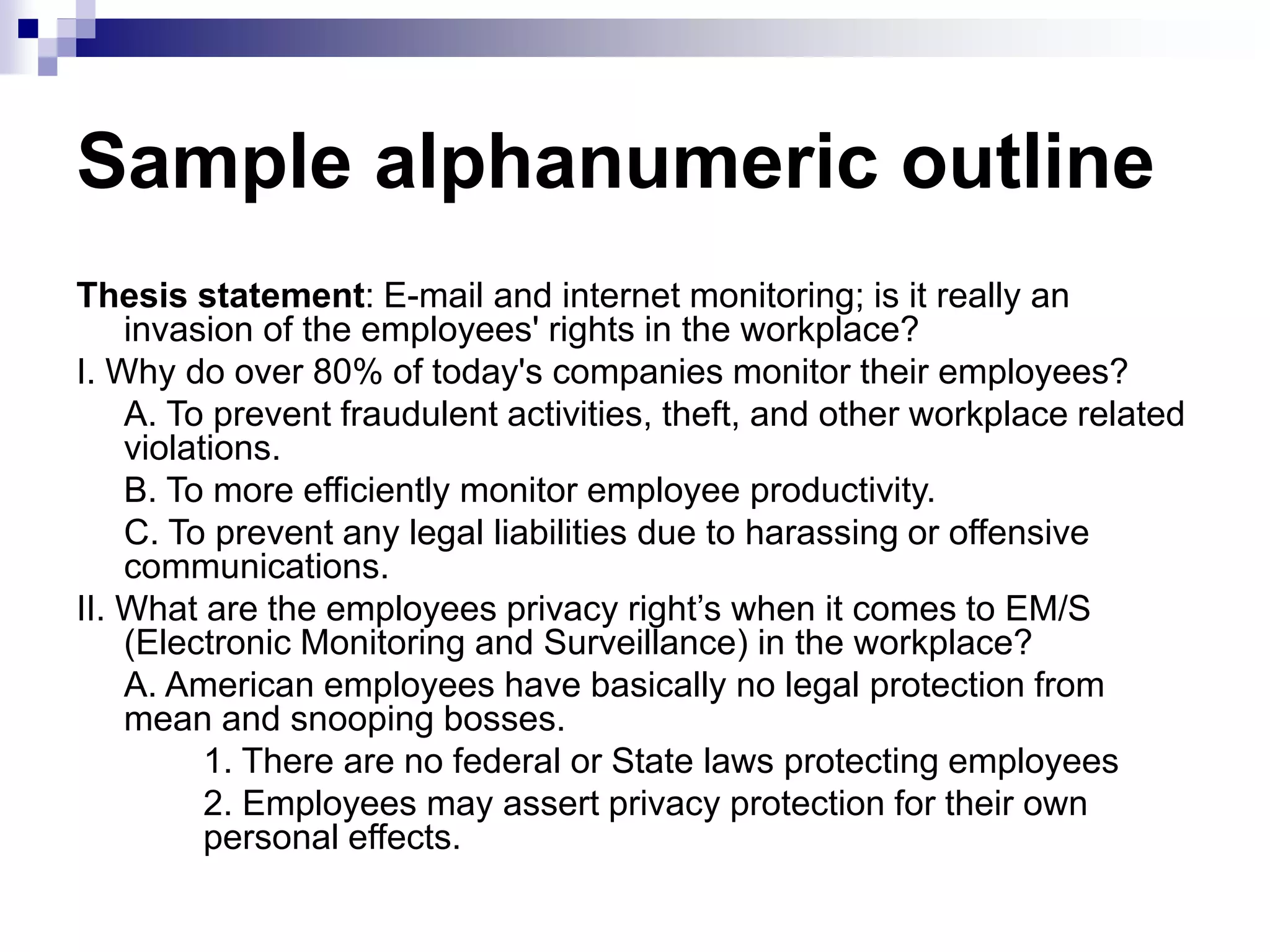
Sample alphanumeric outline
Thesis statement: E-mail and internet monitoring; is it really an
invasion of the employees' rights in the workplace?
I. Why do over 80% of today's companies monitor their employees?
A. To prevent fraudulent activities, theft, and other workplace related
violations.
B. To more efficiently monitor employee productivity.
C. To prevent any legal liabilities due to harassing or offensive
communications.
II. What are the employees privacy right’s when it comes to EM/S
(Electronic Monitoring and Surveillance) in the workplace?
A. American employees have basically no legal protection from
mean and snooping bosses.
1. There are no federal or State laws protecting employees
2. Employees may assert privacy protection for their own
personal effects.
 Note that each category above has at
least two subcategories.
 "Outline." Wikipedia, The Free Encyclopedia. 21 Oct 2008, 21:24 UTC. 22 Oct 2008
<http://en.wikipedia.org/w/index.php?title=Outline&oldid=246808930>.
BASIC OUTLINE FORM
I. MAIN IDEA
A. Subsidiary idea or supporting idea to I
B. Subsidiary idea or supporting idea to I
1. Subsidiary idea to B
2. Subsidiary idea to B
a) Subsidiary idea to 2
b) Subsidiary idea to 2
II. MAIN IDEA
A. Subsidiary or supporting idea to II
B. Subsidiary idea to II
C. Subsidiary idea to II
III. MAIN IDEA
IMPORTANT!!!
 It is up to the writer to decide on how
many main ideas and supporting ideas
adequately describe the subject.
 However, if there is a I in the outline,
there has to be a II; if there is an A,
there has to be a B; if there is a 1, there
has to be a 2, and so forth.
 http://www.lib.jjay.cuny.edu/research/outlining.html
Outlines provide a summary
showing the logical flow of a paper.
 They are useful because:
 help the writer organize their thoughts before getting
bogged down in word choice and sentence
structure;
 show which ideas need illustration or elaboration;
and
 help the writer decide on an organizational
technique for the report, whether it be logical,
chronological, or categorical in nature.
Preparing and Using Outlines
 Using an outline can help you organize your
material and can also help you discover
connections between pieces of information that
you weren't aware of when you first conceived
the plan of your paper.
 It can also make you aware of material that is
not really relevant to the purposes of your paper
or material that you have covered before and
should therefore be removed.
The Working Outline
 A Working Outline might be only an informal list of
topics and subtopics which you are thinking of covering
in your paper.
 The working outline can be revised as you discover new
material and get new ideas that ought to go into your
paper.
 Most word processing programs have outlining features
with automatic formatting that make it easy to create and
revise outlines.
 It is a good idea to keep copies of old outlines in a
computer folder in case new versions of the outline lead
you in false directions that you will later have to
abandon.
The Final Outline
 A Final Outline should enhance the
organization and coherence of your research
paper.
 Material that is not relevant to the purpose of
your paper as revealed in your outline should be
excised from the paper; if portions of your outline
seem weak in comparison to others, more
research may be required to create a sense of
balance in your argument and presentation.
 Try to bring related material together under
general headings and arrange sections so they
relate logically to each other.
 An effective introduction will map out the journey
your reader is about to take, and a satisfactory
conclusion will wrap up the sequence of ideas in
a nice package.
Topic Outlines vs. Sentence
Outlines
 A final outline can be written as a topic
outline, in which you use only short
phrases to suggest ideas, or as a
sentence outline, in which you use full
sentences (even very brief paragraphs) to
show the development of ideas more fully.

Research Paper Outline.ppt

  • 1.
  • 2.
    Making an Outline Writing an outline in addition to the paper may seem like a lot of extra work, especially if your teacher doesn't require one. If you take the time to think about what you want to say and to put your ideas into an outline, writing the actual paper will be easier. An outline is a listing of brief ideas that will be in the paper.
  • 3.
    Four Main Componentsfor Effective Outlines  Parallelism  Coordination  Subordination  Division
  • 4.
    Parallelism How do Iaccomplish this?  Each heading and subheading should preserve parallel structure. If the first heading is a noun, the second heading should be a noun. Example: 1. Choose Desired Colleges 2. Prepare Application  ("Choose" and "Prepare" are both verbs.)
  • 5.
    Coordination How do Iaccomplish this?  All the information contained in Heading 1 should have the same significance as the information contained in Heading 2. The same goes for the subheadings (which should be less significant than the headings). Example: 1. Visit and evaluate college campuses 2. Visit and evaluate college websites 1. Note important statistics 2. Look for interesting classes  (Campus and websites visits are equally significant, as are statistics and classes found on college websites.)
  • 6.
    Subordination How do Iaccomplish this?  The information in the headings should be more general, while the information in the subheadings should be more specific. Example: 1. Describe an influential person in your life 1. Favorite high school teacher 2. Grandparent  (A favorite teacher and grandparent are specific examples of influential people.)
  • 7.
    Division How do Iaccomplish this?  Each heading should be divided into 2 or more parts. Example: 1. Compile resume 1. List relevant coursework 2. List work experience 3. List volunteer experience  (The heading "Compile resume" is divided into 3 parts.)  Copyright ©1995-2008 by The Writing Lab & The OWL at Purdue and Purdue University.  http://owl.english.purdue.edu/owl/resource/544/01/
  • 8.
    Why create anoutline?  Aids in the process of writing  Helps you organize your ideas  Presents your material in a logical form  Shows the relationships among ideas in your writing  Constructs an ordered overview of your writing  Defines boundaries and groups
  • 9.
    How do Icreate an outline?  Determine the purpose of your paper.  Determine the audience you are writing for.  Develop the thesis of your paper.
  • 10.
    Then:  Brainstorm: Listall the ideas that you want to include in your paper.  Organize: Group related ideas together.  Order: Arrange material in subsections from general to specific or from abstract to concrete.  Label: Create main and sub headings.
  • 11.
     Remember: creatingan outline before writing your paper will make organizing your thoughts a lot easier.  Copyright ©1995-2008 by The Writing Lab & The OWL at Purdue and Purdue University  http://owl.english.purdue.edu/owl/resource/544/02/
  • 12.
    Alphanumeric outlines  Analphanumeric outline uses Roman numerals, capitalized letters, Arabic numerals, and lowercase letters, in that order. Each numeral or letter is followed by a period, and each item is capitalized:
  • 13.
    Sample alphanumeric outline Thesisstatement: E-mail and internet monitoring; is it really an invasion of the employees' rights in the workplace? I. Why do over 80% of today's companies monitor their employees? A. To prevent fraudulent activities, theft, and other workplace related violations. B. To more efficiently monitor employee productivity. C. To prevent any legal liabilities due to harassing or offensive communications. II. What are the employees privacy right’s when it comes to EM/S (Electronic Monitoring and Surveillance) in the workplace? A. American employees have basically no legal protection from mean and snooping bosses. 1. There are no federal or State laws protecting employees 2. Employees may assert privacy protection for their own personal effects.
  • 14.
     Note thateach category above has at least two subcategories.  "Outline." Wikipedia, The Free Encyclopedia. 21 Oct 2008, 21:24 UTC. 22 Oct 2008 <http://en.wikipedia.org/w/index.php?title=Outline&oldid=246808930>.
  • 15.
    BASIC OUTLINE FORM I.MAIN IDEA A. Subsidiary idea or supporting idea to I B. Subsidiary idea or supporting idea to I 1. Subsidiary idea to B 2. Subsidiary idea to B a) Subsidiary idea to 2 b) Subsidiary idea to 2 II. MAIN IDEA A. Subsidiary or supporting idea to II B. Subsidiary idea to II C. Subsidiary idea to II III. MAIN IDEA
  • 16.
    IMPORTANT!!!  It isup to the writer to decide on how many main ideas and supporting ideas adequately describe the subject.  However, if there is a I in the outline, there has to be a II; if there is an A, there has to be a B; if there is a 1, there has to be a 2, and so forth.  http://www.lib.jjay.cuny.edu/research/outlining.html
  • 17.
    Outlines provide asummary showing the logical flow of a paper.  They are useful because:  help the writer organize their thoughts before getting bogged down in word choice and sentence structure;  show which ideas need illustration or elaboration; and  help the writer decide on an organizational technique for the report, whether it be logical, chronological, or categorical in nature.
  • 18.
    Preparing and UsingOutlines  Using an outline can help you organize your material and can also help you discover connections between pieces of information that you weren't aware of when you first conceived the plan of your paper.  It can also make you aware of material that is not really relevant to the purposes of your paper or material that you have covered before and should therefore be removed.
  • 19.
    The Working Outline A Working Outline might be only an informal list of topics and subtopics which you are thinking of covering in your paper.  The working outline can be revised as you discover new material and get new ideas that ought to go into your paper.  Most word processing programs have outlining features with automatic formatting that make it easy to create and revise outlines.  It is a good idea to keep copies of old outlines in a computer folder in case new versions of the outline lead you in false directions that you will later have to abandon.
  • 20.
    The Final Outline A Final Outline should enhance the organization and coherence of your research paper.  Material that is not relevant to the purpose of your paper as revealed in your outline should be excised from the paper; if portions of your outline seem weak in comparison to others, more research may be required to create a sense of balance in your argument and presentation.
  • 21.
     Try tobring related material together under general headings and arrange sections so they relate logically to each other.  An effective introduction will map out the journey your reader is about to take, and a satisfactory conclusion will wrap up the sequence of ideas in a nice package.
  • 22.
    Topic Outlines vs.Sentence Outlines  A final outline can be written as a topic outline, in which you use only short phrases to suggest ideas, or as a sentence outline, in which you use full sentences (even very brief paragraphs) to show the development of ideas more fully.