Reading
and
Writing
Prepared by: Neftali F. Somintac
TEXT AS
CONNECTED
DISCOURSE
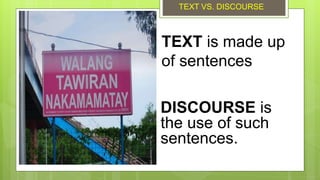
TEXT is made up
of sentences
DISCOURSE is
the use of such
sentences.
TEXT VS. DISCOURSE
TEXT is defined in terms of its being a
physical product.
Meaning is not found in text.
DISCOURSE is viewed as a process.
Meaning is derived through the reader’s
interaction with the text --> discourse.
TEXT VS. DISCOURSE
A discourse is a formal and often
lengthy discussion of a topic, where
concepts and insights are arranged in
an organized and logical manner. Also,
it refers to the way how language is
used to convey meanings or to propel
action or provoke a specific response.
TEXT VS. DISCOURSE
It is often associated with
speech, but it may also be written.
It usually serves as a writer’s or a
scholar’s analysis of a concept or
theory proposed by another writer.
TEXT VS. DISCOURSE
Morphology
- the study of words, how they are
formed, and their relationship to other
words in the same language
- analyzes the structure of words and
parts of words, such as root words,
prefixes, and suffixes
Morpheme
- the smallest grammatical unit in
a language
Two Types of Morpheme:
1. Free Morpheme
2. Bound Morpheme
1. Free Morpheme
- can function independently as
a word
Examples: house, cat, blood
2. Bound Morpheme
- a word element attached to a root word
(the main part of a word) to give it another
meaning
- cannot function independently as a word
Examples: affixes (prefixes and suffixes)
Affix
- a morpheme that is attached
to a root word to
form a new word
1. Prefix
2. Suffix
Prefix
- a morpheme that comes before
a root word
Examples:
auto- (automobile)
in - (incorrect)
over- (overcharge)
Suffix
- a morpheme that comes after a
root word
Examples:
-ful (forgetful)
-ish (childish)
-ive (active)
WHAT MAKES TEXT
A CONNECTED
DISCOURSE?
TEXT BECOMES A
CONNECTED
DISCOURSE
WHEN WE READ 
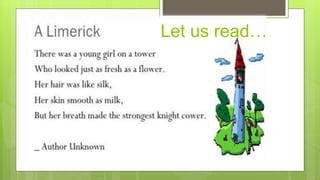
Let us read…
What is reading?
READING is a cognitive process of
decoding symbols to derive meaning
from a text.
It is always an interaction between
the text and the reader.
We read to gain and share
information and ideas,
whether for academic,
personal, or
professional purposes.
EFFECTIVE READING
STRATEGIES
Previewing means looking at the
readily visible parts of the text.
It helps familiarize you with the
contents of the selection and focus on
the important information in the text.
Skimming the text means
you look for the main point
of the reading and identify
the ideas that develop it.
Scanning the reading is looking
for specific information.
This strategy involves physically
moving your eyes quickly along
the lines of text.
Purposes of Discourse
1. To inform – A discourse that aims to inform provides
a descriptive and comprehensive discussion on the
topic. It points out what one should know about a topic
or subject.
2. To persuade – A discourse that aims to persuade
tries to convince the readers that the proposed claim or
solution is better than any other proposal.
3. To entertain – A discourse that aims to amuse
provides a source of entertainment for its readers.
TECHNIQUES IN
ORGANIZING
INFORMATION
Check your knowledge…
How do you
organize your
ideas?
Write the ideas that
would occur in your
mind about “gadgets”.
Techniques are approaches or
methods you as a writer may use
to organize the information you
have gathered, to accomplish your
desired aim in writing and to
improve your writing craft.
BASIC
TECHNIQUES
IN ORGANIZING
INFORMATION
BRAINSTORMING
It is a group creativity
technique by which efforts are made to
find a conclusion for a specific problem
by gathering a list of ideas
spontaneously contributed by its
members.
The term was popularized by Alex
Faickney Osborn in the1953 book
Applied Imagination.
He developed this technique when he
got frustrated that his employees could
not come up with useful techniques as
they worked individually.
BRAINSTORMING
(4) FOUR
BRAINSTORMING
TIPS SUGGESTED BY
MARK NICHOL IN DAILY
WRITING TIPS
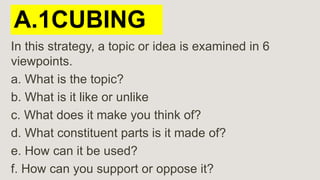
A.1CUBING
In this strategy, a topic or idea is examined in 6
viewpoints.
a. What is the topic?
b. What is it like or unlike
c. What does it make you think of?
d. What constituent parts is it made of?
e. How can it be used?
f. How can you support or oppose it?
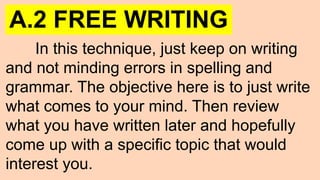
A.2 FREE WRITING
In this technique, just keep on writing
and not minding errors in spelling and
grammar. The objective here is to just write
what comes to your mind. Then review
what you have written later and hopefully
come up with a specific topic that would
interest you.
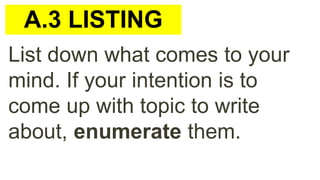
List down what comes to your
mind. If your intention is to
come up with topic to write
about, enumerate them.
A.3 LISTING
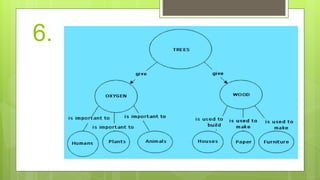
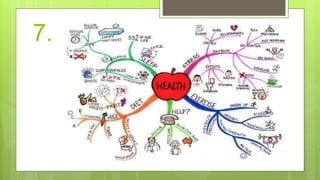
Mapping, also known as clustering and
webbing, is a graphic form of listing that simply
involves jotting down ideas on a large writing
surface and then making connections by
associating similarly themed ideas with color-
coded circles or underlines of distinct patterns
and then indicating other relationships by linking
with lines.
A.4 MAPPING
B. Graphic Organizer
C. Outline
1. ________are approaches or
methods you as a writer may use
to organize the information you
have gathered, to accomplish your
desired aim in writing and to
improve your writing craft.
Q#2RW110918
2. ____________ is a
technique in organizing
information which refers to the
general plan of what you
intend to write.
Q#2RW110918
3. It is a group creativity technique
by which efforts are made to find a
conclusion for a specific problem
by gathering a list of ideas
spontaneously contributed by its
members.
Q#2RW110918
4. _______is a communication
tool that uses visual symbols to
express knowledge, concepts,
thoughts and ideas and the
relationship between them.
Q#2RW110918
5. Who popularized the
term “brainstorming” in his
book, Applied Imagination
in 1953?
6.
7.
8.
9.
10.
11.
12. It is a form of outline that
uses parallel phrases for the
heading all throughout.
13. It is a form of outline
that uses sentences for
the heading all
throughout.
14-15
Enumerate the (2) two
formats of outlining
What is critical reading?
“Critical” is not intended to
have a negative meaning in
the context of “critical
reading.”
Definition:
An active approach to
reading that involves an in
depth examination of the
text.
Memorization and understanding of
the text is achieved.
Additionally, the text is broken down
into its components and examined
critically in order to achieve a
meaningful understanding of the
material.
Goals of Critical Reading
1. to recognize an author’s
purpose
2. to understand tone and
persuasive elements
3. to recognize bias
What is the difference
between restatement
and inferences?
Non-critical reading is satisfied with
recognizing what a text says and
restating the key remarks.
What a text says – restatement
What a text does – description
What a text means – inference
Infer (verb)
:to form (an opinion) from evidence
: to reach (a conclusion) based on
known facts
: to hint or suggest (something)
“The Senator
admitted owning the
gun that killed his
wife.”
What can be inferred from this statement?
There is a Senator.
He owns a gun.
He is married.
His wife is dead.
That gun caused her death.
The Senator admitted owning that gun.
Now, what can’t be inferred?
We do not necessarily know if the Senator's
admission is true.
We do not really know whether the Senator is in
any way responsible for his wife's death, nor do
we know that she died of gun shot wounds.
We do not even know if it was murder—it might
have been suicide or an accident.
Fact or Bluff
You are taller in the morning than in the
evening.
Fact or Bluff
FACT BLUFF
As we go through the day, the cartilage in our
knees and spine slowly compresses causing us to
shrink a little. When we sleep at night the cartilage
has a chance to rest and goes back to its normal
size. On average we are about 1cm taller in the
morning than we are at night.
Fact or Bluff
CORRECT
Fact or Bluff
TRY AGAIN
In ancient Greece, throwing an apple at someone was
done to declare one’s love.
Fact or Bluff
FACT BLUFF
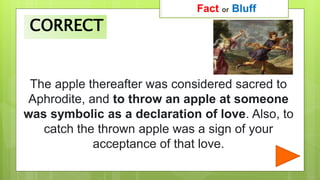
The apple thereafter was considered sacred to
Aphrodite, and to throw an apple at someone
was symbolic as a declaration of love. Also, to
catch the thrown apple was a sign of your
acceptance of that love.
Fact or Bluff
CORRECT
Fact or Bluff
TRY AGAIN
The Philippine flag was sewn in the
Philippines.
Fact or Bluff
FACT BLUFF
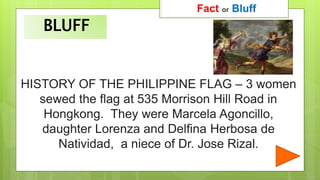
HISTORY OF THE PHILIPPINE FLAG – 3 women
sewed the flag at 535 Morrison Hill Road in
Hongkong. They were Marcela Agoncillo,
daughter Lorenza and Delfina Herbosa de
Natividad, a niece of Dr. Jose Rizal.
Fact or Bluff
BLUFF
Fact or Bluff
TRY AGAIN
Learning Objectives:
 1. Establish self-esteem and sportsmanship by
participating in the provided activities relevant to the
lesson; and
 2. Identifies claims explicitly or implicitly made in a
written text.
a. Claim of Fact, b. Claim of Policy, c. Claim of Value
 3. Make use of the different types of claims by
employing it to each group/individual tasks
Reading is an ACTIVE skill.
Active reading simply means reading something
with a determination to understand and
evaluate it for its relevance to your needs.
Simply reading and re-reading the material isn't an
effective way to understand and learn. Actively and
critically engaging with the content can save you
time.
CLAIMS
 A claim is a central idea.
 What the writer tries to prove in the in
the text by providing details,
explanations, and other types of
evidence.
CLAIMS
 A sentence that summarizes the
most important thing that the
writer wants to convey as a result
of thinking, reading, or writing.
Characteristics of GOOD claim
1. A claim should
be argumentative and debatable.
Example.
Men are better in Math than women.
Characteristics of GOOD claim
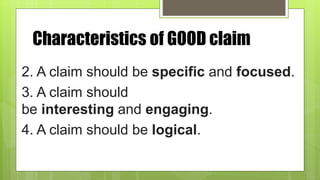
2. A claim should be specific and focused.
3. A claim should
be interesting and engaging.
4. A claim should be logical.
Types of Claims
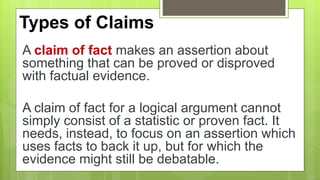
A claim of fact makes an assertion about
something that can be proved or disproved
with factual evidence.
A claim of fact for a logical argument cannot
simply consist of a statistic or proven fact. It
needs, instead, to focus on an assertion which
uses facts to back it up, but for which the
evidence might still be debatable.
Claim of fact
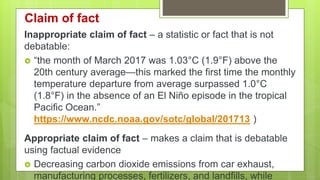
Inappropriate claim of fact – a statistic or fact that is not
debatable:
 “the month of March 2017 was 1.03°C (1.9°F) above the
20th century average—this marked the first time the monthly
temperature departure from average surpassed 1.0°C
(1.8°F) in the absence of an El Niño episode in the tropical
Pacific Ocean.”
https://www.ncdc.noaa.gov/sotc/global/201713 )
Appropriate claim of fact – makes a claim that is debatable
using factual evidence
 Decreasing carbon dioxide emissions from car exhaust,
manufacturing processes, fertilizers, and landfills, while
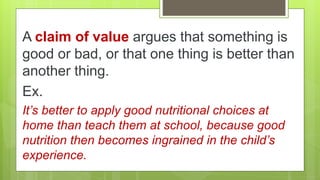
A claim of value argues that something is
good or bad, or that one thing is better than
another thing.
Ex.
It’s better to apply good nutritional choices at
home than teach them at school, because good
nutrition then becomes ingrained in the child’s
experience.
A claim of policy argues that certain conditions
should exist, or that something should or should
not be done, in order to solve a problem.
Example:
Students in the Philippines should join
mandatory ROTC.
Increasing population threatens the
environment.
Students grades are definite measures of their
achievement.
Viewing television is a wasteful activity
The death penalty should be implemented
again.
1.Vaping can lead to increased blood
pressure, lung disease, and insulin
resistance.
2.The basic keys to success are
perseverance and discipline.
3.Studies have shown that exposure to
violent media is a risk factor for violent
To strengthen your understanding of types of claims, take this nine question self-test.
4. The Career Support Network is an excellent
resource for people who are considering a mid-life
career change.
5. In order to insure that graduates are competitive
for top jobs in their fields, the college must put
additional resources into its career services office
and internship programs.
6. Although the International Astronomical Union
announced that Pluto is not actually a planet,
7. Increased investments in solar power will benefit
national security by reducing dependence on fossil
fuels.
8. Parents should not only be aware of how their
children are using social media, but also understand
the potential positive and negative impacts of social
media use.
9. Advances in computer modeling have made it
possible to create completely new types of
To strengthen your understanding of types of claims, take this nine question self-test.
KEYPOINTS
No matter the type of claim, you will
usually combine many types of support
for that claim in order to write a logical
argument, including facts, case studies,
reasons, personal interviews, and more,
as appropriate.
AGREEMENT:
Learners will look for (a) statement/s
from facebook from various sources
and identify what type of claim it is.
Don’t forget to take a screenshots.
Claims…
Central idea or the author’s statements.
Types of Claims
 Claim of Fact
 Claim of Value
 Claim of Policy
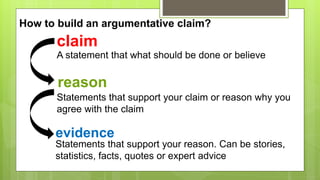
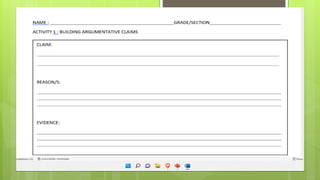
claim
A statement that what should be done or believe
reason
evidence
Statements that support your claim or reason why you
agree with the claim
Statements that support your reason. Can be stories,
statistics, facts, quotes or expert advice
How to build an argumentative claim?
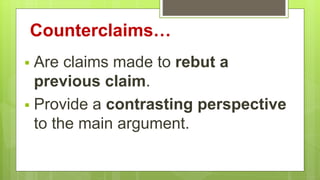
Counterclaims…
 Are claims made to rebut a
previous claim.
 Provide a contrasting perspective
to the main argument.
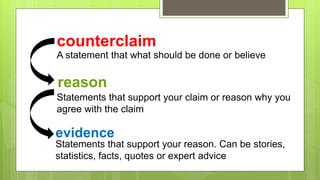
counterclaim
A statement that what should be done or believe
reason
evidence
Statements that support your claim or reason why you
agree with the claim
Statements that support your reason. Can be stories,
statistics, facts, quotes or expert advice
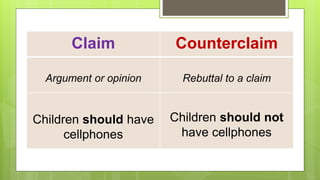
Claim Counterclaim
Argument or opinion Rebuttal to a claim
Children should have
cellphones
Children should not
have cellphones
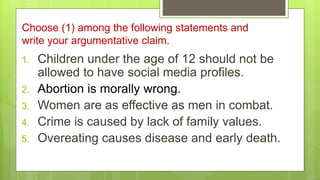
Choose (1) among the following statements and
write your argumentative claim.
1. Children under the age of 12 should not be
allowed to have social media profiles.
2. Abortion is morally wrong.
3. Women are as effective as men in combat.
4. Crime is caused by lack of family values.
5. Overeating causes disease and early death.
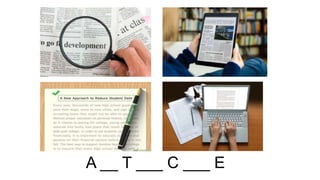
A __ T ___ C ___ E
A R T I C L E
R __ V ___ E ___
R E V I E W
At the end of the lesson, learners must be able to:
1. Define what an article review is
2. Understand the simple format and steps in writing
3. Craft a simple written article review by answering guide
questions to develop critical reasoning and higher order
thinking skills.
4. Understand the importance or purpose of writing a
review
ES
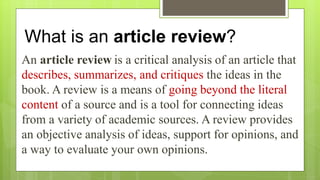
What is an article review?
An article review is a critical analysis of an article that
describes, summarizes, and critiques the ideas in the
book. A review is a means of going beyond the literal
content of a source and is a tool for connecting ideas
from a variety of academic sources. A review provides
an objective analysis of ideas, support for opinions, and
a way to evaluate your own opinions.
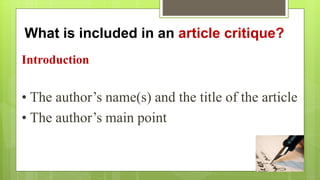
What is included in an article critique?
Introduction
• The author’s name(s) and the title of the article
• The author’s main point
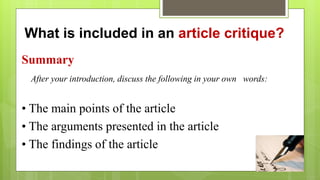
What is included in an article critique?
Summary
After your introduction, discuss the following in your own words:
• The main points of the article
• The arguments presented in the article
• The findings of the article
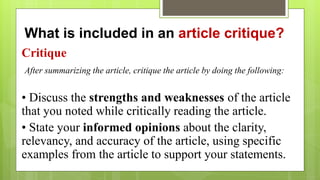
What is included in an article critique?
Critique
After summarizing the article, critique the article by doing the following:
• Discuss the strengths and weaknesses of the article
that you noted while critically reading the article.
• State your informed opinions about the clarity,
relevancy, and accuracy of the article, using specific
examples from the article to support your statements.
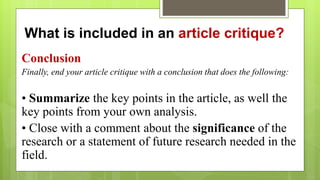
What is included in an article critique?
Conclusion
Finally, end your article critique with a conclusion that does the following:
• Summarize the key points in the article, as well the
key points from your own analysis.
• Close with a comment about the significance of the
research or a statement of future research needed in the
field.
Writing an interesting and well-structured
article review is not easy, as it requires
you to find an article in a reliable source,
read it thoroughly, evaluate the discussed
information, and consider possible
limitations.
GENERALIZATION
In addition, writing an article review
requires you to utilize a set of writing and
analytical skills, arrange the paper according
to instructions, and meet all the
requirements of the professor or a teacher.
At the same time, writing an article review
allows discovering a lot of interesting and
important information, comparing with the
other sources, and define its scientific and
academic value.
The author’s view in this article is to ____________.
From this article, the lawyer, __________ favors the use
_____________.
The author’s view in this article is to ____________.
From this article, the lawyer, __________ favors the use
_____________.
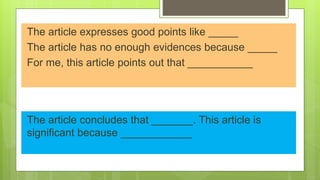
The article expresses good points like _____
The article has no enough evidences because _____
For me, this article points out that ___________
The article concludes that _______. This article is
significant because ____________
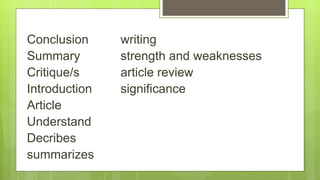
Conclusion writing
Summary strength and weaknesses
Critique/s article review
Introduction significance
Article
Understand
Decribes
summarizes

READING AND WRITING PPT.pptx

  • 1.
  • 2.
  • 3.
    TEXT is madeup of sentences DISCOURSE is the use of such sentences. TEXT VS. DISCOURSE
  • 4.
    TEXT is definedin terms of its being a physical product. Meaning is not found in text. DISCOURSE is viewed as a process. Meaning is derived through the reader’s interaction with the text --> discourse. TEXT VS. DISCOURSE
  • 5.
    A discourse isa formal and often lengthy discussion of a topic, where concepts and insights are arranged in an organized and logical manner. Also, it refers to the way how language is used to convey meanings or to propel action or provoke a specific response. TEXT VS. DISCOURSE
  • 6.
    It is oftenassociated with speech, but it may also be written. It usually serves as a writer’s or a scholar’s analysis of a concept or theory proposed by another writer. TEXT VS. DISCOURSE
  • 7.
    Morphology - the studyof words, how they are formed, and their relationship to other words in the same language - analyzes the structure of words and parts of words, such as root words, prefixes, and suffixes
  • 8.
    Morpheme - the smallestgrammatical unit in a language Two Types of Morpheme: 1. Free Morpheme 2. Bound Morpheme
  • 9.
    1. Free Morpheme -can function independently as a word Examples: house, cat, blood
  • 10.
    2. Bound Morpheme -a word element attached to a root word (the main part of a word) to give it another meaning - cannot function independently as a word Examples: affixes (prefixes and suffixes)
  • 11.
    Affix - a morphemethat is attached to a root word to form a new word 1. Prefix 2. Suffix
  • 12.
    Prefix - a morphemethat comes before a root word Examples: auto- (automobile) in - (incorrect) over- (overcharge)
  • 13.
    Suffix - a morphemethat comes after a root word Examples: -ful (forgetful) -ish (childish) -ive (active)
  • 14.
    WHAT MAKES TEXT ACONNECTED DISCOURSE?
  • 15.
  • 16.
  • 17.
    What is reading? READINGis a cognitive process of decoding symbols to derive meaning from a text. It is always an interaction between the text and the reader.
  • 18.
    We read togain and share information and ideas, whether for academic, personal, or professional purposes.
  • 19.
    EFFECTIVE READING STRATEGIES Previewing meanslooking at the readily visible parts of the text. It helps familiarize you with the contents of the selection and focus on the important information in the text.
  • 20.
    Skimming the textmeans you look for the main point of the reading and identify the ideas that develop it.
  • 21.
    Scanning the readingis looking for specific information. This strategy involves physically moving your eyes quickly along the lines of text.
  • 22.
    Purposes of Discourse 1.To inform – A discourse that aims to inform provides a descriptive and comprehensive discussion on the topic. It points out what one should know about a topic or subject. 2. To persuade – A discourse that aims to persuade tries to convince the readers that the proposed claim or solution is better than any other proposal. 3. To entertain – A discourse that aims to amuse provides a source of entertainment for its readers.
  • 23.
  • 24.
    Check your knowledge… Howdo you organize your ideas?
  • 25.
    Write the ideasthat would occur in your mind about “gadgets”.
  • 26.
    Techniques are approachesor methods you as a writer may use to organize the information you have gathered, to accomplish your desired aim in writing and to improve your writing craft.
  • 27.
  • 28.
    BRAINSTORMING It is agroup creativity technique by which efforts are made to find a conclusion for a specific problem by gathering a list of ideas spontaneously contributed by its members.
  • 29.
    The term waspopularized by Alex Faickney Osborn in the1953 book Applied Imagination. He developed this technique when he got frustrated that his employees could not come up with useful techniques as they worked individually. BRAINSTORMING
  • 30.
    (4) FOUR BRAINSTORMING TIPS SUGGESTEDBY MARK NICHOL IN DAILY WRITING TIPS
  • 31.
    A.1CUBING In this strategy,a topic or idea is examined in 6 viewpoints. a. What is the topic? b. What is it like or unlike c. What does it make you think of? d. What constituent parts is it made of? e. How can it be used? f. How can you support or oppose it?
  • 32.
    A.2 FREE WRITING Inthis technique, just keep on writing and not minding errors in spelling and grammar. The objective here is to just write what comes to your mind. Then review what you have written later and hopefully come up with a specific topic that would interest you.
  • 33.
    List down whatcomes to your mind. If your intention is to come up with topic to write about, enumerate them. A.3 LISTING
  • 34.
    Mapping, also knownas clustering and webbing, is a graphic form of listing that simply involves jotting down ideas on a large writing surface and then making connections by associating similarly themed ideas with color- coded circles or underlines of distinct patterns and then indicating other relationships by linking with lines. A.4 MAPPING
  • 35.
  • 36.
    1. ________are approachesor methods you as a writer may use to organize the information you have gathered, to accomplish your desired aim in writing and to improve your writing craft. Q#2RW110918
  • 37.
    2. ____________ isa technique in organizing information which refers to the general plan of what you intend to write. Q#2RW110918
  • 38.
    3. It isa group creativity technique by which efforts are made to find a conclusion for a specific problem by gathering a list of ideas spontaneously contributed by its members. Q#2RW110918
  • 39.
    4. _______is acommunication tool that uses visual symbols to express knowledge, concepts, thoughts and ideas and the relationship between them. Q#2RW110918
  • 40.
    5. Who popularizedthe term “brainstorming” in his book, Applied Imagination in 1953?
  • 41.
  • 42.
  • 43.
  • 44.
  • 45.
  • 46.
  • 47.
    12. It isa form of outline that uses parallel phrases for the heading all throughout.
  • 48.
    13. It isa form of outline that uses sentences for the heading all throughout.
  • 49.
    14-15 Enumerate the (2)two formats of outlining
  • 50.
    What is criticalreading? “Critical” is not intended to have a negative meaning in the context of “critical reading.”
  • 51.
    Definition: An active approachto reading that involves an in depth examination of the text.
  • 52.
    Memorization and understandingof the text is achieved. Additionally, the text is broken down into its components and examined critically in order to achieve a meaningful understanding of the material.
  • 53.
    Goals of CriticalReading 1. to recognize an author’s purpose 2. to understand tone and persuasive elements 3. to recognize bias
  • 54.
    What is thedifference between restatement and inferences?
  • 55.
    Non-critical reading issatisfied with recognizing what a text says and restating the key remarks. What a text says – restatement What a text does – description What a text means – inference
  • 56.
    Infer (verb) :to form(an opinion) from evidence : to reach (a conclusion) based on known facts : to hint or suggest (something)
  • 57.
    “The Senator admitted owningthe gun that killed his wife.”
  • 58.
    What can beinferred from this statement? There is a Senator. He owns a gun. He is married. His wife is dead. That gun caused her death. The Senator admitted owning that gun.
  • 59.
    Now, what can’tbe inferred? We do not necessarily know if the Senator's admission is true. We do not really know whether the Senator is in any way responsible for his wife's death, nor do we know that she died of gun shot wounds. We do not even know if it was murder—it might have been suicide or an accident.
  • 60.
  • 61.
    You are tallerin the morning than in the evening. Fact or Bluff FACT BLUFF
  • 62.
    As we gothrough the day, the cartilage in our knees and spine slowly compresses causing us to shrink a little. When we sleep at night the cartilage has a chance to rest and goes back to its normal size. On average we are about 1cm taller in the morning than we are at night. Fact or Bluff CORRECT
  • 63.
  • 64.
    In ancient Greece,throwing an apple at someone was done to declare one’s love. Fact or Bluff FACT BLUFF
  • 65.
    The apple thereafterwas considered sacred to Aphrodite, and to throw an apple at someone was symbolic as a declaration of love. Also, to catch the thrown apple was a sign of your acceptance of that love. Fact or Bluff CORRECT
  • 66.
  • 67.
    The Philippine flagwas sewn in the Philippines. Fact or Bluff FACT BLUFF
  • 68.
    HISTORY OF THEPHILIPPINE FLAG – 3 women sewed the flag at 535 Morrison Hill Road in Hongkong. They were Marcela Agoncillo, daughter Lorenza and Delfina Herbosa de Natividad, a niece of Dr. Jose Rizal. Fact or Bluff BLUFF
  • 69.
  • 70.
    Learning Objectives:  1.Establish self-esteem and sportsmanship by participating in the provided activities relevant to the lesson; and  2. Identifies claims explicitly or implicitly made in a written text. a. Claim of Fact, b. Claim of Policy, c. Claim of Value  3. Make use of the different types of claims by employing it to each group/individual tasks
  • 71.
    Reading is anACTIVE skill. Active reading simply means reading something with a determination to understand and evaluate it for its relevance to your needs. Simply reading and re-reading the material isn't an effective way to understand and learn. Actively and critically engaging with the content can save you time.
  • 72.
    CLAIMS  A claimis a central idea.  What the writer tries to prove in the in the text by providing details, explanations, and other types of evidence.
  • 73.
    CLAIMS  A sentencethat summarizes the most important thing that the writer wants to convey as a result of thinking, reading, or writing.
  • 74.
    Characteristics of GOODclaim 1. A claim should be argumentative and debatable. Example. Men are better in Math than women.
  • 75.
    Characteristics of GOODclaim 2. A claim should be specific and focused. 3. A claim should be interesting and engaging. 4. A claim should be logical.

  • 76.
    Types of Claims Aclaim of fact makes an assertion about something that can be proved or disproved with factual evidence. A claim of fact for a logical argument cannot simply consist of a statistic or proven fact. It needs, instead, to focus on an assertion which uses facts to back it up, but for which the evidence might still be debatable.
  • 77.
    Claim of fact Inappropriateclaim of fact – a statistic or fact that is not debatable:  “the month of March 2017 was 1.03°C (1.9°F) above the 20th century average—this marked the first time the monthly temperature departure from average surpassed 1.0°C (1.8°F) in the absence of an El Niño episode in the tropical Pacific Ocean.” https://www.ncdc.noaa.gov/sotc/global/201713 ) Appropriate claim of fact – makes a claim that is debatable using factual evidence  Decreasing carbon dioxide emissions from car exhaust, manufacturing processes, fertilizers, and landfills, while
  • 78.
    A claim ofvalue argues that something is good or bad, or that one thing is better than another thing. Ex. It’s better to apply good nutritional choices at home than teach them at school, because good nutrition then becomes ingrained in the child’s experience.

  • 79.
    A claim ofpolicy argues that certain conditions should exist, or that something should or should not be done, in order to solve a problem. Example: Students in the Philippines should join mandatory ROTC.
  • 80.
    Increasing population threatensthe environment. Students grades are definite measures of their achievement. Viewing television is a wasteful activity The death penalty should be implemented again.
  • 82.
    1.Vaping can leadto increased blood pressure, lung disease, and insulin resistance. 2.The basic keys to success are perseverance and discipline. 3.Studies have shown that exposure to violent media is a risk factor for violent To strengthen your understanding of types of claims, take this nine question self-test.
  • 83.
    To strengthen yourunderstanding of types of claims, take this nine question self-test. 4. The Career Support Network is an excellent resource for people who are considering a mid-life career change. 5. In order to insure that graduates are competitive for top jobs in their fields, the college must put additional resources into its career services office and internship programs. 6. Although the International Astronomical Union announced that Pluto is not actually a planet,
  • 84.
    7. Increased investmentsin solar power will benefit national security by reducing dependence on fossil fuels. 8. Parents should not only be aware of how their children are using social media, but also understand the potential positive and negative impacts of social media use. 9. Advances in computer modeling have made it possible to create completely new types of To strengthen your understanding of types of claims, take this nine question self-test.
  • 85.
    KEYPOINTS No matter thetype of claim, you will usually combine many types of support for that claim in order to write a logical argument, including facts, case studies, reasons, personal interviews, and more, as appropriate.
  • 86.
    AGREEMENT: Learners will lookfor (a) statement/s from facebook from various sources and identify what type of claim it is. Don’t forget to take a screenshots.
  • 87.
    Claims… Central idea orthe author’s statements. Types of Claims  Claim of Fact  Claim of Value  Claim of Policy
  • 88.
    claim A statement thatwhat should be done or believe reason evidence Statements that support your claim or reason why you agree with the claim Statements that support your reason. Can be stories, statistics, facts, quotes or expert advice How to build an argumentative claim?
  • 89.
    Counterclaims…  Are claimsmade to rebut a previous claim.  Provide a contrasting perspective to the main argument.
  • 90.
    counterclaim A statement thatwhat should be done or believe reason evidence Statements that support your claim or reason why you agree with the claim Statements that support your reason. Can be stories, statistics, facts, quotes or expert advice
  • 91.
    Claim Counterclaim Argument oropinion Rebuttal to a claim Children should have cellphones Children should not have cellphones
  • 92.
    Choose (1) amongthe following statements and write your argumentative claim. 1. Children under the age of 12 should not be allowed to have social media profiles. 2. Abortion is morally wrong. 3. Women are as effective as men in combat. 4. Crime is caused by lack of family values. 5. Overeating causes disease and early death.
  • 95.
    A __ T___ C ___ E
  • 96.
    A R TI C L E
  • 97.
    R __ V___ E ___
  • 98.
    R E VI E W
  • 99.
    At the endof the lesson, learners must be able to: 1. Define what an article review is 2. Understand the simple format and steps in writing 3. Craft a simple written article review by answering guide questions to develop critical reasoning and higher order thinking skills. 4. Understand the importance or purpose of writing a review ES
  • 100.
    What is anarticle review? An article review is a critical analysis of an article that describes, summarizes, and critiques the ideas in the book. A review is a means of going beyond the literal content of a source and is a tool for connecting ideas from a variety of academic sources. A review provides an objective analysis of ideas, support for opinions, and a way to evaluate your own opinions.
  • 101.
    What is includedin an article critique? Introduction • The author’s name(s) and the title of the article • The author’s main point
  • 102.
    What is includedin an article critique? Summary After your introduction, discuss the following in your own words: • The main points of the article • The arguments presented in the article • The findings of the article
  • 103.
    What is includedin an article critique? Critique After summarizing the article, critique the article by doing the following: • Discuss the strengths and weaknesses of the article that you noted while critically reading the article. • State your informed opinions about the clarity, relevancy, and accuracy of the article, using specific examples from the article to support your statements.
  • 104.
    What is includedin an article critique? Conclusion Finally, end your article critique with a conclusion that does the following: • Summarize the key points in the article, as well the key points from your own analysis. • Close with a comment about the significance of the research or a statement of future research needed in the field.
  • 105.
    Writing an interestingand well-structured article review is not easy, as it requires you to find an article in a reliable source, read it thoroughly, evaluate the discussed information, and consider possible limitations. GENERALIZATION
  • 106.
    In addition, writingan article review requires you to utilize a set of writing and analytical skills, arrange the paper according to instructions, and meet all the requirements of the professor or a teacher.
  • 107.
    At the sametime, writing an article review allows discovering a lot of interesting and important information, comparing with the other sources, and define its scientific and academic value.
  • 108.
    The author’s viewin this article is to ____________. From this article, the lawyer, __________ favors the use _____________. The author’s view in this article is to ____________. From this article, the lawyer, __________ favors the use _____________.
  • 109.
    The article expressesgood points like _____ The article has no enough evidences because _____ For me, this article points out that ___________ The article concludes that _______. This article is significant because ____________
  • 110.
    Conclusion writing Summary strengthand weaknesses Critique/s article review Introduction significance Article Understand Decribes summarizes

Editor's Notes

  • #54 1. recognizing purpose involves inferring a basis for choices of content and language 3. recognizing tone and persuasive elements involves classifying the nature of language choices 4. recognizing bias involves classifying the nature of patterns of choice of content and language