Lesson 2: Curriculum
Designand Organization
At the end of the lesson, you are expected to:
1. demonstrate knowledge of curriculum designing;
2. identify and describe the different components
of curriculum design; and
3. discuss the different approaches to curriculum
design.
2.
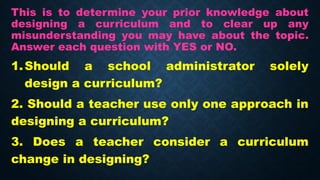
This is todetermine your prior knowledge about
designing a curriculum and to clear up any
misunderstanding you may have about the topic.
Answer each question with YES or NO.
1.Should a school administrator solely
design a curriculum?
2. Should a teacher use only one approach in
designing a curriculum?
3. Does a teacher consider a curriculum
change in designing?
3.
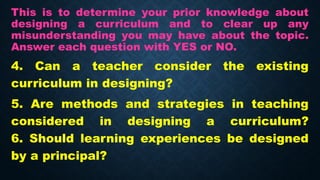
This is todetermine your prior knowledge about
designing a curriculum and to clear up any
misunderstanding you may have about the topic.
Answer each question with YES or NO.
4. Can a teacher consider the existing
curriculum in designing?
5. Are methods and strategies in teaching
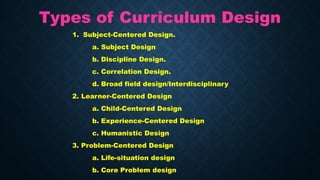
considered in designing a curriculum?
6. Should learning experiences be designed
by a principal?
4.
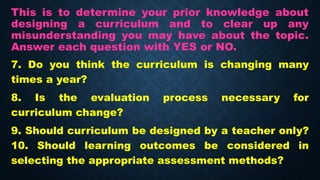
This is todetermine your prior knowledge about
designing a curriculum and to clear up any
misunderstanding you may have about the topic.
Answer each question with YES or NO.
7. Do you think the curriculum is changing many
times a year?
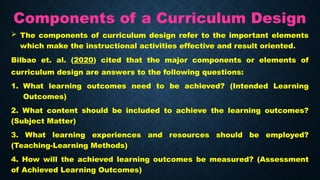
8. Is the evaluation process necessary for
curriculum change?
9. Should curriculum be designed by a teacher only?
10. Should learning outcomes be considered in
selecting the appropriate assessment methods?
5.
THE TEACHER ASA CURRICULUM
DESIGNER
In designing curriculum, every teacher needs
to know the ten (10) axioms for curriculum
designers presented by Gordon W. Taylor and
Peter Oliva as cited by Bilbao et.al. (2020).
These are principles that guide a teacher in
performing his role as a curriculum designer.
6.
THE TEACHER ASA CURRICULUM
DESIGNER
1. Curriculum change is inevitable, necessary and
desirable.
Curriculum is dynamic, thus, changes in
curriculum happen as teachers need to respond
to the changes that occur in school and its
context. The changing conditions brought by the
development of the society and of knowledge
revolution require curriculum designs.
7.
THE TEACHER ASA CURRICULUM
DESIGNER
2. Curriculum is a product of its time.
In order for a curriculum to be relevant, it
should conform to the changes brought
about by current social forces,
philosophical positions, psychological
principles, new knowledge and
educational reforms.
8.
THE TEACHER ASA CURRICULUM
DESIGNER
3. Curriculum changes made earlier can exist
concurrently with newer curriculum changes.
Curriculum revision starts and ends slowly.
More often, curriculum is gradually phased
in and phased out, so the changes can
concur and oftentimes, overlap for long
periods of time.
9.
THE TEACHER ASA CURRICULUM
DESIGNER
4. Curriculum change depends on people who will
implement the change.
Since teachers will be the one to implement the
curriculum, they should be involved in its
development, hence, they should know how to design
a curriculum. As implementers of the curriculum,
they should design and own changes and this will
surely create an effective and lasting change.
10.
THE TEACHER ASA CURRICULUM
DESIGNER
5. Curriculum development is a cooperative group activity.
In some aspects of curriculum development, group
decisions are formulated There should be meetings and
consultations with stakeholders as this will add to a
sense of ownership. Learners should also participate in
some aspect of curriculum designing. Any significant
change in the curriculum should involve a broad range
of stakeholders to gain their understanding, support
and input.
11.
THE TEACHER ASA CURRICULUM
DESIGNER
6. Curriculum development is a decision-making
process made from choices of alternatives.
A teacher as a curriculum designer must
decide what contents to teach, what
philosophy or point of view to support, what
methods and strategies to employ and what
type of evaluation to use as well as how to
provide for multicultural groups.
12.
THE TEACHER ASA CURRICULUM
DESIGNER
7. Curriculum development is an ongoing process.
In designing the curriculum, there are things to
be considered such as continuous monitoring,
examination, evaluation and improvement of
curricula. The curriculum must change as the
needs of learners change, as society changes,
and as new knowledge and technology appear.
13.
THE TEACHER ASA CURRICULUM
DESIGNER
8. Curriculum development is more effective if it is
a comprehensive process, rather than a
"piecemeal".
A curriculum design should be based on a
careful plan, should clearly establish intended
outcomes, support resources and needed time
available and should equip teaching staff
pedagogically.
14.
THE TEACHER ASA CURRICULUM
DESIGNER
9. Curriculum development is more effective when
it follows a systematic process.
A curriculum design to be more effective
should be composed of desired outcomes,
subject matter content complemented with
references, set of procedures, needed
materials and resources, and evaluation
procedure which can be placed in a matrix.
15.
THE TEACHER ASA CURRICULUM
DESIGNER
10. Curriculum development starts where
the curriculum is.
An existing design is a good starting point
for any teacher who plans to enhance and
enrich a curriculum. It is always important
for curriculum designers to begin with
existing curriculum.
16.
Approaches to CurriculumDesign
Approaches to curriculum design are
ways of doing, creating, designing and
thinking about the curriculum. There are
three main approaches:
1. child or learner-centered approach
2. subject-centered approach and
3. problem-centered approach.
17.
Approaches to CurriculumDesign
1.Child or Learner-Centered Approach.
In this approach, the child is at the center
of the educative process. The curriculum
is designed to cater to the needs,
interests, levels, abilities as well as his
social and cultural background. Likewise,
the learner's knowledge, skills, potentials
and previous learnings are considered.
18.
Approaches to CurriculumDesign
1. Child or Learner-Centered Approach.
Example:
In a Grade 10 English class, instead of assigning everyone the same
book to read, the teacher allows students to choose their own novel
based on their interests (mystery, romance, science fiction, etc.).
Students create their own projects like making a book trailer video,
writing an alternate ending, or leading a class discussion about their
book.
The teacher guides them by giving options and feedback, but the
students have control over what they read and how they show their
understanding.
19.
Approaches to CurriculumDesign
1.Child or Learner-Centered Approach.
Some of the underlying principles in this
approach are:
a. Respect the rights of the learners.
b. Design activities that lead to the overall
development of the learners.
c. Consider every learner as a unique
individual in a multicultural classroom.
20.
Approaches to CurriculumDesign
1.Child or Learner-Centered Approach.
Some of the underlying principles in this
approach are:
d. Use differentiated instruction or
teaching.
e. Create a motivating and positive
learning environment for all the learners.
21.
Approaches to CurriculumDesign
2. Subject-Centered Approach.
This approach prescribes separate
distinct subjects for every educational
level: basic education (elementary and
secondary levels); higher education
(college or tertiary level); and vocational
and technical education (post-secondary
level).
22.
Approaches to CurriculumDesign
2. Subject-Centered Approach.
Example
In a Grade 9 Science class, the teacher follows a strictly
organized curriculum where students must learn topics like
Photosynthesis, Cell Structure, and Ecology in a specific order.
Lessons are mainly lecture-based, with fixed objectives for each
topic.
Students are expected to master the content through textbooks,
quizzes, and formal exams.
The focus is on completing the required subject matter, not
necessarily on students' personal interests.
23.
Approaches to CurriculumDesign
2. Subject-Centered Approach.
The following principles are considered in this approach.
a. The focus is on the subject matter.
b. The emphasis is on pieces of information which maybe
detached from life.
c. The subject matter serves as a means of identifying
problems of living.
d. Learning means knowing the content and acquiring
knowledge.
e. The role of the teacher is to give and discuss the content.
24.
Approaches to CurriculumDesign
3. Problem-Centered Approach.
This is based on a curriculum design
which believes that children
experience problems in the process of
living. Hence, problem solving helps
the learners to achieve complete or
total development as individuals.
25.
Approaches to CurriculumDesign
3. Problem-Centered Approach.
Example
In a Grade 10 Social Studies class, instead of just memorizing facts
about climate change, the teacher presents a real-world problem:
"How can our community reduce its carbon footprint?“
Students research causes and effects of carbon emissions.
They work in groups to create action plans, like tree planting
campaigns, recycling programs, or awareness drives.
They present their solutions to the class or even to local leaders.
The teacher guides them but students actively explore, research,
and solve the problem.
26.
Approaches to CurriculumDesign
3. Problem-Centered Approach.
The following are the principles in this approach.
a. The learners have the capability to direct themselves in
resolving problems, thus making them independent learners.
b. The learners are prepared to perform their civic
responsibilities through participation in doing different
activities.
c. The curriculum helps the learners to develop their
potential in seeking solutions to problems, hence, they become
problem solvers themselves.
27.
Types of CurriculumDesign
1. Subject-Centered Design.
a. Subject Design
b. Discipline Design.
c. Correlation Design.
d. Broad field design/Interdisciplinary
2. Learner-Centered Design
a. Child-Centered Design
b. Experience-Centered Design
c. Humanistic Design
3. Problem-Centered Design
a. Life-situation design
b. Core Problem design
28.
Types of CurriculumDesign
1.Subject-Centered Design.
This design focuses on the content. It relies on
the textbook written based on the specific
subject or course. School hours are spent to
different schools such as English, Science,
Mathematics, Social Studies, Physical Education
and many more subjects offered in schools. The
aim of this design is to achieve excellence in the
specific subject content.
29.
Types of CurriculumDesign
1. Subject-Centered Design.
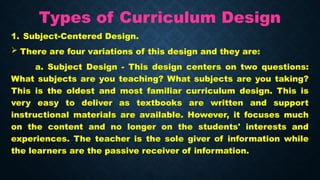
There are four variations of this design and they are:
a. Subject Design - This design centers on two questions:
What subjects are you teaching? What subjects are you taking?
This is the oldest and most familiar curriculum design. This is
very easy to deliver as textbooks are written and support
instructional materials are available. However, it focuses much
on the content and no longer on the students' interests and
experiences. The teacher is the sole giver of information while
the learners are the passive receiver of information.
30.
Types of CurriculumDesign
1. Subject-Centered Design.
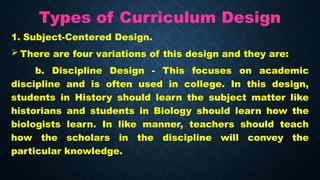
There are four variations of this design and they are:
b. Discipline Design - This focuses on academic
discipline and is often used in college. In this design,
students in History should learn the subject matter like
historians and students in Biology should learn how the
biologists learn. In like manner, teachers should teach
how the scholars in the discipline will convey the
particular knowledge.
31.
Types of CurriculumDesign
1. Subject-Centered Design.
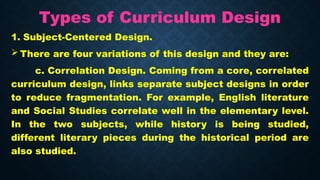
There are four variations of this design and they are:
c. Correlation Design. Coming from a core, correlated
curriculum design, links separate subject designs in order
to reduce fragmentation. For example, English literature
and Social Studies correlate well in the elementary level.
In the two subjects, while history is being studied,
different literary pieces during the historical period are
also studied.
32.
Types of CurriculumDesign
1. Subject-Centered Design.
There are four variations of this design and they are:
c. Correlation Design. Coming from a core, correlated
curriculum design, links separate subject designs in order
to reduce fragmentation. For example, English literature
and Social Studies correlate well in the elementary level.
In the two subjects, while history is being studied,
different literary pieces during the historical period are
also studied.
33.
Types of CurriculumDesign
1. Subject-Centered Design.
There are four variations of this design and they are:
d. Broad field design/Interdisciplinary. This design
was made to cure the compartmentalization of the
separate subjects and integrate the contents that are
related to one another. For example, subjects such as
geography, economics, political science, anthropology,
sociology and history are fused into one subject called
Social Studies.
34.
Types of CurriculumDesign
2. Learner-Centered Design - This design considers the
learner as the center of the educational process.
There are three examples of this design and they are:
a. Child-Centered Design - This design caters to the
needs and interests of the learners where the learner is
considered as an active participant of the teaching-learning
process. Learners actively create and construct meaning to
what they learn and they usually learn by doing. As viewed
by the constructivists, this design is attributed to the
influences of John Dewey, Rousseau, Pestalozzi and Froebel.
35.
Types of CurriculumDesign
2. Learner-Centered Design
There are three examples of this design and they are:
b. Experience-Centered Design - The experiences of the
learners become the starting point of the curriculum. Meaningful
activities should be provided to the learners. Likewise, they should
be exposed to a variety of learning experiences. The emergence of
multiple intelligence theory blends well with experienced-centered
design.
c. Humanistic Design - The development of self is the ultimate
objective of learning. Likewise, it stresses the development of
positive self-concept and interpersonal skills. The key influence in
this curriculum design is Abraham Maslow and Carl Rogers.
36.
Types of CurriculumDesign
3. Problem-Centered Design. It focuses on social problems and various
problems that center on life situations, contemporary life problems and
areas of living. Content must be based on the needs, concerns and
abilities of the learners. Two examples of this design are:
a. Life-situation design. This design uses the past and the present
experiences of learners as a means to analyze the basic areas of living.
The pressing immediate problems of the society and the students'
existing concerns are utilized. Based on Herbert Spencer's curriculum
writing, his emphasis are activities that sustain life, enhance life, and in
rearing children, maintains the individual's social and political relations
and enhance leisure, tasks and feelings.
b. Core Problem design. The central focus of this design includes
common needs, problems and concerns of the learners.
37.
Components of aCurriculum Design
The components of curriculum design refer to the important elements
which make the instructional activities effective and result oriented.
Bilbao et. al. (2020) cited that the major components or elements of
curriculum design are answers to the following questions:
1. What learning outcomes need to be achieved? (Intended Learning
Outcomes)
2. What content should be included to achieve the learning outcomes?
(Subject Matter)
3. What learning experiences and resources should be employed?
(Teaching-Learning Methods)
4. How will the achieved learning outcomes be measured? (Assessment
of Achieved Learning Outcomes)
38.
Component 1 -Behavioral Objectives or Intended
Learning Outcomes
Behavioral Objectives or Intended Learning
Outcomes are those students need to achieve
after a discussion of a lesson. They refer to what
students are expected to learn which attempt to
bring about some changes in them. Objectives
need to be determined at the beginning of the
learning journey for specification of objectives
has the following benefits.
39.
Component 1 -Behavioral Objectives or Intended
Learning Outcomes
1. Objectives determine the learning materials to be
used.
2. They help in the selection of appropriate learning
activities.
3. They direct the students' attention.
4. They improve the adequacy and effectiveness of
the teaching-learning process.
5. They guide the teacher and students on what to
accomplish.
40.
Component 1 -Behavioral Objectives or Intended
Learning Outcomes
Example: Objectives of Lesson 1 in Educ 157
At the end of the lesson, the pre-service teachers
are expected to:
1. define the major conceptions of curriculum;
2. discuss the types and purposes of the
curriculum; and
3. analyze the nature of the curriculum.
41.
Component 1 -Behavioral Objectives or Intended
Learning Outcomes
Behavioral Objectives and Intended Learning
Outcomes are expressed in action words, and they
should follow the characteristics as specified in
the acronym SMART (Specific, Measurable,
Attainable, Result Oriented and Time-bound). It
would be necessary also to provide the condition,
performance and extent of level of performance in
the statement of the Intended Learning Outcomes.
42.
Component 2- Contentor Subject Matter
As stated by Ornstein and Hunkins (2009) the
content or subject matter is the meat of the
curriculum plan. It clearly defines the purpose and
what is to be acted upon in the curriculum.
Generally, it contains all the aspects to be
learned.
43.
Component 2- Contentor Subject Matter
The content or subject matter is considered the element or medium
through which the objectives are accomplished, and it is a
significant component of the process of curriculum due to the
following reasons:
1. It directs the students on what to do.
2. It determines the course of action for every learner.
3. It provides bases to the evaluation process.
4. It helps the teacher in the selection or development of a
textbook.
5. It contains the ideology of a nation and thereby promotes it
through the process of instruction.
44.
Component 2- Contentor Subject Matter
After indicating the content or subject matter in a
plan, the reference follows. The reference
indicates the materials where the subject matter
is taken. It may be a book, magazine, journal,
module, or any type of sources.
Example:
Bilbao, Purita P. et. al. (2008) Curriculum
Development. Cubao, Quezon City: Lorimar
Publishing
45.
Component 3-teaching andLearning Methods
Thus, teaching methods and learning activities must have the
following characteristics:
1. They must be appropriate to the nature of the content.
2. They must be in line with the needs, interests, and levels of the
learners.
3. They must have relevance or connection with the learners'
present conditions and situations.
4. They must encourage the use of available materials in the
classroom and in the community.
5. They should encourage cooperation, competition and
individualism or independent learning among the students.
46.
Component 3-teaching andLearning Methods
Cooperative learning activities motivate students to work
together and learn from each other while independent learning
activities encourage learners to develop personal responsibility.
Individual accountability is an expected outcome. Likewise,
competitive activities motivate students to perform to their
maximum.
In selecting the appropriate methods to be used in teaching, the
teaching-learning environment should also be considered. Brian
Castaldi as cited by Bilbao, et. al. (2020) suggested four criteria
in the provision of the environment or learning spaces in
designing a curriculum. These criteria include the following:
47.
Component 3-teaching andLearning Methods
1. Adequacy. This refers to the actual classroom - its
physical structure and layout. Warm, well-run
classrooms begin with the room's physical layout-the
arrangement of desks and working space, the
attractiveness and appeal of bulletin boards, enough
light and ventilation and the space that would allow
students to work collaboratively in groups making the
learning environment safe and conducive for learning.
Also, there should be provision for the utilization of
technology for teaching and learning.
48.
Component 3-teaching andLearning Methods
2. Suitability. The learning activities must be
within the age level and interests of the
students. The background of the learners is also
considered (socio-cultural, economic and
religious).
3. Efficiency. This refers to operational and
instructional effectiveness.
4. Economy. This refers to cost effectiveness.
49.
Component 3-teaching andLearning Methods
Example of a Teaching Method
In teaching a language lesson, inductive
method involves the learners detecting, or
noticing patterns and working out a 'rule for
themselves before they practice the
language.
50.
Component 3-teaching andLearning Methods
The following are the steps:
I. Learning Objectives
II. Subject Matter
III. Procedure
1. Motivation/Preparation
2. Preparation
3. Discussion
4. Generalization
5. Application
IV Evaluation
V. Assignment (optional)
51.
Component 4-assessment/Evaluation
Assessment includesthe methods and instruments
used to assess the results of the curriculum. It
identifies the quality, process and results of teaching.
It reveals whether the objectives of curriculum have
been achieved and whether the instructional process
brings about behavioral changes in the character or
conduct of the students. Evaluation plays a very
essential role in the curriculum process as explained
in the following sentences below.
52.
Component 4-assessment/Evaluation
1. Itevaluates the performance of the students.
2. It reveals whether the content specifically the learning activities
are suited to the needs, interests and levels of the learners.
3. It determines the effectiveness of the teaching methods or
approaches and other instructional strategies used by the teacher.
4. It provides the bases for modifying the content, teaching
methods and strategies, thus, providing a basis for curriculum
development.
5. It evaluates the performance of the teacher in the teaching-
learning process.
53.
Component 4-assessment/Evaluation
Students needfeedback on the progress of their learning or
information on what they have already learned or have not learned.
This can be done through assessment. Assessment has three main
forms.
1. Self-Assessment. Students monitor and evaluate their own
learning through self-assessment rubrics, checklist,
observations, or tests.
2. Peer Assessment. Students show their outputs to their
classmates, and they provide feedback. Assessment guides should
be provided to them.
3. Teacher Assessment. Teacher assess students’ learning and
performance using traditional and authentic assessment methods.
54.
Component 4-assessment/Evaluation
Assessment mayeither be formative or
summative.
Formative – provides feedback on how
students are learning a course.
Summative – test provides feedback on
how much the students learned in the
course.