CURRICULUM
IMPLEMENTATION
CURRICULUM
• it is a standard- based sequence of
planned experiences where students
practice and achieve proficiency in
content and applied learning skills.
• designs generally provide instructional
suggestions, scripts, lesson plans, and
assessment options related to a set of
objectives.
NATURE OF CURRICULUM
Curriculum is that which makes a difference between maturity and
immaturity, between growth and stasis, between literacy and
illiteracy, between sophistication (intellectual, moral, social and
emotional) and simplicity. It is the accumulated heritage of man’s
knowledge filtered through the prisms of contemporary demands and
pressures. It is that wisdom considered relevant to any age in any
given location. It is that we choose from our vast amount of heritage
of wisdom to make a difference in the life of man.
WHAT IS IMPLEMENTATION
Implementing means using the plan as a guide to engage with the
learners in the teaching-learning process with the end in view that
learning has occurred and learning outcomes have been achieved.
Recomme EVALUATING TH CURRICULUM • It involves the different
strategies of teaching with the support instructional materials to go
with the strategy.
CURRICULUM
IMPLEMENTATION
• focuses on the actual implementation
of curriculum from national level to
local school context
• refers to how teachers deliver
instruction and assessment through
the use of specified resources provided
in a curriculum.
CURRICULUM
IMPLEMENTATION
what is the purpose?
• helps to give learners the appropriate or
relevant content with the application of
the learner’s environment in order make
learning real.
CURRICULUM
IMPLEMENTATION
• Curriculum implementation means putting into
practice the written curriculum that has been
designed in syllabi, course of study, curricular
guides and subjects.
• It is a process wherein the learners acquire the
planned or intended knowledge, skills,
attitudes that are aimed at enabling the same
learners to function effectively in the society.
CURRICULUM
IMPLEMENTATION
who is the most important person in the
curriculum implementation process is the
TEACHER.
Loucks and Lieberman (1983)
•The trying out of a new practice and what it looks like when actually used
in a school system.
In the classroom context
• Teaching
•Implementing means using the plan as a guide to engage with the
learners in the teaching learning process with the end in view that
learning has occurred and learning outcomes have been achieved.
•It involves the different strategies of teaching with the support
instructional materials to go with the strategy.
STAGES OF CURRICULUM
IMPLEMENTATION
1. Planning- this involves developing a clear
roadmap for how the curriculum will be
implemented, including setting goals,
identifying resources and materials and
determining timelines.
2. Instruction- this involves delivering the
curriculum to students through effective
teaching methods, such as lectures , discussion,
and hands on activities.
STAGES OF CURRICULUM
IMPLEMENTATION
3. Assessment- this involves evaluating student
learning and progress through various forms of
assessment, such as test, quizzes, and projects.
4. Evaluation- this involves analyzing the
effectiveness of the curriculum implementation,
identifying areas for improvement, and making
necessary changes to improve student learning
outcomes.
5. Reflection- this involves reflecting on the curriculum
implementation process and using insights gained to
improve future implementation.
FACTORS INFLUENCES THE
CURRICULUM IMPLEMENTATION
1.Learners
2.Resources materials and facilities
3.Teachers
4.School environment
5.Culture and ideology
6.Instructional supervision and assessment
FACTORS INFLUENCES THE
CURRICULUM IMPLEMENTATION
To implement a curriculum effectively students
must understand how to use it.
1.Responsively
2.Intentionaly
3.Fidelity
Elements of curriculum
implementation
1.intended outcomes
2.what is taught
3.manner of implementation
4.assessment and evaluation
ORNSTEIN AND HUNKINS (1998)
curriculum implementation implies as
the following:
As the interaction between the curriculum
that has been written and planned and the
person who are in charged to deliver it. To
them, curriculum implementation implies the
following :
ORNSTEIN AND HUNKINS (1998)
curriculum implementation implies as the
following:
1.Shift from what is current to a new or enhanced
curriculum
a.Analysis
b.Design
c. Development
d.Implement
e.Evaluate
f. Revise
2. Change in knowledge, actions, attitudes of the
person involved
3. Change in behavior using new strategies and
resources
4. Change which requires efforts hence goals should
be achievable
THREE CRITICAL COMPONENTS TO CONSIDER
WHEN ATTEMPT TO IMPLEMENT A NEW
CURRICULUM
1. The speed of the implementation
2. Communication during the implementation
3. Support during the implementation
CHALLENGES IN IMPLEMENTING
THE CURRICULUM
• Lack of time and resources: Teachers are often overworked and
underpaid, and they may not have the time or resources they
need to learn and implement new curriculum or instruction.
CHALLENGES IN IMPLEMENTING
THE CURRICULUM
• Lack of professional development: Teachers may not have the
training or support they need to implement new curriculum or
instruction effectively.
CHALLENGES IN IMPLEMENTING
THE CURRICULUM
• Lack of buy-in from students, parents, and administrators:
Students, parents, and administrators may not be supportive of
new curriculum or instruction, which can make it difficult for
teachers to implement successfully.
CHALLENGES IN IMPLEMENTING
THE CURRICULUM
• Resistance from students: Students may resist new curriculum
or instruction, especially if they are not engaged or motivated.
CHALLENGES IN IMPLEMENTING
THE CURRICULUM
• Difficulty aligning new curriculum with existing curriculum and
instruction: New curriculum may not be aligned with existing
curriculum and instruction, which can make it difficult for
teachers to implement effectively.
FACTORS THAT HINDER EFFECTIVE
CURRICULUM IMPLEMENTATION
INCLUDE:
• Lack of resources.
• Resistance to change.
• Time constraints.
• Inadequate teacher training.
• Misalignment with student needs.
FACTORS THAT HINDER EFFECTIVE
CURRICULUM IMPLEMENTATION
INCLUDE:
To minimize these problems, strategies can include:
• Adequate resource allocation.
• Professional development for teachers.
• Collaboration and support among stakeholders.
• Clear communication and guidance.
• Flexibility and adaptation within the curriculum.
• Monitoring and feedback systems.
WHAT ARE THE ROLES OF A
TEACHER CURRICULUM
IMPLEMENTATION?
• Planning and delivering lessons: Teachers develop lesson plans
that outline the learning objectives, activities, and assessments
for each lesson. They then deliver these lessons in a way that is
engaging and effective for all learners.
• Differentiating instruction: Teachers provide differentiated
instruction to meet the needs of all learners. This means that they
may modify the content, activities, or assessments for certain
students based on their individual needs.
WHAT ARE THE ROLES OF A
TEACHER IN THE CURRICULUM
IMPLEMENTATION?
• Assessing student learning: Teachers use a variety of assessment
methods to measure student learning and progress. This information
is then used to inform instruction and provide students with the
support they need to succeed.
• Collaborating with colleagues: Teachers collaborate with their
colleagues to develop and implement the curriculum. They share
ideas, resources, and best practices to ensure that all students are
receiving a high-quality education.
WHAT ARE THE ROLES OF A
TEACHER IN THE CURRICULUM
IMPLEMENTATION?
• Reflecting on practice: Teachers reflect on their practice to identify
areas for improvement. They also use feedback from students,
colleagues, and administrators to inform their teaching.
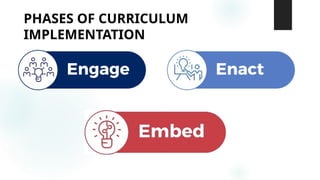
PHASES OF CURRICULUM
IMPLEMENTATION
curriculumimplementation-221009103842-c6698566.pptx.pptx

curriculumimplementation-221009103842-c6698566.pptx.pptx

  • 1.
  • 2.
    CURRICULUM • it isa standard- based sequence of planned experiences where students practice and achieve proficiency in content and applied learning skills. • designs generally provide instructional suggestions, scripts, lesson plans, and assessment options related to a set of objectives.
  • 3.
    NATURE OF CURRICULUM Curriculumis that which makes a difference between maturity and immaturity, between growth and stasis, between literacy and illiteracy, between sophistication (intellectual, moral, social and emotional) and simplicity. It is the accumulated heritage of man’s knowledge filtered through the prisms of contemporary demands and pressures. It is that wisdom considered relevant to any age in any given location. It is that we choose from our vast amount of heritage of wisdom to make a difference in the life of man.
  • 4.
    WHAT IS IMPLEMENTATION Implementingmeans using the plan as a guide to engage with the learners in the teaching-learning process with the end in view that learning has occurred and learning outcomes have been achieved. Recomme EVALUATING TH CURRICULUM • It involves the different strategies of teaching with the support instructional materials to go with the strategy.
  • 5.
    CURRICULUM IMPLEMENTATION • focuses onthe actual implementation of curriculum from national level to local school context • refers to how teachers deliver instruction and assessment through the use of specified resources provided in a curriculum.
  • 6.
    CURRICULUM IMPLEMENTATION what is thepurpose? • helps to give learners the appropriate or relevant content with the application of the learner’s environment in order make learning real.
  • 7.
    CURRICULUM IMPLEMENTATION • Curriculum implementationmeans putting into practice the written curriculum that has been designed in syllabi, course of study, curricular guides and subjects. • It is a process wherein the learners acquire the planned or intended knowledge, skills, attitudes that are aimed at enabling the same learners to function effectively in the society.
  • 8.
    CURRICULUM IMPLEMENTATION who is themost important person in the curriculum implementation process is the TEACHER.
  • 9.
    Loucks and Lieberman(1983) •The trying out of a new practice and what it looks like when actually used in a school system. In the classroom context • Teaching •Implementing means using the plan as a guide to engage with the learners in the teaching learning process with the end in view that learning has occurred and learning outcomes have been achieved. •It involves the different strategies of teaching with the support instructional materials to go with the strategy.
  • 10.
    STAGES OF CURRICULUM IMPLEMENTATION 1.Planning- this involves developing a clear roadmap for how the curriculum will be implemented, including setting goals, identifying resources and materials and determining timelines. 2. Instruction- this involves delivering the curriculum to students through effective teaching methods, such as lectures , discussion, and hands on activities.
  • 11.
    STAGES OF CURRICULUM IMPLEMENTATION 3.Assessment- this involves evaluating student learning and progress through various forms of assessment, such as test, quizzes, and projects. 4. Evaluation- this involves analyzing the effectiveness of the curriculum implementation, identifying areas for improvement, and making necessary changes to improve student learning outcomes. 5. Reflection- this involves reflecting on the curriculum implementation process and using insights gained to improve future implementation.
  • 12.
    FACTORS INFLUENCES THE CURRICULUMIMPLEMENTATION 1.Learners 2.Resources materials and facilities 3.Teachers 4.School environment 5.Culture and ideology 6.Instructional supervision and assessment
  • 13.
    FACTORS INFLUENCES THE CURRICULUMIMPLEMENTATION To implement a curriculum effectively students must understand how to use it. 1.Responsively 2.Intentionaly 3.Fidelity
  • 14.
    Elements of curriculum implementation 1.intendedoutcomes 2.what is taught 3.manner of implementation 4.assessment and evaluation
  • 15.
    ORNSTEIN AND HUNKINS(1998) curriculum implementation implies as the following: As the interaction between the curriculum that has been written and planned and the person who are in charged to deliver it. To them, curriculum implementation implies the following :
  • 16.
    ORNSTEIN AND HUNKINS(1998) curriculum implementation implies as the following: 1.Shift from what is current to a new or enhanced curriculum a.Analysis b.Design c. Development d.Implement e.Evaluate f. Revise
  • 17.
    2. Change inknowledge, actions, attitudes of the person involved 3. Change in behavior using new strategies and resources 4. Change which requires efforts hence goals should be achievable
  • 18.
    THREE CRITICAL COMPONENTSTO CONSIDER WHEN ATTEMPT TO IMPLEMENT A NEW CURRICULUM 1. The speed of the implementation 2. Communication during the implementation 3. Support during the implementation
  • 19.
    CHALLENGES IN IMPLEMENTING THECURRICULUM • Lack of time and resources: Teachers are often overworked and underpaid, and they may not have the time or resources they need to learn and implement new curriculum or instruction.
  • 20.
    CHALLENGES IN IMPLEMENTING THECURRICULUM • Lack of professional development: Teachers may not have the training or support they need to implement new curriculum or instruction effectively.
  • 21.
    CHALLENGES IN IMPLEMENTING THECURRICULUM • Lack of buy-in from students, parents, and administrators: Students, parents, and administrators may not be supportive of new curriculum or instruction, which can make it difficult for teachers to implement successfully.
  • 22.
    CHALLENGES IN IMPLEMENTING THECURRICULUM • Resistance from students: Students may resist new curriculum or instruction, especially if they are not engaged or motivated.
  • 23.
    CHALLENGES IN IMPLEMENTING THECURRICULUM • Difficulty aligning new curriculum with existing curriculum and instruction: New curriculum may not be aligned with existing curriculum and instruction, which can make it difficult for teachers to implement effectively.
  • 24.
    FACTORS THAT HINDEREFFECTIVE CURRICULUM IMPLEMENTATION INCLUDE: • Lack of resources. • Resistance to change. • Time constraints. • Inadequate teacher training. • Misalignment with student needs.
  • 25.
    FACTORS THAT HINDEREFFECTIVE CURRICULUM IMPLEMENTATION INCLUDE: To minimize these problems, strategies can include: • Adequate resource allocation. • Professional development for teachers. • Collaboration and support among stakeholders. • Clear communication and guidance. • Flexibility and adaptation within the curriculum. • Monitoring and feedback systems.
  • 26.
    WHAT ARE THEROLES OF A TEACHER CURRICULUM IMPLEMENTATION? • Planning and delivering lessons: Teachers develop lesson plans that outline the learning objectives, activities, and assessments for each lesson. They then deliver these lessons in a way that is engaging and effective for all learners. • Differentiating instruction: Teachers provide differentiated instruction to meet the needs of all learners. This means that they may modify the content, activities, or assessments for certain students based on their individual needs.
  • 27.
    WHAT ARE THEROLES OF A TEACHER IN THE CURRICULUM IMPLEMENTATION? • Assessing student learning: Teachers use a variety of assessment methods to measure student learning and progress. This information is then used to inform instruction and provide students with the support they need to succeed. • Collaborating with colleagues: Teachers collaborate with their colleagues to develop and implement the curriculum. They share ideas, resources, and best practices to ensure that all students are receiving a high-quality education.
  • 28.
    WHAT ARE THEROLES OF A TEACHER IN THE CURRICULUM IMPLEMENTATION? • Reflecting on practice: Teachers reflect on their practice to identify areas for improvement. They also use feedback from students, colleagues, and administrators to inform their teaching.
  • 29.

Editor's Notes

  • #8 Because with their knowledge, experiences and competencies teachers are central to any curriculum development effort.
  • #14 1. formation of goals, aims and objectives 2.selection of content or subject matter 3.teaching methods and techniques
  • #18 2. Communication during the implementation In general, it is easier to speak with peers rather than with one’s boss. However, normally it is the boss who pushes an implementation. This makes it necessary to speak with them and indicates how the processes are going. A break down in communication can lead to a great curriculum. 3. Support during the implementation A new curriculum cannot be dumped on a teacher. There must be support provided as the teacher acclimate to the new curriculum. Teachers need in-service training, staff development, money, and more to acquire the skills needed to use a new curriculum.
  • #23 In addition to these general challenges, teachers may also face specific challenges when implementing new curriculum or instruction in different subject areas. For example, teachers who are implementing a new math curriculum may have to work to align the new curriculum with the state standards and to ensure that they are using appropriate instructional materials and assessments. Despite the challenges, it is important for teachers to be willing to implement new curriculum or instruction in order to meet the needs of their students and to prepare them for success in the 21st century.
  • #24 I
  • #26 Teachers play a pivotal role in curriculum implementation. They are the ones who bring the curriculum to life in the classroom and help students to learn and grow. Some of the key roles of teachers in curriculum implementation include:
  • #28 In addition to these key roles, teachers also play a vital role in creating a positive and supportive learning environment. They provide students with opportunities to interact with each other and with the teacher in a meaningful way. They also help students to develop their social and emotional skills. Teachers play a crucial role in curriculum implementation. They are the ones who make the curriculum come alive in the classroom and help students to learn and grow.
  • #29 Engage phase – Explore aspects of the new syllabus to identify and plan for changes required for effective curriculum implementation. Enact phase – Teach, assess and report using the new syllabus and evaluate to refine new practices and systems Embed phase – Strengthen and scale to ensure sustainable practices and systems.