IMPLEMENTING
THE DESIGNED
CURRICULUM
AS CHANGE
PROCESS
DEFINITION :
Implementing
- Using the plan as a guide to engage with
the leaners in the teacher-learning process with
the end in the view that learning occurred, and the
learning outcomes have been
achieved.
Design
- A plan or drawing produced to show the
look and function or workings of a building,
garment or other object before it is built or made
Curriculum
-Is a standards-based sequence of planned
experiences where students practice and
achieve proficiency in content and applied learning
skills. A central guide for educators
to know what is essential for teaching and learning.
DEFINITION :
Curriculum Design
Focuses on the creation of the overall coarse
blueprint, mapping content to develop a
course outline and build the course. Each learning
objectives is met with assessment
strategies, exercises, content, subject matter
analysis and interactive activities.
Change
The act or instance of making or becoming
different.
Process
A series of actions or steps taken in order to
achieve a particular end.
DEFINITION :
CURRICULUM IMPLEMENTATION
* Putting into practice the written curriculum
that has been designed in the syllabi, course of
study, curricular guide and subjects.
* It’s a process wherein the learners acquire
the planned or intended knowledge, skill and
attitudes that are aimed at enabling same
leaners to function effectively in the society
Ornstein and Hunkins (1998)
*As the interaction between the curriculum
that has been written and planned, and the
persons
(teachers) who are in charge to deliver it.
•Shift from what is the content to a new or
enhanced curriculum.
•Change in knowledge, actions, attitudes of the
person involved.
•Change in behavior using new strategies and
resources.
•Change which requires efforts hence goals should
be achievable.
Loucks and Lieberman (1983)
They defined it as the trying out of a new practice and what
it looks like when already used in
school system.
*In the classroom context
•Teaching
Concept of Change
*Change is a constant law of nature. It bring improvements.
Change is an ongoing process.
*Not all changes lead to improvement, but all improvement
requires change. The ability to develop, test and implement
changes is essential for any individual, group or
organization that wants to continuously improve.
Features of Change
*It’s a PROCESS not an EVENT
*It requires time, energy and resources
*It is achieved incrementally and entails
development in feelings and skills.
Process of Curriculum Change
*May be assisted by permissiveness and support in
accordance of with a helpful improvement in
curriculum. Changing curriculum changes
individuals.
*It must be necessary in consideration that the
resources of implementation of curriculum are
available or not.
McNeil in 1990 categorized curriculum
change as follows :
Substitution – The current curriculum will be
replaced or substituted by a new one.
Example: Changing an old book to entirely
new one.
Alteration – In alteration, there is a minor
change to the current or existing curriculum.
Example: Instead of using a graphing paper
for mathematics teaching, this can be
altered by using a graphing calculator.
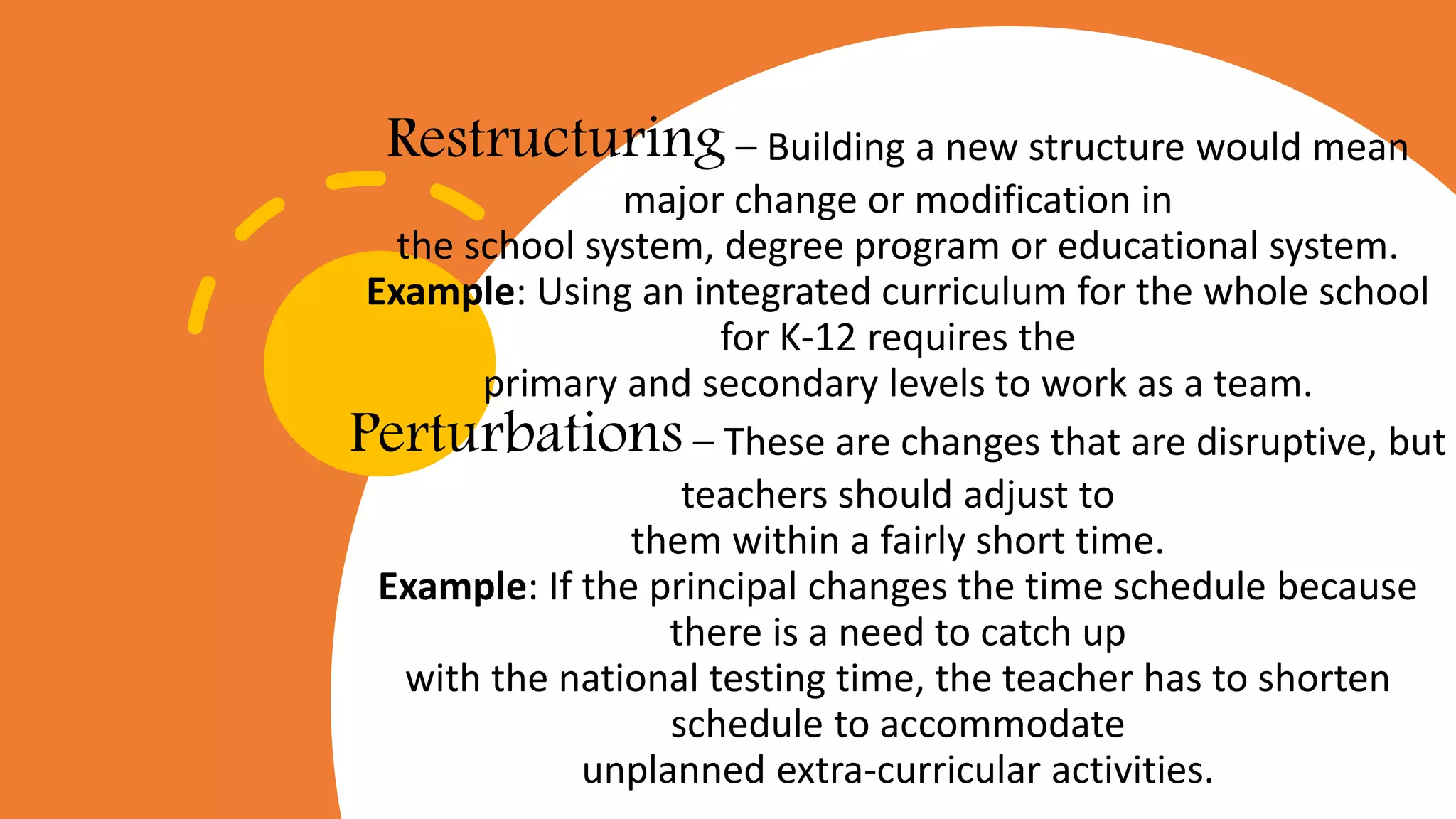
Restructuring – Building a new structure would mean
major change or modification in
the school system, degree program or educational system.
Example: Using an integrated curriculum for the whole school
for K-12 requires the
primary and secondary levels to work as a team.
Perturbations – These are changes that are disruptive, but
teachers should adjust to
them within a fairly short time.
Example: If the principal changes the time schedule because
there is a need to catch up
with the national testing time, the teacher has to shorten
schedule to accommodate
unplanned extra-curricular activities.
Value Orientation - This
classification will respond to shift in the
emphasis that the
teacher provides which are not within
the mission or vision of the school or vise
versa.
Example: When new teachers who are
recruited in religious give emphasis on
academics
and forget the formation of values or
faith, they need a curriculum value
orientation.
IMPORTANT
ELEMENTS IN THE
PROCESS OF
CHANGE
Developmental
It should develop multiple
perspectives, increase
integration and make
learning autonomous, create
a climate openness and trust,
appreciate and affirm
strengths of
the teachers.
Participatory
For curriculum implementation
to succeed, it should be
participatory, especially
other stakeholders like peers,
school leaders, parents and
curriculum specialists are
necessary.
Participation builds a learning
community in which is very
necessary in curriculum
implementation.
Supportive
Material support like supplies, equipment,
conductive learning environment like
classrooms and laboratory should be made
available. For any innovation to be fully
implemented, period of three to five years
to institutionalize a curriculum is suggested.
Time is needed by the teachers to plan,
adapt, train or practice, provide the
necessary requirements
and get support. Support from peers,
principals, external stakeholders will add to
the success of
implementation.
GENERALIZATION
*The teacher is the key agent in the curriculum implementation process.
*Implementation requires adjusting personal habits, ways of behaving, program
emphases, learning spaces, and existing curricula and schedule.
* It also requires time, efforts, energy and resources in order to achieve the goals.
*On the other hand, curriculum need to change because our world is constantly
changing, and students need to be able to change with it.
* Having an updated curriculum seeks to achieve a good balance between academic
and technical and vocational
(practical) learning areas.
*Updated curriculum is paramount to success for everyone.
THANK YOU AND GOD BLESS
-Claudelyn Manicap
Block A

IMPLEMENTING-THE-DESIGNED-CURRICULUM-AS-CHANGE-PROCESS.pptx

  • 1.
  • 2.
    DEFINITION : Implementing - Usingthe plan as a guide to engage with the leaners in the teacher-learning process with the end in the view that learning occurred, and the learning outcomes have been achieved. Design - A plan or drawing produced to show the look and function or workings of a building, garment or other object before it is built or made Curriculum -Is a standards-based sequence of planned experiences where students practice and achieve proficiency in content and applied learning skills. A central guide for educators to know what is essential for teaching and learning.
  • 3.
    DEFINITION : Curriculum Design Focuseson the creation of the overall coarse blueprint, mapping content to develop a course outline and build the course. Each learning objectives is met with assessment strategies, exercises, content, subject matter analysis and interactive activities. Change The act or instance of making or becoming different. Process A series of actions or steps taken in order to achieve a particular end.
  • 4.
    DEFINITION : CURRICULUM IMPLEMENTATION *Putting into practice the written curriculum that has been designed in the syllabi, course of study, curricular guide and subjects. * It’s a process wherein the learners acquire the planned or intended knowledge, skill and attitudes that are aimed at enabling same leaners to function effectively in the society
  • 5.
    Ornstein and Hunkins(1998) *As the interaction between the curriculum that has been written and planned, and the persons (teachers) who are in charge to deliver it. •Shift from what is the content to a new or enhanced curriculum. •Change in knowledge, actions, attitudes of the person involved. •Change in behavior using new strategies and resources. •Change which requires efforts hence goals should be achievable.
  • 6.
    Loucks and Lieberman(1983) They defined it as the trying out of a new practice and what it looks like when already used in school system. *In the classroom context •Teaching Concept of Change *Change is a constant law of nature. It bring improvements. Change is an ongoing process. *Not all changes lead to improvement, but all improvement requires change. The ability to develop, test and implement changes is essential for any individual, group or organization that wants to continuously improve.
  • 7.
    Features of Change *It’sa PROCESS not an EVENT *It requires time, energy and resources *It is achieved incrementally and entails development in feelings and skills. Process of Curriculum Change *May be assisted by permissiveness and support in accordance of with a helpful improvement in curriculum. Changing curriculum changes individuals. *It must be necessary in consideration that the resources of implementation of curriculum are available or not.
  • 8.
    McNeil in 1990categorized curriculum change as follows : Substitution – The current curriculum will be replaced or substituted by a new one. Example: Changing an old book to entirely new one. Alteration – In alteration, there is a minor change to the current or existing curriculum. Example: Instead of using a graphing paper for mathematics teaching, this can be altered by using a graphing calculator.
  • 9.
    Restructuring – Buildinga new structure would mean major change or modification in the school system, degree program or educational system. Example: Using an integrated curriculum for the whole school for K-12 requires the primary and secondary levels to work as a team. Perturbations – These are changes that are disruptive, but teachers should adjust to them within a fairly short time. Example: If the principal changes the time schedule because there is a need to catch up with the national testing time, the teacher has to shorten schedule to accommodate unplanned extra-curricular activities.
  • 10.
    Value Orientation -This classification will respond to shift in the emphasis that the teacher provides which are not within the mission or vision of the school or vise versa. Example: When new teachers who are recruited in religious give emphasis on academics and forget the formation of values or faith, they need a curriculum value orientation.
  • 11.
  • 12.
    Developmental It should developmultiple perspectives, increase integration and make learning autonomous, create a climate openness and trust, appreciate and affirm strengths of the teachers.
  • 13.
    Participatory For curriculum implementation tosucceed, it should be participatory, especially other stakeholders like peers, school leaders, parents and curriculum specialists are necessary. Participation builds a learning community in which is very necessary in curriculum implementation.
  • 14.
    Supportive Material support likesupplies, equipment, conductive learning environment like classrooms and laboratory should be made available. For any innovation to be fully implemented, period of three to five years to institutionalize a curriculum is suggested. Time is needed by the teachers to plan, adapt, train or practice, provide the necessary requirements and get support. Support from peers, principals, external stakeholders will add to the success of implementation.
  • 15.
    GENERALIZATION *The teacher isthe key agent in the curriculum implementation process. *Implementation requires adjusting personal habits, ways of behaving, program emphases, learning spaces, and existing curricula and schedule. * It also requires time, efforts, energy and resources in order to achieve the goals. *On the other hand, curriculum need to change because our world is constantly changing, and students need to be able to change with it. * Having an updated curriculum seeks to achieve a good balance between academic and technical and vocational (practical) learning areas. *Updated curriculum is paramount to success for everyone.
  • 16.
    THANK YOU ANDGOD BLESS -Claudelyn Manicap Block A