![Society, Schizophrenia and Pastiche“If, indeed, the subject has lost its capacity ... to organize its past and future into coherent experience, it becomes difficult ... to see how cultural productions of such a subject could result in anything but ‘heaps of fragments’ and in a practice of the randomly heterogeneous and fragmentary and the aleatory.” (Jameson [1984]1993, p.25)](https://image.slidesharecdn.com/subjectivityandidentity-selfawareness-090522071050-phpapp01/85/Subjectivity-And-Identity-Self-Awareness-3-320.jpg)

![Schizophrenia Jameson used the word schizophrenia, not in a clinical sense, but to describe a ‘break down in the signifying chain’ which ‘constitutes meaning’ (Jameson [1984] 1993, p26 ) “When”, he continues, “the links of the signifying chain snap, then we have schizophrenia in the form of a rubble of distinct and unrelated signifiers”. (ibid.)Nam June Paik (1963) Exposition of Music – Electric TelevisionNam June Paik (1993) In-Flux House.](https://image.slidesharecdn.com/subjectivityandidentity-selfawareness-090522071050-phpapp01/85/Subjectivity-And-Identity-Self-Awareness-5-320.jpg)
![Society, Schizophrenia and Pastiche“We have seen that there is a way in which postmodernism replicates or reproduces – reinforces – the logic of consumer capitalism; the most significant question is whether there is also a way in which it resists that logic.” (Jameson [1982] 1985, p.125)](https://image.slidesharecdn.com/subjectivityandidentity-selfawareness-090522071050-phpapp01/85/Subjectivity-And-Identity-Self-Awareness-8-320.jpg)
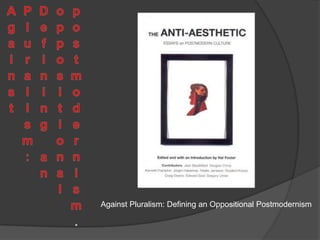
![Against Pluralism: Defining an oppositional postmodernism.“... Postmodernism is not pluralism – the quixotic notion that all positions in culture and politics are now open and equal. This apocalyptic belief that anything goes, that the ‘end of ideology’ is here, is simply the inverse of the fatalistic belief that nothing works, that we live under a ‘total system’ without the hope of redress...” (Foster [1983] 1985, p. Ix.)Against Pluralism: Defining an Oppositional Postmodernism](https://image.slidesharecdn.com/subjectivityandidentity-selfawareness-090522071050-phpapp01/85/Subjectivity-And-Identity-Self-Awareness-10-320.jpg)
![Against Pluralism: Defining an oppositional postmodernism.“In opposition... a resistant position is concerned with a critical deconstruction of tradition, not an instrumental pastiche of pop – or pseudo - historical forms, with a critique of origins, not a return to them. In short, it seeks to question rather than exploit cultural codes, to explore rather than conceal social political affiliations.” (Foster [1983] 1985, p.x.)Against Pluralism: Defining an Oppositional Postmodernism](https://image.slidesharecdn.com/subjectivityandidentity-selfawareness-090522071050-phpapp01/85/Subjectivity-And-Identity-Self-Awareness-11-320.jpg)
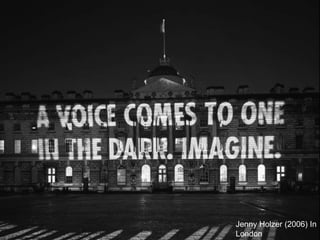
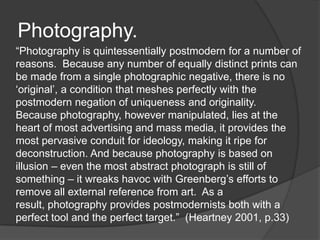

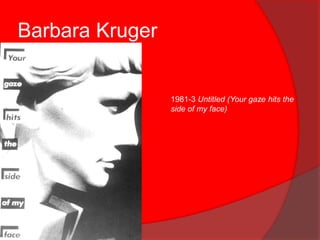
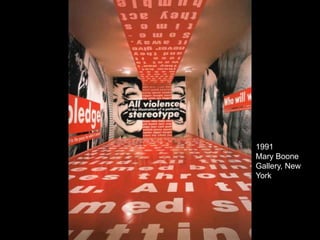
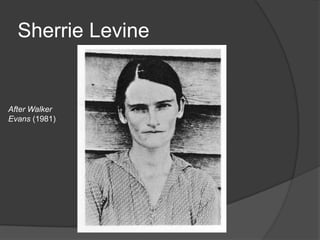
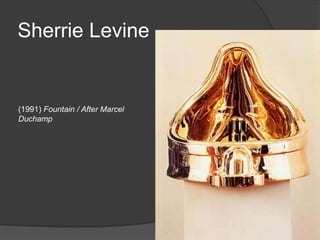

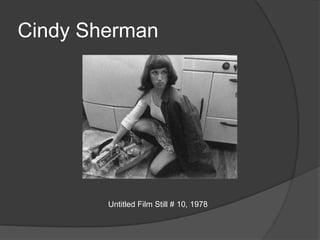
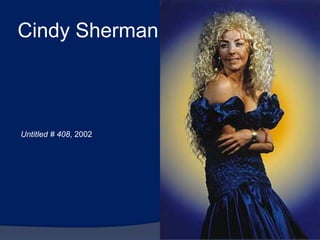
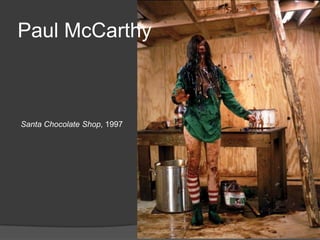
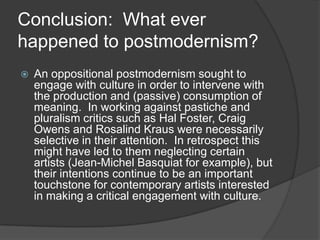
![Conclusion: What ever happened to postmodernism?“I supported a postmodernism that ... advocated artistic practices not only critical of institutional modernism but suggestive of alternative forms – of new ways to practice culture and politics. And we did not loose. In a sense a worse thing happened: treated as a fashion, postmodernism became démodé.” (Foster [1996] 2002, p.206)“Etymologically, to criticise is to judge or to decide, and I doubt if any artist, critic, theorist, or historian can ever escape value judgements. We can, however, make value judgements that ... are not only reactive but active ... not only distinctive but useful. Otherwise critical theory may come to deserve the bad name with which it is often branded today.” (Ibid, p. 226)](https://image.slidesharecdn.com/subjectivityandidentity-selfawareness-090522071050-phpapp01/85/Subjectivity-And-Identity-Self-Awareness-24-320.jpg)
![ReferencesFoster, H (1985) (ed.) Postmodernism: A Preface, in Postmodern Culture. London, Pluto Press.Foster, H ([1996] 2002) What ever happened to postmodernism? In The Return of the Real. London, MIT Press.Heartney, E (2001) Postmodernism. London, Tate Gallery Publishing Ltd.Jameson, F ( [1982] 1985) Postmodernism and Consumer Society, in Postmodern Culture. London, Pluto Press.Jameson, F ([1984] 1993) Postmodernism: or, The Cultural Logic or Late Capitalism. London, Verso.](https://image.slidesharecdn.com/subjectivityandidentity-selfawareness-090522071050-phpapp01/85/Subjectivity-And-Identity-Self-Awareness-25-320.jpg)

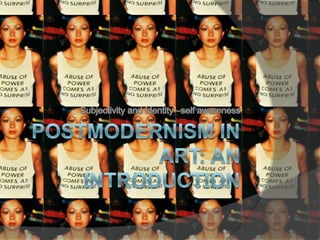
The document explores postmodernism in art, focusing on themes of subjectivity, identity, and the critique of consumer capitalism. It discusses the work of artists like Jenny Holzer and Sherrie Levine and defines oppositional postmodernism as a critical deconstruction of tradition rather than a mere pastiche. The conclusion reflects on the fate of postmodernism, suggesting it has become treated as a fleeting fashion rather than a meaningful cultural practice.


![Representation in the_media[1].ppt banhams](https://cdn.slidesharecdn.com/ss_thumbnails/representationinthemedia1-pptbanhams-110505054013-phpapp01-thumbnail.jpg?width=640&height=640&fit=bounds)


