Elements of a
Curriculum
The elements of curriculum would guarantee the success of a curriculum. The
elements of curriculum are: objectives, content or subject matter, methods or learning
experiences and evaluation.
The appropriate coordination of elements of curriculum would
guarantee the success of a curriculum.
1. Curriculum Objectives
The curriculum aims, goals and objectives spell
out what is to be done. It tries to capture what goals
are to be achieved, the vision, the philosophy, the
mission statement and objectives. Further, it clearly
defines the purpose and what the curriculum is to be
acted upon and try what to drive at. We begin with
this element because it is difficult to plan a successful
trip without a destination.
…..
Aims are often expressed in terms of state
standards, which are expressed in somewhat general
terms, then broken down into more specific goals,
then further broken down into objectives. These
objectives are specific and written in behavioral
terms so as to develop learning structures and
conditions. Sometimes the objectives are sorted
as cognitive, affective, and psychomotor.
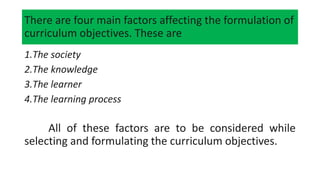
There are four main factors affecting the formulation of
curriculum objectives. These are
1.The society
2.The knowledge
3.The learner
4.The learning process
All of these factors are to be considered while
selecting and formulating the curriculum objectives.
2. Content or Subject Matter
A second element is the content of the curriculum.
It contains information to be learned at school. It is an
element or a medium through which the objectives are
accomplished. Content or subject matter refers to the
body of knowledge that the student will take away
when the course is done. It must assure that the
curriculum objectives are properly met.
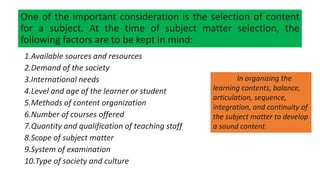
One of the important consideration is the selection of content
for a subject. At the time of subject matter selection, the
following factors are to be kept in mind:
1.Available sources and resources
2.Demand of the society
3.International needs
4.Level and age of the learner or student
5.Methods of content organization
6.Number of courses offered
7.Quantity and qualification of teaching staff
8.Scope of subject matter
9.System of examination
10.Type of society and culture
In organizing the
learning contents, balance,
articulation, sequence,
integration, and continuity of
the subject matter to develop
a sound content.
3. Learning Experiences (Methods of
Delivering Knowledge)
The third element is the strategies and methods of
teaching or the learning experiences adopted by the
teachers during instruction. It deals with the teaching-
learning process including methodology of teaching and
learning experiences both within the institution and
outside, learning environments, teachers’ material as well
as students’ material. In his classic text on curriculum, Tyler
defined the term learning experiences as follows:
…
The term “learning experience” is not the
same as the content with which a course deals
nor the activities performed by the teacher. The
term “learning experience” refers to the
interaction between the learner and the external
conditions in the environment to which he/she
can react. Learning takes place through the
active behavior of the student.
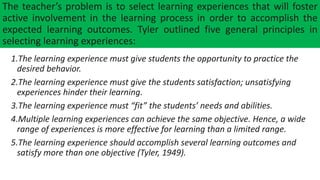
The teacher’s problem is to select learning experiences that will foster
active involvement in the learning process in order to accomplish the
expected learning outcomes. Tyler outlined five general principles in
selecting learning experiences:
1.The learning experience must give students the opportunity to practice the
desired behavior.
2.The learning experience must give the students satisfaction; unsatisfying
experiences hinder their learning.
3.The learning experience must “fit” the students’ needs and abilities.
4.Multiple learning experiences can achieve the same objective. Hence, a wide
range of experiences is more effective for learning than a limited range.
5.The learning experience should accomplish several learning outcomes and
satisfy more than one objective (Tyler, 1949).
4. Curriculum Evaluation
Curriculum evaluation refers to the process
of placing value on a curriculum. Evaluation may
focus on a curriculum’s design, including content
and process; its implementation; or outcomes. It
identifies the quality, effectiveness of the
program, process and product of the curriculum.
4. Curriculum Evaluation
Curriculum evaluation is different from a student
evaluation. It is a broader term being used to make
judgment about the worth and effectiveness of
curriculum. Curriculum evaluation is also important in a
sense that one could assess whether the aims and
objectives have been met or not. It also shows the
effectiveness of strategy of teaching and other
components. The interpretation of evaluation provides the
feedback to the curriculum and its components. With the
help of evaluation phase experts can modify the
curriculum by bringing about desirable changes.
Need Assessment for Curriculum
Need analysis refers to the analysis of the learner and
the society such as learners’ capacity and ability, aptitudes
and potential for learning, motivation, needs, interests and
values as well as society’s orientation to nurturing or using
the individual gainfully. It also provides a framework of
assumptions about emotional, political, cultural, religious
and geographical condition of a country. This helps the
curriculum planners in the selection of objectives, selection
of organization of learning materials and in suggesting
appropriate evaluation procedures.
A needs analysis defines deficiencies or
problems and identifies causes and
solutions. It can be thought of as the
process of identifying gaps between what
should be happening and what is
happening, and accounting for the
causes of these gaps.
In order to devise a curriculum and prepare
course materials and methods based on the
students’ and institution’s objectives, we had
better carry out needs analysis. As Richards
(2007) holds “a sound educational program
should be based on an analysis of learner
needs.” (p. 51).
Needs assessment is the basic element of curriculum which
is usually done before, during and after the curriculum
development in order to determine the course’s outline,
materials and resources. Any course should be set up based
on the students’ needs and we should be “sensitive to our
learners and their needs” (Schmitt, 2000, p. 136). To this
end, Flowerdew and Peacock (2001) contend that needs
analysis attempts “to fine tune the curriculum to the specific
needs of the learner.” (p. 178).
Need Analysis includes
Generally, in addition to determining the learners’ needs, materials and
methods, needs analysis intends to;
• Ascertain the students’ objectives and goals.
• Find out what the students need to do in order to learn (learning needs).
• Determine what the students need to do in the target situation (target
situation analysis).
• Check the place and its availability of the resources, equipment, materials and
facilities (means analysis).
• Establish the students’ language level at the beginning of the program
(present situation analysis).
Subdivision of Needs
In order to better study the learners’ needs, Hutchinson and Waters (1987)
subdivide the needs into necessities, lacks and wants.
1.Necessities:- Necessities refer to the requirement of the
target setting. In other words, the linguistic elements the
learners need to use in the target environment. In this way,
the target situation analysis comes to the fore. Determining
the necessities of the target situation is one of the aspects
of what the learners need to learn.
Subdivision of Needs
In order to better study the learners’ needs, Hutchinson and Waters (1987)
subdivide the needs into necessities, lacks and wants.
2. Lacks:- The other more important issue is to know
what the learners already know. By determining what
the learners have at their disposal, we can identify
which of the necessities they lack. Therefore, by
studying the gap between the necessities and the lacks
we can select and teach the appropriate materials to
the learners.
Subdivision of Needs
In order to better study the learners’ needs, Hutchinson and Waters (1987)
subdivide the needs into necessities, lacks and wants.
3. Wants:- The necessities and lacks are the objective
points that are determined by the needs analysis.
However, the learners themselves have their own
wishes and wants. The learners’ wants may be in
conflict with the teachers’ or other parties perceptions.
perceptions. Therefore, any curriculum designer should
should consider the learners’ wants appropriately.
Importance of Need Assessment in Curriculum
The needs assessment is carried out to identify the
aims, vision, principles, goals, learners’ key competencies,
desirable characteristics, learning standards and indicators in
curriculum development process. Information obtained
during the needs analysis can be used to decide the
appropriate contents for the students. It also ensures that
the decisions about curriculum and instruction are correct,
believable, unbiased, and made on the principle of
reasonableness, reduced errors, and save the time and
resources.
Importance of Need Assessment in Curriculum
Remarkably, needs analysis is not a one-off exercise, rather it is an
ongoing activity carried out continually during the whole teaching-
learning processes. At this juncture, the important issue is the students’
involvement in the needs analysis processes. In order to encourage the
students to participate in the learning process, the teachers and
curriculum designers need to involve the learners in the needs analysis.
As Peacock (2001) argues when the learners’ needs and wishes are not
considered “the results can be frustrated and disappointed students.” (p.
283). Ultimately, the teachers should gather enough information about
the students and the course and convert “needs analysis outcomes into
course content and procedures” (Lynch, 2001, p. 394).

The Elements of Developing Curriculum.pptx

  • 1.
  • 2.
    The elements ofcurriculum would guarantee the success of a curriculum. The elements of curriculum are: objectives, content or subject matter, methods or learning experiences and evaluation. The appropriate coordination of elements of curriculum would guarantee the success of a curriculum.
  • 3.
    1. Curriculum Objectives Thecurriculum aims, goals and objectives spell out what is to be done. It tries to capture what goals are to be achieved, the vision, the philosophy, the mission statement and objectives. Further, it clearly defines the purpose and what the curriculum is to be acted upon and try what to drive at. We begin with this element because it is difficult to plan a successful trip without a destination.
  • 4.
    ….. Aims are oftenexpressed in terms of state standards, which are expressed in somewhat general terms, then broken down into more specific goals, then further broken down into objectives. These objectives are specific and written in behavioral terms so as to develop learning structures and conditions. Sometimes the objectives are sorted as cognitive, affective, and psychomotor.
  • 5.
    There are fourmain factors affecting the formulation of curriculum objectives. These are 1.The society 2.The knowledge 3.The learner 4.The learning process All of these factors are to be considered while selecting and formulating the curriculum objectives.
  • 6.
    2. Content orSubject Matter A second element is the content of the curriculum. It contains information to be learned at school. It is an element or a medium through which the objectives are accomplished. Content or subject matter refers to the body of knowledge that the student will take away when the course is done. It must assure that the curriculum objectives are properly met.
  • 7.
    One of theimportant consideration is the selection of content for a subject. At the time of subject matter selection, the following factors are to be kept in mind: 1.Available sources and resources 2.Demand of the society 3.International needs 4.Level and age of the learner or student 5.Methods of content organization 6.Number of courses offered 7.Quantity and qualification of teaching staff 8.Scope of subject matter 9.System of examination 10.Type of society and culture In organizing the learning contents, balance, articulation, sequence, integration, and continuity of the subject matter to develop a sound content.
  • 8.
    3. Learning Experiences(Methods of Delivering Knowledge) The third element is the strategies and methods of teaching or the learning experiences adopted by the teachers during instruction. It deals with the teaching- learning process including methodology of teaching and learning experiences both within the institution and outside, learning environments, teachers’ material as well as students’ material. In his classic text on curriculum, Tyler defined the term learning experiences as follows:
  • 9.
    … The term “learningexperience” is not the same as the content with which a course deals nor the activities performed by the teacher. The term “learning experience” refers to the interaction between the learner and the external conditions in the environment to which he/she can react. Learning takes place through the active behavior of the student.
  • 10.
    The teacher’s problemis to select learning experiences that will foster active involvement in the learning process in order to accomplish the expected learning outcomes. Tyler outlined five general principles in selecting learning experiences: 1.The learning experience must give students the opportunity to practice the desired behavior. 2.The learning experience must give the students satisfaction; unsatisfying experiences hinder their learning. 3.The learning experience must “fit” the students’ needs and abilities. 4.Multiple learning experiences can achieve the same objective. Hence, a wide range of experiences is more effective for learning than a limited range. 5.The learning experience should accomplish several learning outcomes and satisfy more than one objective (Tyler, 1949).
  • 11.
    4. Curriculum Evaluation Curriculumevaluation refers to the process of placing value on a curriculum. Evaluation may focus on a curriculum’s design, including content and process; its implementation; or outcomes. It identifies the quality, effectiveness of the program, process and product of the curriculum.
  • 12.
    4. Curriculum Evaluation Curriculumevaluation is different from a student evaluation. It is a broader term being used to make judgment about the worth and effectiveness of curriculum. Curriculum evaluation is also important in a sense that one could assess whether the aims and objectives have been met or not. It also shows the effectiveness of strategy of teaching and other components. The interpretation of evaluation provides the feedback to the curriculum and its components. With the help of evaluation phase experts can modify the curriculum by bringing about desirable changes.
  • 13.
    Need Assessment forCurriculum Need analysis refers to the analysis of the learner and the society such as learners’ capacity and ability, aptitudes and potential for learning, motivation, needs, interests and values as well as society’s orientation to nurturing or using the individual gainfully. It also provides a framework of assumptions about emotional, political, cultural, religious and geographical condition of a country. This helps the curriculum planners in the selection of objectives, selection of organization of learning materials and in suggesting appropriate evaluation procedures.
  • 14.
    A needs analysisdefines deficiencies or problems and identifies causes and solutions. It can be thought of as the process of identifying gaps between what should be happening and what is happening, and accounting for the causes of these gaps.
  • 15.
    In order todevise a curriculum and prepare course materials and methods based on the students’ and institution’s objectives, we had better carry out needs analysis. As Richards (2007) holds “a sound educational program should be based on an analysis of learner needs.” (p. 51).
  • 16.
    Needs assessment isthe basic element of curriculum which is usually done before, during and after the curriculum development in order to determine the course’s outline, materials and resources. Any course should be set up based on the students’ needs and we should be “sensitive to our learners and their needs” (Schmitt, 2000, p. 136). To this end, Flowerdew and Peacock (2001) contend that needs analysis attempts “to fine tune the curriculum to the specific needs of the learner.” (p. 178).
  • 17.
    Need Analysis includes Generally,in addition to determining the learners’ needs, materials and methods, needs analysis intends to; • Ascertain the students’ objectives and goals. • Find out what the students need to do in order to learn (learning needs). • Determine what the students need to do in the target situation (target situation analysis). • Check the place and its availability of the resources, equipment, materials and facilities (means analysis). • Establish the students’ language level at the beginning of the program (present situation analysis).
  • 18.
    Subdivision of Needs Inorder to better study the learners’ needs, Hutchinson and Waters (1987) subdivide the needs into necessities, lacks and wants. 1.Necessities:- Necessities refer to the requirement of the target setting. In other words, the linguistic elements the learners need to use in the target environment. In this way, the target situation analysis comes to the fore. Determining the necessities of the target situation is one of the aspects of what the learners need to learn.
  • 19.
    Subdivision of Needs Inorder to better study the learners’ needs, Hutchinson and Waters (1987) subdivide the needs into necessities, lacks and wants. 2. Lacks:- The other more important issue is to know what the learners already know. By determining what the learners have at their disposal, we can identify which of the necessities they lack. Therefore, by studying the gap between the necessities and the lacks we can select and teach the appropriate materials to the learners.
  • 20.
    Subdivision of Needs Inorder to better study the learners’ needs, Hutchinson and Waters (1987) subdivide the needs into necessities, lacks and wants. 3. Wants:- The necessities and lacks are the objective points that are determined by the needs analysis. However, the learners themselves have their own wishes and wants. The learners’ wants may be in conflict with the teachers’ or other parties perceptions. perceptions. Therefore, any curriculum designer should should consider the learners’ wants appropriately.
  • 21.
    Importance of NeedAssessment in Curriculum The needs assessment is carried out to identify the aims, vision, principles, goals, learners’ key competencies, desirable characteristics, learning standards and indicators in curriculum development process. Information obtained during the needs analysis can be used to decide the appropriate contents for the students. It also ensures that the decisions about curriculum and instruction are correct, believable, unbiased, and made on the principle of reasonableness, reduced errors, and save the time and resources.
  • 22.
    Importance of NeedAssessment in Curriculum Remarkably, needs analysis is not a one-off exercise, rather it is an ongoing activity carried out continually during the whole teaching- learning processes. At this juncture, the important issue is the students’ involvement in the needs analysis processes. In order to encourage the students to participate in the learning process, the teachers and curriculum designers need to involve the learners in the needs analysis. As Peacock (2001) argues when the learners’ needs and wishes are not considered “the results can be frustrated and disappointed students.” (p. 283). Ultimately, the teachers should gather enough information about the students and the course and convert “needs analysis outcomes into course content and procedures” (Lynch, 2001, p. 394).