Evironment Analysis
Need
WEEK 2 – CHAPTER 2
The aim of this part of the curriculum design
process is to find the situational factors that will
strongly affect the course.
CONSIDERING THE ENVIRONMENT
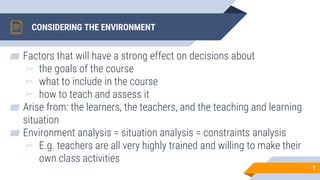
▰ Factors that will have a strong effect on decisions about
▻ the goals of the course
▻ what to include in the course
▻ how to teach and assess it
▰ Arise from: the learners, the teachers, and the teaching and learning
situation
▰ Environment analysis = situation analysis = constraints analysis
▻ E.g. teachers are all very highly trained and willing to make their
own class activities
2
CONSIDERING THE ENVIRONMENT
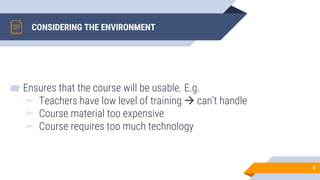
▰ Ensures that the course will be usable. E.g.
▻ Teachers have low level of training → can’t handle
▻ Course material too expensive
▻ Course requires too much technology
3
CONSIDERING THE ENVIRONMENT
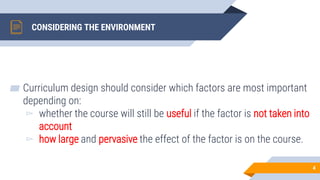
▰ Curriculum design should consider which factors are most important
depending on:
▻ whether the course will still be useful if the factor is not taken into
account
▻ how large and pervasive the effect of the factor is on the course.
4
AN EXAMPLE OF ENVIRONMENT ANALYSIS
▰ A course for young Japanese learners aged six to nine years old who
had lived in Englishspeaking countries while their parents were there
▰ They learned quite a lot of English in much the same way as native
speaking learners
▰ Once a week, 1.5 hours they attended a special class to help maintain
their English
▰ Could speak Japanese and were attending Japanese medium schools
in Japan.
5
AN EXAMPLE OF ENVIRONMENT ANALYSIS
6
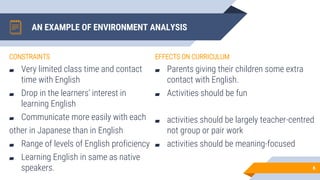
CONSTRAINTS
▰ Very limited class time and contact
time with English
▰ Drop in the learners’ interest in
learning English
▰ Communicate more easily with each
other in Japanese than in English
▰ Range of levels of English proficiency
▰ Learning English in same as native
speakers.
EFFECTS ON CURRICULUM
▰ Parents giving their children some extra
contact with English.
▰ Activities should be fun
▰ activities should be largely teacher-centred
not group or pair work
▰ activities should be meaning-focused
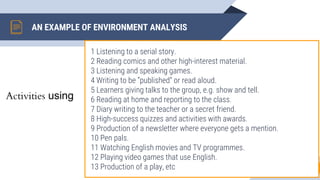
AN EXAMPLE OF ENVIRONMENT ANALYSIS
1 Listening to a serial story.
2 Reading comics and other high-interest material.
3 Listening and speaking games.
4 Writing to be “published” or read aloud.
5 Learners giving talks to the group, e.g. show and tell.
6 Reading at home and reporting to the class.
7 Diary writing to the teacher or a secret friend.
8 High-success quizzes and activities with awards.
9 Production of a newsletter where everyone gets a mention.
10 Pen pals.
11 Watching English movies and TV programmes.
12 Playing video games that use English.
13 Production of a play, etc 7
Activities using
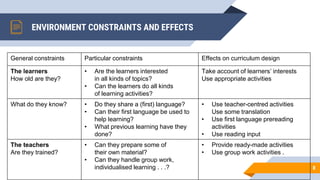
ENVIRONMENT CONSTRAINTS AND EFFECTS
8
General constraints Particular constraints Effects on curriculum design
The learners
How old are they?
• Are the learners interested
in all kinds of topics?
• Can the learners do all kinds
of learning activities?
Take account of learners’ interests
Use appropriate activities
What do they know? • Do they share a (first) language?
• Can their first language be used to
help learning?
• What previous learning have they
done?
• Use teacher-centred activities
Use some translation
• Use first language prereading
activities
• Use reading input
The teachers
Are they trained?
• Can they prepare some of
their own material?
• Can they handle group work,
individualised learning . . .?
• Provide ready-made activities
• Use group work activities .
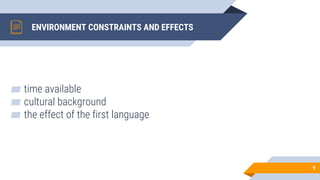
ENVIRONMENT CONSTRAINTS AND EFFECTS
▰ time available
▰ cultural background
▰ the effect of the first language
9
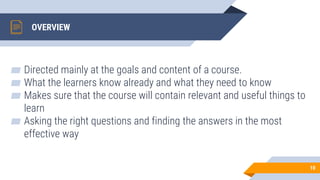
OVERVIEW
▰ Directed mainly at the goals and content of a course.
▰ What the learners know already and what they need to know
▰ Makes sure that the course will contain relevant and useful things to
learn
▰ Asking the right questions and finding the answers in the most
effective way
10
TASK 1
Imgine that you’re a lecturer at NTTU
Think of at least 3 constrainsts that may affect your teaching
Describe these constrainsts and say why they are important
How can you modify the syllabus?
11
TASK 2
A company would like to improve their employee’s speaking competence
so that they can join conferences with foreign customers.
▰ Ages: 24 – 35
▰ Time: 3 hours/week. (Flexible working time)
▰ Proficiency: Elementary to Preintermediate
Discuss a list of possible constraints and how they effect curriculum
design
12
Needs Analysis
WEEK 2 – CHAPTER 3 By NGUYEN MINH DUC
The aim of this part of the curriculum design
process is to discover what needs to be learned
and what the learners want to learn.
THE VARIOUS FOCUSES OF NEEDS ANALYSIS
Range of information that can be gathered in needs analysis
▰ target needs (i.e. what the learner needs to do in the target situation)
▰ learning needs:what the learner needs to do in order to learn
14
OTHER WAYS TO DISTINGUISH NEEDS
Present knowledge VS required knowledge
Objective needs VS subjective needs
15
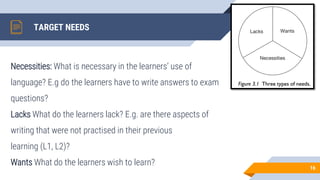
TARGET NEEDS
Necessities: What is necessary in the learners’ use of
language? E.g do the learners have to write answers to exam
questions?
Lacks What do the learners lack? E.g. are there aspects of
writing that were not practised in their previous
learning (L1, L2)?
Wants What do the learners wish to learn? 16
OBJECTIVE NEEDS
Information can be gathered by
▰ questionnaires,
▰ personal interviews
▰ data collection (gathering exam papers or text books and analysing
them)
▰ observation (for example, following a learner through a typical day),
informal consultation with teachers and learners, and tests
17
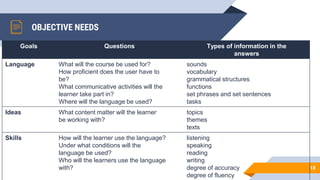
OBJECTIVE NEEDS
18
Goals Questions Types of information in the
answers
Language What will the course be used for?
How proficient does the user have to
be?
What communicative activities will the
learner take part in?
Where will the language be used?
sounds
vocabulary
grammatical structures
functions
set phrases and set sentences
tasks
Ideas What content matter will the learner
be working with?
topics
themes
texts
Skills How will the learner use the language?
Under what conditions will the
language be used?
Who will the learners use the language
with?
listening
speaking
reading
writing
degree of accuracy
degree of fluency
LACKS
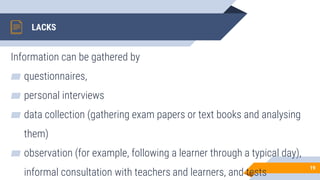
Information can be gathered by
▰ questionnaires,
▰ personal interviews
▰ data collection (gathering exam papers or text books and analysing
them)
▰ observation (for example, following a learner through a typical day),
informal consultation with teachers and learners, and tests
19
WANTS
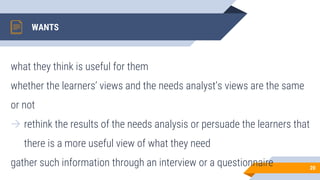
what they think is useful for them
whether the learners’ views and the needs analyst’s views are the same
or not
→ rethink the results of the needs analysis or persuade the learners that
there is a more useful view of what they need
gather such information through an interview or a questionnaire 20
EVALUATING NEEDS ANALYSIS
▰ Needs analysis is a kind of assessment
▰ Considering its reliability, validity and practicality
21
EVALUATING NEEDS ANALYSIS
Reliable:
▰ Observe people performing tasks after the course.
▰ Use a checklist, or by recording and apply standardized analysis
procedures.
22
EVALUATING NEEDS ANALYSIS
Validity:
▰ Look at what is relevant and important
▰ Do a ranking activity to decide what type of need should get priority in
the needs analysis investigation
23
EVALUATING NEEDS ANALYSIS
Practicality:
▰ not expensive
▰ not occupy too much of the learners’ and teacher’s time
▰ provides clear, easy-to-understand results
▰ easily be incorporated into the curriculum design process
24
ISSUES IN NEEDS ANALYSIS
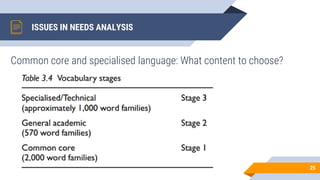
Common core and specialised language: What content to choose?
25
ISSUES IN NEEDS ANALYSIS
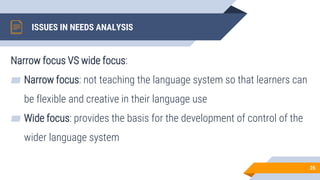
Narrow focus VS wide focus:
▰ Narrow focus: not teaching the language system so that learners can
be flexible and creative in their language use
▰ Wide focus: provides the basis for the development of control of the
wider language system
26
ISSUES IN NEEDS ANALYSIS
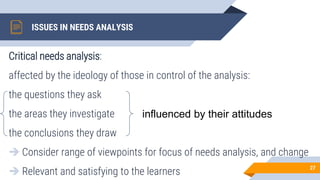
Critical needs analysis:
affected by the ideology of those in control of the analysis:
the questions they ask
the areas they investigate
the conclusions they draw
➔ Consider range of viewpoints for focus of needs analysis, and change
➔ Relevant and satisfying to the learners 27
influenced by their attitudes
SUMMARY OF THE STEPS
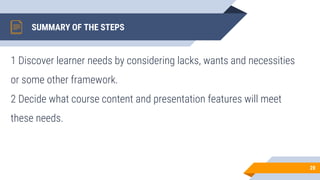
1 Discover learner needs by considering lacks, wants and necessities
or some other framework.
2 Decide what course content and presentation features will meet
these needs.
28

Curriculum Design - Environment Analysis

  • 1.
    Evironment Analysis Need WEEK 2– CHAPTER 2 The aim of this part of the curriculum design process is to find the situational factors that will strongly affect the course.
  • 2.
    CONSIDERING THE ENVIRONMENT ▰Factors that will have a strong effect on decisions about ▻ the goals of the course ▻ what to include in the course ▻ how to teach and assess it ▰ Arise from: the learners, the teachers, and the teaching and learning situation ▰ Environment analysis = situation analysis = constraints analysis ▻ E.g. teachers are all very highly trained and willing to make their own class activities 2
  • 3.
    CONSIDERING THE ENVIRONMENT ▰Ensures that the course will be usable. E.g. ▻ Teachers have low level of training → can’t handle ▻ Course material too expensive ▻ Course requires too much technology 3
  • 4.
    CONSIDERING THE ENVIRONMENT ▰Curriculum design should consider which factors are most important depending on: ▻ whether the course will still be useful if the factor is not taken into account ▻ how large and pervasive the effect of the factor is on the course. 4
  • 5.
    AN EXAMPLE OFENVIRONMENT ANALYSIS ▰ A course for young Japanese learners aged six to nine years old who had lived in Englishspeaking countries while their parents were there ▰ They learned quite a lot of English in much the same way as native speaking learners ▰ Once a week, 1.5 hours they attended a special class to help maintain their English ▰ Could speak Japanese and were attending Japanese medium schools in Japan. 5
  • 6.
    AN EXAMPLE OFENVIRONMENT ANALYSIS 6 CONSTRAINTS ▰ Very limited class time and contact time with English ▰ Drop in the learners’ interest in learning English ▰ Communicate more easily with each other in Japanese than in English ▰ Range of levels of English proficiency ▰ Learning English in same as native speakers. EFFECTS ON CURRICULUM ▰ Parents giving their children some extra contact with English. ▰ Activities should be fun ▰ activities should be largely teacher-centred not group or pair work ▰ activities should be meaning-focused
  • 7.
    AN EXAMPLE OFENVIRONMENT ANALYSIS 1 Listening to a serial story. 2 Reading comics and other high-interest material. 3 Listening and speaking games. 4 Writing to be “published” or read aloud. 5 Learners giving talks to the group, e.g. show and tell. 6 Reading at home and reporting to the class. 7 Diary writing to the teacher or a secret friend. 8 High-success quizzes and activities with awards. 9 Production of a newsletter where everyone gets a mention. 10 Pen pals. 11 Watching English movies and TV programmes. 12 Playing video games that use English. 13 Production of a play, etc 7 Activities using
  • 8.
    ENVIRONMENT CONSTRAINTS ANDEFFECTS 8 General constraints Particular constraints Effects on curriculum design The learners How old are they? • Are the learners interested in all kinds of topics? • Can the learners do all kinds of learning activities? Take account of learners’ interests Use appropriate activities What do they know? • Do they share a (first) language? • Can their first language be used to help learning? • What previous learning have they done? • Use teacher-centred activities Use some translation • Use first language prereading activities • Use reading input The teachers Are they trained? • Can they prepare some of their own material? • Can they handle group work, individualised learning . . .? • Provide ready-made activities • Use group work activities .
  • 9.
    ENVIRONMENT CONSTRAINTS ANDEFFECTS ▰ time available ▰ cultural background ▰ the effect of the first language 9
  • 10.
    OVERVIEW ▰ Directed mainlyat the goals and content of a course. ▰ What the learners know already and what they need to know ▰ Makes sure that the course will contain relevant and useful things to learn ▰ Asking the right questions and finding the answers in the most effective way 10
  • 11.
    TASK 1 Imgine thatyou’re a lecturer at NTTU Think of at least 3 constrainsts that may affect your teaching Describe these constrainsts and say why they are important How can you modify the syllabus? 11
  • 12.
    TASK 2 A companywould like to improve their employee’s speaking competence so that they can join conferences with foreign customers. ▰ Ages: 24 – 35 ▰ Time: 3 hours/week. (Flexible working time) ▰ Proficiency: Elementary to Preintermediate Discuss a list of possible constraints and how they effect curriculum design 12
  • 13.
    Needs Analysis WEEK 2– CHAPTER 3 By NGUYEN MINH DUC The aim of this part of the curriculum design process is to discover what needs to be learned and what the learners want to learn.
  • 14.
    THE VARIOUS FOCUSESOF NEEDS ANALYSIS Range of information that can be gathered in needs analysis ▰ target needs (i.e. what the learner needs to do in the target situation) ▰ learning needs:what the learner needs to do in order to learn 14
  • 15.
    OTHER WAYS TODISTINGUISH NEEDS Present knowledge VS required knowledge Objective needs VS subjective needs 15
  • 16.
    TARGET NEEDS Necessities: Whatis necessary in the learners’ use of language? E.g do the learners have to write answers to exam questions? Lacks What do the learners lack? E.g. are there aspects of writing that were not practised in their previous learning (L1, L2)? Wants What do the learners wish to learn? 16
  • 17.
    OBJECTIVE NEEDS Information canbe gathered by ▰ questionnaires, ▰ personal interviews ▰ data collection (gathering exam papers or text books and analysing them) ▰ observation (for example, following a learner through a typical day), informal consultation with teachers and learners, and tests 17
  • 18.
    OBJECTIVE NEEDS 18 Goals QuestionsTypes of information in the answers Language What will the course be used for? How proficient does the user have to be? What communicative activities will the learner take part in? Where will the language be used? sounds vocabulary grammatical structures functions set phrases and set sentences tasks Ideas What content matter will the learner be working with? topics themes texts Skills How will the learner use the language? Under what conditions will the language be used? Who will the learners use the language with? listening speaking reading writing degree of accuracy degree of fluency
  • 19.
    LACKS Information can begathered by ▰ questionnaires, ▰ personal interviews ▰ data collection (gathering exam papers or text books and analysing them) ▰ observation (for example, following a learner through a typical day), informal consultation with teachers and learners, and tests 19
  • 20.
    WANTS what they thinkis useful for them whether the learners’ views and the needs analyst’s views are the same or not → rethink the results of the needs analysis or persuade the learners that there is a more useful view of what they need gather such information through an interview or a questionnaire 20
  • 21.
    EVALUATING NEEDS ANALYSIS ▰Needs analysis is a kind of assessment ▰ Considering its reliability, validity and practicality 21
  • 22.
    EVALUATING NEEDS ANALYSIS Reliable: ▰Observe people performing tasks after the course. ▰ Use a checklist, or by recording and apply standardized analysis procedures. 22
  • 23.
    EVALUATING NEEDS ANALYSIS Validity: ▰Look at what is relevant and important ▰ Do a ranking activity to decide what type of need should get priority in the needs analysis investigation 23
  • 24.
    EVALUATING NEEDS ANALYSIS Practicality: ▰not expensive ▰ not occupy too much of the learners’ and teacher’s time ▰ provides clear, easy-to-understand results ▰ easily be incorporated into the curriculum design process 24
  • 25.
    ISSUES IN NEEDSANALYSIS Common core and specialised language: What content to choose? 25
  • 26.
    ISSUES IN NEEDSANALYSIS Narrow focus VS wide focus: ▰ Narrow focus: not teaching the language system so that learners can be flexible and creative in their language use ▰ Wide focus: provides the basis for the development of control of the wider language system 26
  • 27.
    ISSUES IN NEEDSANALYSIS Critical needs analysis: affected by the ideology of those in control of the analysis: the questions they ask the areas they investigate the conclusions they draw ➔ Consider range of viewpoints for focus of needs analysis, and change ➔ Relevant and satisfying to the learners 27 influenced by their attitudes
  • 28.
    SUMMARY OF THESTEPS 1 Discover learner needs by considering lacks, wants and necessities or some other framework. 2 Decide what course content and presentation features will meet these needs. 28