10.2 The Glorious Revolution of England and the Rise of constitutional monarchies.1The Restoration and the Glorious Revolution
10.2 The Glorious Revolution of England and the Rise of constitutional monarchies.2TopicsCharles II ( R. 1660-1685) James II (R. 1685-1689 )The Glorious Revolution.
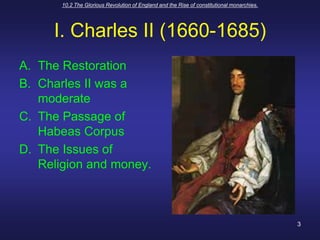
10.2 The Glorious Revolution of England and the Rise of constitutional monarchies.3I. Charles II (1660-1685)The RestorationCharles II was a moderateThe Passage of Habeas CorpusThe Issues of Religion and money.
10.2 The Glorious Revolution of England and the Rise of constitutional monarchies.4A. The Restoration.Parliament invited Charles Stuart back to Restore the Monarchy.He was the Merry MonarchHe brought back the theater and woman where included.Sporting events and merry making were welcome.
10.2 The Glorious Revolution of England and the Rise of constitutional monarchies.5B. Charles II was a moderate.He did not believe in Divine Right.Preferred Religious tolerationWas secretly CatholicAccepted both Protestants and Catholics.He accepted a role of Parliament.Passage of Habeas Corpus
10.2 The Glorious Revolution of England and the Rise of constitutional monarchies.6C. The Passage of Habeas Corpus.Citizen’s have a right for a trial before a judge.They could not be held indefinitely.Right to know the charges against you.
10.2 The Glorious Revolution of England and the Rise of constitutional monarchies.7D. The Issues of Religion and Money.Charles II signs Treaty of DoverFrance and Britain versus the Dutch Charles will receive money every year.He must become Catholic at a later date.Parliament fears Catholic influencesCharles issues the Declaration of IndulgenceSuspends laws against CatholicsParliament suspends funding for war as response Parliament passes Test actOfficials must denounce substantiationAn attack on Catholics
10.2 The Glorious Revolution of England and the Rise of constitutional monarchies.8Cont…James II , brother, was the heir and devout  Catholic.Whigs formed against James II.Tories remained in support of the monarchy.
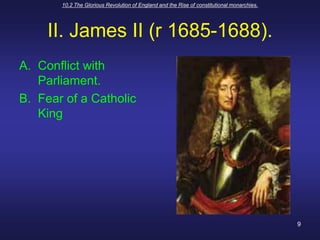
10.2 The Glorious Revolution of England and the Rise of constitutional monarchies.9II. James II (r 1685-1688).Conflict with Parliament.Fear of a Catholic King
10.2 The Glorious Revolution of England and the Rise of constitutional monarchies.10A. James II and his conflict with parliament.He believed in Divine Right.Demanded repeal of Test Actappointed Catholics to high political offices.lost support of the ToriesJames II dissolves parliament as a response.James II places 13,000 troops outside of London.
10.2 The Glorious Revolution of England and the Rise of constitutional monarchies.11B. Fear of a Catholic Line of Kings.James II and his second wife have a son.Protestants fear that England will have a line of Catholic Kings in England.James II religion as well as his willingness to use the crown’s power led to his downfall.
10.2 The Glorious Revolution of England and the Rise of constitutional monarchies.12III. The Glorious RevolutionGlorious RevolutionWilliam and Mary
10.2 The Glorious Revolution of England and the Rise of constitutional monarchies.13A. The Glorious Revolution of 1688Parliament turns to James II first child, Mary, who was raised a protestant and married William of Orange.Parliament asks them to be the new King and Queen of England.William and Mary arrive and achieve victory in a bloodless revolution.
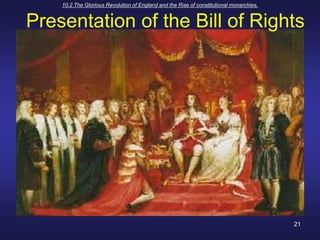
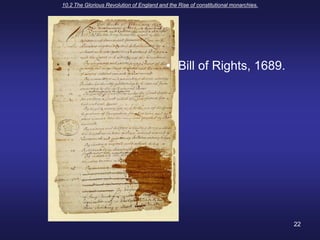
10.2 The Glorious Revolution of England and the Rise of constitutional monarchies.14B. William and Mary accept the role of Parliament.Parliament passed the English bill of Rights.New restrictions were placed on the Monarchy.No suspending parliaments laws.No levying taxes without parliament approval.Freedom of speech for members of parliamentNo excessive bailNo standing army in times of peace.
10.2 The Glorious Revolution of England and the Rise of constitutional monarchies.15I. British Constitutional MonarchyParliament and Crown shared power.Development of the cabinet.Role of Prime Minister
10.2 The Glorious Revolution of England and the Rise of constitutional monarchies.16A. Parliament and the Crown shared Power.Since Glorious Revolution England had a Constitutional Monarchy.Power of crown became increasingly limited by law.If Parliament and Crown disagreed, it became difficult to accomplish anything.How to break a tie???
10.2 The Glorious Revolution of England and the Rise of constitutional monarchies.17B. Development of the Cabinet.Executive committee develops to improve communication between parliament and Crown.Originally it was the Monarchs closest friends.Gradually became majority party officials.King would gain more influence in Parliament.
10.2 The Glorious Revolution of England and the Rise of constitutional monarchies.18C. Role of Prime Minister.1714 last of Stuart family dies.Hanover dynasty begins.George I could not speak English.Sir Robert Walpole acted as leader of England for 20 years.Under Walpole leader of Majority party became Prime Minister.
10.2 The Glorious Revolution of England and the Rise of constitutional monarchies.19What do we Know?Religion and the crown’s absolutism were major causes to the Glorious Revolution?The Revolution prevented a Catholic line of Kings in England.The Revolution also demonstrated a major shift in power from the Crown to Parliament.
10.2 The Glorious Revolution of England and the Rise of constitutional monarchies.20Terms	Habeas CorpusBill of RightsAbsolute MonarchyRestorationCharles IIJohn MiltonToryWhigJames IIWilliam and MaryGlorious Revolution
10.2 The Glorious Revolution of England and the Rise of constitutional monarchies.21Presentation of the Bill of Rights
10.2 The Glorious Revolution of England and the Rise of constitutional monarchies.22Bill of Rights, 1689.
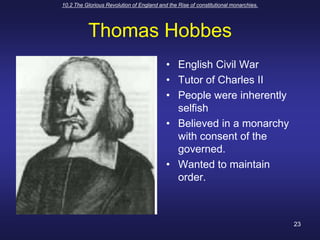
10.2 The Glorious Revolution of England and the Rise of constitutional monarchies.23Thomas HobbesEnglish Civil WarTutor of Charles IIPeople were inherently selfishBelieved in a monarchy with consent of the governed.Wanted to maintain order.
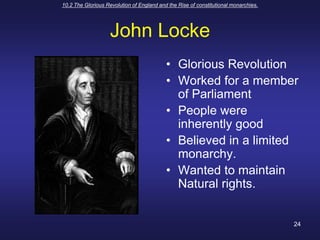
10.2 The Glorious Revolution of England and the Rise of constitutional monarchies.24John LockeGlorious RevolutionWorked for a member of ParliamentPeople were inherently goodBelieved in a limited monarchy.Wanted to maintain Natural rights.

Topic 3 The Glourious Revolution

  • 1.
    10.2 The GloriousRevolution of England and the Rise of constitutional monarchies.1The Restoration and the Glorious Revolution
  • 2.
    10.2 The GloriousRevolution of England and the Rise of constitutional monarchies.2TopicsCharles II ( R. 1660-1685) James II (R. 1685-1689 )The Glorious Revolution.
  • 3.
    10.2 The GloriousRevolution of England and the Rise of constitutional monarchies.3I. Charles II (1660-1685)The RestorationCharles II was a moderateThe Passage of Habeas CorpusThe Issues of Religion and money.
  • 4.
    10.2 The GloriousRevolution of England and the Rise of constitutional monarchies.4A. The Restoration.Parliament invited Charles Stuart back to Restore the Monarchy.He was the Merry MonarchHe brought back the theater and woman where included.Sporting events and merry making were welcome.
  • 5.
    10.2 The GloriousRevolution of England and the Rise of constitutional monarchies.5B. Charles II was a moderate.He did not believe in Divine Right.Preferred Religious tolerationWas secretly CatholicAccepted both Protestants and Catholics.He accepted a role of Parliament.Passage of Habeas Corpus
  • 6.
    10.2 The GloriousRevolution of England and the Rise of constitutional monarchies.6C. The Passage of Habeas Corpus.Citizen’s have a right for a trial before a judge.They could not be held indefinitely.Right to know the charges against you.
  • 7.
    10.2 The GloriousRevolution of England and the Rise of constitutional monarchies.7D. The Issues of Religion and Money.Charles II signs Treaty of DoverFrance and Britain versus the Dutch Charles will receive money every year.He must become Catholic at a later date.Parliament fears Catholic influencesCharles issues the Declaration of IndulgenceSuspends laws against CatholicsParliament suspends funding for war as response Parliament passes Test actOfficials must denounce substantiationAn attack on Catholics
  • 8.
    10.2 The GloriousRevolution of England and the Rise of constitutional monarchies.8Cont…James II , brother, was the heir and devout Catholic.Whigs formed against James II.Tories remained in support of the monarchy.
  • 9.
    10.2 The GloriousRevolution of England and the Rise of constitutional monarchies.9II. James II (r 1685-1688).Conflict with Parliament.Fear of a Catholic King
  • 10.
    10.2 The GloriousRevolution of England and the Rise of constitutional monarchies.10A. James II and his conflict with parliament.He believed in Divine Right.Demanded repeal of Test Actappointed Catholics to high political offices.lost support of the ToriesJames II dissolves parliament as a response.James II places 13,000 troops outside of London.
  • 11.
    10.2 The GloriousRevolution of England and the Rise of constitutional monarchies.11B. Fear of a Catholic Line of Kings.James II and his second wife have a son.Protestants fear that England will have a line of Catholic Kings in England.James II religion as well as his willingness to use the crown’s power led to his downfall.
  • 12.
    10.2 The GloriousRevolution of England and the Rise of constitutional monarchies.12III. The Glorious RevolutionGlorious RevolutionWilliam and Mary
  • 13.
    10.2 The GloriousRevolution of England and the Rise of constitutional monarchies.13A. The Glorious Revolution of 1688Parliament turns to James II first child, Mary, who was raised a protestant and married William of Orange.Parliament asks them to be the new King and Queen of England.William and Mary arrive and achieve victory in a bloodless revolution.
  • 14.
    10.2 The GloriousRevolution of England and the Rise of constitutional monarchies.14B. William and Mary accept the role of Parliament.Parliament passed the English bill of Rights.New restrictions were placed on the Monarchy.No suspending parliaments laws.No levying taxes without parliament approval.Freedom of speech for members of parliamentNo excessive bailNo standing army in times of peace.
  • 15.
    10.2 The GloriousRevolution of England and the Rise of constitutional monarchies.15I. British Constitutional MonarchyParliament and Crown shared power.Development of the cabinet.Role of Prime Minister
  • 16.
    10.2 The GloriousRevolution of England and the Rise of constitutional monarchies.16A. Parliament and the Crown shared Power.Since Glorious Revolution England had a Constitutional Monarchy.Power of crown became increasingly limited by law.If Parliament and Crown disagreed, it became difficult to accomplish anything.How to break a tie???
  • 17.
    10.2 The GloriousRevolution of England and the Rise of constitutional monarchies.17B. Development of the Cabinet.Executive committee develops to improve communication between parliament and Crown.Originally it was the Monarchs closest friends.Gradually became majority party officials.King would gain more influence in Parliament.
  • 18.
    10.2 The GloriousRevolution of England and the Rise of constitutional monarchies.18C. Role of Prime Minister.1714 last of Stuart family dies.Hanover dynasty begins.George I could not speak English.Sir Robert Walpole acted as leader of England for 20 years.Under Walpole leader of Majority party became Prime Minister.
  • 19.
    10.2 The GloriousRevolution of England and the Rise of constitutional monarchies.19What do we Know?Religion and the crown’s absolutism were major causes to the Glorious Revolution?The Revolution prevented a Catholic line of Kings in England.The Revolution also demonstrated a major shift in power from the Crown to Parliament.
  • 20.
    10.2 The GloriousRevolution of England and the Rise of constitutional monarchies.20Terms Habeas CorpusBill of RightsAbsolute MonarchyRestorationCharles IIJohn MiltonToryWhigJames IIWilliam and MaryGlorious Revolution
  • 21.
    10.2 The GloriousRevolution of England and the Rise of constitutional monarchies.21Presentation of the Bill of Rights
  • 22.
    10.2 The GloriousRevolution of England and the Rise of constitutional monarchies.22Bill of Rights, 1689.
  • 23.
    10.2 The GloriousRevolution of England and the Rise of constitutional monarchies.23Thomas HobbesEnglish Civil WarTutor of Charles IIPeople were inherently selfishBelieved in a monarchy with consent of the governed.Wanted to maintain order.
  • 24.
    10.2 The GloriousRevolution of England and the Rise of constitutional monarchies.24John LockeGlorious RevolutionWorked for a member of ParliamentPeople were inherently goodBelieved in a limited monarchy.Wanted to maintain Natural rights.