Freedom of Religion Chapter 19 Section 2
Topics The Establishment Clause Lemon vs. Kurtz, 1971 The Free Exercise Clause
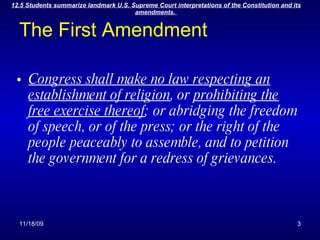
The First Amendment Congress shall make no law respecting an establishment of religion , or  prohibiting the free exercise thereof ; or abridging the freedom of speech, or of the press; or the right of the people peaceably to assemble, and to petition the government for a redress of grievances.
I. The Establishment Clause The Establishment Clause Establishment and Education Release Time School Prayer Student Groups Evolution
A. The Establishment Clause “ Congress shall make no law respecting the establishment of religion….” Christianity has many interpretations  Prevents the adoption of a national religion Insures a separation of Church and State The U.S. still has a religious history Predominantly Christian Has changed with immigration
B. Establishment and Education Everson vs. Board of Education,1947 Issue : Can a state fund busing of students to parochial schools? Yes, it was in the interest of the state to protect children. (Student safety in Busing) Affirmed that not all forms of state and federal aid to church related schools are outlawed.
C. Release Time McCollum vs. Board of Education, 1948 . Issue : Can students be released from public school for religious instruction? Classrooms could not be used for religious instruction. Use of Classrooms implied endorsement. Zorach vs. Clauson,1952 Release time was allowed if instruction was off campus.
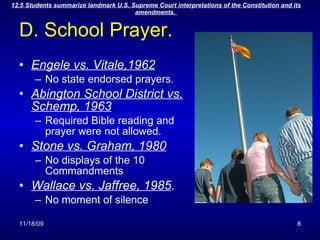
D. School Prayer. Engele vs. Vitale,1962 No state endorsed prayers. Abington School District vs. Schemp, 1963 Required Bible reading and prayer were not allowed. Stone vs. Graham, 1980 No displays of the 10 Commandments Wallace vs. Jaffree, 1985 . No moment of silence
E. Student religious Groups Equal Access act of 1984 Any school that receives federal funds, must allow student religious groups to meet on campus. Court has upheld this several times. Westside community schools vs. Mergen, 1990 Good News Club vs. Milford Central school, 2001.
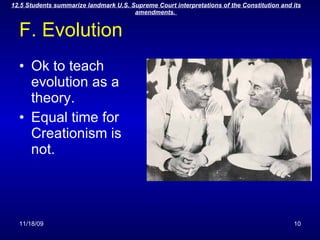
F. Evolution Ok to teach evolution as a theory. Equal time for Creationism is not.
What does it mean??? It is  not unconstitutional  to pray in school School led prayer  implies state endorsement No religious action can be endorsed by the school You can still study the Bible if it is  secular  in nature.
II. The Lemon Test Lemon vs. Kurtz 1971 The Lemon Test Aid to Parochial Schools. Seasonal displays Chaplains
A. Lemon vs. Kurtz 1971 Pennsylvania law allowed for public payment of parochial schools teacher salaries, books, and supplies. Court argued that sponsorship, financial support, and involvement in religious activity violated the establishment clause.
B. The Lemon Test This decision attempted to develop a test to determine violations of the establishment clause. First : law must have a secular purpose. Second : it must have the effect of neither inhibiting or advancing a religion. Third : it must not foster excessive government entanglement with religion.
C. Aid to Parochial Schools. All aid to parochial schools should (???) pass the Lemon test. Mueller vs. Allen, 1983. Can parents claim a tax deduction for tuition to private schools. Yes, it benefits all parents. Court does allow states to pay for tests, grants for sex education, interpreters.
D. Seasonal Displays. Lynch vs. Donnelly, 1984: can a display of the nativity be placed in city hall? No, cannot endorse one religion over others. Alleghany vs. ACLU, 1984 Multiple religious displays from several religions are ok.
F. Chaplains Legislatures often open a session with a prayer. Acceptable for two reasons. A practice since colonial times Legislators are not impressionable children.
III. The Free Exercise Clause.  Free Exercise Clause Reynolds vs. United States. 1879. Limits on  Free Exercise Free Exercise protected. A standard??? Issue of Flag salute.
A. Free Exercise Clause The Free Exercise clause allows us to  believe  and  worship  as we wish. But what about about religious  action ? In general the court supports an absolute right to belief. The issue of Practice is different.
B. Reynolds vs. United States. 1879. Reynolds vs. United States,  1879 . Could a Mormon be Polygamous? Believe it, yes. Practice, no. Congress has power to punish violations of social duties or subversive good order.
C. Limits on  Free Exercise Practice is allowed as long as health safety and morals of general public are protected. Jacobson vs. Massachusetts. 1905 State laws requiring vaccination were upheld Bunn vs. North Carolina, 1949. Forbid use of poisonous snakes in religious rites. Lukumi Babalu Aye vs. City of Hialeah, 1993. City ordinance against animal sacrifice Court ruled against ordnance
D. Free Exercise protected. Wisconsin vs. Yoder. 1972 Amish were not required to attend public schools after 8 th  grade. Ministers can hold public office.
E. Does a standard exist? Court wants to protect “ those beliefs rooted in religion”. What does that mean?????
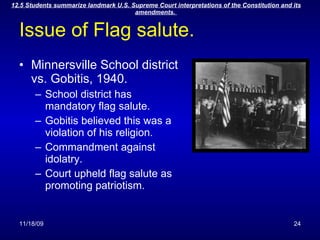
Issue of Flag salute. Minnersville School district vs. Gobitis, 1940. School district has mandatory flag salute. Gobitis believed this was a violation of his religion. Commandment against idolatry. Court upheld flag salute as promoting patriotism.
Continued  West Virginia B of E vs. Burnette, 1943.  Another compulsory flag salute case. Court reversed decision. Why?
Terms Establishment Clause Free Exercise Clause Parochial The Lemon Test Everson vs. Board of Education,1947 McCollum vs. Board of Education, 1948 . Zorach vs. Clauson,1952 Equal Access act of 1984 Lemon vs. Kurtz 1971 Reynolds vs. United States. 1879 Jacobson vs. Massachusetts. 1905 Wisconsin vs. Yoder. 1972
In summary Explain the establishment and free exercise clause. How have establishment cases involved schools? Explain the lemon test. How has free exercise been limited? How has free exercise been protected?

Ch 19 Sec 2 Religion

  • 1.
    Freedom of ReligionChapter 19 Section 2
  • 2.
    Topics The EstablishmentClause Lemon vs. Kurtz, 1971 The Free Exercise Clause
  • 3.
    The First AmendmentCongress shall make no law respecting an establishment of religion , or prohibiting the free exercise thereof ; or abridging the freedom of speech, or of the press; or the right of the people peaceably to assemble, and to petition the government for a redress of grievances.
  • 4.
    I. The EstablishmentClause The Establishment Clause Establishment and Education Release Time School Prayer Student Groups Evolution
  • 5.
    A. The EstablishmentClause “ Congress shall make no law respecting the establishment of religion….” Christianity has many interpretations Prevents the adoption of a national religion Insures a separation of Church and State The U.S. still has a religious history Predominantly Christian Has changed with immigration
  • 6.
    B. Establishment andEducation Everson vs. Board of Education,1947 Issue : Can a state fund busing of students to parochial schools? Yes, it was in the interest of the state to protect children. (Student safety in Busing) Affirmed that not all forms of state and federal aid to church related schools are outlawed.
  • 7.
    C. Release TimeMcCollum vs. Board of Education, 1948 . Issue : Can students be released from public school for religious instruction? Classrooms could not be used for religious instruction. Use of Classrooms implied endorsement. Zorach vs. Clauson,1952 Release time was allowed if instruction was off campus.
  • 8.
    D. School Prayer.Engele vs. Vitale,1962 No state endorsed prayers. Abington School District vs. Schemp, 1963 Required Bible reading and prayer were not allowed. Stone vs. Graham, 1980 No displays of the 10 Commandments Wallace vs. Jaffree, 1985 . No moment of silence
  • 9.
    E. Student religiousGroups Equal Access act of 1984 Any school that receives federal funds, must allow student religious groups to meet on campus. Court has upheld this several times. Westside community schools vs. Mergen, 1990 Good News Club vs. Milford Central school, 2001.
  • 10.
    F. Evolution Okto teach evolution as a theory. Equal time for Creationism is not.
  • 11.
    What does itmean??? It is not unconstitutional to pray in school School led prayer implies state endorsement No religious action can be endorsed by the school You can still study the Bible if it is secular in nature.
  • 12.
    II. The LemonTest Lemon vs. Kurtz 1971 The Lemon Test Aid to Parochial Schools. Seasonal displays Chaplains
  • 13.
    A. Lemon vs.Kurtz 1971 Pennsylvania law allowed for public payment of parochial schools teacher salaries, books, and supplies. Court argued that sponsorship, financial support, and involvement in religious activity violated the establishment clause.
  • 14.
    B. The LemonTest This decision attempted to develop a test to determine violations of the establishment clause. First : law must have a secular purpose. Second : it must have the effect of neither inhibiting or advancing a religion. Third : it must not foster excessive government entanglement with religion.
  • 15.
    C. Aid toParochial Schools. All aid to parochial schools should (???) pass the Lemon test. Mueller vs. Allen, 1983. Can parents claim a tax deduction for tuition to private schools. Yes, it benefits all parents. Court does allow states to pay for tests, grants for sex education, interpreters.
  • 16.
    D. Seasonal Displays.Lynch vs. Donnelly, 1984: can a display of the nativity be placed in city hall? No, cannot endorse one religion over others. Alleghany vs. ACLU, 1984 Multiple religious displays from several religions are ok.
  • 17.
    F. Chaplains Legislaturesoften open a session with a prayer. Acceptable for two reasons. A practice since colonial times Legislators are not impressionable children.
  • 18.
    III. The FreeExercise Clause. Free Exercise Clause Reynolds vs. United States. 1879. Limits on Free Exercise Free Exercise protected. A standard??? Issue of Flag salute.
  • 19.
    A. Free ExerciseClause The Free Exercise clause allows us to believe and worship as we wish. But what about about religious action ? In general the court supports an absolute right to belief. The issue of Practice is different.
  • 20.
    B. Reynolds vs.United States. 1879. Reynolds vs. United States, 1879 . Could a Mormon be Polygamous? Believe it, yes. Practice, no. Congress has power to punish violations of social duties or subversive good order.
  • 21.
    C. Limits on Free Exercise Practice is allowed as long as health safety and morals of general public are protected. Jacobson vs. Massachusetts. 1905 State laws requiring vaccination were upheld Bunn vs. North Carolina, 1949. Forbid use of poisonous snakes in religious rites. Lukumi Babalu Aye vs. City of Hialeah, 1993. City ordinance against animal sacrifice Court ruled against ordnance
  • 22.
    D. Free Exerciseprotected. Wisconsin vs. Yoder. 1972 Amish were not required to attend public schools after 8 th grade. Ministers can hold public office.
  • 23.
    E. Does astandard exist? Court wants to protect “ those beliefs rooted in religion”. What does that mean?????
  • 24.
    Issue of Flagsalute. Minnersville School district vs. Gobitis, 1940. School district has mandatory flag salute. Gobitis believed this was a violation of his religion. Commandment against idolatry. Court upheld flag salute as promoting patriotism.
  • 25.
    Continued WestVirginia B of E vs. Burnette, 1943. Another compulsory flag salute case. Court reversed decision. Why?
  • 26.
    Terms Establishment ClauseFree Exercise Clause Parochial The Lemon Test Everson vs. Board of Education,1947 McCollum vs. Board of Education, 1948 . Zorach vs. Clauson,1952 Equal Access act of 1984 Lemon vs. Kurtz 1971 Reynolds vs. United States. 1879 Jacobson vs. Massachusetts. 1905 Wisconsin vs. Yoder. 1972
  • 27.
    In summary Explainthe establishment and free exercise clause. How have establishment cases involved schools? Explain the lemon test. How has free exercise been limited? How has free exercise been protected?