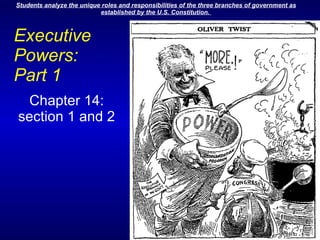
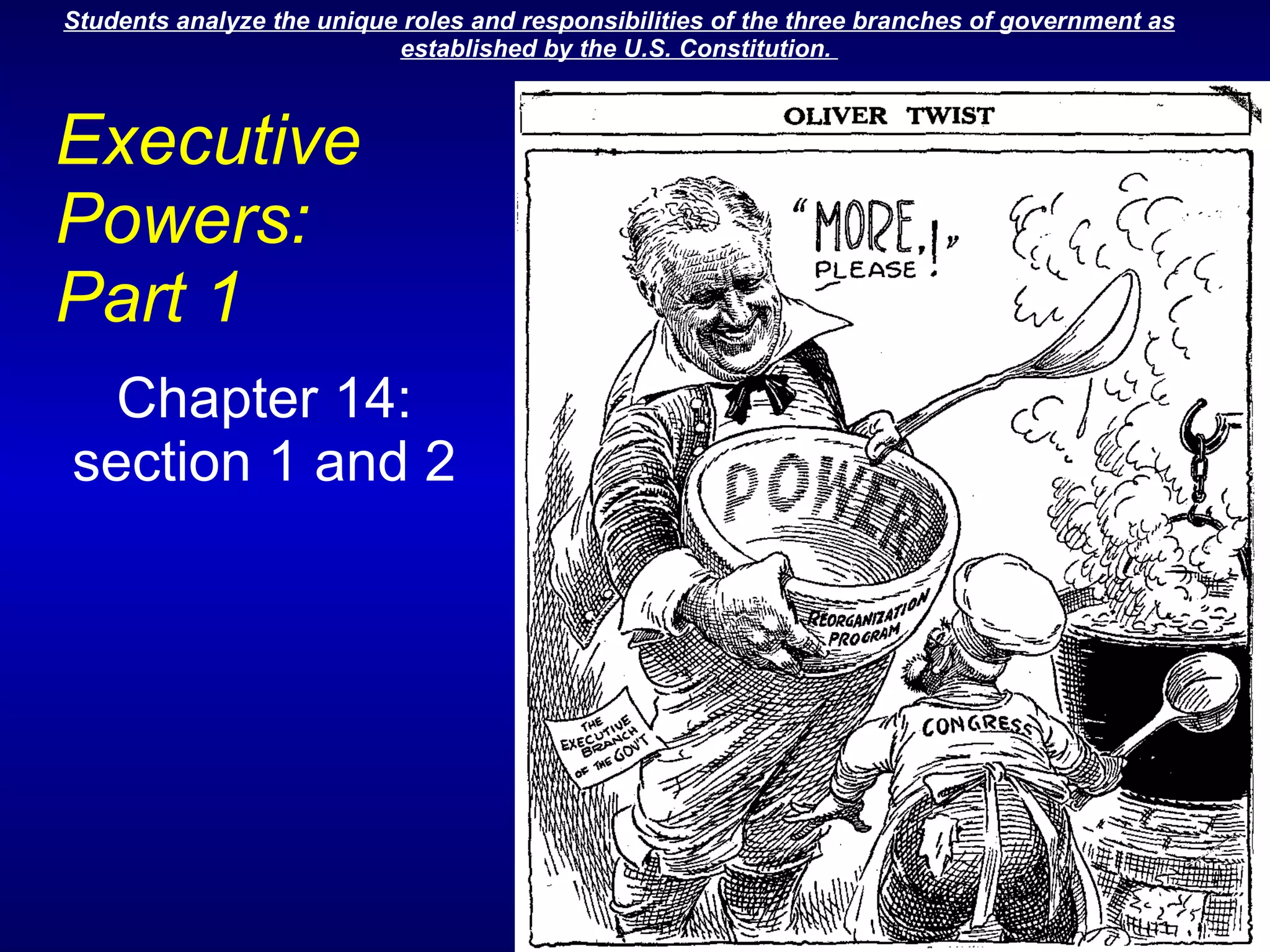
Executive Powers:  Part 1  Chapter 14: section 1 and 2
Topics Growth of the Office The Executive Powers
I. Growth of the Office Early Executive power Why has executive power grown? The Modern Presidency
A. Early Executive power Typically was weak. Limited by Washington himself Many believed in stronger State governments Executive branch had a small staff Congress was seen to have most of the power. It was the first branch It was deemed as inherently more democratic
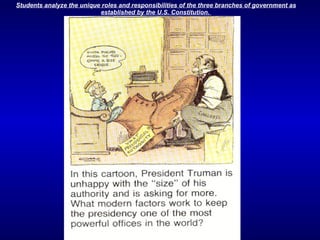
B. Why has executive power grown? Personal style matters The Legislative branch is divided. The President is unified The Power of crisis has impacted the power of the Presidency Many expect stronger action from the executive to address modern issues Media tends to focus on the Presidency.
C. The Modern Presidency People usually look to one leader. It is easier. Sets the agenda. Influence of the media. Rise of the Federal bureaucracy to execute the law
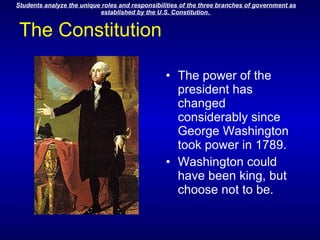
The Constitution The power of the president has changed considerably since George Washington took power in 1789. Washington could have been king, but choose not to be.                                               
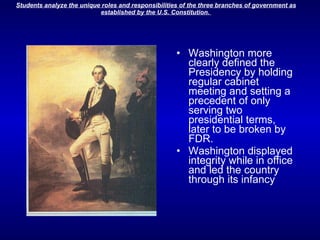
Washington more clearly defined the Presidency by holding regular cabinet meeting and setting a precedent of only serving two presidential terms, later to be broken by FDR.  Washington displayed integrity while in office and led the country through its infancy
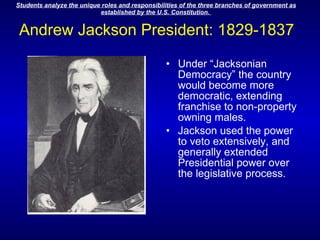
Andrew Jackson President: 1829-1837 Under “Jacksonian Democracy” the country would become more democratic, extending franchise to non-property owning males. Jackson used the power to veto extensively, and generally extended Presidential power over the legislative process.
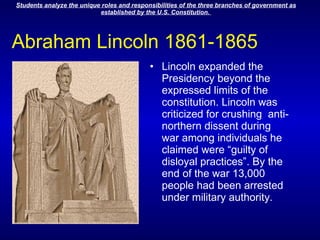
Abraham Lincoln 1861-1865 Lincoln expanded the Presidency beyond the expressed limits of the constitution. Lincoln was criticized for crushing  anti-northern dissent during war among individuals he claimed were “guilty of disloyal practices”. By the end of the war 13,000 people had been arrested under military authority.
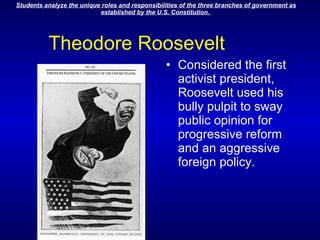
Theodore Roosevelt Considered the first activist president, Roosevelt used his bully pulpit to sway public opinion for progressive reform and an aggressive foreign policy.
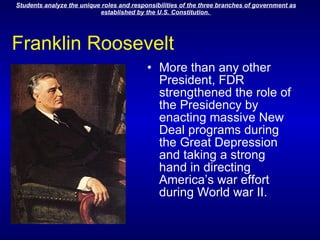
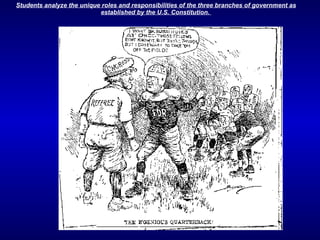
Franklin Roosevelt More than any other President, FDR strengthened the role of the Presidency by enacting massive New Deal programs during the Great Depression and taking a strong hand in directing America’s war effort during World war II.                                             
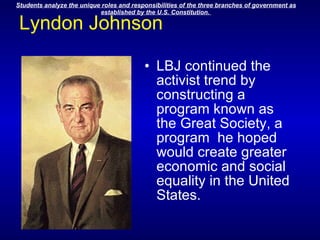
Lyndon Johnson LBJ continued the activist trend by constructing a program known as the Great Society, a program  he hoped would create greater economic and social equality in the United States.                                              
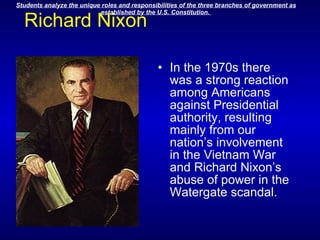
Richard Nixon In the 1970s there was a strong reaction among Americans against Presidential authority, resulting mainly from our nation’s involvement in the Vietnam War and Richard Nixon’s abuse of power in the Watergate scandal.                                           
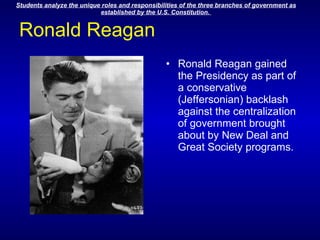
Ronald Reagan Ronald Reagan gained the Presidency as part of a conservative (Jeffersonian) backlash against the centralization of government brought about by New Deal and Great Society programs.
 
II. Executive Power Executive Powers  The Federal Bureaucracy  Appointment powers Executive Privilege
 
 
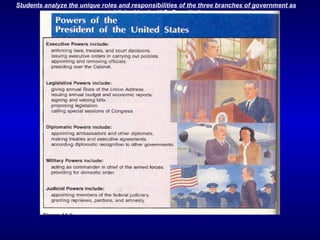
A. Executive Powers Main job of the president is to insure that all federal laws, treaties, and court decisions are faithfully executed. Often referred to as  ordinance power .  Executive orders , an implied power, permits the President to issue an order to carry out the law. Truman and Desegregation of Military. FDR and Japanese Internment
B.  Federal Bureaucracy The President is the boss of the vast federal bureaucracy deciding policy and issuing orders for departments and agencies to carry out. Roughly 2.7 million people work for the executive branch
C. Appointment Powers The President may appoint executive Secretaries. All cabinet posts Defense, State, Treasury and Attorney General. Federal Judges. Must have approval of senate. Lower jobs are filled by Civil Service.
D.  Executive Privilege The president can claim  executive privilege  to secretly conduct foreign affairs. Issues of National Security It is necessary, but how democratic is it?  The Supreme Court decision  United States v. Nixon  stated that President Nixon could not withhold tapes he claimed contained sensitive information.
Terms Executive article Imperial presidency Executive order Federal Bureaucracy Executive privilege United States vs. Nixon
In summary Why has executive power grown? What is executive power? What is an executive order? What is the function of the Federal bureaucracy? Why is executive privilege controversial?

Executive Powers Part 1

  • 1.
    Executive Powers: Part 1 Chapter 14: section 1 and 2
  • 2.
    Topics Growth ofthe Office The Executive Powers
  • 3.
    I. Growth ofthe Office Early Executive power Why has executive power grown? The Modern Presidency
  • 4.
    A. Early Executivepower Typically was weak. Limited by Washington himself Many believed in stronger State governments Executive branch had a small staff Congress was seen to have most of the power. It was the first branch It was deemed as inherently more democratic
  • 5.
    B. Why hasexecutive power grown? Personal style matters The Legislative branch is divided. The President is unified The Power of crisis has impacted the power of the Presidency Many expect stronger action from the executive to address modern issues Media tends to focus on the Presidency.
  • 6.
    C. The ModernPresidency People usually look to one leader. It is easier. Sets the agenda. Influence of the media. Rise of the Federal bureaucracy to execute the law
  • 7.
    The Constitution Thepower of the president has changed considerably since George Washington took power in 1789. Washington could have been king, but choose not to be.                                               
  • 8.
    Washington more clearlydefined the Presidency by holding regular cabinet meeting and setting a precedent of only serving two presidential terms, later to be broken by FDR. Washington displayed integrity while in office and led the country through its infancy
  • 9.
    Andrew Jackson President:1829-1837 Under “Jacksonian Democracy” the country would become more democratic, extending franchise to non-property owning males. Jackson used the power to veto extensively, and generally extended Presidential power over the legislative process.
  • 10.
    Abraham Lincoln 1861-1865Lincoln expanded the Presidency beyond the expressed limits of the constitution. Lincoln was criticized for crushing anti-northern dissent during war among individuals he claimed were “guilty of disloyal practices”. By the end of the war 13,000 people had been arrested under military authority.
  • 11.
    Theodore Roosevelt Consideredthe first activist president, Roosevelt used his bully pulpit to sway public opinion for progressive reform and an aggressive foreign policy.
  • 12.
    Franklin Roosevelt Morethan any other President, FDR strengthened the role of the Presidency by enacting massive New Deal programs during the Great Depression and taking a strong hand in directing America’s war effort during World war II.                                             
  • 13.
    Lyndon Johnson LBJcontinued the activist trend by constructing a program known as the Great Society, a program he hoped would create greater economic and social equality in the United States.                                              
  • 14.
    Richard Nixon Inthe 1970s there was a strong reaction among Americans against Presidential authority, resulting mainly from our nation’s involvement in the Vietnam War and Richard Nixon’s abuse of power in the Watergate scandal.                                           
  • 15.
    Ronald Reagan RonaldReagan gained the Presidency as part of a conservative (Jeffersonian) backlash against the centralization of government brought about by New Deal and Great Society programs.
  • 16.
  • 17.
    II. Executive PowerExecutive Powers The Federal Bureaucracy Appointment powers Executive Privilege
  • 18.
  • 19.
  • 20.
    A. Executive PowersMain job of the president is to insure that all federal laws, treaties, and court decisions are faithfully executed. Often referred to as ordinance power . Executive orders , an implied power, permits the President to issue an order to carry out the law. Truman and Desegregation of Military. FDR and Japanese Internment
  • 21.
    B. FederalBureaucracy The President is the boss of the vast federal bureaucracy deciding policy and issuing orders for departments and agencies to carry out. Roughly 2.7 million people work for the executive branch
  • 22.
    C. Appointment PowersThe President may appoint executive Secretaries. All cabinet posts Defense, State, Treasury and Attorney General. Federal Judges. Must have approval of senate. Lower jobs are filled by Civil Service.
  • 23.
    D. ExecutivePrivilege The president can claim executive privilege to secretly conduct foreign affairs. Issues of National Security It is necessary, but how democratic is it? The Supreme Court decision United States v. Nixon stated that President Nixon could not withhold tapes he claimed contained sensitive information.
  • 24.
    Terms Executive articleImperial presidency Executive order Federal Bureaucracy Executive privilege United States vs. Nixon
  • 25.
    In summary Whyhas executive power grown? What is executive power? What is an executive order? What is the function of the Federal bureaucracy? Why is executive privilege controversial?