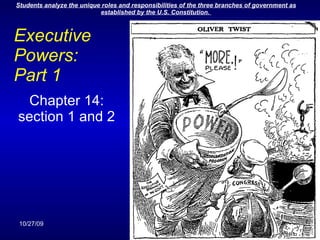
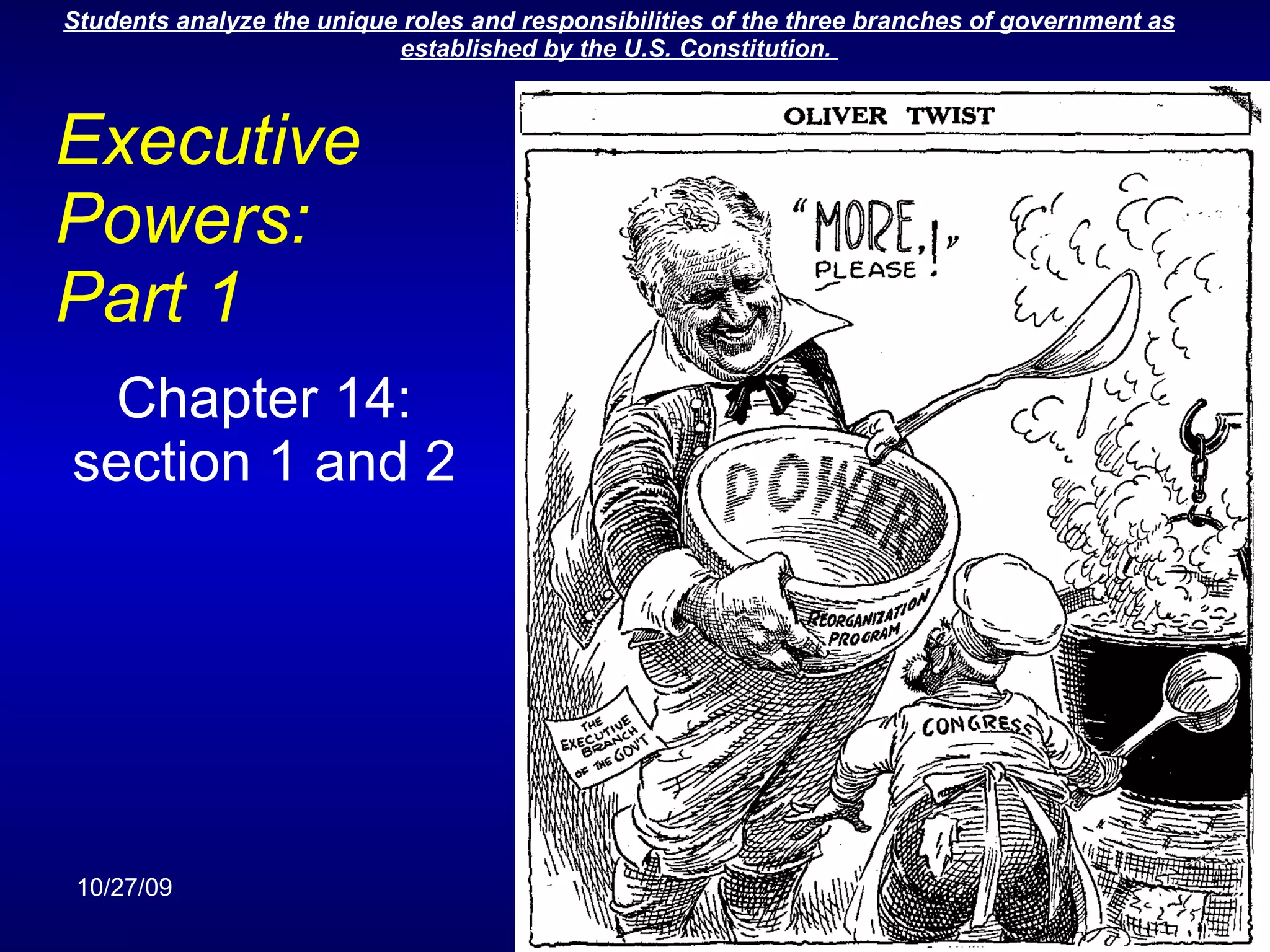
Executive Powers:  Part 1  Chapter 14: section 1 and 2
 
Topics Diplomatic and Military Power Legislative Power Judicial Power
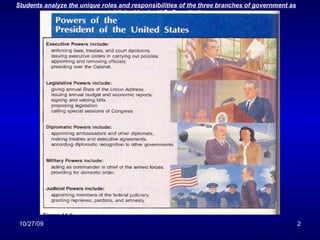
I. Diplomatic and Military Power Treaties and Executive Agreements Recognition War Powers War Powers Act of 1973
A. Treaties and Executive Agreements The President can make treaties with two-thirds approval of the Senate. The President can by-pass senate approval with  executive agreement . These agreements have the same legal status as treaties. They do not require the approval of the senate
B. Recognition Another diplomatic power of the President is the power of  recognition .   To recognize a foreign government as legitimate. Recognition is given or withheld from foreign governments as a method of approving or disapproving that nations actions. China and Cuba. Hamas??? Tibet and Taiwan???
Alexander Hamilton wrote: “ the direction of war most peculiarly demands those qualities which distinguished the exercise of power by a single hand”.   Federalist 74
C. War Powers The President is the Commander in Chief, commander of the Armed Services. President has sent troops into combat without Congressional approval. Barbary Coast Pirates under Jefferson James Polk and the Nueces River valley Korean War and Vietnam War Military strikes against Libya, Afghanistan, Sudan, Bosnia, Granada, Panama, and on Congress has power to declare war. Has passed joint resolutions 8 times in support of military action.
D. War Powers Resolution  of 1973 3 provisions President must report to congress of any military action within 48 hours. Troop involvement is limited to 60 days. Congress can approve for longer involvement. Congress may pass a concurrent resolution to end combat operations Many oppose the WPR as unconstitutional. Restricts the power of the executive.
II. Legislative Power State of The Union Address Veto power
A. State of the Union Address Each year the President stands before congress to deliver this address. Tells the  State of the Union . Sets a national agenda Attempts to influence Congress The President can also work closely with individual legislators to push a specific agenda.
B. Veto Power The president has the power to  veto  legislation made by congress. Can also  pocket Veto Congress can override a presidential veto with a two-thirds vote. Some want to give the President the power of  Line Item Veto
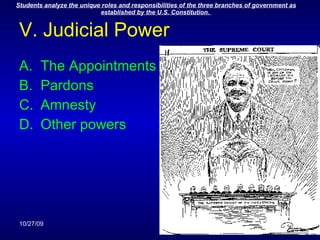
V. Judicial Power The Appointments Pardons  Amnesty Other powers
A. The Appointments The Power to appoint Supreme Court Judges. Must be confirmed by the Senate. Has an incredible impact. Judges serve the rest of their life. Far reaching impact. They interpret the constitution
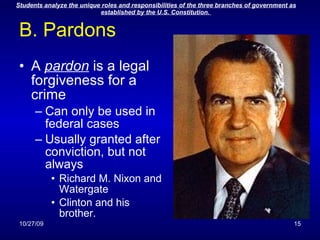
B. Pardons A  pardon  is a legal forgiveness for a crime Can only be used in federal cases Usually granted after conviction, but not always Richard M. Nixon and Watergate Clinton and his brother.
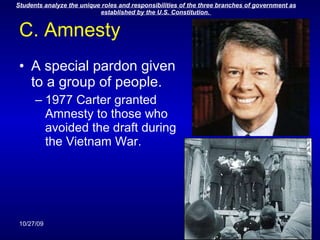
C. Amnesty A special pardon given to a group of people. 1977 Carter granted Amnesty to those who avoided the draft during the Vietnam War.
D. Other powers reprieve  is the postponement of the execution of a sentence. Still guilty Penalty is postponed A commutation reduces the sentence or the fine imposed Still guilt The penalty has been reduced
What we know What are the diplomatic and military powers of the executive? How is there a conflict between the executive and legislative branch over the issue of military powers? What is the War Powers Resolution of 1973? How can the President influence legislation? How can the President influence the courts?
Terms Executive agreement Treaty Recognition War Powers Resolution of 1973 Line item veto State of union address Pardon Amnesty Reprieve Clemency

Executive Powers Ch 14 Part 2

  • 1.
    Executive Powers: Part 1 Chapter 14: section 1 and 2
  • 2.
  • 3.
    Topics Diplomatic andMilitary Power Legislative Power Judicial Power
  • 4.
    I. Diplomatic andMilitary Power Treaties and Executive Agreements Recognition War Powers War Powers Act of 1973
  • 5.
    A. Treaties andExecutive Agreements The President can make treaties with two-thirds approval of the Senate. The President can by-pass senate approval with executive agreement . These agreements have the same legal status as treaties. They do not require the approval of the senate
  • 6.
    B. Recognition Anotherdiplomatic power of the President is the power of recognition . To recognize a foreign government as legitimate. Recognition is given or withheld from foreign governments as a method of approving or disapproving that nations actions. China and Cuba. Hamas??? Tibet and Taiwan???
  • 7.
    Alexander Hamilton wrote:“ the direction of war most peculiarly demands those qualities which distinguished the exercise of power by a single hand”. Federalist 74
  • 8.
    C. War PowersThe President is the Commander in Chief, commander of the Armed Services. President has sent troops into combat without Congressional approval. Barbary Coast Pirates under Jefferson James Polk and the Nueces River valley Korean War and Vietnam War Military strikes against Libya, Afghanistan, Sudan, Bosnia, Granada, Panama, and on Congress has power to declare war. Has passed joint resolutions 8 times in support of military action.
  • 9.
    D. War PowersResolution of 1973 3 provisions President must report to congress of any military action within 48 hours. Troop involvement is limited to 60 days. Congress can approve for longer involvement. Congress may pass a concurrent resolution to end combat operations Many oppose the WPR as unconstitutional. Restricts the power of the executive.
  • 10.
    II. Legislative PowerState of The Union Address Veto power
  • 11.
    A. State ofthe Union Address Each year the President stands before congress to deliver this address. Tells the State of the Union . Sets a national agenda Attempts to influence Congress The President can also work closely with individual legislators to push a specific agenda.
  • 12.
    B. Veto PowerThe president has the power to veto legislation made by congress. Can also pocket Veto Congress can override a presidential veto with a two-thirds vote. Some want to give the President the power of Line Item Veto
  • 13.
    V. Judicial PowerThe Appointments Pardons Amnesty Other powers
  • 14.
    A. The AppointmentsThe Power to appoint Supreme Court Judges. Must be confirmed by the Senate. Has an incredible impact. Judges serve the rest of their life. Far reaching impact. They interpret the constitution
  • 15.
    B. Pardons A pardon is a legal forgiveness for a crime Can only be used in federal cases Usually granted after conviction, but not always Richard M. Nixon and Watergate Clinton and his brother.
  • 16.
    C. Amnesty Aspecial pardon given to a group of people. 1977 Carter granted Amnesty to those who avoided the draft during the Vietnam War.
  • 17.
    D. Other powersreprieve is the postponement of the execution of a sentence. Still guilty Penalty is postponed A commutation reduces the sentence or the fine imposed Still guilt The penalty has been reduced
  • 18.
    What we knowWhat are the diplomatic and military powers of the executive? How is there a conflict between the executive and legislative branch over the issue of military powers? What is the War Powers Resolution of 1973? How can the President influence legislation? How can the President influence the courts?
  • 19.
    Terms Executive agreementTreaty Recognition War Powers Resolution of 1973 Line item veto State of union address Pardon Amnesty Reprieve Clemency