PSCI 1500:
Introduction to Economics
Market Structures
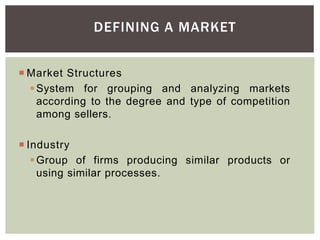
DEFINING A MARKET
 Market Structures
System for grouping and analyzing markets
according to the degree and type of competition
among sellers.
 Industry
Group of firms producing similar products or
using similar processes.
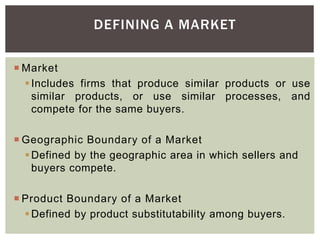
DEFINING A MARKET
 Market
Includes firms that produce similar products or use
similar products, or use similar processes, and
compete for the same buyers.
 Geographic Boundary of a Market
Defined by the geographic area in which sellers and
buyers compete.
 Product Boundary of a Market
Defined by product substitutability among buyers.
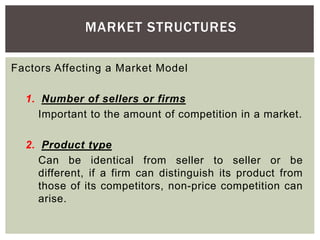
MARKET STRUCTURES
Factors Affecting a Market Model
1. Number of sellers or firms
Important to the amount of competition in a market.
2. Product type
Can be identical from seller to seller or be
different, if a firm can distinguish its product from
those of its competitors, non-price competition can
arise.
MARKET STRUCTURES
Factors Affecting a Market Model
3. Barriers to entry (and exit)
The ease with which a firm may enter or leave a
market.
4. The control over price
Refers to large control over price, or control price
depends on the product differentiation
PURE COMPETITION
 Characteristics
Large number of independent sellers.
Identical products are offered for sale.
Easy entry into and exit from the market.
 Control Over Price
Price Takers - Sellers with no control over the
price of their products.
Market demand and market supply determine the
equilibrium price and quantity of a product.
PURE COMPETITION
 Long-Run Position
Cost of production is as low as it can possibly be.
Price of the product is as low as possible.
 Non-price Competition
Firms focus on a feature other than price to
attract buyers to their products.
Does not occur in purely competitive markets.
PURE COMPETITION
 Effect of Entry & Exit
Entry
Firms are attracted to enter a market when
economic profit is being made by individual firms in
that market.
This causes the market supply to increase and the
equilibrium price to fall.
Exit
Firms drop out of a market in the long run when
others begin to operate at a loss.
Causes the market supply to decrease and the
equilibrium price to rise.
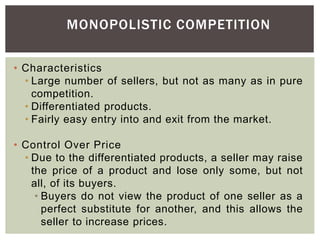
MONOPOLISTIC COMPETITION
• Characteristics
• Large number of sellers, but not as many as in pure
competition.
• Differentiated products.
• Fairly easy entry into and exit from the market.
• Control Over Price
• Due to the differentiated products, a seller may raise
the price of a product and lose only some, but not
all, of its buyers.
• Buyers do not view the product of one seller as a
perfect substitute for another, and this allows the
seller to increase prices.
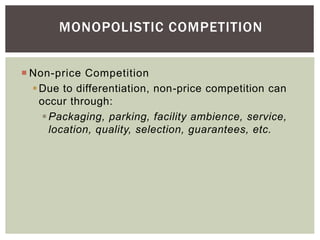
MONOPOLISTIC COMPETITION
 Non-price Competition
Due to differentiation, non-price competition can
occur through:
Packaging, parking, facility ambience, service,
location, quality, selection, guarantees, etc.
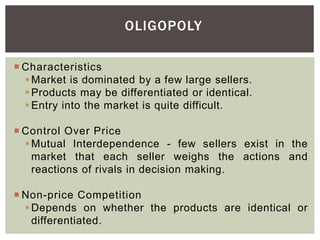
OLIGOPOLY
 Characteristics
Market is dominated by a few large sellers.
Products may be differentiated or identical.
Entry into the market is quite difficult.
 Control Over Price
Mutual Interdependence - few sellers exist in the
market that each seller weighs the actions and
reactions of rivals in decision making.
 Non-price Competition
Depends on whether the products are identical or
differentiated.
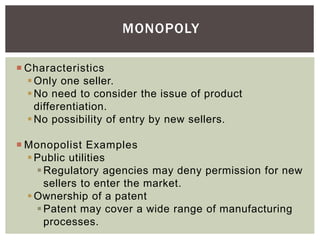
MONOPOLY
 Characteristics
Only one seller.
No need to consider the issue of product
differentiation.
No possibility of entry by new sellers.
 Monopolist Examples
Public utilities
Regulatory agencies may deny permission for new
sellers to enter the market.
Ownership of a patent
Patent may cover a wide range of manufacturing
processes.
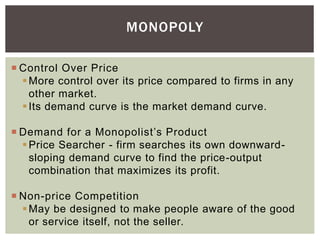
MONOPOLY
 Control Over Price
More control over its price compared to firms in any
other market.
Its demand curve is the market demand curve.
 Demand for a Monopolist’s Product
Price Searcher - firm searches its own downward-
sloping demand curve to find the price-output
combination that maximizes its profit.
 Non-price Competition
May be designed to make people aware of the good
or service itself, not the seller.
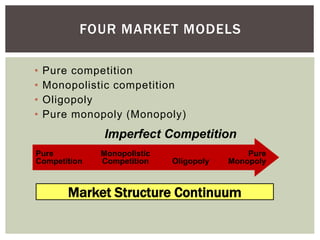
FOUR MARKET MODELS
• Pure competition
• Monopolistic competition
• Oligopoly
• Pure monopoly (Monopoly)
Market Structure Continuum
Pure
Competition
Monopolistic
Competition Oligopoly
Pure
Monopoly
Imperfect Competition
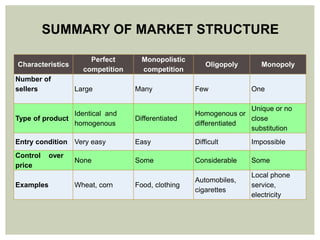
Characteristics
Perfect
competition
Monopolistic
competition
Oligopoly Monopoly
Number of
sellers Large Many Few One
Type of product
Identical and
homogenous
Differentiated
Homogenous or
differentiated
Unique or no
close
substitution
Entry condition Very easy Easy Difficult Impossible
Control over
price
None Some Considerable Some
Examples Wheat, corn Food, clothing
Automobiles,
cigarettes
Local phone
service,
electricity
SUMMARY OF MARKET STRUCTURE
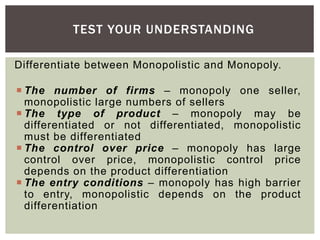
TEST YOUR UNDERSTANDING
Differentiate between Monopolistic and Monopoly.
 The number of firms – monopoly one seller,
monopolistic large numbers of sellers
 The type of product – monopoly may be
differentiated or not differentiated, monopolistic
must be differentiated
 The control over price – monopoly has large
control over price, monopolistic control price
depends on the product differentiation
 The entry conditions – monopoly has high barrier
to entry, monopolistic depends on the product
differentiation

Topic 14 - Market Structures

  • 1.
    PSCI 1500: Introduction toEconomics Market Structures
  • 2.
    DEFINING A MARKET Market Structures System for grouping and analyzing markets according to the degree and type of competition among sellers.  Industry Group of firms producing similar products or using similar processes.
  • 3.
    DEFINING A MARKET Market Includes firms that produce similar products or use similar products, or use similar processes, and compete for the same buyers.  Geographic Boundary of a Market Defined by the geographic area in which sellers and buyers compete.  Product Boundary of a Market Defined by product substitutability among buyers.
  • 4.
    MARKET STRUCTURES Factors Affectinga Market Model 1. Number of sellers or firms Important to the amount of competition in a market. 2. Product type Can be identical from seller to seller or be different, if a firm can distinguish its product from those of its competitors, non-price competition can arise.
  • 5.
    MARKET STRUCTURES Factors Affectinga Market Model 3. Barriers to entry (and exit) The ease with which a firm may enter or leave a market. 4. The control over price Refers to large control over price, or control price depends on the product differentiation
  • 6.
    PURE COMPETITION  Characteristics Largenumber of independent sellers. Identical products are offered for sale. Easy entry into and exit from the market.  Control Over Price Price Takers - Sellers with no control over the price of their products. Market demand and market supply determine the equilibrium price and quantity of a product.
  • 7.
    PURE COMPETITION  Long-RunPosition Cost of production is as low as it can possibly be. Price of the product is as low as possible.  Non-price Competition Firms focus on a feature other than price to attract buyers to their products. Does not occur in purely competitive markets.
  • 8.
    PURE COMPETITION  Effectof Entry & Exit Entry Firms are attracted to enter a market when economic profit is being made by individual firms in that market. This causes the market supply to increase and the equilibrium price to fall. Exit Firms drop out of a market in the long run when others begin to operate at a loss. Causes the market supply to decrease and the equilibrium price to rise.
  • 9.
    MONOPOLISTIC COMPETITION • Characteristics •Large number of sellers, but not as many as in pure competition. • Differentiated products. • Fairly easy entry into and exit from the market. • Control Over Price • Due to the differentiated products, a seller may raise the price of a product and lose only some, but not all, of its buyers. • Buyers do not view the product of one seller as a perfect substitute for another, and this allows the seller to increase prices.
  • 10.
    MONOPOLISTIC COMPETITION  Non-priceCompetition Due to differentiation, non-price competition can occur through: Packaging, parking, facility ambience, service, location, quality, selection, guarantees, etc.
  • 11.
    OLIGOPOLY  Characteristics Market isdominated by a few large sellers. Products may be differentiated or identical. Entry into the market is quite difficult.  Control Over Price Mutual Interdependence - few sellers exist in the market that each seller weighs the actions and reactions of rivals in decision making.  Non-price Competition Depends on whether the products are identical or differentiated.
  • 12.
    MONOPOLY  Characteristics Only oneseller. No need to consider the issue of product differentiation. No possibility of entry by new sellers.  Monopolist Examples Public utilities Regulatory agencies may deny permission for new sellers to enter the market. Ownership of a patent Patent may cover a wide range of manufacturing processes.
  • 13.
    MONOPOLY  Control OverPrice More control over its price compared to firms in any other market. Its demand curve is the market demand curve.  Demand for a Monopolist’s Product Price Searcher - firm searches its own downward- sloping demand curve to find the price-output combination that maximizes its profit.  Non-price Competition May be designed to make people aware of the good or service itself, not the seller.
  • 14.
    FOUR MARKET MODELS •Pure competition • Monopolistic competition • Oligopoly • Pure monopoly (Monopoly) Market Structure Continuum Pure Competition Monopolistic Competition Oligopoly Pure Monopoly Imperfect Competition
  • 15.
    Characteristics Perfect competition Monopolistic competition Oligopoly Monopoly Number of sellersLarge Many Few One Type of product Identical and homogenous Differentiated Homogenous or differentiated Unique or no close substitution Entry condition Very easy Easy Difficult Impossible Control over price None Some Considerable Some Examples Wheat, corn Food, clothing Automobiles, cigarettes Local phone service, electricity SUMMARY OF MARKET STRUCTURE
  • 16.
    TEST YOUR UNDERSTANDING Differentiatebetween Monopolistic and Monopoly.  The number of firms – monopoly one seller, monopolistic large numbers of sellers  The type of product – monopoly may be differentiated or not differentiated, monopolistic must be differentiated  The control over price – monopoly has large control over price, monopolistic control price depends on the product differentiation  The entry conditions – monopoly has high barrier to entry, monopolistic depends on the product differentiation