Stephin Abraham Sabu
Roll No. 15
S1 IEM
What is a Market?
• Place where there are many buyers and sellers .
• Actively engaged in buying and selling acts.
• Contact through different means of communication
like letters, telephone etc.
• Thus, It does not mean a particular place but the
entire area where buyers and sellers of a
commodity are in close contact and they have one
price of same commodity.
Market StructureMarket Structure
The selling environment in which a firm
produces and sells its product is called a
market structure.
Defined by three characteristics:
◦ The number of firms in the market
◦ The ease of entry and exit of firms
◦ The degree of product differentiation
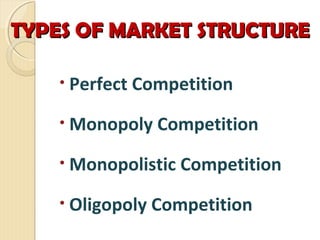
TYPES OF MARKET STRUCTURETYPES OF MARKET STRUCTURE
• Perfect Competition
• Monopoly Competition
• Monopolistic Competition
• Oligopoly Competition
IntroductionIntroduction
Perfect competition, with an infinite
number of firms, and monopoly, with a
single firm, are polar opposites.
• Monopolistic competition and oligopoly lie
between these two extremes.
Perfect CompetitionPerfect Competition
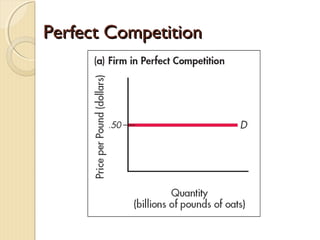
A perfectly competitive market has the
following characteristics:
There are many buyers and sellers in the market.
The goods offered by the various sellers are
largely the same - Homogeneous product
The price of the product is determined by
the industry .
Firms can freely enter or exit the market.
• Large number of buyers and sellers
• Homogeneous product
• No barriers to entry
• Perfect mobility of factors of production
• Perfect knowledge about the market
conditions
• Non- existence of transport cost
The Meaning of CompetitionThe Meaning of Competition
As a result of its characteristics, the perfectly
competitive market has the following
outcomes:
The actions of any single buyer or seller in
the market have a negligible impact on the
market price.
Each buyer and seller takes the market
price as given.
Thus, each buyer and seller is a price taker.
Perfect CompetitionPerfect Competition
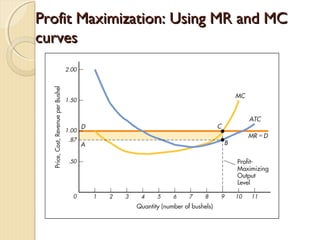
Profit Maximization: Using MR and MCProfit Maximization: Using MR and MC
curvescurves
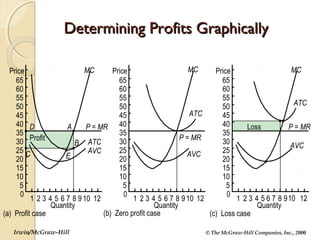
(a) Profit case (b) Zero profit case (c) Loss case
Determining Profits GraphicallyDetermining Profits Graphically
Quantity Quantity Quantity
Price
65
60
55
50
45
40
35
30
25
20
15
10
5
0
65
60
55
50
45
40
35
30
25
20
15
10
5
0
1 2 3 4 5 6 7 8 910 12 1 2 3 4 5 6 7 8 910 12
D
MC
A P = MR
B ATC
AVC
E
Profit
C
MC
ATC
AVC
MC
ATC
AVC
Loss
65
60
55
50
45
40
35
30
25
20
15
10
5
0
1 2 3 4 5 6 7 8 910 12
P = MR
P = MR
Price Price
© The McGraw-Hill Companies, Inc., 2000Irwin/McGraw-Hill
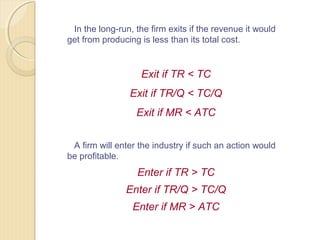
In the long-run, the firm exits if the revenue it would
get from producing is less than its total cost.
Exit if TR < TC
Exit if TR/Q < TC/Q
Exit if MR < ATC
A firm will enter the industry if such an action would
be profitable.
Enter if TR > TC
Enter if TR/Q > TC/Q
Enter if MR > ATC
MonopolyMonopoly
• It is a market structure in which there is
only a single seller of the product .
• One firm has full control over the supply
of the product .
• Example : Indian Railway
TYPESTYPES ofof MONOPOLYMONOPOLY
Natural Monopoly – limited supply of raw
materials
Social Monopoly – owned & managed by
government
Legal Monopoly – patents, trademarks etc.
Voluntary Monopoly – combination of
different producers
• Sole supplier of the product
• Large number of buyers
• No close substitutes
• One firm industry
• Varies from industry to industry
• Absence of entry
• Monopolist is price maker
• It is a mid-way between perfect
competition and monopoly .
• In this the number of buyers and sellers
is high considering different products
• Most common market situation
• Large number of firms
• Product differentiation - hetrogenous
• Freedom of entry and exit
• Price policy
• Selling cost
• Close substitutes
• It is a market structure in which there are few
sellers of a product selling identical or
differentiated products .
• If they are selling identical products, it’s a case
of Pure Oligopoly.
• If they are selling differentiated products, it’s
a case of Differentiated Oligopoly .
• Relatively small number of sellers
• Interdependence of the firms
• Price rigidity and price war
• Difficulty in entry and exit
• Selling Costs
• Indeterminateness of the demand
curve
market structure

market structure

  • 1.
  • 2.
    What is aMarket? • Place where there are many buyers and sellers . • Actively engaged in buying and selling acts. • Contact through different means of communication like letters, telephone etc. • Thus, It does not mean a particular place but the entire area where buyers and sellers of a commodity are in close contact and they have one price of same commodity.
  • 3.
    Market StructureMarket Structure Theselling environment in which a firm produces and sells its product is called a market structure. Defined by three characteristics: ◦ The number of firms in the market ◦ The ease of entry and exit of firms ◦ The degree of product differentiation
  • 4.
    TYPES OF MARKETSTRUCTURETYPES OF MARKET STRUCTURE • Perfect Competition • Monopoly Competition • Monopolistic Competition • Oligopoly Competition
  • 5.
    IntroductionIntroduction Perfect competition, withan infinite number of firms, and monopoly, with a single firm, are polar opposites. • Monopolistic competition and oligopoly lie between these two extremes.
  • 6.
    Perfect CompetitionPerfect Competition Aperfectly competitive market has the following characteristics: There are many buyers and sellers in the market. The goods offered by the various sellers are largely the same - Homogeneous product The price of the product is determined by the industry . Firms can freely enter or exit the market.
  • 7.
    • Large numberof buyers and sellers • Homogeneous product • No barriers to entry • Perfect mobility of factors of production • Perfect knowledge about the market conditions • Non- existence of transport cost
  • 8.
    The Meaning ofCompetitionThe Meaning of Competition As a result of its characteristics, the perfectly competitive market has the following outcomes: The actions of any single buyer or seller in the market have a negligible impact on the market price. Each buyer and seller takes the market price as given. Thus, each buyer and seller is a price taker.
  • 9.
  • 10.
    Profit Maximization: UsingMR and MCProfit Maximization: Using MR and MC curvescurves
  • 11.
    (a) Profit case(b) Zero profit case (c) Loss case Determining Profits GraphicallyDetermining Profits Graphically Quantity Quantity Quantity Price 65 60 55 50 45 40 35 30 25 20 15 10 5 0 65 60 55 50 45 40 35 30 25 20 15 10 5 0 1 2 3 4 5 6 7 8 910 12 1 2 3 4 5 6 7 8 910 12 D MC A P = MR B ATC AVC E Profit C MC ATC AVC MC ATC AVC Loss 65 60 55 50 45 40 35 30 25 20 15 10 5 0 1 2 3 4 5 6 7 8 910 12 P = MR P = MR Price Price © The McGraw-Hill Companies, Inc., 2000Irwin/McGraw-Hill
  • 12.
    In the long-run,the firm exits if the revenue it would get from producing is less than its total cost. Exit if TR < TC Exit if TR/Q < TC/Q Exit if MR < ATC A firm will enter the industry if such an action would be profitable. Enter if TR > TC Enter if TR/Q > TC/Q Enter if MR > ATC
  • 13.
    MonopolyMonopoly • It isa market structure in which there is only a single seller of the product . • One firm has full control over the supply of the product . • Example : Indian Railway
  • 14.
    TYPESTYPES ofof MONOPOLYMONOPOLY NaturalMonopoly – limited supply of raw materials Social Monopoly – owned & managed by government Legal Monopoly – patents, trademarks etc. Voluntary Monopoly – combination of different producers
  • 15.
    • Sole supplierof the product • Large number of buyers • No close substitutes • One firm industry • Varies from industry to industry • Absence of entry • Monopolist is price maker
  • 16.
    • It isa mid-way between perfect competition and monopoly . • In this the number of buyers and sellers is high considering different products • Most common market situation
  • 17.
    • Large numberof firms • Product differentiation - hetrogenous • Freedom of entry and exit • Price policy • Selling cost • Close substitutes
  • 18.
    • It isa market structure in which there are few sellers of a product selling identical or differentiated products . • If they are selling identical products, it’s a case of Pure Oligopoly. • If they are selling differentiated products, it’s a case of Differentiated Oligopoly .
  • 19.
    • Relatively smallnumber of sellers • Interdependence of the firms • Price rigidity and price war • Difficulty in entry and exit • Selling Costs • Indeterminateness of the demand curve