CHAPTER FIVE
MARKET STRUCTURE
Market Structure
Market is a mechanism that brings buyer and seller
together.
A firm’s decision concerning price and production
depends greatly on the character of the industry in
which it is operating
Economist group industries into four distinct
market structures:
pure competition(perfectly competitive market)
pure monopoly
monopolistic competition(monopolistically CM)
oligopoly
Con‘d
These four market models differ in several
respects:
The number of firms in the industry
Whether those firms produce a standardized
product or try to differentiate their products
from those of other firms
How easy or how difficult it is for firms to
enter the industry
PURE COMPETITION(PCM)
Involves a very large number of buyers and sellers
of a product.
firms producing a standardized(homogenous)
product (that is, a product identical to that of other
producers, such as corn)
Perfect knowlegde or perfect information : every
buyer and seller has full information about the
market and nature of the product.
Free entry and exit: New firms can enter or exit the
industry very easily
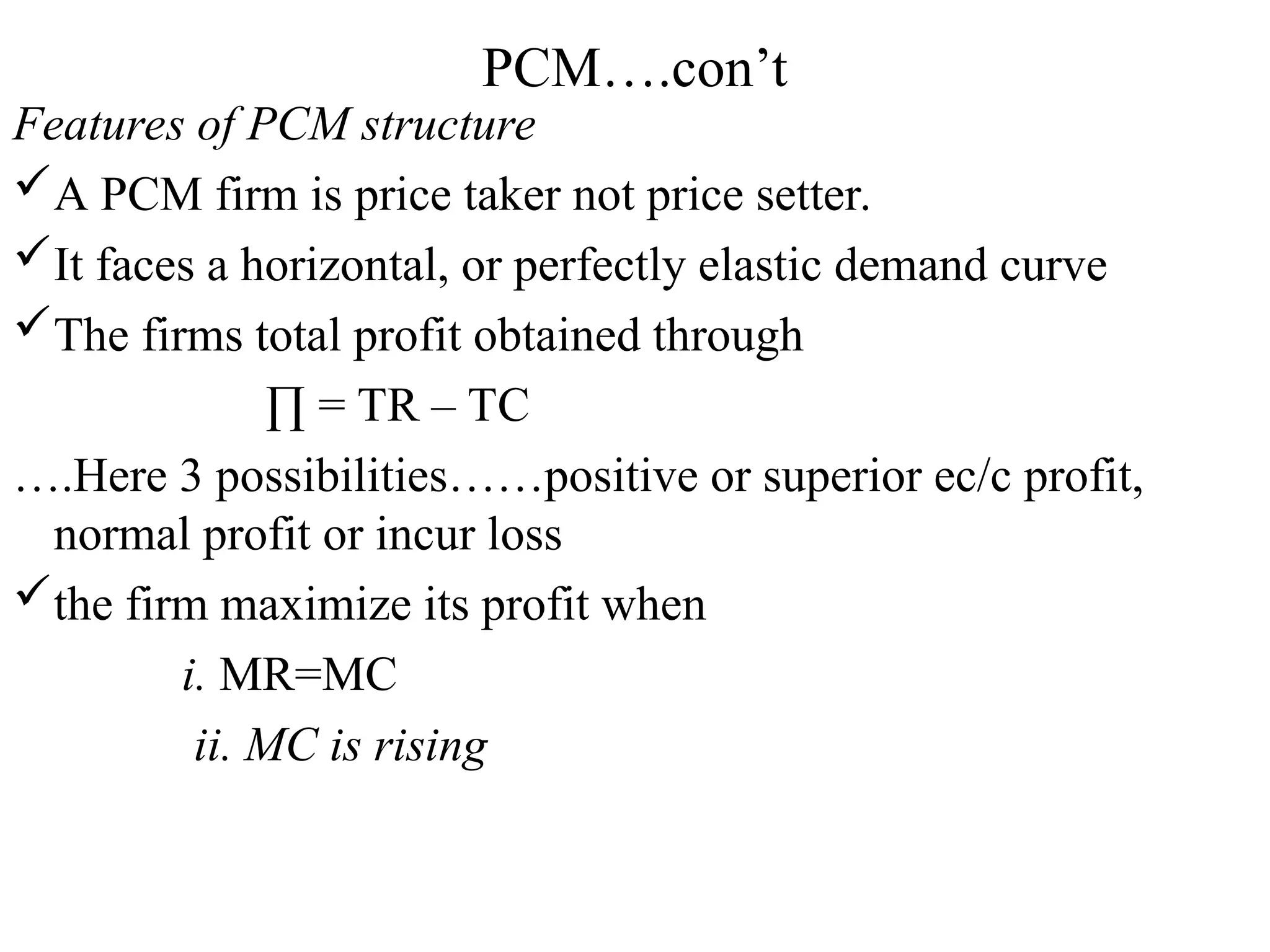
PCM….con’t
Features of PCM structure
A PCM firm is price taker not price setter.
It faces a horizontal, or perfectly elastic demand curve
The firms total profit obtained through
∏ = TR – TC
….Here 3 possibilities……positive or superior ec/c profit,
normal profit or incur loss
the firm maximize its profit when
i. MR=MC
ii. MC is rising
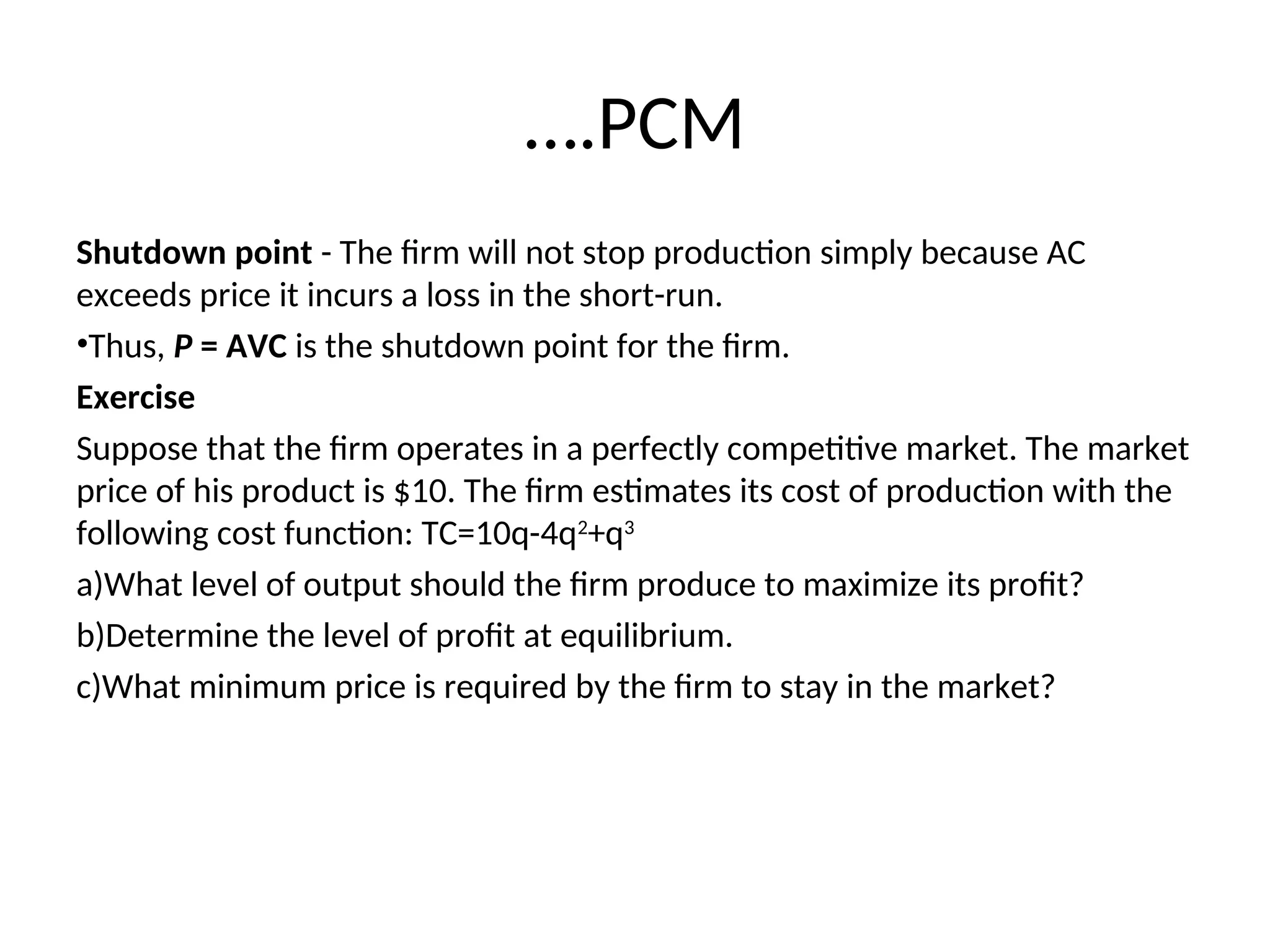
….PCM
Shutdown point - The firm will not stop production simply because AC
exceeds price it incurs a loss in the short-run.
•Thus, P = AVC is the shutdown point for the firm.
Exercise
Suppose that the firm operates in a perfectly competitive market. The market
price of his product is $10. The firm estimates its cost of production with the
following cost function: TC=10q-4q2
+q3
a)What level of output should the firm produce to maximize its profit?
b)Determine the level of profit at equilibrium.
c)What minimum price is required by the firm to stay in the market?
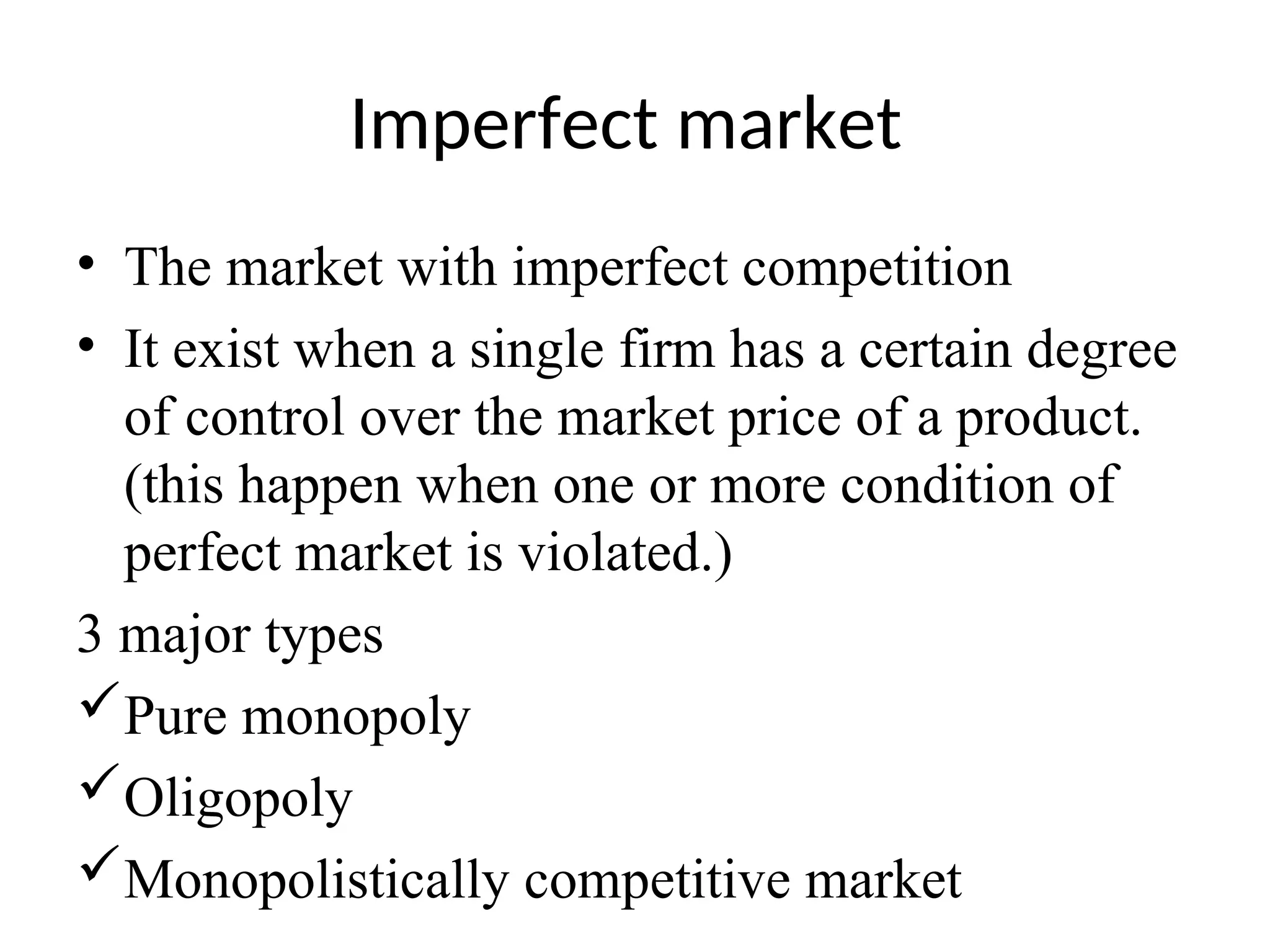
Imperfect market
• The market with imperfect competition
• It exist when a single firm has a certain degree
of control over the market price of a product.
(this happen when one or more condition of
perfect market is violated.)
3 major types
Pure monopoly
Oligopoly
Monopolistically competitive market
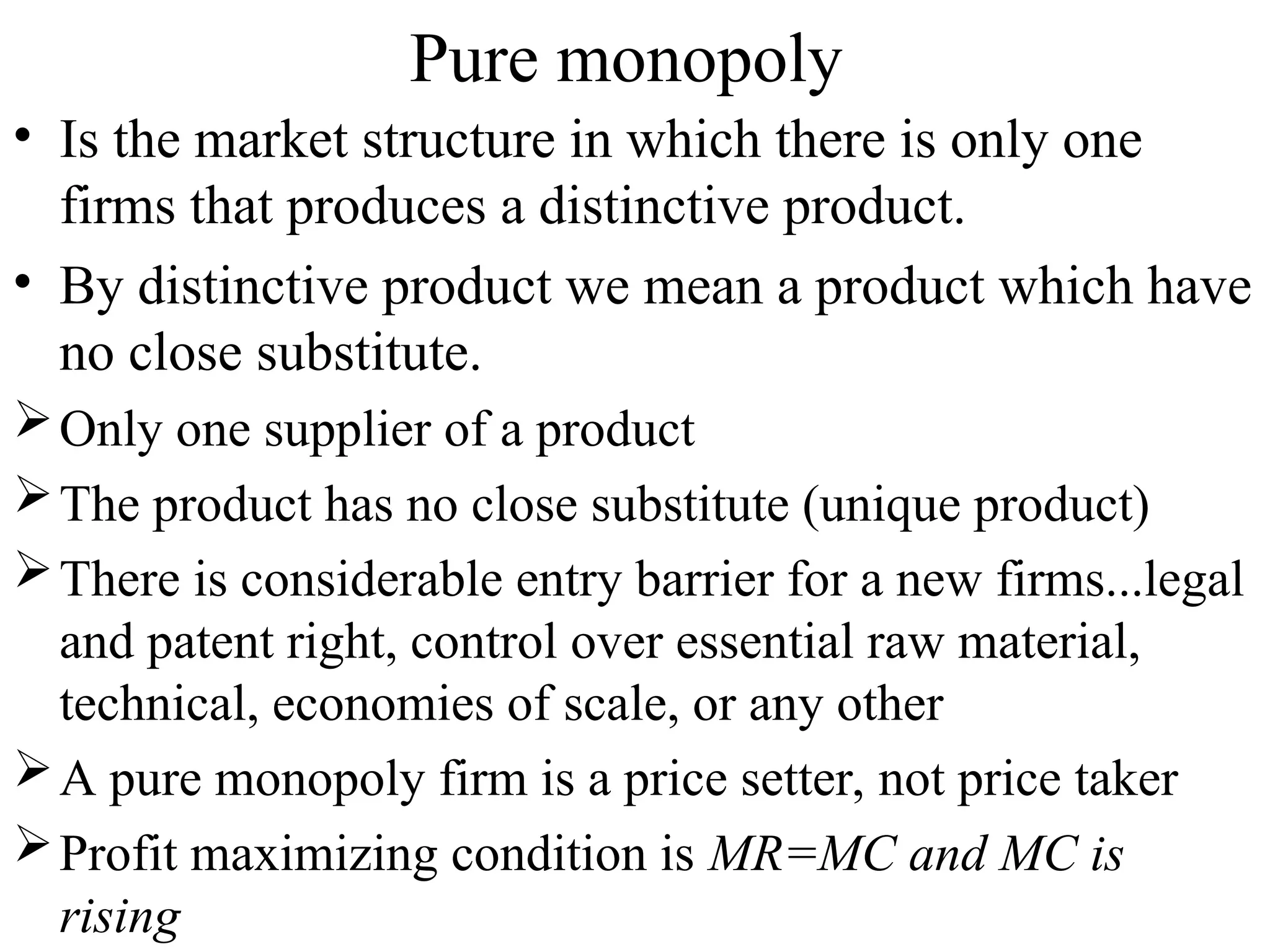
Pure monopoly
• Is the market structure in which there is only one
firms that produces a distinctive product.
• By distinctive product we mean a product which have
no close substitute.
Only one supplier of a product
The product has no close substitute (unique product)
There is considerable entry barrier for a new firms...legal
and patent right, control over essential raw material,
technical, economies of scale, or any other
A pure monopoly firm is a price setter, not price taker
Profit maximizing condition is MR=MC and MC is
rising
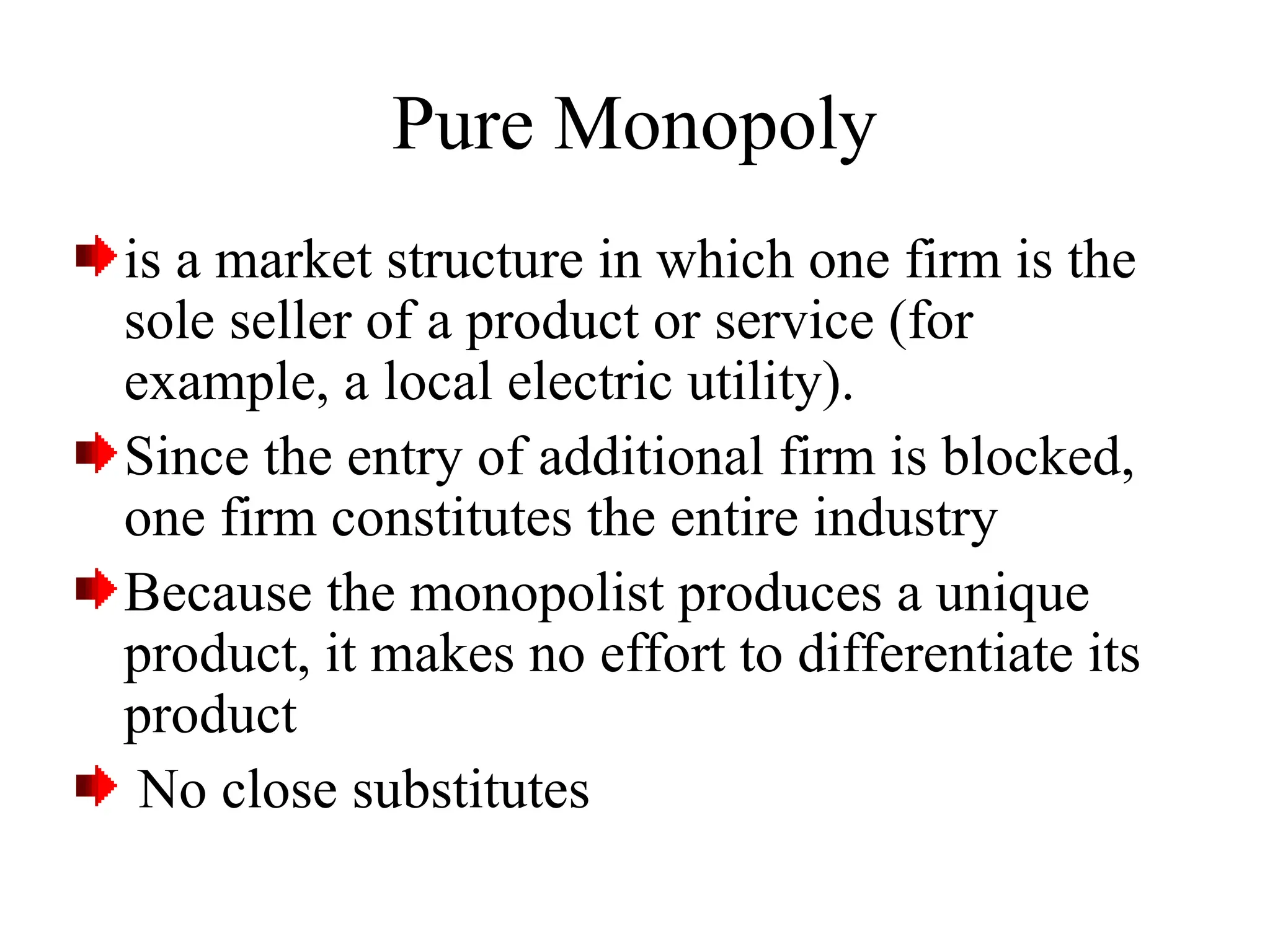
Pure Monopoly
is a market structure in which one firm is the
sole seller of a product or service (for
example, a local electric utility).
Since the entry of additional firm is blocked,
one firm constitutes the entire industry
Because the monopolist produces a unique
product, it makes no effort to differentiate its
product
No close substitutes
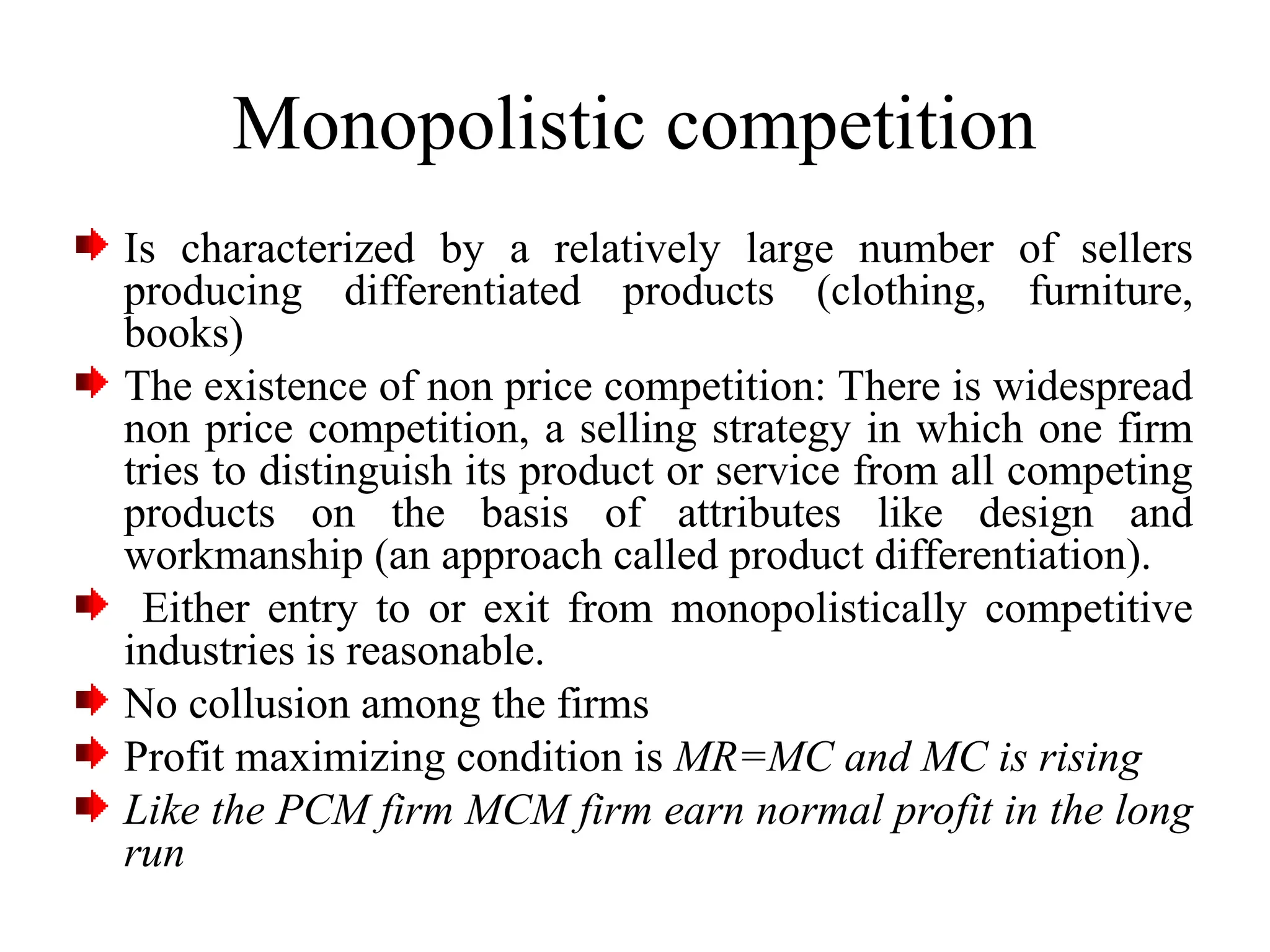
Monopolistic competition
Is characterized by a relatively large number of sellers
producing differentiated products (clothing, furniture,
books)
The existence of non price competition: There is widespread
non price competition, a selling strategy in which one firm
tries to distinguish its product or service from all competing
products on the basis of attributes like design and
workmanship (an approach called product differentiation).
Either entry to or exit from monopolistically competitive
industries is reasonable.
No collusion among the firms
Profit maximizing condition is MR=MC and MC is rising
Like the PCM firm MCM firm earn normal profit in the long
run
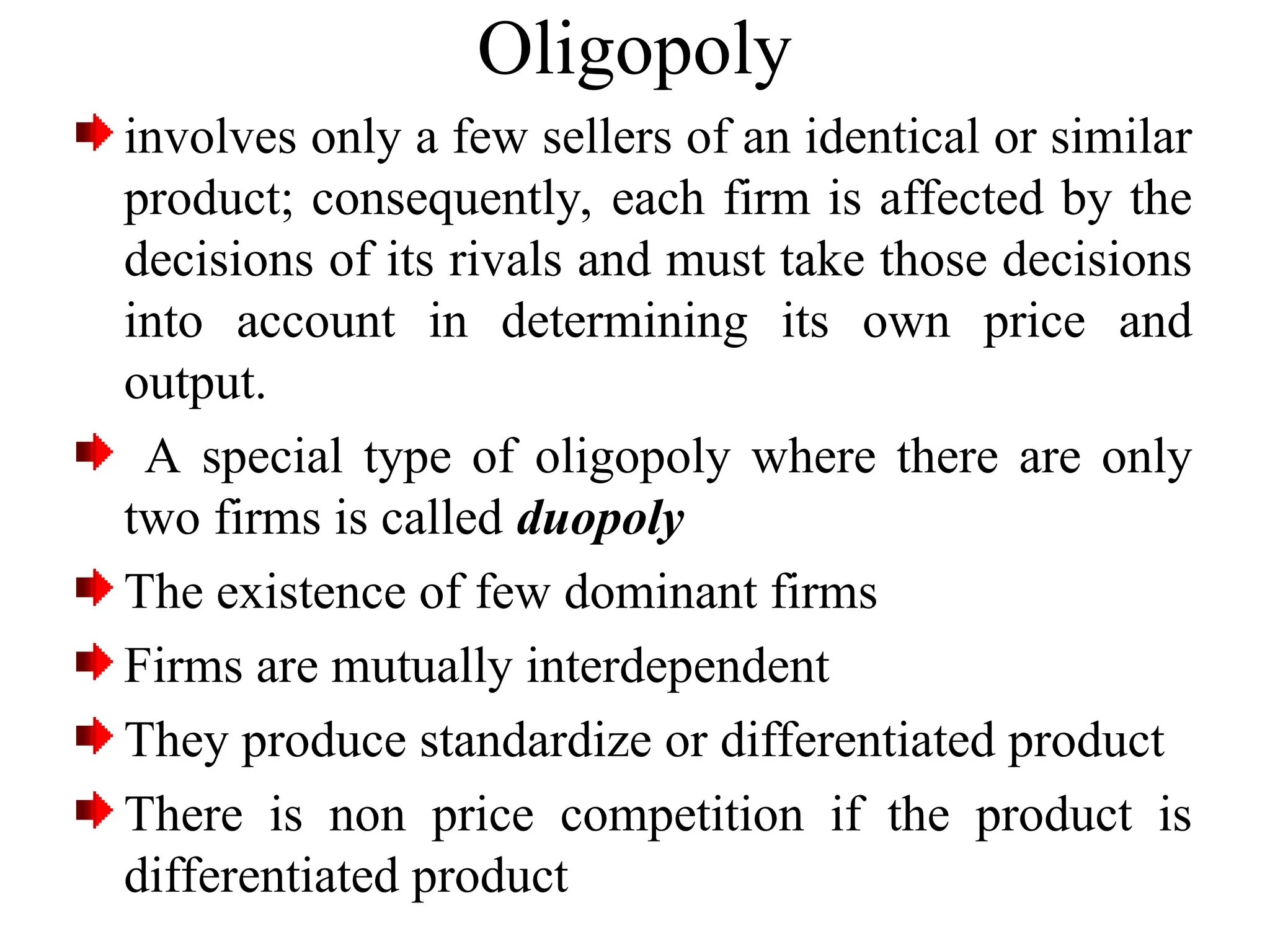
Oligopoly
involves only a few sellers of an identical or similar
product; consequently, each firm is affected by the
decisions of its rivals and must take those decisions
into account in determining its own price and
output.
A special type of oligopoly where there are only
two firms is called duopoly
The existence of few dominant firms
Firms are mutually interdependent
They produce standardize or differentiated product
There is non price competition if the product is
differentiated product
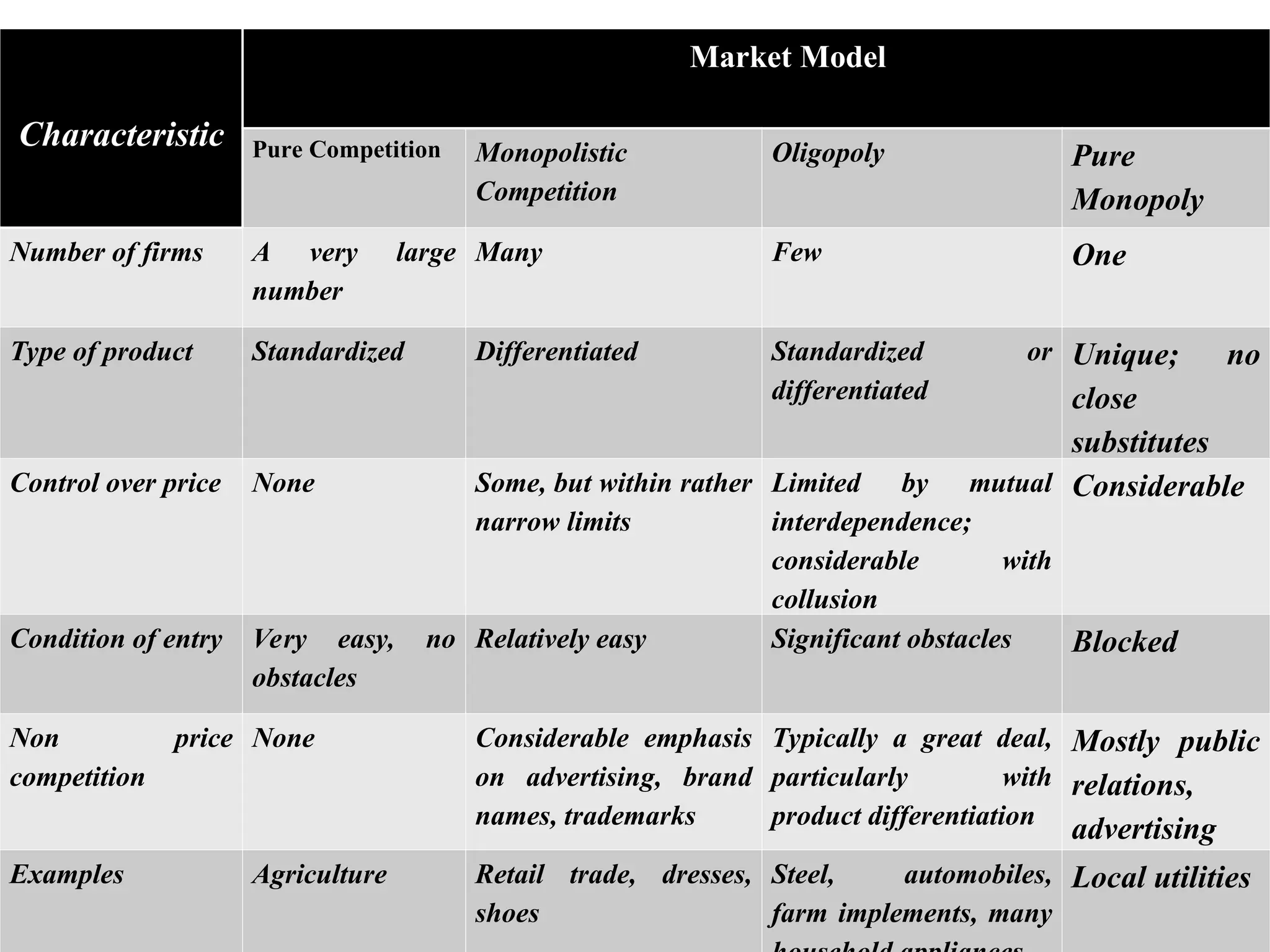
Characteristic
Market Model
Pure Competition Monopolistic
Competition
Oligopoly Pure
Monopoly
Number of firms A very large
number
Many Few One
Type of product Standardized Differentiated Standardized or
differentiated
Unique; no
close
substitutes
Control over price None Some, but within rather
narrow limits
Limited by mutual
interdependence;
considerable with
collusion
Considerable
Condition of entry Very easy, no
obstacles
Relatively easy Significant obstacles Blocked
Non price
competition
None Considerable emphasis
on advertising, brand
names, trademarks
Typically a great deal,
particularly with
product differentiation
Mostly public
relations,
advertising
Examples Agriculture Retail trade, dresses,
shoes
Steel, automobiles,
farm implements, many
Local utilities

chapter 5. Market structure from Ecusta

  • 1.
  • 2.
    Market Structure Market isa mechanism that brings buyer and seller together. A firm’s decision concerning price and production depends greatly on the character of the industry in which it is operating Economist group industries into four distinct market structures: pure competition(perfectly competitive market) pure monopoly monopolistic competition(monopolistically CM) oligopoly
  • 3.
    Con‘d These four marketmodels differ in several respects: The number of firms in the industry Whether those firms produce a standardized product or try to differentiate their products from those of other firms How easy or how difficult it is for firms to enter the industry
  • 4.
    PURE COMPETITION(PCM) Involves avery large number of buyers and sellers of a product. firms producing a standardized(homogenous) product (that is, a product identical to that of other producers, such as corn) Perfect knowlegde or perfect information : every buyer and seller has full information about the market and nature of the product. Free entry and exit: New firms can enter or exit the industry very easily
  • 5.
    PCM….con’t Features of PCMstructure A PCM firm is price taker not price setter. It faces a horizontal, or perfectly elastic demand curve The firms total profit obtained through ∏ = TR – TC ….Here 3 possibilities……positive or superior ec/c profit, normal profit or incur loss the firm maximize its profit when i. MR=MC ii. MC is rising
  • 6.
    ….PCM Shutdown point -The firm will not stop production simply because AC exceeds price it incurs a loss in the short-run. •Thus, P = AVC is the shutdown point for the firm. Exercise Suppose that the firm operates in a perfectly competitive market. The market price of his product is $10. The firm estimates its cost of production with the following cost function: TC=10q-4q2 +q3 a)What level of output should the firm produce to maximize its profit? b)Determine the level of profit at equilibrium. c)What minimum price is required by the firm to stay in the market?
  • 7.
    Imperfect market • Themarket with imperfect competition • It exist when a single firm has a certain degree of control over the market price of a product. (this happen when one or more condition of perfect market is violated.) 3 major types Pure monopoly Oligopoly Monopolistically competitive market
  • 8.
    Pure monopoly • Isthe market structure in which there is only one firms that produces a distinctive product. • By distinctive product we mean a product which have no close substitute. Only one supplier of a product The product has no close substitute (unique product) There is considerable entry barrier for a new firms...legal and patent right, control over essential raw material, technical, economies of scale, or any other A pure monopoly firm is a price setter, not price taker Profit maximizing condition is MR=MC and MC is rising
  • 9.
    Pure Monopoly is amarket structure in which one firm is the sole seller of a product or service (for example, a local electric utility). Since the entry of additional firm is blocked, one firm constitutes the entire industry Because the monopolist produces a unique product, it makes no effort to differentiate its product No close substitutes
  • 10.
    Monopolistic competition Is characterizedby a relatively large number of sellers producing differentiated products (clothing, furniture, books) The existence of non price competition: There is widespread non price competition, a selling strategy in which one firm tries to distinguish its product or service from all competing products on the basis of attributes like design and workmanship (an approach called product differentiation). Either entry to or exit from monopolistically competitive industries is reasonable. No collusion among the firms Profit maximizing condition is MR=MC and MC is rising Like the PCM firm MCM firm earn normal profit in the long run
  • 11.
    Oligopoly involves only afew sellers of an identical or similar product; consequently, each firm is affected by the decisions of its rivals and must take those decisions into account in determining its own price and output. A special type of oligopoly where there are only two firms is called duopoly The existence of few dominant firms Firms are mutually interdependent They produce standardize or differentiated product There is non price competition if the product is differentiated product
  • 12.
    Characteristic Market Model Pure CompetitionMonopolistic Competition Oligopoly Pure Monopoly Number of firms A very large number Many Few One Type of product Standardized Differentiated Standardized or differentiated Unique; no close substitutes Control over price None Some, but within rather narrow limits Limited by mutual interdependence; considerable with collusion Considerable Condition of entry Very easy, no obstacles Relatively easy Significant obstacles Blocked Non price competition None Considerable emphasis on advertising, brand names, trademarks Typically a great deal, particularly with product differentiation Mostly public relations, advertising Examples Agriculture Retail trade, dresses, shoes Steel, automobiles, farm implements, many Local utilities