DANILO F. MARIBAO
PALIPARAN III SENIOR HIGH SCHOOL
DASMARINAS CITY, CAVITE
MAN AND
SOCIETY
1. Group the class into 5 groups
2. Each group must appoint for a
leader and secretary.
3. Once you hear “what is your score”
the group must announce their
score.
4. The first group who announce their
score will get an additional points.
5. Highest score gets 10pts- 8 pts- 6
pts- 4 pts.-2 pts
REVIEW
Question:
1. perspective that defines how
he or she perceives and relate
to reality.
1. Egocentric
ANSWER:
2. Defines interpersonal
relations as the “self” being
aware on himself or herself.
Question:
ANSWER:
2. Existentialist
3. A philosophical concept
that refer to interaction
between the self and the
other.
Question:
ANSWER:
3. Intersubjectivity
4. Considers human
relationship as frustrating and
are often inauthentic and
ambiguous.
Question:
ANSWER:
4. Jean-Paul Sartre
5. The awareness that the
other is a person with thoughts
and feelings.
Question:
ANSWER:
5. Empathy
ACTIVITY:
LET’S PONDER:
Write down your ideas on what makes
a person a FILIPINO. Use the graphic
organizer
FILIPINO
ANALYSIS:
1. What factors led to the
development of these
characteristics among
Filipinos?
2. Which among the
descriptions could be
considered unique to us
Filipinos?
ABSTRACTION:
WHAT IS SOCIETY?
Refers to a large, independent, and
organized group of people living in
the same territory and sharing a
common culture and heritage.
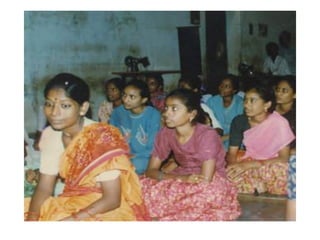
People within society impart to its
other knowledge, skills, and behaviors
through their various everyday
interactions.
These interactions are often governed
by written and unwritten rules that
reflect the shared ideas, views, and
values of the members of society.
Society can take many forms and has
evolved to develop various
characteristics. The simplest and
earliest societies are the hunting –and
–gathering societies that adopt a
lifestyle dependent on resources
readily available from their
surroundings.
These societies are often described as
“primitive” since they utilize the
simplest technology.
• Nomadic tribes such as the San in
Africa and small tribes found in
remote locations throughout the
world.
Agricultural Societies are those
engaged primarily in agricultural
activities such as farming, fishing, and
livestock-raising as a primary way of
life.
Industrial Societies are centered on
mechanized production and the
exchange of goods and services.
Modern Societies are technologically-
advanced societies characterized by
industry, mass production, and
advance communication and
transportation.
Advances of technology, meanwhile,
have enabled people to establish
“virtual societies” that are not
confined by territory and are
composed of individuals coming from
various social backgrounds.
• Social Media
• Online message
• Online games
Social Philosophy focus on studying
society and its influence on the human
person.
It applies philosophical concepts in a

social context and looks into how social
interactions shape people’s perception.
Experience, ideas, and values.
Topics related to Social Philosophy:
• Social ontology
• Social ethics
• Democracy
• Human rights
• Equality
• Justice
The ideas and discussions in Social
Philosophy often influence other social
sciences such as:
• Psychology
• Political Science
• Sociology
• Linguistics
HOW IS SOCIETY FORMED?
Humans are considered to have natural
tendency to cooperate and organize,
and society is a natural outcome of this
human to socialize.
During the Enlightenment, social
philosophers pondered on the natural
laws to govern societies, and in their
discussions, several philosophers put
forth their ideas regarding the
formation of societies.
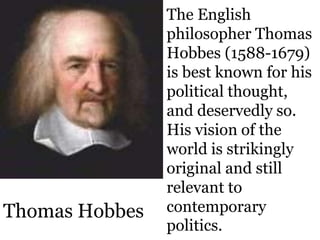
The English
philosopher Thomas
Hobbes (1588-1679)
is best known for his
political thought,
and deservedly so.
His vision of the
world is strikingly
original and still
relevant to
contemporary
politics.
Thomas Hobbes
a person or group empowered to
decide every social and political
issue
Social Contract an agreement where
individuals sacrifice some of their
wants and submit to a higher
authority.
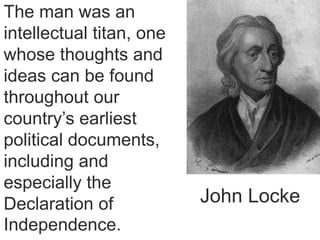
The man was an
intellectual titan, one
whose thoughts and
ideas can be found
throughout our
country’s earliest
political documents,
including and
especially the
Declaration of
Independence.
John Locke
Social Contract is a covenant among
individuals to cooperate and share
burden of upholding the welfare of
society.
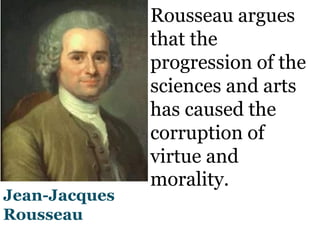
Rousseau argues
that the
progression of the
sciences and arts
has caused the
corruption of
virtue and
morality.
Jean-Jacques
Rousseau
Social Contract give emphasis to
individual decision-making in
society.
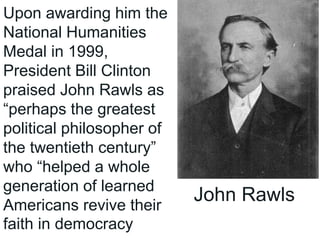
Upon awarding him the
National Humanities
Medal in 1999,
President Bill Clinton
praised John Rawls as
“perhaps the greatest
political philosopher of
the twentieth century”
who “helped a whole
generation of learned
Americans revive their
faith in democracy
John Rawls
Social Contract –that human beings
approach social cooperation in a
rational manner in order to meet
their individual self-interests.
He imagined humans as having a
“veil of ignorance” or no knowledge
of one’s own formation.
Another
contemporary
philosopher who
follows in the
tradition of Hobbes
is David
Gauthier of the
University of
PittsburghDavid Gauthier
Morals By Agreement, he argues
that voluntary compliance with
moral rules, even in the absence of
enforcement, is in one’s rational
self-interest. Specifically, he
contends that one should become
a constrained maximizer, a person
disposed to cooperate with others
on the condition that they expect
others to cooperate.
How does Society influence the
Person?
Socialization the process by
which an individual learns the
prevailing behaviors, attitudes, and
values within his or her society, a
person adopts a set of ideals and
behavior considered appropriate
within his or her own society.
Stanford Prison Experiment
Conducted 1971 in Stanford
University.
Twenty four male volunteers, who
were of sound mental state and had
a history of violence, were made
participate in a simulated person
environment in order to determine
the factors that led to prisoner
abuse in actual prisons.
Social Roles
Entail a set of expected behaviors
that must be performed by a person.
Normative Democratic Theory
Is a perspective which considers a
democratic society as morally
desirable.
Western Society is recognized to be
more individualistic and secular
and often embody these values in
their behavior.
They are more likely to be seen as
being assertive and direct in the
dealings with others.
Asian societies are more rigid and
formal in their social dealings as
they value respect, familial
relations, and social status.
How does our own society define
our identity as Filipinos?
Our own Filipino society has a set of
social values that govern our
everyday interactions and define
our character as uniquely Filipino
Evident in Filipino Society:
• Close family ties
• Extended family relations
• Community relations
Traditions that contribute to
harmonious relations:
• Pakikisama
• Pakikipagkapwa-tao
• Utang-na-loob
• Damayan
• Bayanihan
Religion also occupies an important
role in Filipino Society.
Majority of Filipinos profess in
Christian faith and religion has
significant influence in many
traditions and practices.
• Fiesta
• Celebrations
Kung pagwapuhan ang laban si
Bestfriend na ang panalo.
APPLICATION:
THINK:
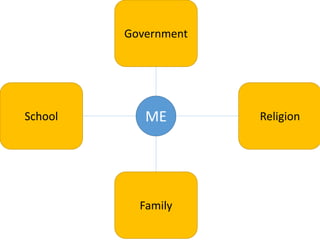
Describe how the following social
institutions influence your
development as a person. Write
your answers in the boxes.
Government
ME ReligionSchool
Family
ASSESSMENT
1. Refers to a large, independent,
and organized group of people
living in the same territory and
sharing a common culture and
heritage.
QUESTION:
2. focus on studying society and its
influence on the human person.
QUESTION:
3. The English philosopher is best
known for his political thought, and
deservedly so.
QUESTION:
4. According to him Social Contract
is a covenant among individuals to
cooperate and share burden of
upholding the welfare of society.
QUESTION:
5. He said that Social Contract
give emphasis to individual
decision-making in society.
QUESTION:
1. Society
2. Social Philosophy
3. Thomas Hobbes
4. John Locke
5. Jean-Jacques Rousseau
ANSWERS:
ASSIGNMENT / AGREEMENT
Look for an articles on
the effect of social
problems on Filipinos.
Write your opinion
about it.
End…

Topic 13 man and society

  • 1.
    DANILO F. MARIBAO PALIPARANIII SENIOR HIGH SCHOOL DASMARINAS CITY, CAVITE MAN AND SOCIETY
  • 2.
    1. Group theclass into 5 groups 2. Each group must appoint for a leader and secretary. 3. Once you hear “what is your score” the group must announce their score. 4. The first group who announce their score will get an additional points. 5. Highest score gets 10pts- 8 pts- 6 pts- 4 pts.-2 pts
  • 4.
  • 5.
    Question: 1. perspective thatdefines how he or she perceives and relate to reality.
  • 6.
  • 7.
    2. Defines interpersonal relationsas the “self” being aware on himself or herself. Question:
  • 8.
  • 9.
    3. A philosophicalconcept that refer to interaction between the self and the other. Question:
  • 10.
  • 11.
    4. Considers human relationshipas frustrating and are often inauthentic and ambiguous. Question:
  • 12.
  • 13.
    5. The awarenessthat the other is a person with thoughts and feelings. Question:
  • 14.
  • 15.
  • 16.
    LET’S PONDER: Write downyour ideas on what makes a person a FILIPINO. Use the graphic organizer
  • 17.
  • 18.
  • 19.
    1. What factorsled to the development of these characteristics among Filipinos? 2. Which among the descriptions could be considered unique to us Filipinos?
  • 20.
  • 21.
    WHAT IS SOCIETY? Refersto a large, independent, and organized group of people living in the same territory and sharing a common culture and heritage.
  • 22.
    People within societyimpart to its other knowledge, skills, and behaviors through their various everyday interactions. These interactions are often governed by written and unwritten rules that reflect the shared ideas, views, and values of the members of society.
  • 26.
    Society can takemany forms and has evolved to develop various characteristics. The simplest and earliest societies are the hunting –and –gathering societies that adopt a lifestyle dependent on resources readily available from their surroundings.
  • 27.
    These societies areoften described as “primitive” since they utilize the simplest technology. • Nomadic tribes such as the San in Africa and small tribes found in remote locations throughout the world.
  • 28.
    Agricultural Societies arethose engaged primarily in agricultural activities such as farming, fishing, and livestock-raising as a primary way of life.
  • 29.
    Industrial Societies arecentered on mechanized production and the exchange of goods and services.
  • 30.
    Modern Societies aretechnologically- advanced societies characterized by industry, mass production, and advance communication and transportation.
  • 31.
    Advances of technology,meanwhile, have enabled people to establish “virtual societies” that are not confined by territory and are composed of individuals coming from various social backgrounds. • Social Media • Online message • Online games
  • 32.
    Social Philosophy focuson studying society and its influence on the human person. It applies philosophical concepts in a social context and looks into how social interactions shape people’s perception. Experience, ideas, and values.
  • 33.
    Topics related toSocial Philosophy: • Social ontology • Social ethics • Democracy • Human rights • Equality • Justice
  • 34.
    The ideas anddiscussions in Social Philosophy often influence other social sciences such as: • Psychology • Political Science • Sociology • Linguistics
  • 35.
    HOW IS SOCIETYFORMED? Humans are considered to have natural tendency to cooperate and organize, and society is a natural outcome of this human to socialize.
  • 36.
    During the Enlightenment,social philosophers pondered on the natural laws to govern societies, and in their discussions, several philosophers put forth their ideas regarding the formation of societies.
  • 37.
    The English philosopher Thomas Hobbes(1588-1679) is best known for his political thought, and deservedly so. His vision of the world is strikingly original and still relevant to contemporary politics. Thomas Hobbes
  • 38.
    a person orgroup empowered to decide every social and political issue Social Contract an agreement where individuals sacrifice some of their wants and submit to a higher authority.
  • 39.
    The man wasan intellectual titan, one whose thoughts and ideas can be found throughout our country’s earliest political documents, including and especially the Declaration of Independence. John Locke
  • 40.
    Social Contract isa covenant among individuals to cooperate and share burden of upholding the welfare of society.
  • 41.
    Rousseau argues that the progressionof the sciences and arts has caused the corruption of virtue and morality. Jean-Jacques Rousseau
  • 42.
    Social Contract giveemphasis to individual decision-making in society.
  • 43.
    Upon awarding himthe National Humanities Medal in 1999, President Bill Clinton praised John Rawls as “perhaps the greatest political philosopher of the twentieth century” who “helped a whole generation of learned Americans revive their faith in democracy John Rawls
  • 44.
    Social Contract –thathuman beings approach social cooperation in a rational manner in order to meet their individual self-interests. He imagined humans as having a “veil of ignorance” or no knowledge of one’s own formation.
  • 45.
    Another contemporary philosopher who follows inthe tradition of Hobbes is David Gauthier of the University of PittsburghDavid Gauthier
  • 46.
    Morals By Agreement,he argues that voluntary compliance with moral rules, even in the absence of enforcement, is in one’s rational self-interest. Specifically, he contends that one should become a constrained maximizer, a person disposed to cooperate with others on the condition that they expect others to cooperate.
  • 47.
    How does Societyinfluence the Person? Socialization the process by which an individual learns the prevailing behaviors, attitudes, and values within his or her society, a person adopts a set of ideals and behavior considered appropriate within his or her own society.
  • 48.
    Stanford Prison Experiment Conducted1971 in Stanford University. Twenty four male volunteers, who were of sound mental state and had a history of violence, were made participate in a simulated person environment in order to determine the factors that led to prisoner abuse in actual prisons.
  • 49.
    Social Roles Entail aset of expected behaviors that must be performed by a person. Normative Democratic Theory Is a perspective which considers a democratic society as morally desirable.
  • 50.
    Western Society isrecognized to be more individualistic and secular and often embody these values in their behavior. They are more likely to be seen as being assertive and direct in the dealings with others.
  • 51.
    Asian societies aremore rigid and formal in their social dealings as they value respect, familial relations, and social status.
  • 52.
    How does ourown society define our identity as Filipinos? Our own Filipino society has a set of social values that govern our everyday interactions and define our character as uniquely Filipino
  • 53.
    Evident in FilipinoSociety: • Close family ties • Extended family relations • Community relations
  • 54.
    Traditions that contributeto harmonious relations: • Pakikisama • Pakikipagkapwa-tao • Utang-na-loob • Damayan • Bayanihan
  • 55.
    Religion also occupiesan important role in Filipino Society. Majority of Filipinos profess in Christian faith and religion has significant influence in many traditions and practices. • Fiesta • Celebrations
  • 56.
    Kung pagwapuhan anglaban si Bestfriend na ang panalo.
  • 57.
  • 58.
    THINK: Describe how thefollowing social institutions influence your development as a person. Write your answers in the boxes.
  • 59.
  • 60.
  • 61.
    1. Refers toa large, independent, and organized group of people living in the same territory and sharing a common culture and heritage. QUESTION:
  • 62.
    2. focus onstudying society and its influence on the human person. QUESTION:
  • 63.
    3. The Englishphilosopher is best known for his political thought, and deservedly so. QUESTION:
  • 64.
    4. According tohim Social Contract is a covenant among individuals to cooperate and share burden of upholding the welfare of society. QUESTION:
  • 65.
    5. He saidthat Social Contract give emphasis to individual decision-making in society. QUESTION:
  • 66.
    1. Society 2. SocialPhilosophy 3. Thomas Hobbes 4. John Locke 5. Jean-Jacques Rousseau ANSWERS:
  • 67.
  • 68.
    Look for anarticles on the effect of social problems on Filipinos. Write your opinion about it.
  • 69.