Introduction to the Philosophy
of the Human Person
The Human Person in Society
When individuals are organized, do they constitute a society?
Society is a group of individuals involved in persistent social
interaction, or a large social group sharing the same social territory,
typically subject to the same political authority and dominant
cultural expectations.
Societies are characterized by patterns of relationships (social
relations) between individuals who share a distinctive culture and
institutions; a given society may be described as the sum total of
such relationships among its constituent members. Societies
construct patterns of behavior by deeming certain actions known as
societal norms which undergo gradual and perpetual changes.
OBJECTIVES:
1. Write a Reaction Paper on the songs Tatsulok,
People Who Need
People, It’s I Who Build Community, Imagine and
Blowin’ In The Wind.
2. Write a Position Paper on the quotes of Gandhi,
Ralph Nader, Charles Horton Cook, and C. Wright
Mills on society.
MULTIPLE CHOICE: Choose the letter that best corresponds to
your answer and write it on a separate sheet of paper.
1. This is recognized as the earliest and simplest form of
society.
A. Feudal B. Horticultural
C. Pastoral D. Hunting and Gathering
2. These are more formal and stringent norms that establish
and define acceptable behavior of citizens with punishments
for violation.
A. Folkways B. Laws C. Taboos D. Mores
3. It is the organized or patterned set of relationships
among individuals and groups that compose a
society.
A. Social System B. Social Roles
C. Social Classes D. Social Institutions
4. These are the certain groups that perform vital
functions in society like the family, school,
government, and religion.
A. Social Roles B. Social System
C. Social Classes D. Social Institutions
5. Norms, laws, and other rules that regulate human
interactions give rise to an organized or patterned set of
relationships among individuals and groups that compose a
society.
A. Social Classes B. Social System
C. Social Roles D. Social Institutions
6. Refer to traits and behavior that society consider
acceptable, and are thusencouraged and passed on to other
members.
A. Folkways B. Norms
C. Taboos D. Laws
7. Which of the following is incorrect?
A. Pope Leo XIII: God made a human person to live in society and placed him
or her among his or her kind so that the natural necessities which alone he or
she could not satisfy could be fulfilled in society.
B. Vatican II: Society was not made for a person, for his or her convenience and
disposition, but is a vital necessity, an indispensable need which he or she
cannot do without.
C. Aristotle: Human person is a political animal that can realize his or her
truest self only in society.
D. Plato: No one is sufficient in himself or herself; everyone needs the aid
of others. They must, thus, live with others in society
8. Society may be defined as ____________.
A. The process of learning another culture.
B. The process of learning one’s own culture.
C. The minority culture is fully absorbed into the
majority culture.
D. A lasting association of people for mutual help
in attaining their common goal
either necessitated by nature or by their free
consent.
9. The following statements are true about hunting and
gathering society, EXCEPT_______.
A. It is generally characterized by its small size and is
composed mainly of families.
B. Its members are generally treated equally and decisions
are usually arrived through a consensus.
C. It is characterized by the domestication of animals for
food for a more stable and predictable food supply.
D. They are nomadic because they spend most of their time
searching for food and thus, have no permanent territory.
10. Which of the following statements is incorrect?
A. Taboos refer to social or religious custom prohibiting or
forbidding certain acts.
B. Folkways involve the interdependence of world economies
through globalization.
C. Laws establish guidance, define acceptable behavior of citizens,
and provide punishments for its violation.
D. Norms are set of traits and behavior that society consider
acceptable, and are thus encouraged and passed on to other
members.
11. Which of the following acts does not
constitute a taboo? A. In many Jewish and Muslim
communities, people are forbidden from eating
pork. B. Hinduism forbids its followers to eat beef.
C. In some Polynesian communities, people are
forbidden to touch the shadow of a chief. D. For
having served prison time and paid civil indemnity
to his victim, a convict can be pardoned by the
President exercising executive clemency.
12. The “generation gap” has something to do with the
following, EXCEPT ___.
A. The disparity in experience and views based on age gap of
individuals.
B. The divide occurring between the rich and the poor brought
about by inequalities due to economic opportunities.
C. This disparity in experience and views often leads to conflict
among people of different ages when discussing topics.
D. Your parents and elders were born top an earlier generation
and have thus gone through experiences that you will never
encounter.
13.Which of the following statements is true about a horticultural
society?
A. Involves in large-scale and long-term cultivation of crops and
domestication of animals.
B. It is characterized by improved technology, the use of tools, and
farming methods to aid in farming which result in increased
production, giving rise to a growing population.
C. Primarily engages in the small-scale cultivation of plants, fruits, ang
vegetables, and the domestication of animals.
D. The increasingly complex social organization and growing
importance of territory often result in conflicts among neighboring
societies over resources and land.
14.The following statements are true about a feudal
society, EXCEPT ___.
A. This is based on the ownership of land called fief.
B. The lords grant their vassals the right to manage
parcels of land.
C. Arose when rival kingdoms were engaged in conflict
over resources, particularly land.
D. Roles and responsibilities are more clearly defined
with many tasks assigned according to gender.
15. Society’s principle of subsidiary has something to do with the
following, EXCEPT__.
A. It obliges a society to look after the responsibilities and needs of
the smaller organizations.
B. The liability of teachers and other school personnel for any
untoward accidents to students while under their supervision.
C. A barangay must be given the chance to eradicate drug abuse
through its own effort, but the city government must always be ready
to extend help to attain that objective.
D. This principle allows the smaller groups to do what they can do by
themselves and the same time compels the society (the bigger group)
to help these groups fulfill certain tasks which they cannot accomplish
without society’s assistance.
HUMAN PERSON AS
BASIS OF SOCIAL
ACTIVITIES
The basis of social activities is the
human person. This is to say that the
goal of all social institutions is and must
be the human person, whose very
nature needs other human persons.
While, of course, the human person is
society’s focal point, some philosophers
tend to miss this point.
In the 19th century, the
philosophy called individualism
flourished. Overemphasizing the
“individuality” of a person, it
considered the individual as absolute,
superior to the State (government), and thus
independent of State control. Hence, individuals could
disregard social obligations. The philosophy of
individualism was thought to have made the powerful
few become super-rich, at the expense of the common
people.
On the other hand, there
was Totalitarianism, a philosophy
which considered the state as
all-powerful and absolute that
it could disregard the rights and
freedoms of people. Its abuses were visible in
modern totalitarian states where people were
either forced to do hard labor, or killed under the
pretext of being politically dangerous.
Can you cite reasons why persons need a society? Upon birth, does he or she
initially need the provisions of material things or care from his or her family?
For education, does he or she need schools?
How about health services from hospitals?
Is Philippines a society?
Are your neighborhood, circle of friends, church, youth organizations, sitio and
barangay considered societies?
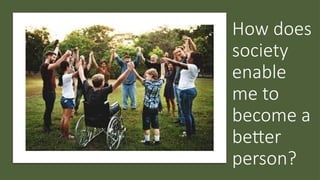
How does
society
enable
me to
become a
better
person?
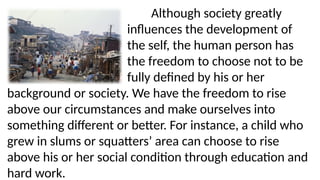
Although society greatly
influences the development of
the self, the human person has
the freedom to choose not to be
fully defined by his or her
background or society. We have the freedom to rise
above our circumstances and make ourselves into
something different or better. For instance, a child who
grew in slums or squatters’ area can choose to rise
above his or her social condition through education and
hard work.
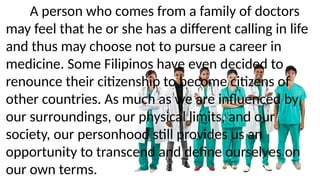
A person who comes from a family of doctors
may feel that he or she has a different calling in life
and thus may choose not to pursue a career in
medicine. Some Filipinos have even decided to
renounce their citizenship to become citizens of
other countries. As much as we are influenced by
our surroundings, our physical limits, and our
society, our personhood still provides us an
opportunity to transcend and define ourselves on
our own terms.
Society recognizes the capability of the person
to develop and provides its members with
opportunities to better themselves. Efficient and
effective public service,
education, and the
maintenance of peace and
order are some of the ways,
society ensures that we are able to have
productive lives and realize our potential.
Social systems are in place to ensure the
welfare of the person in society. Social systems
which include various institutions and groups,
a society strives to recognize
and promote the individual
dignity of persons and
guarantees that they are able
to live harmoniously with others.
Activity 1: TRUE or
FALSE
Instructions: Write T if the statement is true, and F, if it is
false. This activity is worth ten (10) points. Use a
separate sheet of paper for your answers.
1. Totalitarianism, as a philosophy, considers the state as
inferior to the whims and caprices of the individuals
comprising it.
2. Totalitarian governments, autocratic as they are,
unarguably with absolute powers can disregard the rights
and freedoms of people.
3. Society strives to recognize and promote the individual
dignity of persons and guarantees that they are able to live
harmoniously with others.
4. Efficient and effective public service, education, and the
maintenance of peace
and order are some of the ways, society ensures that we are
able to have
productive lives and realize our potential.
5. Your youth organization is one form of society.
6. The philosophy called individualism overemphasizing the
“individuality” of a person results in
the State or government curtailing the persons’ exercise of
rights and freedoms.
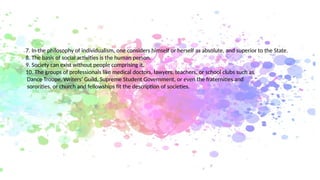
7. In the philosophy of individualism, one considers himself or herself as absolute, and superior to the State.
8. The basis of social activities is the human person.
9. Society can exist without people comprising it.
10. The groups of professionals like medical doctors, lawyers, teachers, or school clubs such as
Dance Troupe, Writers’ Guild, Supreme Student Government, or even the fraternities and
sororities, or church and fellowships fit the description of societies.
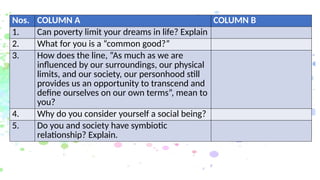
Activity 2: MIND MAPPING
Instructions: Write statements on Column B as responses to
questions on Column
A. This activity is worth twenty-five (25) points where each
number is graded based
on the content of ideas of three (3) points, and the organization
of thoughts of two
(2) points. Write your answers on a separate sheet of paper.
Nos. COLUMN A COLUMN B
1. Can poverty limit your dreams in life? Explain
2. What for you is a “common good?”
3. How does the line, “As much as we are
influenced by our surroundings, our physical
limits, and our society, our personhood still
provides us an opportunity to transcend and
define ourselves on our own terms”, mean to
you?
4. Why do you consider yourself a social being?
5. Do you and society have symbiotic
relationship? Explain.
THE HUMAN PERSON
NEEDS SOCIETY
The human person is social in his roots. In every
dimension of his or her being, he or she lives in a
community of people. Every I-You relationship becomes
ultimately a We relationship.
Pope Leo XIII said: God made a human person to live in
society and placed him or her among his or her kind so that
the natural necessities which alone he or she could not
satisfy
could be fulfilled in society.
Vatican II says that “God did not create man for life in
isolation, but for the formation of social unity.
Aristotle said that the human person is a political
animal that can realize his or her truest self only in
society. He added that society was not made for a
person, for his or her convenience and disposition,
but is a vital necessity, an indispensable need which
he or she cannot do without.
Plato believed that no one is sufficient in himself
or herself; everyone needs the aid of others. They
must, thus, live with others in society.
John Stuart Mill recognized that humans naturally tend to
their own interests. He thought that by living in society, they
can acquire the habit of sharing their happiness with the
happiness of others.
Philosophers Locke, Rousseau, Schelling, and others
believed that human’s true self is realized only in the right kind
of social group. They saw that society is the means to the best
kind of life, for one who lives among fellow humans develops
characteristics which are most worthwhile. Hence, society
becomes a vehicle for the total development of the human
person. The more an individual is involved in his or her
community, the greater is that individual’s self actualization.
Are persons, by nature, social animals? Are
combing of the hair and even the brushing of
the teeth social acts? Is relating with others important
to achieve not only your goal but ultimately
the common good for all? Are persons termed hermits
living in solitude truly happy? Does North
Korea’s isolationist policy make it as a “hermit
kingdom” when it distanced itself from globalized
activities?
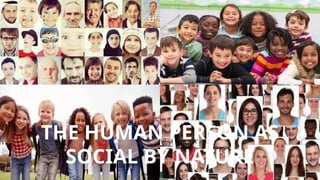
THE HUMAN PERSON AS
SOCIAL BY NATURE
The natural sociability of human
person is shown by the fact that all
people lived in society. This fact, which
has always existed in spite of the
differences of place, time, race, ideas,
and feelings, must proceed from a
constant and universal cause: that
humans are, by nature, social beings.
If human beings are social by nature, then they
have the natural duty to work with others for the good
of society as a whole. Humans need other people to
satisfy their needs and interests. In other words,
people need people to be happy. It is, therefore, but
proper that they should repay society by serving
society and obeying its laws. In like manner, society
has the right to impose its authority upon the people.
Authority refers to socially approved and legitimate
power to make decisions binding and the orders
obligatory.
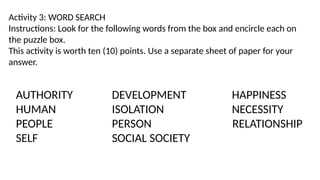
Activity 3: WORD SEARCH
Instructions: Look for the following words from the box and encircle each on
the puzzle box.
This activity is worth ten (10) points. Use a separate sheet of paper for your
answer.
AUTHORITY DEVELOPMENT HAPPINESS
HUMAN ISOLATION NECESSITY
PEOPLE PERSON RELATIONSHIP
SELF SOCIAL SOCIETY
Activity 4: IDENTIFICATION
Instructions: Identify what or who is being asked by the
following statements. You can use the answer more than
once. Use a separate sheet of paper for your answers.
1. Referred to as social beings by nature.
2. Refers to socially approved and legitimate power to
make decisions binding and the orders obligatory.
3. Becomes a vehicle for the total development of the
human person.
4. He recognized the idea that humans, by living in
society, they can acquire the habit of sharing their
happiness with the happiness of others.
5. He believed that no one is sufficient in himself or
herself.
6. He said that the human person is a political animal
that can realize his or her truest self only in society.
7. The social dimension of a person using the I-You
relation happens when his or her self becomes one with
others in society.
8. He said that society was not made for a person, for
his or her convenience and disposition, but is a vital
necessity, an indispensable need which he or she cannot
do without.
9. He said that God made a human person to live in
society and placed him or her among his or her kind so
that the natural necessities which alone he or she could
not satisfy could be fulfilled in society.
10. The entity saying that, “God did not create man for
life in isolation, but for the formation of social unity.”
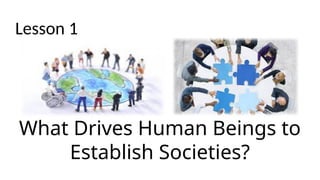
What Drives Human Beings to
Establish Societies?
Lesson 1
REFLECTION:
•Are you a social being whose human nature needs the
company of others?
•What are the human needs which through forging
relationships with others can be realized?
•Can you think of yourself without belonging to an
association like family, neighborhood, school, barangay,
or your country?
Now, have you ever pondered how your world has
defined you? Have you ever thought about your place
in this world and among the people you interact
with every day? Have you ever reflected on how your
presence has affected the world and people around
you? Can you name the factors or influences that drive
you and others to establish societies? You regularly
interact with your groups; how do these groups uphold
the common good?
Do we value our ties as family members? Do
we take care of our elderly family members?
Do we send them to nursing homes in their
twilight years like most Western cultures do?
Or, do you expect your parents to move you
out from your homes once you have attained
the age of majority after graduating high
school like Western cultures do?
In like manner, do animals have
the tendency to form groups with
others?
Could it be for their mutual
protection and survival? Can that
bond too be deemed as forming a
society as well?
WHAT IS SOCIETY?
The human person exists to
relate with others. The person is by
nature a social being because he or
she has a tendency to go out of
himself or herself to form bonds
and relationships with others.
Throughout the person’s life, he or she experiences a
variety of relationships that help shape him or her as a person.
Infants first relate with their immediate family as the source of
basic needs. As they grow, they expand their horizons and start
relating with people who are not part of their immediate
family. They establish friendships beginning in their childhood
and into their teenage and adult years. They also learn how to
deal with other figures of authority aside from their parents. As
we grow into adulthood, our relationships and responsibilities
also change because we play more significant roles in the
communities, we live in.
The pursuit of our goals is made
easier by the fact that we do not need to
do our activities alone, that we can live
our life and pursue our happiness with
other people by our side.
Society is an organized group of
people whose members interact
frequently and have a common territory
and culture. Society also refers to a
companionship or friendly association
with others, an alliance, a community, or
a union.
Philosophers consider society the product of
deliberate actions by individuals who come
together in pursuit of a common goal. Society is
considered unique among all other groups because
of the nature of the human persons that compose
it, as well as the relationship among its members.
Do animals have also the tendency to form groups
for mutual protection and survival, too?
Society provides support that ensures the
development of the human person to become
a productive individual. Society also provides
opportunities to further individuals’ growth in
coming years. An evident influence of society
on individuals is the emergence of specific
traits and characteristics unique to a certain
society which are manifested by its members.
How Society Transforms Human Relations
Which Lead to the Transformation of its Members
Lesson 2
REFLECTION:
Can you think of a person outside society?
Or, a society without persons? Do persons and
their societies have a very dynamic relationship
in which they cannot exist without the other? Is it
important to consider society’s role in the growth
and the development of a person, and the
person’s role in transforming society?
Is to say “Hello!”, the first thing to do, when you meet a
person for the first time?
How about handshake as a form of greeting?
Is “pagmamano”, a unique gesture to greet
to show respect to elders?
Are these some of the norms to which members of society are
expected to conform?
Do norms establish and maintain social order?
Do individuals not conforming to norms experience negative
consequences, such as punishment or social stigma?
Now, think of the rules established by your
family and school.
Why do you think these rules are put in
place?
What happens when these rules are
violated?
How have these rules influenced your
behavior?
In what ways does society transform
individuals? Do social norms, values,
language, religion, and historical events
influence you and others’ beliefs and ways
of behavior? Are some of these norms
immoral which when done, people get
upset and therefore, obstacles to social
acceptance?
Are there rules of conduct that
define your actions and relations with
others? Are social norms such as
folkways, mores, or laws put in place to
guide human actions?
SOCIETY’S ABILITY TO
INFLUENCE PERSONS
What makes us Filipino? Being born in the
Philippines is not our choice. As we grow up in
society, we begin to adopt the traits, traditions, and
characteristics that distinguish Filipino culture. We
learn to speak mother languages through
interactions.
Through these interactions with other
individuals and institutions, we learn how to
behave appropriately, what beliefs and traditions to
practice, and what ideas and
perspectives to consider acceptable.
Society influences our development as persons
in various ways. Society is the backdrop by which we
adopt the prevailing culture, identity, values, ideas,
and knowledge of the persons, groups, and
communities that surround us. Your interactions
with your family, friends, schoolmates, teachers, and
other people have all left indelible marks on your
identity. Society shapes all individuals that are part
of it, though each person is influenced by society in
different ways.
One of society’s ability to influence
persons is to define the relationships and
interactions among its members through
the establishment of norms. Norms are
set of traits and behavior that society
consider acceptable, and are thus
encouraged and passed on to other
members.
Society, through the establishment of norms,
can also influence knowledge and ideas. If the traffic
light flashed red, what does it mean? Is color red the
universal signal for us to STOP on the road? Now,
imagine that tomorrow, the traffic signals get
switched – red now means go, green means caution,
and yellow means stop. What do you think will
happen in the streets? Have society’s rules and
traditions in place for a
long time influenced our knowledge?
Laws are more formal and stringent norms
that establish and define acceptable behavior of
citizens with punishments for their violation. Will
violation of Cybercrime Prevention Law results into
the imprisonment of netizens posting libelous posts
or comments on social media? Is wanton throwing
of garbage by anyone punishable under the Solid
Waste Management Act? Will you be held
accountable under the Anti-Bullying Law for
shaming or inflicting injuries to classmates?
Folkways are less formal
norms that arise from tradition
and do not result in punishment
when violated.
Norms, laws, and other rules that regulate human interactions
give rise to a social system, which is the organized or patterned set
of relationships among individuals and groups that compose a society.
Here, members are assigned social roles, which are actions and
behaviors expected of certain individuals. Individuals who share
similar backgrounds or perform similar roles are grouped together into
social groups or social classes. Certain groups that perform
vital functions in society are recognized as social institutions, and
these include the family, school, government, and religion. A well-
functioning social system where all members, groups, and institutions
work in harmony will ensure that society remains harmonious and
continues to uphold the welfare of its members.
Society also transforms human relations,
which leads to the transformation of its
members. The historical development of society has
brought
about significant changes in the way human beings relate to
each other. Early societies were initially centered on the
family and the clan. But the emergence of industrial
societies transformed human relations, as interactions were
no longer based on the family and community ties, but also
interactions in the workplace.
Virtual societies have brought about
another great transformation in human
relations, as improved communication
technologies make it possible for people
from faraway places to interact closely with
each other.
Over the course of his or her life, a person
will undertake various social
roles as he or she continually interacts with
other members of society. An individual is not
just a member of a family, he or she is also a
neighbor, a citizen, a worker, and a member
of an organization, group, or religion. These roles
entail sets of responsibilities that the
person must undertake.
Another way society shapes us is
through social values, which are actions
or ideals that are considered important by
society. Values such as cooperation,
obedience to the law, concern for others,
and respect for others are considered vital
to maintaining an orderly society.
Other aspects of society that
contribute to the formation of the
individual include language, religion,
and historical events. Do you have
similar beliefs and ideas with those of
your parents or elders? But are your ideas,
beliefs, and views shaped
by other people as well?
Your parents and elders were born to an
earlier generation and have thus gone
through experiences that you will never
encounter. In the same way, you were born
into a generation that has unique experiences
and characteristics. This disparity in
experience and views brings about the
“generation gap”, which often leads to
conflict among people of different ages when
discussing topics.
Note: CONGRATULATIONS! You and your
teacher-facilitator have just journeyed
together the first part of this module for
one (1) week. Your next destination will be
to unravel the mysteries of Lesson 3 on
the “Evolution of Societies”, as we know it
today. Enjoy and make the habit of
philosophizing!
The Different Forms of
Societies
Lesson 3
REFLECTION:
Which among the societies do you prefer the most?
How does each society transform individuals? Which society
makes life simple or complicated? Can simple life usher in a
life of contentment and bliss, far removed from the
complexities of modern living?
Haven’t you become impatient or stressful when poor
Internet connections disrupt your conversations online? Can
you imagine the loss of physical warmth among family
members, though near, who are too preoccupied with
whatever mobile apps they are manipulating?
THE DIFFERENT FORMS OF SOCIETIES
The development of societies throughout
history shows the development of humankind
in response to changing surroundings and
historical developments. The various forms of
societies that emerged include:
1.Hunting and gathering society
This is recognized as the earliest and simplest form of
society. It is generally characterized by its small size and is
composed mainly of families. They are nomadic because
they spend most of their time searching for food and thus,
have no permanent territory. The hierarchy in this type of
society is not very varied. Its members are generally treated
equally and decisions are usually arrived through a
consensus. Because of this, the roles of its members and the
division of labor are not very clearly defined.
2.Pastoral society
This type of society is characterized by the
domestication of animals for food for a more stable and
predictable food supply. Pastoral communities have large
population and remain longer in one place. They
often produce surplus food and resources, which they trade
with other societies. This relative prosperity enables the
people to engage in other activities apart from those
necessary for survival, such as handicrafts. This eventually
leads to the emergence of specialized tasks in the
community.
3.Horticultural society
This society primarily engages in the small-scale cultivation of
plants, fruits, ang vegetables, and the domestication of animals.
These societies are seminomadic, which means that they travel to
another place when they have already depleted the resources in one
area.
Roles and responsibilities are more clearly defined with many
tasks assigned according to gender. Women were doing mostly
domestic work in the home, while the men engaged in hunting and
farming. There is also surplus of goods, which sometimes leads to
inequalities among its members. Individuals here are very family and
clan oriented, and their behaviors and actions are clearly restricted by
tradition.
4.Agrarian or agricultural society
This type of society is a further evolution of the pastoral and
horticultural societies. Agriculture involves the large-scale and
long-term cultivation of crops and domestication of animals.
It is characterized by improved technology, the use of tools,
and farming methods to aid in farming which result in increased
production, giving rise to a growing population.
The large population leads to a more structured social
system that helps manage resources and its members. The
increasingly complex social organization and growing importance of
territory often result in conflicts among neighboring societies over
resources and land.
5.Feudal society
This is based on the ownership of land (fief). Feudal
societies arose out of developments in Western Europe during
Medieval times (Middle Ages), when rival kingdoms were
engaged in conflict over resources, particularly land. In a
feudal society, lords (rulers and owners of big tracts of lands)
grant their vassals (followers) the right to manage parcels of
land. These vassals, in turn, are served by peasant workers
who cultivate the land and tend to animals in the farms.
Members of societies are organized based on
status. Those who own the land (rulers) are
considered the most powerful, while the peasants
are considered the lowest group. Social relations are
characterized by dependence. The lord depends on
his vassals to provide him with resources, the vassals
depend on the peasants for their service, while the
peasants depend on their vassals for protection.
6.Industrial society
This is based on the use of specialized
machinery in the production of goods and
services. The advances in science and technology
in the late 18th
century resulted in the Industrial
Revolution, which in turn gave rise to new
production and industrial methods, as well as
innovations in transportation and communication.
These technological advances resulted in improved
trade and communication and better life conditions for
many people. Work is done in factories and public
education is more prevalent. However, the emergence
of industrialized societies is characterized by greater
inequalities in wealth, power, and influence. The
capitalists (bourgeoisie) are the most influential, while
the workers (proletariat) were greatly disadvantaged.
7.Post-Industrial society
This society is marked by the establishment of societies
based on knowledge, information, and the sale of
services. Led by the human mind and aided by highly
advanced technology, the trend has shifted from industry to
the generation, storage, manipulation, and sale of
information. Members of this society have higher
educational attainment, better training, and specialized
roles.
The virtual society, where people organize themselves through
communication technology and the Internet, is a product of a post-
industrial society. The growth and development of the various forms of
society highlight the growing complexity of human interactions over
time. The technological advances and cultural changes that brought
about these changes result in the expansion of communities that now
include people from varied ethnicities. But despite these
advancements and changes, the human person still remains the
heart and center of society. The person is the primary agent of
change, as he or she drives social changes based on responses to
events and developments affecting society.
THE HUMAN PERSON IN SOCIETY
REFLECTION:
Have you heard of the line, “No man is an island?” Can a
person truly find his meaning all alone by himself or herself?
Doesn’t he or she need others to provide him or her basic
necessities in the form of food, shelter, and clothing? How about
the need for human relations that are founded on love, compassion,
support, or camaraderie?
I. DEFINITION OF SOCIETY
1.Abelos defines society as a population that occupies the same
territory, is subject to the same political authority, and participates in
common culture. Its definition includes four elements: territory,
autonomous government, culture, and people. For
example, Philippine society occupies 299, 681 square kilometers, is
governed by an autonomous government; its citizens share common
culture; and it has an estimated population of about 109,581,078
people as of 2020.
2.Society may be defined as a lasting association of
people for mutual help in attaining their common
goal either necessitated by nature of free consent.
Those necessitated by nature are called necessary
societies also known as natural or primary societies
like the family or nation. Voluntary societies, also
known as secondary societies, are products of free
consent like educational societies, sports, clubs, and
religious societies.
The primary function all societies is to
attain the common good of its members.
Common good involves sound physical and
mental health, sufficient education, enough
opportunities for work, favorable conditions
for religious and cultural life, and socio-
economic development.
Society has also a complementary function better known
as the principle of subsidiary which obliges a society to look
after the responsibilities and needs of the smaller
organizations. This principle allows the smaller groups to do
what they can do by themselves and the same time compels
the society (the bigger group) to help these groups fulfill
certain tasks which they cannot accomplish without society’s
assistance. For example, a barangay must be given the
chance to eradicate drug abuse through its own effort, but
the city
government must always be ready to extend help to attain
that objective.
II: THE ORIGINS OF HUMAN SOCIETY
The Social Contract Theory
During the Enlightenment, social philosophers pondered the
natural laws that govern human relations, and in their discussions,
they put forth their theories regarding the formation of societies.
Enlightenment philosophers such as Thomas Hobbes, John
Locke, and Jean Jacques Rousseau tackled the origins of human
society. To truly understand the true character of
society, they imagined humans as living in a so-called “natural
state,” removed from modernity and civilization.
1.“Life is solitary, poor, nasty, brutish, and short because individuals
are in a war of all against all; a war of every man against every man."
For Thomas Hobbes, persons in their natural states are
governed by their desires and these often lead to conflict with their
fellowmen. Society, therefore, is the means by which
people seek to control their natural tendencies and impose order.
Individuals who establish societies enter into a “social contract” – an
agreement where individuals sacrifice an amount of their freedom
and submit to a higher authority. In this way, society is able to
function and meet the needs of the many, ensuring the survival of
humanity.
2. “Being all equal and
independent, no one ought to
harm another in his life, health,
liberty, or possessions.”
John Locke considered persons in their natural state as
more cooperative and reasonable, and that society, is
formed through the consent of individuals that organized it.
This concept is known as the “consent of the
governed”, a covenant (agreement) among individuals to
cooperate and share the burden of upholding the welfare of
society. Also, the authority that runs society should reflect
the ideals of the people and should that authority fail its
obligation, it would be replaced with a new one.
3.“Humans are born free and that in their natural state, they
have a great deal of freedom and choice about what they do.”
Jean Jacques Rousseau's idea was that it was madness
for people to forfeit their natural freedom for a state in which
they lived without freedom. His concept of the “general will”
believed that even if the people are the ones who organized
society and established government, in extreme cases, the
government be allowed to impose its will on the people based
on the assumption that the people have empowered the
government to act on their behalf, and that it is considered to
be the best judge on what is most beneficial for society.
4. “Citizens making choices about their
society are asked to make them from an
"original position" of equality, behind a "veil
of ignorance", without knowing what
gender, race, abilities, tastes, wealth, or
position in society they will have.”
The original position often referred to as the “veil of ignorance”,
is a thought experiment developed by American philosopher John
Rawls to discover the principles that should structure a society of
free, equal and moral people. In the original position, you are asked
to consider which principles you would select for the basic structure
of society, but you must select as if you had no knowledge ahead of
time what position you would end up having in that society. This
choice is made from behind a "veil of ignorance", which prevents you
from knowing your ethnicity, social status, gender and, crucially, your
individual idea of how to lead a good life. Ideally, this would force
participants to select principles impartially and rationally.
5. “One should become a constrained maximizer, a person disposed to
cooperate with others on the condition that they expect others to
cooperate.”
In his influential text “Morals By Agreement”, David Gauthier
argues that voluntary compliance with moral rules, even in the
absence of enforcement, is in one’s rational self-interest. People can
all do better by voluntarily cooperating, considering the cost of
establishing and maintaining enforcement agencies. People choose to
cooperate since it is beneficial to meet their self-interests. This self-
interest benefits society as a whole, since the actions of individuals in
meeting their individual needs also further the interests of the
members of society.
Although, there are variations on the social contract theory,
perhaps one common feature they all have is the fact that the
different individuals enter into a kind of agreement with one
another to form a society. Individual members put aside their
self interest to create a community where they may live
harmoniously with others. Society is founded on the concept
of common good which refer to the social conditions enabling
persons and groups to fulfill their goals and achieve well-
being. On a larger scale, examples of common good may
include peace and order, clean and safe public spaces, an
efficient transport system, and efficient public service.
Terms:
The Enlightenment (18th century), a
philosophical movement that dominated in
Europe, was centered around the idea that reason is
the primary source of authority and legitimacy, and
advocated such ideals as liberty, progress, tolerance,
fraternity, constitutional government, and separation
of church and state.
Social contract theory, an actual or
hypothetical compact, or agreement
between the ruled and their rulers,
views that persons' moral and/or
political obligations are dependent upon
a contract or agreement among them to
form the society in which they live.
Theory is a well-substantiated explanation of an
aspect of the natural world that can incorporate laws,
hypotheses and facts. In everyday use, the word
"theory“ often means a guess without supporting
evidence, but for scientists, it is an idea to explain
something, or a set of guiding principles. Einstein's
ideas about relativity are an example of the theory of
relativity.
III: SOCIAL NORMS: Folkways,
Mores, Taboo, and Laws
Norms can be internalized, which would
make an individual conform without external
rewards or punishments. There are four types of
social norms that can help inform people about
behavior that is considered acceptable or not:
folkways, mores, taboos, and law. Further, social
norms can vary across time, cultures, place, and
even sub-group.
1. Folkways are behaviors that are learned and shared by a
social group that we often refer to as “customs” in a group
that are not morally significant, but they can be important for
social acceptance.
You should not chew loudly. That would be considered
rude, and it is against class ‘customs’ to do so. To make it
worse, imagine burping without saying ‘excuse me.’ These
would-be folkway violations. Remember, this may not be
disrespectful in all cultures, and it is very subjective.
2.Mores pronounced as (/ˈmɔːreɪz/ sometimes /ˈmɔːriːz/, are
norms of morality, or right and wrong, and if you break one, it
is often considered offensive to most people of a culture.
Sometimes a “more” violation can also be illegal, but other
times it can just be offensive. If a more is not written down in
legislation, it cannot get sanctioned by the criminal justice
system. Other times it can be both illegal and morally wrong.
If one attended a funeral for a family member, no one
would expect to see someone in bright pink clothes or a
bikini. Most people are encouraged to wear black clothing out
of respect. It would be disrespectful to the individual people
are mourning.
3. A taboo is an activity or behavior that
is forbidden, prohibited or otherwise
outside of what is considered acceptable
in society. Taboos are grounded in
morality, and can also be linked to
groups’ culture or religion. An act may be
taboo in one culture and not in another.
Examples of taboos include birth control (in some religions,
such as Catholicism, it is considered taboo to use birth control
medications or devices); blood transfusions (Jehovah
Witnesses are forbidden to undergo blood transfusions or use
certain blood products); eating beef (Hindu faith forbids
consuming beef); eating pork (forbidden in Judaism and
Islam); holiday and birthday celebrations (Jehovah’s
Witnesses don’t celebrate these); premarital sex (most
religions consider sexual relations prior to marriage to be
taboo); and homosexuality (in some religions or cultures,
sexual relations with people of the same sex is considered
taboo), and many more.
4. Lastly, and most important to the study of crime and
criminal justice, our laws. Remember, a social norm is an
obligation to society that can lead to sanctions if
one violates them. Therefore, laws are social norms that have
become formally inscribed (written) which can result in
formal punishment for violations, such as fines, incarceration
(imprisonment), or even death.
The law on bigamy punishes married persons from
contracting a subsequent marriage while the previous
marriage is subsisting, except Filipino Muslims under their
Shariah law.
IV: HOW DOES SOCIETY ENABLE ME
TO BECOME A BETTER PERSON?
Society recognizes the capability of the person to
develop and provides its members with opportunities to
better themselves. Social systems are in place to
ensure the welfare of the person in society. Social
systems which include various institutions and groups, a
society strives to recognize and promote the individual
dignity of persons and guarantees that they are able to
live harmoniously with others.
Do you think society affect the human person
entirely? How do the norms or
patterns of behavior shape your outlook and
perspectives in life? Will society make
you a responsible citizen? If in the affirmative, do
you believe that you can be an
instrument of change this country needs by
becoming an active, politically engaged,
and personally empowered citizen?
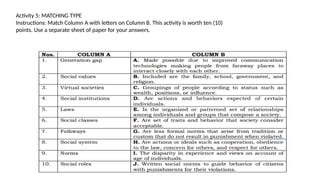
Activity 5: MATCHING TYPE
Instructions: Match Column A with letters on Column B. This activity is worth ten (10)
points. Use a separate sheet of paper for your answers.
Activity 6. MODIFIED TRUE or FALSE
Instructions: Write T if the statement is true,
write the word or group of words that
makes the sentence false, and write the
CORRECT ANSWER beside it. Write your
answers on a separate sheet of paper.
1. Roles of members and the division of labor are not very clearly
defined in hunting and gathering society.
2. Chewing your food loudly is rude as this is against the social norm
called law.
3. The family or nation is an example of a voluntary society.
4. The Industrial Revolution was centered around the idea that
reason is the primary source of authority and legitimacy, and
advocated such ideals as liberty, progress, or tolerance.
5. Feudal society exists where people organize themselves through
communication technology and the Internet.
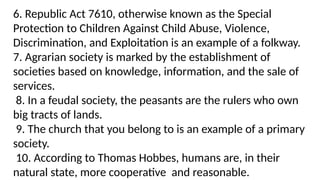
6. Republic Act 7610, otherwise known as the Special
Protection to Children Against Child Abuse, Violence,
Discrimination, and Exploitation is an example of a folkway.
7. Agrarian society is marked by the establishment of
societies based on knowledge, information, and the sale of
services.
8. In a feudal society, the peasants are the rulers who own
big tracts of lands.
9. The church that you belong to is an example of a primary
society.
10. According to Thomas Hobbes, humans are, in their
natural state, more cooperative and reasonable.
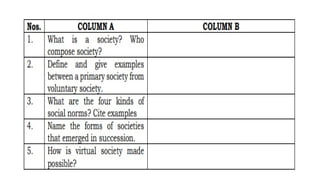
Activity 7: IDEA GENERATION
Instructions: Write your answers in sentence form
on Column B, as responses to statements on Column
A. Each response must conform with the content of
ideas of three (3) points, and the organization of
thoughts of two (2) points as criteria for grading. Use
a separate sheet of paper for your answers.
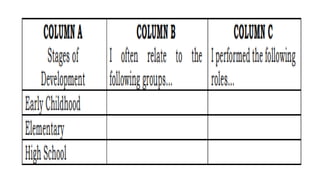
ACTIVITY 8: SOCIETY AND MYSELF
Instructions: Read the guide information below and copy the table
on your sheet of paper. Write your relationships and roles in
society that have changed throughout the different stages of your
life under Column A to complete the introductory phrases under
Column B and Column C. Each number is worth five (5) points
based on the substance of ideas of three (3) points, and the
organization of your thoughts of two (2) points. Use a separate
sheet of paper for your answers.
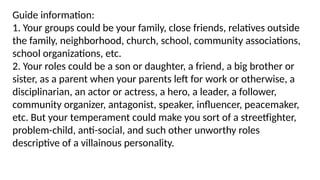
Guide information:
1. Your groups could be your family, close friends, relatives outside
the family, neighborhood, church, school, community associations,
school organizations, etc.
2. Your roles could be a son or daughter, a friend, a big brother or
sister, as a parent when your parents left for work or otherwise, a
disciplinarian, an actor or actress, a hero, a leader, a follower,
community organizer, antagonist, speaker, influencer, peacemaker,
etc. But your temperament could make you sort of a streetfighter,
problem-child, anti-social, and such other unworthy roles
descriptive of a villainous personality.
After filling out your answers, have
you noticed the significant changes in
your relationships with others as you
grow of age, and the role of society
playing on these changes?
Activity 9: THE CATALYST OF CHANGE IN ME
Instructions: Write responses in sentence form to the
following questions after
deliberate reflection. Each number is graded with
three (3) points for the organization
of thoughts, and two (2) points for the
substance/content of ideas. Use a separate
sheet of paper for your answers.
1.How does society enable its members, myself included, to
develop and achieve well - being?
2.How can individuals contribute to bring positive change in
society?
3.How can you uphold the common good in your respective
societies both as a member of your chosen organizations and a
resident of your ‘purok’ or barangay?
4.What positive changes have occurred in your community?
5.What are the most common problems in your “purok” and
barangay? How can you be the part of that solution?
introduction to the human philosophy....

  • 1.
    Introduction to thePhilosophy of the Human Person The Human Person in Society
  • 2.
    When individuals areorganized, do they constitute a society? Society is a group of individuals involved in persistent social interaction, or a large social group sharing the same social territory, typically subject to the same political authority and dominant cultural expectations. Societies are characterized by patterns of relationships (social relations) between individuals who share a distinctive culture and institutions; a given society may be described as the sum total of such relationships among its constituent members. Societies construct patterns of behavior by deeming certain actions known as societal norms which undergo gradual and perpetual changes.
  • 3.
    OBJECTIVES: 1. Write aReaction Paper on the songs Tatsulok, People Who Need People, It’s I Who Build Community, Imagine and Blowin’ In The Wind. 2. Write a Position Paper on the quotes of Gandhi, Ralph Nader, Charles Horton Cook, and C. Wright Mills on society.
  • 4.
    MULTIPLE CHOICE: Choosethe letter that best corresponds to your answer and write it on a separate sheet of paper. 1. This is recognized as the earliest and simplest form of society. A. Feudal B. Horticultural C. Pastoral D. Hunting and Gathering 2. These are more formal and stringent norms that establish and define acceptable behavior of citizens with punishments for violation. A. Folkways B. Laws C. Taboos D. Mores
  • 5.
    3. It isthe organized or patterned set of relationships among individuals and groups that compose a society. A. Social System B. Social Roles C. Social Classes D. Social Institutions 4. These are the certain groups that perform vital functions in society like the family, school, government, and religion. A. Social Roles B. Social System C. Social Classes D. Social Institutions
  • 6.
    5. Norms, laws,and other rules that regulate human interactions give rise to an organized or patterned set of relationships among individuals and groups that compose a society. A. Social Classes B. Social System C. Social Roles D. Social Institutions 6. Refer to traits and behavior that society consider acceptable, and are thusencouraged and passed on to other members. A. Folkways B. Norms C. Taboos D. Laws
  • 7.
    7. Which ofthe following is incorrect? A. Pope Leo XIII: God made a human person to live in society and placed him or her among his or her kind so that the natural necessities which alone he or she could not satisfy could be fulfilled in society. B. Vatican II: Society was not made for a person, for his or her convenience and disposition, but is a vital necessity, an indispensable need which he or she cannot do without. C. Aristotle: Human person is a political animal that can realize his or her truest self only in society. D. Plato: No one is sufficient in himself or herself; everyone needs the aid of others. They must, thus, live with others in society
  • 8.
    8. Society maybe defined as ____________. A. The process of learning another culture. B. The process of learning one’s own culture. C. The minority culture is fully absorbed into the majority culture. D. A lasting association of people for mutual help in attaining their common goal either necessitated by nature or by their free consent.
  • 9.
    9. The followingstatements are true about hunting and gathering society, EXCEPT_______. A. It is generally characterized by its small size and is composed mainly of families. B. Its members are generally treated equally and decisions are usually arrived through a consensus. C. It is characterized by the domestication of animals for food for a more stable and predictable food supply. D. They are nomadic because they spend most of their time searching for food and thus, have no permanent territory.
  • 10.
    10. Which ofthe following statements is incorrect? A. Taboos refer to social or religious custom prohibiting or forbidding certain acts. B. Folkways involve the interdependence of world economies through globalization. C. Laws establish guidance, define acceptable behavior of citizens, and provide punishments for its violation. D. Norms are set of traits and behavior that society consider acceptable, and are thus encouraged and passed on to other members.
  • 11.
    11. Which ofthe following acts does not constitute a taboo? A. In many Jewish and Muslim communities, people are forbidden from eating pork. B. Hinduism forbids its followers to eat beef. C. In some Polynesian communities, people are forbidden to touch the shadow of a chief. D. For having served prison time and paid civil indemnity to his victim, a convict can be pardoned by the President exercising executive clemency.
  • 12.
    12. The “generationgap” has something to do with the following, EXCEPT ___. A. The disparity in experience and views based on age gap of individuals. B. The divide occurring between the rich and the poor brought about by inequalities due to economic opportunities. C. This disparity in experience and views often leads to conflict among people of different ages when discussing topics. D. Your parents and elders were born top an earlier generation and have thus gone through experiences that you will never encounter.
  • 13.
    13.Which of thefollowing statements is true about a horticultural society? A. Involves in large-scale and long-term cultivation of crops and domestication of animals. B. It is characterized by improved technology, the use of tools, and farming methods to aid in farming which result in increased production, giving rise to a growing population. C. Primarily engages in the small-scale cultivation of plants, fruits, ang vegetables, and the domestication of animals. D. The increasingly complex social organization and growing importance of territory often result in conflicts among neighboring societies over resources and land.
  • 14.
    14.The following statementsare true about a feudal society, EXCEPT ___. A. This is based on the ownership of land called fief. B. The lords grant their vassals the right to manage parcels of land. C. Arose when rival kingdoms were engaged in conflict over resources, particularly land. D. Roles and responsibilities are more clearly defined with many tasks assigned according to gender.
  • 15.
    15. Society’s principleof subsidiary has something to do with the following, EXCEPT__. A. It obliges a society to look after the responsibilities and needs of the smaller organizations. B. The liability of teachers and other school personnel for any untoward accidents to students while under their supervision. C. A barangay must be given the chance to eradicate drug abuse through its own effort, but the city government must always be ready to extend help to attain that objective. D. This principle allows the smaller groups to do what they can do by themselves and the same time compels the society (the bigger group) to help these groups fulfill certain tasks which they cannot accomplish without society’s assistance.
  • 16.
    HUMAN PERSON AS BASISOF SOCIAL ACTIVITIES
  • 17.
    The basis ofsocial activities is the human person. This is to say that the goal of all social institutions is and must be the human person, whose very nature needs other human persons. While, of course, the human person is society’s focal point, some philosophers tend to miss this point.
  • 18.
    In the 19thcentury, the philosophy called individualism flourished. Overemphasizing the “individuality” of a person, it considered the individual as absolute, superior to the State (government), and thus independent of State control. Hence, individuals could disregard social obligations. The philosophy of individualism was thought to have made the powerful few become super-rich, at the expense of the common people.
  • 19.
    On the otherhand, there was Totalitarianism, a philosophy which considered the state as all-powerful and absolute that it could disregard the rights and freedoms of people. Its abuses were visible in modern totalitarian states where people were either forced to do hard labor, or killed under the pretext of being politically dangerous.
  • 20.
    Can you citereasons why persons need a society? Upon birth, does he or she initially need the provisions of material things or care from his or her family? For education, does he or she need schools? How about health services from hospitals? Is Philippines a society? Are your neighborhood, circle of friends, church, youth organizations, sitio and barangay considered societies?
  • 21.
  • 22.
    Although society greatly influencesthe development of the self, the human person has the freedom to choose not to be fully defined by his or her background or society. We have the freedom to rise above our circumstances and make ourselves into something different or better. For instance, a child who grew in slums or squatters’ area can choose to rise above his or her social condition through education and hard work.
  • 23.
    A person whocomes from a family of doctors may feel that he or she has a different calling in life and thus may choose not to pursue a career in medicine. Some Filipinos have even decided to renounce their citizenship to become citizens of other countries. As much as we are influenced by our surroundings, our physical limits, and our society, our personhood still provides us an opportunity to transcend and define ourselves on our own terms.
  • 24.
    Society recognizes thecapability of the person to develop and provides its members with opportunities to better themselves. Efficient and effective public service, education, and the maintenance of peace and order are some of the ways, society ensures that we are able to have productive lives and realize our potential.
  • 25.
    Social systems arein place to ensure the welfare of the person in society. Social systems which include various institutions and groups, a society strives to recognize and promote the individual dignity of persons and guarantees that they are able to live harmoniously with others.
  • 26.
    Activity 1: TRUEor FALSE Instructions: Write T if the statement is true, and F, if it is false. This activity is worth ten (10) points. Use a separate sheet of paper for your answers. 1. Totalitarianism, as a philosophy, considers the state as inferior to the whims and caprices of the individuals comprising it. 2. Totalitarian governments, autocratic as they are, unarguably with absolute powers can disregard the rights and freedoms of people. 3. Society strives to recognize and promote the individual dignity of persons and guarantees that they are able to live harmoniously with others.
  • 27.
    4. Efficient andeffective public service, education, and the maintenance of peace and order are some of the ways, society ensures that we are able to have productive lives and realize our potential. 5. Your youth organization is one form of society. 6. The philosophy called individualism overemphasizing the “individuality” of a person results in the State or government curtailing the persons’ exercise of rights and freedoms.
  • 28.
    7. In thephilosophy of individualism, one considers himself or herself as absolute, and superior to the State. 8. The basis of social activities is the human person. 9. Society can exist without people comprising it. 10. The groups of professionals like medical doctors, lawyers, teachers, or school clubs such as Dance Troupe, Writers’ Guild, Supreme Student Government, or even the fraternities and sororities, or church and fellowships fit the description of societies.
  • 29.
    Activity 2: MINDMAPPING Instructions: Write statements on Column B as responses to questions on Column A. This activity is worth twenty-five (25) points where each number is graded based on the content of ideas of three (3) points, and the organization of thoughts of two (2) points. Write your answers on a separate sheet of paper.
  • 30.
    Nos. COLUMN ACOLUMN B 1. Can poverty limit your dreams in life? Explain 2. What for you is a “common good?” 3. How does the line, “As much as we are influenced by our surroundings, our physical limits, and our society, our personhood still provides us an opportunity to transcend and define ourselves on our own terms”, mean to you? 4. Why do you consider yourself a social being? 5. Do you and society have symbiotic relationship? Explain.
  • 31.
  • 32.
    The human personis social in his roots. In every dimension of his or her being, he or she lives in a community of people. Every I-You relationship becomes ultimately a We relationship. Pope Leo XIII said: God made a human person to live in society and placed him or her among his or her kind so that the natural necessities which alone he or she could not satisfy could be fulfilled in society. Vatican II says that “God did not create man for life in isolation, but for the formation of social unity.
  • 33.
    Aristotle said thatthe human person is a political animal that can realize his or her truest self only in society. He added that society was not made for a person, for his or her convenience and disposition, but is a vital necessity, an indispensable need which he or she cannot do without. Plato believed that no one is sufficient in himself or herself; everyone needs the aid of others. They must, thus, live with others in society.
  • 34.
    John Stuart Millrecognized that humans naturally tend to their own interests. He thought that by living in society, they can acquire the habit of sharing their happiness with the happiness of others. Philosophers Locke, Rousseau, Schelling, and others believed that human’s true self is realized only in the right kind of social group. They saw that society is the means to the best kind of life, for one who lives among fellow humans develops characteristics which are most worthwhile. Hence, society becomes a vehicle for the total development of the human person. The more an individual is involved in his or her community, the greater is that individual’s self actualization.
  • 35.
    Are persons, bynature, social animals? Are combing of the hair and even the brushing of the teeth social acts? Is relating with others important to achieve not only your goal but ultimately the common good for all? Are persons termed hermits living in solitude truly happy? Does North Korea’s isolationist policy make it as a “hermit kingdom” when it distanced itself from globalized activities?
  • 36.
    THE HUMAN PERSONAS SOCIAL BY NATURE
  • 37.
    The natural sociabilityof human person is shown by the fact that all people lived in society. This fact, which has always existed in spite of the differences of place, time, race, ideas, and feelings, must proceed from a constant and universal cause: that humans are, by nature, social beings.
  • 38.
    If human beingsare social by nature, then they have the natural duty to work with others for the good of society as a whole. Humans need other people to satisfy their needs and interests. In other words, people need people to be happy. It is, therefore, but proper that they should repay society by serving society and obeying its laws. In like manner, society has the right to impose its authority upon the people. Authority refers to socially approved and legitimate power to make decisions binding and the orders obligatory.
  • 39.
    Activity 3: WORDSEARCH Instructions: Look for the following words from the box and encircle each on the puzzle box. This activity is worth ten (10) points. Use a separate sheet of paper for your answer. AUTHORITY DEVELOPMENT HAPPINESS HUMAN ISOLATION NECESSITY PEOPLE PERSON RELATIONSHIP SELF SOCIAL SOCIETY
  • 41.
    Activity 4: IDENTIFICATION Instructions:Identify what or who is being asked by the following statements. You can use the answer more than once. Use a separate sheet of paper for your answers. 1. Referred to as social beings by nature. 2. Refers to socially approved and legitimate power to make decisions binding and the orders obligatory. 3. Becomes a vehicle for the total development of the human person.
  • 42.
    4. He recognizedthe idea that humans, by living in society, they can acquire the habit of sharing their happiness with the happiness of others. 5. He believed that no one is sufficient in himself or herself. 6. He said that the human person is a political animal that can realize his or her truest self only in society. 7. The social dimension of a person using the I-You relation happens when his or her self becomes one with others in society.
  • 43.
    8. He saidthat society was not made for a person, for his or her convenience and disposition, but is a vital necessity, an indispensable need which he or she cannot do without. 9. He said that God made a human person to live in society and placed him or her among his or her kind so that the natural necessities which alone he or she could not satisfy could be fulfilled in society. 10. The entity saying that, “God did not create man for life in isolation, but for the formation of social unity.”
  • 44.
    What Drives HumanBeings to Establish Societies? Lesson 1
  • 45.
    REFLECTION: •Are you asocial being whose human nature needs the company of others? •What are the human needs which through forging relationships with others can be realized? •Can you think of yourself without belonging to an association like family, neighborhood, school, barangay, or your country?
  • 46.
    Now, have youever pondered how your world has defined you? Have you ever thought about your place in this world and among the people you interact with every day? Have you ever reflected on how your presence has affected the world and people around you? Can you name the factors or influences that drive you and others to establish societies? You regularly interact with your groups; how do these groups uphold the common good?
  • 47.
    Do we valueour ties as family members? Do we take care of our elderly family members? Do we send them to nursing homes in their twilight years like most Western cultures do? Or, do you expect your parents to move you out from your homes once you have attained the age of majority after graduating high school like Western cultures do?
  • 48.
    In like manner,do animals have the tendency to form groups with others? Could it be for their mutual protection and survival? Can that bond too be deemed as forming a society as well?
  • 49.
  • 50.
    The human personexists to relate with others. The person is by nature a social being because he or she has a tendency to go out of himself or herself to form bonds and relationships with others.
  • 51.
    Throughout the person’slife, he or she experiences a variety of relationships that help shape him or her as a person. Infants first relate with their immediate family as the source of basic needs. As they grow, they expand their horizons and start relating with people who are not part of their immediate family. They establish friendships beginning in their childhood and into their teenage and adult years. They also learn how to deal with other figures of authority aside from their parents. As we grow into adulthood, our relationships and responsibilities also change because we play more significant roles in the communities, we live in.
  • 52.
    The pursuit ofour goals is made easier by the fact that we do not need to do our activities alone, that we can live our life and pursue our happiness with other people by our side.
  • 53.
    Society is anorganized group of people whose members interact frequently and have a common territory and culture. Society also refers to a companionship or friendly association with others, an alliance, a community, or a union.
  • 54.
    Philosophers consider societythe product of deliberate actions by individuals who come together in pursuit of a common goal. Society is considered unique among all other groups because of the nature of the human persons that compose it, as well as the relationship among its members. Do animals have also the tendency to form groups for mutual protection and survival, too?
  • 55.
    Society provides supportthat ensures the development of the human person to become a productive individual. Society also provides opportunities to further individuals’ growth in coming years. An evident influence of society on individuals is the emergence of specific traits and characteristics unique to a certain society which are manifested by its members.
  • 56.
    How Society TransformsHuman Relations Which Lead to the Transformation of its Members Lesson 2
  • 57.
    REFLECTION: Can you thinkof a person outside society? Or, a society without persons? Do persons and their societies have a very dynamic relationship in which they cannot exist without the other? Is it important to consider society’s role in the growth and the development of a person, and the person’s role in transforming society?
  • 58.
    Is to say“Hello!”, the first thing to do, when you meet a person for the first time? How about handshake as a form of greeting? Is “pagmamano”, a unique gesture to greet to show respect to elders? Are these some of the norms to which members of society are expected to conform? Do norms establish and maintain social order? Do individuals not conforming to norms experience negative consequences, such as punishment or social stigma?
  • 59.
    Now, think ofthe rules established by your family and school. Why do you think these rules are put in place? What happens when these rules are violated? How have these rules influenced your behavior?
  • 60.
    In what waysdoes society transform individuals? Do social norms, values, language, religion, and historical events influence you and others’ beliefs and ways of behavior? Are some of these norms immoral which when done, people get upset and therefore, obstacles to social acceptance?
  • 61.
    Are there rulesof conduct that define your actions and relations with others? Are social norms such as folkways, mores, or laws put in place to guide human actions?
  • 62.
  • 63.
    What makes usFilipino? Being born in the Philippines is not our choice. As we grow up in society, we begin to adopt the traits, traditions, and characteristics that distinguish Filipino culture. We learn to speak mother languages through interactions. Through these interactions with other individuals and institutions, we learn how to behave appropriately, what beliefs and traditions to practice, and what ideas and perspectives to consider acceptable.
  • 64.
    Society influences ourdevelopment as persons in various ways. Society is the backdrop by which we adopt the prevailing culture, identity, values, ideas, and knowledge of the persons, groups, and communities that surround us. Your interactions with your family, friends, schoolmates, teachers, and other people have all left indelible marks on your identity. Society shapes all individuals that are part of it, though each person is influenced by society in different ways.
  • 65.
    One of society’sability to influence persons is to define the relationships and interactions among its members through the establishment of norms. Norms are set of traits and behavior that society consider acceptable, and are thus encouraged and passed on to other members.
  • 66.
    Society, through theestablishment of norms, can also influence knowledge and ideas. If the traffic light flashed red, what does it mean? Is color red the universal signal for us to STOP on the road? Now, imagine that tomorrow, the traffic signals get switched – red now means go, green means caution, and yellow means stop. What do you think will happen in the streets? Have society’s rules and traditions in place for a long time influenced our knowledge?

  • 67.
    Laws are moreformal and stringent norms that establish and define acceptable behavior of citizens with punishments for their violation. Will violation of Cybercrime Prevention Law results into the imprisonment of netizens posting libelous posts or comments on social media? Is wanton throwing of garbage by anyone punishable under the Solid Waste Management Act? Will you be held accountable under the Anti-Bullying Law for shaming or inflicting injuries to classmates?
  • 68.
    Folkways are lessformal norms that arise from tradition and do not result in punishment when violated.
  • 69.
    Norms, laws, andother rules that regulate human interactions give rise to a social system, which is the organized or patterned set of relationships among individuals and groups that compose a society. Here, members are assigned social roles, which are actions and behaviors expected of certain individuals. Individuals who share similar backgrounds or perform similar roles are grouped together into social groups or social classes. Certain groups that perform vital functions in society are recognized as social institutions, and these include the family, school, government, and religion. A well- functioning social system where all members, groups, and institutions work in harmony will ensure that society remains harmonious and continues to uphold the welfare of its members.
  • 70.
    Society also transformshuman relations, which leads to the transformation of its members. The historical development of society has brought about significant changes in the way human beings relate to each other. Early societies were initially centered on the family and the clan. But the emergence of industrial societies transformed human relations, as interactions were no longer based on the family and community ties, but also interactions in the workplace.
  • 71.
    Virtual societies havebrought about another great transformation in human relations, as improved communication technologies make it possible for people from faraway places to interact closely with each other.
  • 72.
    Over the courseof his or her life, a person will undertake various social roles as he or she continually interacts with other members of society. An individual is not just a member of a family, he or she is also a neighbor, a citizen, a worker, and a member of an organization, group, or religion. These roles entail sets of responsibilities that the person must undertake.
  • 73.
    Another way societyshapes us is through social values, which are actions or ideals that are considered important by society. Values such as cooperation, obedience to the law, concern for others, and respect for others are considered vital to maintaining an orderly society.
  • 74.
    Other aspects ofsociety that contribute to the formation of the individual include language, religion, and historical events. Do you have similar beliefs and ideas with those of your parents or elders? But are your ideas, beliefs, and views shaped by other people as well?
  • 75.
    Your parents andelders were born to an earlier generation and have thus gone through experiences that you will never encounter. In the same way, you were born into a generation that has unique experiences and characteristics. This disparity in experience and views brings about the “generation gap”, which often leads to conflict among people of different ages when discussing topics.
  • 76.
    Note: CONGRATULATIONS! Youand your teacher-facilitator have just journeyed together the first part of this module for one (1) week. Your next destination will be to unravel the mysteries of Lesson 3 on the “Evolution of Societies”, as we know it today. Enjoy and make the habit of philosophizing!
  • 77.
    The Different Formsof Societies Lesson 3
  • 78.
    REFLECTION: Which among thesocieties do you prefer the most? How does each society transform individuals? Which society makes life simple or complicated? Can simple life usher in a life of contentment and bliss, far removed from the complexities of modern living? Haven’t you become impatient or stressful when poor Internet connections disrupt your conversations online? Can you imagine the loss of physical warmth among family members, though near, who are too preoccupied with whatever mobile apps they are manipulating?
  • 79.
    THE DIFFERENT FORMSOF SOCIETIES The development of societies throughout history shows the development of humankind in response to changing surroundings and historical developments. The various forms of societies that emerged include:
  • 80.
    1.Hunting and gatheringsociety This is recognized as the earliest and simplest form of society. It is generally characterized by its small size and is composed mainly of families. They are nomadic because they spend most of their time searching for food and thus, have no permanent territory. The hierarchy in this type of society is not very varied. Its members are generally treated equally and decisions are usually arrived through a consensus. Because of this, the roles of its members and the division of labor are not very clearly defined.
  • 81.
    2.Pastoral society This typeof society is characterized by the domestication of animals for food for a more stable and predictable food supply. Pastoral communities have large population and remain longer in one place. They often produce surplus food and resources, which they trade with other societies. This relative prosperity enables the people to engage in other activities apart from those necessary for survival, such as handicrafts. This eventually leads to the emergence of specialized tasks in the community.
  • 82.
    3.Horticultural society This societyprimarily engages in the small-scale cultivation of plants, fruits, ang vegetables, and the domestication of animals. These societies are seminomadic, which means that they travel to another place when they have already depleted the resources in one area. Roles and responsibilities are more clearly defined with many tasks assigned according to gender. Women were doing mostly domestic work in the home, while the men engaged in hunting and farming. There is also surplus of goods, which sometimes leads to inequalities among its members. Individuals here are very family and clan oriented, and their behaviors and actions are clearly restricted by tradition.
  • 83.
    4.Agrarian or agriculturalsociety This type of society is a further evolution of the pastoral and horticultural societies. Agriculture involves the large-scale and long-term cultivation of crops and domestication of animals. It is characterized by improved technology, the use of tools, and farming methods to aid in farming which result in increased production, giving rise to a growing population. The large population leads to a more structured social system that helps manage resources and its members. The increasingly complex social organization and growing importance of territory often result in conflicts among neighboring societies over resources and land.
  • 84.
    5.Feudal society This isbased on the ownership of land (fief). Feudal societies arose out of developments in Western Europe during Medieval times (Middle Ages), when rival kingdoms were engaged in conflict over resources, particularly land. In a feudal society, lords (rulers and owners of big tracts of lands) grant their vassals (followers) the right to manage parcels of land. These vassals, in turn, are served by peasant workers who cultivate the land and tend to animals in the farms.
  • 85.
    Members of societiesare organized based on status. Those who own the land (rulers) are considered the most powerful, while the peasants are considered the lowest group. Social relations are characterized by dependence. The lord depends on his vassals to provide him with resources, the vassals depend on the peasants for their service, while the peasants depend on their vassals for protection.
  • 86.
    6.Industrial society This isbased on the use of specialized machinery in the production of goods and services. The advances in science and technology in the late 18th century resulted in the Industrial Revolution, which in turn gave rise to new production and industrial methods, as well as innovations in transportation and communication.
  • 87.
    These technological advancesresulted in improved trade and communication and better life conditions for many people. Work is done in factories and public education is more prevalent. However, the emergence of industrialized societies is characterized by greater inequalities in wealth, power, and influence. The capitalists (bourgeoisie) are the most influential, while the workers (proletariat) were greatly disadvantaged.
  • 88.
    7.Post-Industrial society This societyis marked by the establishment of societies based on knowledge, information, and the sale of services. Led by the human mind and aided by highly advanced technology, the trend has shifted from industry to the generation, storage, manipulation, and sale of information. Members of this society have higher educational attainment, better training, and specialized roles.
  • 89.
    The virtual society,where people organize themselves through communication technology and the Internet, is a product of a post- industrial society. The growth and development of the various forms of society highlight the growing complexity of human interactions over time. The technological advances and cultural changes that brought about these changes result in the expansion of communities that now include people from varied ethnicities. But despite these advancements and changes, the human person still remains the heart and center of society. The person is the primary agent of change, as he or she drives social changes based on responses to events and developments affecting society.
  • 90.
    THE HUMAN PERSONIN SOCIETY REFLECTION: Have you heard of the line, “No man is an island?” Can a person truly find his meaning all alone by himself or herself? Doesn’t he or she need others to provide him or her basic necessities in the form of food, shelter, and clothing? How about the need for human relations that are founded on love, compassion, support, or camaraderie?
  • 91.
    I. DEFINITION OFSOCIETY 1.Abelos defines society as a population that occupies the same territory, is subject to the same political authority, and participates in common culture. Its definition includes four elements: territory, autonomous government, culture, and people. For example, Philippine society occupies 299, 681 square kilometers, is governed by an autonomous government; its citizens share common culture; and it has an estimated population of about 109,581,078 people as of 2020.
  • 92.
    2.Society may bedefined as a lasting association of people for mutual help in attaining their common goal either necessitated by nature of free consent. Those necessitated by nature are called necessary societies also known as natural or primary societies like the family or nation. Voluntary societies, also known as secondary societies, are products of free consent like educational societies, sports, clubs, and religious societies.
  • 93.
    The primary functionall societies is to attain the common good of its members. Common good involves sound physical and mental health, sufficient education, enough opportunities for work, favorable conditions for religious and cultural life, and socio- economic development.
  • 94.
    Society has alsoa complementary function better known as the principle of subsidiary which obliges a society to look after the responsibilities and needs of the smaller organizations. This principle allows the smaller groups to do what they can do by themselves and the same time compels the society (the bigger group) to help these groups fulfill certain tasks which they cannot accomplish without society’s assistance. For example, a barangay must be given the chance to eradicate drug abuse through its own effort, but the city government must always be ready to extend help to attain that objective.
  • 95.
    II: THE ORIGINSOF HUMAN SOCIETY The Social Contract Theory During the Enlightenment, social philosophers pondered the natural laws that govern human relations, and in their discussions, they put forth their theories regarding the formation of societies. Enlightenment philosophers such as Thomas Hobbes, John Locke, and Jean Jacques Rousseau tackled the origins of human society. To truly understand the true character of society, they imagined humans as living in a so-called “natural state,” removed from modernity and civilization.
  • 96.
    1.“Life is solitary,poor, nasty, brutish, and short because individuals are in a war of all against all; a war of every man against every man." For Thomas Hobbes, persons in their natural states are governed by their desires and these often lead to conflict with their fellowmen. Society, therefore, is the means by which people seek to control their natural tendencies and impose order. Individuals who establish societies enter into a “social contract” – an agreement where individuals sacrifice an amount of their freedom and submit to a higher authority. In this way, society is able to function and meet the needs of the many, ensuring the survival of humanity.
  • 97.
    2. “Being allequal and independent, no one ought to harm another in his life, health, liberty, or possessions.”
  • 98.
    John Locke consideredpersons in their natural state as more cooperative and reasonable, and that society, is formed through the consent of individuals that organized it. This concept is known as the “consent of the governed”, a covenant (agreement) among individuals to cooperate and share the burden of upholding the welfare of society. Also, the authority that runs society should reflect the ideals of the people and should that authority fail its obligation, it would be replaced with a new one.
  • 99.
    3.“Humans are bornfree and that in their natural state, they have a great deal of freedom and choice about what they do.” Jean Jacques Rousseau's idea was that it was madness for people to forfeit their natural freedom for a state in which they lived without freedom. His concept of the “general will” believed that even if the people are the ones who organized society and established government, in extreme cases, the government be allowed to impose its will on the people based on the assumption that the people have empowered the government to act on their behalf, and that it is considered to be the best judge on what is most beneficial for society.
  • 100.
    4. “Citizens makingchoices about their society are asked to make them from an "original position" of equality, behind a "veil of ignorance", without knowing what gender, race, abilities, tastes, wealth, or position in society they will have.”
  • 101.
    The original positionoften referred to as the “veil of ignorance”, is a thought experiment developed by American philosopher John Rawls to discover the principles that should structure a society of free, equal and moral people. In the original position, you are asked to consider which principles you would select for the basic structure of society, but you must select as if you had no knowledge ahead of time what position you would end up having in that society. This choice is made from behind a "veil of ignorance", which prevents you from knowing your ethnicity, social status, gender and, crucially, your individual idea of how to lead a good life. Ideally, this would force participants to select principles impartially and rationally.
  • 102.
    5. “One shouldbecome a constrained maximizer, a person disposed to cooperate with others on the condition that they expect others to cooperate.” In his influential text “Morals By Agreement”, David Gauthier argues that voluntary compliance with moral rules, even in the absence of enforcement, is in one’s rational self-interest. People can all do better by voluntarily cooperating, considering the cost of establishing and maintaining enforcement agencies. People choose to cooperate since it is beneficial to meet their self-interests. This self- interest benefits society as a whole, since the actions of individuals in meeting their individual needs also further the interests of the members of society.
  • 103.
    Although, there arevariations on the social contract theory, perhaps one common feature they all have is the fact that the different individuals enter into a kind of agreement with one another to form a society. Individual members put aside their self interest to create a community where they may live harmoniously with others. Society is founded on the concept of common good which refer to the social conditions enabling persons and groups to fulfill their goals and achieve well- being. On a larger scale, examples of common good may include peace and order, clean and safe public spaces, an efficient transport system, and efficient public service.
  • 104.
    Terms: The Enlightenment (18thcentury), a philosophical movement that dominated in Europe, was centered around the idea that reason is the primary source of authority and legitimacy, and advocated such ideals as liberty, progress, tolerance, fraternity, constitutional government, and separation of church and state.
  • 105.
    Social contract theory,an actual or hypothetical compact, or agreement between the ruled and their rulers, views that persons' moral and/or political obligations are dependent upon a contract or agreement among them to form the society in which they live.
  • 106.
    Theory is awell-substantiated explanation of an aspect of the natural world that can incorporate laws, hypotheses and facts. In everyday use, the word "theory“ often means a guess without supporting evidence, but for scientists, it is an idea to explain something, or a set of guiding principles. Einstein's ideas about relativity are an example of the theory of relativity.
  • 107.
    III: SOCIAL NORMS:Folkways, Mores, Taboo, and Laws
  • 108.
    Norms can beinternalized, which would make an individual conform without external rewards or punishments. There are four types of social norms that can help inform people about behavior that is considered acceptable or not: folkways, mores, taboos, and law. Further, social norms can vary across time, cultures, place, and even sub-group.
  • 109.
    1. Folkways arebehaviors that are learned and shared by a social group that we often refer to as “customs” in a group that are not morally significant, but they can be important for social acceptance. You should not chew loudly. That would be considered rude, and it is against class ‘customs’ to do so. To make it worse, imagine burping without saying ‘excuse me.’ These would-be folkway violations. Remember, this may not be disrespectful in all cultures, and it is very subjective.
  • 110.
    2.Mores pronounced as(/ˈmɔːreɪz/ sometimes /ˈmɔːriːz/, are norms of morality, or right and wrong, and if you break one, it is often considered offensive to most people of a culture. Sometimes a “more” violation can also be illegal, but other times it can just be offensive. If a more is not written down in legislation, it cannot get sanctioned by the criminal justice system. Other times it can be both illegal and morally wrong. If one attended a funeral for a family member, no one would expect to see someone in bright pink clothes or a bikini. Most people are encouraged to wear black clothing out of respect. It would be disrespectful to the individual people are mourning.
  • 111.
    3. A taboois an activity or behavior that is forbidden, prohibited or otherwise outside of what is considered acceptable in society. Taboos are grounded in morality, and can also be linked to groups’ culture or religion. An act may be taboo in one culture and not in another.
  • 112.
    Examples of taboosinclude birth control (in some religions, such as Catholicism, it is considered taboo to use birth control medications or devices); blood transfusions (Jehovah Witnesses are forbidden to undergo blood transfusions or use certain blood products); eating beef (Hindu faith forbids consuming beef); eating pork (forbidden in Judaism and Islam); holiday and birthday celebrations (Jehovah’s Witnesses don’t celebrate these); premarital sex (most religions consider sexual relations prior to marriage to be taboo); and homosexuality (in some religions or cultures, sexual relations with people of the same sex is considered taboo), and many more.
  • 113.
    4. Lastly, andmost important to the study of crime and criminal justice, our laws. Remember, a social norm is an obligation to society that can lead to sanctions if one violates them. Therefore, laws are social norms that have become formally inscribed (written) which can result in formal punishment for violations, such as fines, incarceration (imprisonment), or even death. The law on bigamy punishes married persons from contracting a subsequent marriage while the previous marriage is subsisting, except Filipino Muslims under their Shariah law.
  • 114.
    IV: HOW DOESSOCIETY ENABLE ME TO BECOME A BETTER PERSON?
  • 115.
    Society recognizes thecapability of the person to develop and provides its members with opportunities to better themselves. Social systems are in place to ensure the welfare of the person in society. Social systems which include various institutions and groups, a society strives to recognize and promote the individual dignity of persons and guarantees that they are able to live harmoniously with others.
  • 116.
    Do you thinksociety affect the human person entirely? How do the norms or patterns of behavior shape your outlook and perspectives in life? Will society make you a responsible citizen? If in the affirmative, do you believe that you can be an instrument of change this country needs by becoming an active, politically engaged, and personally empowered citizen?

  • 117.
    Activity 5: MATCHINGTYPE Instructions: Match Column A with letters on Column B. This activity is worth ten (10) points. Use a separate sheet of paper for your answers.
  • 118.
    Activity 6. MODIFIEDTRUE or FALSE Instructions: Write T if the statement is true, write the word or group of words that makes the sentence false, and write the CORRECT ANSWER beside it. Write your answers on a separate sheet of paper.
  • 119.
    1. Roles ofmembers and the division of labor are not very clearly defined in hunting and gathering society. 2. Chewing your food loudly is rude as this is against the social norm called law. 3. The family or nation is an example of a voluntary society. 4. The Industrial Revolution was centered around the idea that reason is the primary source of authority and legitimacy, and advocated such ideals as liberty, progress, or tolerance. 5. Feudal society exists where people organize themselves through communication technology and the Internet.
  • 120.
    6. Republic Act7610, otherwise known as the Special Protection to Children Against Child Abuse, Violence, Discrimination, and Exploitation is an example of a folkway. 7. Agrarian society is marked by the establishment of societies based on knowledge, information, and the sale of services. 8. In a feudal society, the peasants are the rulers who own big tracts of lands. 9. The church that you belong to is an example of a primary society. 10. According to Thomas Hobbes, humans are, in their natural state, more cooperative and reasonable.
  • 121.
    Activity 7: IDEAGENERATION Instructions: Write your answers in sentence form on Column B, as responses to statements on Column A. Each response must conform with the content of ideas of three (3) points, and the organization of thoughts of two (2) points as criteria for grading. Use a separate sheet of paper for your answers.
  • 123.
    ACTIVITY 8: SOCIETYAND MYSELF Instructions: Read the guide information below and copy the table on your sheet of paper. Write your relationships and roles in society that have changed throughout the different stages of your life under Column A to complete the introductory phrases under Column B and Column C. Each number is worth five (5) points based on the substance of ideas of three (3) points, and the organization of your thoughts of two (2) points. Use a separate sheet of paper for your answers.
  • 125.
    Guide information: 1. Yourgroups could be your family, close friends, relatives outside the family, neighborhood, church, school, community associations, school organizations, etc. 2. Your roles could be a son or daughter, a friend, a big brother or sister, as a parent when your parents left for work or otherwise, a disciplinarian, an actor or actress, a hero, a leader, a follower, community organizer, antagonist, speaker, influencer, peacemaker, etc. But your temperament could make you sort of a streetfighter, problem-child, anti-social, and such other unworthy roles descriptive of a villainous personality.
  • 126.
    After filling outyour answers, have you noticed the significant changes in your relationships with others as you grow of age, and the role of society playing on these changes?
  • 127.
    Activity 9: THECATALYST OF CHANGE IN ME Instructions: Write responses in sentence form to the following questions after deliberate reflection. Each number is graded with three (3) points for the organization of thoughts, and two (2) points for the substance/content of ideas. Use a separate sheet of paper for your answers.
  • 128.
    1.How does societyenable its members, myself included, to develop and achieve well - being? 2.How can individuals contribute to bring positive change in society? 3.How can you uphold the common good in your respective societies both as a member of your chosen organizations and a resident of your ‘purok’ or barangay? 4.What positive changes have occurred in your community? 5.What are the most common problems in your “purok” and barangay? How can you be the part of that solution?