4
P I C S
1 W O R D
HOW TO PLAY?
HOW TO PLAY?
The game displays four pictures linked by
one word. The player's goal is to figure
out the word using a set of letters
provided below the pictures.
LET’S START!
A Z N
M F O
R Y L
P H I
A
Z N
M
F
O
R Y
L
P H
I
R S F
E K O
N Y L
P D I
R S
F E
K O
N
Y L
P
D
I
R H F
C K O
O Y L
P S I
R
H
F
C
K
O O
Y
P
S
I
L
R W A
C K O
O Y L
P E I
O Y
I
R
W O K P L A C E
I L Y
A M
F
E N D
R I
F
F
O O L
C H
S
R
W O K P L A C E
THE HUMAN PERSON
IN SOCIETY
1. Have you ever wondered how
your world defined you?
2. Have you ever thought about your
place in this world and among the
people you interact with every day?
3. Have you ever reflected on how
your presence has affected the world
and people around you?
The human person exists to relate
with others.
The person is by nature a SOCIAL
BEING because he or she has a
tendency to go out of himself or
herself TO FORM BONDS and
relationships with others.
Throughout a person's life, he or she
experiences a variety of
RELATIONSHIPS that help SHAPE HIM
OR HER AS A PERSON.
Throughout a person's life, he or she
experiences a variety of
RELATIONSHIPS that help SHAPE HIM
OR HER AS A PERSON.
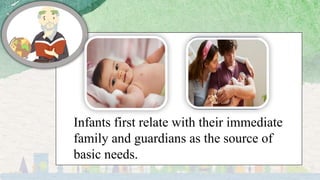
Infants first relate with their immediate
family and guardians as the source of
basic needs.
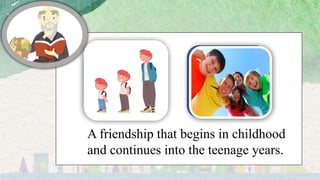
A friendship that begins in childhood
and continues into the teenage years.
As we grow up, we meet new colleagues and
understand our responsibilities.
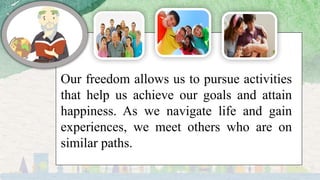
Our freedom allows us to pursue activities
that help us achieve our goals and attain
happiness. As we navigate life and gain
experiences, we meet others who are on
similar paths.
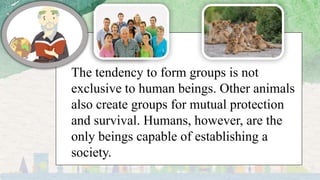
The tendency to form groups is not
exclusive to human beings. Other animals
also create groups for mutual protection
and survival. Humans, however, are the
only beings capable of establishing a
society.
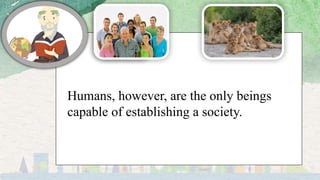
Humans, however, are the only beings
capable of establishing a society.
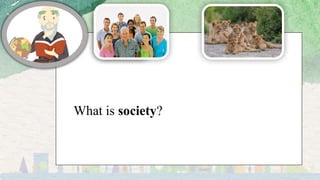
What is society?
What is society?
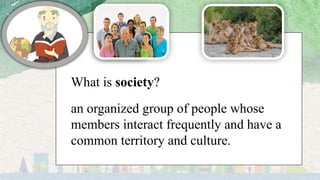
an organized group of people whose
members interact frequently and have a
common territory and culture.
Philosophers view society as the result of
intentional actions by individuals working
together toward a common goal. It is
distinct from other groups due to the
unique nature of the individuals involved
and the relationships they share.
As individual persons, members of
society can transform themselves and
attain development through their
interactions within society, In turn,
humans are also able to influence society
through their actions.
Society enables the emergence of
individualities and is essential for
human survival.
• An infant's survival relies on family
and human relationships.
• As individuals grow, they interact
with others outside the home,
forming friendships in various
settings like school and work.
Society provides support for personal
development, starting with education at
home and continuing in schools.
Education equips individuals with
knowledge and skills for effective
societal interaction.
Society influences the emergence of
specific traits and characteristics among
its members.
Cultural differences in family values:
• Filipinos emphasize family ties and care for the
elderly at home.
• Western cultures prioritize independence, often
placing elderly family members in retirement
homes.
• Western parents expect children to move out after
high school, while Filipino parents typically
continue supporting adult children living at home.
THE SOCIAL CONTRACT THEORY
During the enlightenment, social philosophers
ponderd the natural laws that govern human societies;
and in their discussions, several philosophers put forth
their theories regarding the formation of societies.
Enlightenment philosophers such as Thomas Hobbes,
John Locke, and Jean Jacques Rousseau, were
among the most prominent social theorists who
tackled the origins of the society. To fully understand
the true character of the society, they imagined human
as living in a so called “Natural State” .
The "natural state" is a theoretical concept used by
Enlightenment philosophers to understand the origins
of society and human behavior. It's imagines a world
without any established government, laws, or social
structures. In this state, humans are free from any
external constraints, living in a state of nature.
Thomas Hobbes, believed the natural state was a
"state of war," where individuals are driven by self-
preservation and fear, constantly competing for
resources and power. He believes that life in this state
is "solitary, poor, nasty, brutish, and short."
unlike Thomas Hobbes, John Locke believed that
humans in their natural state are not inherently driven
by conflict. Instead, he saw them as capable of reason
and cooperation. Locke argued that society is formed
through the consent of the governed, meaning that
people willingly agree to live under a government that
protects their rights and promotes their welfare.
John Rawls introduced the original position, a
hypothetical state of "veil of ignorance" where
individuals are unaware of their personal attributes
such as Gender, Race, or Social Status. From this
position, rational self-interest leads them to choose
principles creating a just and fair society for all.
David Gauthier contributed Self-Interest to the
social contract theories, He argues that self-interest is
a significant factor in building and maintaining
societies; individuals cooperate because it benefits
them, and this ultimately benefits society as a whole.
Society is built on the concept of the common good,
emerging from the human desire for survival and the
natural inclination toward goodness. People are driven
to form relationships and collaborate, recognizing that
others also seek what is good. When multiple
individuals work towards a shared good, a common
good is established among them.
SUMMARY
The common good encompases social conditions
enabling individuals and groups to achieve their goals
and well-being. Examples includes peace, clean
spaces, efficient transport, and effective public
services. All members of society benefit and share
responsibility for its achievement, creating
opportunities for individual and collective fulfillment.

Philosophy in edcation report-REPORT.pptx

  • 1.
    4 P I CS 1 W O R D
  • 2.
  • 3.
    HOW TO PLAY? Thegame displays four pictures linked by one word. The player's goal is to figure out the word using a set of letters provided below the pictures.
  • 4.
  • 5.
    A Z N MF O R Y L P H I
  • 6.
  • 7.
    R S F EK O N Y L P D I
  • 8.
    R S F E KO N Y L P D I
  • 9.
    R H F CK O O Y L P S I
  • 10.
  • 11.
    R W A CK O O Y L P E I
  • 12.
    O Y I R W OK P L A C E
  • 13.
    I L Y AM F E N D R I F F O O L C H S R W O K P L A C E
  • 14.
  • 15.
    1. Have youever wondered how your world defined you? 2. Have you ever thought about your place in this world and among the people you interact with every day? 3. Have you ever reflected on how your presence has affected the world and people around you?
  • 16.
    The human personexists to relate with others.
  • 17.
    The person isby nature a SOCIAL BEING because he or she has a tendency to go out of himself or herself TO FORM BONDS and relationships with others.
  • 18.
    Throughout a person'slife, he or she experiences a variety of RELATIONSHIPS that help SHAPE HIM OR HER AS A PERSON.
  • 19.
    Throughout a person'slife, he or she experiences a variety of RELATIONSHIPS that help SHAPE HIM OR HER AS A PERSON.
  • 22.
    Infants first relatewith their immediate family and guardians as the source of basic needs.
  • 23.
    A friendship thatbegins in childhood and continues into the teenage years.
  • 24.
    As we growup, we meet new colleagues and understand our responsibilities.
  • 25.
    Our freedom allowsus to pursue activities that help us achieve our goals and attain happiness. As we navigate life and gain experiences, we meet others who are on similar paths.
  • 26.
    The tendency toform groups is not exclusive to human beings. Other animals also create groups for mutual protection and survival. Humans, however, are the only beings capable of establishing a society.
  • 27.
    Humans, however, arethe only beings capable of establishing a society.

  • 28.
  • 29.
    What is society? anorganized group of people whose members interact frequently and have a common territory and culture.
  • 30.
    Philosophers view societyas the result of intentional actions by individuals working together toward a common goal. It is distinct from other groups due to the unique nature of the individuals involved and the relationships they share.
  • 31.
    As individual persons,members of society can transform themselves and attain development through their interactions within society, In turn, humans are also able to influence society through their actions.
  • 32.
    Society enables theemergence of individualities and is essential for human survival.
  • 33.
    • An infant'ssurvival relies on family and human relationships. • As individuals grow, they interact with others outside the home, forming friendships in various settings like school and work.
  • 34.
    Society provides supportfor personal development, starting with education at home and continuing in schools. Education equips individuals with knowledge and skills for effective societal interaction.
  • 35.
    Society influences theemergence of specific traits and characteristics among its members.
  • 36.
    Cultural differences infamily values: • Filipinos emphasize family ties and care for the elderly at home. • Western cultures prioritize independence, often placing elderly family members in retirement homes. • Western parents expect children to move out after high school, while Filipino parents typically continue supporting adult children living at home.
  • 37.
    THE SOCIAL CONTRACTTHEORY During the enlightenment, social philosophers ponderd the natural laws that govern human societies; and in their discussions, several philosophers put forth their theories regarding the formation of societies.
  • 38.
    Enlightenment philosophers suchas Thomas Hobbes, John Locke, and Jean Jacques Rousseau, were among the most prominent social theorists who tackled the origins of the society. To fully understand the true character of the society, they imagined human as living in a so called “Natural State” .
  • 39.
    The "natural state"is a theoretical concept used by Enlightenment philosophers to understand the origins of society and human behavior. It's imagines a world without any established government, laws, or social structures. In this state, humans are free from any external constraints, living in a state of nature.
  • 40.
    Thomas Hobbes, believedthe natural state was a "state of war," where individuals are driven by self- preservation and fear, constantly competing for resources and power. He believes that life in this state is "solitary, poor, nasty, brutish, and short."
  • 41.
    unlike Thomas Hobbes,John Locke believed that humans in their natural state are not inherently driven by conflict. Instead, he saw them as capable of reason and cooperation. Locke argued that society is formed through the consent of the governed, meaning that people willingly agree to live under a government that protects their rights and promotes their welfare.
  • 42.
    John Rawls introducedthe original position, a hypothetical state of "veil of ignorance" where individuals are unaware of their personal attributes such as Gender, Race, or Social Status. From this position, rational self-interest leads them to choose principles creating a just and fair society for all.
  • 43.
    David Gauthier contributedSelf-Interest to the social contract theories, He argues that self-interest is a significant factor in building and maintaining societies; individuals cooperate because it benefits them, and this ultimately benefits society as a whole.
  • 44.
    Society is builton the concept of the common good, emerging from the human desire for survival and the natural inclination toward goodness. People are driven to form relationships and collaborate, recognizing that others also seek what is good. When multiple individuals work towards a shared good, a common good is established among them. SUMMARY
  • 45.
    The common goodencompases social conditions enabling individuals and groups to achieve their goals and well-being. Examples includes peace, clean spaces, efficient transport, and effective public services. All members of society benefit and share responsibility for its achievement, creating opportunities for individual and collective fulfillment.