Keys
• A key is define the piece inserted in a axial
direction between a shaft and hub to prevent
relative rotation but allow sliding movement along
the shaft if required.
• Keys are temporary fastening and are always
made of mild steel because they are subjected to
shearing and compressive stresses caused by the
torque they transmit.
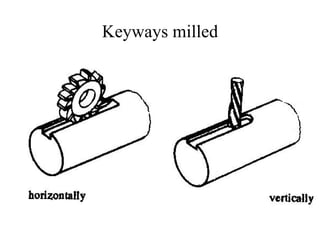
• a keyway is the groove cut in the shaft or hub to
accommodate a key. Key ways can be milled
horizontally or vertically .
Keyways milled
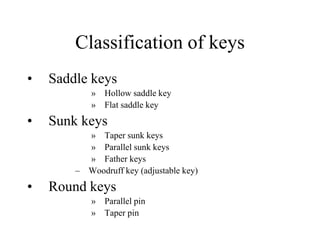
Classification of keys
• Saddle keys
» Hollow saddle key
» Flat saddle key
• Sunk keys
» Taper sunk keys
» Parallel sunk keys
» Father keys
– Woodruff key (adjustable key)
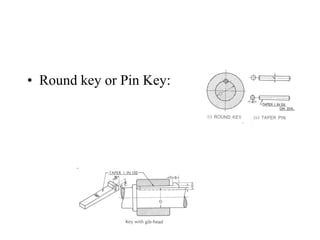
• Round keys
» Parallel pin
» Taper pin
Saddley keys
• Saddle key are taper keys which are sunk
into the hub only.(note: a taper key in
uniform in width but tapered in thikness on
one side, usually 1:100 and is used where
no axial movement along the shaft is
required).
• Saddle key is suitable for light duty, since
they rely on a friction deive alone and are
liable to slip on the shaft under load.
Type of the saddle key
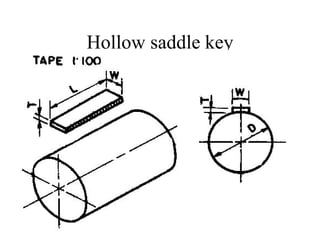
• Hollow saddle key:
– this key has its underside hollow out so that it can be placed
on the curved surface of the shaft. The keyway is cut in the
mating piece (hub) only. Hollow saddle key is used for light
duty.
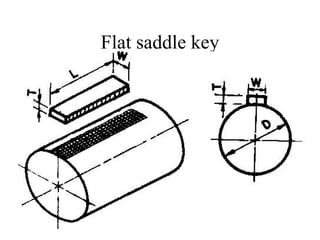
• Flat saddle key:
– In this the flat surface is made on the shaft over which the
key is placed in position . In this , holding force is
comparative large than the hollow saddle key. It is used for
light duty.
» Let D = dimeter of the shaft
» Width of the key, W = D/4
» Nominal thickness at the large end , T = W/3 = D/12
» Length of the key , L = D to 1.5D
» Taper on the top surface = 1:100
Hollow saddle key
Flat saddle key
Sunk keys
• Sunk keys are sunk into the shaft and into the hub. These
keys are suitable for heavy duty since they rely on
positive drive.
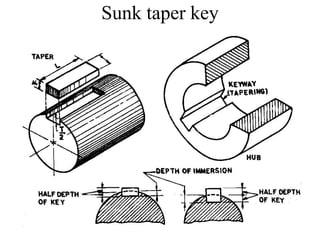
– Taper sunk keys:
• This is the standard form of the key and may be either of
rectangular or square cross-section .the key is sunk in the
shaft to a depth of half its nominal thickness when measured
at the side.
– This key gives a very sound fastening without any fear of slipping
between the two parts, unless , of course, the key shears. Such a key
can be safely used for heavy duty work.
» Rectangular cross-section
let D = diameter of the shaft
width of the key W = D/4
nominal thickness T = (2/3)W = (1/6)D
» Square cross-section:
T = W
Sunk taper key
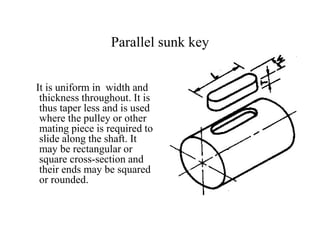
Parallel sunk key
It is uniform in width and
thickness throughout. It is
thus taper less and is used
where the pulley or other
mating piece is required to
slide along the shaft. It
may be rectangular or
square cross-section and
their ends may be squared
or rounded.
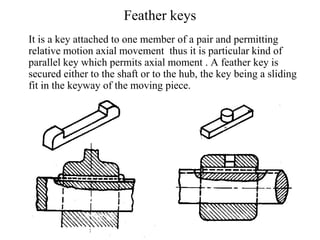
Feather keys
It is a key attached to one member of a pair and permitting
relative motion axial movement thus it is particular kind of
parallel key which permits axial moment . A feather key is
secured either to the shaft or to the hub, the key being a sliding
fit in the keyway of the moving piece.
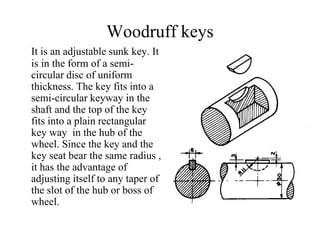
Woodruff keys
It is an adjustable sunk key. It
is in the form of a semi-
circular disc of uniform
thickness. The key fits into a
semi-circular keyway in the
shaft and the top of the key
fits into a plain rectangular
key way in the hub of the
wheel. Since the key and the
key seat bear the same radius ,
it has the advantage of
adjusting itself to any taper of
the slot of the hub or boss of
wheel.
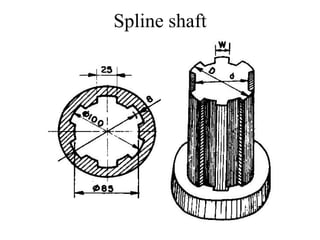
Spline shaft and hub
• A spline shaft is used when the hub is required
to slide along the shaft. These shafts are used
mostly for sliding gear application as in
automotive gear box and propeller shaft of
aircraft.
• A spline shaft in which are cut equiangular
longitudinal groove, the metal between these
groove forming splines or feathers of uniform
depth.
– By this means the power transmitted is equally divided
amongst the number of keys giving great strength and security
against total failure than by using a single key.
Spline shaft
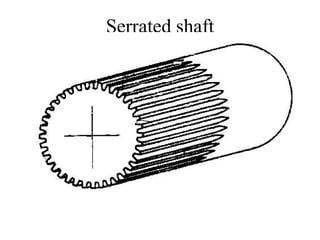
Serrated shafts
• A spine shaft suffer from the disadvantage of
reduced strength .this disadvantage is
eliminated by use of a serrated shaft which
gives maximum strength for a given weight of
material. in a serrated shaft , a number of
corresponding grooves are cut In the shaft and
mating piece, the two being tightly pressed,
one over the other the bottom of the serrations
and the crests of the teeth are flat. these are
used in aircraft manufacturing:
Serrated shaft
• Round key or Pin Key:

keys

  • 1.
    Keys • A keyis define the piece inserted in a axial direction between a shaft and hub to prevent relative rotation but allow sliding movement along the shaft if required. • Keys are temporary fastening and are always made of mild steel because they are subjected to shearing and compressive stresses caused by the torque they transmit. • a keyway is the groove cut in the shaft or hub to accommodate a key. Key ways can be milled horizontally or vertically .
  • 2.
  • 3.
    Classification of keys •Saddle keys » Hollow saddle key » Flat saddle key • Sunk keys » Taper sunk keys » Parallel sunk keys » Father keys – Woodruff key (adjustable key) • Round keys » Parallel pin » Taper pin
  • 4.
    Saddley keys • Saddlekey are taper keys which are sunk into the hub only.(note: a taper key in uniform in width but tapered in thikness on one side, usually 1:100 and is used where no axial movement along the shaft is required). • Saddle key is suitable for light duty, since they rely on a friction deive alone and are liable to slip on the shaft under load.
  • 5.
    Type of thesaddle key • Hollow saddle key: – this key has its underside hollow out so that it can be placed on the curved surface of the shaft. The keyway is cut in the mating piece (hub) only. Hollow saddle key is used for light duty. • Flat saddle key: – In this the flat surface is made on the shaft over which the key is placed in position . In this , holding force is comparative large than the hollow saddle key. It is used for light duty. » Let D = dimeter of the shaft » Width of the key, W = D/4 » Nominal thickness at the large end , T = W/3 = D/12 » Length of the key , L = D to 1.5D » Taper on the top surface = 1:100
  • 6.
  • 7.
  • 8.
    Sunk keys • Sunkkeys are sunk into the shaft and into the hub. These keys are suitable for heavy duty since they rely on positive drive. – Taper sunk keys: • This is the standard form of the key and may be either of rectangular or square cross-section .the key is sunk in the shaft to a depth of half its nominal thickness when measured at the side. – This key gives a very sound fastening without any fear of slipping between the two parts, unless , of course, the key shears. Such a key can be safely used for heavy duty work. » Rectangular cross-section let D = diameter of the shaft width of the key W = D/4 nominal thickness T = (2/3)W = (1/6)D » Square cross-section: T = W
  • 9.
  • 10.
    Parallel sunk key Itis uniform in width and thickness throughout. It is thus taper less and is used where the pulley or other mating piece is required to slide along the shaft. It may be rectangular or square cross-section and their ends may be squared or rounded.
  • 11.
    Feather keys It isa key attached to one member of a pair and permitting relative motion axial movement thus it is particular kind of parallel key which permits axial moment . A feather key is secured either to the shaft or to the hub, the key being a sliding fit in the keyway of the moving piece.
  • 12.
    Woodruff keys It isan adjustable sunk key. It is in the form of a semi- circular disc of uniform thickness. The key fits into a semi-circular keyway in the shaft and the top of the key fits into a plain rectangular key way in the hub of the wheel. Since the key and the key seat bear the same radius , it has the advantage of adjusting itself to any taper of the slot of the hub or boss of wheel.
  • 13.
    Spline shaft andhub • A spline shaft is used when the hub is required to slide along the shaft. These shafts are used mostly for sliding gear application as in automotive gear box and propeller shaft of aircraft. • A spline shaft in which are cut equiangular longitudinal groove, the metal between these groove forming splines or feathers of uniform depth. – By this means the power transmitted is equally divided amongst the number of keys giving great strength and security against total failure than by using a single key.
  • 14.
  • 15.
    Serrated shafts • Aspine shaft suffer from the disadvantage of reduced strength .this disadvantage is eliminated by use of a serrated shaft which gives maximum strength for a given weight of material. in a serrated shaft , a number of corresponding grooves are cut In the shaft and mating piece, the two being tightly pressed, one over the other the bottom of the serrations and the crests of the teeth are flat. these are used in aircraft manufacturing:
  • 16.
  • 17.
    • Round keyor Pin Key: