CHAPTER 9 
INDIRECT TAXES 
ATXB 213 Malaysian Taxation I 1
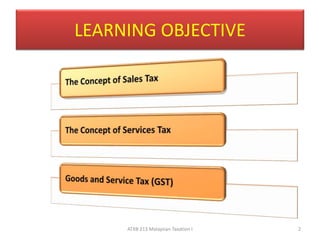
LEARNING OBJECTIVE 
ATXB 213 Malaysian Taxation I 2
INTRODUCTION 
 The responsibility to administer indirect taxation in 
Malaysia lies with the DG of Royal Customs 
Department 
 There are several indirect taxes that are currently 
regulated in Malaysia such as sales tax, service tax, 
custom duty and excise duty. 
 The legislations involving these taxes are: 
ATXB 213 Malaysian Taxation I 3 
Custom Act 1967 
Excise Act 1976 
Sales Tax Act 1972 
Service Tax Act 1975
Sales Tax 
 The objective of sales tax are: 
To increase revenue collection. 
Used by the government as a financial measure to 
regulate economic growth and national development. 
ATXB 213 Malaysian Taxation I 4
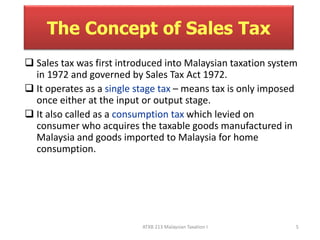
The Concept of Sales Tax 
 Sales tax was first introduced into Malaysian taxation system 
in 1972 and governed by Sales Tax Act 1972. 
 It operates as a single stage tax – means tax is only imposed 
once either at the input or output stage. 
 It also called as a consumption tax which levied on 
consumer who acquires the taxable goods manufactured in 
Malaysia and goods imported to Malaysia for home 
consumption. 
ATXB 213 Malaysian Taxation I 5
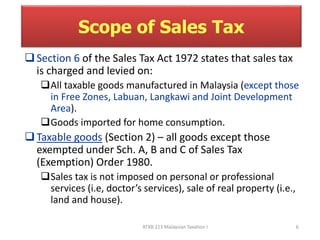
Scope of Sales Tax 
 Section 6 of the Sales Tax Act 1972 states that sales tax 
is charged and levied on: 
All taxable goods manufactured in Malaysia (except those 
in Free Zones, Labuan, Langkawi and Joint Development 
Area). 
Goods imported for home consumption. 
 Taxable goods (Section 2) – all goods except those 
exempted under Sch. A, B and C of Sales Tax 
(Exemption) Order 1980. 
Sales tax is not imposed on personal or professional 
services (i.e, doctor’s services), sale of real property (i.e., 
land and house). 
ATXB 213 Malaysian Taxation I 6
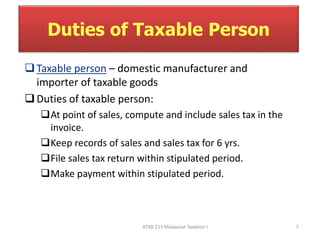
Duties of Taxable Person 
 Taxable person – domestic manufacturer and 
importer of taxable goods 
 Duties of taxable person: 
At point of sales, compute and include sales tax in the 
invoice. 
Keep records of sales and sales tax for 6 yrs. 
File sales tax return within stipulated period. 
Make payment within stipulated period. 
ATXB 213 Malaysian Taxation I 7
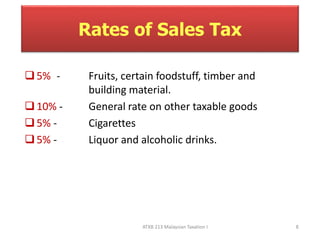
Rates of Sales Tax 
5% - Fruits, certain foodstuff, timber and 
building material. 
 10% - General rate on other taxable goods 
 5% - Cigarettes 
5% - Liquor and alcoholic drinks. 
ATXB 213 Malaysian Taxation I 8
Payment of Sales Tax 
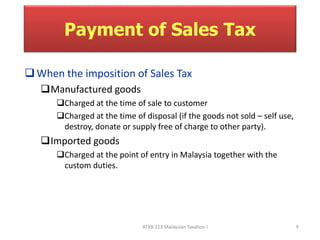
 When the imposition of Sales Tax 
ATXB 213 Malaysian Taxation I 9 
Manufactured goods 
Charged at the time of sale to customer 
Charged at the time of disposal (if the goods not sold – self use, 
destroy, donate or supply free of charge to other party). 
Imported goods 
Charged at the point of entry in Malaysia together with the 
custom duties.
Payment of Sales Tax 
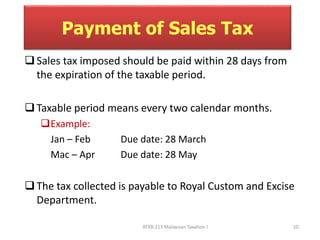
 Sales tax imposed should be paid within 28 days from 
the expiration of the taxable period. 
 Taxable period means every two calendar months. 
Example: 
Jan – Feb Due date: 28 March 
Mac – Apr Due date: 28 May 
 The tax collected is payable to Royal Custom and Excise 
ATXB 213 Malaysian Taxation I 10 
Department.
Determination of Sales Value 
ATXB 213 Malaysian Taxation I 11 
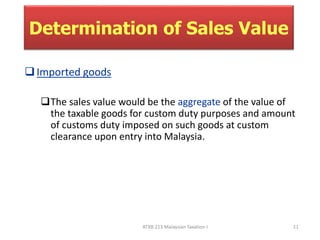
 Imported goods 
The sales value would be the aggregate of the value of 
the taxable goods for custom duty purposes and amount 
of customs duty imposed on such goods at custom 
clearance upon entry into Malaysia.
Determination of Sales Value 
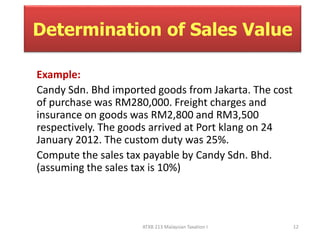
Example: 
Candy Sdn. Bhd imported goods from Jakarta. The cost 
of purchase was RM280,000. Freight charges and 
insurance on goods was RM2,800 and RM3,500 
respectively. The goods arrived at Port klang on 24 
January 2012. The custom duty was 25%. 
Compute the sales tax payable by Candy Sdn. Bhd. 
(assuming the sales tax is 10%) 
ATXB 213 Malaysian Taxation I 12
Discussion 
ATXB 213 Malaysian Taxation I 13 
Answer:
Determination of Sales Value 
ATXB 213 Malaysian Taxation I 14 
Manufactured goods 
If sold to independent person – sales value = actual 
selling price. 
If sold to non-independent person – sales value = market 
value.
Continue 
 Sales value should only include manufacturing costs 
such as: 
Cost of raw material 
Direct labour cost 
Manufacturing o/head (rental, electricity, water) 
Non-manufacturing o/head (office exp, advertising) 
ATXB 213 Malaysian Taxation I 15
Continue 
Depreciation of machinery, building and equipment 
Profit or mark up. 
 Cost involving marketing and sale should be excluded. 
ATXB 213 Malaysian Taxation I 16
Example – 
Manufactured Goods 
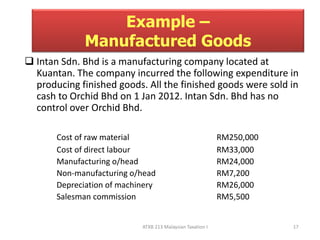
 Intan Sdn. Bhd is a manufacturing company located at 
Kuantan. The company incurred the following expenditure in 
producing finished goods. All the finished goods were sold in 
cash to Orchid Bhd on 1 Jan 2012. Intan Sdn. Bhd has no 
control over Orchid Bhd. 
Cost of raw material RM250,000 
Cost of direct labour RM33,000 
Manufacturing o/head RM24,000 
Non-manufacturing o/head RM7,200 
Depreciation of machinery RM26,000 
Salesman commission RM5,500 
ATXB 213 Malaysian Taxation I 17
Example – 
Manufactured Goods 
ATXB 213 Malaysian Taxation I 18 
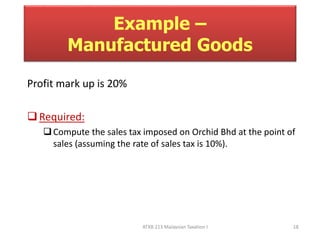
Profit mark up is 20% 
 Required: 
 Compute the sales tax imposed on Orchid Bhd at the point of 
sales (assuming the rate of sales tax is 10%).
Exemption on Raw Material 
Inputs 
 Ring System [section 9(1) and (2) Sales Tax Act] 
– Provision of tax free materials from one manufacturer to 
another 
– Application has to be made to the Sales Tax Office 
– The applicant has to be licensed 
– The materials are used in the manufacture of finished 
product 
ATXB 213 Malaysian Taxation I 19
Exemption on Raw Material 
Inputs 
 Refund System [section 31 Sales Tax Act] 
– Modified version of ring system 
– A licensed manufacturer can purchase raw materials free 
of sales tax from a vendor who has paid the sales tax 
– The vendor can then apply to claim a refund 
 Credit System [section31A Sales tax Act] 
– Intended for small manufacturers 
– Ensures their inputs do not suffer any tax 
– Based on a refund of tax paid by the manufacturer 
– Licensed manufacturer able to obtain a credit of the tax 
ATXB 213 Malaysian Taxation I 20
Penalty 
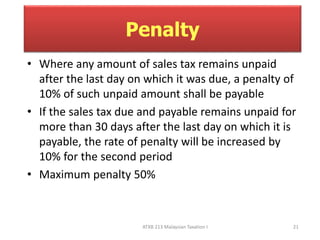
• Where any amount of sales tax remains unpaid 
after the last day on which it was due, a penalty of 
10% of such unpaid amount shall be payable 
• If the sales tax due and payable remains unpaid for 
more than 30 days after the last day on which it is 
payable, the rate of penalty will be increased by 
10% for the second period 
• Maximum penalty 50% 
ATXB 213 Malaysian Taxation I 21
Service Tax 
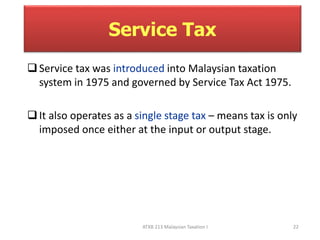
 Service tax was introduced into Malaysian taxation 
system in 1975 and governed by Service Tax Act 1975. 
 It also operates as a single stage tax – means tax is only 
imposed once either at the input or output stage. 
ATXB 213 Malaysian Taxation I 22
Service Tax 
 It also called as a consumption tax which levied on 
consumer who consumes prescribed goods sold and 
services provided by the prescribed establishment or 
prescribed professional establishment. 
 Rate of service tax is 6% effected from 1 January 2011. 
Prior to 1 January 2011, the rate of service tax was 5%. 
 The Service tax applies throughout Malaysia excluding 
Langkawi, Labuan, Tioman and Joint Development 
Area. 
ATXB 213 Malaysian Taxation I 23
Licensing Requirements 
(Section 8 STA) 
 Every taxable person is required to apply for a license 
ATXB 213 Malaysian Taxation I 24 
to collect services tax. 
 No taxable person is allowed to carry on the business of 
providing taxable services or selling or providing 
taxable goods unless in possession of such a license. 
 The license will remain a taxable person until his license 
is revoked.
Licensing Requirements 
(Section 8 STA) 
Director General of the Royal Customs Department 
revokes/cancel if: 
 Cessation of business 
 Death 
 Dissolution of company 
 Failure to provide taxable services 
Voluntary licensing (Section 8A STA) 
Any person who is not required to be licensed, voluntary 
apply to the DG to be licensed to collect services tax from 
their customers. The license will be granted if the person 
satisfied to the Director General – provides taxable service. 
ATXB 213 Malaysian Taxation I 25
Continue 
 The service tax is levied on the: 
ATXB 213 Malaysian Taxation I 26 
Taxable Person 
Operators of hotel, excluding for hotel not more than 25 rooms, 
hostels for students of education institutions or religious 
institution. 
Operators of restaurants, bars, snacks-bars or coffee houses 
located in hotels, health centers, private clubs having annual 
sales turnover of at least RM300,000 of taxable goods and 
taxable services. 
Motor vehicles service agencies, companies, firms and sole 
proprietors providing employment services, hire & drive car, 
consultancy services, telecommunication services, management 
services and others.
Continue 
 The service tax is levied on the: 
ATXB 213 Malaysian Taxation I 27 
Taxable services 
Provision of rooms for lodging or sleeping accommodation in a 
hotel having than 25 rooms, premises for meeting or for 
promotion of cultural or fashion shows, health services, 
massages or beauty salons in a hotel having more than 25 
rooms. 
Provision of all advertising services, accounting, auditing, 
bookkeeping, consultancy and other professional services 
provided by Public Accountants. 
Provision of all types of employment services, parking space for 
motor vehicles, credit card, services provided by dentists and 
veterinary surgeons and others.
Scope of Charge 
 Timing of imposition of service tax 
Prescribed taxable goods – the tax is levied at the point 
of sales. 
The actual price for which goods are sold OR 
Where no charge is made, the charge which would have been 
made in the ordinary course of the business 
Prescribed taxable services – charged at the time when 
the taxable service is provided to customer by taxable 
person. 
ATXB 213 Malaysian Taxation I 28
Example 
 Elite Corporate Service Sdn Bhd (ECSB) is a Penang based 
company providing taxable services to its clients under STA. 
In providing consultancy services to its client, Ramsami 
Bhd., ECSB sough legal advice from Dharma & Co., a 
reputable legal firm located in Sungai Petani. The legal firm 
issued an invoice amounting to RM7,500 (inclusive of 
service tax). ECSB issued an invoice for RM10,000 to 
Ramsami Bhd. being charges for consultancy services. ECSB 
provided all the services to Ramsami Bhd. in June 2012. 
miscellaneous expenses incurred by ECSB are as follows: 
 Transport cost RM450 
 Telephone expenses RM120 
 Fax charges RM30 
ATXB 213 Malaysian Taxation I 29
Discussion 
Required: 
 Assuming that ECSB provides taxable services under the 
Service Tax Act, prepare the invoice to be issued by the 
company to Ramsami Bhd. Indicating all charges, icluding 
the sum invoiced by the legal firm (Dharma & Co.) 
ATXB 213 Malaysian Taxation I 30
Management Services 
 Corporate affairs' management 
 Human resource management 
 Internal audit 
 Management information systems 
 Administrative and secretarial 
 Sales and marketing management 
 Property management 
 Financial management 
 Asset management 
 Project management services 
 Construction management services 
ATXB 213 Malaysian Taxation I 31
Management Services 
Management services provided by a company in a 
group of companies to any company in the same 
group of companies are no longer regarded as 
taxable services. 
To qualify as companies within a group, one 
company within the group MUST control the other 
company. The required shareholding is: 
At least 50% of issued share capital either directly or 
indirectly through subsidiaries, OR 
Between 20% to 50% with the powers to appoint or 
remove all or a majority of directors in the second 
company 
ATXB 213 Malaysian Taxation I 32
Payment of Service Tax 
 Service tax imposed should be paid within 28 days from the 
expiration of the taxable period. 
 Taxable period means every two calendar months. 
Example: 
Jan – Feb Due date: 28 March 
Mac – Apr Due date: 28 May 
 The tax collected is payable to Royal Custom and Excise 
ATXB 213 Malaysian Taxation I 33 
Department.
Goods and Service Tax (GST) 
 The Malaysian govt made a commitment in the Budget 
2005 to introduce GST in 2007 but has postponed of its 
implementation to 2010? 
 GST is a levy on consumption and is essentially a 
ATXB 213 Malaysian Taxation I 34 
territorial tax. 
 This tax will replace the sales and service tax 
 The common features of GST are: 
 The tax is collected at every stage of production process 
 The amount collected at each stage is based on the value added at 
that stage.
Rationale for GST 
 The rationale for introducing GST is as follows: 
 It would improve collection of revenue for the Government 
in a manner that is more comprehensive, transparent and 
effective. 
Means of increasing the Government tax base by reaching 
out to a broader group of people, namely consumers 
 The GST system has a self-policing mechanism due to in-built 
cross checking features which would improve tax 
ATXB 213 Malaysian Taxation I 35 
compliance 
 Provide opportunity for the Government to lower corporate 
and individual tax rates 
 Encourage greater foreign direct investment as well as 
foster saving among the taxpayers.
Attributes of GST 
 Input Tax credit - the gross GST liability of each business 
is assessed as tax rate applied to sales and then allows the 
business credit against GST incorporated in the business 
input costs 
 Zero Rating – totally free of GST but can claim input 
tax credit during the purchase. 
 Exemption – not required to charge GST on their sales 
and not entitled to claim input tax credit on their 
purchase. 
ATXB 213 Malaysian Taxation I 36
Drafting Legislation for GST 
 The following are the four pronged rules should taken 
into consideration in drafting legislation for GST: 
Rule 1: Reduce exemptions 
Rule 2: Zero ratings only for exports 
Rule 3: Exempt small business 
Rule 4: Administration of GST and income Tax by the 
ATXB 213 Malaysian Taxation I 37 
same agency.
Advantages of GST 
 Could reduce the income tax rate for company as well as 
individual taxpayers so that the income tax system becomes 
more competitive 
 Avoid cascading effect prevalent under existing sales tax and 
ATXB 213 Malaysian Taxation I 38 
service tax 
 Improve ability to detect non-compliance 
 Increase the tax revenue in the future. 
 GST is a multistage concept of indirect tax, thus should be 
able to speed up the 
 Collection of tax revenue for the government.
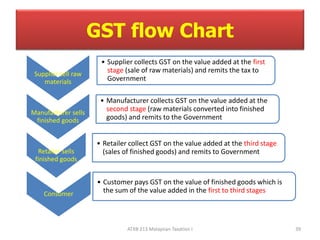
GST flow Chart 
Supplier sell raw 
materials 
• Supplier collects GST on the value added at the first 
stage (sale of raw materials) and remits the tax to 
Government 
Manufacturer sells 
finished goods 
• Manufacturer collects GST on the value added at the 
second stage (raw materials converted into finished 
goods) and remits to the Government 
Retailer sells 
finished goods 
• Retailer collect GST on the value added at the third stage 
(sales of finished goods) and remits to Government 
Consumer 
• Customer pays GST on the value of finished goods which is 
the sum of the value added in the first to third stages 
ATXB 213 Malaysian Taxation I 39
THANK YOU 
Q & A 
ATXB 213 Malaysian Taxation I 40

Chapter 9, indirect tax

  • 1.
    CHAPTER 9 INDIRECTTAXES ATXB 213 Malaysian Taxation I 1
  • 2.
    LEARNING OBJECTIVE ATXB213 Malaysian Taxation I 2
  • 3.
    INTRODUCTION  Theresponsibility to administer indirect taxation in Malaysia lies with the DG of Royal Customs Department  There are several indirect taxes that are currently regulated in Malaysia such as sales tax, service tax, custom duty and excise duty.  The legislations involving these taxes are: ATXB 213 Malaysian Taxation I 3 Custom Act 1967 Excise Act 1976 Sales Tax Act 1972 Service Tax Act 1975
  • 4.
    Sales Tax The objective of sales tax are: To increase revenue collection. Used by the government as a financial measure to regulate economic growth and national development. ATXB 213 Malaysian Taxation I 4
  • 5.
    The Concept ofSales Tax  Sales tax was first introduced into Malaysian taxation system in 1972 and governed by Sales Tax Act 1972.  It operates as a single stage tax – means tax is only imposed once either at the input or output stage.  It also called as a consumption tax which levied on consumer who acquires the taxable goods manufactured in Malaysia and goods imported to Malaysia for home consumption. ATXB 213 Malaysian Taxation I 5
  • 6.
    Scope of SalesTax  Section 6 of the Sales Tax Act 1972 states that sales tax is charged and levied on: All taxable goods manufactured in Malaysia (except those in Free Zones, Labuan, Langkawi and Joint Development Area). Goods imported for home consumption.  Taxable goods (Section 2) – all goods except those exempted under Sch. A, B and C of Sales Tax (Exemption) Order 1980. Sales tax is not imposed on personal or professional services (i.e, doctor’s services), sale of real property (i.e., land and house). ATXB 213 Malaysian Taxation I 6
  • 7.
    Duties of TaxablePerson  Taxable person – domestic manufacturer and importer of taxable goods  Duties of taxable person: At point of sales, compute and include sales tax in the invoice. Keep records of sales and sales tax for 6 yrs. File sales tax return within stipulated period. Make payment within stipulated period. ATXB 213 Malaysian Taxation I 7
  • 8.
    Rates of SalesTax 5% - Fruits, certain foodstuff, timber and building material.  10% - General rate on other taxable goods  5% - Cigarettes 5% - Liquor and alcoholic drinks. ATXB 213 Malaysian Taxation I 8
  • 9.
    Payment of SalesTax  When the imposition of Sales Tax ATXB 213 Malaysian Taxation I 9 Manufactured goods Charged at the time of sale to customer Charged at the time of disposal (if the goods not sold – self use, destroy, donate or supply free of charge to other party). Imported goods Charged at the point of entry in Malaysia together with the custom duties.
  • 10.
    Payment of SalesTax  Sales tax imposed should be paid within 28 days from the expiration of the taxable period.  Taxable period means every two calendar months. Example: Jan – Feb Due date: 28 March Mac – Apr Due date: 28 May  The tax collected is payable to Royal Custom and Excise ATXB 213 Malaysian Taxation I 10 Department.
  • 11.
    Determination of SalesValue ATXB 213 Malaysian Taxation I 11  Imported goods The sales value would be the aggregate of the value of the taxable goods for custom duty purposes and amount of customs duty imposed on such goods at custom clearance upon entry into Malaysia.
  • 12.
    Determination of SalesValue Example: Candy Sdn. Bhd imported goods from Jakarta. The cost of purchase was RM280,000. Freight charges and insurance on goods was RM2,800 and RM3,500 respectively. The goods arrived at Port klang on 24 January 2012. The custom duty was 25%. Compute the sales tax payable by Candy Sdn. Bhd. (assuming the sales tax is 10%) ATXB 213 Malaysian Taxation I 12
  • 13.
    Discussion ATXB 213Malaysian Taxation I 13 Answer:
  • 14.
    Determination of SalesValue ATXB 213 Malaysian Taxation I 14 Manufactured goods If sold to independent person – sales value = actual selling price. If sold to non-independent person – sales value = market value.
  • 15.
    Continue  Salesvalue should only include manufacturing costs such as: Cost of raw material Direct labour cost Manufacturing o/head (rental, electricity, water) Non-manufacturing o/head (office exp, advertising) ATXB 213 Malaysian Taxation I 15
  • 16.
    Continue Depreciation ofmachinery, building and equipment Profit or mark up.  Cost involving marketing and sale should be excluded. ATXB 213 Malaysian Taxation I 16
  • 17.
    Example – ManufacturedGoods  Intan Sdn. Bhd is a manufacturing company located at Kuantan. The company incurred the following expenditure in producing finished goods. All the finished goods were sold in cash to Orchid Bhd on 1 Jan 2012. Intan Sdn. Bhd has no control over Orchid Bhd. Cost of raw material RM250,000 Cost of direct labour RM33,000 Manufacturing o/head RM24,000 Non-manufacturing o/head RM7,200 Depreciation of machinery RM26,000 Salesman commission RM5,500 ATXB 213 Malaysian Taxation I 17
  • 18.
    Example – ManufacturedGoods ATXB 213 Malaysian Taxation I 18 Profit mark up is 20%  Required:  Compute the sales tax imposed on Orchid Bhd at the point of sales (assuming the rate of sales tax is 10%).
  • 19.
    Exemption on RawMaterial Inputs  Ring System [section 9(1) and (2) Sales Tax Act] – Provision of tax free materials from one manufacturer to another – Application has to be made to the Sales Tax Office – The applicant has to be licensed – The materials are used in the manufacture of finished product ATXB 213 Malaysian Taxation I 19
  • 20.
    Exemption on RawMaterial Inputs  Refund System [section 31 Sales Tax Act] – Modified version of ring system – A licensed manufacturer can purchase raw materials free of sales tax from a vendor who has paid the sales tax – The vendor can then apply to claim a refund  Credit System [section31A Sales tax Act] – Intended for small manufacturers – Ensures their inputs do not suffer any tax – Based on a refund of tax paid by the manufacturer – Licensed manufacturer able to obtain a credit of the tax ATXB 213 Malaysian Taxation I 20
  • 21.
    Penalty • Whereany amount of sales tax remains unpaid after the last day on which it was due, a penalty of 10% of such unpaid amount shall be payable • If the sales tax due and payable remains unpaid for more than 30 days after the last day on which it is payable, the rate of penalty will be increased by 10% for the second period • Maximum penalty 50% ATXB 213 Malaysian Taxation I 21
  • 22.
    Service Tax Service tax was introduced into Malaysian taxation system in 1975 and governed by Service Tax Act 1975.  It also operates as a single stage tax – means tax is only imposed once either at the input or output stage. ATXB 213 Malaysian Taxation I 22
  • 23.
    Service Tax It also called as a consumption tax which levied on consumer who consumes prescribed goods sold and services provided by the prescribed establishment or prescribed professional establishment.  Rate of service tax is 6% effected from 1 January 2011. Prior to 1 January 2011, the rate of service tax was 5%.  The Service tax applies throughout Malaysia excluding Langkawi, Labuan, Tioman and Joint Development Area. ATXB 213 Malaysian Taxation I 23
  • 24.
    Licensing Requirements (Section8 STA)  Every taxable person is required to apply for a license ATXB 213 Malaysian Taxation I 24 to collect services tax.  No taxable person is allowed to carry on the business of providing taxable services or selling or providing taxable goods unless in possession of such a license.  The license will remain a taxable person until his license is revoked.
  • 25.
    Licensing Requirements (Section8 STA) Director General of the Royal Customs Department revokes/cancel if:  Cessation of business  Death  Dissolution of company  Failure to provide taxable services Voluntary licensing (Section 8A STA) Any person who is not required to be licensed, voluntary apply to the DG to be licensed to collect services tax from their customers. The license will be granted if the person satisfied to the Director General – provides taxable service. ATXB 213 Malaysian Taxation I 25
  • 26.
    Continue  Theservice tax is levied on the: ATXB 213 Malaysian Taxation I 26 Taxable Person Operators of hotel, excluding for hotel not more than 25 rooms, hostels for students of education institutions or religious institution. Operators of restaurants, bars, snacks-bars or coffee houses located in hotels, health centers, private clubs having annual sales turnover of at least RM300,000 of taxable goods and taxable services. Motor vehicles service agencies, companies, firms and sole proprietors providing employment services, hire & drive car, consultancy services, telecommunication services, management services and others.
  • 27.
    Continue  Theservice tax is levied on the: ATXB 213 Malaysian Taxation I 27 Taxable services Provision of rooms for lodging or sleeping accommodation in a hotel having than 25 rooms, premises for meeting or for promotion of cultural or fashion shows, health services, massages or beauty salons in a hotel having more than 25 rooms. Provision of all advertising services, accounting, auditing, bookkeeping, consultancy and other professional services provided by Public Accountants. Provision of all types of employment services, parking space for motor vehicles, credit card, services provided by dentists and veterinary surgeons and others.
  • 28.
    Scope of Charge  Timing of imposition of service tax Prescribed taxable goods – the tax is levied at the point of sales. The actual price for which goods are sold OR Where no charge is made, the charge which would have been made in the ordinary course of the business Prescribed taxable services – charged at the time when the taxable service is provided to customer by taxable person. ATXB 213 Malaysian Taxation I 28
  • 29.
    Example  EliteCorporate Service Sdn Bhd (ECSB) is a Penang based company providing taxable services to its clients under STA. In providing consultancy services to its client, Ramsami Bhd., ECSB sough legal advice from Dharma & Co., a reputable legal firm located in Sungai Petani. The legal firm issued an invoice amounting to RM7,500 (inclusive of service tax). ECSB issued an invoice for RM10,000 to Ramsami Bhd. being charges for consultancy services. ECSB provided all the services to Ramsami Bhd. in June 2012. miscellaneous expenses incurred by ECSB are as follows:  Transport cost RM450  Telephone expenses RM120  Fax charges RM30 ATXB 213 Malaysian Taxation I 29
  • 30.
    Discussion Required: Assuming that ECSB provides taxable services under the Service Tax Act, prepare the invoice to be issued by the company to Ramsami Bhd. Indicating all charges, icluding the sum invoiced by the legal firm (Dharma & Co.) ATXB 213 Malaysian Taxation I 30
  • 31.
    Management Services Corporate affairs' management  Human resource management  Internal audit  Management information systems  Administrative and secretarial  Sales and marketing management  Property management  Financial management  Asset management  Project management services  Construction management services ATXB 213 Malaysian Taxation I 31
  • 32.
    Management Services Managementservices provided by a company in a group of companies to any company in the same group of companies are no longer regarded as taxable services. To qualify as companies within a group, one company within the group MUST control the other company. The required shareholding is: At least 50% of issued share capital either directly or indirectly through subsidiaries, OR Between 20% to 50% with the powers to appoint or remove all or a majority of directors in the second company ATXB 213 Malaysian Taxation I 32
  • 33.
    Payment of ServiceTax  Service tax imposed should be paid within 28 days from the expiration of the taxable period.  Taxable period means every two calendar months. Example: Jan – Feb Due date: 28 March Mac – Apr Due date: 28 May  The tax collected is payable to Royal Custom and Excise ATXB 213 Malaysian Taxation I 33 Department.
  • 34.
    Goods and ServiceTax (GST)  The Malaysian govt made a commitment in the Budget 2005 to introduce GST in 2007 but has postponed of its implementation to 2010?  GST is a levy on consumption and is essentially a ATXB 213 Malaysian Taxation I 34 territorial tax.  This tax will replace the sales and service tax  The common features of GST are:  The tax is collected at every stage of production process  The amount collected at each stage is based on the value added at that stage.
  • 35.
    Rationale for GST  The rationale for introducing GST is as follows:  It would improve collection of revenue for the Government in a manner that is more comprehensive, transparent and effective. Means of increasing the Government tax base by reaching out to a broader group of people, namely consumers  The GST system has a self-policing mechanism due to in-built cross checking features which would improve tax ATXB 213 Malaysian Taxation I 35 compliance  Provide opportunity for the Government to lower corporate and individual tax rates  Encourage greater foreign direct investment as well as foster saving among the taxpayers.
  • 36.
    Attributes of GST  Input Tax credit - the gross GST liability of each business is assessed as tax rate applied to sales and then allows the business credit against GST incorporated in the business input costs  Zero Rating – totally free of GST but can claim input tax credit during the purchase.  Exemption – not required to charge GST on their sales and not entitled to claim input tax credit on their purchase. ATXB 213 Malaysian Taxation I 36
  • 37.
    Drafting Legislation forGST  The following are the four pronged rules should taken into consideration in drafting legislation for GST: Rule 1: Reduce exemptions Rule 2: Zero ratings only for exports Rule 3: Exempt small business Rule 4: Administration of GST and income Tax by the ATXB 213 Malaysian Taxation I 37 same agency.
  • 38.
    Advantages of GST  Could reduce the income tax rate for company as well as individual taxpayers so that the income tax system becomes more competitive  Avoid cascading effect prevalent under existing sales tax and ATXB 213 Malaysian Taxation I 38 service tax  Improve ability to detect non-compliance  Increase the tax revenue in the future.  GST is a multistage concept of indirect tax, thus should be able to speed up the  Collection of tax revenue for the government.
  • 39.
    GST flow Chart Supplier sell raw materials • Supplier collects GST on the value added at the first stage (sale of raw materials) and remits the tax to Government Manufacturer sells finished goods • Manufacturer collects GST on the value added at the second stage (raw materials converted into finished goods) and remits to the Government Retailer sells finished goods • Retailer collect GST on the value added at the third stage (sales of finished goods) and remits to Government Consumer • Customer pays GST on the value of finished goods which is the sum of the value added in the first to third stages ATXB 213 Malaysian Taxation I 39
  • 40.
    THANK YOU Q& A ATXB 213 Malaysian Taxation I 40