FINALS: BASIC
SENTENCE PATTERNS
EN110
The Basic Elements of a Sentence
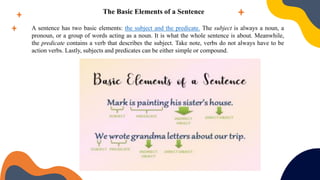
A sentence has two basic elements: the subject and the predicate. The subject is always a noun, a
pronoun, or a group of words acting as a noun. It is what the whole sentence is about. Meanwhile,
the predicate contains a verb that describes the subject. Take note, verbs do not always have to be
action verbs. Lastly, subjects and predicates can be either simple or compound.
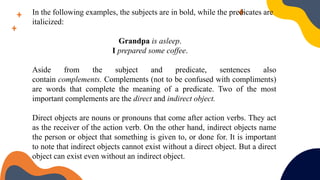
In the following examples, the subjects are in bold, while the predicates are
italicized:
Grandpa is asleep.
I prepared some coffee.
Aside from the subject and predicate, sentences also
contain complements. Complements (not to be confused with compliments)
are words that complete the meaning of a predicate. Two of the most
important complements are the direct and indirect object.
Direct objects are nouns or pronouns that come after action verbs. They act
as the receiver of the action verb. On the other hand, indirect objects name
the person or object that something is given to, or done for. It is important
to note that indirect objects cannot exist without a direct object. But a direct
object can exist even without an indirect object.
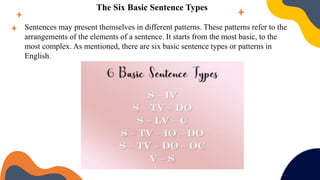
The Six Basic Sentence Types
Sentences may present themselves in different patterns. These patterns refer to the
arrangements of the elements of a sentence. It starts from the most basic, to the
most complex. As mentioned, there are six basic sentence types or patterns in
English.
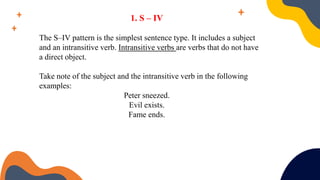
1. S – IV
The S–IV pattern is the simplest sentence type. It includes a subject
and an intransitive verb. Intransitive verbs are verbs that do not have
a direct object.
Take note of the subject and the intransitive verb in the following
examples:
Peter sneezed.
Evil exists.
Fame ends.
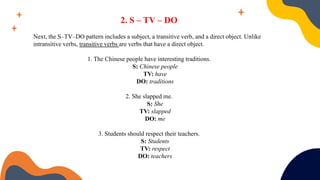
2. S – TV – DO
Next, the S–TV–DO pattern includes a subject, a transitive verb, and a direct object. Unlike
intransitive verbs, transitive verbs are verbs that have a direct object.
1. The Chinese people have interesting traditions.
S: Chinese people
TV: have
DO: traditions
2. She slapped me.
S: She
TV: slapped
DO: me
3. Students should respect their teachers.
S: Students
TV: respect
DO: teachers
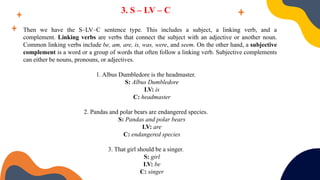
3. S – LV – C
Then we have the S–LV–C sentence type. This includes a subject, a linking verb, and a
complement. Linking verbs are verbs that connect the subject with an adjective or another noun.
Common linking verbs include be, am, are, is, was, were, and seem. On the other hand, a subjective
complement is a word or a group of words that often follow a linking verb. Subjective complements
can either be nouns, pronouns, or adjectives.
1. Albus Dumbledore is the headmaster.
S: Albus Dumbledore
LV: is
C: headmaster
2. Pandas and polar bears are endangered species.
S: Pandas and polar bears
LV: are
C: endangered species
3. That girl should be a singer.
S: girl
LV: be
C: singer
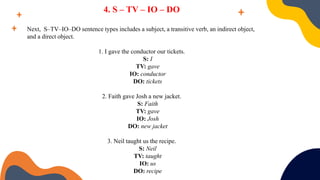
4. S – TV – IO – DO
Next, S–TV–IO–DO sentence types includes a subject, a transitive verb, an indirect object,
and a direct object.
1. I gave the conductor our tickets.
S: I
TV: gave
IO: conductor
DO: tickets
2. Faith gave Josh a new jacket.
S: Faith
TV: gave
IO: Josh
DO: new jacket
3. Neil taught us the recipe.
S: Neil
TV: taught
IO: us
DO: recipe
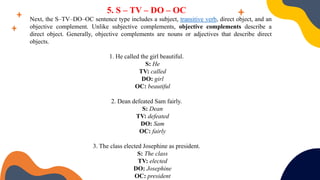
5. S – TV – DO – OC
Next, the S–TV–DO–OC sentence type includes a subject, transitive verb, direct object, and an
objective complement. Unlike subjective complements, objective complements describe a
direct object. Generally, objective complements are nouns or adjectives that describe direct
objects.
1. He called the girl beautiful.
S: He
TV: called
DO: girl
OC: beautiful
2. Dean defeated Sam fairly.
S: Dean
TV: defeated
DO: Sam
OC: fairly
3. The class elected Josephine as president.
S: The class
TV: elected
DO: Josephine
OC: president
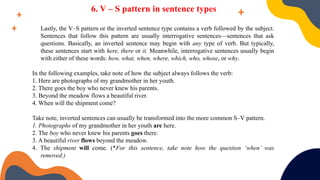
6. V – S pattern in sentence types
Lastly, the V–S pattern or the inverted sentence type contains a verb followed by the subject.
Sentences that follow this pattern are usually interrogative sentences—sentences that ask
questions. Basically, an inverted sentence may begin with any type of verb. But typically,
these sentences start with here, there or it. Meanwhile, interrogative sentences usually begin
with either of these words: how, what, when, where, which, who, whose, or why.
In the following examples, take note of how the subject always follows the verb:
1. Here are photographs of my grandmother in her youth.
2. There goes the boy who never knew his parents.
3. Beyond the meadow flows a beautiful river.
4. When will the shipment come?
Take note, inverted sentences can usually be transformed into the more common S–V pattern.
1. Photographs of my grandmother in her youth are here.
2. The boy who never knew his parents goes there.
3. A beautiful river flows beyond the meadow.
4. The shipment will come. (*For this sentence, take note how the question ‘when’ was
removed.)
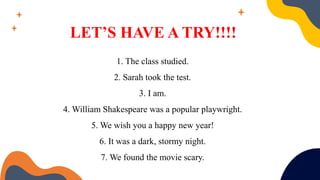
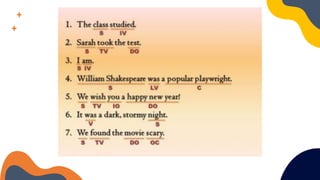
LET’S HAVE A TRY!!!!
1. The class studied.
2. Sarah took the test.
3. I am.
4. William Shakespeare was a popular playwright.
5. We wish you a happy new year!
6. It was a dark, stormy night.
7. We found the movie scary.
Basic Sentence Patterns.pdf

Basic Sentence Patterns.pdf

  • 1.
  • 2.
    The Basic Elementsof a Sentence A sentence has two basic elements: the subject and the predicate. The subject is always a noun, a pronoun, or a group of words acting as a noun. It is what the whole sentence is about. Meanwhile, the predicate contains a verb that describes the subject. Take note, verbs do not always have to be action verbs. Lastly, subjects and predicates can be either simple or compound.
  • 3.
    In the followingexamples, the subjects are in bold, while the predicates are italicized: Grandpa is asleep. I prepared some coffee. Aside from the subject and predicate, sentences also contain complements. Complements (not to be confused with compliments) are words that complete the meaning of a predicate. Two of the most important complements are the direct and indirect object. Direct objects are nouns or pronouns that come after action verbs. They act as the receiver of the action verb. On the other hand, indirect objects name the person or object that something is given to, or done for. It is important to note that indirect objects cannot exist without a direct object. But a direct object can exist even without an indirect object.
  • 4.
    The Six BasicSentence Types Sentences may present themselves in different patterns. These patterns refer to the arrangements of the elements of a sentence. It starts from the most basic, to the most complex. As mentioned, there are six basic sentence types or patterns in English.
  • 5.
    1. S –IV The S–IV pattern is the simplest sentence type. It includes a subject and an intransitive verb. Intransitive verbs are verbs that do not have a direct object. Take note of the subject and the intransitive verb in the following examples: Peter sneezed. Evil exists. Fame ends.
  • 6.
    2. S –TV – DO Next, the S–TV–DO pattern includes a subject, a transitive verb, and a direct object. Unlike intransitive verbs, transitive verbs are verbs that have a direct object. 1. The Chinese people have interesting traditions. S: Chinese people TV: have DO: traditions 2. She slapped me. S: She TV: slapped DO: me 3. Students should respect their teachers. S: Students TV: respect DO: teachers
  • 7.
    3. S –LV – C Then we have the S–LV–C sentence type. This includes a subject, a linking verb, and a complement. Linking verbs are verbs that connect the subject with an adjective or another noun. Common linking verbs include be, am, are, is, was, were, and seem. On the other hand, a subjective complement is a word or a group of words that often follow a linking verb. Subjective complements can either be nouns, pronouns, or adjectives. 1. Albus Dumbledore is the headmaster. S: Albus Dumbledore LV: is C: headmaster 2. Pandas and polar bears are endangered species. S: Pandas and polar bears LV: are C: endangered species 3. That girl should be a singer. S: girl LV: be C: singer
  • 8.
    4. S –TV – IO – DO Next, S–TV–IO–DO sentence types includes a subject, a transitive verb, an indirect object, and a direct object. 1. I gave the conductor our tickets. S: I TV: gave IO: conductor DO: tickets 2. Faith gave Josh a new jacket. S: Faith TV: gave IO: Josh DO: new jacket 3. Neil taught us the recipe. S: Neil TV: taught IO: us DO: recipe
  • 9.
    5. S –TV – DO – OC Next, the S–TV–DO–OC sentence type includes a subject, transitive verb, direct object, and an objective complement. Unlike subjective complements, objective complements describe a direct object. Generally, objective complements are nouns or adjectives that describe direct objects. 1. He called the girl beautiful. S: He TV: called DO: girl OC: beautiful 2. Dean defeated Sam fairly. S: Dean TV: defeated DO: Sam OC: fairly 3. The class elected Josephine as president. S: The class TV: elected DO: Josephine OC: president
  • 10.
    6. V –S pattern in sentence types Lastly, the V–S pattern or the inverted sentence type contains a verb followed by the subject. Sentences that follow this pattern are usually interrogative sentences—sentences that ask questions. Basically, an inverted sentence may begin with any type of verb. But typically, these sentences start with here, there or it. Meanwhile, interrogative sentences usually begin with either of these words: how, what, when, where, which, who, whose, or why. In the following examples, take note of how the subject always follows the verb: 1. Here are photographs of my grandmother in her youth. 2. There goes the boy who never knew his parents. 3. Beyond the meadow flows a beautiful river. 4. When will the shipment come? Take note, inverted sentences can usually be transformed into the more common S–V pattern. 1. Photographs of my grandmother in her youth are here. 2. The boy who never knew his parents goes there. 3. A beautiful river flows beyond the meadow. 4. The shipment will come. (*For this sentence, take note how the question ‘when’ was removed.)
  • 11.
    LET’S HAVE ATRY!!!! 1. The class studied. 2. Sarah took the test. 3. I am. 4. William Shakespeare was a popular playwright. 5. We wish you a happy new year! 6. It was a dark, stormy night. 7. We found the movie scary.