UNIT VII
PATTERNS
A pattern is a model we follow to write a sentence. In English we can find 7
patterns.
I
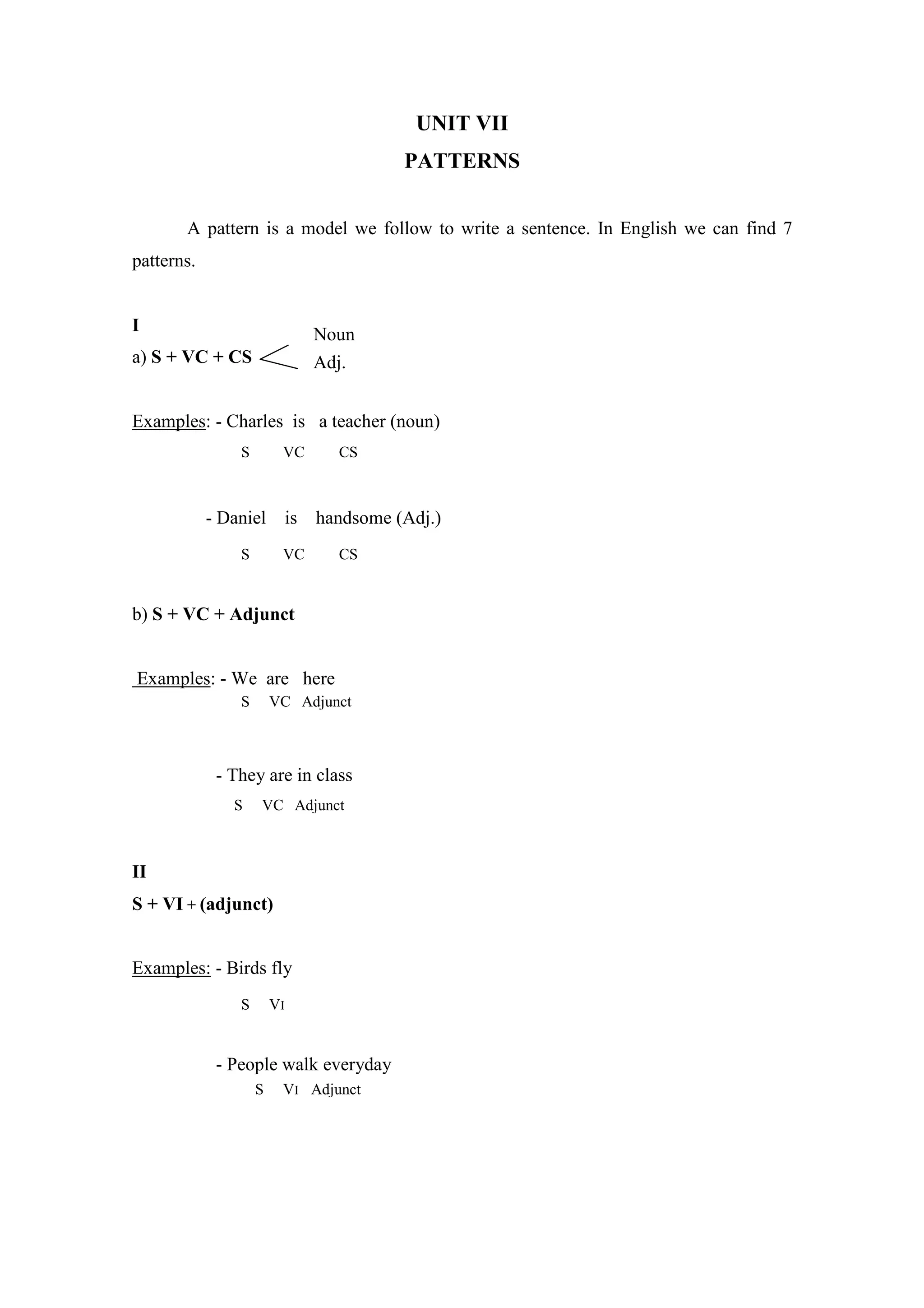
a) S + VC + CS
Examples: - Charles is a teacher (noun)
- Daniel is handsome (Adj.)
b) S + VC + Adjunct
Examples: - We are here
- They are in class
II
S + VI + (adjunct)
Examples: - Birds fly
- People walk everyday
Noun
Adj.
S VC CS
S VC CS
S VC Adjunct
S VI Adjunct
S VI
S VC Adjunct
III
S + VT + DO
Examples: - I like apples
- I love swimming
IV
S + VT + DO + IO
Example: - I gave a house to my mother
V
S + VT + IO + DO
Example: - I gave my mother a house
VI
S + VT + DO + CO
Examples: - I consider Nancy intelligent
- The class elected Mary president
VII
There + V be + S + Adjunct
Examples: - There is a book on the table
S VT DO
S VT DO
S VT DO IO
S VT IO DO
S VT DO CO
S VT DO CO
there V be S adjunct
- There were some flowers on the desk
- S: Subject
- VC: Copulative verb
- VT: Transitive verb
- VI: Intransitive verb
- CO: Complement of the object
- CS: Complement of the subject
- Adjunct: Adverb of time, place or manner
- DO: Direct Object
- IO: Indirect object
* Copulative verbs express condition or state. These verbs link the subject to a
noun, pronoun or an adjective that describes or modifies it. The word that is linked to
the subject is called subject complement. Some common copulative verbs are: look,
seem, turn, taste, grow, remain, smell, feel, stay, sound, etc.
* Transitive verbs need a direct object
* Intransitive verbs can stand alone
- Important to know:
- Some verbs can be both transitive and intransitive.
Example: I closed the door/ the door closed
- Some transitive verbs can have their objects left out when the meaning is clear from
the context
Example: He has smoked (cigarettes) since he was 12
* A direct object is a noun or pronoun that receives the action of a transitive
verb in an active sentence. It answers the questions what? or whom? About the
transitive verb.
* Indirect objects are usually placed directly before the direct object. They
usually answer the questions "to what/whom?" or "for what/whom?".
there V be S adjunct
Exercises: Identify the patterns in these sentences:
1. The author is our guest
2. The advantages and disadvantages of different systems will be discussed
3. There will be a workshop this morning
4. You can move the king in any direction
5. I will visit you tomorrow
References
Leech and Svartvik (1993). A Communicative grammar of English
http://www.ucalgary.ca/UofC/eduweb/grammar/course/sentence/2_2d.htm
http://www.ucalgary.ca/UofC/eduweb/grammar/course/speech/1_3b.htm

UNIT_SEVEN.pdf

  • 1.
    UNIT VII PATTERNS A patternis a model we follow to write a sentence. In English we can find 7 patterns. I a) S + VC + CS Examples: - Charles is a teacher (noun) - Daniel is handsome (Adj.) b) S + VC + Adjunct Examples: - We are here - They are in class II S + VI + (adjunct) Examples: - Birds fly - People walk everyday Noun Adj. S VC CS S VC CS S VC Adjunct S VI Adjunct S VI S VC Adjunct
  • 2.
    III S + VT+ DO Examples: - I like apples - I love swimming IV S + VT + DO + IO Example: - I gave a house to my mother V S + VT + IO + DO Example: - I gave my mother a house VI S + VT + DO + CO Examples: - I consider Nancy intelligent - The class elected Mary president VII There + V be + S + Adjunct Examples: - There is a book on the table S VT DO S VT DO S VT DO IO S VT IO DO S VT DO CO S VT DO CO there V be S adjunct
  • 3.
    - There weresome flowers on the desk - S: Subject - VC: Copulative verb - VT: Transitive verb - VI: Intransitive verb - CO: Complement of the object - CS: Complement of the subject - Adjunct: Adverb of time, place or manner - DO: Direct Object - IO: Indirect object * Copulative verbs express condition or state. These verbs link the subject to a noun, pronoun or an adjective that describes or modifies it. The word that is linked to the subject is called subject complement. Some common copulative verbs are: look, seem, turn, taste, grow, remain, smell, feel, stay, sound, etc. * Transitive verbs need a direct object * Intransitive verbs can stand alone - Important to know: - Some verbs can be both transitive and intransitive. Example: I closed the door/ the door closed - Some transitive verbs can have their objects left out when the meaning is clear from the context Example: He has smoked (cigarettes) since he was 12 * A direct object is a noun or pronoun that receives the action of a transitive verb in an active sentence. It answers the questions what? or whom? About the transitive verb. * Indirect objects are usually placed directly before the direct object. They usually answer the questions "to what/whom?" or "for what/whom?". there V be S adjunct
  • 4.
    Exercises: Identify thepatterns in these sentences: 1. The author is our guest 2. The advantages and disadvantages of different systems will be discussed 3. There will be a workshop this morning 4. You can move the king in any direction 5. I will visit you tomorrow References Leech and Svartvik (1993). A Communicative grammar of English http://www.ucalgary.ca/UofC/eduweb/grammar/course/sentence/2_2d.htm http://www.ucalgary.ca/UofC/eduweb/grammar/course/speech/1_3b.htm