Sentence
A sentence is a word or group of words that usually contain a
subject (S) and a verb (V) and expresses a complete idea.
1. The students went to the park.
2. The cat jumped over the fence.
3. He missed the bus.
The Basic Elements of a Sentence
A sentence has two basic elements: the Subject and the
Predicate.
A Transitive Verb is a verb that requires an object to receive the
action.
Generally, we use the word “object” to talk about the
thing/person that the action is done to. Or, the one who
receives the action.
An Intransitive Verb is a “verb that indicates a complete
action without being accompanied by a direct object
The Basic Elements of a Sentence
A Direct Object refers to the person or thing affected by the
action of the verb.
An Indirect Object usually refers to the person who ‘benefits’
from the action of the verb.
Object Complements follow and modify a direct object and
provide additional information about it. An object complement
can be a noun or adjective or any word acting as a noun or
adjective.
The Subject Complement is normally a noun or an adjective
that defines or renames the subject in some way.
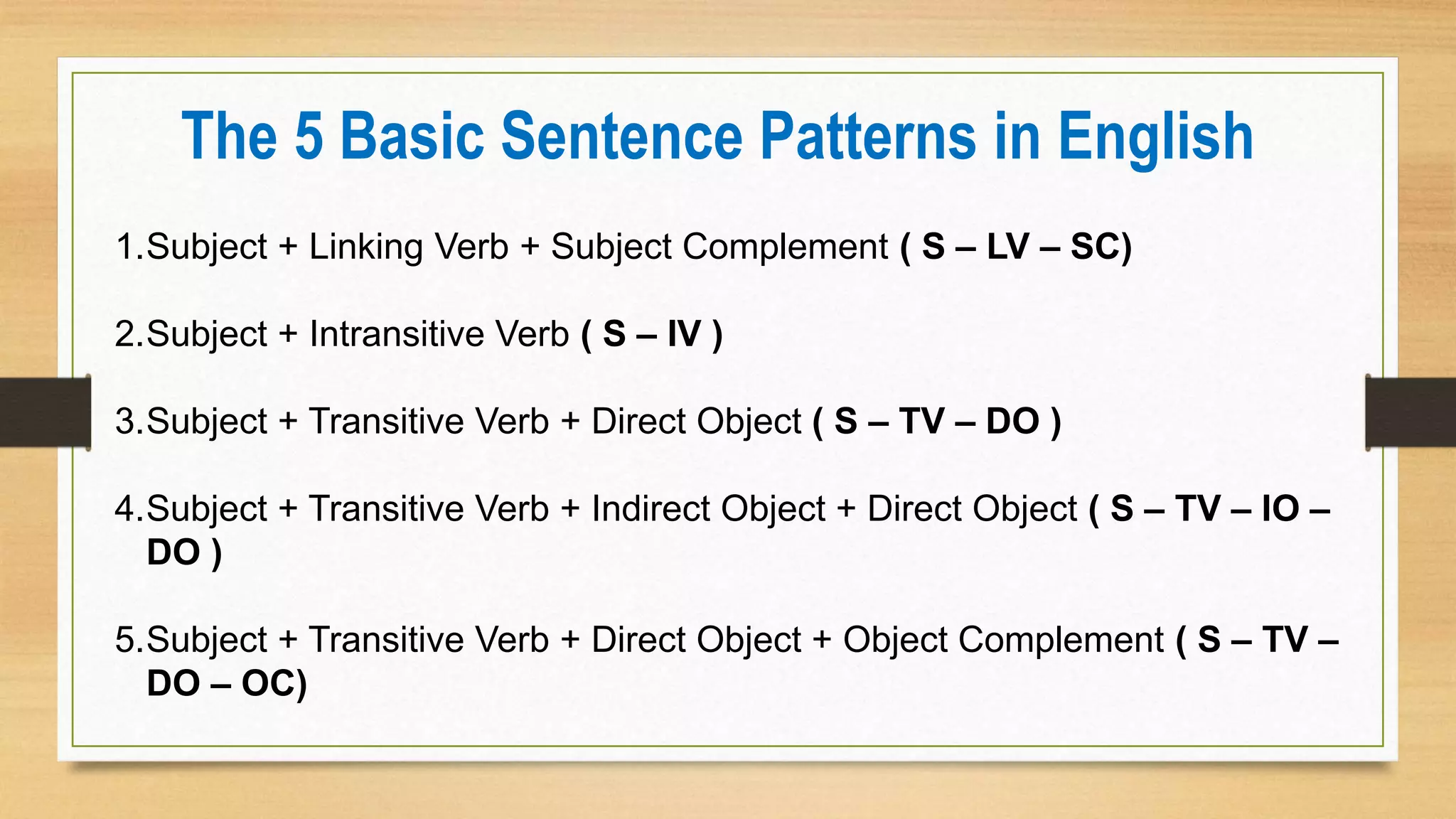
The 5 Basic Sentence Patterns in English
1.Subject + Linking Verb + Subject Complement ( S – LV – SC)
2.Subject + Intransitive Verb ( S – IV )
3.Subject + Transitive Verb + Direct Object ( S – TV – DO )
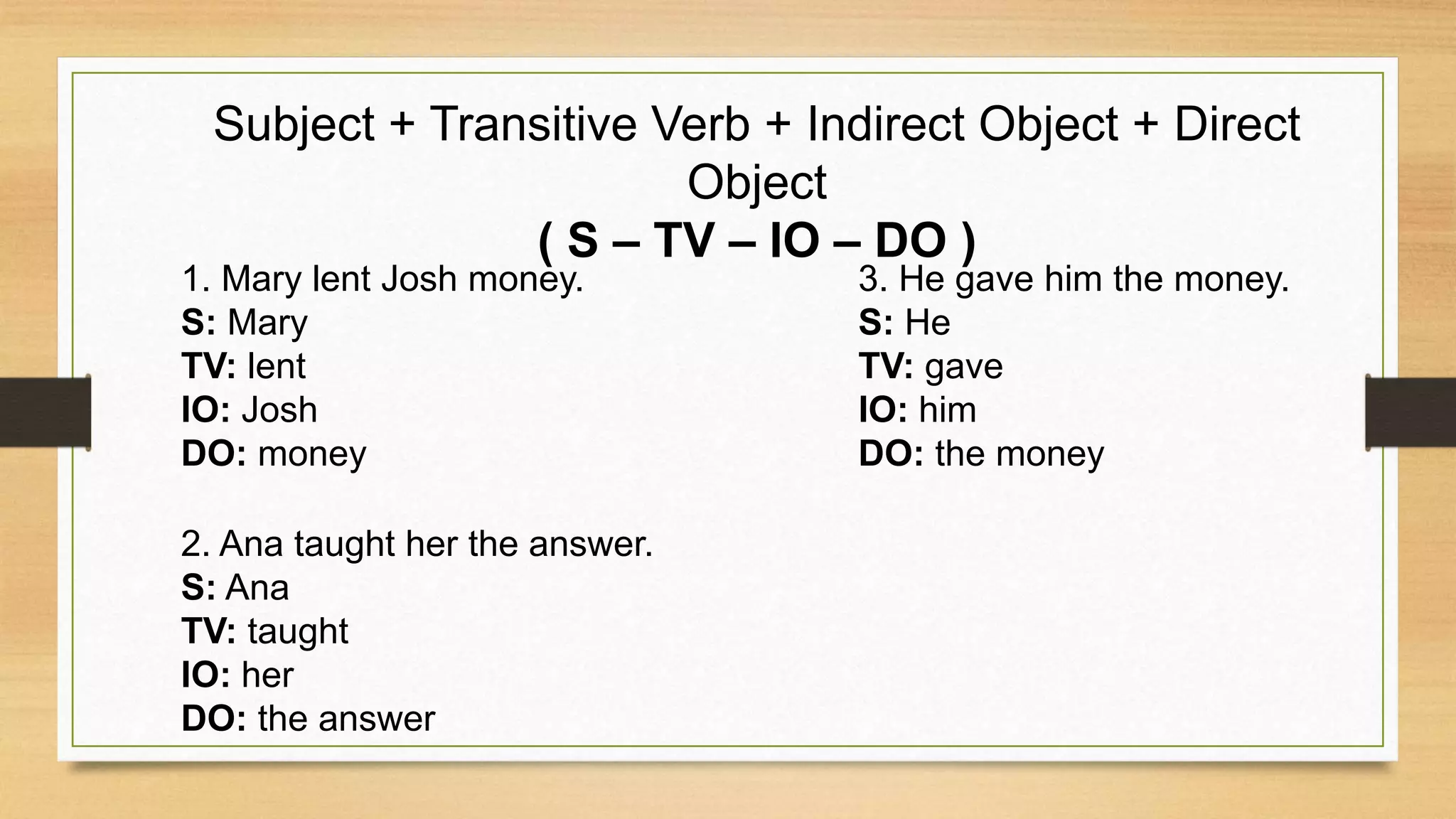
4.Subject + Transitive Verb + Indirect Object + Direct Object ( S – TV – IO –
DO )
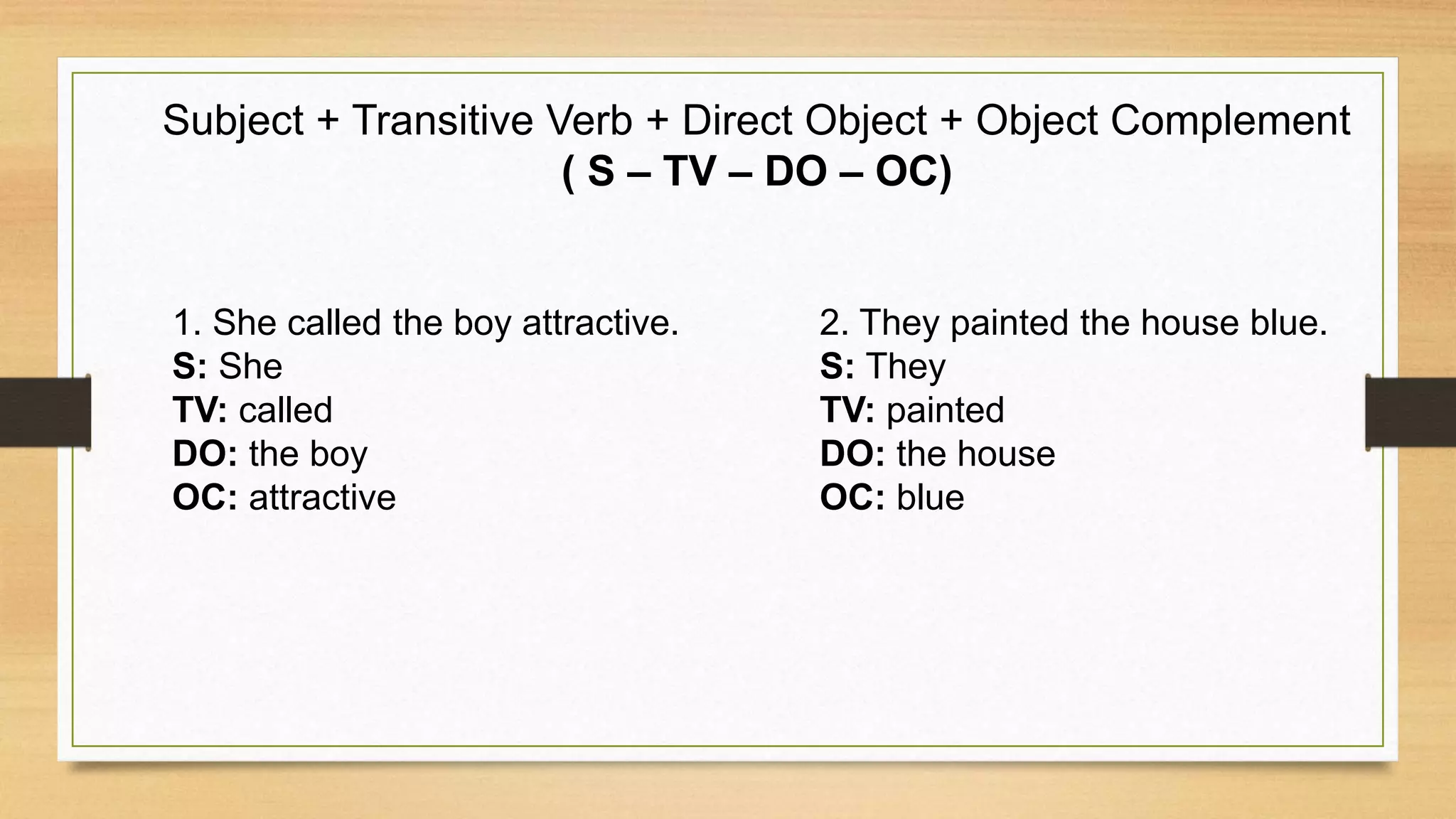
5.Subject + Transitive Verb + Direct Object + Object Complement ( S – TV –
DO – OC)
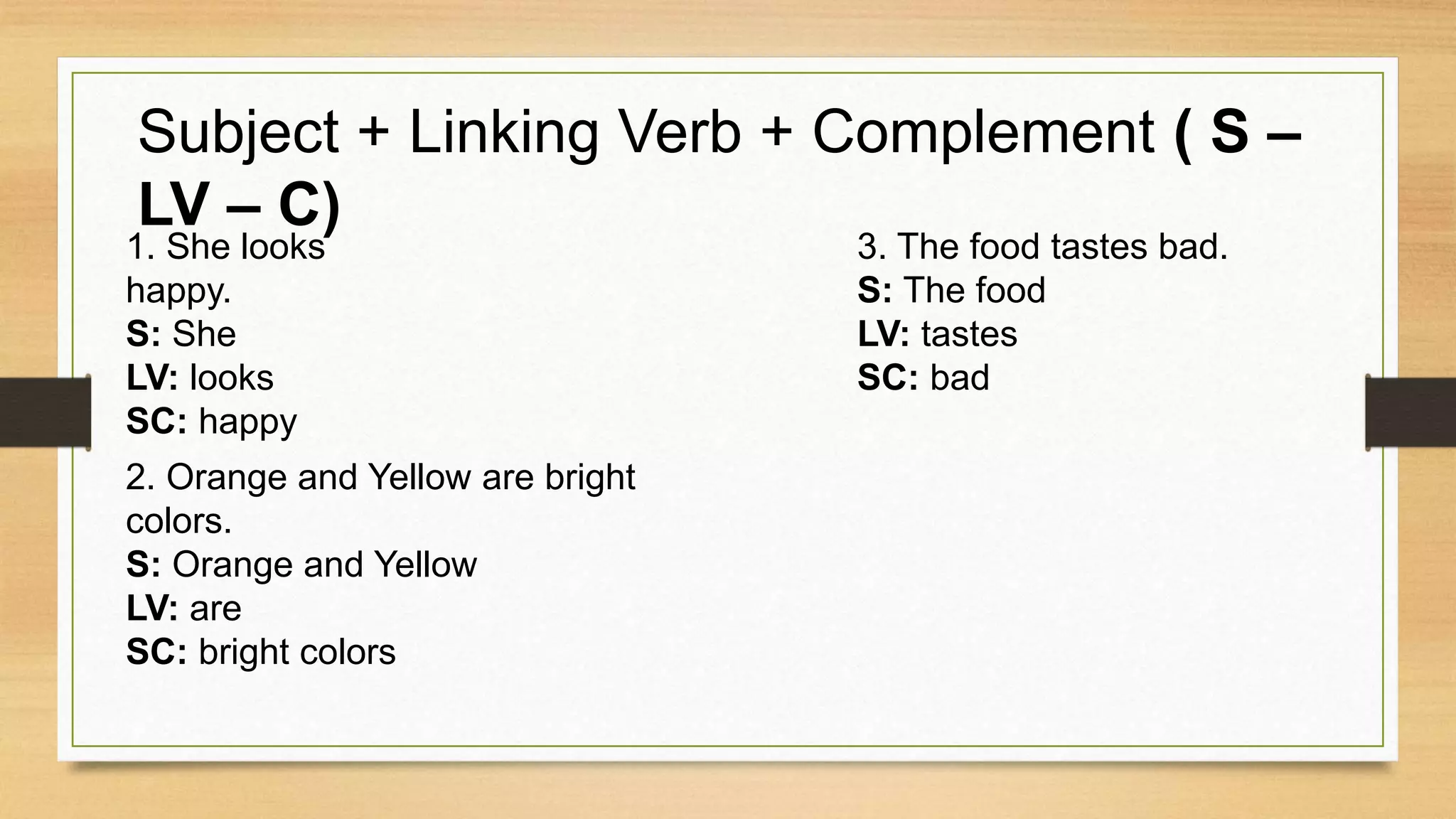
Subject + Linking Verb + Complement ( S –
LV – C)
1. She looks
happy.
S: She
LV: looks
SC: happy
2. Orange and Yellow are bright
colors.
S: Orange and Yellow
LV: are
SC: bright colors
3. The food tastes bad.
S: The food
LV: tastes
SC: bad
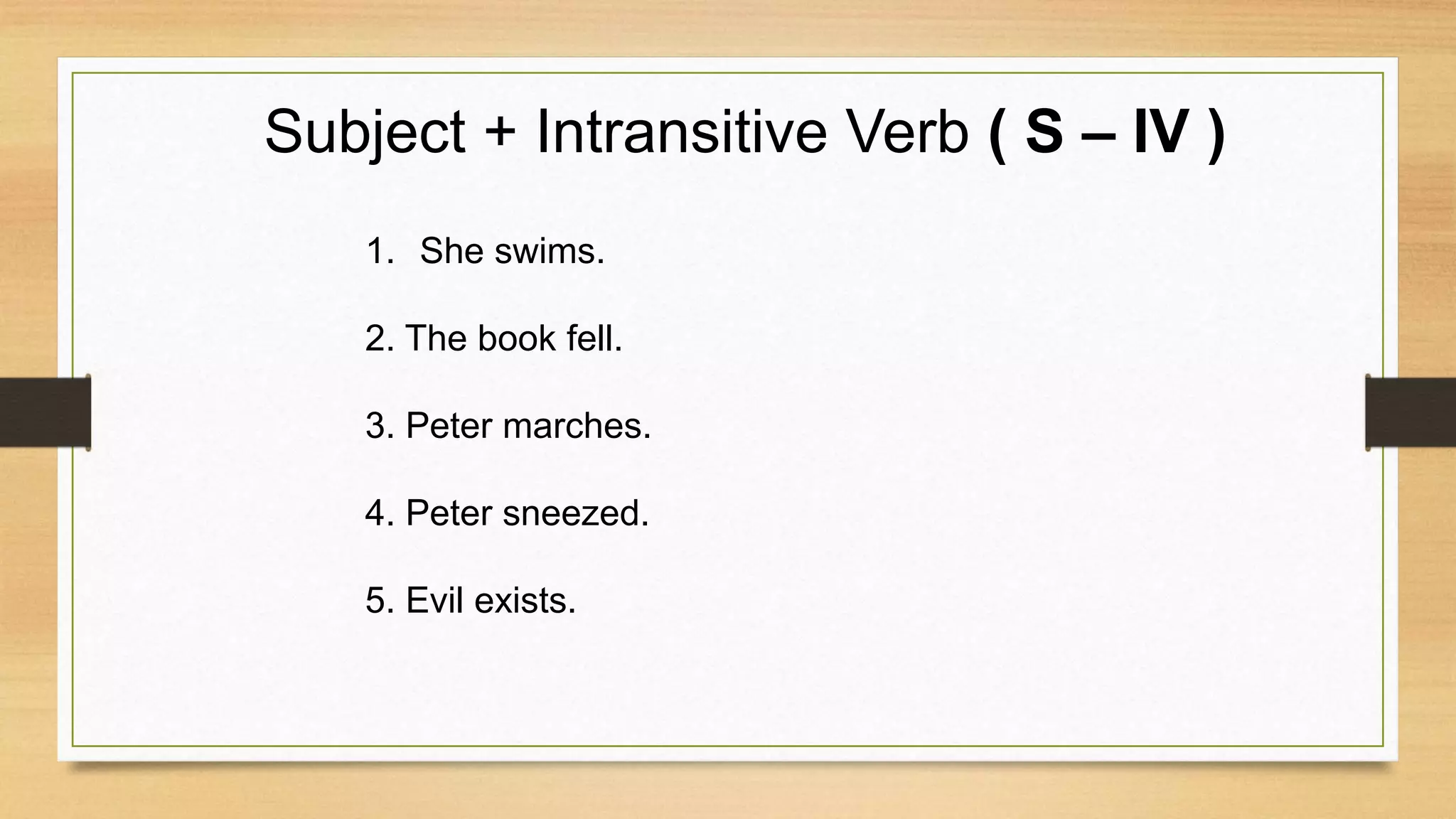
Subject + Intransitive Verb ( S – IV )
1. She swims.
2. The book fell.
3. Peter marches.
4. Peter sneezed.
5. Evil exists.
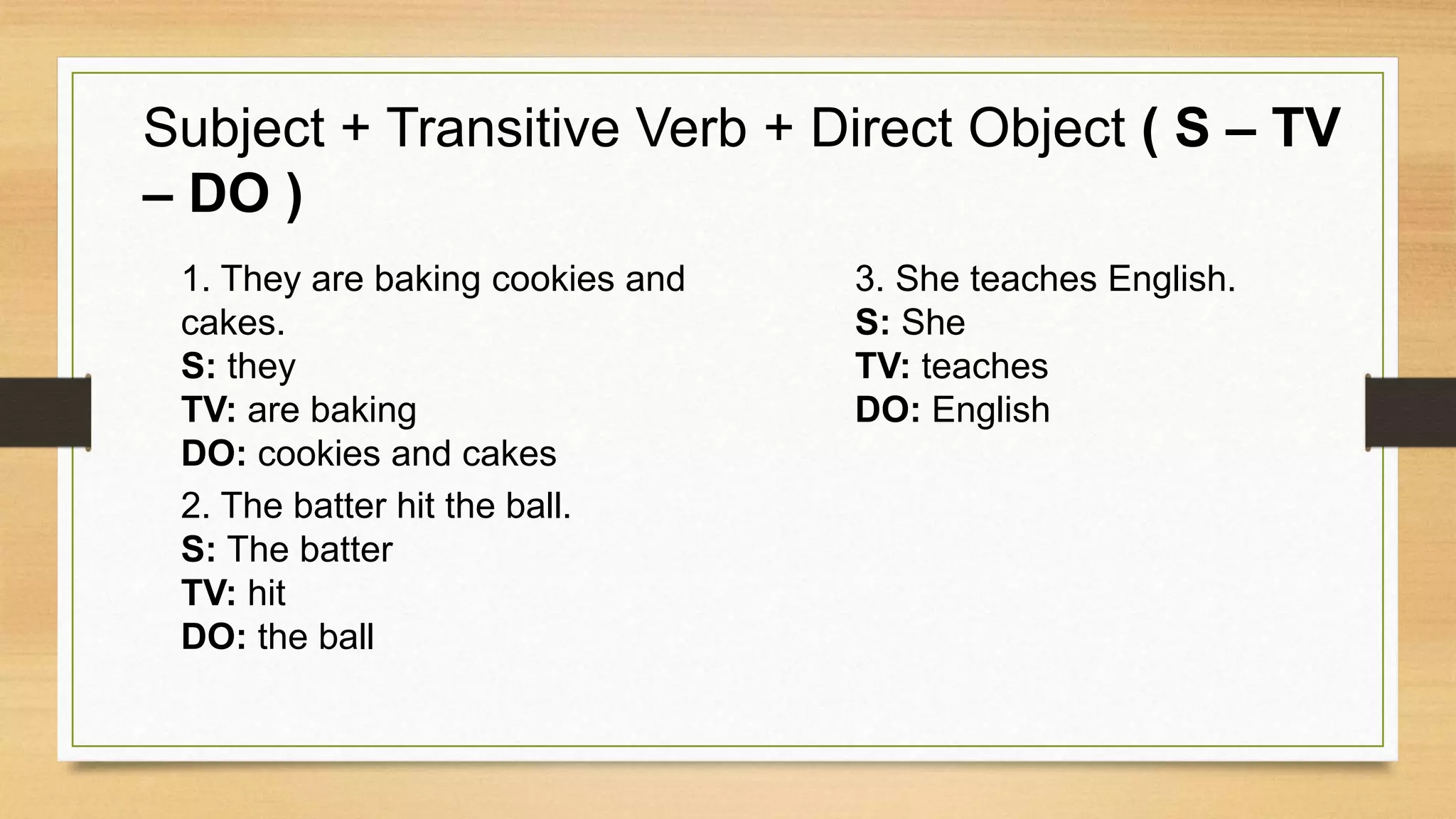
Subject + Transitive Verb + Direct Object ( S – TV
– DO )
1. They are baking cookies and
cakes.
S: they
TV: are baking
DO: cookies and cakes
2. The batter hit the ball.
S: The batter
TV: hit
DO: the ball
3. She teaches English.
S: She
TV: teaches
DO: English
Subject + Transitive Verb + Indirect Object + Direct
Object
( S – TV – IO – DO )
1. Mary lent Josh money.
S: Mary
TV: lent
IO: Josh
DO: money
2. Ana taught her the answer.
S: Ana
TV: taught
IO: her
DO: the answer
3. He gave him the money.
S: He
TV: gave
IO: him
DO: the money
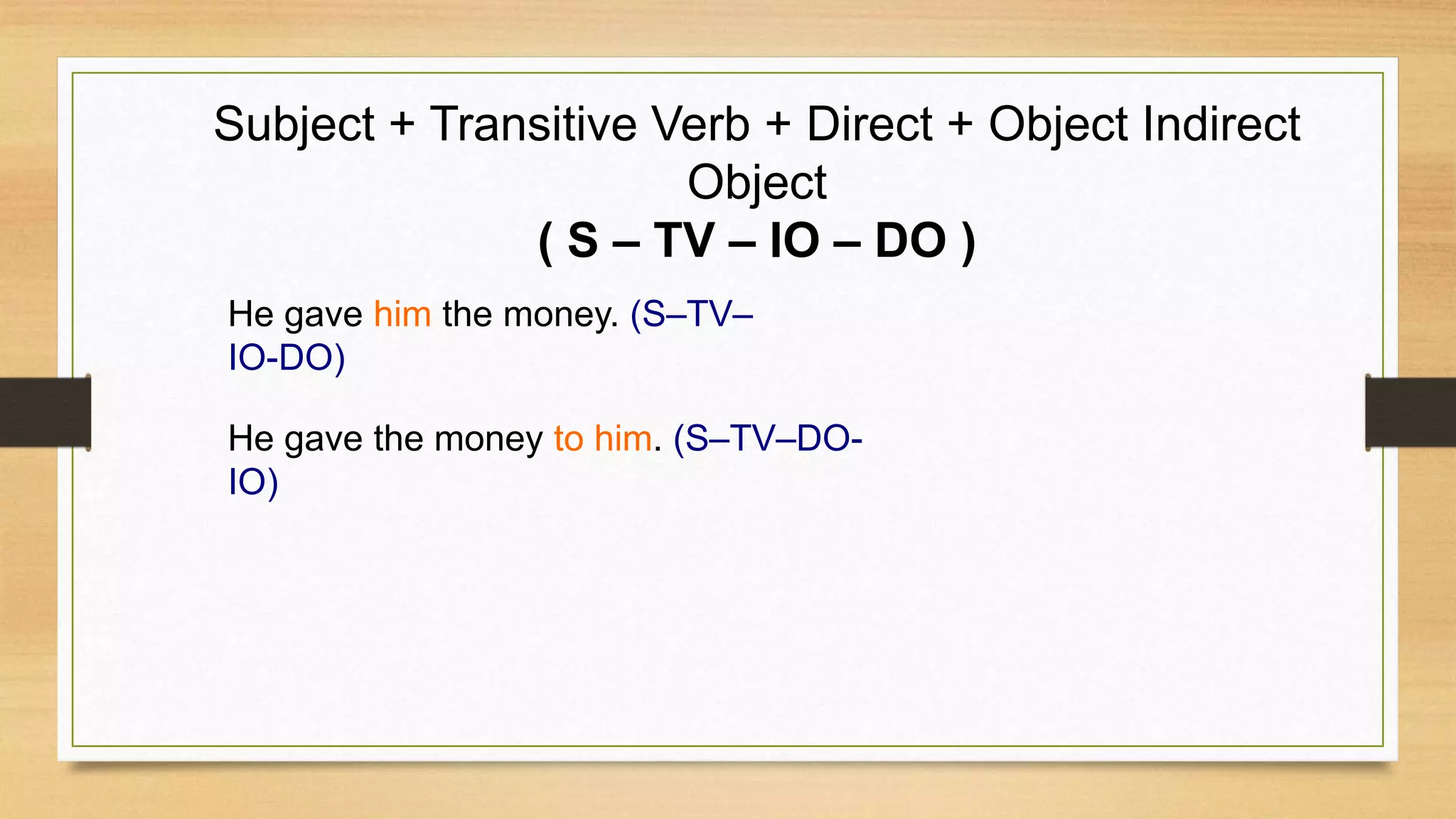
Subject + Transitive Verb + Direct + Object Indirect
Object
( S – TV – IO – DO )
He gave him the money. (S–TV–
IO-DO)
He gave the money to him. (S–TV–DO-
IO)
Subject + Transitive Verb + Direct Object + Object Complement
( S – TV – DO – OC)
1. She called the boy attractive.
S: She
TV: called
DO: the boy
OC: attractive
2. They painted the house blue.
S: They
TV: painted
DO: the house
OC: blue
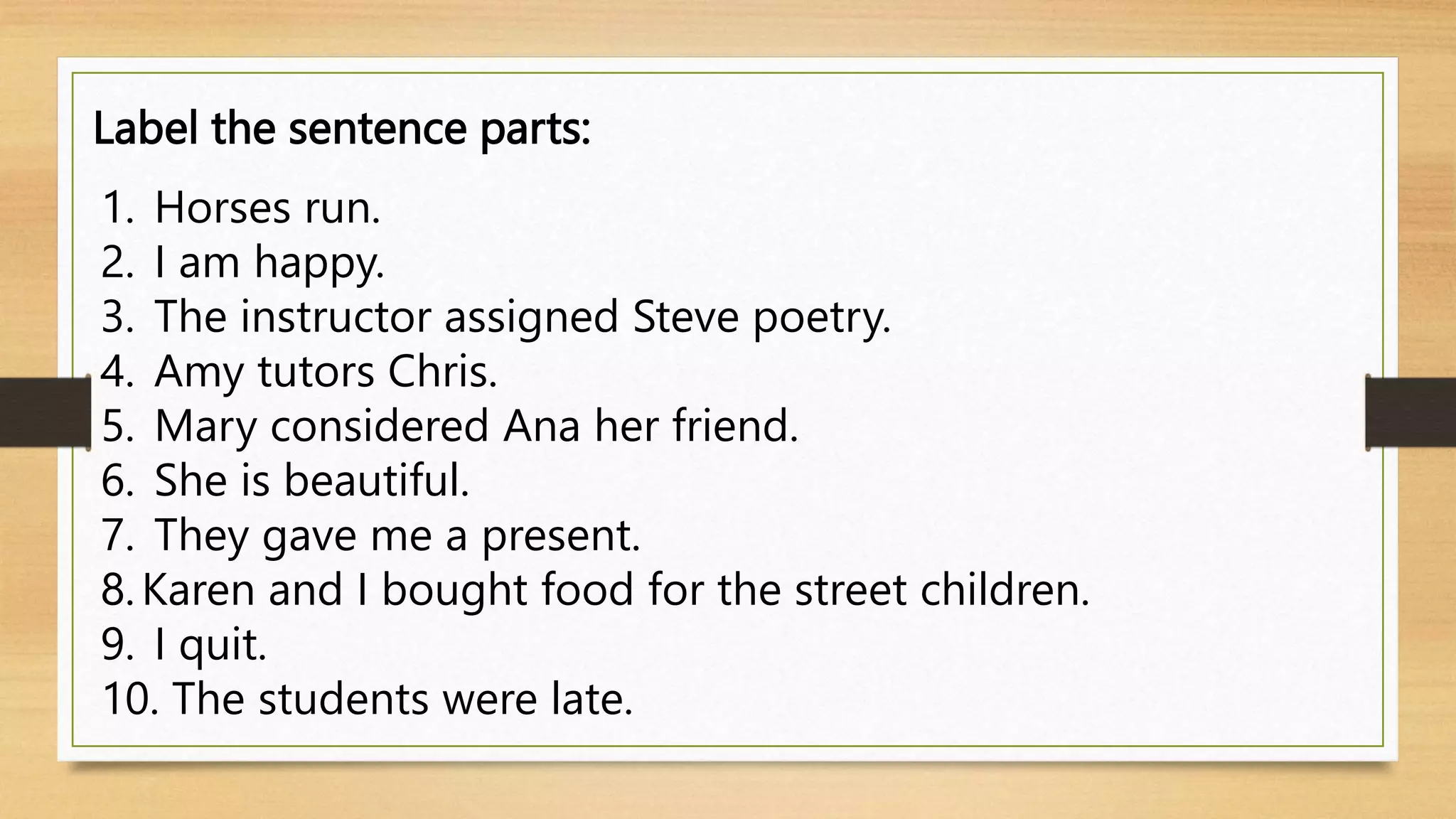
Label the sentence parts:
1. Horses run.
2. I am happy.
3. The instructor assigned Steve poetry.
4. Amy tutors Chris.
5. Mary considered Ana her friend.
6. She is beautiful.
7. They gave me a present.
8.Karen and I bought food for the street children.
9. I quit.
10. The students were late.
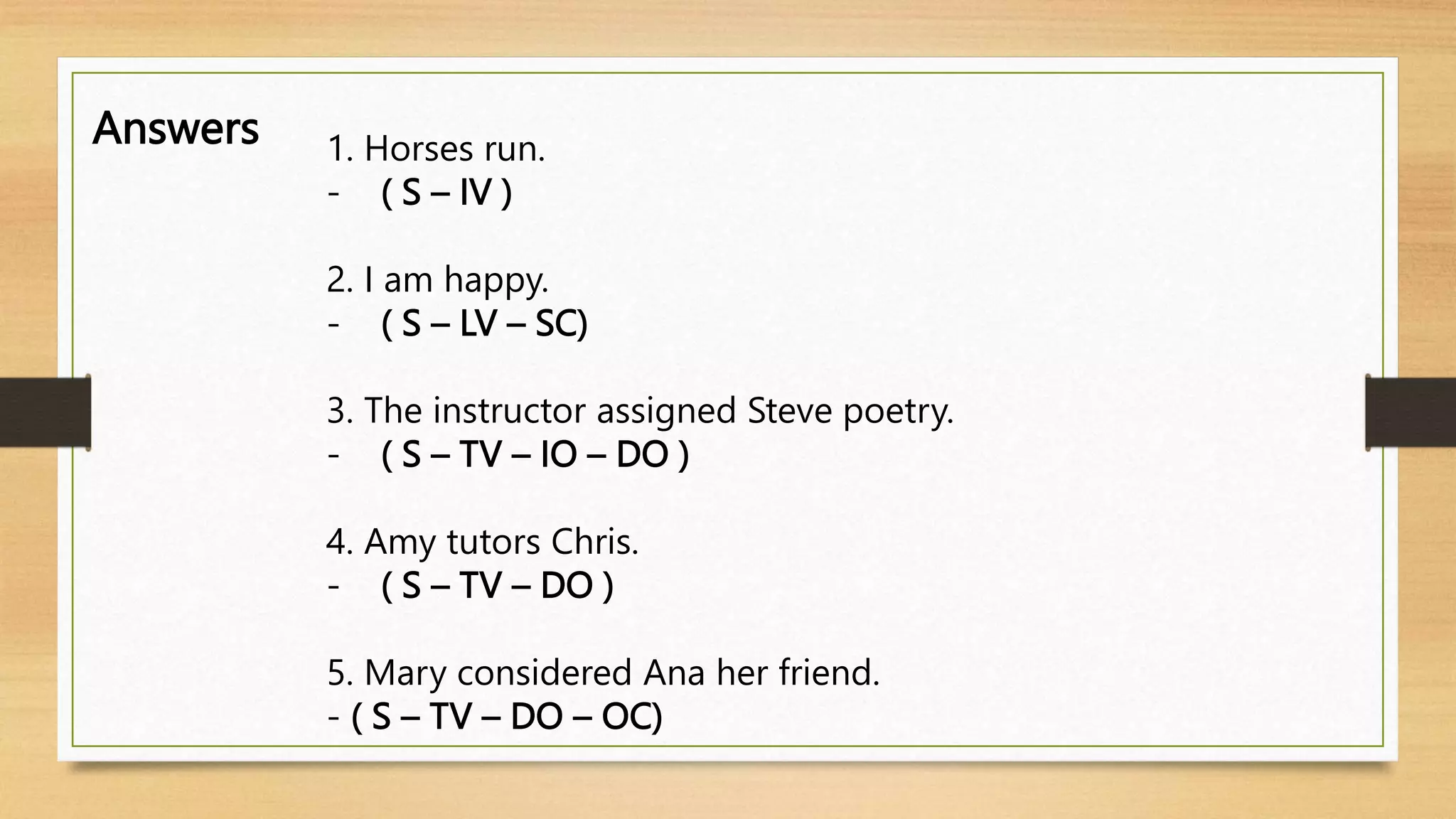
Answers 1. Horses run.
- ( S – IV )
2. I am happy.
- ( S – LV – SC)
3. The instructor assigned Steve poetry.
- ( S – TV – IO – DO )
4. Amy tutors Chris.
- ( S – TV – DO )
5. Mary considered Ana her friend.
- ( S – TV – DO – OC)
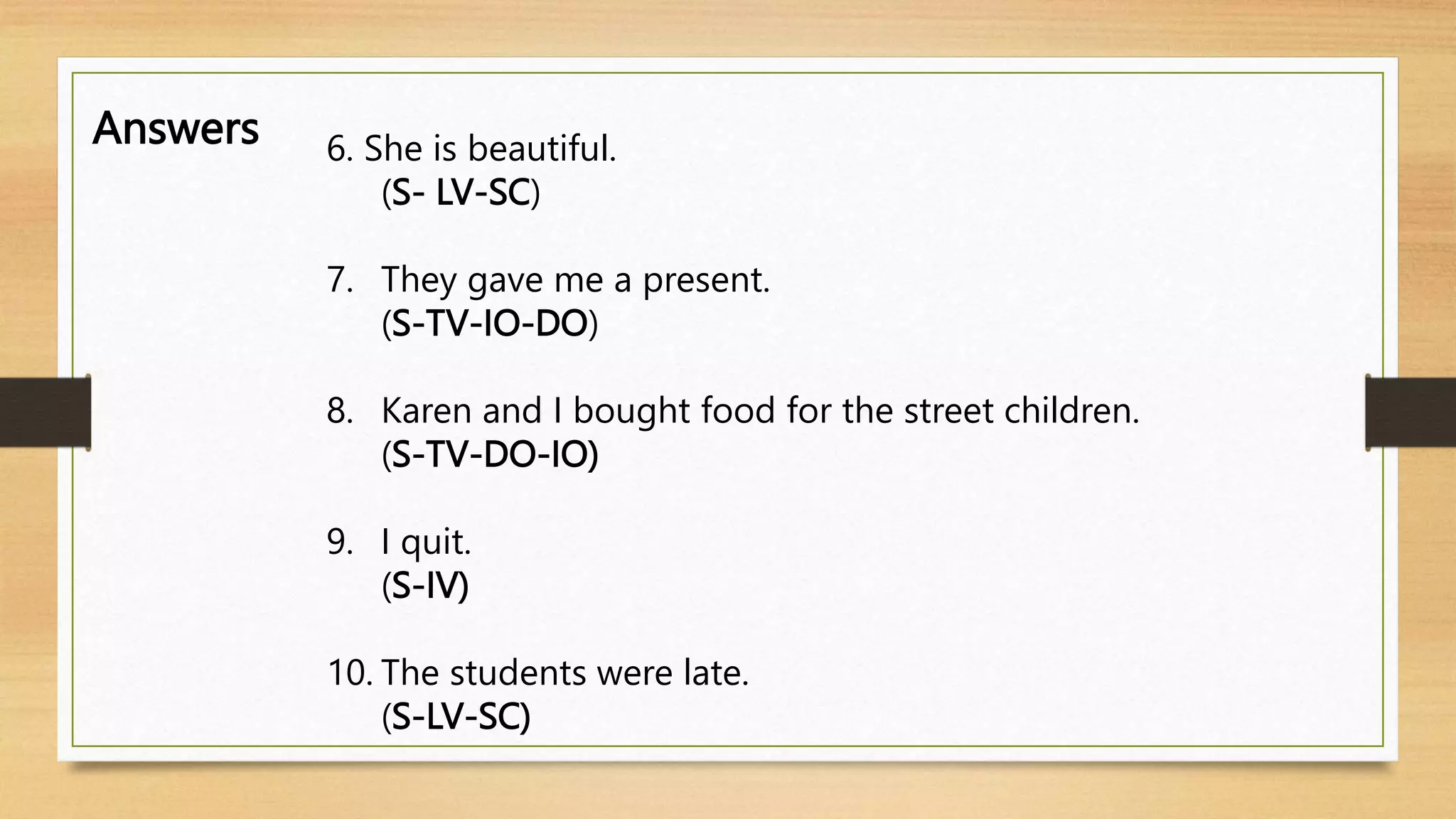
Answers 6. She is beautiful.
(S- LV-SC)
7. They gave me a present.
(S-TV-IO-DO)
8. Karen and I bought food for the street children.
(S-TV-DO-IO)
9. I quit.
(S-IV)
10. The students were late.
(S-LV-SC)

5 Basic Sentence Patterns.pptx

  • 2.
    Sentence A sentence isa word or group of words that usually contain a subject (S) and a verb (V) and expresses a complete idea. 1. The students went to the park. 2. The cat jumped over the fence. 3. He missed the bus.
  • 3.
    The Basic Elementsof a Sentence A sentence has two basic elements: the Subject and the Predicate. A Transitive Verb is a verb that requires an object to receive the action. Generally, we use the word “object” to talk about the thing/person that the action is done to. Or, the one who receives the action. An Intransitive Verb is a “verb that indicates a complete action without being accompanied by a direct object
  • 4.
    The Basic Elementsof a Sentence A Direct Object refers to the person or thing affected by the action of the verb. An Indirect Object usually refers to the person who ‘benefits’ from the action of the verb. Object Complements follow and modify a direct object and provide additional information about it. An object complement can be a noun or adjective or any word acting as a noun or adjective. The Subject Complement is normally a noun or an adjective that defines or renames the subject in some way.
  • 5.
    The 5 BasicSentence Patterns in English 1.Subject + Linking Verb + Subject Complement ( S – LV – SC) 2.Subject + Intransitive Verb ( S – IV ) 3.Subject + Transitive Verb + Direct Object ( S – TV – DO ) 4.Subject + Transitive Verb + Indirect Object + Direct Object ( S – TV – IO – DO ) 5.Subject + Transitive Verb + Direct Object + Object Complement ( S – TV – DO – OC)
  • 6.
    Subject + LinkingVerb + Complement ( S – LV – C) 1. She looks happy. S: She LV: looks SC: happy 2. Orange and Yellow are bright colors. S: Orange and Yellow LV: are SC: bright colors 3. The food tastes bad. S: The food LV: tastes SC: bad
  • 7.
    Subject + IntransitiveVerb ( S – IV ) 1. She swims. 2. The book fell. 3. Peter marches. 4. Peter sneezed. 5. Evil exists.
  • 8.
    Subject + TransitiveVerb + Direct Object ( S – TV – DO ) 1. They are baking cookies and cakes. S: they TV: are baking DO: cookies and cakes 2. The batter hit the ball. S: The batter TV: hit DO: the ball 3. She teaches English. S: She TV: teaches DO: English
  • 9.
    Subject + TransitiveVerb + Indirect Object + Direct Object ( S – TV – IO – DO ) 1. Mary lent Josh money. S: Mary TV: lent IO: Josh DO: money 2. Ana taught her the answer. S: Ana TV: taught IO: her DO: the answer 3. He gave him the money. S: He TV: gave IO: him DO: the money
  • 10.
    Subject + TransitiveVerb + Direct + Object Indirect Object ( S – TV – IO – DO ) He gave him the money. (S–TV– IO-DO) He gave the money to him. (S–TV–DO- IO)
  • 11.
    Subject + TransitiveVerb + Direct Object + Object Complement ( S – TV – DO – OC) 1. She called the boy attractive. S: She TV: called DO: the boy OC: attractive 2. They painted the house blue. S: They TV: painted DO: the house OC: blue
  • 13.
    Label the sentenceparts: 1. Horses run. 2. I am happy. 3. The instructor assigned Steve poetry. 4. Amy tutors Chris. 5. Mary considered Ana her friend. 6. She is beautiful. 7. They gave me a present. 8.Karen and I bought food for the street children. 9. I quit. 10. The students were late.
  • 14.
    Answers 1. Horsesrun. - ( S – IV ) 2. I am happy. - ( S – LV – SC) 3. The instructor assigned Steve poetry. - ( S – TV – IO – DO ) 4. Amy tutors Chris. - ( S – TV – DO ) 5. Mary considered Ana her friend. - ( S – TV – DO – OC)
  • 15.
    Answers 6. Sheis beautiful. (S- LV-SC) 7. They gave me a present. (S-TV-IO-DO) 8. Karen and I bought food for the street children. (S-TV-DO-IO) 9. I quit. (S-IV) 10. The students were late. (S-LV-SC)