





Thought-Provoking Questions
Project Zero Sydney
25 February 2017
Cameron Paterson & Natasha Terry-Armstrong
cpaterson@shore.nsw.edu.au
nterryarmstrong@riverview.nsw.edu.au
@cpaterso
Understanding Goals
• What are good questions?
• How can we craft better questions?
• How can we encourage our students to
ask better questions?
• How can we utilise questioning to
promote interactions that better support
thinking and learning?
“Everything we know has its origins in questions.
Questions, we might say, are the principal intellectual
instruments available to human beings.”
- Neil Postman in The End of Education
Your questions……
Question Starts
1. Brainstorm a list of at least 12 questions about the topic.
Use these question-starts to help you think of interesting
questions:
• Why…?
• What are the reasons…?
• What if…?
• What is the purpose of…?
• How would it be different if…?
• Suppose that…?
• What if we knew…?
• What would change if…?
Question Starts
2. Review the brainstormed list and star the questions that
seem most interesting. Then, select one or more of the
starred questions to discuss for a few moments.
Question Starts
3. Reflect: What new ideas do you have about the topic that
you didn’t have before?
Essential Questions: https://www.youtube.com/watch?v=qvH1Vu7bwFQ
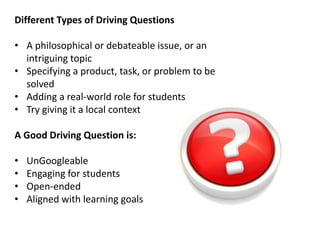
Different Types of Driving Questions
• A philosophical or debateable issue, or an
intriguing topic
• Specifying a product, task, or problem to be
solved
• Adding a real-world role for students
• Try giving it a local context
A Good Driving Question is:
• UnGoogleable
• Engaging for students
• Open-ended
• Aligned with learning goals
Sample Driving Questions
 How do we, as archaeologists, determine what happened to the
people at Angkor?
 Is unification worth it?
 Why do people write poetry?
 What makes life complicated for teenagers?
 How can we use Horrible Histories to teach others about the
federation of Australia?
 How has the legacy of the Romantics continued into the 21st
Century?
 How have governments used identity to justify the use of force
against others?
 What should we do in a drought?
 Was art really ‘reborn’ during the Renaissance?
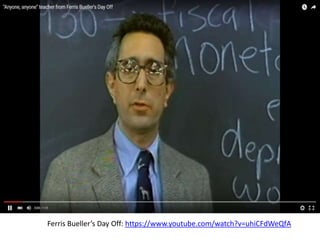
Ferris Bueller’s Day Off: https://www.youtube.com/watch?v=uhiCFdWeQfA
“Teachers tend to monopolize the right to
question.”
D. Wolf, (1987, Winter) “The Art of Questioning”,
Academic Connections.
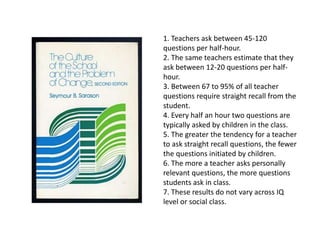
1. Teachers ask between 45-120
questions per half-hour.
2. The same teachers estimate that they
ask between 12-20 questions per half-
hour.
3. Between 67 to 95% of all teacher
questions require straight recall from the
student.
4. Every half an hour two questions are
typically asked by children in the class.
5. The greater the tendency for a teacher
to ask straight recall questions, the fewer
the questions initiated by children.
6. The more a teacher asks personally
relevant questions, the more questions
students ask in class.
7. These results do not vary across IQ
level or social class.
5 Minute
Stretch
Break
The Big Idea
Students are more successful when they learn to
ask their own questions
The QFT
A rigorous step-by-step process that helps students to
consistently:
Produce their own questions
Improve their questions
Strategise on how to use their questions
Rules for Producing Questions
1. Ask as many questions as you can
2. Do not stop to answer, judge, or discuss
3. Write down every question exactly as stated
4. Change any statements into questions
Question Focus
Some students are not asking questions
Question Focus
Some students are not asking questions
1. Ask Questions
2. Follow the Rules
• Ask as many questions as you can.
• Do not stop to answer, judge, or discuss.
• Write down every question exactly as it was stated.
• Change any statements into questions.
3. Number the Questions
Categorising Questions: Closed/Open
Definitions:
Closed-ended questions can be answered with a “yes” or
“no” or with a one-word answer.
Open-ended questions require more explanation.
Directions: identify your questions as closed-ended or
oepn-ended by marking them with a “C” or an “O”.
Discussion
Open-ended Questions
Advantages/Disadvantages
Improve Questions
Take one closed-ended question and change it into an
open-ended question.
Take one open-ended question and change it into a
closed-ended question.
Prioritising Questions
Review your list of questions
• Choose the three questions you consider most
important
• While prioritising, think about your question focus:
Some students are not asking questions
Prioritising Questions
After prioritising consider…
• Why did you choose those three questions as the most
important?
• Where are your priority questions in the sequence of
your entire list of questions?
Next Steps
From priority questions to action plan
• In order to answer your priority questions”
• What do you need to know? INFORMATION
• What do you need to do? TASKS
Share
1. Questions you changed from open/closed
2. Your three priority questions and their numbers in your
original sequence
3. Rationale for choosing priority questions
4. What you will do with the questions
Reflection
• What did you learn?
• How did you learn it?
• What do you understand differently now about asking
questions?
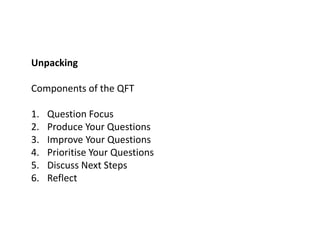
Unpacking
Components of the QFT
1. Question Focus
2. Produce Your Questions
3. Improve Your Questions
4. Prioritise Your Questions
5. Discuss Next Steps
6. Reflect
The Shift in Practice
ONE BASIC CHANGE
Your students are the ones asking the questions
Unpacking the Outcomes
Three changes in students
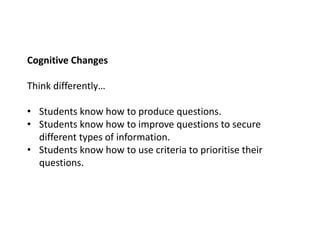
Cognitive Changes
Think differently…
• Students know how to produce questions.
• Students know how to improve questions to secure
different types of information.
• Students know how to use criteria to prioritise their
questions.
Affective Changes
Feel differently…
• Students feel more confident.
• Students express greater interest and are more curious.
• Students feel a greater sense of urgency and
responsibility to get the answers.
Behavioural Changes
Behave differently…
• Students are asking questions.
• Students are working with their questions
• Students self-regulate more effectively.
• Students collaborate and listen to each other’s
questions.
http://rightquestion.org/
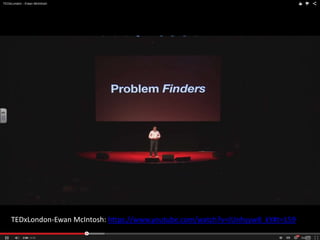
TEDxLondon-Ewan McIntosh: https://www.youtube.com/watch?v=JUnhyyw8_kY#t=159
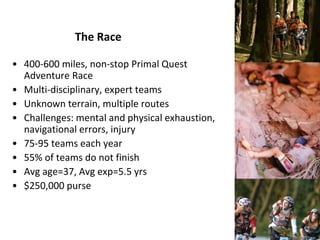
The Race
• 400-600 miles, non-stop Primal Quest
Adventure Race
• Multi-disciplinary, expert teams
• Unknown terrain, multiple routes
• Challenges: mental and physical exhaustion,
navigational errors, injury
• 75-95 teams each year
• 55% of teams do not finish
• Avg age=37, Avg exp=5.5 yrs
• $250,000 purse
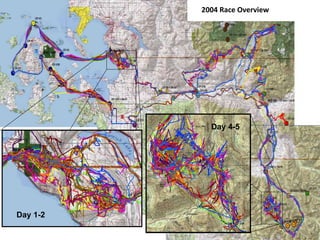
Map of Race
Day 1-2
Day 4-5
2004 Race Overview
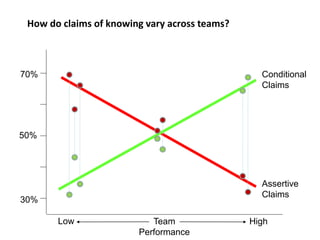
50%
70% Conditional
Claims
Assertive
Claims
Team
Performance
HighLow
30%
How do claims of knowing vary across teams?
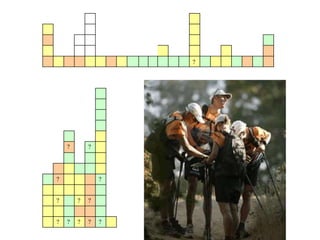
?
? ?
? ?
? ? ?
? ? ? ? ?
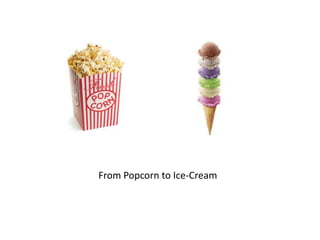
From Popcorn to Ice-Cream
From Ping-Pong to Basketball
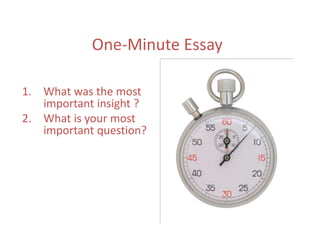
One-Minute Essay
1. What was the most
important insight ?
2. What is your most
important question?
Thought-Provoking Questions

Thought-Provoking Questions

  • 1.
    Thought-Provoking Questions Project ZeroSydney 25 February 2017 Cameron Paterson & Natasha Terry-Armstrong cpaterson@shore.nsw.edu.au nterryarmstrong@riverview.nsw.edu.au @cpaterso
  • 4.
    Understanding Goals • Whatare good questions? • How can we craft better questions? • How can we encourage our students to ask better questions? • How can we utilise questioning to promote interactions that better support thinking and learning?
  • 5.
    “Everything we knowhas its origins in questions. Questions, we might say, are the principal intellectual instruments available to human beings.” - Neil Postman in The End of Education
  • 6.
  • 7.
    Question Starts 1. Brainstorma list of at least 12 questions about the topic. Use these question-starts to help you think of interesting questions: • Why…? • What are the reasons…? • What if…? • What is the purpose of…? • How would it be different if…? • Suppose that…? • What if we knew…? • What would change if…?
  • 8.
    Question Starts 2. Reviewthe brainstormed list and star the questions that seem most interesting. Then, select one or more of the starred questions to discuss for a few moments.
  • 9.
    Question Starts 3. Reflect:What new ideas do you have about the topic that you didn’t have before?
  • 12.
  • 13.
    Different Types ofDriving Questions • A philosophical or debateable issue, or an intriguing topic • Specifying a product, task, or problem to be solved • Adding a real-world role for students • Try giving it a local context A Good Driving Question is: • UnGoogleable • Engaging for students • Open-ended • Aligned with learning goals
  • 14.
    Sample Driving Questions How do we, as archaeologists, determine what happened to the people at Angkor?  Is unification worth it?  Why do people write poetry?  What makes life complicated for teenagers?  How can we use Horrible Histories to teach others about the federation of Australia?  How has the legacy of the Romantics continued into the 21st Century?  How have governments used identity to justify the use of force against others?  What should we do in a drought?  Was art really ‘reborn’ during the Renaissance?
  • 15.
    Ferris Bueller’s DayOff: https://www.youtube.com/watch?v=uhiCFdWeQfA
  • 16.
    “Teachers tend tomonopolize the right to question.” D. Wolf, (1987, Winter) “The Art of Questioning”, Academic Connections.
  • 17.
    1. Teachers askbetween 45-120 questions per half-hour. 2. The same teachers estimate that they ask between 12-20 questions per half- hour. 3. Between 67 to 95% of all teacher questions require straight recall from the student. 4. Every half an hour two questions are typically asked by children in the class. 5. The greater the tendency for a teacher to ask straight recall questions, the fewer the questions initiated by children. 6. The more a teacher asks personally relevant questions, the more questions students ask in class. 7. These results do not vary across IQ level or social class.
  • 18.
  • 20.
    The Big Idea Studentsare more successful when they learn to ask their own questions
  • 21.
    The QFT A rigorousstep-by-step process that helps students to consistently: Produce their own questions Improve their questions Strategise on how to use their questions
  • 22.
    Rules for ProducingQuestions 1. Ask as many questions as you can 2. Do not stop to answer, judge, or discuss 3. Write down every question exactly as stated 4. Change any statements into questions
  • 23.
    Question Focus Some studentsare not asking questions
  • 24.
    Question Focus Some studentsare not asking questions 1. Ask Questions 2. Follow the Rules • Ask as many questions as you can. • Do not stop to answer, judge, or discuss. • Write down every question exactly as it was stated. • Change any statements into questions. 3. Number the Questions
  • 25.
    Categorising Questions: Closed/Open Definitions: Closed-endedquestions can be answered with a “yes” or “no” or with a one-word answer. Open-ended questions require more explanation. Directions: identify your questions as closed-ended or oepn-ended by marking them with a “C” or an “O”.
  • 26.
  • 27.
    Improve Questions Take oneclosed-ended question and change it into an open-ended question. Take one open-ended question and change it into a closed-ended question.
  • 28.
    Prioritising Questions Review yourlist of questions • Choose the three questions you consider most important • While prioritising, think about your question focus: Some students are not asking questions
  • 29.
    Prioritising Questions After prioritisingconsider… • Why did you choose those three questions as the most important? • Where are your priority questions in the sequence of your entire list of questions?
  • 30.
    Next Steps From priorityquestions to action plan • In order to answer your priority questions” • What do you need to know? INFORMATION • What do you need to do? TASKS
  • 31.
    Share 1. Questions youchanged from open/closed 2. Your three priority questions and their numbers in your original sequence 3. Rationale for choosing priority questions 4. What you will do with the questions
  • 32.
    Reflection • What didyou learn? • How did you learn it? • What do you understand differently now about asking questions?
  • 33.
    Unpacking Components of theQFT 1. Question Focus 2. Produce Your Questions 3. Improve Your Questions 4. Prioritise Your Questions 5. Discuss Next Steps 6. Reflect
  • 34.
    The Shift inPractice ONE BASIC CHANGE Your students are the ones asking the questions
  • 35.
    Unpacking the Outcomes Threechanges in students
  • 36.
    Cognitive Changes Think differently… •Students know how to produce questions. • Students know how to improve questions to secure different types of information. • Students know how to use criteria to prioritise their questions.
  • 37.
    Affective Changes Feel differently… •Students feel more confident. • Students express greater interest and are more curious. • Students feel a greater sense of urgency and responsibility to get the answers.
  • 38.
    Behavioural Changes Behave differently… •Students are asking questions. • Students are working with their questions • Students self-regulate more effectively. • Students collaborate and listen to each other’s questions.
  • 39.
  • 40.
  • 41.
    The Race • 400-600miles, non-stop Primal Quest Adventure Race • Multi-disciplinary, expert teams • Unknown terrain, multiple routes • Challenges: mental and physical exhaustion, navigational errors, injury • 75-95 teams each year • 55% of teams do not finish • Avg age=37, Avg exp=5.5 yrs • $250,000 purse
  • 42.
    Map of Race Day1-2 Day 4-5 2004 Race Overview
  • 43.
  • 44.
    ? ? ? ? ? ?? ? ? ? ? ? ?
  • 45.
    From Popcorn toIce-Cream
  • 46.
  • 49.
    One-Minute Essay 1. Whatwas the most important insight ? 2. What is your most important question?