Basic
Sentence
Patterns
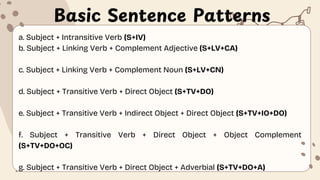
Basic Sentence Patterns
a. Subject + Intransitive Verb (S+IV)
b. Subject + Linking Verb + Complement Adjective (S+LV+CA)
c. Subject + Linking Verb + Complement Noun (S+LV+CN)
d. Subject + Transitive Verb + Direct Object (S+TV+DO)
e. Subject + Transitive Verb + Indirect Object + Direct Object (S+TV+IO+DO)
f. Subject + Transitive Verb + Direct Object + Object Complement
(S+TV+DO+OC)
g. Subject + Transitive Verb + Direct Object + Adverbial (S+TV+DO+A)
Basic Sentence Patterns
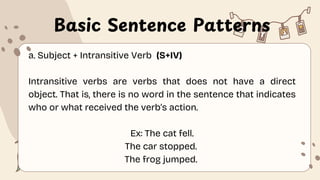
a. Subject + Intransitive Verb (S+IV)
Intransitive verbs are verbs that does not have a direct
object. That is, there is no word in the sentence that indicates
who or what received the verb’s action.
Ex: The cat fell.
The car stopped.
The frog jumped.
Basic Sentence Patterns
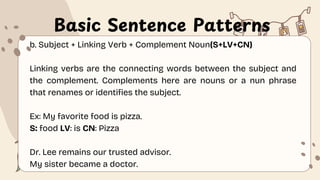
b. Subject + Linking Verb + Complement Noun(S+LV+CN)
Linking verbs are the connecting words between the subject and
the complement. Complements here are nouns or a nun phrase
that renames or identifies the subject.
Ex: My favorite food is pizza.
S: food LV: is CN: Pizza
Dr. Lee remains our trusted advisor.
My sister became a doctor.
Basic Sentence Patterns
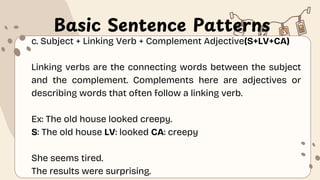
c. Subject + Linking Verb + Complement Adjective(S+LV+CA)
Linking verbs are the connecting words between the subject
and the complement. Complements here are adjectives or
describing words that often follow a linking verb.
Ex: The old house looked creepy.
S: The old house LV: looked CA: creepy
She seems tired.
The results were surprising.
Basic Sentence Patterns
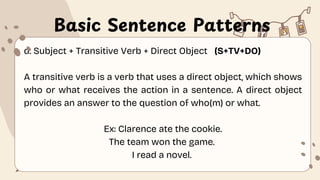
d. Subject + Transitive Verb + Direct Object (S+TV+DO)
A transitive verb is a verb that uses a direct object, which shows
who or what receives the action in a sentence. A direct object
provides an answer to the question of who(m) or what.
Ex: Clarence ate the cookie.
The team won the game.
I read a novel.
Basic Sentence Patterns
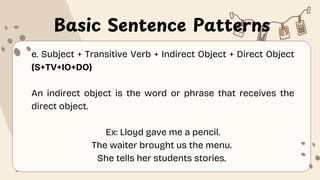
e. Subject + Transitive Verb + Indirect Object + Direct Object
(S+TV+IO+DO)
An indirect object is the word or phrase that receives the
direct object.
Ex: Lloyd gave me a pencil.
The waiter brought us the menu.
She tells her students stories.
Basic Sentence Patterns
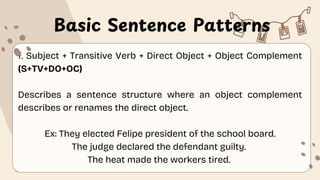
f. Subject + Transitive Verb + Direct Object + Object Complement
(S+TV+DO+OC)
Describes a sentence structure where an object complement
describes or renames the direct object.
Ex: They elected Felipe president of the school board.
The judge declared the defendant guilty.
The heat made the workers tired.
Basic Sentence Patterns
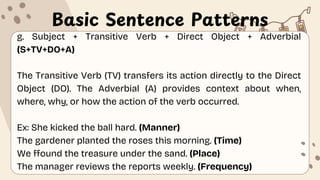
g. Subject + Transitive Verb + Direct Object + Adverbial
(S+TV+DO+A)
The Transitive Verb (TV) transfers its action directly to the Direct
Object (DO). The Adverbial (A) provides context about when,
where, why, or how the action of the verb occurred.
Ex: She kicked the ball hard. (Manner)
The gardener planted the roses this morning. (Time)
We ffound the treasure under the sand. (Place)
The manager reviews the reports weekly. (Frequency)
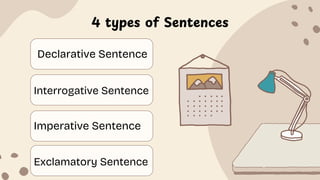
4 types of Sentences
Declarative Sentence
Interrogative Sentence
Imperative Sentence
Exclamatory Sentence
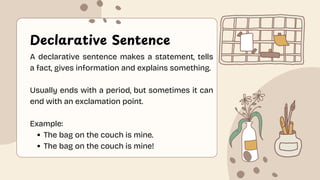
Declarative Sentence
A declarative sentence makes a statement, tells
a fact, gives information and explains something.
Usually ends with a period, but sometimes it can
end with an exclamation point.
Example:
The bag on the couch is mine.
The bag on the couch is mine!
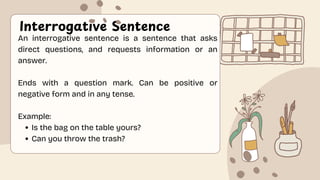
Interrogative Sentence
An interrogative sentence is a sentence that asks
direct questions, and requests information or an
answer.
Ends with a question mark. Can be positive or
negative form and in any tense.
Example:
Is the bag on the table yours?
Can you throw the trash?
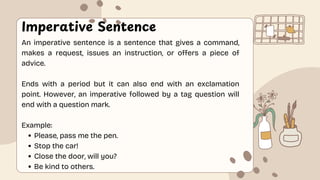
Imperative Sentence
An imperative sentence is a sentence that gives a command,
makes a request, issues an instruction, or offers a piece of
advice.
Ends with a period but it can also end with an exclamation
point. However, an imperative followed by a tag question will
end with a question mark.
Example:
Please, pass me the pen.
Stop the car!
Close the door, will you?
Be kind to others.
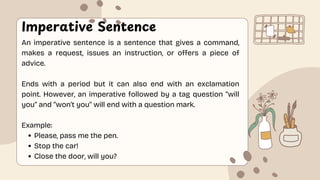
Imperative Sentence
An imperative sentence is a sentence that gives a command,
makes a request, issues an instruction, or offers a piece of
advice.
Ends with a period but it can also end with an exclamation
point. However, an imperative followed by a tag question “will
you” and “won’t you” will end with a question mark.
Example:
Please, pass me the pen.
Stop the car!
Close the door, will you?
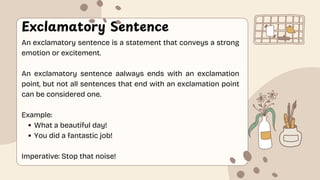
Exclamatory Sentence
An exclamatory sentence is a statement that conveys a strong
emotion or excitement.
An exclamatory sentence aalways ends with an exclamation
point, but not all sentences that end with an exclamation point
can be considered one.
Example:
What a beautiful day!
You did a fantastic job!
Imperative: Stop that noise!

Basic-Sentence-Patterns-and-Types-of-Sentences.pdf

  • 1.
  • 2.
    Basic Sentence Patterns a.Subject + Intransitive Verb (S+IV) b. Subject + Linking Verb + Complement Adjective (S+LV+CA) c. Subject + Linking Verb + Complement Noun (S+LV+CN) d. Subject + Transitive Verb + Direct Object (S+TV+DO) e. Subject + Transitive Verb + Indirect Object + Direct Object (S+TV+IO+DO) f. Subject + Transitive Verb + Direct Object + Object Complement (S+TV+DO+OC) g. Subject + Transitive Verb + Direct Object + Adverbial (S+TV+DO+A)
  • 3.
    Basic Sentence Patterns a.Subject + Intransitive Verb (S+IV) Intransitive verbs are verbs that does not have a direct object. That is, there is no word in the sentence that indicates who or what received the verb’s action. Ex: The cat fell. The car stopped. The frog jumped.
  • 4.
    Basic Sentence Patterns b.Subject + Linking Verb + Complement Noun(S+LV+CN) Linking verbs are the connecting words between the subject and the complement. Complements here are nouns or a nun phrase that renames or identifies the subject. Ex: My favorite food is pizza. S: food LV: is CN: Pizza Dr. Lee remains our trusted advisor. My sister became a doctor.
  • 5.
    Basic Sentence Patterns c.Subject + Linking Verb + Complement Adjective(S+LV+CA) Linking verbs are the connecting words between the subject and the complement. Complements here are adjectives or describing words that often follow a linking verb. Ex: The old house looked creepy. S: The old house LV: looked CA: creepy She seems tired. The results were surprising.
  • 6.
    Basic Sentence Patterns d.Subject + Transitive Verb + Direct Object (S+TV+DO) A transitive verb is a verb that uses a direct object, which shows who or what receives the action in a sentence. A direct object provides an answer to the question of who(m) or what. Ex: Clarence ate the cookie. The team won the game. I read a novel.
  • 7.
    Basic Sentence Patterns e.Subject + Transitive Verb + Indirect Object + Direct Object (S+TV+IO+DO) An indirect object is the word or phrase that receives the direct object. Ex: Lloyd gave me a pencil. The waiter brought us the menu. She tells her students stories.
  • 8.
    Basic Sentence Patterns f.Subject + Transitive Verb + Direct Object + Object Complement (S+TV+DO+OC) Describes a sentence structure where an object complement describes or renames the direct object. Ex: They elected Felipe president of the school board. The judge declared the defendant guilty. The heat made the workers tired.
  • 9.
    Basic Sentence Patterns g.Subject + Transitive Verb + Direct Object + Adverbial (S+TV+DO+A) The Transitive Verb (TV) transfers its action directly to the Direct Object (DO). The Adverbial (A) provides context about when, where, why, or how the action of the verb occurred. Ex: She kicked the ball hard. (Manner) The gardener planted the roses this morning. (Time) We ffound the treasure under the sand. (Place) The manager reviews the reports weekly. (Frequency)
  • 10.
    4 types ofSentences Declarative Sentence Interrogative Sentence Imperative Sentence Exclamatory Sentence
  • 11.
    Declarative Sentence A declarativesentence makes a statement, tells a fact, gives information and explains something. Usually ends with a period, but sometimes it can end with an exclamation point. Example: The bag on the couch is mine. The bag on the couch is mine!
  • 12.
    Interrogative Sentence An interrogativesentence is a sentence that asks direct questions, and requests information or an answer. Ends with a question mark. Can be positive or negative form and in any tense. Example: Is the bag on the table yours? Can you throw the trash?
  • 13.
    Imperative Sentence An imperativesentence is a sentence that gives a command, makes a request, issues an instruction, or offers a piece of advice. Ends with a period but it can also end with an exclamation point. However, an imperative followed by a tag question will end with a question mark. Example: Please, pass me the pen. Stop the car! Close the door, will you? Be kind to others.
  • 14.
    Imperative Sentence An imperativesentence is a sentence that gives a command, makes a request, issues an instruction, or offers a piece of advice. Ends with a period but it can also end with an exclamation point. However, an imperative followed by a tag question “will you” and “won’t you” will end with a question mark. Example: Please, pass me the pen. Stop the car! Close the door, will you?
  • 15.
    Exclamatory Sentence An exclamatorysentence is a statement that conveys a strong emotion or excitement. An exclamatory sentence aalways ends with an exclamation point, but not all sentences that end with an exclamation point can be considered one. Example: What a beautiful day! You did a fantastic job! Imperative: Stop that noise!