Immediate Constituent Theory
• Leonard Bloomfield (1933)
• Every structure maybe divided into its
immediate constituent almost always two
ways
• Each of which may in turn be divided and
subdivided until the ultimate constituents
are reached (words).
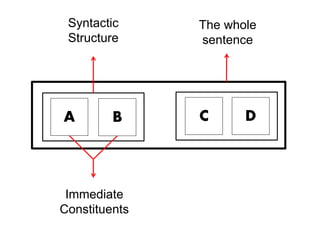
A C DB
Immediate
Constituents
Syntactic
Structure
The whole
sentence
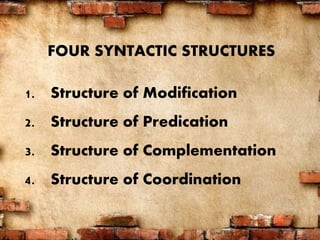
FOUR SYNTACTIC STRUCTURES
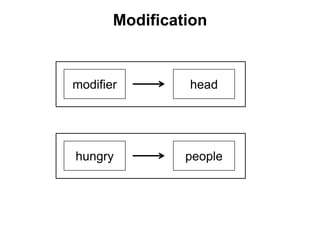
1. Structure of Modification
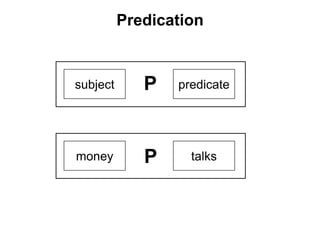
2. Structure of Predication
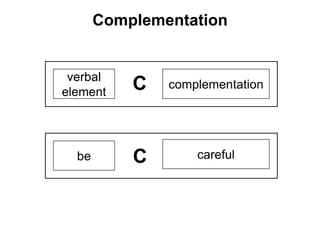
3. Structure of Complementation
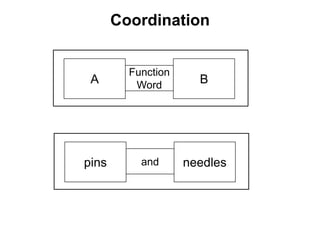
4. Structure of Coordination
Modification
modifier head
hungry people
Predication
subject predicate
money talks
P
P
Complementation
verbal
element
complementation
be
C
C careful
Coordination
A B
Function
Word
pins needlesand
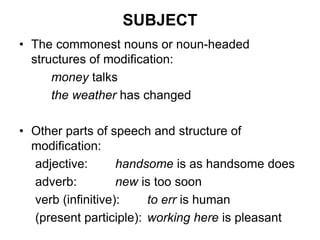
SUBJECT
• The commonest nouns or noun-headed
structures of modification:
money talks
the weather has changed
• Other parts of speech and structure of
modification:
adjective: handsome is as handsome does
adverb: new is too soon
verb (infinitive): to err is human
(present participle): working here is pleasant
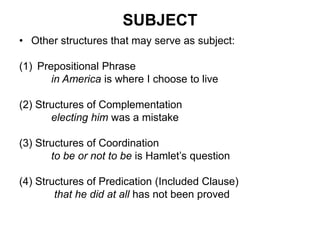
SUBJECT
• Other structures that may serve as subject:
(1) Prepositional Phrase
in America is where I choose to live
(2) Structures of Complementation
electing him was a mistake
(3) Structures of Coordination
to be or not to be is Hamlet’s question
(4) Structures of Predication (Included Clause)
that he did at all has not been proved
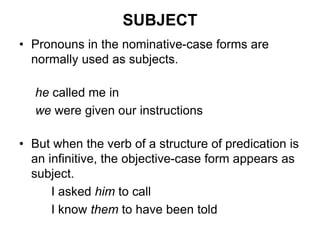
SUBJECT
• Pronouns in the nominative-case forms are
normally used as subjects.
he called me in
we were given our instructions
• But when the verb of a structure of predication is
an infinitive, the objective-case form appears as
subject.
I asked him to call
I know them to have been told
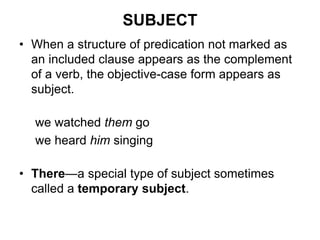
SUBJECT
• When a structure of predication not marked as
an included clause appears as the complement
of a verb, the objective-case form appears as
subject.
we watched them go
we heard him singing
• There—a special type of subject sometimes
called a temporary subject.
SUBJECT
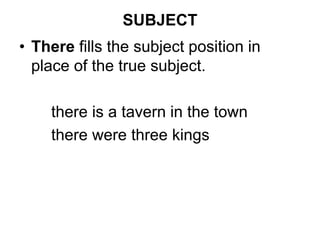
• There fills the subject position in
place of the true subject.
there is a tavern in the town
there were three kings

Structures of Predication Introduction