SENTENCE ELEMENTS AND PATTERNS
English
•The simple declarative sentence can
be described in terms of the following
five elements: Subject (S), Verb (V),
Object (Oi, Od), Complement (C) and
Adverbial (A)
1. Subject
In a declarative sentence, the subject is
typically a noun phrase (noun or
pronoun) that determines the person
and number of the verb. It refers to the
doer of the action expressed by the
verb
● John arrived late.
● Some students should take summer
courses.
● Nobody attended the meeting.
● We thought that the teacher would
be absent.
● It is snowing. (empty subject)
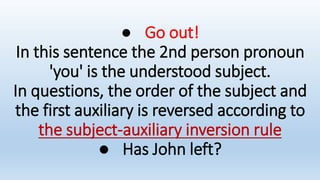
every sentence must have an explicit subject,
except for the imperative and sentences with
the infinitive form of the verb
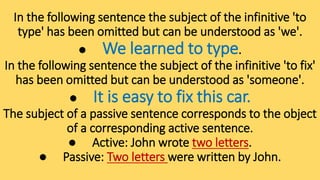
● Go out!
In this sentence the 2nd person pronoun
'you' is the understood subject.
In questions, the order of the subject and
the first auxiliary is reversed according to
the subject-auxiliary inversion rule
● Has John left?
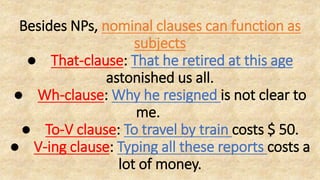
In the following sentence the subject of the infinitive 'to
type' has been omitted but can be understood as 'we'.
● We learned to type.
In the following sentence the subject of the infinitive 'to fix'
has been omitted but can be understood as 'someone'.
● It is easy to fix this car.
The subject of a passive sentence corresponds to the object
of a corresponding active sentence.
● Active: John wrote two letters.
● Passive: Two letters were written by John.
Besides NPs, nominal clauses can function as
subjects
● That-clause: That he retired at this age
astonished us all.
● Wh-clause: Why he resigned is not clear to
me.
● To-V clause: To travel by train costs $ 50.
● V-ing clause: Typing all these reports costs a
lot of money.
IDENTIFY THE MAIN SUBJECT IN THE
FOLLOWING SENTENCE:
THE NEW GAS STOVE IN THE KITCHEN
WHICH I BOUGHT LAST MONTH HAS A VERY
EFFICIENT OVEN
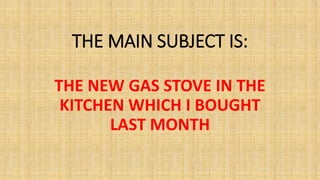
THE MAIN SUBJECT IS:
THE NEW GAS STOVE IN THE
KITCHEN WHICH I BOUGHT
LAST MONTH
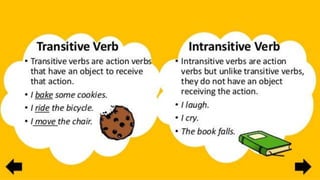
2. Verb
English has three types of main
verbs:
transitive
intransitive
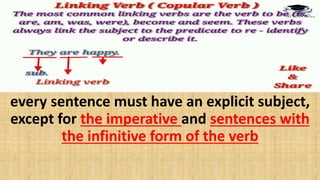
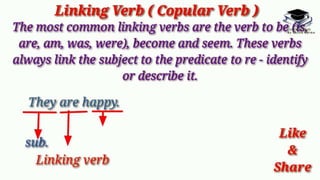
copular / copulative / linking
verb
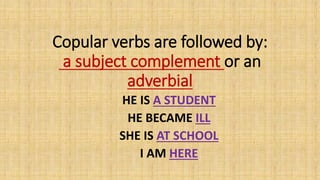
Copular verbs are followed by:
a subject complement or an
adverbial
HE IS A STUDENT
HE BECAME ILL
SHE IS AT SCHOOL
I AM HERE
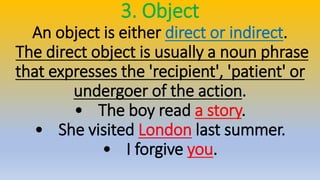
3. Object
An object is either direct or indirect.
The direct object is usually a noun phrase
that expresses the 'recipient', 'patient' or
undergoer of the action.
• The boy read a story.
• She visited London last summer.
• I forgive you.
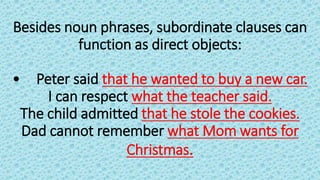
Besides noun phrases, subordinate clauses can
function as direct objects:
• Peter said that he wanted to buy a new car.
I can respect what the teacher said.
The child admitted that he stole the cookies.
Dad cannot remember what Mom wants for
Christmas.
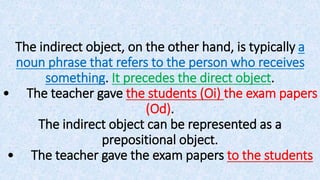
The indirect object, on the other hand, is typically a
noun phrase that refers to the person who receives
something. It precedes the direct object.
• The teacher gave the students (Oi) the exam papers
(Od).
The indirect object can be represented as a
prepositional object.
• The teacher gave the exam papers to the students
If the two objects happen to be
pronouns, direct object must precede
the prepositional object.
• He gave it to me
Among verbs that take two
objects are: teach, give,
show, ask, wish, offer,
promise, take, read, owe,
get, lend, make
4. Complement
A complement tells us something about the
subject or object. It is required for verb
complementation. They usually follow the
subject and verb (subject complement) or
the subject, verb and object (object
complement)
Complements can be realized by noun
phrases or adjective phrases.
Copular/linking verbs are followed by
complements:
• Most of the participants were doctors
• They looked tired
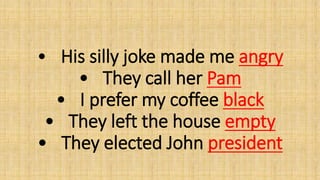
Object complements follow the direct
object of the sentence .
• His silly joke made me angry
• They call her Pam
• I prefer my coffee black
• They left the house empty
• They elected John president
The five elements may combine to form the following eight
basic sentence patterns:
(1) SV: John left.
(2) SVO: Mary bought a car.
(3) SVOiOd: She gave me a book.
(4) SVA: John is here.
(5) SVC: The teacher became impatient.
(6) SVOC: They have elected John president
(7) SVOA: She put the vase on the table.
(8) SVSA:There is a man at the door.
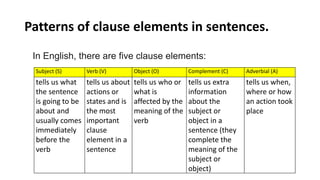
Patterns of clause elements in sentences.
Subject (S) Verb (V) Object (O) Complement (C) Adverbial (A)
tells us what
the sentence
is going to be
about and
usually comes
immediately
before the
verb
tells us about
actions or
states and is
the most
important
clause
element in a
sentence
tells us who or
what is
affected by the
meaning of the
verb
tells us extra
information
about the
subject or
object in a
sentence (they
complete the
meaning of the
subject or
object)
tells us when,
where or how
an action took
place
In English, there are five clause elements:
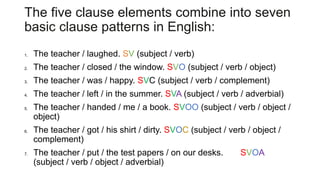
The five clause elements combine into seven
basic clause patterns in English:
1. The teacher / laughed. SV (subject / verb)
2. The teacher / closed / the window. SVO (subject / verb / object)
3. The teacher / was / happy. SVC (subject / verb / complement)
4. The teacher / left / in the summer. SVA (subject / verb / adverbial)
5. The teacher / handed / me / a book. SVOO (subject / verb / object /
object)
6. The teacher / got / his shirt / dirty. SVOC (subject / verb / object /
complement)
7. The teacher / put / the test papers / on our desks. SVOA
(subject / verb / object / adverbial)
•Worksheet

sentence patterns. types of sentences pptx

  • 1.
    SENTENCE ELEMENTS ANDPATTERNS English •The simple declarative sentence can be described in terms of the following five elements: Subject (S), Verb (V), Object (Oi, Od), Complement (C) and Adverbial (A)
  • 3.
    1. Subject In adeclarative sentence, the subject is typically a noun phrase (noun or pronoun) that determines the person and number of the verb. It refers to the doer of the action expressed by the verb
  • 4.
    ● John arrivedlate. ● Some students should take summer courses. ● Nobody attended the meeting. ● We thought that the teacher would be absent. ● It is snowing. (empty subject)
  • 5.
    every sentence musthave an explicit subject, except for the imperative and sentences with the infinitive form of the verb
  • 6.
    ● Go out! Inthis sentence the 2nd person pronoun 'you' is the understood subject. In questions, the order of the subject and the first auxiliary is reversed according to the subject-auxiliary inversion rule ● Has John left?
  • 7.
    In the followingsentence the subject of the infinitive 'to type' has been omitted but can be understood as 'we'. ● We learned to type. In the following sentence the subject of the infinitive 'to fix' has been omitted but can be understood as 'someone'. ● It is easy to fix this car. The subject of a passive sentence corresponds to the object of a corresponding active sentence. ● Active: John wrote two letters. ● Passive: Two letters were written by John.
  • 8.
    Besides NPs, nominalclauses can function as subjects ● That-clause: That he retired at this age astonished us all. ● Wh-clause: Why he resigned is not clear to me. ● To-V clause: To travel by train costs $ 50. ● V-ing clause: Typing all these reports costs a lot of money.
  • 9.
    IDENTIFY THE MAINSUBJECT IN THE FOLLOWING SENTENCE: THE NEW GAS STOVE IN THE KITCHEN WHICH I BOUGHT LAST MONTH HAS A VERY EFFICIENT OVEN
  • 10.
    THE MAIN SUBJECTIS: THE NEW GAS STOVE IN THE KITCHEN WHICH I BOUGHT LAST MONTH
  • 11.
    2. Verb English hasthree types of main verbs: transitive intransitive copular / copulative / linking verb
  • 13.
    Copular verbs arefollowed by: a subject complement or an adverbial HE IS A STUDENT HE BECAME ILL SHE IS AT SCHOOL I AM HERE
  • 15.
    3. Object An objectis either direct or indirect. The direct object is usually a noun phrase that expresses the 'recipient', 'patient' or undergoer of the action. • The boy read a story. • She visited London last summer. • I forgive you.
  • 16.
    Besides noun phrases,subordinate clauses can function as direct objects: • Peter said that he wanted to buy a new car. I can respect what the teacher said. The child admitted that he stole the cookies. Dad cannot remember what Mom wants for Christmas.
  • 17.
    The indirect object,on the other hand, is typically a noun phrase that refers to the person who receives something. It precedes the direct object. • The teacher gave the students (Oi) the exam papers (Od). The indirect object can be represented as a prepositional object. • The teacher gave the exam papers to the students
  • 18.
    If the twoobjects happen to be pronouns, direct object must precede the prepositional object. • He gave it to me
  • 19.
    Among verbs thattake two objects are: teach, give, show, ask, wish, offer, promise, take, read, owe, get, lend, make
  • 20.
    4. Complement A complementtells us something about the subject or object. It is required for verb complementation. They usually follow the subject and verb (subject complement) or the subject, verb and object (object complement)
  • 21.
    Complements can berealized by noun phrases or adjective phrases. Copular/linking verbs are followed by complements: • Most of the participants were doctors • They looked tired
  • 22.
    Object complements followthe direct object of the sentence .
  • 23.
    • His sillyjoke made me angry • They call her Pam • I prefer my coffee black • They left the house empty • They elected John president
  • 24.
    The five elementsmay combine to form the following eight basic sentence patterns: (1) SV: John left. (2) SVO: Mary bought a car. (3) SVOiOd: She gave me a book. (4) SVA: John is here. (5) SVC: The teacher became impatient. (6) SVOC: They have elected John president (7) SVOA: She put the vase on the table. (8) SVSA:There is a man at the door.
  • 25.
    Patterns of clauseelements in sentences. Subject (S) Verb (V) Object (O) Complement (C) Adverbial (A) tells us what the sentence is going to be about and usually comes immediately before the verb tells us about actions or states and is the most important clause element in a sentence tells us who or what is affected by the meaning of the verb tells us extra information about the subject or object in a sentence (they complete the meaning of the subject or object) tells us when, where or how an action took place In English, there are five clause elements:
  • 26.
    The five clauseelements combine into seven basic clause patterns in English: 1. The teacher / laughed. SV (subject / verb) 2. The teacher / closed / the window. SVO (subject / verb / object) 3. The teacher / was / happy. SVC (subject / verb / complement) 4. The teacher / left / in the summer. SVA (subject / verb / adverbial) 5. The teacher / handed / me / a book. SVOO (subject / verb / object / object) 6. The teacher / got / his shirt / dirty. SVOC (subject / verb / object / complement) 7. The teacher / put / the test papers / on our desks. SVOA (subject / verb / object / adverbial)
  • 28.