Verb and
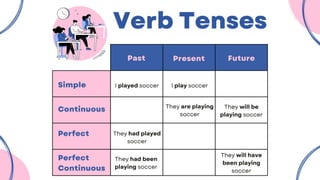
Verb Tenses
With Teacher Carol
CMU-LHS
Grade 8 Gemini
What is Verb Tense?
Verb tense refers to when the action
in the sentence takes place, whether it
happened in the past, is currently
happening in the present, or will happen
in the future.
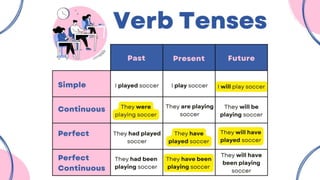
Simple Past: Formed by adding "-
ed" to regular verbs or using the
past forms of irregular verbs.
Example: He walked to the store
yesterday.
Simple Past
Talk- Talked
Fry- Fried (verb ends with letter
y)
Transfer- Transferred (CVC)
Simple Past Tense
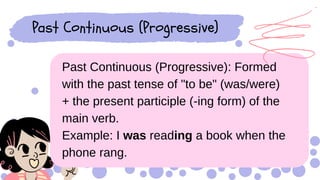
Past Continuous (Progressive): Formed
with the past tense of "to be" (was/were)
+ the present participle (-ing form) of the
main verb.
Example: I was reading a book when the
phone rang.
Past Continuous (Progressive)
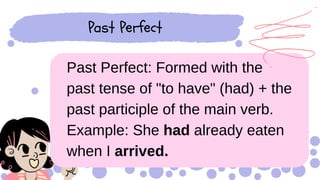
Past Perfect: Formed with the
past tense of "to have" (had) + the
past participle of the main verb.
Example: She had already eaten
when I arrived.
Past Perfect
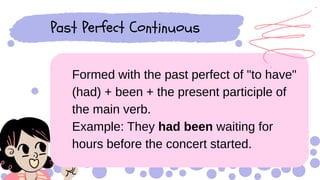
Formed with the past perfect of "to have"
(had) + been + the present participle of
the main verb.
Example: They had been waiting for
hours before the concert started.
Past Perfect Continuous
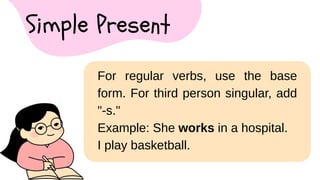
For regular verbs, use the base
form. For third person singular, add
"-s."
Example: She works in a hospital.
I play basketball.
Simple Present
Present Continuous
(Progressive)
Formed with the present tense of
"to be" (am/are/is) + the present
participle (-ing form) of the main
verb.
Example: They are eating breakfast
right now.
Present Perfect
Formed with the present tense of
"to have" (have/has) + the past
participle of the main verb.
Example: I have visited that city
before.
Present Perfect
Continuous (Progressive)
Formed with the present perfect of
"to have" (have/has) + been + the
present participle of the main verb.
Example: She has been working
on her project all day.
Formed with the modal verb
"will" + the base form of the
main verb.
Example: They will arrive
tomorrow.
Future Tense
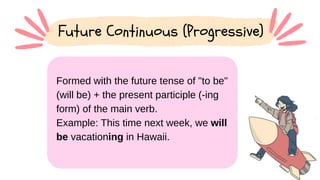
Formed with the future tense of "to be"
(will be) + the present participle (-ing
form) of the main verb.
Example: This time next week, we will
be vacationing in Hawaii.
Future Continuous (Progressive)
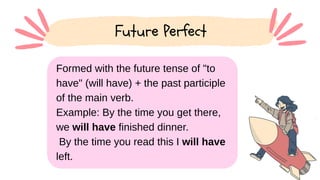
Formed with the future tense of "to
have" (will have) + the past participle
of the main verb.
Example: By the time you get there,
we will have finished dinner.
By the time you read this I will have
left.
Future Perfect
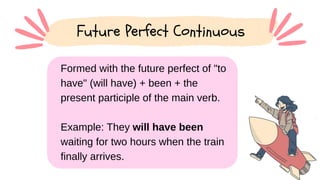
Formed with the future perfect of "to
have" (will have) + been + the
present participle of the main verb.
Example: They will have been
waiting for two hours when the train
finally arrives.
Future Perfect Continuous
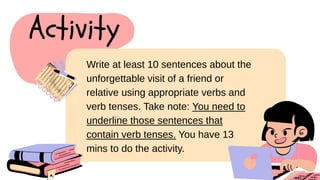
Activity
Write at least 10 sentences about the
unforgettable visit of a friend or
relative using appropriate verbs and
verb tenses. Take note: You need to
underline those sentences that
contain verb tenses. You have 13
mins to do the activity.
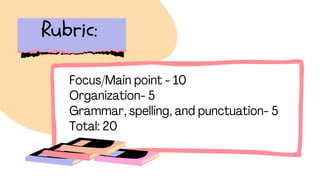
Rubric:
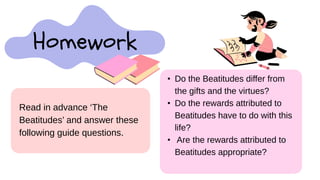
Homework
• Do the Beatitudes differ from
the gifts and the virtues?
• Do the rewards attributed to
Beatitudes have to do with this
life?
• Are the rewards attributed to
Beatitudes appropriate?
Read in advance ‘The
Beatitudes’ and answer these
following guide questions.
Have a great day ahead!
Thank you!

Verb and Verb Tenses - Ppt Presentation.

  • 1.
    Verb and Verb Tenses WithTeacher Carol CMU-LHS Grade 8 Gemini
  • 2.
    What is VerbTense? Verb tense refers to when the action in the sentence takes place, whether it happened in the past, is currently happening in the present, or will happen in the future.
  • 3.
    Simple Past: Formedby adding "- ed" to regular verbs or using the past forms of irregular verbs. Example: He walked to the store yesterday. Simple Past
  • 4.
    Talk- Talked Fry- Fried(verb ends with letter y) Transfer- Transferred (CVC) Simple Past Tense
  • 5.
    Past Continuous (Progressive):Formed with the past tense of "to be" (was/were) + the present participle (-ing form) of the main verb. Example: I was reading a book when the phone rang. Past Continuous (Progressive)
  • 6.
    Past Perfect: Formedwith the past tense of "to have" (had) + the past participle of the main verb. Example: She had already eaten when I arrived. Past Perfect
  • 7.
    Formed with thepast perfect of "to have" (had) + been + the present participle of the main verb. Example: They had been waiting for hours before the concert started. Past Perfect Continuous
  • 8.
    For regular verbs,use the base form. For third person singular, add "-s." Example: She works in a hospital. I play basketball. Simple Present
  • 9.
    Present Continuous (Progressive) Formed withthe present tense of "to be" (am/are/is) + the present participle (-ing form) of the main verb. Example: They are eating breakfast right now.
  • 10.
    Present Perfect Formed withthe present tense of "to have" (have/has) + the past participle of the main verb. Example: I have visited that city before.
  • 11.
    Present Perfect Continuous (Progressive) Formedwith the present perfect of "to have" (have/has) + been + the present participle of the main verb. Example: She has been working on her project all day.
  • 12.
    Formed with themodal verb "will" + the base form of the main verb. Example: They will arrive tomorrow. Future Tense
  • 13.
    Formed with thefuture tense of "to be" (will be) + the present participle (-ing form) of the main verb. Example: This time next week, we will be vacationing in Hawaii. Future Continuous (Progressive)
  • 14.
    Formed with thefuture tense of "to have" (will have) + the past participle of the main verb. Example: By the time you get there, we will have finished dinner. By the time you read this I will have left. Future Perfect
  • 15.
    Formed with thefuture perfect of "to have" (will have) + been + the present participle of the main verb. Example: They will have been waiting for two hours when the train finally arrives. Future Perfect Continuous
  • 18.
    Activity Write at least10 sentences about the unforgettable visit of a friend or relative using appropriate verbs and verb tenses. Take note: You need to underline those sentences that contain verb tenses. You have 13 mins to do the activity.
  • 19.
  • 20.
    Homework • Do theBeatitudes differ from the gifts and the virtues? • Do the rewards attributed to Beatitudes have to do with this life? • Are the rewards attributed to Beatitudes appropriate? Read in advance ‘The Beatitudes’ and answer these following guide questions.
  • 21.
    Have a greatday ahead! Thank you!