Context Clues: You be
    the Detective
Context Clues – What Are They?
• Context clues are bits of information from
  the text that, when combined with prior
  knowledge, allow you to decide the
  meaning of unknown words in the story or
  article you are reading.
• As a reader you must act similar to a
  detective and put together clues from
  sentences surrounding an unknown word
  in order to make an intelligent “guess” as
  to what the definition of a word is.
Context Clues – How Do They Help
     You Read New Words?
• Textbook writers and authors include
  words or phrases to help their readers
  understand the meaning of a new or
  difficult word.
• These words or phrases are built into the
  sentences around the new or difficult
  word. By becoming more aware of the
  words around a difficult word, readers can
  make logical guesses about the meanings
  of many words.
Still Wondering What a
         Context Clue Is?
 Clickon the link below to watch a
  video clip. Pay careful attention to
  what the song tells you.
 When the video is over click the back
  arrow  in the upper left hand
  corner.
 http://www.youtube.com/watch?v=qgaS
Types of Context Clues
Authors use many different
types of context clues when
writing texts. Three of these
types are:
  Directdefinition context clues
  Synonym context clues

  Antonym context clues
Direct definition context clues are
    words that say, “Stop - don’t touch that
      dictionary. The definition of the word
    you don’t know is right here in the text!"
EXAMPLES:
 There are many theories, or ideas,
  about what made the Ice Ages happen.
 In this sentence the word “ideas” tells us
  that theories are different thoughts people
  have about something.
 After a time, glaciers, or slowly
  moving rivers of ice, formed over
  many parts of the Earth.
 In this sentence the words “slowly moving
  rivers of ice” tell us what glaciers are.
Synonym context clues are words around a
     difficult word that mean the same or nearly
                the same as the word.
EXAMPLES:
   After seeing the picture of the starving
    children, we felt compassion or pity for their
    suffering.
   In this sentence the word “pity” tells us that
    compassion means to have understanding for.
   Mary admonished her students and they knew
    they were in hot water for their actions.
   In this sentence the words “in hot water” tell us
    that admonished means cautioned or scolded.
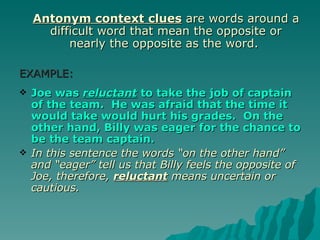
Antonym context clues are words around a
      difficult word that mean the opposite or
          nearly the opposite as the word.

EXAMPLE:
   Joe was reluctant to take the job of captain
    of the team. He was afraid that the time it
    would take would hurt his grades. On the
    other hand, Billy was eager for the chance to
    be the team captain.
   In this sentence the words “on the other hand”
    and “eager” tell us that Billy feels the opposite of
    Joe, therefore, reluctant means uncertain or
    cautious.
Now it is your turn to be
 a detective and follow
       the clues!


Use what you have learned about
context clues to complete the activity
on the next 5 slides.
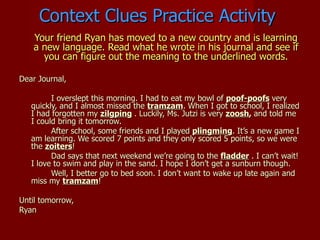
Context Clues Practice Activity
   Your friend Ryan has moved to a new country and is learning
   a new language. Read what he wrote in his journal and see if
     you can figure out the meaning to the underlined words.

Dear Journal,

         I overslept this morning. I had to eat my bowl of poof-poofs very
   quickly, and I almost missed the tramzam. When I got to school, I realized
   I had forgotten my zilgping . Luckily, Ms. Jutzi is very zoosh, and told me
   I could bring it tomorrow.
         After school, some friends and I played plingming. It’s a new game I
   am learning. We scored 7 points and they only scored 5 points, so we were
   the zoiters!
         Dad says that next weekend we’re going to the fladder . I can’t wait!
   I love to swim and play in the sand. I hope I don’t get a sunburn though.
         Well, I better go to bed soon. I don’t want to wake up late again and
   miss my tramzam!

Until tomorrow,
Ryan
Directions
It’s time for some detective work.
Take each word from Ryan’s diary
that is written in his new language
and use the context clues in the text
to figure them out!
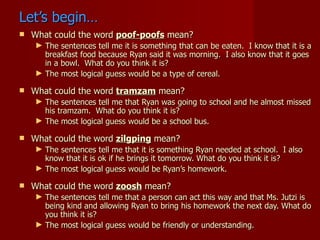
Let’s begin…
   What could the word poof-poofs mean?
    ► The sentences tell me it is something that can be eaten. I know that it is a
      breakfast food because Ryan said it was morning. I also know that it goes
      in a bowl. What do you think it is?
    ► The most logical guess would be a type of cereal.

   What could the word tramzam mean?
    ► The sentences tell me that Ryan was going to school and he almost missed
      his tramzam. What do you think it is?
    ► The most logical guess would be a school bus.

   What could the word zilgping mean?
    ► The sentences tell me that it is something Ryan needed at school. I also
      know that it is ok if he brings it tomorrow. What do you think it is?
    ► The most logical guess would be Ryan’s homework.

   What could the word zoosh mean?
    ► The sentences tell me that a person can act this way and that Ms. Jutzi is
      being kind and allowing Ryan to bring his homework the next day. What do
      you think it is?
    ► The most logical guess would be friendly or understanding.
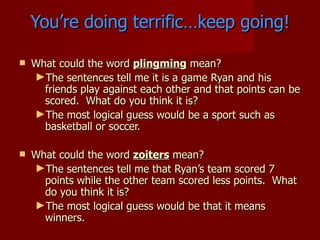
You’re doing terrific…keep going!

   What could the word plingming mean?
    ►The sentences tell me it is a game Ryan and his
      friends play against each other and that points can be
      scored. What do you think it is?
    ►The most logical guess would be a sport such as
      basketball or soccer.

   What could the word zoiters mean?
    ►The sentences tell me that Ryan’s team scored 7
      points while the other team scored less points. What
      do you think it is?
    ►The most logical guess would be that it means
      winners.
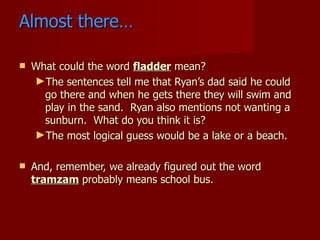
Almost there…

   What could the word fladder mean?
    ►The sentences tell me that Ryan’s dad said he could
      go there and when he gets there they will swim and
      play in the sand. Ryan also mentions not wanting a
      sunburn. What do you think it is?
    ►The most logical guess would be a lake or a beach.

   And, remember, we already figured out the word
    tramzam probably means school bus.
Congratulations!
 You  are doing a super job! You’re a
  top notch detective. Keep going on
  to do more context clues activities.
 Remember, you will need to click the
  back arrow  to return for more
  activities.

Context Clues

  • 1.
    Context Clues: Yoube the Detective
  • 2.
    Context Clues –What Are They? • Context clues are bits of information from the text that, when combined with prior knowledge, allow you to decide the meaning of unknown words in the story or article you are reading. • As a reader you must act similar to a detective and put together clues from sentences surrounding an unknown word in order to make an intelligent “guess” as to what the definition of a word is.
  • 3.
    Context Clues –How Do They Help You Read New Words? • Textbook writers and authors include words or phrases to help their readers understand the meaning of a new or difficult word. • These words or phrases are built into the sentences around the new or difficult word. By becoming more aware of the words around a difficult word, readers can make logical guesses about the meanings of many words.
  • 4.
    Still Wondering Whata Context Clue Is?  Clickon the link below to watch a video clip. Pay careful attention to what the song tells you.  When the video is over click the back arrow  in the upper left hand corner.  http://www.youtube.com/watch?v=qgaS
  • 5.
    Types of ContextClues Authors use many different types of context clues when writing texts. Three of these types are: Directdefinition context clues Synonym context clues Antonym context clues
  • 6.
    Direct definition contextclues are words that say, “Stop - don’t touch that dictionary. The definition of the word you don’t know is right here in the text!" EXAMPLES:  There are many theories, or ideas, about what made the Ice Ages happen.  In this sentence the word “ideas” tells us that theories are different thoughts people have about something.  After a time, glaciers, or slowly moving rivers of ice, formed over many parts of the Earth.  In this sentence the words “slowly moving rivers of ice” tell us what glaciers are.
  • 7.
    Synonym context cluesare words around a difficult word that mean the same or nearly the same as the word. EXAMPLES:  After seeing the picture of the starving children, we felt compassion or pity for their suffering.  In this sentence the word “pity” tells us that compassion means to have understanding for.  Mary admonished her students and they knew they were in hot water for their actions.  In this sentence the words “in hot water” tell us that admonished means cautioned or scolded.
  • 8.
    Antonym context cluesare words around a difficult word that mean the opposite or nearly the opposite as the word. EXAMPLE:  Joe was reluctant to take the job of captain of the team. He was afraid that the time it would take would hurt his grades. On the other hand, Billy was eager for the chance to be the team captain.  In this sentence the words “on the other hand” and “eager” tell us that Billy feels the opposite of Joe, therefore, reluctant means uncertain or cautious.
  • 9.
    Now it isyour turn to be a detective and follow the clues! Use what you have learned about context clues to complete the activity on the next 5 slides.
  • 10.
    Context Clues PracticeActivity Your friend Ryan has moved to a new country and is learning a new language. Read what he wrote in his journal and see if you can figure out the meaning to the underlined words. Dear Journal, I overslept this morning. I had to eat my bowl of poof-poofs very quickly, and I almost missed the tramzam. When I got to school, I realized I had forgotten my zilgping . Luckily, Ms. Jutzi is very zoosh, and told me I could bring it tomorrow. After school, some friends and I played plingming. It’s a new game I am learning. We scored 7 points and they only scored 5 points, so we were the zoiters! Dad says that next weekend we’re going to the fladder . I can’t wait! I love to swim and play in the sand. I hope I don’t get a sunburn though. Well, I better go to bed soon. I don’t want to wake up late again and miss my tramzam! Until tomorrow, Ryan
  • 11.
    Directions It’s time forsome detective work. Take each word from Ryan’s diary that is written in his new language and use the context clues in the text to figure them out!
  • 12.
    Let’s begin…  What could the word poof-poofs mean? ► The sentences tell me it is something that can be eaten. I know that it is a breakfast food because Ryan said it was morning. I also know that it goes in a bowl. What do you think it is? ► The most logical guess would be a type of cereal.  What could the word tramzam mean? ► The sentences tell me that Ryan was going to school and he almost missed his tramzam. What do you think it is? ► The most logical guess would be a school bus.  What could the word zilgping mean? ► The sentences tell me that it is something Ryan needed at school. I also know that it is ok if he brings it tomorrow. What do you think it is? ► The most logical guess would be Ryan’s homework.  What could the word zoosh mean? ► The sentences tell me that a person can act this way and that Ms. Jutzi is being kind and allowing Ryan to bring his homework the next day. What do you think it is? ► The most logical guess would be friendly or understanding.
  • 13.
    You’re doing terrific…keepgoing!  What could the word plingming mean? ►The sentences tell me it is a game Ryan and his friends play against each other and that points can be scored. What do you think it is? ►The most logical guess would be a sport such as basketball or soccer.  What could the word zoiters mean? ►The sentences tell me that Ryan’s team scored 7 points while the other team scored less points. What do you think it is? ►The most logical guess would be that it means winners.
  • 14.
    Almost there…  What could the word fladder mean? ►The sentences tell me that Ryan’s dad said he could go there and when he gets there they will swim and play in the sand. Ryan also mentions not wanting a sunburn. What do you think it is? ►The most logical guess would be a lake or a beach.  And, remember, we already figured out the word tramzam probably means school bus.
  • 15.
    Congratulations!  You are doing a super job! You’re a top notch detective. Keep going on to do more context clues activities.  Remember, you will need to click the back arrow  to return for more activities.