RECENT DEVELOPMENTS IN
MANAGEMENT ACCOUNTING
1BKAM 3033 - Topic 1(a)
Lecture outline:
• Management accounting scope
• The evolution of management
accounting
• Management accounting change
• The gap between theory and practice
2BKAM 3033 - Topic 1(a)
Management Accounting
3
• Management accounting is the branch of accounting, which
is concerned with supplying relevant information to
managers at appropriate time to enable them to take
decisions in organization.
• It is the process of accounting, which generates accounting
information from both financial accounting and cost
accounting and provides essential accounting information to
all departments concerned.
• Management accounting is the process of identifying,
measuring, analyzing, interpreting and communicating
accounting information to department concerns to meet
organizational goals and objectives.
BKAM 3033 - Topic 1(a)
Objectives of Management Accounting
4
• Providing information for decision making and planning in
revenue and cost projection of organization
• Helps managers to interpret financial data that are not
understand by internal users.
• Management accountants are crucial in an organization
that they become an integral part of management team
who provides necessary information.
• Helps managers in directing and controlling operations
through its attention in their function.
• Motivating managers to achieve organization's goals
• Measures the performance of managers, subunits and
employees within organization.
• Assess organizations’ competitive position, and working
with the other managers to ensure organization's long
term competitiveness
BKAM 3033 - Topic 1(a)
Role of Managerial Accounting
5
• To achieve its’ goals, organization acquires
resources, hires people, and then engages in an
organized set of activities.
• It is up to the management team to make the best
use of the organization's resources, activities, and
people in achieving the organization's goals.
• Planning
• Directing operational activities
• Controlling
• Decision Making
BKAM 3033 - Topic 1(a)
Differences Between Management And Cost Accounting
Basis Management accounting Cost Accounting
Objectives Its objective is to assist managers
providing accounting information for
decision-making.
Its objective is to determine and record
the cost of production of goods and
services.
Scope It has broad scope, and includes
financial and cost accounting.
Its scope is limited in cost determination
and record.
Sources of
data
It uses both quantitative and
qualitative data
It uses the quantitative data only.
Accounting
principles
No specific principles like
accounting and cost accounting.
Certain principles and procedures are
followed in cost determination and
allocation.
Nature It uses past and present data in the
projection of future.
It uses both past and present data and
figure.
6BKAM 3033 - Topic 1(a)
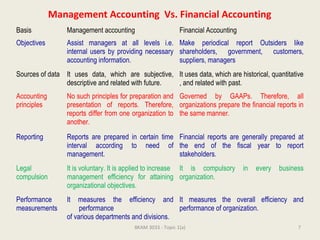
Management Accounting Vs. Financial Accounting
Basis Management accounting Financial Accounting
Objectives Assist managers at all levels i.e.
internal users by providing necessary
accounting information.
Make periodical report Outsiders like
shareholders, government, customers,
suppliers, managers
Sources of data It uses data, which are subjective,
descriptive and related with future.
It uses data, which are historical, quantitative
, and related with past.
Accounting
principles
No such principles for preparation and
presentation of reports. Therefore,
reports differ from one organization to
another.
Governed by GAAPs. Therefore, all
organizations prepare the financial reports in
the same manner.
Reporting Reports are prepared in certain time
interval according to need of
management.
Financial reports are generally prepared at
the end of the fiscal year to report
stakeholders.
Legal
compulsion
It is voluntary. It is applied to increase
management efficiency for attaining
organizational objectives.
It is compulsory in every business
organization.
Performance
measurements
It measures the efficiency and
performance
of various departments and divisions.
It measures the overall efficiency and
performance of organization.
7BKAM 3033 - Topic 1(a)
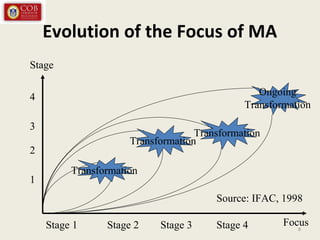
Evolution of the Focus of MA
Stage
Transformation
Transformation
Transformation
Ongoing
Transformation
1
2
3
4
FocusStage 1 Stage 2 Stage 3 Stage 4
Source: IFAC, 1998
8
Management Accounting Change
Stage 1
Stage 2
Stage 3
Stage 4
• Cost determination
• Financial control
• Management planning and
control
• Reduction of waste
• Value creation
9BKAM 3033 - Topic 1(a)
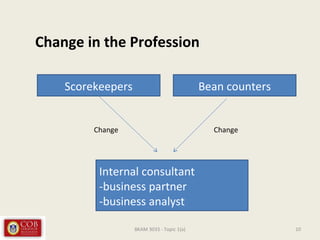
Change in the Profession
Scorekeepers Bean counters
ChangeChange
Internal consultant
-business partner
-business analyst
10BKAM 3033 - Topic 1(a)
Change in the Profession
“Accounting is changing. You are no longer sitting behind a desk
just working on a computer, just crunching the numbers. You
are actually getting to be part of the day-to-day functions of
the business.” (Abbott Laboratories)
“We are looked upon as more business advisors than just
accountants, which has a lot to do with the additional analysis
and forward-looking goals that we are setting. We spend
more of our time analyzing and understanding our margins,
our prices, and the markets in which we business. People
have a sense of purpose, have a sense of “I am adding value
to the company.” (Caterpillar, Inc)
11BKAM 3033 - Topic 1(a)
12
Change in Profession
The Prior Business
Environment
Financial reporting and
cost
Common emphasis on
standardization & Std
cost
The accountants as
functional expert and
financial scorekeeper
The Contemporary
Business
EnvironmentView of cost Act as a
tool for the development
and implementation of
business strategy
The accountant as a
business partner
Blocher, Chen, Lin
BKAM 3033 - Topic 1(a)
Change in Profession
• Today’s management accountants need the
following skills:
– Solid knowledge of both financial and
management accounting
– Analytical skills
– Knowledge of how a business functions
– Ability to work on a team
– Oral and written communication skills
13BKAM 3033 - Topic 1(a)
Evolution and Adaptation in
Managerial Accounting
Continuous Improvement
Service Vs. Manufacturing
Firms
Emergence of New
Industries
Global Competition
Focus on the Customer
Cross-Functional Teams
Computer-Integrated
Manufacturing
Product Life Cycles
Time-Based Competition
Information and
Communication
Technology
Just-in-Time Inventory
Total Quality
Management
Change
BKAM 3033 - Topic 1(a) 14
WHAT FACTORS DRIVE CHANGE OF
MA
External
•Customer oriented (competition)
•Technology
•Globalization
Customer-oriented (competition)Internal
Organizational
15BKAM 3033 - Topic 1(a)
WHAT FACTORS DRIVE CHANGE OF MA –
External
Focus on customer satisfaction
16BKAM 3033 - Topic 1(a)
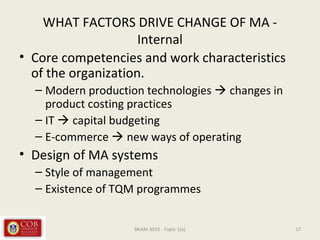
WHAT FACTORS DRIVE CHANGE OF MA -
Internal
• Core competencies and work characteristics
of the organization.
– Modern production technologies  changes in
product costing practices
– IT  capital budgeting
– E-commerce  new ways of operating
• Design of MA systems
– Style of management
– Existence of TQM programmes
17BKAM 3033 - Topic 1(a)
WHAT FACTORS DRIVE CHANGE OF MA -
Organizational
• Merger and acquisition
• Organizational restructuring
• Corporate failures  enhanced corporate
governance
18BKAM 3033 - Topic 1(a)
The Gap between Theory and
Practices
• Management accounting practices can be
observed at the macro or micro levels
(Drury, 2008):
• Macro refers to concepts and techniques
• Micro refers to the behavioral patterns of
use.
• Tendency towards globalization at the
macro level.
19BKAM 3033 - Topic 1(a)
The Gap between Theory and
Practices
• Drivers of convergence include:
• Global competition
• Information technology (e.g. ERP systems)
• Standardization by transnational companies
• Global consultancy
• Use of global textbooks
• At the micro level accounting information may be
used in different ways due to influence of different
national and local cultures.
20BKAM 3033 - Topic 1(a)
The Gap between Theory and
Practices
• Professional bodies play an important role to bridge
the gap between MA theory and practice.
• For example, CIMA stated its first objective as “to
promote and develop the science of management
accountancy”.
• CIMA established the Technical Committee to
oversee a rigorous technical development agenda.
– Review developing practices and highlight what’s working
and what’s not.
21BKAM 3033 - Topic 1(a)
The Gap between Theory and
Practices
• CIMA also worked with IFAC to develop the concept
of enterprise governance, focusing on the balance
between regulatory conformance and business
performance.
• In Malaysia, NAfMA awards is introduced by CIMA
and MIA to promote best practices of MA.
• The NAfMA awards recognize the best practices in
MA that lead to value creation and excellent
business performance based on the MA concepts of
IFAC.
22BKAM 3033 - Topic 1(a)
The Gap between Theory and
Practices• NAfMA award is a response to the criticism by
accounting practitioners and educators on the
ground that MA practices had changed little over for
almost 60 years (e.g. Johnson & Kaplan,1987),
despite radical changes in the business environment.
• The awards also reflects the shift from ‘number
cruncher’ and ‘corporate cop’ to decision-support
specialists and reflects what it takes to compete in
today’s lean, global, technologically-driven
environment.
23BKAM 3033 - Topic 1(a)

Topic 1 1_

  • 1.
    RECENT DEVELOPMENTS IN MANAGEMENTACCOUNTING 1BKAM 3033 - Topic 1(a)
  • 2.
    Lecture outline: • Managementaccounting scope • The evolution of management accounting • Management accounting change • The gap between theory and practice 2BKAM 3033 - Topic 1(a)
  • 3.
    Management Accounting 3 • Managementaccounting is the branch of accounting, which is concerned with supplying relevant information to managers at appropriate time to enable them to take decisions in organization. • It is the process of accounting, which generates accounting information from both financial accounting and cost accounting and provides essential accounting information to all departments concerned. • Management accounting is the process of identifying, measuring, analyzing, interpreting and communicating accounting information to department concerns to meet organizational goals and objectives. BKAM 3033 - Topic 1(a)
  • 4.
    Objectives of ManagementAccounting 4 • Providing information for decision making and planning in revenue and cost projection of organization • Helps managers to interpret financial data that are not understand by internal users. • Management accountants are crucial in an organization that they become an integral part of management team who provides necessary information. • Helps managers in directing and controlling operations through its attention in their function. • Motivating managers to achieve organization's goals • Measures the performance of managers, subunits and employees within organization. • Assess organizations’ competitive position, and working with the other managers to ensure organization's long term competitiveness BKAM 3033 - Topic 1(a)
  • 5.
    Role of ManagerialAccounting 5 • To achieve its’ goals, organization acquires resources, hires people, and then engages in an organized set of activities. • It is up to the management team to make the best use of the organization's resources, activities, and people in achieving the organization's goals. • Planning • Directing operational activities • Controlling • Decision Making BKAM 3033 - Topic 1(a)
  • 6.
    Differences Between ManagementAnd Cost Accounting Basis Management accounting Cost Accounting Objectives Its objective is to assist managers providing accounting information for decision-making. Its objective is to determine and record the cost of production of goods and services. Scope It has broad scope, and includes financial and cost accounting. Its scope is limited in cost determination and record. Sources of data It uses both quantitative and qualitative data It uses the quantitative data only. Accounting principles No specific principles like accounting and cost accounting. Certain principles and procedures are followed in cost determination and allocation. Nature It uses past and present data in the projection of future. It uses both past and present data and figure. 6BKAM 3033 - Topic 1(a)
  • 7.
    Management Accounting Vs.Financial Accounting Basis Management accounting Financial Accounting Objectives Assist managers at all levels i.e. internal users by providing necessary accounting information. Make periodical report Outsiders like shareholders, government, customers, suppliers, managers Sources of data It uses data, which are subjective, descriptive and related with future. It uses data, which are historical, quantitative , and related with past. Accounting principles No such principles for preparation and presentation of reports. Therefore, reports differ from one organization to another. Governed by GAAPs. Therefore, all organizations prepare the financial reports in the same manner. Reporting Reports are prepared in certain time interval according to need of management. Financial reports are generally prepared at the end of the fiscal year to report stakeholders. Legal compulsion It is voluntary. It is applied to increase management efficiency for attaining organizational objectives. It is compulsory in every business organization. Performance measurements It measures the efficiency and performance of various departments and divisions. It measures the overall efficiency and performance of organization. 7BKAM 3033 - Topic 1(a)
  • 8.
    Evolution of theFocus of MA Stage Transformation Transformation Transformation Ongoing Transformation 1 2 3 4 FocusStage 1 Stage 2 Stage 3 Stage 4 Source: IFAC, 1998 8
  • 9.
    Management Accounting Change Stage1 Stage 2 Stage 3 Stage 4 • Cost determination • Financial control • Management planning and control • Reduction of waste • Value creation 9BKAM 3033 - Topic 1(a)
  • 10.
    Change in theProfession Scorekeepers Bean counters ChangeChange Internal consultant -business partner -business analyst 10BKAM 3033 - Topic 1(a)
  • 11.
    Change in theProfession “Accounting is changing. You are no longer sitting behind a desk just working on a computer, just crunching the numbers. You are actually getting to be part of the day-to-day functions of the business.” (Abbott Laboratories) “We are looked upon as more business advisors than just accountants, which has a lot to do with the additional analysis and forward-looking goals that we are setting. We spend more of our time analyzing and understanding our margins, our prices, and the markets in which we business. People have a sense of purpose, have a sense of “I am adding value to the company.” (Caterpillar, Inc) 11BKAM 3033 - Topic 1(a)
  • 12.
    12 Change in Profession ThePrior Business Environment Financial reporting and cost Common emphasis on standardization & Std cost The accountants as functional expert and financial scorekeeper The Contemporary Business EnvironmentView of cost Act as a tool for the development and implementation of business strategy The accountant as a business partner Blocher, Chen, Lin BKAM 3033 - Topic 1(a)
  • 13.
    Change in Profession •Today’s management accountants need the following skills: – Solid knowledge of both financial and management accounting – Analytical skills – Knowledge of how a business functions – Ability to work on a team – Oral and written communication skills 13BKAM 3033 - Topic 1(a)
  • 14.
    Evolution and Adaptationin Managerial Accounting Continuous Improvement Service Vs. Manufacturing Firms Emergence of New Industries Global Competition Focus on the Customer Cross-Functional Teams Computer-Integrated Manufacturing Product Life Cycles Time-Based Competition Information and Communication Technology Just-in-Time Inventory Total Quality Management Change BKAM 3033 - Topic 1(a) 14
  • 15.
    WHAT FACTORS DRIVECHANGE OF MA External •Customer oriented (competition) •Technology •Globalization Customer-oriented (competition)Internal Organizational 15BKAM 3033 - Topic 1(a)
  • 16.
    WHAT FACTORS DRIVECHANGE OF MA – External Focus on customer satisfaction 16BKAM 3033 - Topic 1(a)
  • 17.
    WHAT FACTORS DRIVECHANGE OF MA - Internal • Core competencies and work characteristics of the organization. – Modern production technologies  changes in product costing practices – IT  capital budgeting – E-commerce  new ways of operating • Design of MA systems – Style of management – Existence of TQM programmes 17BKAM 3033 - Topic 1(a)
  • 18.
    WHAT FACTORS DRIVECHANGE OF MA - Organizational • Merger and acquisition • Organizational restructuring • Corporate failures  enhanced corporate governance 18BKAM 3033 - Topic 1(a)
  • 19.
    The Gap betweenTheory and Practices • Management accounting practices can be observed at the macro or micro levels (Drury, 2008): • Macro refers to concepts and techniques • Micro refers to the behavioral patterns of use. • Tendency towards globalization at the macro level. 19BKAM 3033 - Topic 1(a)
  • 20.
    The Gap betweenTheory and Practices • Drivers of convergence include: • Global competition • Information technology (e.g. ERP systems) • Standardization by transnational companies • Global consultancy • Use of global textbooks • At the micro level accounting information may be used in different ways due to influence of different national and local cultures. 20BKAM 3033 - Topic 1(a)
  • 21.
    The Gap betweenTheory and Practices • Professional bodies play an important role to bridge the gap between MA theory and practice. • For example, CIMA stated its first objective as “to promote and develop the science of management accountancy”. • CIMA established the Technical Committee to oversee a rigorous technical development agenda. – Review developing practices and highlight what’s working and what’s not. 21BKAM 3033 - Topic 1(a)
  • 22.
    The Gap betweenTheory and Practices • CIMA also worked with IFAC to develop the concept of enterprise governance, focusing on the balance between regulatory conformance and business performance. • In Malaysia, NAfMA awards is introduced by CIMA and MIA to promote best practices of MA. • The NAfMA awards recognize the best practices in MA that lead to value creation and excellent business performance based on the MA concepts of IFAC. 22BKAM 3033 - Topic 1(a)
  • 23.
    The Gap betweenTheory and Practices• NAfMA award is a response to the criticism by accounting practitioners and educators on the ground that MA practices had changed little over for almost 60 years (e.g. Johnson & Kaplan,1987), despite radical changes in the business environment. • The awards also reflects the shift from ‘number cruncher’ and ‘corporate cop’ to decision-support specialists and reflects what it takes to compete in today’s lean, global, technologically-driven environment. 23BKAM 3033 - Topic 1(a)

Editor's Notes

  • #9 1970s – oil price shock (Threats to Western established markets) Early 1980s – increased global competition (Threats to Western established markets) There was rapid technological developments + increased competition  affected the industrial sector e.g. use of robotics and computer-controlled processes  improved quality + reduced costs E.g. developments in computers: change the nature and amount of data accessible by managers Thus, design, maintenance and interpretation of information systems became of considerable importance in effective management Challenge of meeting global competition: introduced new management and production techniques controlling costs: through “reduction of waste in resources used in business processes” (IFAC, 1998). supported by employee empowerment (as need for management information and decision-making to be diffused throughout the organisation) Challenge for management accountants as primary providers of information: To ensure that through the use of process analysis and cost management technologies, appropriate information is available to support managers and employees at all levels. In 1990s: World-wide industry continued to face considerable uncertainty and unprecedented advances in manufacturing and information processing technologies e.g. the development of www + associated technologies  e-commerce + increased global competition Focus of management accountants shifted to the generation and creation of value through the effective use of resources achieved through the use of technologies which examine the drivers of customer value, shareholder value and organisational innovation