LECTURE 2
ACCOUNTING THEORY
CONSTRUCTION
ARTHIK DAVIANTI, SE. MSI. AK. CA.
BASIC THOUGHTS
 Theories’ assumptions
 Formulation of theories
 Approaches to explaining and
predicting
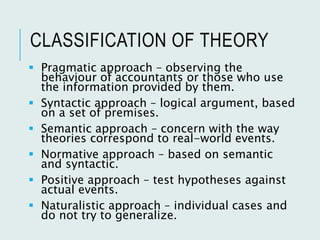
CLASSIFICATION OF THEORY
 Pragmatic approach – observing the
behaviour of accountants or those who use
the information provided by them.
 Syntactic approach – logical argument, based
on a set of premises.
 Semantic approach – concern with the way
theories correspond to real-world events.
 Normative approach – based on semantic
and syntactic.
 Positive approach – test hypotheses against
actual events.
 Naturalistic approach – individual cases and
do not try to generalize.
PRAGMATIC THEORIES
Descriptive pragmatic approach:
 based on observed behaviour of
accountants
 theory developed from how accountants
act in certain situations
 tested by observing whether accountants
do act in the way the theory suggests
 is an inductive approach
4
PRAGMATIC THEORIES
Criticisms of descriptive pragmatic approach:
 does not consider the quality of an
accountant’s action
 does not provide for accounting practices
to be challenged
 focuses on accountants’ behaviour not on
measuring the attributes of the firm
PRAGMATIC THEORIES
Psychological pragmatic approach:
 theory depends on observations of
the reactions of users to the
accountants’ outputs
 a reaction is taken as evidence that
the outputs are useful and contain
relevant information
6
PRAGMATIC THEORIES
Criticisms of the psychological pragmatic
approach:
 some users may react in an illogical manner
 some users might have a preconditioned
response
 some users may not react when they should
Theories are therefore tested using large
samples of people
7
SYNTACTIC AND SEMANTIC
THEORIES
Semantic inputs are the transactions
and exchanges recorded in vouchers,
journals and ledgers
• The inputs are then manipulated on
the basis of the premises and
assumptions of historical cost
accounting
8
SYNTACTIC AND SEMANTIC
THEORIES
Criticised because there is no
independent empirical verification of the
calculated outputs
The outputs may be criticised for poor
syntax inaccurate e.g. different types of
monetary measures are added together
9
SYNTACTIC AND SEMANTIC
THEORIES
The outputs may be syntactically
accurate but nevertheless be
valueless due to a lack of semantic
accuracy (a lack of correspondence
with real-world events, transactions
or values)
10
SYNTACTIC AND SEMANTIC
THEORIES
Historic cost accounting may produce
‘accurate’ outputs but which
nevertheless have little or no utility
That is, they are not useful for economic
decision making except to verify
accounting entries
11
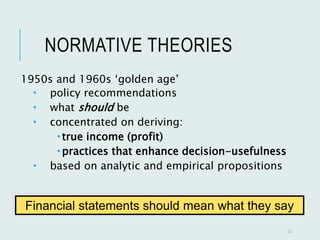
NORMATIVE THEORIES
1950s and 1960s ‘golden age’
 policy recommendations
 what should be
 concentrated on deriving:
 true income (profit)
 practices that enhance decision-usefulness
 based on analytic and empirical propositions
12
Financial statements should mean what they say
NORMATIVE THEORIES
True income:
 a single measure for assets
 a unique and correct profit figure
Decision usefulness:
 the basic objective of accounting is to
aid the decision-making process of
certain ‘users’ of accounting reports by
providing useful accounting data
13
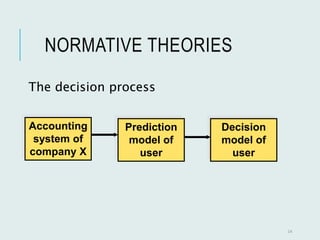
NORMATIVE THEORIES
The decision process
14
Accounting
system of
company X
Prediction
model of
user
Decision
model of
user
POSITIVE THEORIES
• Expanded during the 1970s
• Based on ‘experiences’ or ‘facts’ of the
real world
• Explain the reasons for current
practice
• Predict the role of accounting
information in decision-making
15
POSITIVE THEORIES
The main difference between normative
and positive theories is that
 normative theories are prescriptive
 positive theories are descriptive,
explanatory or predictive
16
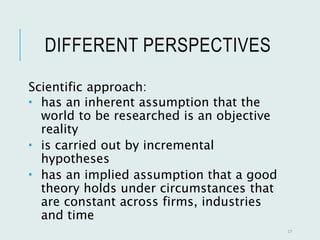
DIFFERENT PERSPECTIVES
Scientific approach:
 has an inherent assumption that the
world to be researched is an objective
reality
 is carried out by incremental
hypotheses
 has an implied assumption that a good
theory holds under circumstances that
are constant across firms, industries
and time
17
DIFFERENT PERSPECTIVES
Criticism of the scientific method:
 large-scale statistical research tends to
lump everything together
 it is conducted in environments that
are often remote from the world of or
the concerns of accountants
18
DIFFERENT PERSPECTIVES
Naturalistic approach:
 implies that there are no preconceived
assumptions or theories
 focuses on firm-specific real-world
problems
19
DIFFERENT PERSPECTIVES
Alternative ways of looking at the world:
20
CATEGORY ASSUMPTION
1. Reality as a concrete structure
2. Reality as a concrete process
3. Reality as a contextual field of information
4. Reality as a symbolic discourse
5. Reality as a social construction
6. Reality as projection of human imagination
For categories 1 – 3 it is more appropriate to
use the scientific approach
For categories 4-6 the naturalistic approach is
more appropriate
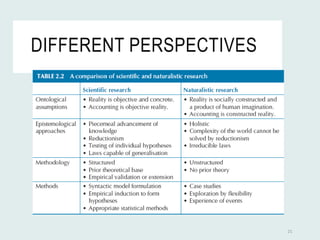
DIFFERENT PERSPECTIVES
21
SOCIOLOGICAL AND
DISCURSIVE PERSPECTIVE
Schiell, Borba, and Murcia (2010)
Latour (1989) and Whitley (1984) – the
sociological and discursive perspective are
basically determined by the extent and
intensity of its interaction with society.
Accounting – a “socio-systemic” structure, with
input, process, and output.
The strong interdependence between science
and society.
SCIENTIFIC APPROACH
APPLIED TO ACCOUNTING
Misconceptions of purpose
Make scientists out of accounting practitioners
Researchers = practitioners
The desire for ‘absolute truth’
23
The scientific method does not claim to provide
‘truth’
It attempts to provide persuasive evidence which
may describe, explain or predict
ISSUES FOR AUDITING THEORY
CONSTRUCTION
Auditing is a verification process that is applied
to the accounting inputs and processes
Auditors provide an opinion on
 whether the financial statements accord with
the applicable reporting framework
 whether the statements give a true and fair
view
24
ISSUES FOR AUDITING THEORY
CONSTRUCTION
Auditing is a verification process that is applied
to the accounting inputs and processes
Auditors provide an opinion on
 whether the financial statements accord with
the applicable reporting framework
 whether the statements give a true and fair
view
25
ISSUES FOR AUDITING THEORY
CONSTRUCTION
Focus on the conduct of an audit – fraud
detection, discovery of errors of principles and
the nature of account verification.
Mautz and Sharaf (1961) – attempted to provide a
comprehensive theory of auditing with the
purpose to prevent the view that auditing was a
practical exercise – not requiring theoretical
development.
Concepts: evidence, due audit care, fair
representation, independence and ethical conduct
26
ISSUES FOR AUDITING THEORY
CONSTRUCTION
The normative era of accounting coincided with
a normative approach to auditing theory.
The positive ere of accounting has led to a
positive approach to auditing theory.
Experimentalists – micro-level understanding
of the audit testing or judgment process.
Judgements and decision making research.
27
SUMMARY
Many different approaches to theory
formulation in accounting
Evolution of accounting theory
 positive v. normative
 scientific v. naturalistic
28

Accounting Theory Construction

  • 1.
  • 2.
    BASIC THOUGHTS  Theories’assumptions  Formulation of theories  Approaches to explaining and predicting
  • 3.
    CLASSIFICATION OF THEORY Pragmatic approach – observing the behaviour of accountants or those who use the information provided by them.  Syntactic approach – logical argument, based on a set of premises.  Semantic approach – concern with the way theories correspond to real-world events.  Normative approach – based on semantic and syntactic.  Positive approach – test hypotheses against actual events.  Naturalistic approach – individual cases and do not try to generalize.
  • 4.
    PRAGMATIC THEORIES Descriptive pragmaticapproach:  based on observed behaviour of accountants  theory developed from how accountants act in certain situations  tested by observing whether accountants do act in the way the theory suggests  is an inductive approach 4
  • 5.
    PRAGMATIC THEORIES Criticisms ofdescriptive pragmatic approach:  does not consider the quality of an accountant’s action  does not provide for accounting practices to be challenged  focuses on accountants’ behaviour not on measuring the attributes of the firm
  • 6.
    PRAGMATIC THEORIES Psychological pragmaticapproach:  theory depends on observations of the reactions of users to the accountants’ outputs  a reaction is taken as evidence that the outputs are useful and contain relevant information 6
  • 7.
    PRAGMATIC THEORIES Criticisms ofthe psychological pragmatic approach:  some users may react in an illogical manner  some users might have a preconditioned response  some users may not react when they should Theories are therefore tested using large samples of people 7
  • 8.
    SYNTACTIC AND SEMANTIC THEORIES Semanticinputs are the transactions and exchanges recorded in vouchers, journals and ledgers • The inputs are then manipulated on the basis of the premises and assumptions of historical cost accounting 8
  • 9.
    SYNTACTIC AND SEMANTIC THEORIES Criticisedbecause there is no independent empirical verification of the calculated outputs The outputs may be criticised for poor syntax inaccurate e.g. different types of monetary measures are added together 9
  • 10.
    SYNTACTIC AND SEMANTIC THEORIES Theoutputs may be syntactically accurate but nevertheless be valueless due to a lack of semantic accuracy (a lack of correspondence with real-world events, transactions or values) 10
  • 11.
    SYNTACTIC AND SEMANTIC THEORIES Historiccost accounting may produce ‘accurate’ outputs but which nevertheless have little or no utility That is, they are not useful for economic decision making except to verify accounting entries 11
  • 12.
    NORMATIVE THEORIES 1950s and1960s ‘golden age’  policy recommendations  what should be  concentrated on deriving:  true income (profit)  practices that enhance decision-usefulness  based on analytic and empirical propositions 12 Financial statements should mean what they say
  • 13.
    NORMATIVE THEORIES True income: a single measure for assets  a unique and correct profit figure Decision usefulness:  the basic objective of accounting is to aid the decision-making process of certain ‘users’ of accounting reports by providing useful accounting data 13
  • 14.
    NORMATIVE THEORIES The decisionprocess 14 Accounting system of company X Prediction model of user Decision model of user
  • 15.
    POSITIVE THEORIES • Expandedduring the 1970s • Based on ‘experiences’ or ‘facts’ of the real world • Explain the reasons for current practice • Predict the role of accounting information in decision-making 15
  • 16.
    POSITIVE THEORIES The maindifference between normative and positive theories is that  normative theories are prescriptive  positive theories are descriptive, explanatory or predictive 16
  • 17.
    DIFFERENT PERSPECTIVES Scientific approach: has an inherent assumption that the world to be researched is an objective reality  is carried out by incremental hypotheses  has an implied assumption that a good theory holds under circumstances that are constant across firms, industries and time 17
  • 18.
    DIFFERENT PERSPECTIVES Criticism ofthe scientific method:  large-scale statistical research tends to lump everything together  it is conducted in environments that are often remote from the world of or the concerns of accountants 18
  • 19.
    DIFFERENT PERSPECTIVES Naturalistic approach: implies that there are no preconceived assumptions or theories  focuses on firm-specific real-world problems 19
  • 20.
    DIFFERENT PERSPECTIVES Alternative waysof looking at the world: 20 CATEGORY ASSUMPTION 1. Reality as a concrete structure 2. Reality as a concrete process 3. Reality as a contextual field of information 4. Reality as a symbolic discourse 5. Reality as a social construction 6. Reality as projection of human imagination For categories 1 – 3 it is more appropriate to use the scientific approach For categories 4-6 the naturalistic approach is more appropriate
  • 21.
  • 22.
    SOCIOLOGICAL AND DISCURSIVE PERSPECTIVE Schiell,Borba, and Murcia (2010) Latour (1989) and Whitley (1984) – the sociological and discursive perspective are basically determined by the extent and intensity of its interaction with society. Accounting – a “socio-systemic” structure, with input, process, and output. The strong interdependence between science and society.
  • 23.
    SCIENTIFIC APPROACH APPLIED TOACCOUNTING Misconceptions of purpose Make scientists out of accounting practitioners Researchers = practitioners The desire for ‘absolute truth’ 23 The scientific method does not claim to provide ‘truth’ It attempts to provide persuasive evidence which may describe, explain or predict
  • 24.
    ISSUES FOR AUDITINGTHEORY CONSTRUCTION Auditing is a verification process that is applied to the accounting inputs and processes Auditors provide an opinion on  whether the financial statements accord with the applicable reporting framework  whether the statements give a true and fair view 24
  • 25.
    ISSUES FOR AUDITINGTHEORY CONSTRUCTION Auditing is a verification process that is applied to the accounting inputs and processes Auditors provide an opinion on  whether the financial statements accord with the applicable reporting framework  whether the statements give a true and fair view 25
  • 26.
    ISSUES FOR AUDITINGTHEORY CONSTRUCTION Focus on the conduct of an audit – fraud detection, discovery of errors of principles and the nature of account verification. Mautz and Sharaf (1961) – attempted to provide a comprehensive theory of auditing with the purpose to prevent the view that auditing was a practical exercise – not requiring theoretical development. Concepts: evidence, due audit care, fair representation, independence and ethical conduct 26
  • 27.
    ISSUES FOR AUDITINGTHEORY CONSTRUCTION The normative era of accounting coincided with a normative approach to auditing theory. The positive ere of accounting has led to a positive approach to auditing theory. Experimentalists – micro-level understanding of the audit testing or judgment process. Judgements and decision making research. 27
  • 28.
    SUMMARY Many different approachesto theory formulation in accounting Evolution of accounting theory  positive v. normative  scientific v. naturalistic 28