1
OWASP API SECURITY TOP 10
This work is licensed under a Creative Commons Attribution-NonCommercial-
ShareAlike 4.0 International License.
APIS ARE THE NEW ATTACKS VECTOR!
Data breaches via APIs are on the rise
✓ 150+ issues reported on
apisecurity.io since Oct. 2018
✓ And those are just the public ones!
Most recurrent causes:
✓ Input validation issues
✓ Bad security configuration
✓ Data/Exception leakage
2
FINALLY! OWASP API SECURITY TOP 10
A recognition that API Security is not Web Application Security
✓ Different attack vectors
✓ Data centric (lots of attacks come from mishandling API data)
3
https://github.com/OWASP/API-Security/blob/develop/2019/en/dist/owasp-api-security-top-10.pdf
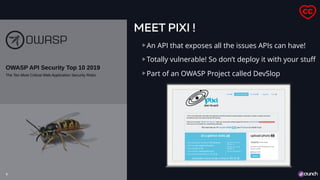
MEET PIXI !
An API that exposes all the issues APIs can have!
Totally vulnerable! So don’t deploy it with your stuff
Part of an OWASP Project called DevSlop
4
EXTRACTION VIA ENUMERATION
APIs relies on public IDs to retrieve information, for example
✓ GET /shops/shop1/revenue_data.json
✓ Returns info from shop1 if you’re authenticated
✓ What happens if I call GET /shops/shop2/revenue_data.json?
In 2017, a major flaw was discovered in a T-mobile API which
would have allowed to retrieve any T-mobile customer
information from their phone number. All you needed was a
valid token.
What can you do ?
✓ Use non-guessable IDs (UUIDs)
✓ Implement authorization checks to validate the user actually owns the
data they are trying to retrieve
✓ Don’t expose internal IDs externally - Instead use a non-guessable ID you
then map to internal IDs.
5
A1: OBJECT LEVEL ACCESS CONTROL
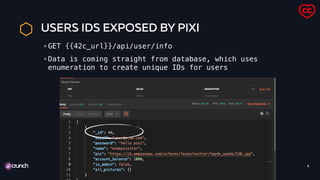
USERS IDS EXPOSED BY PIXI
GET {{42c_url}}/api/user/info
Data is coming straight from database, which uses
enumeration to create unique IDs for users
6
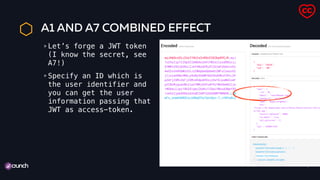
A1 AND A7 COMBINED EFFECT
Let’s forge a JWT token
(I know the secret, see
A7!)
Specify an ID which is
the user identifier and
you can get the user
information passing that
JWT as access-token.
7
ACCESS TOKENS MISUSE
Access tokens are used for authentication purposes
A single token allows to access many APIs and operations
API Keys and OAuth secrets are leaking all over Github
✓ A very easy mistake!
What you should do
✓ Restrict access token usage
• Google APIs example (restrictions on referrers, APIs list, IPs).
• OAuth scopes
• Fine-grained authorization (attribute-based for example)
✓ Don’t rely on access tokens to authenticate a user (use OpenID
Connect instead) - Remember the hotel card analogy!
✓ Use short-lived access tokens
✓ Authenticate your apps (so you know who is talking to you)
8
A2:BROKEN AUTHENTICATION
PREVENT DATA LEAKAGE
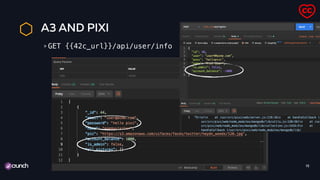
Developers tend to create generic APIs which
expose lots of information and let client UIs filter
what they need.
APIs return excessive information
APIs leak exception information (exposing server
internals)
What you can do
✓ Describe precisely the response structure and block
anything not matching the specification
✓ Use a controller layer to filter the data an API can expose
externally
9
A3: EXCESSIVE DATA EXPOSURE
A3 AND PIXI
GET {{42c_url}}/api/user/info
10
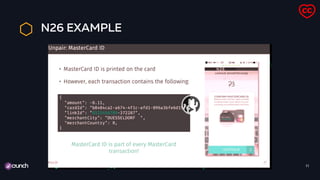
N26 EXAMPLE
11
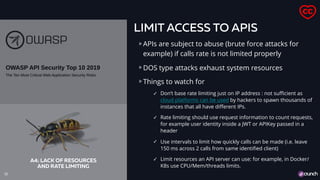
LIMIT ACCESS TO APIS
APIs are subject to abuse (brute force attacks for
example) if calls rate is not limited properly
DOS type attacks exhaust system resources
Things to watch for
✓ Don’t base rate limiting just on IP address : not sufficient as
cloud platforms can be used by hackers to spawn thousands of
instances that all have different IPs.
✓ Rate limiting should use request information to count requests,
for example user identity inside a JWT or APIKey passed in a
header
✓ Use intervals to limit how quickly calls can be made (i.e. leave
150 ms across 2 calls from same identified client)
✓ Limit resources an API server can use: for example, in Docker/
K8s use CPU/Mem/threads limits.
12
A4: LACK OF RESOURCES
AND RATE LIMITING
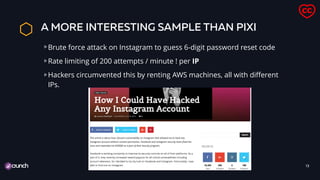
A MORE INTERESTING SAMPLE THAN PIXI
Brute force attack on Instagram to guess 6-digit password reset code
Rate limiting of 200 attempts / minute ! per IP
Hackers circumvented this by renting AWS machines, all with different
IPs.
13
BLOCKING UN-AUTHORIZED CALLS
Example:
✓ Developers mix admin operation together with non-admin ones
in same API
✓ Developers leave sensitive verbs (PATCH/DELETE) in API
implementation that can be exploited to update/delete data
with no further authorization
Hackers use bots to guess which potential paths are
open (say GET /admin/user or PUT /user) and get
access to information that should be hidden.
What you can do
✓ Detect whether verbs not specified in API contract can be used
✓ Systematically reject any path not described in the API contract
✓ Validate that the user has proper access rights
14
A5: RESOURCE LEVEL ACCESS CONTROL
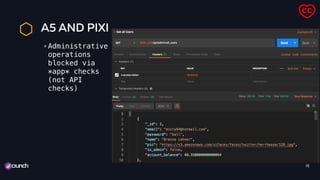
A5 AND PIXI
Administrative
operations
blocked via
*app* checks
(not API
checks)
15
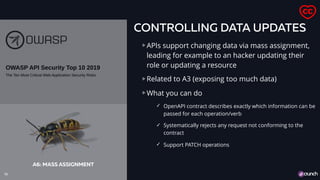
CONTROLLING DATA UPDATES
APIs support changing data via mass assignment,
leading for example to an hacker updating their
role or updating a resource
Related to A3 (exposing too much data)
What you can do
✓ OpenAPI contract describes exactly which information can be
passed for each operation/verb
✓ Systematically rejects any request not conforming to the
contract
✓ Support PATCH operations
16
A6: MASS ASSIGNMENT
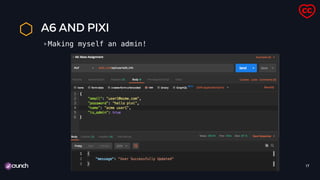
A6 AND PIXI
17
Making myself an admin!
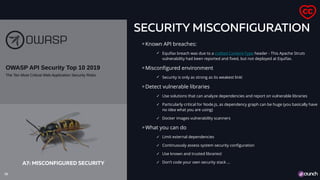
SECURITY MISCONFIGURATION
Known API breaches:
✓ Equifax breach was due to a crafted Content-Type header - This Apache Struts
vulnerability had been reported and fixed, but not deployed at Equifax.
Misconfigured environment
✓ Security is only as strong as its weakest link!
Detect vulnerable libraries
✓ Use solutions that can analyze dependencies and report on vulnerable libraries
✓ Particularly critical for Node.js, as dependency graph can be huge (you basically have
no idea what you are using)
✓ Docker images vulnerability scanners
What you can do
✓ Limit external dependencies
✓ Continuously assess system security configuration
✓ Use known and trusted libraries!
✓ Don’t code your own security stack …
18
A7: MISCONFIGURED SECURITY
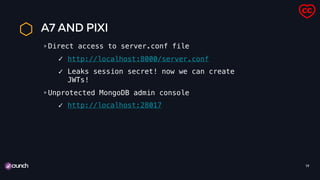
A7 AND PIXI
Direct access to server.conf file
✓ http://localhost:8000/server.conf
✓ Leaks session secret! now we can create
JWTs!
Unprotected MongoDB admin console
✓ http://localhost:28017
19
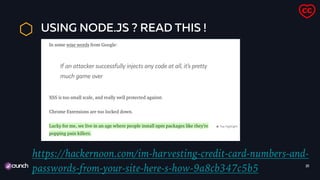
USING NODE.JS ? READ THIS !
20
https://hackernoon.com/im-harvesting-credit-card-numbers-and-
passwords-from-your-site-here-s-how-9a8cb347c5b5
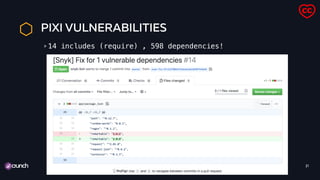
PIXI VULNERABILITIES
14 includes (require) , 598 dependencies!
21
PREVENTING TYPICAL INJECTIONS
This is a common issue across web applications
and APIs.
Remote code injection, SQL injection, noSQL
injection all fall in this category
Samsung Smarthings is a good example of JSON
injection leading to crashing the video server
What you need to do:
✓ Sanitize inputs
22
A8: INJECTION
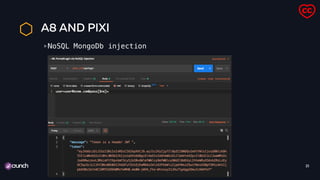
A8 AND PIXI
NoSQL MongoDb injection
23
IMPROPER ASSETS MANAGEMENT
Document all APIs with OpenAPI/RAML
Implement APIs governance
Make sure API versions are tracked (deprecated,
retired, etc.)
Adopt DevSecOps so that security is considered as
early as possible. This way, even Dev APIs are
protected.
API deployment can be blocked via CI/CD pipelines
to prevent unsecured APIs from being deployed,
even in Dev/QA.
24
A9:IMPROPER ASSETS MANAGEMENT
API SECURITY VISIBILITY
Abuse of APIs goes un-noticed … i.e. you realize weeks
later that you had a breach.
Produce transaction logs which can be exported to 3rd
party systems, such as SIEMs for further analysis and
exploitation
Protect Logs !
✓ Make sure you’re not vulnerable to log injection!
Watch what you write in logs!
✓ Token and keys passed in URL versus HTTP Headers
✓ Tokens and Keys written from code
✓ Use Redaction whenever possible (
• For example, redact 50% of the strings, so they are still useful for debugging, but
useless for hacking, for example DFETEHD-xxxxxxxx
25
A10: INSUFFICIENT LOGGING
AND MONITORING
A10 AND PIXI
Leaking information in logs
26
pixiapp | token
"eyJhbGciOiJIUzI1NiIsInR5cCI6IkpXVCJ9.eyJ1c2VyIjp7Il9pZCI6MzMsImVtYWlsIjoiaGFja2VyQGdldG1l
mluIiwicGFzc3dvcmQiOiJoZWxsb3BpeGkiLCJuYW1lIjoiaW52b2x2ZWRwbHVzIiwicGljIjoiaHR0cHM6Ly9zMy5
bWF6b25hd3MuY29tL3VpZmFjZXMvZmFjZXMvdHdpdHRlci90aGlhZ292ZXJuZXR0aS8xMjguanBnIiwiaXNfYWRtaW
iOmZhbHNlLCJhY2NvdW50X2JhbGFuY2UiOjUwLCJhbGxfcGljdHVyZXMiOltdfSwiaWF0IjoxNTY4MjE2OTc3fQ.Ld
9xT1Q2JqbrnPBe395kFrny3vgg9BKxRQ-OTa6f6U"
pixiapp | owaspbrokenwebapps
pixiapp | my user {"user":{"_id":
33,"email":"hacker@getme.in","password":"hellopixi","name":"involvedplus","pic":"https://
s3.amazonaws.com/uifaces/faces/twitter/thiagovernetti/
128.jpg","is_admin":false,"account_balance":50,"all_pictures":[]},"iat":1568216977}
pixiapp | user id 33

OWASP API Security Top 10 Examples

  • 1.
    1 OWASP API SECURITYTOP 10 This work is licensed under a Creative Commons Attribution-NonCommercial- ShareAlike 4.0 International License.
  • 2.
    APIS ARE THENEW ATTACKS VECTOR! Data breaches via APIs are on the rise ✓ 150+ issues reported on apisecurity.io since Oct. 2018 ✓ And those are just the public ones! Most recurrent causes: ✓ Input validation issues ✓ Bad security configuration ✓ Data/Exception leakage 2
  • 3.
    FINALLY! OWASP APISECURITY TOP 10 A recognition that API Security is not Web Application Security ✓ Different attack vectors ✓ Data centric (lots of attacks come from mishandling API data) 3 https://github.com/OWASP/API-Security/blob/develop/2019/en/dist/owasp-api-security-top-10.pdf
  • 4.
    MEET PIXI ! AnAPI that exposes all the issues APIs can have! Totally vulnerable! So don’t deploy it with your stuff Part of an OWASP Project called DevSlop 4
  • 5.
    EXTRACTION VIA ENUMERATION APIsrelies on public IDs to retrieve information, for example ✓ GET /shops/shop1/revenue_data.json ✓ Returns info from shop1 if you’re authenticated ✓ What happens if I call GET /shops/shop2/revenue_data.json? In 2017, a major flaw was discovered in a T-mobile API which would have allowed to retrieve any T-mobile customer information from their phone number. All you needed was a valid token. What can you do ? ✓ Use non-guessable IDs (UUIDs) ✓ Implement authorization checks to validate the user actually owns the data they are trying to retrieve ✓ Don’t expose internal IDs externally - Instead use a non-guessable ID you then map to internal IDs. 5 A1: OBJECT LEVEL ACCESS CONTROL
  • 6.
    USERS IDS EXPOSEDBY PIXI GET {{42c_url}}/api/user/info Data is coming straight from database, which uses enumeration to create unique IDs for users 6
  • 7.
    A1 AND A7COMBINED EFFECT Let’s forge a JWT token (I know the secret, see A7!) Specify an ID which is the user identifier and you can get the user information passing that JWT as access-token. 7
  • 8.
    ACCESS TOKENS MISUSE Accesstokens are used for authentication purposes A single token allows to access many APIs and operations API Keys and OAuth secrets are leaking all over Github ✓ A very easy mistake! What you should do ✓ Restrict access token usage • Google APIs example (restrictions on referrers, APIs list, IPs). • OAuth scopes • Fine-grained authorization (attribute-based for example) ✓ Don’t rely on access tokens to authenticate a user (use OpenID Connect instead) - Remember the hotel card analogy! ✓ Use short-lived access tokens ✓ Authenticate your apps (so you know who is talking to you) 8 A2:BROKEN AUTHENTICATION
  • 9.
    PREVENT DATA LEAKAGE Developerstend to create generic APIs which expose lots of information and let client UIs filter what they need. APIs return excessive information APIs leak exception information (exposing server internals) What you can do ✓ Describe precisely the response structure and block anything not matching the specification ✓ Use a controller layer to filter the data an API can expose externally 9 A3: EXCESSIVE DATA EXPOSURE
  • 10.
    A3 AND PIXI GET{{42c_url}}/api/user/info 10
  • 11.
  • 12.
    LIMIT ACCESS TOAPIS APIs are subject to abuse (brute force attacks for example) if calls rate is not limited properly DOS type attacks exhaust system resources Things to watch for ✓ Don’t base rate limiting just on IP address : not sufficient as cloud platforms can be used by hackers to spawn thousands of instances that all have different IPs. ✓ Rate limiting should use request information to count requests, for example user identity inside a JWT or APIKey passed in a header ✓ Use intervals to limit how quickly calls can be made (i.e. leave 150 ms across 2 calls from same identified client) ✓ Limit resources an API server can use: for example, in Docker/ K8s use CPU/Mem/threads limits. 12 A4: LACK OF RESOURCES AND RATE LIMITING
  • 13.
    A MORE INTERESTINGSAMPLE THAN PIXI Brute force attack on Instagram to guess 6-digit password reset code Rate limiting of 200 attempts / minute ! per IP Hackers circumvented this by renting AWS machines, all with different IPs. 13
  • 14.
    BLOCKING UN-AUTHORIZED CALLS Example: ✓Developers mix admin operation together with non-admin ones in same API ✓ Developers leave sensitive verbs (PATCH/DELETE) in API implementation that can be exploited to update/delete data with no further authorization Hackers use bots to guess which potential paths are open (say GET /admin/user or PUT /user) and get access to information that should be hidden. What you can do ✓ Detect whether verbs not specified in API contract can be used ✓ Systematically reject any path not described in the API contract ✓ Validate that the user has proper access rights 14 A5: RESOURCE LEVEL ACCESS CONTROL
  • 15.
    A5 AND PIXI Administrative operations blockedvia *app* checks (not API checks) 15
  • 16.
    CONTROLLING DATA UPDATES APIssupport changing data via mass assignment, leading for example to an hacker updating their role or updating a resource Related to A3 (exposing too much data) What you can do ✓ OpenAPI contract describes exactly which information can be passed for each operation/verb ✓ Systematically rejects any request not conforming to the contract ✓ Support PATCH operations 16 A6: MASS ASSIGNMENT
  • 17.
    A6 AND PIXI 17 Makingmyself an admin!
  • 18.
    SECURITY MISCONFIGURATION Known APIbreaches: ✓ Equifax breach was due to a crafted Content-Type header - This Apache Struts vulnerability had been reported and fixed, but not deployed at Equifax. Misconfigured environment ✓ Security is only as strong as its weakest link! Detect vulnerable libraries ✓ Use solutions that can analyze dependencies and report on vulnerable libraries ✓ Particularly critical for Node.js, as dependency graph can be huge (you basically have no idea what you are using) ✓ Docker images vulnerability scanners What you can do ✓ Limit external dependencies ✓ Continuously assess system security configuration ✓ Use known and trusted libraries! ✓ Don’t code your own security stack … 18 A7: MISCONFIGURED SECURITY
  • 19.
    A7 AND PIXI Directaccess to server.conf file ✓ http://localhost:8000/server.conf ✓ Leaks session secret! now we can create JWTs! Unprotected MongoDB admin console ✓ http://localhost:28017 19
  • 20.
    USING NODE.JS ?READ THIS ! 20 https://hackernoon.com/im-harvesting-credit-card-numbers-and- passwords-from-your-site-here-s-how-9a8cb347c5b5
  • 21.
    PIXI VULNERABILITIES 14 includes(require) , 598 dependencies! 21
  • 22.
    PREVENTING TYPICAL INJECTIONS Thisis a common issue across web applications and APIs. Remote code injection, SQL injection, noSQL injection all fall in this category Samsung Smarthings is a good example of JSON injection leading to crashing the video server What you need to do: ✓ Sanitize inputs 22 A8: INJECTION
  • 23.
    A8 AND PIXI NoSQLMongoDb injection 23
  • 24.
    IMPROPER ASSETS MANAGEMENT Documentall APIs with OpenAPI/RAML Implement APIs governance Make sure API versions are tracked (deprecated, retired, etc.) Adopt DevSecOps so that security is considered as early as possible. This way, even Dev APIs are protected. API deployment can be blocked via CI/CD pipelines to prevent unsecured APIs from being deployed, even in Dev/QA. 24 A9:IMPROPER ASSETS MANAGEMENT
  • 25.
    API SECURITY VISIBILITY Abuseof APIs goes un-noticed … i.e. you realize weeks later that you had a breach. Produce transaction logs which can be exported to 3rd party systems, such as SIEMs for further analysis and exploitation Protect Logs ! ✓ Make sure you’re not vulnerable to log injection! Watch what you write in logs! ✓ Token and keys passed in URL versus HTTP Headers ✓ Tokens and Keys written from code ✓ Use Redaction whenever possible ( • For example, redact 50% of the strings, so they are still useful for debugging, but useless for hacking, for example DFETEHD-xxxxxxxx 25 A10: INSUFFICIENT LOGGING AND MONITORING
  • 26.
    A10 AND PIXI Leakinginformation in logs 26 pixiapp | token "eyJhbGciOiJIUzI1NiIsInR5cCI6IkpXVCJ9.eyJ1c2VyIjp7Il9pZCI6MzMsImVtYWlsIjoiaGFja2VyQGdldG1l mluIiwicGFzc3dvcmQiOiJoZWxsb3BpeGkiLCJuYW1lIjoiaW52b2x2ZWRwbHVzIiwicGljIjoiaHR0cHM6Ly9zMy5 bWF6b25hd3MuY29tL3VpZmFjZXMvZmFjZXMvdHdpdHRlci90aGlhZ292ZXJuZXR0aS8xMjguanBnIiwiaXNfYWRtaW iOmZhbHNlLCJhY2NvdW50X2JhbGFuY2UiOjUwLCJhbGxfcGljdHVyZXMiOltdfSwiaWF0IjoxNTY4MjE2OTc3fQ.Ld 9xT1Q2JqbrnPBe395kFrny3vgg9BKxRQ-OTa6f6U" pixiapp | owaspbrokenwebapps pixiapp | my user {"user":{"_id": 33,"email":"hacker@getme.in","password":"hellopixi","name":"involvedplus","pic":"https:// s3.amazonaws.com/uifaces/faces/twitter/thiagovernetti/ 128.jpg","is_admin":false,"account_balance":50,"all_pictures":[]},"iat":1568216977} pixiapp | user id 33