Andrew MacMillan , VP ECM Product Management, Oracle Brian “Bex” Huff , President and Chief Software Architect, Bezzotech A Pragmatic Strategy For Oracle Enterprise Content Management (ECM)
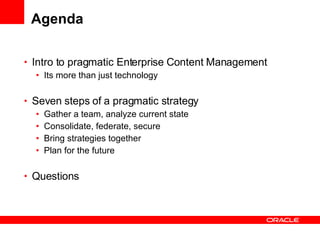
Agenda Intro to pragmatic Enterprise Content Management Its more than just technology Seven steps of a pragmatic strategy Gather a team, analyze current state Consolidate, federate, secure Bring strategies together Plan for the future Questions
What is Enterprise Content Management? ECM focuses on “unstructured” information Emails, Microsoft Office documents, videos, web sites Covers the entire life cycle Capture it, define it, tag it Find it, convert it, deliver it Use it, re-use it, enrich it Secure it, retain it, destroy it Improves communication efficiency
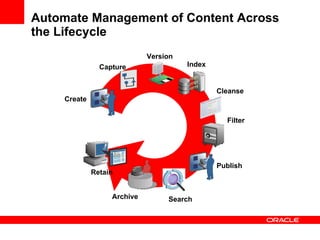
Automate Management of Content Across the Lifecycle Publish Retain Filter Search Create Capture Version Index Cleanse Archive
What is Pragmatic ECM? Movement beyond “point solutions”  Avoid department-centric solutions Think strategically about enterprise interoperability Act tactically to address specific needs Its not just about technology Its about a culture of information sharing. It’s about dedication to a “single source of truth” Its about making content manageable!
Strategic vs Tactical ECM Strategic ECM systems Enterprise-wide Infrastructure level Used for Active, Transactional, and Historical data Tactical ECM systems Makes one specific department better at one thing Leads to content silos Remember: these exist for a very good reason! A pragmatic strategy must support both
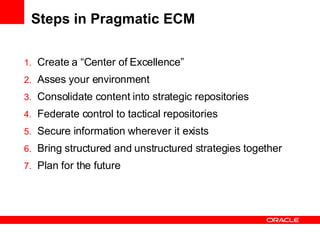
Steps in Pragmatic ECM Create a “Center of Excellence” Asses your environment Consolidate content into strategic repositories Federate control to tactical repositories Secure information wherever it exists Bring structured and unstructured strategies together Plan for the future
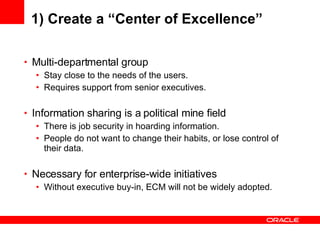
1) Create a “Center of Excellence” Multi-departmental group Stay close to the needs of the users. Requires support from senior executives. Information sharing is a political mine field There is job security in hoarding information. People do not want to change their habits, or lose control of their data. Necessary for enterprise-wide initiatives Without executive buy-in, ECM will not be widely adopted.
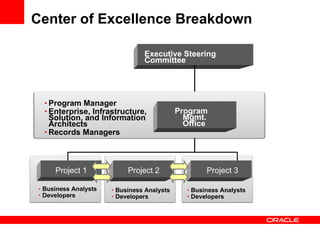
Center of Excellence Breakdown Project 1 Project 2 Project 3 Executive Steering Committee Program Mgmt. Office Business Analysts Developers Program Manager Enterprise, Infrastructure, Solution, and Information Architects Records Managers Business Analysts Developers Business Analysts Developers
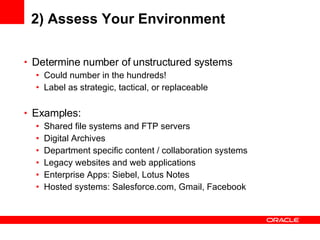
2) Assess Your Environment Determine number of unstructured systems Could number in the hundreds! Label as strategic, tactical, or replaceable Examples: Shared file systems and FTP servers Digital Archives Department specific content / collaboration systems Legacy websites and web applications Enterprise Apps: Siebel, Lotus Notes Hosted systems: Salesforce.com, Gmail, Facebook
Label Existing Systems Strategic: ECM systems with the features you need Easy interoperability Tactical: Insufficient for a strategic infrastructure. Too useful to replace. Not cost-effective to re-implement required features.  Replaceable: Not many features: low cost, low complexity
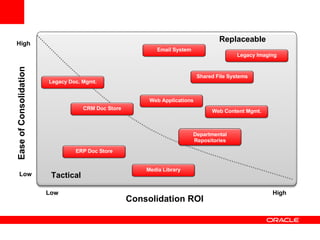
Consolidation ROI Ease of Consolidation High Low Low High Tactical Replaceable Shared File Systems Legacy Imaging ERP Doc Store Email System Web Applications CRM Doc Store Departmental Repositories Web Content Mgmt. Legacy Doc. Mgmt. Media Library
3) Consolidate Strategic Repositories Migrate from replaceable into strategic system High-value content in one central repository for easy re-use Significantly reduces cost and complexity Extend strategic repository to other applications Active: Web applications, portals Transactional: Imaging and process management Historical: email archives, digital archives
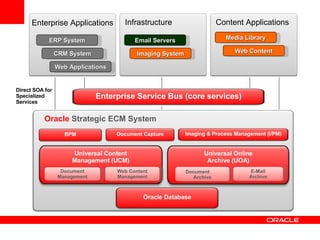
ERP System CRM System Email Servers Web Applications Enterprise Applications Infrastructure Content Applications Media Library Imaging System Web Content Enterprise Service Bus (core services) Universal Content Management (UCM) Universal Online Archive (UOA) Imaging & Process Management (I/PM) Document  Archive Document Management E-Mail Archive Web Content Management BPM Document Capture Oracle  Strategic ECM System Direct SOA for Specialized Services Oracle Database
Consolidation Tools Enterprise Service Bus Server to server orchestration with BPEL workflows Open Web Content Management (OpenWCM) Embed in-context editing in portals / app servers Standards-compliant ECM interfaces  CMIS, JSR 170, RSS, WebDAV Custom Integrations SOAP, Archiving Services, Java API
4) Federate to Tactical Repositories Tactical systems exist for a reason! Helps one department do their tasks more efficiently Too useful to eliminate, too expensive to consolidate Pragmatic ECM does not punish tactical systems It offers federation tools to extend the repository Helps makes your content  manageable Get control over content, wherever it is Centralized policies, federated repositories
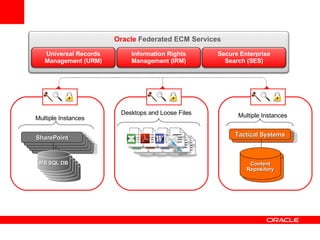
Oracle  Federated ECM Services Multiple Instances Desktops and Loose Files Tactical Systems Content Repository Multiple Instances SharePoint MS SQL DB Universal Records Management (URM) Information Rights Management (IRM) Secure Enterprise Search (SES)
Federation Tools Universal Records Managements Custom “adapters” run in remote systems Enforces retention and destruction policies Secure Enterprise Search Single, secure place to search for content anywhere Group and display results differently, depending on the user ALUI Ensemble (Oracle WebCenter Services) Embeds any web app inside any other web app Helps manage application proliferation
5) Secure Information Where It Exists Security Paradox:  Information is only secure when you are not using it! In a repository?  Safe. Removed from the repository for viewing?  Unsafe. Can we do better? Add more layers of security. Make a “defensible” content security strategy.  An ECM should store content, not users Integrate with best-of-breed identity management systems
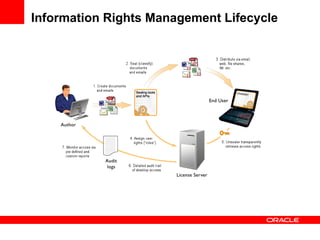
Security Tools Information Rights Management Encrypts documents Must request temporary key to view content Centralized policy management, monitoring, and reporting Content Cleansing Remove “Track Changes” and “invisible” content from documents Dynamic Watermarks on PDFs Embed user name and access date
Information Rights Management Lifecycle
6) Unify Your Strategies Blurred line:  unstructured vs. structured content Unstructured apps need structured content Should consume structured services Structured apps need unstructured content Should consume unstructured content services Extract structure from unstructured content Keywords, metadata, taxonomy, controlled thesaurus
Unification Tools Imaging and Process Management Brings scanned images to enterprise apps Business Intelligence Publisher Generate reports, put into ECM, then on web sites Siebel Files Replacement  Business Analytics and Data Mining Tools Imagine data mining your email archives…
Unification Tools Real Time Decisions and “Next Best Activity” Based on user’s history, what are the likely to want to see? Customer communication Management (SkyWire) Auto Categorization Extract keywords, metadata, and thesaurus terms Determine which content items are similar Microformats Embed easily extracted structure in documents
7) Plan for the Future Need 3-year plans for ECM Technology is changing rapidly New tools, new integrations, new migrations Consolidation may be a better option in the future. Content is being created faster and faster Need to frequently assess storage and findability Think strategically, implement tactically
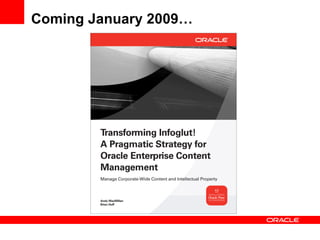
Coming January 2009…
Questions? A Pragmatic Strategy for Oracle Enterprise Content Management Presenters: Andrew MacMillan [email_address] Brian “Bex” Huff [email_address] Thank you!

A Pragmatic Strategy for Oracle Enterprise Content Management (ECM)

  • 1.
  • 2.
    Andrew MacMillan ,VP ECM Product Management, Oracle Brian “Bex” Huff , President and Chief Software Architect, Bezzotech A Pragmatic Strategy For Oracle Enterprise Content Management (ECM)
  • 3.
    Agenda Intro topragmatic Enterprise Content Management Its more than just technology Seven steps of a pragmatic strategy Gather a team, analyze current state Consolidate, federate, secure Bring strategies together Plan for the future Questions
  • 4.
    What is EnterpriseContent Management? ECM focuses on “unstructured” information Emails, Microsoft Office documents, videos, web sites Covers the entire life cycle Capture it, define it, tag it Find it, convert it, deliver it Use it, re-use it, enrich it Secure it, retain it, destroy it Improves communication efficiency
  • 5.
    Automate Management ofContent Across the Lifecycle Publish Retain Filter Search Create Capture Version Index Cleanse Archive
  • 6.
    What is PragmaticECM? Movement beyond “point solutions” Avoid department-centric solutions Think strategically about enterprise interoperability Act tactically to address specific needs Its not just about technology Its about a culture of information sharing. It’s about dedication to a “single source of truth” Its about making content manageable!
  • 7.
    Strategic vs TacticalECM Strategic ECM systems Enterprise-wide Infrastructure level Used for Active, Transactional, and Historical data Tactical ECM systems Makes one specific department better at one thing Leads to content silos Remember: these exist for a very good reason! A pragmatic strategy must support both
  • 8.
    Steps in PragmaticECM Create a “Center of Excellence” Asses your environment Consolidate content into strategic repositories Federate control to tactical repositories Secure information wherever it exists Bring structured and unstructured strategies together Plan for the future
  • 9.
    1) Create a“Center of Excellence” Multi-departmental group Stay close to the needs of the users. Requires support from senior executives. Information sharing is a political mine field There is job security in hoarding information. People do not want to change their habits, or lose control of their data. Necessary for enterprise-wide initiatives Without executive buy-in, ECM will not be widely adopted.
  • 10.
    Center of ExcellenceBreakdown Project 1 Project 2 Project 3 Executive Steering Committee Program Mgmt. Office Business Analysts Developers Program Manager Enterprise, Infrastructure, Solution, and Information Architects Records Managers Business Analysts Developers Business Analysts Developers
  • 11.
    2) Assess YourEnvironment Determine number of unstructured systems Could number in the hundreds! Label as strategic, tactical, or replaceable Examples: Shared file systems and FTP servers Digital Archives Department specific content / collaboration systems Legacy websites and web applications Enterprise Apps: Siebel, Lotus Notes Hosted systems: Salesforce.com, Gmail, Facebook
  • 12.
    Label Existing SystemsStrategic: ECM systems with the features you need Easy interoperability Tactical: Insufficient for a strategic infrastructure. Too useful to replace. Not cost-effective to re-implement required features. Replaceable: Not many features: low cost, low complexity
  • 13.
    Consolidation ROI Easeof Consolidation High Low Low High Tactical Replaceable Shared File Systems Legacy Imaging ERP Doc Store Email System Web Applications CRM Doc Store Departmental Repositories Web Content Mgmt. Legacy Doc. Mgmt. Media Library
  • 14.
    3) Consolidate StrategicRepositories Migrate from replaceable into strategic system High-value content in one central repository for easy re-use Significantly reduces cost and complexity Extend strategic repository to other applications Active: Web applications, portals Transactional: Imaging and process management Historical: email archives, digital archives
  • 15.
    ERP System CRMSystem Email Servers Web Applications Enterprise Applications Infrastructure Content Applications Media Library Imaging System Web Content Enterprise Service Bus (core services) Universal Content Management (UCM) Universal Online Archive (UOA) Imaging & Process Management (I/PM) Document Archive Document Management E-Mail Archive Web Content Management BPM Document Capture Oracle Strategic ECM System Direct SOA for Specialized Services Oracle Database
  • 16.
    Consolidation Tools EnterpriseService Bus Server to server orchestration with BPEL workflows Open Web Content Management (OpenWCM) Embed in-context editing in portals / app servers Standards-compliant ECM interfaces CMIS, JSR 170, RSS, WebDAV Custom Integrations SOAP, Archiving Services, Java API
  • 17.
    4) Federate toTactical Repositories Tactical systems exist for a reason! Helps one department do their tasks more efficiently Too useful to eliminate, too expensive to consolidate Pragmatic ECM does not punish tactical systems It offers federation tools to extend the repository Helps makes your content manageable Get control over content, wherever it is Centralized policies, federated repositories
  • 18.
    Oracle FederatedECM Services Multiple Instances Desktops and Loose Files Tactical Systems Content Repository Multiple Instances SharePoint MS SQL DB Universal Records Management (URM) Information Rights Management (IRM) Secure Enterprise Search (SES)
  • 19.
    Federation Tools UniversalRecords Managements Custom “adapters” run in remote systems Enforces retention and destruction policies Secure Enterprise Search Single, secure place to search for content anywhere Group and display results differently, depending on the user ALUI Ensemble (Oracle WebCenter Services) Embeds any web app inside any other web app Helps manage application proliferation
  • 20.
    5) Secure InformationWhere It Exists Security Paradox: Information is only secure when you are not using it! In a repository? Safe. Removed from the repository for viewing? Unsafe. Can we do better? Add more layers of security. Make a “defensible” content security strategy. An ECM should store content, not users Integrate with best-of-breed identity management systems
  • 21.
    Security Tools InformationRights Management Encrypts documents Must request temporary key to view content Centralized policy management, monitoring, and reporting Content Cleansing Remove “Track Changes” and “invisible” content from documents Dynamic Watermarks on PDFs Embed user name and access date
  • 22.
  • 23.
    6) Unify YourStrategies Blurred line: unstructured vs. structured content Unstructured apps need structured content Should consume structured services Structured apps need unstructured content Should consume unstructured content services Extract structure from unstructured content Keywords, metadata, taxonomy, controlled thesaurus
  • 24.
    Unification Tools Imagingand Process Management Brings scanned images to enterprise apps Business Intelligence Publisher Generate reports, put into ECM, then on web sites Siebel Files Replacement Business Analytics and Data Mining Tools Imagine data mining your email archives…
  • 25.
    Unification Tools RealTime Decisions and “Next Best Activity” Based on user’s history, what are the likely to want to see? Customer communication Management (SkyWire) Auto Categorization Extract keywords, metadata, and thesaurus terms Determine which content items are similar Microformats Embed easily extracted structure in documents
  • 26.
    7) Plan forthe Future Need 3-year plans for ECM Technology is changing rapidly New tools, new integrations, new migrations Consolidation may be a better option in the future. Content is being created faster and faster Need to frequently assess storage and findability Think strategically, implement tactically
  • 27.
  • 28.
    Questions? A PragmaticStrategy for Oracle Enterprise Content Management Presenters: Andrew MacMillan [email_address] Brian “Bex” Huff [email_address] Thank you!