PRINCIPLES AND FORMULATION AND BUILDING
BLOCKS OF ORAL CARE PRODUCTS
P.DHARUNSHANKAR
B.PHARM- 8TH SEM
INTRODUCTION:
• Keeping the teeth and oral cavity and fresh has been part of the human
daily routine for a long time.
• In the past, dental care products were primarily cleansing aids which
were used to remove debris and polish the teeth.
• Today, the majority of dental care products offer additional benefits in
the prevention of common dental problems such as caries or gingivitis.
• There are many oral and dental diseases that may result from poor dental
hygiene.
• The most common problems include plaque formation, dental caries,
tartar formation, gum disease, tooth sensitivity, dental stain and bad
breath which could be prevented with regular use of dental and oral care
products.
• Tooth paste and mouth wash may be classified as either cosmetics or OTC
drug- cosmetic products, depending on the claims made as well as the
concentration of active ingrdients present.
• Toothpaste, also known as oral dentrifrice, is a paste or gel designed to help
remove plaque and stains from the teeth and keeps the breath fresh.
• It improves the mechanical brushing and cleaning power of a toothbrush.
• It typically contains abrasive ingredients, coloring, flavoring, sweetner as
well as other ingredients that make the toothpaste a smooth paste, foam and
stay moist.
• The primary function of these products is to clean and refresh the teeth and
the oral cavity, which are considered pure cosmetic benefits.
TOOTH PASTE FOR BLEEDING GUMS AND SENSITIVE TEETH
• Tooth paste is a mild cosmetic detergent for cleaning the teeth. Initially
intended to freshens the breath and remove deposits from teeth, the
evolution of tooth paste has also made it as a vehicle for the protection of
teeth from cavities, calculus formation and gum disease.
• Bleeeding gums are a sign of gingivitis or inflammation of gums.
• It’s a common and mild form of gum disease, and it’s caused by a buildup
of plaque at gumline.
• If there a gingivitis, gums may be irritated, red and swollen. The may be
bleed when brush the teeth.
BLEEDING GUM
• It is the most often symptom of gum disease. But it can be also point to
other health problems.
• Occasional bleeding of the gums can be caused by brushing teeth too
vigorosuly or wearing dentures that don’t fit correctly.
• Gingivitis (inflammation of the gums) and periodontitis make gums
sensitive sensitive and prone to bleeding.
• Vitamin C and K deficiencies and lack of clotting cells (platelets) can also
cause gums to bleed easily.
SENSITIVE TEETH TOOTHPASTE
• Sensitive teeth are typically the result of worn tooth enamel or exposed tooth
roots.
• Certain activities such as brushing, eating and drinking can cause sharp,
temporary pain in teeth .
• Sometimes, however, tooth discomfort is caused by other factors such as cavity,
a cracked or chipped tooth, a worn filling or gum disease.
• It may be temporary or a chronic problem and it can affect one tooth, several
teeth, or all the teeth in a single individual.
• It can have a number of different causes, but most cases of sensitive teeth are
easily treated with a change in the oral hygiene regimen.
• It is composed of four dental tissues ie., enamel, dentin and cementum and the
pulp
FORMULATION OF TOOTH PASTE
POLISHING OR ABRASIVE AGENTS:
These agents polish the teeth and remove food debris from their surface.
They are used in 20-50% concentration of the total formulation.
Examples: Precipitated calcium carbonate, Phosphates of calcium, Dental GRADED
SILICA/POLYMERS OF SILICA (SI02 ) N., TRIHYDRATED ALUMINA.
FOAMING OR WETTING AGENTS OR SURFACTANTS:
They serve the purpose of cleansing by reducing the surface tension at the
interface of the adhered material and teeth enamel . They facilitate the abrasive action
by wetting the teeth surface. They easily diffuse into the narrow spaces, and enhance
the cleansing action.
Examples: Sodium Lauryl Sulphate, Sodium lauryl sarcosinate
HUMECTANTS:
These agents prevent rapid drying of the product by preventing
excessive moisture loss. They also impart plasticity to the product. They are
used in 20-40% concentration in the formulation.
Examples: Sorbitol, Glycerine, Propylene Glycol
CEILING OR BINDING AGENTS:
These agents, e.g., Carboxy Methyl Cellulose ( CMC), Sodium CMC,
hydroxyethyl cellulose, cellulose ethers, etc., hold the solid and the liquid
components together to form a smooth paste and to retain this property during
storage. They prevent bleeding from the paste and also add up to the body and
viscosity of the product.
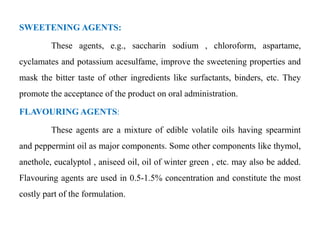
SWEETENING AGENTS:
These agents, e.g., saccharin sodium , chloroform, aspartame,
cyclamates and potassium acesulfame, improve the sweetening properties and
mask the bitter taste of other ingredients like surfactants, binders, etc. They
promote the acceptance of the product on oral administration.
FLAVOURING AGENTS:
These agents are a mixture of edible volatile oils having spearmint
and peppermint oil as major components. Some other components like thymol,
anethole, eucalyptol , aniseed oil, oil of winter green , etc. may also be added.
Flavouring agents are used in 0.5-1.5% concentration and constitute the most
costly part of the formulation.
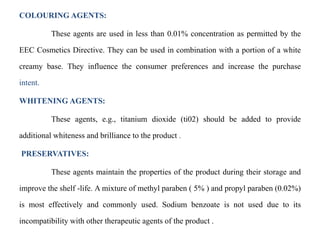
COLOURING AGENTS:
These agents are used in less than 0.01% concentration as permitted by the
EEC Cosmetics Directive. They can be used in combination with a portion of a white
creamy base. They influence the consumer preferences and increase the purchase
intent.
WHITENING AGENTS:
These agents, e.g., titanium dioxide (ti02) should be added to provide
additional whiteness and brilliance to the product .
PRESERVATIVES:
These agents maintain the properties of the product during their storage and
improve the shelf -life. A mixture of methyl paraben ( 5% ) and propyl paraben (0.02%)
is most effectively and commonly used. Sodium benzoate is not used due to its
incompatibility with other therapeutic agents of the product .
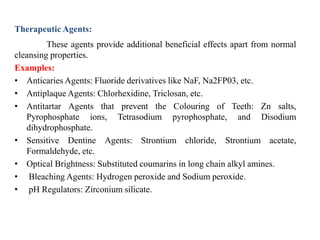
Therapeutic Agents:
These agents provide additional beneficial effects apart from normal
cleansing properties.
Examples:
• Anticaries Agents: Fluoride derivatives like NaF, Na2FP03, etc.
• Antiplaque Agents: Chlorhexidine, Triclosan, etc.
• Antitartar Agents that prevent the Colouring of Teeth: Zn salts,
Pyrophosphate ions, Tetrasodium pyrophosphate, and Disodium
dihydrophosphate.
• Sensitive Dentine Agents: Strontium chloride, Strontium acetate,
Formaldehyde, etc.
• Optical Brightness: Substituted coumarins in long chain alkyl amines.
• Bleaching Agents: Hydrogen peroxide and Sodium peroxide.
• pH Regulators: Zirconium silicate.
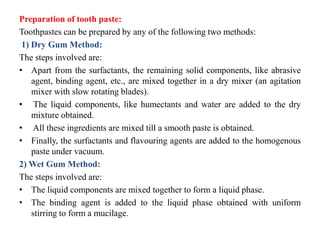
Preparation of tooth paste:
Toothpastes can be prepared by any of the following two methods:
1) Dry Gum Method:
The steps involved are:
• Apart from the surfactants, the remaining solid components, like abrasive
agent, binding agent, etc., are mixed together in a dry mixer (an agitation
mixer with slow rotating blades).
• The liquid components, like humectants and water are added to the dry
mixture obtained.
• All these ingredients are mixed till a smooth paste is obtained.
• Finally, the surfactants and flavouring agents are added to the homogenous
paste under vacuum.
2) Wet Gum Method:
The steps involved are:
• The liquid components are mixed together to form a liquid phase.
• The binding agent is added to the liquid phase obtained with uniform
stirring to form a mucilage.
• Thereafter, the solid ingredients except the surfactants are uniformly mixed
with the mucilage in an agitation mixer to form a homogenous paste.
• Finally, the surfactants, flavouring agents, and colouring agents are added
to the homogenous paste under vacuum.
Cold Compression Technique:
The steps involved in the preparation of toothpastes by this technique are:
• The humectant, like sorbitol (70% w/v) or glycerine is taken in the mixer
bowl. ii) The binding agent is sprinkled over the humectant under agitation
for uniform dispersion.
• The liquid components, like water, sweetener, and preservatives are mixed
separately to form a separate liquid phase.
• If required then the therapeutic ingredients are added to the liquid phase
obtained.
• Thereafter, the liquid phase is added to the humectant-binder mixture in the
mixer bowl and mixed for 5 minutes to remove air from the thick
gelatinous liquid phase.
• Vacuum supply is stopped and the abrasive agents are added with constant
mixing to dissolve them completely.
• Vacuum is reapplied and mixing is continued for half an hour.
• Surfactants and the flavouring agents are dispersed separately in 5%
humectant.
• The obtained mixture is added to the vacuum at the end and mixed for
another 5 minutes to obtain an air free smooth paste.
Multiple Liquid Phase Technique:
• This technique is used for formulations using combination of CMC and
magnesium aluminium silicate. It is also suitable for preparing clear-gel
dentifrices.
The steps involved in the preparation of toothpastes by this technique are:
• Hot water is taken in a mixer bowl and magnesium aluminium silicate is
added to it.
• Humectant, flavouring agent, binding agent, and preservative are mixed
separately to form a liquid phase.
• This liquid phase is added to the mixer and the final volume is made up
with the humectant.
• Vacuum is applied into the bowl to remove air from the liquid mixture.
• thereafter, the vacuum supply is removed and the abrasive agents are
added.
• Vacuum is again introduced and the ingredients are mixed for 30 minutes
• Finally, the surfactants are added with constant mixing for 5 minutes.
Hot Liquid Phase Technique:
The steps involved in the preparation of toothpastes by this technique are:
i) The abrasive agent, binding agent, and preservative are mixed separately
in a dry mixer to obtain a dry powder.
ii) The humectant, sweetener, and water are mixed separately to obtain a
liquid phase.
iii) This liquid phase is heated and slowly added to dry powder with constant
mixing.
iv) The obtained mass is mixed under vacuum for 30 minutes.
v) Finally, flavouring agent and surfactant solution is added under vacuum
and mixed for 5 minutes to obtain a clear and homogeneous paste.
MOUTHWASH
• Mouthwashes are concentrated, clear aqueous solution having a pleasant
taste that is used to clean and deodorise the mouth or buccal cavity.
• Mouthwash contains antibacterial agents, alcohol, glycerin, sweetening
agent flavouring agent and colouring agents.
• They are also used in oral mucous disease to treat mouth infections and to
maintain oral hygiene.
• They are used after diluting with warm water.
• They have more cosmetic value.
•Mouthwashes or mouth rinse are the hydro-alcoholic solutions used for oral
hygiene to deodorise and clean the buccal cavity.
•Usually, these products consist of alcohol, antibacterial agents, sweetening
agent, glycerine, colouring agents and flavouring agents.
• The food particles entrapped deep inside the throat and the mucous in the
mouth can be removed with the help of some strong flavoured and alcoholic
mouthwashes by inducing cough in a person.
CHARACTERISTICS
• It should be quick in action and potent enough to show its intended action at specific dilution.
• Flavour must be strong enough to mask foul smell of mouth.
• It should have an acceptable taste, in most cases sweet taste is preferred.
• Low cost of production.
• No irritation should be caused to oral cavity or mucous membrane.
• It must be non-toxic.
TYPES OF MOUTHWASH
• Cosmetic mouthwashes
• Antiseptic mouthwashes
• Mouthwash concentrates
• Buffered mouthwashes
• Deodouring mouthwashes
• Therapeutic mouthwashes
BASED ON THE TYPE OF PRODUCT FORM
Liquid Mouthwashes: These mouthwashes are ready to be used without any
dilution.
Concentrated Mouthwashes: These mouthwashes are required to be diluted
before use along with water because they are prepared and issued in a
concentrated from.
Tablet Preparations: These are required to be dissolved or dispersed in water
before use.
Granular or Powder Preparations: These are required to be dissolved or
dispersed in water before use.
Aerosol Mouthwashes or Mouth Fresheners: These are recommended for
freshen the breath after eating, drinking or smoking and generally containing
only flavouring agents, although they may also contain antibacterial agents.
Aerosol mouth fresheners are generally presented in a 1/2 oz. ( 14 g ) pack,
having a metered valve and contains sufficient product for 200-300
applications.
INGREDIENTS:
ANTISEPTIC SUBSTANCES:
These are the active constituents of most of the mouthwashes.
Examples are Phenol and its derivatives, hexachlorophene, quaternary
ammonium compounds, thymol, salicylic acid, formalin, boric acid, tannic
acid, hydroxy benzoates, etc are commonly used substance.
ASTRINGENTS:
They are being used in mouthwashes from a long time.
Astringents are incorporated in mouthwashes for following actions:
i ) To shrink and protect inflamed mucous surfaces.
ii ) To precipitate proteins of saliva.
iii ) To diminish accumulated mucous secretions by precipitation.
Examples are Zinc chloride, zinc acetate, aluminium sulphate
DEODORISING AGENTS:
• Causes of bad breathe are not only the bacterial growth on food particles in
the mouth , but several other factors, that are responsible to the cause of
bad breath.
• Quaternary ammonium compounds, chlorophylline have been found to
exert deodorising effect in oral cavity.
DRUG EXTRACTS:
•Several extracts have found use in mouthwashes that act as astringents,
stimulants or flavouring agents.
•Tincture of myrrh, an oleogum-resin obtained from the stem of commiphora
molmol or other species, tincture of cinchona, benzoic tincture, tincture of
quillaia, etc are some extracts used in mouthwashes.
FLAVOURS:
Various flavouring agents that are commonly used in mouthwashes.
Peppermint oil, menthol , thymol , aniseed oil, clove oil, eucalyptus oil,
cinnamon oil, anethole, fennel, methyl salicylate.
SURFACTANTS:
Occasionally surfactants are incorporated in mouthwashes to have wetting, or
detergent , or solubilising effects.
Sometimes solubilising agents are used to keep all the ingredients intact in
case of more water content in solution and sometimes solubilising agents may
be required.
Tweens or other compatible surfactants can be used.
SWEETENERS:
•Sugars are not used as sweetener in mouthwashes, in fact Saccharine, or other synthetic
sweetener extracts can be used for this purpose.
COLOURS:
• Mouthwashes are often coloured with vegetable dyes. The useful dyes are saffron, carmine,
phloxine, erythrosine which do not have effect other ingredients and their action.
VEHICLE:
•This is a very important ingredient as all the constituents have to be kept in solution in the
vehicle. Alcohol alone or in combination with water is the widely used solvent.
•Glycerine is also incorporated in mouthwashes. Use of glycerine has an added advantage as
it is also a sweetening agent with a flavour. It has also a demulcent and conditioning effect
on mucous membrane. Sometimes a small quantity of hydrocolloids is incorporated to
increase the viscosity.
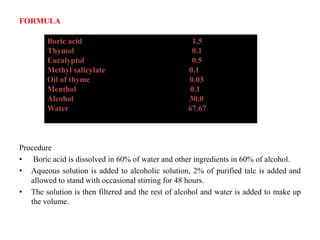
FORMULA
Procedure
• Boric acid is dissolved in 60% of water and other ingredients in 60% of alcohol.
• Aqueous solution is added to alcoholic solution, 2% of purified talc is added and
allowed to stand with occasional stirring for 48 hours.
• The solution is then filtered and the rest of alcohol and water is added to make up
the volume.
Boric acid 1.5
Thymol 0.1
Eucalyptol 0.5
Methyl salicylate 0.1
Oil of thyme 0.03
Menthol 0.1
Alcohol 30.0
Water 67.67
seminar.pptx

seminar.pptx

  • 1.
    PRINCIPLES AND FORMULATIONAND BUILDING BLOCKS OF ORAL CARE PRODUCTS P.DHARUNSHANKAR B.PHARM- 8TH SEM
  • 2.
    INTRODUCTION: • Keeping theteeth and oral cavity and fresh has been part of the human daily routine for a long time. • In the past, dental care products were primarily cleansing aids which were used to remove debris and polish the teeth. • Today, the majority of dental care products offer additional benefits in the prevention of common dental problems such as caries or gingivitis. • There are many oral and dental diseases that may result from poor dental hygiene. • The most common problems include plaque formation, dental caries, tartar formation, gum disease, tooth sensitivity, dental stain and bad breath which could be prevented with regular use of dental and oral care products.
  • 3.
    • Tooth pasteand mouth wash may be classified as either cosmetics or OTC drug- cosmetic products, depending on the claims made as well as the concentration of active ingrdients present. • Toothpaste, also known as oral dentrifrice, is a paste or gel designed to help remove plaque and stains from the teeth and keeps the breath fresh. • It improves the mechanical brushing and cleaning power of a toothbrush. • It typically contains abrasive ingredients, coloring, flavoring, sweetner as well as other ingredients that make the toothpaste a smooth paste, foam and stay moist. • The primary function of these products is to clean and refresh the teeth and the oral cavity, which are considered pure cosmetic benefits.
  • 4.
    TOOTH PASTE FORBLEEDING GUMS AND SENSITIVE TEETH • Tooth paste is a mild cosmetic detergent for cleaning the teeth. Initially intended to freshens the breath and remove deposits from teeth, the evolution of tooth paste has also made it as a vehicle for the protection of teeth from cavities, calculus formation and gum disease. • Bleeeding gums are a sign of gingivitis or inflammation of gums. • It’s a common and mild form of gum disease, and it’s caused by a buildup of plaque at gumline. • If there a gingivitis, gums may be irritated, red and swollen. The may be bleed when brush the teeth.
  • 5.
    BLEEDING GUM • Itis the most often symptom of gum disease. But it can be also point to other health problems. • Occasional bleeding of the gums can be caused by brushing teeth too vigorosuly or wearing dentures that don’t fit correctly. • Gingivitis (inflammation of the gums) and periodontitis make gums sensitive sensitive and prone to bleeding. • Vitamin C and K deficiencies and lack of clotting cells (platelets) can also cause gums to bleed easily.
  • 6.
    SENSITIVE TEETH TOOTHPASTE •Sensitive teeth are typically the result of worn tooth enamel or exposed tooth roots. • Certain activities such as brushing, eating and drinking can cause sharp, temporary pain in teeth . • Sometimes, however, tooth discomfort is caused by other factors such as cavity, a cracked or chipped tooth, a worn filling or gum disease. • It may be temporary or a chronic problem and it can affect one tooth, several teeth, or all the teeth in a single individual. • It can have a number of different causes, but most cases of sensitive teeth are easily treated with a change in the oral hygiene regimen. • It is composed of four dental tissues ie., enamel, dentin and cementum and the pulp
  • 7.
    FORMULATION OF TOOTHPASTE POLISHING OR ABRASIVE AGENTS: These agents polish the teeth and remove food debris from their surface. They are used in 20-50% concentration of the total formulation. Examples: Precipitated calcium carbonate, Phosphates of calcium, Dental GRADED SILICA/POLYMERS OF SILICA (SI02 ) N., TRIHYDRATED ALUMINA. FOAMING OR WETTING AGENTS OR SURFACTANTS: They serve the purpose of cleansing by reducing the surface tension at the interface of the adhered material and teeth enamel . They facilitate the abrasive action by wetting the teeth surface. They easily diffuse into the narrow spaces, and enhance the cleansing action. Examples: Sodium Lauryl Sulphate, Sodium lauryl sarcosinate
  • 8.
    HUMECTANTS: These agents preventrapid drying of the product by preventing excessive moisture loss. They also impart plasticity to the product. They are used in 20-40% concentration in the formulation. Examples: Sorbitol, Glycerine, Propylene Glycol CEILING OR BINDING AGENTS: These agents, e.g., Carboxy Methyl Cellulose ( CMC), Sodium CMC, hydroxyethyl cellulose, cellulose ethers, etc., hold the solid and the liquid components together to form a smooth paste and to retain this property during storage. They prevent bleeding from the paste and also add up to the body and viscosity of the product.
  • 9.
    SWEETENING AGENTS: These agents,e.g., saccharin sodium , chloroform, aspartame, cyclamates and potassium acesulfame, improve the sweetening properties and mask the bitter taste of other ingredients like surfactants, binders, etc. They promote the acceptance of the product on oral administration. FLAVOURING AGENTS: These agents are a mixture of edible volatile oils having spearmint and peppermint oil as major components. Some other components like thymol, anethole, eucalyptol , aniseed oil, oil of winter green , etc. may also be added. Flavouring agents are used in 0.5-1.5% concentration and constitute the most costly part of the formulation.
  • 10.
    COLOURING AGENTS: These agentsare used in less than 0.01% concentration as permitted by the EEC Cosmetics Directive. They can be used in combination with a portion of a white creamy base. They influence the consumer preferences and increase the purchase intent. WHITENING AGENTS: These agents, e.g., titanium dioxide (ti02) should be added to provide additional whiteness and brilliance to the product . PRESERVATIVES: These agents maintain the properties of the product during their storage and improve the shelf -life. A mixture of methyl paraben ( 5% ) and propyl paraben (0.02%) is most effectively and commonly used. Sodium benzoate is not used due to its incompatibility with other therapeutic agents of the product .
  • 11.
    Therapeutic Agents: These agentsprovide additional beneficial effects apart from normal cleansing properties. Examples: • Anticaries Agents: Fluoride derivatives like NaF, Na2FP03, etc. • Antiplaque Agents: Chlorhexidine, Triclosan, etc. • Antitartar Agents that prevent the Colouring of Teeth: Zn salts, Pyrophosphate ions, Tetrasodium pyrophosphate, and Disodium dihydrophosphate. • Sensitive Dentine Agents: Strontium chloride, Strontium acetate, Formaldehyde, etc. • Optical Brightness: Substituted coumarins in long chain alkyl amines. • Bleaching Agents: Hydrogen peroxide and Sodium peroxide. • pH Regulators: Zirconium silicate.
  • 12.
    Preparation of toothpaste: Toothpastes can be prepared by any of the following two methods: 1) Dry Gum Method: The steps involved are: • Apart from the surfactants, the remaining solid components, like abrasive agent, binding agent, etc., are mixed together in a dry mixer (an agitation mixer with slow rotating blades). • The liquid components, like humectants and water are added to the dry mixture obtained. • All these ingredients are mixed till a smooth paste is obtained. • Finally, the surfactants and flavouring agents are added to the homogenous paste under vacuum. 2) Wet Gum Method: The steps involved are: • The liquid components are mixed together to form a liquid phase. • The binding agent is added to the liquid phase obtained with uniform stirring to form a mucilage.
  • 13.
    • Thereafter, thesolid ingredients except the surfactants are uniformly mixed with the mucilage in an agitation mixer to form a homogenous paste. • Finally, the surfactants, flavouring agents, and colouring agents are added to the homogenous paste under vacuum. Cold Compression Technique: The steps involved in the preparation of toothpastes by this technique are: • The humectant, like sorbitol (70% w/v) or glycerine is taken in the mixer bowl. ii) The binding agent is sprinkled over the humectant under agitation for uniform dispersion. • The liquid components, like water, sweetener, and preservatives are mixed separately to form a separate liquid phase. • If required then the therapeutic ingredients are added to the liquid phase obtained. • Thereafter, the liquid phase is added to the humectant-binder mixture in the mixer bowl and mixed for 5 minutes to remove air from the thick gelatinous liquid phase.
  • 14.
    • Vacuum supplyis stopped and the abrasive agents are added with constant mixing to dissolve them completely. • Vacuum is reapplied and mixing is continued for half an hour. • Surfactants and the flavouring agents are dispersed separately in 5% humectant. • The obtained mixture is added to the vacuum at the end and mixed for another 5 minutes to obtain an air free smooth paste. Multiple Liquid Phase Technique: • This technique is used for formulations using combination of CMC and magnesium aluminium silicate. It is also suitable for preparing clear-gel dentifrices.
  • 15.
    The steps involvedin the preparation of toothpastes by this technique are: • Hot water is taken in a mixer bowl and magnesium aluminium silicate is added to it. • Humectant, flavouring agent, binding agent, and preservative are mixed separately to form a liquid phase. • This liquid phase is added to the mixer and the final volume is made up with the humectant. • Vacuum is applied into the bowl to remove air from the liquid mixture. • thereafter, the vacuum supply is removed and the abrasive agents are added. • Vacuum is again introduced and the ingredients are mixed for 30 minutes • Finally, the surfactants are added with constant mixing for 5 minutes.
  • 16.
    Hot Liquid PhaseTechnique: The steps involved in the preparation of toothpastes by this technique are: i) The abrasive agent, binding agent, and preservative are mixed separately in a dry mixer to obtain a dry powder. ii) The humectant, sweetener, and water are mixed separately to obtain a liquid phase. iii) This liquid phase is heated and slowly added to dry powder with constant mixing. iv) The obtained mass is mixed under vacuum for 30 minutes. v) Finally, flavouring agent and surfactant solution is added under vacuum and mixed for 5 minutes to obtain a clear and homogeneous paste.
  • 17.
    MOUTHWASH • Mouthwashes areconcentrated, clear aqueous solution having a pleasant taste that is used to clean and deodorise the mouth or buccal cavity. • Mouthwash contains antibacterial agents, alcohol, glycerin, sweetening agent flavouring agent and colouring agents. • They are also used in oral mucous disease to treat mouth infections and to maintain oral hygiene. • They are used after diluting with warm water. • They have more cosmetic value.
  • 18.
    •Mouthwashes or mouthrinse are the hydro-alcoholic solutions used for oral hygiene to deodorise and clean the buccal cavity. •Usually, these products consist of alcohol, antibacterial agents, sweetening agent, glycerine, colouring agents and flavouring agents. • The food particles entrapped deep inside the throat and the mucous in the mouth can be removed with the help of some strong flavoured and alcoholic mouthwashes by inducing cough in a person.
  • 19.
    CHARACTERISTICS • It shouldbe quick in action and potent enough to show its intended action at specific dilution. • Flavour must be strong enough to mask foul smell of mouth. • It should have an acceptable taste, in most cases sweet taste is preferred. • Low cost of production. • No irritation should be caused to oral cavity or mucous membrane. • It must be non-toxic. TYPES OF MOUTHWASH • Cosmetic mouthwashes • Antiseptic mouthwashes • Mouthwash concentrates • Buffered mouthwashes • Deodouring mouthwashes • Therapeutic mouthwashes
  • 20.
    BASED ON THETYPE OF PRODUCT FORM Liquid Mouthwashes: These mouthwashes are ready to be used without any dilution. Concentrated Mouthwashes: These mouthwashes are required to be diluted before use along with water because they are prepared and issued in a concentrated from. Tablet Preparations: These are required to be dissolved or dispersed in water before use. Granular or Powder Preparations: These are required to be dissolved or dispersed in water before use. Aerosol Mouthwashes or Mouth Fresheners: These are recommended for freshen the breath after eating, drinking or smoking and generally containing only flavouring agents, although they may also contain antibacterial agents. Aerosol mouth fresheners are generally presented in a 1/2 oz. ( 14 g ) pack, having a metered valve and contains sufficient product for 200-300 applications.
  • 21.
    INGREDIENTS: ANTISEPTIC SUBSTANCES: These arethe active constituents of most of the mouthwashes. Examples are Phenol and its derivatives, hexachlorophene, quaternary ammonium compounds, thymol, salicylic acid, formalin, boric acid, tannic acid, hydroxy benzoates, etc are commonly used substance. ASTRINGENTS: They are being used in mouthwashes from a long time. Astringents are incorporated in mouthwashes for following actions: i ) To shrink and protect inflamed mucous surfaces. ii ) To precipitate proteins of saliva. iii ) To diminish accumulated mucous secretions by precipitation. Examples are Zinc chloride, zinc acetate, aluminium sulphate
  • 22.
    DEODORISING AGENTS: • Causesof bad breathe are not only the bacterial growth on food particles in the mouth , but several other factors, that are responsible to the cause of bad breath. • Quaternary ammonium compounds, chlorophylline have been found to exert deodorising effect in oral cavity. DRUG EXTRACTS: •Several extracts have found use in mouthwashes that act as astringents, stimulants or flavouring agents. •Tincture of myrrh, an oleogum-resin obtained from the stem of commiphora molmol or other species, tincture of cinchona, benzoic tincture, tincture of quillaia, etc are some extracts used in mouthwashes.
  • 23.
    FLAVOURS: Various flavouring agentsthat are commonly used in mouthwashes. Peppermint oil, menthol , thymol , aniseed oil, clove oil, eucalyptus oil, cinnamon oil, anethole, fennel, methyl salicylate. SURFACTANTS: Occasionally surfactants are incorporated in mouthwashes to have wetting, or detergent , or solubilising effects. Sometimes solubilising agents are used to keep all the ingredients intact in case of more water content in solution and sometimes solubilising agents may be required. Tweens or other compatible surfactants can be used.
  • 24.
    SWEETENERS: •Sugars are notused as sweetener in mouthwashes, in fact Saccharine, or other synthetic sweetener extracts can be used for this purpose. COLOURS: • Mouthwashes are often coloured with vegetable dyes. The useful dyes are saffron, carmine, phloxine, erythrosine which do not have effect other ingredients and their action. VEHICLE: •This is a very important ingredient as all the constituents have to be kept in solution in the vehicle. Alcohol alone or in combination with water is the widely used solvent. •Glycerine is also incorporated in mouthwashes. Use of glycerine has an added advantage as it is also a sweetening agent with a flavour. It has also a demulcent and conditioning effect on mucous membrane. Sometimes a small quantity of hydrocolloids is incorporated to increase the viscosity.
  • 25.
    FORMULA Procedure • Boric acidis dissolved in 60% of water and other ingredients in 60% of alcohol. • Aqueous solution is added to alcoholic solution, 2% of purified talc is added and allowed to stand with occasional stirring for 48 hours. • The solution is then filtered and the rest of alcohol and water is added to make up the volume. Boric acid 1.5 Thymol 0.1 Eucalyptol 0.5 Methyl salicylate 0.1 Oil of thyme 0.03 Menthol 0.1 Alcohol 30.0 Water 67.67