Toothpaste
Nasir Al-Hamlan BDS, MPH, MSc, FDS RCSEd, FDS RCSEd, MOrth RCSEd, FICD
Consultant and Assistant Professor, Orthodontics
King Saud bin Abdulaziz University for Health Sciences
Riyadh, Saudi Arabia
@nhalhamlan
@saudibraces
nasiralhamlan
@nasiralhamlan
❑ Purpose
❑ History
❑ Ingredients
❑ More about toothpaste with:
▪ Fluoride
▪ Baking Soda
▪ Tartar Control
▪ Toothpaste without SLS
▪ Desensitizing
▪ What does %w/w, %w/v and %v/v mean?
History
Recipes were found for making toothpaste that date back to 1500 BC.
Hippocrates (460 - 377 BC) recommended their use.
The 18th Century
The earliest record of an actual toothpaste was in 1780 and included
scrubbing the teeth with a formula containing burnt bread (a common North
American breakfast).
History
The 19th Century
In the 19th century, charcoal became very popular for teeth cleaning purposes.
Most toothpastes at this time were in the form of a powder. The purpose of the
tooth powder was not only to clean the teeth, but to give fresh breath.
History
The 20th Century
In the 1900's advertising began heralding the benefits of the active
ingredients. Pepsodent contained the enzyme pepsin, which supposedly
whitened teeth and dissolved dental plaque. Ipana contained ipecac, which was
believed to be effective against the bacteria that caused periodontitis.
In the 1950's, Procter & Gamble launched a marketing campaign for Crest with
stannous fluoride which made it the No. 1 selling toothpaste for over forty
years.
History
Purpose
Toothpaste is not required to clean teeth. Toothpaste can aid
in cleaning, but more importantly, it delivers active
ingredients to help teeth and/or gums.
Ingredients
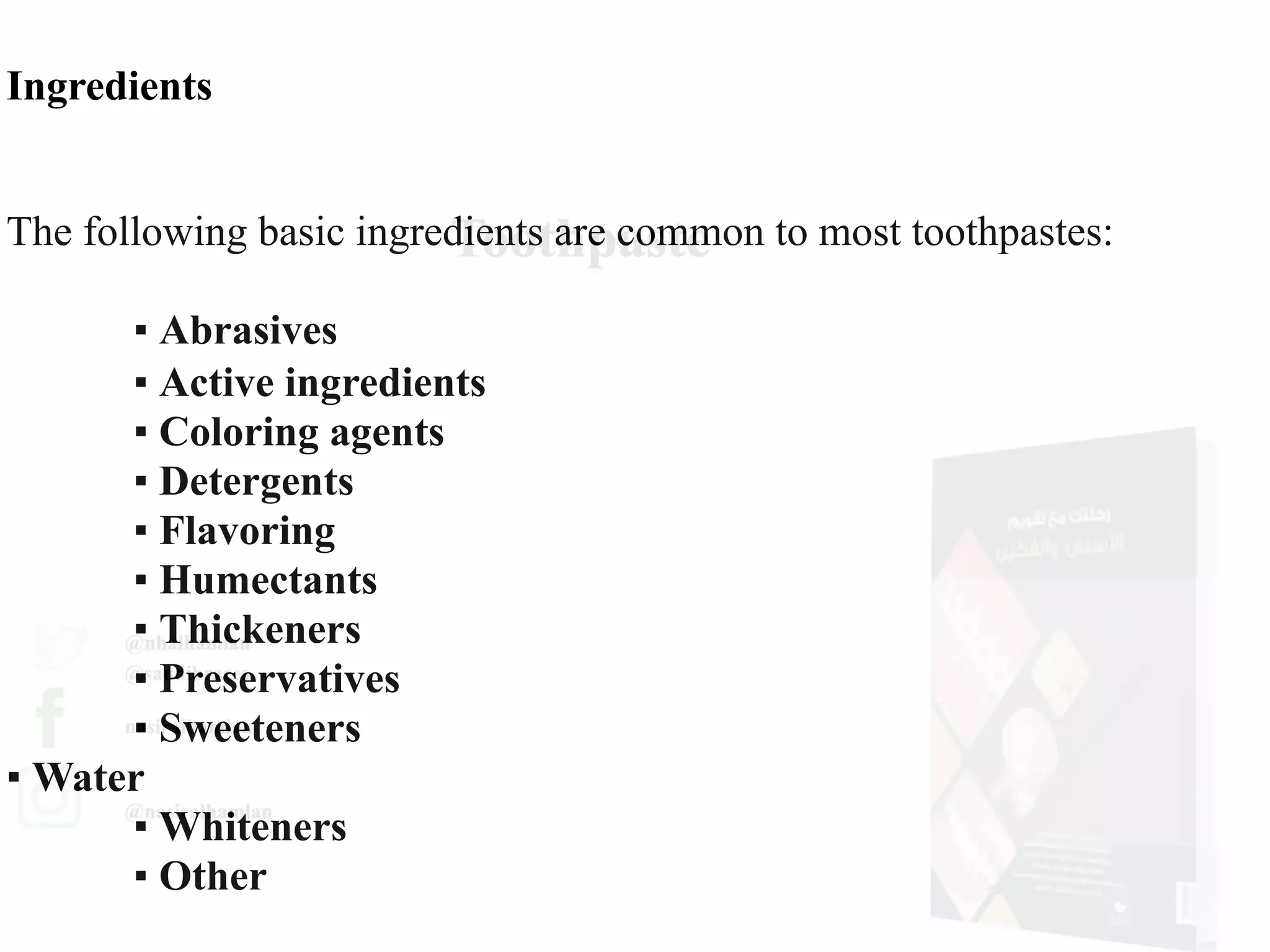
The following basic ingredients are common to most toothpastes:
▪ Abrasives
▪ Active ingredients
▪ Coloring agents
▪ Detergents
▪ Flavoring
▪ Humectants
▪ Thickeners
▪ Preservatives
▪ Sweeteners
▪ Water
▪ Whiteners
▪ Other
Ingredients
Abrasives10-50%
Used to aid in the removal of plaque / tartar.
Examples: alumina, hydrated silica, dicalcium phosphate, salt,
pumice, kaolin, bentonite, calcium carbonate (chalk), sodium
bicarbonate (baking soda), calcium pyrophosphate
Active ingredients 0.2-1.5%
Ingredients
Active ingredients are those components of toothpaste that have a direct effect on
the teeth or gums. Active ingredients must be blended in a way that their activity is
not lost.
Examples:
Decay prevention;
- Fluoride (sodium monofluorophosphate, stannous fluoride, or sodium fluoride),
xylitol [reduces decay levels and enhances remineralization]
PPM
1500
1000
500
Sodium fluoride
0.32%
0.22%
0.11%
Sodium Monofluorophosphate
1.14%
0.76%
0.38%
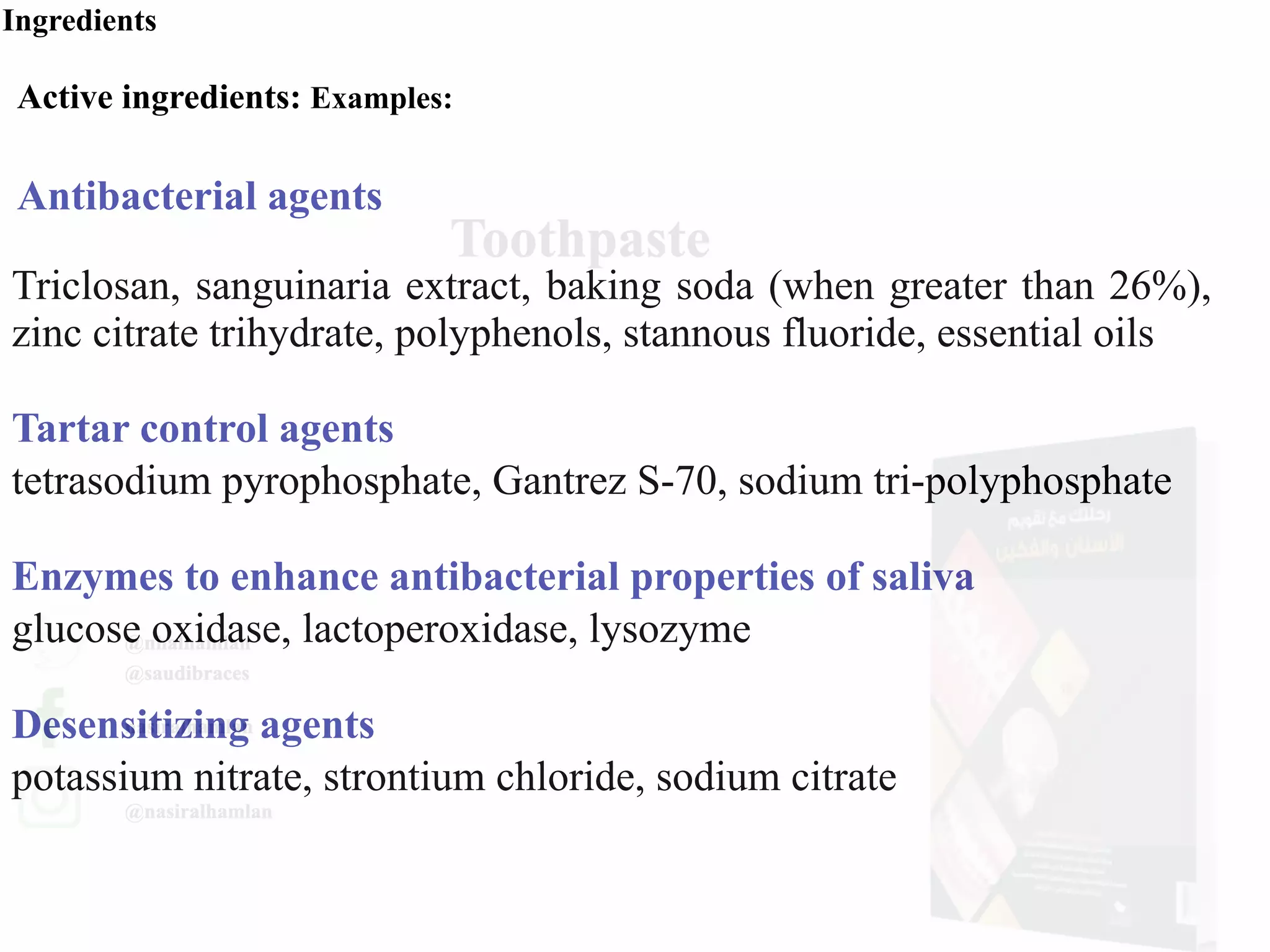
Active ingredients: Examples:
Antibacterial agents
Ingredients
Triclosan, sanguinaria extract, baking soda (when greater than 26%),
zinc citrate trihydrate, polyphenols, stannous fluoride, essential oils
Tartar control agents
tetrasodium pyrophosphate, Gantrez S-70, sodium tri-polyphosphate
Enzymes to enhance antibacterial properties of saliva
glucose oxidase, lactoperoxidase, lysozyme
Desensitizing agents
potassium nitrate, strontium chloride, sodium citrate
Ingredients
Coloring agents
Coloring adds pleasant esthetics so that we find toothpaste visually
appealing.
Examples: red, green (D&C #5), and blue; titanium dioxide (white)
Ingredients
Detergents 0.5-2%
Also known as soaps, foaming agents, or surfactants. All
surfactants help aid in the removal of compounds that have
properties different from one another like oil and water. The
presence of detergents requires flavoring to mask their dreadful
flavor.
Examples: sodium lauryl sulfate (SLS), sodium lauroyl
sarcosinate, sodium N-lauryl sarcosinate, dioctyl sodium
sulfosuccinate, sodium stearyl fumarate, sodium stearyl lactate,
sodium lauryl sulfoacetate
Ingredients
Flavoring 0.8-1.5%
Flavoring is added for obvious reasons. It is also functions to mask
the flavor of the detergent component, especially SLS.
Mint flavors, especially when combined with menthol, contain oils
that volatilize in the warmth of the mouth. The volatilization
requires energy, which is extracted from the tissues of the mouth as
heat, thereby imparting a cooling sensation.
Examples: peppermint, spearmint, cinnamon, wintergreen, and
menthol, fennel
Ingredients
Humectants15-70%
Humectants retain water and help maintain a consistent paste-like
quality in the toothpaste, preventing a separation of the liquid and
solids in the toothpaste. Humectants in some cases can affect flavor,
coolness and sweetness.
Examples: sorbitol, pentatol, glycerol, glycerin, propylene glycol,
polyethylene glycol, water, xylitol (uncommon, but superior), PEG
8 (polyoxyethylene glycol esters), PPG (polyoxyethylene ethers)
Ingredients
Thickeners 0.4-2%
Thickeners create the texture of toothpaste.
Examples: carrageenan, cellulose gum, xanthan gum, gum arabic,
sodium carboxymethyl cellulose (CMC), cellulose ethers, sodium
alginate, carbopols, silica thickeners, sodium aluminum silicates,
clays
Ingredients
Preservatives
Preservatives prevent the growth of microorganisms in toothpaste.
Examples: sodium benzoate, methyl paraben, ethyl paraben
Ingredients
Sweeteners 0.8-1.5%
Sweeteners are provided for palatability and acceptance. Most
toothpastes have sorbitol or glycerol/glycerin as humectants which
are sweet, but only about 60% the sweetness of sucrose (table sugar),
so other sweeteners are needed.
Examples: calcium or sodium saccharin (banned in Canada),
aspartame (Nutrasweet)
Ingredients
water 0-50%
Necessary component of toothpaste.
Ingredients
Whiteners
Whiteners added to toothpaste cannot whiten the teeth, but rather
work to reduce stain on teeth.
Examples: peroxide, citroxain, titanium dioxide, and certain
abrasives
Ingredients
Other
Many other agents are included in toothpaste for beneficial effects.
Examples: stabilized chlorine dioxide, mellaleuca, neem, CPP-ACP
More About Toothpaste
Fluoride
Source
Drinking water fluoride (ideal)
Toothpaste fluoride
Gel-Kam, Omni Gel
Prevident (Rx required)
office strength (Rx required)
PPM
1
1,000 - 1,500
1,000
5,000
9,000
▪ Fluoride in the drinking water is only for teeth that are still forming(until
age 16). It is built into the tooth.
▪ Fluoride in toothpaste and fluoride treatments are for the surfaces of
teeth - and definitely work to prevent decay.
Dietary Fluoride Supplement Recommendations
Fluoride ion level in drinking water (ppm)*
Age
Birth - 6 months
6 months - 3 years
3 - 6 years
6 - 16 years
less than 0.3 ppm
None
0.25 mg/day**
0.50 mg/day
1.0 mg/day
0.3 - 0.6 ppm
None
None
0.25 mg/day
0.50 mg/day
greater than0.6 ppm
None
None
None
None
* 1 part per million (ppm) = 1 milligram/liter (mg/L)
** 2.2 mg sodium fluoride contains 1 mg fluoride ion.
More About Toothpaste
Dietary Fluoride Supplement Recommendations
It is suggested that only children living in non-fluoridated areas use dietary
fluoride supplements between the ages of six months to 16 years. Your physician
or dentist can prescribe the correct dosage for your child based on the following
considerations.
• Level of fluoride in your drinking water. If the fluoride level is not known, it
should be tested first. State and local health departments can provide
information on testing drinking water for fluoride levels.
• A complete fluoride history should include all the your child's sources of
fluoride. Don't forget all water sources (drinking water, juice, etc.).
• If your child is to benefit from the cavity protection that dietary fluoride
supplements can provide, long-term use on a daily basis is required.
More About Toothpaste
Baking Soda Toothpaste
Toothpaste
(with baking soda)
Peroxicare Tartar Control
Crest
Colgate
Mentadent
%
baking soda
51%
20%
12%
5%
Baking soda is very low on abrasion (even plain baking
soda is less abrasive than Crest or Colgate).
It's primary function is to kill bacteria; however, at
least 26% baking soda is required.
Only Arm & Hammer Multi-Benefit Peroxicare toothpaste has
enough at 51%.
More About Toothpaste
Tartar Control
Tartar control works. The tartar control ingredients cannot remove tartar, they
only prevent it - about 40-50% reduction in the amount of tartar.
Even for the tartar that may form, it is much less tenacious when tartar control
is used all the time.
Tartar is hardened plaque germs. It is more beneficial to prevent tartar from
even forming by removing plaque completely by brushing and flossing
effectively.
Tartar is not the main problem, in fact, you can even have healthy gums with
tartar present, it's just more difficult to do. The plaque germs that adhere to the
rough tartar are the main problem. Tartar is also what stains, not teeth. No tartar,
no stain*.
* Over years teeth do in fact pick up some color internally and this is what tooth bleaching is
designed to address.
Some people are sensitive to a common ingredient in most toothpaste called
sodium lauryl sulfate that can cause Canker Sores.
More About Toothpaste
Toothpaste Without SLS (sodium lauryl sulfate)
More About Toothpaste
Desensitizing Toothpaste
Desensitizing toothpaste works if used regularly. It helps block
microscopic pores on the root surface. Also, it will take 4-6 weeks to feel
results.
A hint to speed the desensitizing process is to place a small amount of
desensitizing toothpaste on the exposed root surface when you are done
brushing and rinsing.
What does %w/w, %w/v and %v/v mean?
Percentages listed on ingredient labels are calculated in very specific ways. Here is the scoop on what
those percentages mean.
Percentage weight for weight - %w/w
This means the percent by weight of solute in the total weight of solution. Percent here is the number of
grams of solute in 100 grams of solution. For example, a 10% w/w solution of sodium fluoride would be
made by first dissolving 10 grams of sodium fluoride in a solvent (most probably water in this case) and then
adding solvent to a final weight of 100 grams of solution. (This is not 100 grams of solvent, but sufficient
solvent such that the final weight of solution, that is, solute (sodium fluoride) plus solvent (water), is 100
grams.
Percentage weight for volume - %w/v
This means the percent by weight of solute in the total volume of solution. Normally used where the solute
is a solid. For example, a 10% w/v sodium fluoride solution would be prepared by dissolving 10 grams of
sodium fluoride in 100ml of water.
Percentage volume for volume - %v/v
This means the percent by volume of solute in the total volume of solution. Normally used where the
solute is a liquid. For example, a 10% v/v ethanol solution (in water) is 10ml of ethanol in 100ml of solution.
More About Toothpaste
THANK YOU

Toothpaste

  • 1.
    Toothpaste Nasir Al-Hamlan BDS,MPH, MSc, FDS RCSEd, FDS RCSEd, MOrth RCSEd, FICD Consultant and Assistant Professor, Orthodontics King Saud bin Abdulaziz University for Health Sciences Riyadh, Saudi Arabia @nhalhamlan @saudibraces nasiralhamlan @nasiralhamlan
  • 2.
    ❑ Purpose ❑ History ❑Ingredients ❑ More about toothpaste with: ▪ Fluoride ▪ Baking Soda ▪ Tartar Control ▪ Toothpaste without SLS ▪ Desensitizing ▪ What does %w/w, %w/v and %v/v mean?
  • 3.
    History Recipes were foundfor making toothpaste that date back to 1500 BC. Hippocrates (460 - 377 BC) recommended their use.
  • 4.
    The 18th Century Theearliest record of an actual toothpaste was in 1780 and included scrubbing the teeth with a formula containing burnt bread (a common North American breakfast). History
  • 5.
    The 19th Century Inthe 19th century, charcoal became very popular for teeth cleaning purposes. Most toothpastes at this time were in the form of a powder. The purpose of the tooth powder was not only to clean the teeth, but to give fresh breath. History
  • 6.
    The 20th Century Inthe 1900's advertising began heralding the benefits of the active ingredients. Pepsodent contained the enzyme pepsin, which supposedly whitened teeth and dissolved dental plaque. Ipana contained ipecac, which was believed to be effective against the bacteria that caused periodontitis. In the 1950's, Procter & Gamble launched a marketing campaign for Crest with stannous fluoride which made it the No. 1 selling toothpaste for over forty years. History
  • 7.
    Purpose Toothpaste is notrequired to clean teeth. Toothpaste can aid in cleaning, but more importantly, it delivers active ingredients to help teeth and/or gums.
  • 8.
    Ingredients The following basicingredients are common to most toothpastes: ▪ Abrasives ▪ Active ingredients ▪ Coloring agents ▪ Detergents ▪ Flavoring ▪ Humectants ▪ Thickeners ▪ Preservatives ▪ Sweeteners ▪ Water ▪ Whiteners ▪ Other
  • 9.
    Ingredients Abrasives10-50% Used to aidin the removal of plaque / tartar. Examples: alumina, hydrated silica, dicalcium phosphate, salt, pumice, kaolin, bentonite, calcium carbonate (chalk), sodium bicarbonate (baking soda), calcium pyrophosphate
  • 10.
    Active ingredients 0.2-1.5% Ingredients Activeingredients are those components of toothpaste that have a direct effect on the teeth or gums. Active ingredients must be blended in a way that their activity is not lost. Examples: Decay prevention; - Fluoride (sodium monofluorophosphate, stannous fluoride, or sodium fluoride), xylitol [reduces decay levels and enhances remineralization] PPM 1500 1000 500 Sodium fluoride 0.32% 0.22% 0.11% Sodium Monofluorophosphate 1.14% 0.76% 0.38%
  • 11.
    Active ingredients: Examples: Antibacterialagents Ingredients Triclosan, sanguinaria extract, baking soda (when greater than 26%), zinc citrate trihydrate, polyphenols, stannous fluoride, essential oils Tartar control agents tetrasodium pyrophosphate, Gantrez S-70, sodium tri-polyphosphate Enzymes to enhance antibacterial properties of saliva glucose oxidase, lactoperoxidase, lysozyme Desensitizing agents potassium nitrate, strontium chloride, sodium citrate
  • 12.
    Ingredients Coloring agents Coloring addspleasant esthetics so that we find toothpaste visually appealing. Examples: red, green (D&C #5), and blue; titanium dioxide (white)
  • 13.
    Ingredients Detergents 0.5-2% Also knownas soaps, foaming agents, or surfactants. All surfactants help aid in the removal of compounds that have properties different from one another like oil and water. The presence of detergents requires flavoring to mask their dreadful flavor. Examples: sodium lauryl sulfate (SLS), sodium lauroyl sarcosinate, sodium N-lauryl sarcosinate, dioctyl sodium sulfosuccinate, sodium stearyl fumarate, sodium stearyl lactate, sodium lauryl sulfoacetate
  • 14.
    Ingredients Flavoring 0.8-1.5% Flavoring isadded for obvious reasons. It is also functions to mask the flavor of the detergent component, especially SLS. Mint flavors, especially when combined with menthol, contain oils that volatilize in the warmth of the mouth. The volatilization requires energy, which is extracted from the tissues of the mouth as heat, thereby imparting a cooling sensation. Examples: peppermint, spearmint, cinnamon, wintergreen, and menthol, fennel
  • 15.
    Ingredients Humectants15-70% Humectants retain waterand help maintain a consistent paste-like quality in the toothpaste, preventing a separation of the liquid and solids in the toothpaste. Humectants in some cases can affect flavor, coolness and sweetness. Examples: sorbitol, pentatol, glycerol, glycerin, propylene glycol, polyethylene glycol, water, xylitol (uncommon, but superior), PEG 8 (polyoxyethylene glycol esters), PPG (polyoxyethylene ethers)
  • 16.
    Ingredients Thickeners 0.4-2% Thickeners createthe texture of toothpaste. Examples: carrageenan, cellulose gum, xanthan gum, gum arabic, sodium carboxymethyl cellulose (CMC), cellulose ethers, sodium alginate, carbopols, silica thickeners, sodium aluminum silicates, clays
  • 17.
    Ingredients Preservatives Preservatives prevent thegrowth of microorganisms in toothpaste. Examples: sodium benzoate, methyl paraben, ethyl paraben
  • 18.
    Ingredients Sweeteners 0.8-1.5% Sweeteners areprovided for palatability and acceptance. Most toothpastes have sorbitol or glycerol/glycerin as humectants which are sweet, but only about 60% the sweetness of sucrose (table sugar), so other sweeteners are needed. Examples: calcium or sodium saccharin (banned in Canada), aspartame (Nutrasweet)
  • 19.
  • 20.
    Ingredients Whiteners Whiteners added totoothpaste cannot whiten the teeth, but rather work to reduce stain on teeth. Examples: peroxide, citroxain, titanium dioxide, and certain abrasives
  • 21.
    Ingredients Other Many other agentsare included in toothpaste for beneficial effects. Examples: stabilized chlorine dioxide, mellaleuca, neem, CPP-ACP
  • 22.
  • 23.
    More About Toothpaste Fluoride Source Drinkingwater fluoride (ideal) Toothpaste fluoride Gel-Kam, Omni Gel Prevident (Rx required) office strength (Rx required) PPM 1 1,000 - 1,500 1,000 5,000 9,000 ▪ Fluoride in the drinking water is only for teeth that are still forming(until age 16). It is built into the tooth. ▪ Fluoride in toothpaste and fluoride treatments are for the surfaces of teeth - and definitely work to prevent decay.
  • 24.
    Dietary Fluoride SupplementRecommendations Fluoride ion level in drinking water (ppm)* Age Birth - 6 months 6 months - 3 years 3 - 6 years 6 - 16 years less than 0.3 ppm None 0.25 mg/day** 0.50 mg/day 1.0 mg/day 0.3 - 0.6 ppm None None 0.25 mg/day 0.50 mg/day greater than0.6 ppm None None None None * 1 part per million (ppm) = 1 milligram/liter (mg/L) ** 2.2 mg sodium fluoride contains 1 mg fluoride ion. More About Toothpaste
  • 25.
    Dietary Fluoride SupplementRecommendations It is suggested that only children living in non-fluoridated areas use dietary fluoride supplements between the ages of six months to 16 years. Your physician or dentist can prescribe the correct dosage for your child based on the following considerations. • Level of fluoride in your drinking water. If the fluoride level is not known, it should be tested first. State and local health departments can provide information on testing drinking water for fluoride levels. • A complete fluoride history should include all the your child's sources of fluoride. Don't forget all water sources (drinking water, juice, etc.). • If your child is to benefit from the cavity protection that dietary fluoride supplements can provide, long-term use on a daily basis is required. More About Toothpaste
  • 26.
    More About Toothpaste BakingSoda Toothpaste Toothpaste (with baking soda) Peroxicare Tartar Control Crest Colgate Mentadent % baking soda 51% 20% 12% 5% Baking soda is very low on abrasion (even plain baking soda is less abrasive than Crest or Colgate). It's primary function is to kill bacteria; however, at least 26% baking soda is required. Only Arm & Hammer Multi-Benefit Peroxicare toothpaste has enough at 51%.
  • 27.
    More About Toothpaste TartarControl Tartar control works. The tartar control ingredients cannot remove tartar, they only prevent it - about 40-50% reduction in the amount of tartar. Even for the tartar that may form, it is much less tenacious when tartar control is used all the time. Tartar is hardened plaque germs. It is more beneficial to prevent tartar from even forming by removing plaque completely by brushing and flossing effectively. Tartar is not the main problem, in fact, you can even have healthy gums with tartar present, it's just more difficult to do. The plaque germs that adhere to the rough tartar are the main problem. Tartar is also what stains, not teeth. No tartar, no stain*. * Over years teeth do in fact pick up some color internally and this is what tooth bleaching is designed to address.
  • 28.
    Some people aresensitive to a common ingredient in most toothpaste called sodium lauryl sulfate that can cause Canker Sores. More About Toothpaste Toothpaste Without SLS (sodium lauryl sulfate)
  • 29.
    More About Toothpaste DesensitizingToothpaste Desensitizing toothpaste works if used regularly. It helps block microscopic pores on the root surface. Also, it will take 4-6 weeks to feel results. A hint to speed the desensitizing process is to place a small amount of desensitizing toothpaste on the exposed root surface when you are done brushing and rinsing.
  • 30.
    What does %w/w,%w/v and %v/v mean? Percentages listed on ingredient labels are calculated in very specific ways. Here is the scoop on what those percentages mean. Percentage weight for weight - %w/w This means the percent by weight of solute in the total weight of solution. Percent here is the number of grams of solute in 100 grams of solution. For example, a 10% w/w solution of sodium fluoride would be made by first dissolving 10 grams of sodium fluoride in a solvent (most probably water in this case) and then adding solvent to a final weight of 100 grams of solution. (This is not 100 grams of solvent, but sufficient solvent such that the final weight of solution, that is, solute (sodium fluoride) plus solvent (water), is 100 grams. Percentage weight for volume - %w/v This means the percent by weight of solute in the total volume of solution. Normally used where the solute is a solid. For example, a 10% w/v sodium fluoride solution would be prepared by dissolving 10 grams of sodium fluoride in 100ml of water. Percentage volume for volume - %v/v This means the percent by volume of solute in the total volume of solution. Normally used where the solute is a liquid. For example, a 10% v/v ethanol solution (in water) is 10ml of ethanol in 100ml of solution. More About Toothpaste
  • 31.