Canola Viruses:
Ecology, Detection and Occurrence
5 August 2014
Joop van Leur1
, Mohammad Aftab2
, Kurt Lindbeck1
, Angela
Freeman2
1
New South Wales Department of Primary Industries
2
Department of Environment and Primary Industries, Victoria
Email: joop.vanleur@dpi.nsw.gov.au
What are plant viruses?
• A relatively small amount of genetic material (mostly RNA)
encapsulated by a protein coat.
• Most plant viruses need living plant tissue to survive between
cropping seasons. Some can survive in seed embryo’s
• Most plant viruses need an insect vector (mostly an aphid) to
spread from an infected plant to a healthy plant. Vector
ecology has to be understood in order to understand virus
spread
• Different modes of vector transmission exist; persistently
transmitted and non-persistently transmitted viruses.
• Once a plant is virus infected it can not be cured. Virus control
strategies are therefore based on preventing virus infections.
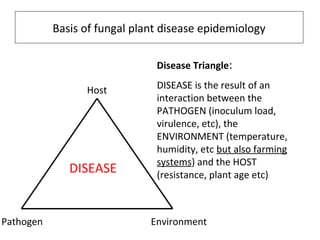
EnvironmentPathogen
Host
DISEASE
Disease Triangle:
DISEASE is the result of an
interaction between the
PATHOGEN (inoculum load,
virulence, etc), the
ENVIRONMENT (temperature,
humidity, etc but also farming
systems) and the HOST
(resistance, plant age etc)
Basis of fungal plant disease epidemiology
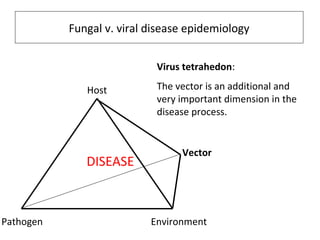
Virus tetrahedon:
The vector is an additional and
very important dimension in the
disease process.
EnvironmentPathogen
Host
DISEASE
Vector
Fungal v. viral disease epidemiology
The importance of vectors to virus epidemiology
• Vectors are the most difficult and therefore least studied
component in virus ecology.
• Nearly all of the important pulse viruses require aphid vectors
for their spread.
• The way the virus is transmitted (persistently or non-
persistently) is of crucial importance to design control
strategies.
• Not every aphid is viruliferous!
• Without aphid movement there will be no spread of plant
viruses: Colonising aphids are not necessarily the most
important virus vectors.
From RL Groves (2009) “Managing Viruses and Vectors in
Vegetable Crops”, University of Wisconsin
Non-persistently transmitted (stylet-borne) plant viruses
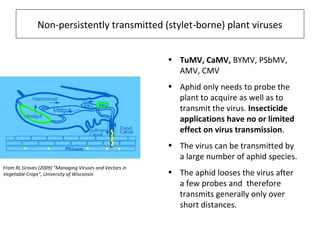
• TuMV, CaMV, BYMV, PSbMV,
AMV, CMV
• Aphid only needs to probe the
plant to acquire as well as to
transmit the virus. Insecticide
applications have no or limited
effect on virus transmission.
• The virus can be transmitted by
a large number of aphid species.
• The aphid looses the virus after
a few probes and therefore
transmits generally only over
short distances.
From RL Groves (2009) “Managing Viruses and Vectors in
Vegetable Crops”, University of Wisconsin
Persistently (circulative) transmitted plant viruses
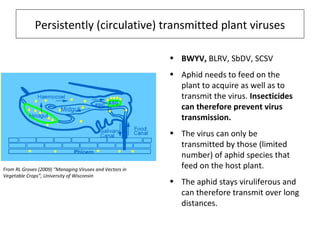
• BWYV, BLRV, SbDV, SCSV
• Aphid needs to feed on the
plant to acquire as well as to
transmit the virus. Insecticides
can therefore prevent virus
transmission.
• The virus can only be
transmitted by those (limited
number) of aphid species that
feed on the host plant.
• The aphid stays viruliferous and
can therefore transmit over long
distances.
Aphid transmission of persistently transmitted, phloem-limited, viruses
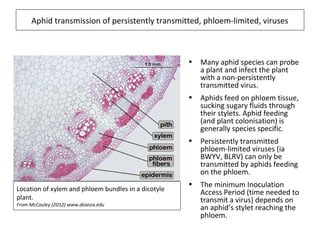
• Many aphid species can probe
a plant and infect the plant
with a non-persistently
transmitted virus.
• Aphids feed on phloem tissue,
sucking sugary fluids through
their stylets. Aphid feeding
(and plant colonisation) is
generally species specific.
• Persistently transmitted
phloem-limited viruses (ia
BWYV, BLRV) can only be
transmitted by aphids feeding
on the phloem.
• The minimum Inoculation
Access Period (time needed to
transmit a virus) depends on
an aphid’s stylet reaching the
phloem.
Location of xylem and phloem bundles in a dicotyle
plant.
From McCauley (2012) www.deanza.edu
Importance of Green Peach Aphid (Myzus persicae) as a vector
of BWYV in canola crops
• Highly efficient vector of BWYV and a number of other viruses.
• Will feed on a large number of plant species (polyfagous). Can
therefore bring the virus from summer hosts in a canola crop.
• Active in autumn when emerging seedlings are particularly
vulnerable to viruses and aphid feeding.
• Moves more in the crop than the other canola aphid species (?)
• Has developed resistance to a range insecticides.
Virus Control Strategies
• Virus control strategies are based on preventing infection as there are
no curative options.
• First virus infections in a crop originate from immigrating vectors.
• By the time aphids are noticed in the crop, infection is likely to have
already occurred.
• Avoiding virus infection (sow in stubble, higher sowing densities, later
sowing, good management practices)
• Control of / Distance from inoculum sources (weeds, pasture legumes)
• Compensation for affected plants (high sowing densities)
• Use of aphicides seed dressings for persistently transmitted viruses
• Virus resistance
Canola viruses reported in Australia
• Beet western yellows virus (BWYV) / Turnip yellows virus (TuYV)
– Persistently transmitted
– Wide host range (> 150 species)
– Early infection can cause yield loss
– Frequently reported, but generally low levels
• Turnip mosaic virus (TuMV)
– Non-persistently transmitted
– Very wide host range
– Can cause severe losses
– High levels reported in juncea, rarely (so far) in canola
• Cauliflower mosaic virus (CaMV)
– Non-persistently transmitted
– Limited host range
– Only low levels reported
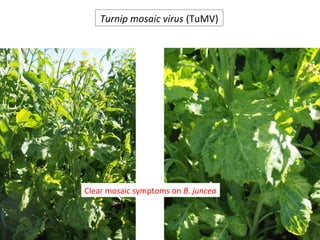
Turnip mosaic virus (TuMV)
Clear mosaic symptoms on B. juncea
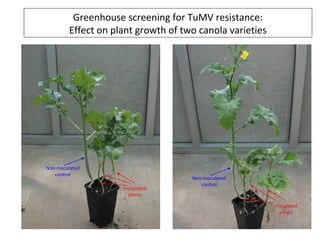
Greenhouse screening for TuMV resistance:
Effect on plant growth of two canola varieties
Non-inoculated
control
Inoculated
plants
Non-inoculated
control
Inoculated
plants
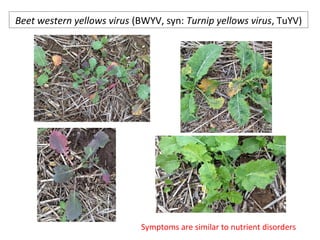
Beet western yellows virus (BWYV, syn: Turnip yellows virus, TuYV)
Symptoms are similar to nutrient disorders
Need for virus diagnostics
• Symptoms caused by a range of biotic and abiotic stress
factors can easily be confused with those caused by viruses.
• Need to determine latent (non-symptomatic) infections.
• The diagnostics need to be reliable, yet fast and able to
handle large numbers of individual plant samples.
• For diagnosis of field samples from surveys and screening
trials cost is often more important than precision.
Virus diagnostic techniques
• Polymerase chain reaction (PCR)
– High degree of precision
– High costs
• Enzyme-linked immunosorbent assay (ELISA)
– High degree of precision
– Moderate costs
• Tissue-blot immunassay (TBIA)
– Acceptable degree of precision
– Relatively low costs
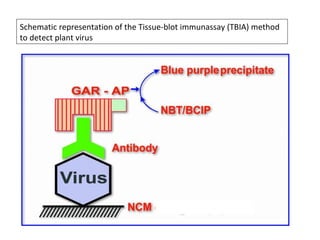
Schematic representation of the Tissue-blot immunassay (TBIA) method
to detect plant virus
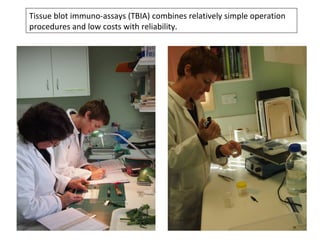
Tissue blot immuno-assays (TBIA) combines relatively simple operation
procedures and low costs with reliability.
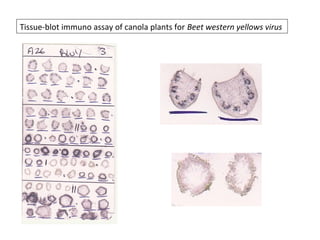
Tissue-blot immuno assay of canola plants for Beet western yellows virus
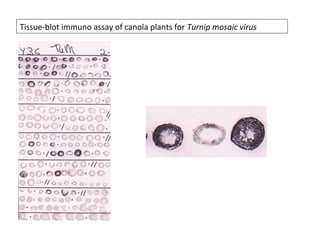
Tissue-blot immuno assay of canola plants for Turnip mosaic virus
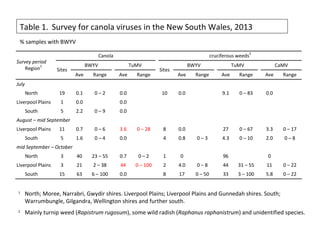
Table 1. Survey for canola viruses in the New South Wales, 2013
1
North; Moree, Narrabri, Gwydir shires. Liverpool Plains; Liverpool Plains and Gunnedah shires. South;
Warrumbungle, Gilgandra, Wellington shires and further south.
2
Mainly turnip weed (Rapistrum rugosum), some wild radish (Raphanus raphanistrum) and unidentified species.
Canola cruciferous weeds
2
BWYV TuMV BWYV TuMV CaMV
Survey period
Region
1
Sites
Ave Range Ave Range
Sites
Ave Range Ave Range Ave Range
July
North 19 0.1 0 – 2 0.0 10 0.0 9.1 0 – 83 0.0
Liverpool Plains 1 0.0 0.0
South 5 2.2 0 – 9 0.0
August – mid September
Liverpool Plains 11 0.7 0 – 6 3.6 0 – 28 8 0.0 27 0 – 67 3.3 0 – 17
South 5 1.6 0 – 4 0.0 4 0.8 0 – 3 4.3 0 – 10 2.0 0 – 8
mid September – October
North 3 40 23 – 55 0.7 0 – 2 1 0 96 0
Liverpool Plains 3 21 2 – 38 44 0 – 100 2 4.0 0 – 8 44 31 – 55 11 0 – 22
South 15 63 6 – 100 0.0 8 17 0 – 50 33 3 – 100 5.8 0 – 22
% samples with BWYV
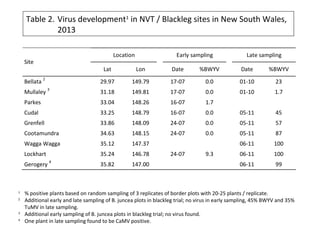
Table 2. Virus development1
in NVT / Blackleg sites in New South Wales,
2013
1
% positive plants based on random sampling of 3 replicates of border plots with 20-25 plants / replicate.
2
Additional early and late sampling of B. juncea plots in blackleg trial; no virus in early sampling, 45% BWYV and 35%
TuMV in late sampling.
3
Additional early sampling of B. juncea plots in blackleg trial; no virus found.
4
One plant in late sampling found to be CaMV positive.
Location Early sampling Late sampling
Site
Lat Lon Date %BWYV Date %BWYV
Bellata
2
29.97 149.79 17-07 0.0 01-10 23
Mullaley
3
31.18 149.81 17-07 0.0 01-10 1.7
Parkes 33.04 148.26 16-07 1.7
Cudal 33.25 148.79 16-07 0.0 05-11 45
Grenfell 33.86 148.09 24-07 0.0 05-11 57
Cootamundra 34.63 148.15 24-07 0.0 05-11 87
Wagga Wagga 35.12 147.37 06-11 100
Lockhart 35.24 146.78 24-07 9.3 06-11 100
Gerogery
4
35.82 147.00 06-11 99
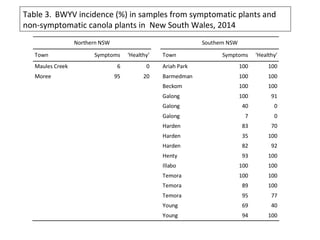
Table 3. BWYV incidence (%) in samples from symptomatic plants and
non-symptomatic canola plants in New South Wales, 2014
Northern NSW Southern NSW
Town Symptoms ‘Healthy’ Town Symptoms ‘Healthy’
Maules Creek 6 0 Ariah Park 100 100
Moree 95 20 Barmedman 100 100
Beckom 100 100
Galong 100 91
Galong 40 0
Galong 7 0
Harden 83 70
Harden 35 100
Harden 82 92
Henty 93 100
Illabo 100 100
Temora 100 100
Temora 89 100
Temora 95 77
Young 69 40
Young 94 100
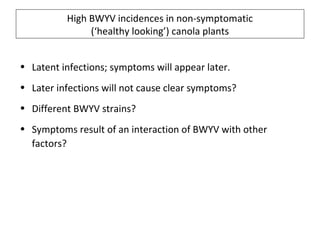
High BWYV incidences in non-symptomatic
(‘healthy looking’) canola plants
• Latent infections; symptoms will appear later.
• Later infections will not cause clear symptoms?
• Different BWYV strains?
• Symptoms result of an interaction of BWYV with other
factors?
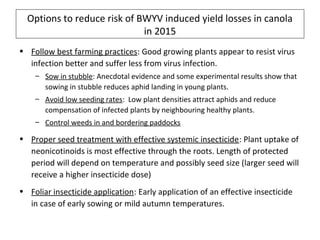
Options to reduce risk of BWYV induced yield losses in canola
in 2015
• Follow best farming practices: Good growing plants appear to resist virus
infection better and suffer less from virus infection.
– Sow in stubble: Anecdotal evidence and some experimental results show that
sowing in stubble reduces aphid landing in young plants.
– Avoid low seeding rates: Low plant densities attract aphids and reduce
compensation of infected plants by neighbouring healthy plants.
– Control weeds in and bordering paddocks
• Proper seed treatment with effective systemic insecticide: Plant uptake of
neonicotinoids is most effective through the roots. Length of protected
period will depend on temperature and possibly seed size (larger seed will
receive a higher insecticide dose)
• Foliar insecticide application: Early application of an effective insecticide
in case of early sowing or mild autumn temperatures.
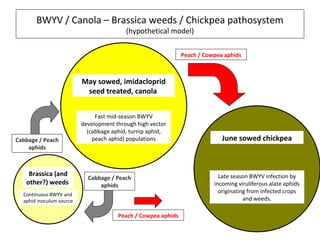
BWYV / Canola – Brassica weeds / Chickpea pathosystem
(hypothetical model)
May sowed, imidacloprid
seed treated, canola
Fast mid-season BWYV
development through high vector
(cabbage aphid, turnip aphid,
peach aphid) populations
Brassica (and
other?) weeds
Continuous BWYV and
aphid inoculum source
June sowed chickpea
Late season BWYV infection by
incoming viruliferous alate aphids
originating from infected crops
and weeds.
Cabbage / Peach
aphids
Peach / Cowpea aphids
Cabbage / Peach
aphids
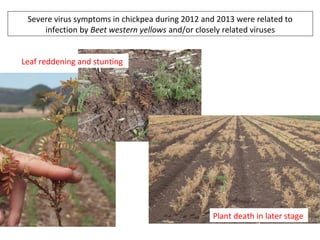
Severe virus symptoms in chickpea during 2012 and 2013 were related to
infection by Beet western yellows and/or closely related viruses
Leaf reddening and stunting
Plant death in later stage
Risk of BWYV induced yield losses in pulse crops
Experience in the Northern Region
• No clear relation between BWYV infection in canola and BWYV
infection in pulse crops was found in 2013.
• BWYV is readily found in faba bean and field pea, but does not
appear to cause symptoms.
• BWYV can cause severe problems in chickpeas, but other BWYV
related viruses that are not hosted by canola appear to be more
important.
• Importance of BWYV in lentils is not clear. In the northern region
lentils are infected by a range of viruses (BWYV, BLRV, CMV, AMV),
causing regular crop failure.
Acknowledgements
• Funding
– Grains Research and Development Cooperation
– Australian Oilseeds Federation
• Entomological advice
– Paul Umina, Melina Miles
• Sample collection
– Canola growers and agronomists
• Technical Assistance
– J Sipple, J George, M Riley, S Marshman

Joop van Leur Canola viruses 2014-0805

  • 1.
    Canola Viruses: Ecology, Detectionand Occurrence 5 August 2014 Joop van Leur1 , Mohammad Aftab2 , Kurt Lindbeck1 , Angela Freeman2 1 New South Wales Department of Primary Industries 2 Department of Environment and Primary Industries, Victoria Email: joop.vanleur@dpi.nsw.gov.au
  • 2.
    What are plantviruses? • A relatively small amount of genetic material (mostly RNA) encapsulated by a protein coat. • Most plant viruses need living plant tissue to survive between cropping seasons. Some can survive in seed embryo’s • Most plant viruses need an insect vector (mostly an aphid) to spread from an infected plant to a healthy plant. Vector ecology has to be understood in order to understand virus spread • Different modes of vector transmission exist; persistently transmitted and non-persistently transmitted viruses. • Once a plant is virus infected it can not be cured. Virus control strategies are therefore based on preventing virus infections.
  • 3.
    EnvironmentPathogen Host DISEASE Disease Triangle: DISEASE isthe result of an interaction between the PATHOGEN (inoculum load, virulence, etc), the ENVIRONMENT (temperature, humidity, etc but also farming systems) and the HOST (resistance, plant age etc) Basis of fungal plant disease epidemiology
  • 4.
    Virus tetrahedon: The vectoris an additional and very important dimension in the disease process. EnvironmentPathogen Host DISEASE Vector Fungal v. viral disease epidemiology
  • 5.
    The importance ofvectors to virus epidemiology • Vectors are the most difficult and therefore least studied component in virus ecology. • Nearly all of the important pulse viruses require aphid vectors for their spread. • The way the virus is transmitted (persistently or non- persistently) is of crucial importance to design control strategies. • Not every aphid is viruliferous! • Without aphid movement there will be no spread of plant viruses: Colonising aphids are not necessarily the most important virus vectors.
  • 6.
    From RL Groves(2009) “Managing Viruses and Vectors in Vegetable Crops”, University of Wisconsin Non-persistently transmitted (stylet-borne) plant viruses • TuMV, CaMV, BYMV, PSbMV, AMV, CMV • Aphid only needs to probe the plant to acquire as well as to transmit the virus. Insecticide applications have no or limited effect on virus transmission. • The virus can be transmitted by a large number of aphid species. • The aphid looses the virus after a few probes and therefore transmits generally only over short distances.
  • 7.
    From RL Groves(2009) “Managing Viruses and Vectors in Vegetable Crops”, University of Wisconsin Persistently (circulative) transmitted plant viruses • BWYV, BLRV, SbDV, SCSV • Aphid needs to feed on the plant to acquire as well as to transmit the virus. Insecticides can therefore prevent virus transmission. • The virus can only be transmitted by those (limited number) of aphid species that feed on the host plant. • The aphid stays viruliferous and can therefore transmit over long distances.
  • 8.
    Aphid transmission ofpersistently transmitted, phloem-limited, viruses • Many aphid species can probe a plant and infect the plant with a non-persistently transmitted virus. • Aphids feed on phloem tissue, sucking sugary fluids through their stylets. Aphid feeding (and plant colonisation) is generally species specific. • Persistently transmitted phloem-limited viruses (ia BWYV, BLRV) can only be transmitted by aphids feeding on the phloem. • The minimum Inoculation Access Period (time needed to transmit a virus) depends on an aphid’s stylet reaching the phloem. Location of xylem and phloem bundles in a dicotyle plant. From McCauley (2012) www.deanza.edu
  • 9.
    Importance of GreenPeach Aphid (Myzus persicae) as a vector of BWYV in canola crops • Highly efficient vector of BWYV and a number of other viruses. • Will feed on a large number of plant species (polyfagous). Can therefore bring the virus from summer hosts in a canola crop. • Active in autumn when emerging seedlings are particularly vulnerable to viruses and aphid feeding. • Moves more in the crop than the other canola aphid species (?) • Has developed resistance to a range insecticides.
  • 10.
    Virus Control Strategies •Virus control strategies are based on preventing infection as there are no curative options. • First virus infections in a crop originate from immigrating vectors. • By the time aphids are noticed in the crop, infection is likely to have already occurred. • Avoiding virus infection (sow in stubble, higher sowing densities, later sowing, good management practices) • Control of / Distance from inoculum sources (weeds, pasture legumes) • Compensation for affected plants (high sowing densities) • Use of aphicides seed dressings for persistently transmitted viruses • Virus resistance
  • 11.
    Canola viruses reportedin Australia • Beet western yellows virus (BWYV) / Turnip yellows virus (TuYV) – Persistently transmitted – Wide host range (> 150 species) – Early infection can cause yield loss – Frequently reported, but generally low levels • Turnip mosaic virus (TuMV) – Non-persistently transmitted – Very wide host range – Can cause severe losses – High levels reported in juncea, rarely (so far) in canola • Cauliflower mosaic virus (CaMV) – Non-persistently transmitted – Limited host range – Only low levels reported
  • 12.
    Turnip mosaic virus(TuMV) Clear mosaic symptoms on B. juncea
  • 13.
    Greenhouse screening forTuMV resistance: Effect on plant growth of two canola varieties Non-inoculated control Inoculated plants Non-inoculated control Inoculated plants
  • 14.
    Beet western yellowsvirus (BWYV, syn: Turnip yellows virus, TuYV) Symptoms are similar to nutrient disorders
  • 15.
    Need for virusdiagnostics • Symptoms caused by a range of biotic and abiotic stress factors can easily be confused with those caused by viruses. • Need to determine latent (non-symptomatic) infections. • The diagnostics need to be reliable, yet fast and able to handle large numbers of individual plant samples. • For diagnosis of field samples from surveys and screening trials cost is often more important than precision.
  • 16.
    Virus diagnostic techniques •Polymerase chain reaction (PCR) – High degree of precision – High costs • Enzyme-linked immunosorbent assay (ELISA) – High degree of precision – Moderate costs • Tissue-blot immunassay (TBIA) – Acceptable degree of precision – Relatively low costs
  • 17.
    Schematic representation ofthe Tissue-blot immunassay (TBIA) method to detect plant virus
  • 18.
    Tissue blot immuno-assays(TBIA) combines relatively simple operation procedures and low costs with reliability.
  • 19.
    Tissue-blot immuno assayof canola plants for Beet western yellows virus
  • 20.
    Tissue-blot immuno assayof canola plants for Turnip mosaic virus
  • 21.
    Table 1. Surveyfor canola viruses in the New South Wales, 2013 1 North; Moree, Narrabri, Gwydir shires. Liverpool Plains; Liverpool Plains and Gunnedah shires. South; Warrumbungle, Gilgandra, Wellington shires and further south. 2 Mainly turnip weed (Rapistrum rugosum), some wild radish (Raphanus raphanistrum) and unidentified species. Canola cruciferous weeds 2 BWYV TuMV BWYV TuMV CaMV Survey period Region 1 Sites Ave Range Ave Range Sites Ave Range Ave Range Ave Range July North 19 0.1 0 – 2 0.0 10 0.0 9.1 0 – 83 0.0 Liverpool Plains 1 0.0 0.0 South 5 2.2 0 – 9 0.0 August – mid September Liverpool Plains 11 0.7 0 – 6 3.6 0 – 28 8 0.0 27 0 – 67 3.3 0 – 17 South 5 1.6 0 – 4 0.0 4 0.8 0 – 3 4.3 0 – 10 2.0 0 – 8 mid September – October North 3 40 23 – 55 0.7 0 – 2 1 0 96 0 Liverpool Plains 3 21 2 – 38 44 0 – 100 2 4.0 0 – 8 44 31 – 55 11 0 – 22 South 15 63 6 – 100 0.0 8 17 0 – 50 33 3 – 100 5.8 0 – 22 % samples with BWYV
  • 22.
    Table 2. Virusdevelopment1 in NVT / Blackleg sites in New South Wales, 2013 1 % positive plants based on random sampling of 3 replicates of border plots with 20-25 plants / replicate. 2 Additional early and late sampling of B. juncea plots in blackleg trial; no virus in early sampling, 45% BWYV and 35% TuMV in late sampling. 3 Additional early sampling of B. juncea plots in blackleg trial; no virus found. 4 One plant in late sampling found to be CaMV positive. Location Early sampling Late sampling Site Lat Lon Date %BWYV Date %BWYV Bellata 2 29.97 149.79 17-07 0.0 01-10 23 Mullaley 3 31.18 149.81 17-07 0.0 01-10 1.7 Parkes 33.04 148.26 16-07 1.7 Cudal 33.25 148.79 16-07 0.0 05-11 45 Grenfell 33.86 148.09 24-07 0.0 05-11 57 Cootamundra 34.63 148.15 24-07 0.0 05-11 87 Wagga Wagga 35.12 147.37 06-11 100 Lockhart 35.24 146.78 24-07 9.3 06-11 100 Gerogery 4 35.82 147.00 06-11 99
  • 23.
    Table 3. BWYVincidence (%) in samples from symptomatic plants and non-symptomatic canola plants in New South Wales, 2014 Northern NSW Southern NSW Town Symptoms ‘Healthy’ Town Symptoms ‘Healthy’ Maules Creek 6 0 Ariah Park 100 100 Moree 95 20 Barmedman 100 100 Beckom 100 100 Galong 100 91 Galong 40 0 Galong 7 0 Harden 83 70 Harden 35 100 Harden 82 92 Henty 93 100 Illabo 100 100 Temora 100 100 Temora 89 100 Temora 95 77 Young 69 40 Young 94 100
  • 24.
    High BWYV incidencesin non-symptomatic (‘healthy looking’) canola plants • Latent infections; symptoms will appear later. • Later infections will not cause clear symptoms? • Different BWYV strains? • Symptoms result of an interaction of BWYV with other factors?
  • 25.
    Options to reducerisk of BWYV induced yield losses in canola in 2015 • Follow best farming practices: Good growing plants appear to resist virus infection better and suffer less from virus infection. – Sow in stubble: Anecdotal evidence and some experimental results show that sowing in stubble reduces aphid landing in young plants. – Avoid low seeding rates: Low plant densities attract aphids and reduce compensation of infected plants by neighbouring healthy plants. – Control weeds in and bordering paddocks • Proper seed treatment with effective systemic insecticide: Plant uptake of neonicotinoids is most effective through the roots. Length of protected period will depend on temperature and possibly seed size (larger seed will receive a higher insecticide dose) • Foliar insecticide application: Early application of an effective insecticide in case of early sowing or mild autumn temperatures.
  • 26.
    BWYV / Canola– Brassica weeds / Chickpea pathosystem (hypothetical model) May sowed, imidacloprid seed treated, canola Fast mid-season BWYV development through high vector (cabbage aphid, turnip aphid, peach aphid) populations Brassica (and other?) weeds Continuous BWYV and aphid inoculum source June sowed chickpea Late season BWYV infection by incoming viruliferous alate aphids originating from infected crops and weeds. Cabbage / Peach aphids Peach / Cowpea aphids Peach / Cowpea aphids Cabbage / Peach aphids
  • 27.
    Severe virus symptomsin chickpea during 2012 and 2013 were related to infection by Beet western yellows and/or closely related viruses Leaf reddening and stunting Plant death in later stage
  • 28.
    Risk of BWYVinduced yield losses in pulse crops Experience in the Northern Region • No clear relation between BWYV infection in canola and BWYV infection in pulse crops was found in 2013. • BWYV is readily found in faba bean and field pea, but does not appear to cause symptoms. • BWYV can cause severe problems in chickpeas, but other BWYV related viruses that are not hosted by canola appear to be more important. • Importance of BWYV in lentils is not clear. In the northern region lentils are infected by a range of viruses (BWYV, BLRV, CMV, AMV), causing regular crop failure.
  • 29.
    Acknowledgements • Funding – GrainsResearch and Development Cooperation – Australian Oilseeds Federation • Entomological advice – Paul Umina, Melina Miles • Sample collection – Canola growers and agronomists • Technical Assistance – J Sipple, J George, M Riley, S Marshman

Editor's Notes

  • #2 Wagga –Wagga meeting 05-08-14
  • #3 01-08-14
  • #7 12Kunming 03-04-12: copied from www.entomology.wisc.edu/vegento/xtras/ppt/2009_VV.pdf
  • #8 12Kunming 03-04-12: copied from www.entomology.wisc.edu/vegento/xtras/ppt/2009_VV.pdf
  • #9 01-08-14 Modified from 13Breeza.ppt 28-02-13 http://www.deanza.edu/faculty/mccauley/6a-labs-plants-05.htm
  • #10 01-08-14
  • #11 01-08-14
  • #25 01-08-14 Modified from 13Breeza.ppt
  • #26 01-08-14 Modified from 13Breeza.ppt
  • #29 01-08-14 Modified from 13Breeza.ppt