Dr. Pawan Kumar Kanaujia
Assistant Professor
Molecular Virology (Theory)
Potato Virus Y
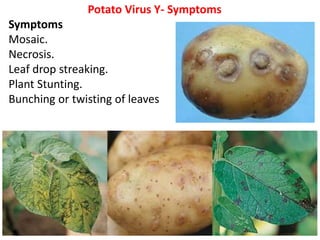
Potato Virus Y- Symptoms
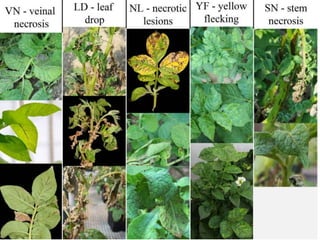
Symptoms
Mosaic.
Necrosis.
Leaf drop streaking.
Plant Stunting.
Bunching or twisting of leaves
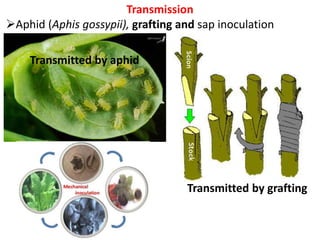
Transmitted by aphid
Transmitted by grafting
Transmission
Aphid (Aphis gossypii), grafting and sap inoculation
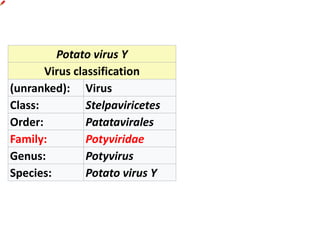
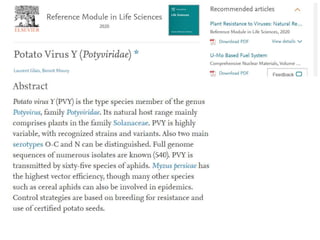
Potato virus Y
Virus classification
(unranked): Virus
Class: Stelpaviricetes
Order: Patatavirales
Family: Potyviridae
Genus: Potyvirus
Species: Potato virus Y
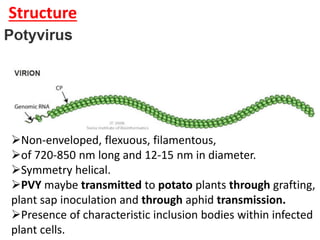
Structure
Non-enveloped, flexuous, filamentous,
of 720-850 nm long and 12-15 nm in diameter.
Symmetry helical.
PVY maybe transmitted to potato plants through grafting,
plant sap inoculation and through aphid transmission.
Presence of characteristic inclusion bodies within infected
plant cells.
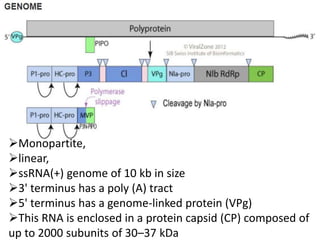
Monopartite,
linear,
ssRNA(+) genome of 10 kb in size
3' terminus has a poly (A) tract
5' terminus has a genome-linked protein (VPg)
This RNA is enclosed in a protein capsid (CP) composed of
up to 2000 subunits of 30–37 kDa
GENE EXPRESSION
The virion RNA is infectious and serves as both the
genome and viral messenger RNA.
The genomic RNA is translated into polyproteins which are
subsequently processed by the action of three viral-encoded
proteinases into functional products.
P3N-PIPO is expressed by polymerase slippage mechanism
from the P3 ORF and probably acts as a movement protein.
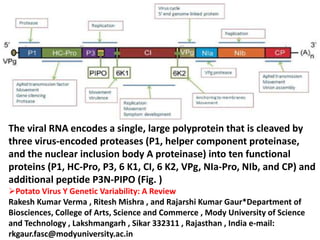
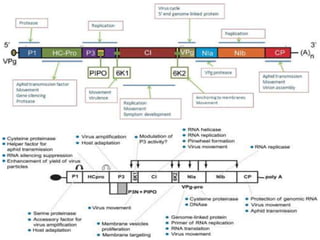
The viral RNA encodes a single, large polyprotein that is cleaved by
three virus-encoded proteases (P1, helper component proteinase,
and the nuclear inclusion body A proteinase) into ten functional
proteins (P1, HC-Pro, P3, 6 K1, CI, 6 K2, VPg, NIa-Pro, NIb, and CP) and
additional peptide P3N-PIPO (Fig. )
Potato Virus Y Genetic Variability: A Review
Rakesh Kumar Verma , Ritesh Mishra , and Rajarshi Kumar Gaur*Department of
Biosciences, College of Arts, Science and Commerce , Mody University of Science
and Technology , Lakshmangarh , Sikar 332311 , Rajasthan , India e-mail:
rkgaur.fasc@modyuniversity.ac.in
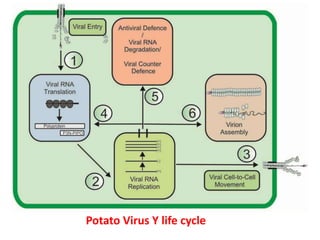
REPLICATION
CYTOPLASMIC
Virus penetrates into the host cell.
Uncoating, and release of the viral genomic RNA into the cytoplasm.
The viral RNA is translated to produce a polyprotein which is
processed by viral proteases into the RdRp protein and structural
proteins.
Replication takes place in cytoplasmic viral factories. A dsRNA
genome is synthesized from the genomic ssRNA(+).
The dsRNA genome is transcribed/replicated thereby providing viral
mRNAs/new ssRNA(+) genomes.
Virus assembly in the cytoplasm.
Viral movement protein P3N-PIPO probably mediates virion cell-to-
cell transfer.
Potato Virus Y life cycle
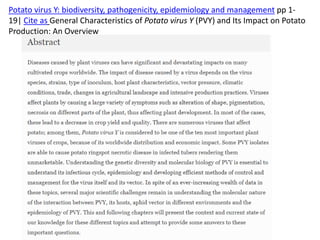
Potato virus Y: biodiversity, pathogenicity, epidemiology and management pp 1-
19| Cite as General Characteristics of Potato virus Y (PVY) and Its Impact on Potato
Production: An Overview
Thank you

Potato virus Y (PVY)

  • 1.
    Dr. Pawan KumarKanaujia Assistant Professor Molecular Virology (Theory) Potato Virus Y
  • 2.
    Potato Virus Y-Symptoms Symptoms Mosaic. Necrosis. Leaf drop streaking. Plant Stunting. Bunching or twisting of leaves
  • 4.
    Transmitted by aphid Transmittedby grafting Transmission Aphid (Aphis gossypii), grafting and sap inoculation
  • 5.
    Potato virus Y Virusclassification (unranked): Virus Class: Stelpaviricetes Order: Patatavirales Family: Potyviridae Genus: Potyvirus Species: Potato virus Y
  • 6.
    Structure Non-enveloped, flexuous, filamentous, of720-850 nm long and 12-15 nm in diameter. Symmetry helical. PVY maybe transmitted to potato plants through grafting, plant sap inoculation and through aphid transmission. Presence of characteristic inclusion bodies within infected plant cells.
  • 7.
    Monopartite, linear, ssRNA(+) genome of10 kb in size 3' terminus has a poly (A) tract 5' terminus has a genome-linked protein (VPg) This RNA is enclosed in a protein capsid (CP) composed of up to 2000 subunits of 30–37 kDa
  • 8.
    GENE EXPRESSION The virionRNA is infectious and serves as both the genome and viral messenger RNA. The genomic RNA is translated into polyproteins which are subsequently processed by the action of three viral-encoded proteinases into functional products. P3N-PIPO is expressed by polymerase slippage mechanism from the P3 ORF and probably acts as a movement protein.
  • 9.
    The viral RNAencodes a single, large polyprotein that is cleaved by three virus-encoded proteases (P1, helper component proteinase, and the nuclear inclusion body A proteinase) into ten functional proteins (P1, HC-Pro, P3, 6 K1, CI, 6 K2, VPg, NIa-Pro, NIb, and CP) and additional peptide P3N-PIPO (Fig. ) Potato Virus Y Genetic Variability: A Review Rakesh Kumar Verma , Ritesh Mishra , and Rajarshi Kumar Gaur*Department of Biosciences, College of Arts, Science and Commerce , Mody University of Science and Technology , Lakshmangarh , Sikar 332311 , Rajasthan , India e-mail: rkgaur.fasc@modyuniversity.ac.in
  • 11.
    REPLICATION CYTOPLASMIC Virus penetrates intothe host cell. Uncoating, and release of the viral genomic RNA into the cytoplasm. The viral RNA is translated to produce a polyprotein which is processed by viral proteases into the RdRp protein and structural proteins. Replication takes place in cytoplasmic viral factories. A dsRNA genome is synthesized from the genomic ssRNA(+). The dsRNA genome is transcribed/replicated thereby providing viral mRNAs/new ssRNA(+) genomes. Virus assembly in the cytoplasm. Viral movement protein P3N-PIPO probably mediates virion cell-to- cell transfer.
  • 12.
    Potato Virus Ylife cycle
  • 13.
    Potato virus Y:biodiversity, pathogenicity, epidemiology and management pp 1- 19| Cite as General Characteristics of Potato virus Y (PVY) and Its Impact on Potato Production: An Overview
  • 15.