Dealing with complex virus disease
             problems
 a case of Tospovirus Diseases in
            Vegetables
   Naidu A. Rayapati
   Department of Plant Pathology
   Washington State University
   Irrigated Agriculture Research & Extension Center
   Prosser, WA 99350, USA
   naidu@wsu.edu
Topics

An overview

 Thrips vectors

 Tospoviruses
Thrips: What are they?


Thrips : Greek word for “wood worms”

Thrips : a plural noun

Each individual is “a thrips” like the word “sheep”
What are Tospoviruses ?

Type member: Tomato spotted wilt virus


Group of emerging plant viruses
causing     economically      significant
damage to a broad range of field crops,
vegetables, ornamentals, fruits, etc.
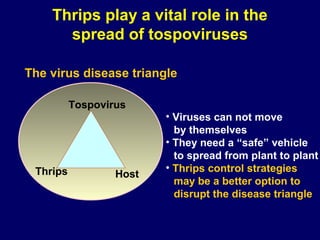
Thrips play a vital role in the
      spread of tospoviruses

The virus disease triangle

          Tospovirus
                         • Viruses can not move
                           by themselves
                         • They need a “safe” vehicle
                           to spread from plant to plant
 Thrips                  • Thrips control strategies
                  Host
                           may be a better option to
                           disrupt the disease triangle
Thrips as vectors of viruses


• As vectors directly transmitting viruses
    e.g.   Tospoviruses in vegetables, field crops
           and ornamentals

• As carriers of pollen containing viruses
    e.g.   certain other viruses (Tobacco streak virus)
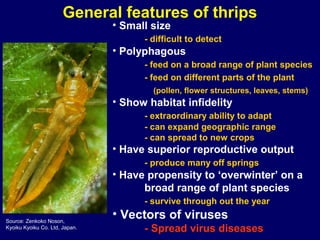
General features of thrips
                                • Small size
                                      - difficult to detect
                                • Polyphagous
                                      - feed on a broad range of plant species
                                      - feed on different parts of the plant
                                        (pollen, flower structures, leaves, stems)
                                • Show habitat infidelity
                                      - extraordinary ability to adapt
                                      - can expand geographic range
                                      - can spread to new crops
                                • Have superior reproductive output
                                      - produce many off springs
                                • Have propensity to ‘overwinter’ on a
                                      broad range of plant species
                                      - survive through out the year

Source: Zenkoko Noson,
                                • Vectors of viruses
Kyoiku Kyoiku Co. Ltd, Japan.         - Spread virus diseases
Thrips
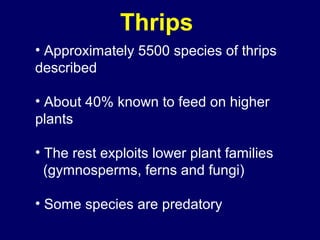
• Approximately 5500 species of thrips
described

• About 40% known to feed on higher
plants

• The rest exploits lower plant families
  (gymnosperms, ferns and fungi)

• Some species are predatory
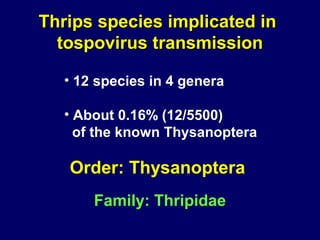
Thrips species implicated in
  tospovirus transmission

  • 12 species in 4 genera

  • About 0.16% (12/5500)
    of the known Thysanoptera

   Order: Thysanoptera
      Family: Thripidae
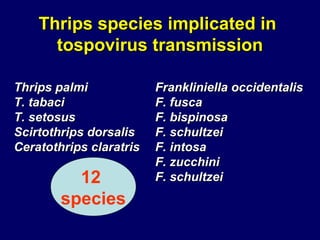
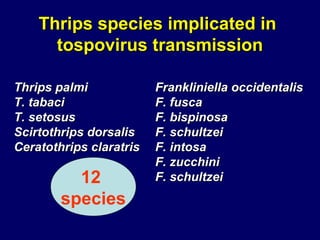
Thrips species implicated in
      tospovirus transmission

Thrips palmi             Frankliniella occidentalis
T. tabaci                F. fusca
T. setosus               F. bispinosa
Scirtothrips dorsalis    F. schultzei
Ceratothrips claratris   F. intosa
                         F. zucchini
          12             F. schultzei
        species
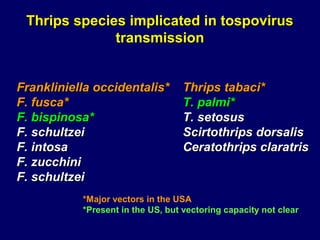
Thrips species implicated in tospovirus
              transmission


Frankliniella occidentalis*        Thrips tabaci*
F. fusca*                          T. palmi*
F. bispinosa*                      T. setosus
F. schultzei                       Scirtothrips dorsalis
F. intosa                          Ceratothrips claratris
F. zucchini
F. schultzei
           *Major vectors in the USA
           *Present in the US, but vectoring capacity not clear
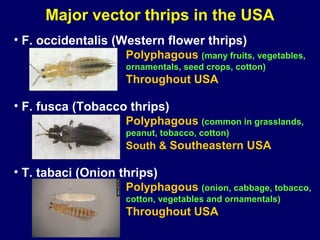
Major vector thrips in the USA
• F. occidentalis (Western flower thrips)
                    Polyphagous (many fruits, vegetables,
                    ornamentals, seed crops, cotton)
                    Throughout USA

• F. fusca (Tobacco thrips)
                    Polyphagous (common in grasslands,
                    peanut, tobacco, cotton)
                    South & Southeastern USA

• T. tabaci (Onion thrips)
                    Polyphagous (onion, cabbage, tobacco,
                    cotton, vegetables and ornamentals)
                    Throughout USA
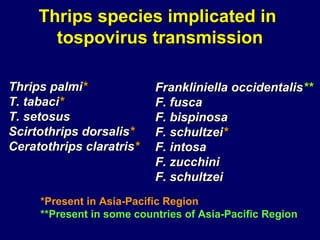
Thrips species implicated in
       tospovirus transmission

Thrips palmi*              Frankliniella occidentalis**
T. tabaci*                 F. fusca
T. setosus                 F. bispinosa
Scirtothrips dorsalis*     F. schultzei*
Ceratothrips claratris*    F. intosa
                           F. zucchini
                           F. schultzei
     *Present in Asia-Pacific Region
     **Present in some countries of Asia-Pacific Region
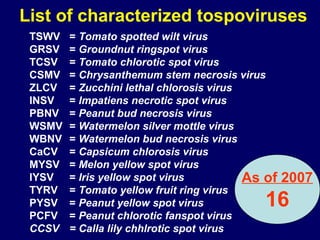
List of characterized tospoviruses
 TSWV   = Tomato spotted wilt virus
 GRSV   = Groundnut ringspot virus
 TCSV   = Tomato chlorotic spot virus
 CSMV   = Chrysanthemum stem necrosis virus
 ZLCV   = Zucchini lethal chlorosis virus
 INSV   = Impatiens necrotic spot virus
 PBNV   = Peanut bud necrosis virus
 WSMV   = Watermelon silver mottle virus
 WBNV   = Watermelon bud necrosis virus
 CaCV   = Capsicum chlorosis virus
 MYSV   = Melon yellow spot virus
 IYSV   = Iris yellow spot virus          As of   2007
 TYRV   = Tomato yellow fruit ring virus
 PYSV   = Peanut yellow spot virus          16
 PCFV   = Peanut chlorotic fanspot virus
 CCSV   = Calla lily chhlrotic spot virus
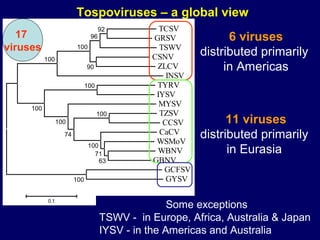
Tospoviruses – a global view
                                     92          TCSV
   17                           96             GRSV             6 viruses
viruses                   100                    TSWV
                                                          distributed primarily
           100                                 CSNV
                               90               ZLCV           in Americas
                                                   INSV
                               100              TYRV
                                                IYSV
                                                 MYSV
     100
                                     100         TZSV
                  100                             CCSV          11 viruses
                    74                           CaCV
                                                WSMoV
                                                          distributed primarily
                                100
                                  71            WBNV            in Eurasia
                                    63         GBNV
                                                  GCFSV
                         100                       GYSV

            0.1
                                                    Some exceptions
                                     TSWV - in Europe, Africa, Australia & Japan
                                     IYSV - in the Americas and Australia
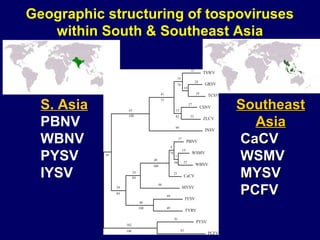
Geographic structuring of tospoviruses
   within South & Southeast Asia


  S. Asia                    Southeast
  PBNV                         Asia
  WBNV                       CaCV
  PYSV                       WSMV
  IYSV                       MYSV
                             PCFV
Thrips species implicated in
      tospovirus transmission

Thrips palmi             Frankliniella occidentalis
T. tabaci                F. fusca
T. setosus               F. bispinosa
Scirtothrips dorsalis    F. schultzei
Ceratothrips claratris   F. intosa
                         F. zucchini
          12             F. schultzei
        species
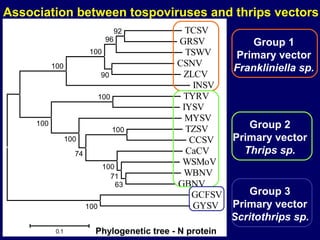
Association between tospoviruses and thrips vectors
                                     92         TCSV
                                96            GRSV             Group 1
                          100                   TSWV       Primary vector
                                              CSNV
           100                                             Frankliniella sp.
                               90              ZLCV
                                                  INSV
                               100             TYRV
                                               IYSV
                                                MYSV
     100
                                     100        TZSV          Group 2
                  100                            CCSV      Primary vector
                    74                          CaCV         Thrips sp.
                                100
                                               WSMoV
                                  71           WBNV
                                    63        GBNV
                                                 GCFSV         Group 3
                         100                      GYSV     Primary vector
                                                           Scritothrips sp.
            0.1            Phylogenetic tree - N protein
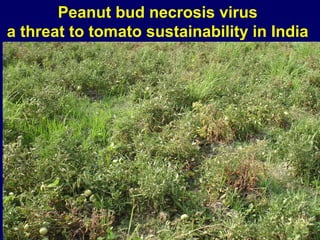
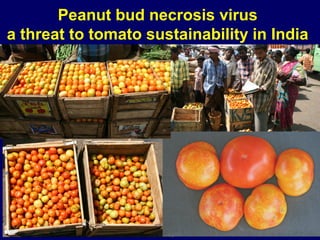
Peanut bud necrosis virus
a threat to tomato sustainability in India
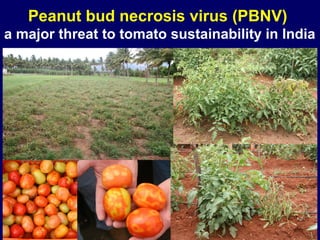
Peanut bud necrosis virus (PBNV)
a major threat to tomato sustainability in India
Peanut bud necrosis virus
a threat to tomato sustainability in India


  Healthy   Infected
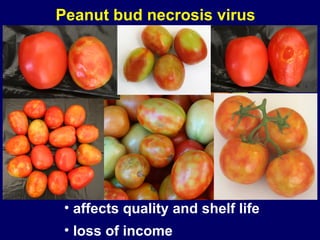
Peanut bud necrosis virus


 • affects quality and shelf life
 • loss of income
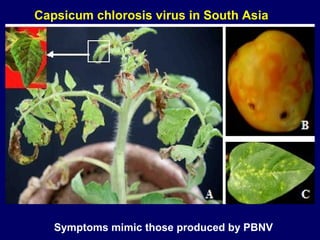
Capsicum chlorosis virus in South Asia


   Symptoms mimic those produced by PBNV
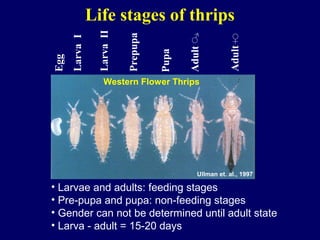
Life stages of thrips


                 Larva II
                                              ♂             ♀


                            Prepupa
      Larva I


                                                           Adult
                                             Adult
                                      Pupa
Egg

                    Western Flower Thrips


                                                Ullman et. al., 1997

• Larvae and adults: feeding stages
• Pre-pupa and pupa: non-feeding stages
• Gender can not be determined until adult state
• Larva - adult = 15-20 days
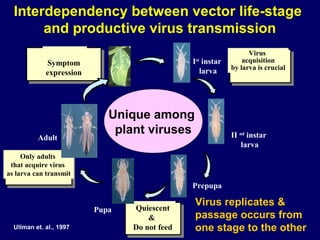
Interdependency between vector life-stage
       and productive virus transmission
                                                                Virus
             Symptom                           I instar
                                               st             acquisition
                                                          by larva is crucial
             expression                          larva


                             Unique among
                              plant viruses               II nd instar
          Adult
                                                              larva
     Only adults
 that acquire virus
as larva can transmit
                                               Prepupa

                                 Quiescent
                                               Virus replicates &
                          Pupa
                                     &         passage occurs from
  Ullman et. al., 1997           Do not feed   one stage to the other
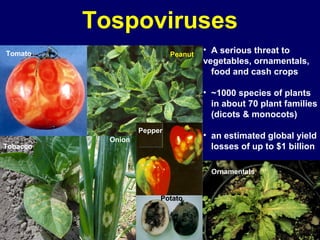
Tospoviruses
Tomato                       Peanut
                                      • A serious threat to
                                      vegetables, ornamentals,
                                        food and cash crops

                                      • ~1000 species of plants
                                        in about 70 plant families
                                        (dicots & monocots)
                    Pepper
            Onion
                                      • an estimated global yield
Tobacco                                 losses of up to $1 billion

                                        Ornamentals


                         Potato
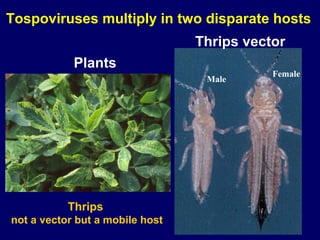
Tospoviruses multiply in two disparate hosts
                                 Thrips vector
            Plants
                                            Female
                                  Male


           Thrips
not a vector but a mobile host
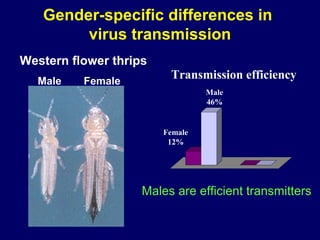
Gender-specific differences in
        virus transmission
Western flower thrips
  Male    Female
                         Transmission efficiency
                                 Male
                                 46%


                        Female
                         12%


                    Males are efficient transmitters
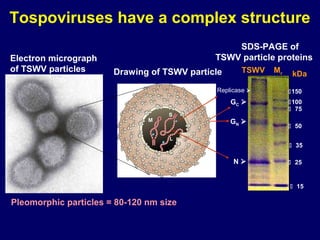
Tospoviruses have a complex structure
                                                 SDS-PAGE of
Electron micrograph                          TSWV particle proteins
of TSWV particles      Drawing of TSWV particle      TSWV   Mr    kDa
                                             Replicase          150
                                                  GC            100
                                                                  75
                                    S
                               M                  GN 
                                                                  50
                                    L
                                                                  35

                                                  N              25


                                                                  15

Pleomorphic particles = 80-120 nm size
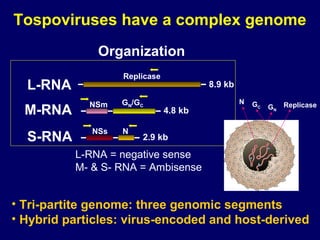
Tospoviruses have a complex genome
              Organization
                   Replicase
  L-RNA                                 8.9 kb

             NSm   GN/GC                         N   GC        Replicase
  M-RNA                        4.8 kb                     GN


             NSs   N
  S-RNA                2.9 kb

          L-RNA = negative sense
          M- & S- RNA = Ambisense


• Tri-partite genome: three genomic segments
• Hybrid particles: virus-encoded and host-derived
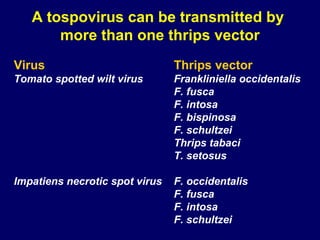
A tospovirus can be transmitted by
       more than one thrips vector
Virus                           Thrips vector
Tomato spotted wilt virus       Frankliniella occidentalis
                                F. fusca
                                F. intosa
                                F. bispinosa
                                F. schultzei
                                Thrips tabaci
                                T. setosus

Impatiens necrotic spot virus   F. occidentalis
                                F. fusca
                                F. intosa
                                F. schultzei
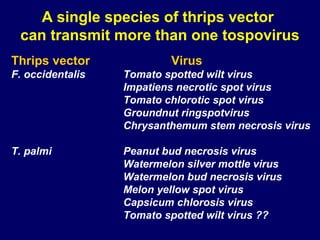
A single species of thrips vector
 can transmit more than one tospovirus
Thrips vector              Virus
F. occidentalis   Tomato spotted wilt virus
                  Impatiens necrotic spot virus
                  Tomato chlorotic spot virus
                  Groundnut ringspotvirus
                  Chrysanthemum stem necrosis virus

T. palmi          Peanut bud necrosis virus
                  Watermelon silver mottle virus
                  Watermelon bud necrosis virus
                  Melon yellow spot virus
                  Capsicum chlorosis virus
                  Tomato spotted wilt virus ??
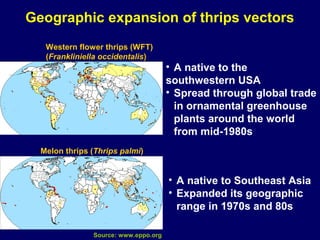
Geographic expansion of thrips vectors
   Western flower thrips (WFT)
   (Frankliniella occidentalis)
                                      • A native to the
                                      southwestern USA
                                      • Spread through global trade
                                        in ornamental greenhouse
                                        plants around the world
                                        from mid-1980s
  Melon thrips (Thrips palmi)


                                      • A native to Southeast Asia
                                      • Expanded its geographic
                                        range in 1970s and 80s

               Source: www.eppo.org
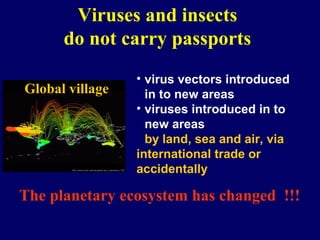
Viruses and insects
      do not carry passports
                 • virus vectors introduced
Global village     in to new areas
                 • viruses introduced in to
                   new areas
                   by land, sea and air, via
                 international trade or
                 accidentally

The planetary ecosystem has changed !!!
Challenges in controlling
  tospovirus diseases

    Tospoviruses
• broad host range
• multiple vector species
• evolution of new strains
• ability to overcome
 host plant resistance
Challenges in controlling
     tospovirus diseases

           Vector thrips
• polyphagous & show habitat infidelity
• has superior reproductive output
• has propensity to ‘overwinter’ on a
  broad range of plant species
• develop resistance against pesticides
Challenges in controlling
      tospovirus diseases

      Host plant resistance

   Resistance only against TSWV
• Sw-5 resistance gene in tomato
against TSWV
• Tsw resistance gene in Capsicum
against TSWV
Challenges in controlling
       tospovirus diseases
        Host plant resistance
• No broad-spectrum resistance
 e.g. CaCV overcame the Sw-5 resistance gene
 in tomato
 e.g CaCV overcame TSWV resistance in
Capsicum chinense accessions PI 152225,
 PI 159236 and AVRDC 00943
• Resistance to ‘Asian’ tospoviruses
  not yet known
 e.g. is there resistance to PBNV in tomato ?
Challenges in controlling
   tospovirus diseases

   Host plant resistance

• virus-specific
• no ‘one-size-fits all’ approach
Durable resistance is difficult
            to achieve
    due to rapid evolution of
resistance-breaking virus strains


                         K.S. Ravi, Mahyco, India
Crop Improvement against
      tospoviruses

biologic chess game !!!
Management of tospovirus
          diseases:
       an IPM approach
• Knowledge about the virus & vector
• Diagnostic tools
• Ecology and epidemiology
• Thrips vector management options
• Altering cropping patterns
• Deploying tolerant/resistant cultivars
• Capacity building
Integrated Management of Thrips-borne Tospoviruses
           in Vegetable Cropping Systems
      in South Asia and Southeast Asia Region


                              Funded by
 Integrated Pest Management Collaborative Research
        Support Program (IPM CRSP) of USAID

  Global IPM Theme: Insect-transmitted viruses
Project Goal
“minimize crop losses due to thrips-borne
tospoviruses in smallholder vegetable
farming systems in South and Southeast
Asia through new science and technologies
and multidisciplinary global partnerships,
and improve nutritional status of people
including women and children”
Project Objectives
1. Conduct strategic research on tospoviruses
  and thrips vectors

2. Carryout applied and adaptive research to
  deploy ‘eco-friendly’ IPM strategies to control
  tospovirus diseases

3. Strengthening institutional capacities within
  host countries to conduct problem-oriented
  research on virus diseases
        (short- and long-term training)
Thank You

How to deal with complex virus disease problems

  • 1.
    Dealing with complexvirus disease problems a case of Tospovirus Diseases in Vegetables Naidu A. Rayapati Department of Plant Pathology Washington State University Irrigated Agriculture Research & Extension Center Prosser, WA 99350, USA naidu@wsu.edu
  • 2.
    Topics An overview Thripsvectors Tospoviruses
  • 3.
    Thrips: What arethey? Thrips : Greek word for “wood worms” Thrips : a plural noun Each individual is “a thrips” like the word “sheep”
  • 4.
    What are Tospoviruses? Type member: Tomato spotted wilt virus Group of emerging plant viruses causing economically significant damage to a broad range of field crops, vegetables, ornamentals, fruits, etc.
  • 5.
    Thrips play avital role in the spread of tospoviruses The virus disease triangle Tospovirus • Viruses can not move by themselves • They need a “safe” vehicle to spread from plant to plant Thrips • Thrips control strategies Host may be a better option to disrupt the disease triangle
  • 6.
    Thrips as vectorsof viruses • As vectors directly transmitting viruses e.g. Tospoviruses in vegetables, field crops and ornamentals • As carriers of pollen containing viruses e.g. certain other viruses (Tobacco streak virus)
  • 7.
    General features ofthrips • Small size - difficult to detect • Polyphagous - feed on a broad range of plant species - feed on different parts of the plant (pollen, flower structures, leaves, stems) • Show habitat infidelity - extraordinary ability to adapt - can expand geographic range - can spread to new crops • Have superior reproductive output - produce many off springs • Have propensity to ‘overwinter’ on a broad range of plant species - survive through out the year Source: Zenkoko Noson, • Vectors of viruses Kyoiku Kyoiku Co. Ltd, Japan. - Spread virus diseases
  • 8.
    Thrips • Approximately 5500species of thrips described • About 40% known to feed on higher plants • The rest exploits lower plant families (gymnosperms, ferns and fungi) • Some species are predatory
  • 9.
    Thrips species implicatedin tospovirus transmission • 12 species in 4 genera • About 0.16% (12/5500) of the known Thysanoptera Order: Thysanoptera Family: Thripidae
  • 10.
    Thrips species implicatedin tospovirus transmission Thrips palmi Frankliniella occidentalis T. tabaci F. fusca T. setosus F. bispinosa Scirtothrips dorsalis F. schultzei Ceratothrips claratris F. intosa F. zucchini 12 F. schultzei species
  • 11.
    Thrips species implicatedin tospovirus transmission Frankliniella occidentalis* Thrips tabaci* F. fusca* T. palmi* F. bispinosa* T. setosus F. schultzei Scirtothrips dorsalis F. intosa Ceratothrips claratris F. zucchini F. schultzei *Major vectors in the USA *Present in the US, but vectoring capacity not clear
  • 12.
    Major vector thripsin the USA • F. occidentalis (Western flower thrips) Polyphagous (many fruits, vegetables, ornamentals, seed crops, cotton) Throughout USA • F. fusca (Tobacco thrips) Polyphagous (common in grasslands, peanut, tobacco, cotton) South & Southeastern USA • T. tabaci (Onion thrips) Polyphagous (onion, cabbage, tobacco, cotton, vegetables and ornamentals) Throughout USA
  • 13.
    Thrips species implicatedin tospovirus transmission Thrips palmi* Frankliniella occidentalis** T. tabaci* F. fusca T. setosus F. bispinosa Scirtothrips dorsalis* F. schultzei* Ceratothrips claratris* F. intosa F. zucchini F. schultzei *Present in Asia-Pacific Region **Present in some countries of Asia-Pacific Region
  • 14.
    List of characterizedtospoviruses TSWV = Tomato spotted wilt virus GRSV = Groundnut ringspot virus TCSV = Tomato chlorotic spot virus CSMV = Chrysanthemum stem necrosis virus ZLCV = Zucchini lethal chlorosis virus INSV = Impatiens necrotic spot virus PBNV = Peanut bud necrosis virus WSMV = Watermelon silver mottle virus WBNV = Watermelon bud necrosis virus CaCV = Capsicum chlorosis virus MYSV = Melon yellow spot virus IYSV = Iris yellow spot virus As of 2007 TYRV = Tomato yellow fruit ring virus PYSV = Peanut yellow spot virus 16 PCFV = Peanut chlorotic fanspot virus CCSV = Calla lily chhlrotic spot virus
  • 15.
    Tospoviruses – aglobal view 92 TCSV 17 96 GRSV 6 viruses viruses 100 TSWV distributed primarily 100 CSNV 90 ZLCV in Americas INSV 100 TYRV IYSV MYSV 100 100 TZSV 100 CCSV 11 viruses 74 CaCV WSMoV distributed primarily 100 71 WBNV in Eurasia 63 GBNV GCFSV 100 GYSV 0.1 Some exceptions TSWV - in Europe, Africa, Australia & Japan IYSV - in the Americas and Australia
  • 16.
    Geographic structuring oftospoviruses within South & Southeast Asia S. Asia Southeast PBNV Asia WBNV CaCV PYSV WSMV IYSV MYSV PCFV
  • 17.
    Thrips species implicatedin tospovirus transmission Thrips palmi Frankliniella occidentalis T. tabaci F. fusca T. setosus F. bispinosa Scirtothrips dorsalis F. schultzei Ceratothrips claratris F. intosa F. zucchini 12 F. schultzei species
  • 18.
    Association between tospovirusesand thrips vectors 92 TCSV 96 GRSV Group 1 100 TSWV Primary vector CSNV 100 Frankliniella sp. 90 ZLCV INSV 100 TYRV IYSV MYSV 100 100 TZSV Group 2 100 CCSV Primary vector 74 CaCV Thrips sp. 100 WSMoV 71 WBNV 63 GBNV GCFSV Group 3 100 GYSV Primary vector Scritothrips sp. 0.1 Phylogenetic tree - N protein
  • 19.
    Peanut bud necrosisvirus a threat to tomato sustainability in India
  • 20.
    Peanut bud necrosisvirus (PBNV) a major threat to tomato sustainability in India
  • 21.
    Peanut bud necrosisvirus a threat to tomato sustainability in India Healthy Infected
  • 22.
    Peanut bud necrosisvirus • affects quality and shelf life • loss of income
  • 23.
    Capsicum chlorosis virusin South Asia Symptoms mimic those produced by PBNV
  • 24.
    Life stages ofthrips Larva II ♂ ♀ Prepupa Larva I Adult Adult Pupa Egg Western Flower Thrips Ullman et. al., 1997 • Larvae and adults: feeding stages • Pre-pupa and pupa: non-feeding stages • Gender can not be determined until adult state • Larva - adult = 15-20 days
  • 25.
    Interdependency between vectorlife-stage and productive virus transmission Virus Symptom I instar st acquisition by larva is crucial expression larva Unique among plant viruses II nd instar Adult larva Only adults that acquire virus as larva can transmit Prepupa Quiescent Virus replicates & Pupa & passage occurs from Ullman et. al., 1997 Do not feed one stage to the other
  • 26.
    Tospoviruses Tomato Peanut • A serious threat to vegetables, ornamentals, food and cash crops • ~1000 species of plants in about 70 plant families (dicots & monocots) Pepper Onion • an estimated global yield Tobacco losses of up to $1 billion Ornamentals Potato
  • 27.
    Tospoviruses multiply intwo disparate hosts Thrips vector Plants Female Male Thrips not a vector but a mobile host
  • 28.
    Gender-specific differences in virus transmission Western flower thrips Male Female Transmission efficiency Male 46% Female 12% Males are efficient transmitters
  • 29.
    Tospoviruses have acomplex structure SDS-PAGE of Electron micrograph TSWV particle proteins of TSWV particles Drawing of TSWV particle TSWV Mr kDa Replicase  150 GC  100  75 S M GN   50 L  35 N  25  15 Pleomorphic particles = 80-120 nm size
  • 30.
    Tospoviruses have acomplex genome Organization Replicase L-RNA 8.9 kb NSm GN/GC N GC Replicase M-RNA 4.8 kb GN NSs N S-RNA 2.9 kb L-RNA = negative sense M- & S- RNA = Ambisense • Tri-partite genome: three genomic segments • Hybrid particles: virus-encoded and host-derived
  • 31.
    A tospovirus canbe transmitted by more than one thrips vector Virus Thrips vector Tomato spotted wilt virus Frankliniella occidentalis F. fusca F. intosa F. bispinosa F. schultzei Thrips tabaci T. setosus Impatiens necrotic spot virus F. occidentalis F. fusca F. intosa F. schultzei
  • 32.
    A single speciesof thrips vector can transmit more than one tospovirus Thrips vector Virus F. occidentalis Tomato spotted wilt virus Impatiens necrotic spot virus Tomato chlorotic spot virus Groundnut ringspotvirus Chrysanthemum stem necrosis virus T. palmi Peanut bud necrosis virus Watermelon silver mottle virus Watermelon bud necrosis virus Melon yellow spot virus Capsicum chlorosis virus Tomato spotted wilt virus ??
  • 33.
    Geographic expansion ofthrips vectors Western flower thrips (WFT) (Frankliniella occidentalis) • A native to the southwestern USA • Spread through global trade in ornamental greenhouse plants around the world from mid-1980s Melon thrips (Thrips palmi) • A native to Southeast Asia • Expanded its geographic range in 1970s and 80s Source: www.eppo.org
  • 34.
    Viruses and insects do not carry passports • virus vectors introduced Global village in to new areas • viruses introduced in to new areas by land, sea and air, via international trade or accidentally The planetary ecosystem has changed !!!
  • 35.
    Challenges in controlling tospovirus diseases Tospoviruses • broad host range • multiple vector species • evolution of new strains • ability to overcome host plant resistance
  • 36.
    Challenges in controlling tospovirus diseases Vector thrips • polyphagous & show habitat infidelity • has superior reproductive output • has propensity to ‘overwinter’ on a broad range of plant species • develop resistance against pesticides
  • 37.
    Challenges in controlling tospovirus diseases Host plant resistance Resistance only against TSWV • Sw-5 resistance gene in tomato against TSWV • Tsw resistance gene in Capsicum against TSWV
  • 38.
    Challenges in controlling tospovirus diseases Host plant resistance • No broad-spectrum resistance e.g. CaCV overcame the Sw-5 resistance gene in tomato e.g CaCV overcame TSWV resistance in Capsicum chinense accessions PI 152225, PI 159236 and AVRDC 00943 • Resistance to ‘Asian’ tospoviruses not yet known e.g. is there resistance to PBNV in tomato ?
  • 39.
    Challenges in controlling tospovirus diseases Host plant resistance • virus-specific • no ‘one-size-fits all’ approach
  • 40.
    Durable resistance isdifficult to achieve due to rapid evolution of resistance-breaking virus strains K.S. Ravi, Mahyco, India
  • 41.
    Crop Improvement against tospoviruses biologic chess game !!!
  • 42.
    Management of tospovirus diseases: an IPM approach • Knowledge about the virus & vector • Diagnostic tools • Ecology and epidemiology • Thrips vector management options • Altering cropping patterns • Deploying tolerant/resistant cultivars • Capacity building
  • 43.
    Integrated Management ofThrips-borne Tospoviruses in Vegetable Cropping Systems in South Asia and Southeast Asia Region Funded by Integrated Pest Management Collaborative Research Support Program (IPM CRSP) of USAID Global IPM Theme: Insect-transmitted viruses
  • 44.
    Project Goal “minimize croplosses due to thrips-borne tospoviruses in smallholder vegetable farming systems in South and Southeast Asia through new science and technologies and multidisciplinary global partnerships, and improve nutritional status of people including women and children”
  • 45.
    Project Objectives 1. Conductstrategic research on tospoviruses and thrips vectors 2. Carryout applied and adaptive research to deploy ‘eco-friendly’ IPM strategies to control tospovirus diseases 3. Strengthening institutional capacities within host countries to conduct problem-oriented research on virus diseases (short- and long-term training)
  • 46.

Editor's Notes

  • #25 Thrips have different developmental stages