Botanical discriptrion
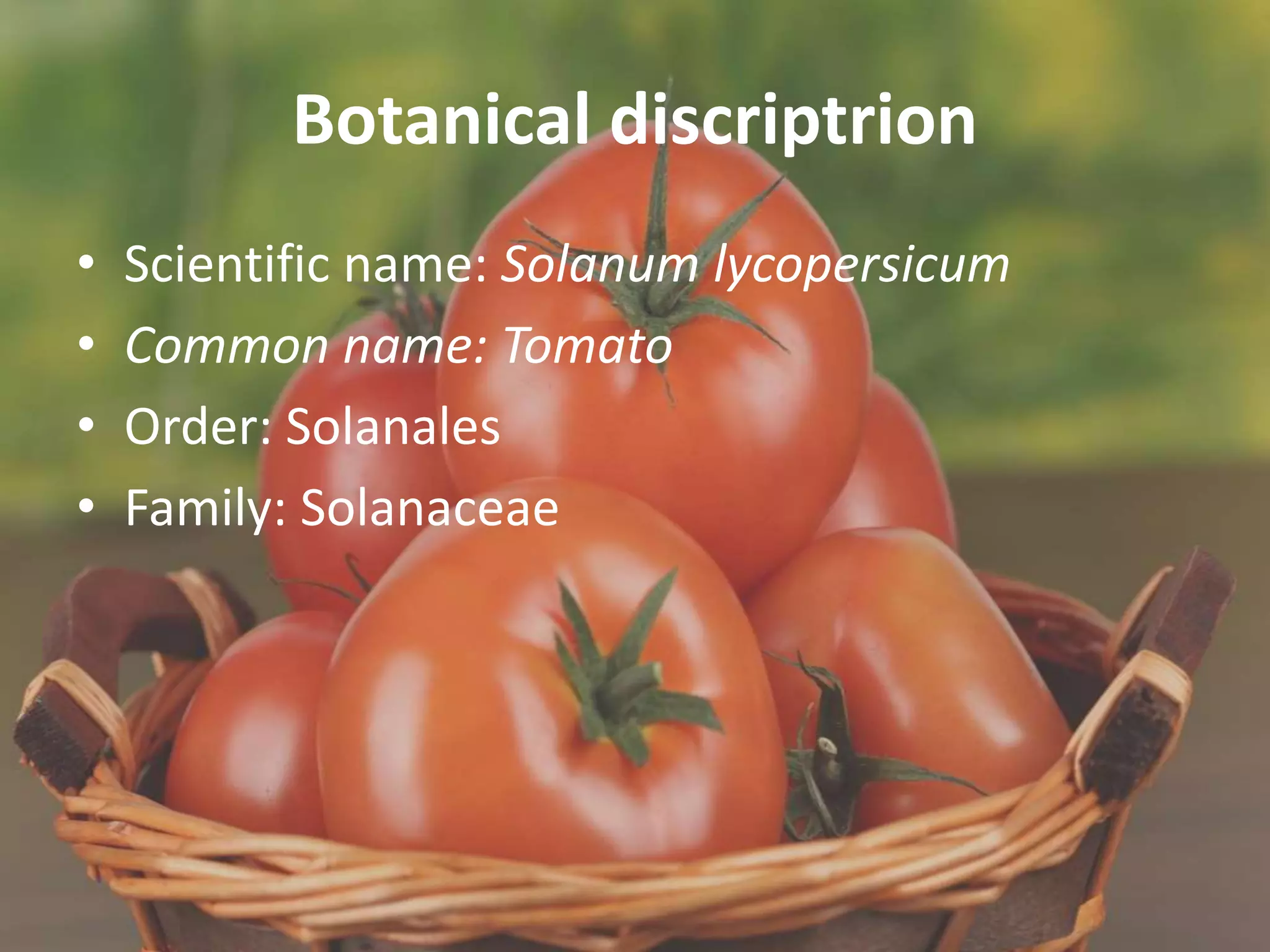
• Scientific name: Solanum lycopersicum
• Common name: Tomato
• Order: Solanales
• Family: Solanaceae
Origin and distribution
• Origin: South America
• Distribution: Cultivated tomato was brought
to Europe by the Spanish in the 16th century
and later from Europe to southern and
eastern Asia.
• In karnataka: Kolar, Belgaum, Mandya, Haveri
and Banglore(R).
Area and production
Place Area(1000 ha) Production
(1000tons)
Productivity
(Tons/ha)
India 767.32 16384.98 21.35
Karnataka 64.25 2034.37 31.66
Importance and uses
• It is reffered as “Poor Man’s orange”
• They are rich in minerals like Ca, Na and
vitamins like A, B and C
• Its soup is good remedy for preventing
constipation
• Red colour due to Lycopene and Yellow colour
is due to carotenes.
• Tomato can reduce high blood pressure.
Botany
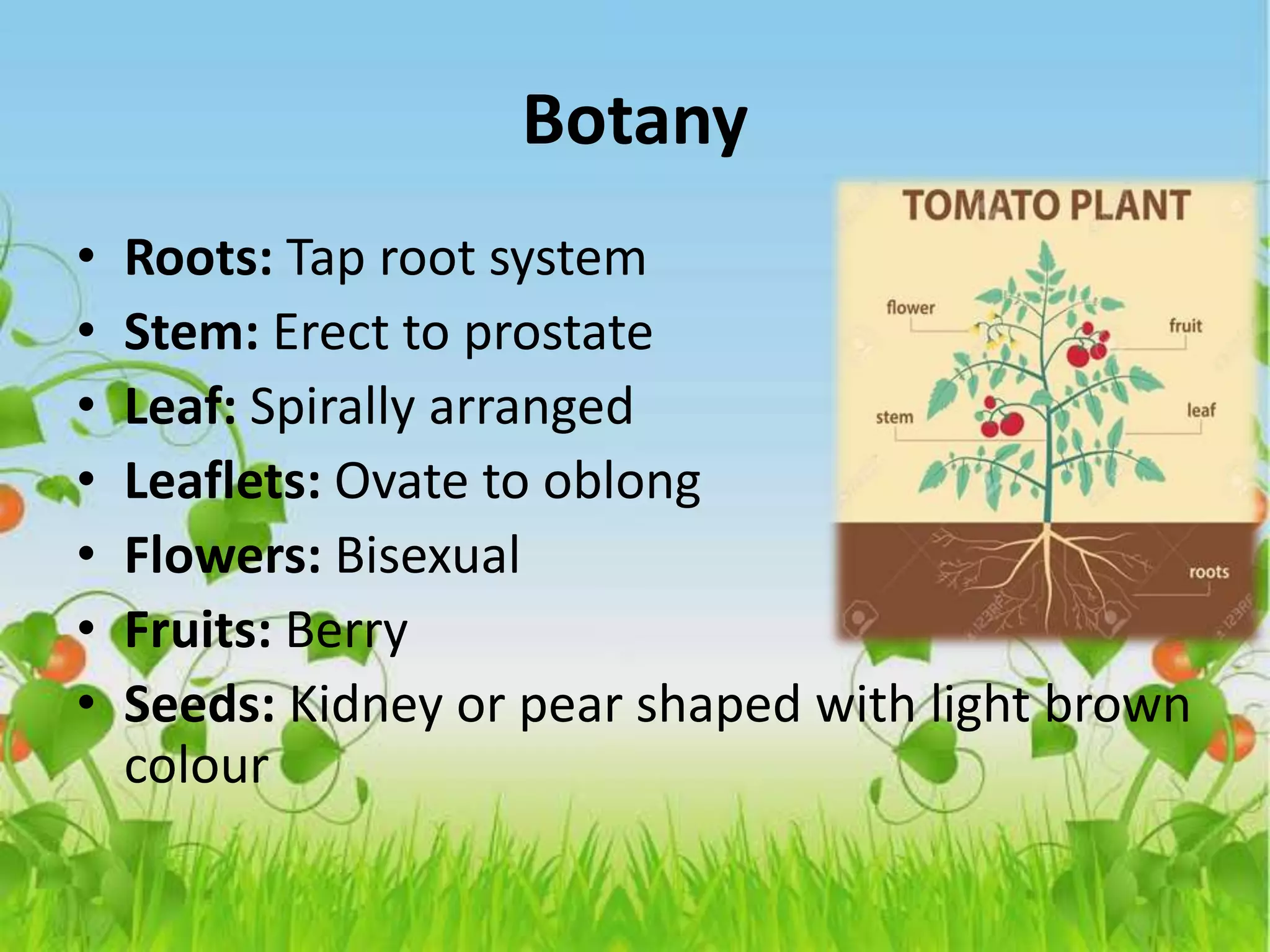
• Roots: Tap root system
• Stem: Erect to prostate
• Leaf: Spirally arranged
• Leaflets: Ovate to oblong
• Flowers: Bisexual
• Fruits: Berry
• Seeds: Kidney or pear shaped with light brown
colour
Production technology
Climate:
• Day neutral plant with optimal temperature of 21 to
28*C during day and 15-20*C during night.
• Above 32*C day and Below 12*C night temp affect fruit
set adversly.
Soil:
• Grows well in all kinds of soil.
• But well drained fairly fertile soils rich in organic matter
are preferred.
• PH: 6-7
Growth habit of tomato
1.Indeterminate type: Terminal buds end with a
leafy bud
2.Determinate type: Terminal bud end with
floral bud
eg: Pusa early dwarf
3.Semi determinate: Growth between
determinate and indeterminate.
eg: S-12, Roma.
IIHR Varieties
1.Arka rakshak
• F1 hybrid has triple disease resistance to
tomato leaf curl, bacterial wilt and early
blight.
IIHR Varieties
2.Arka sourab
• Semi determinate
• Fruit: Firm and nipple
tipped
• Yield:300q/ha.
IIHR Varieties
3.Arka vikas
• Tolerant to moisture
stress condition
• Semi-determinate type
• Yield:300q/ha.
IIHR Varieties
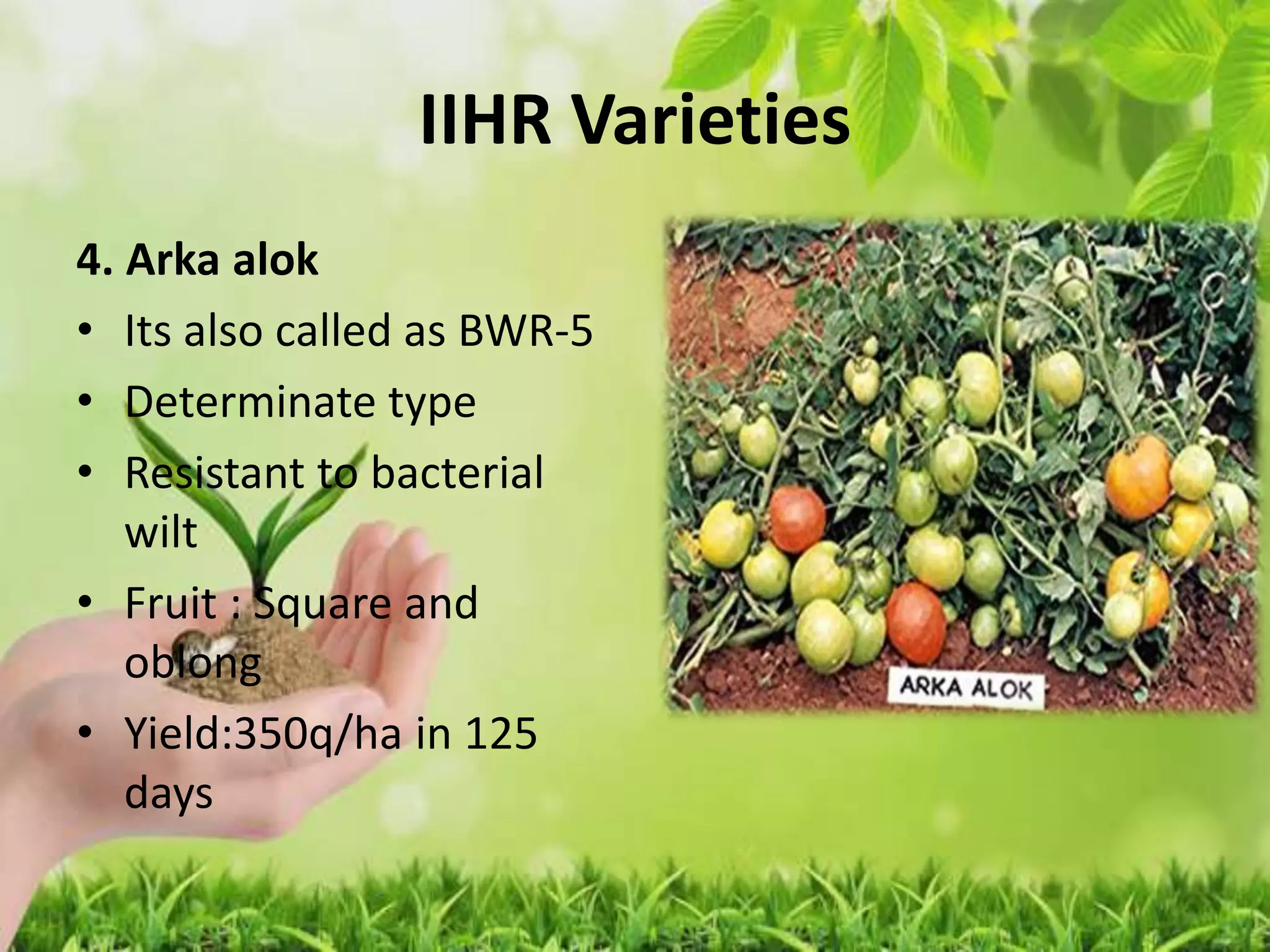
4. Arka alok
• Its also called as BWR-5
• Determinate type
• Resistant to bacterial
wilt
• Fruit : Square and
oblong
• Yield:350q/ha in 125
days
IIHR Varieties
5.Arka abha
• Tolerant to powdery
mildew
• Resistant to bacterial
wilt.
• Semi-determinate type
• Yield:350q/ha.
UASB varieties
• Nandi
• Vaibhav
• Sankranti
IARI varieties
• Pusa early dwarf
• Pusa ruby
• Pusa Sadhabahar
• Pusa sheetal
• Pusa gaurav
• Pusa rohini
• Kashi amrit
CULTIVATION
1. Nursery seed bed preparation
2. Field preparation
3. Planting
4. Manures and fertilizers
5. Irrigation
6. Weed management
7. Training and pruning
8. Harvesting
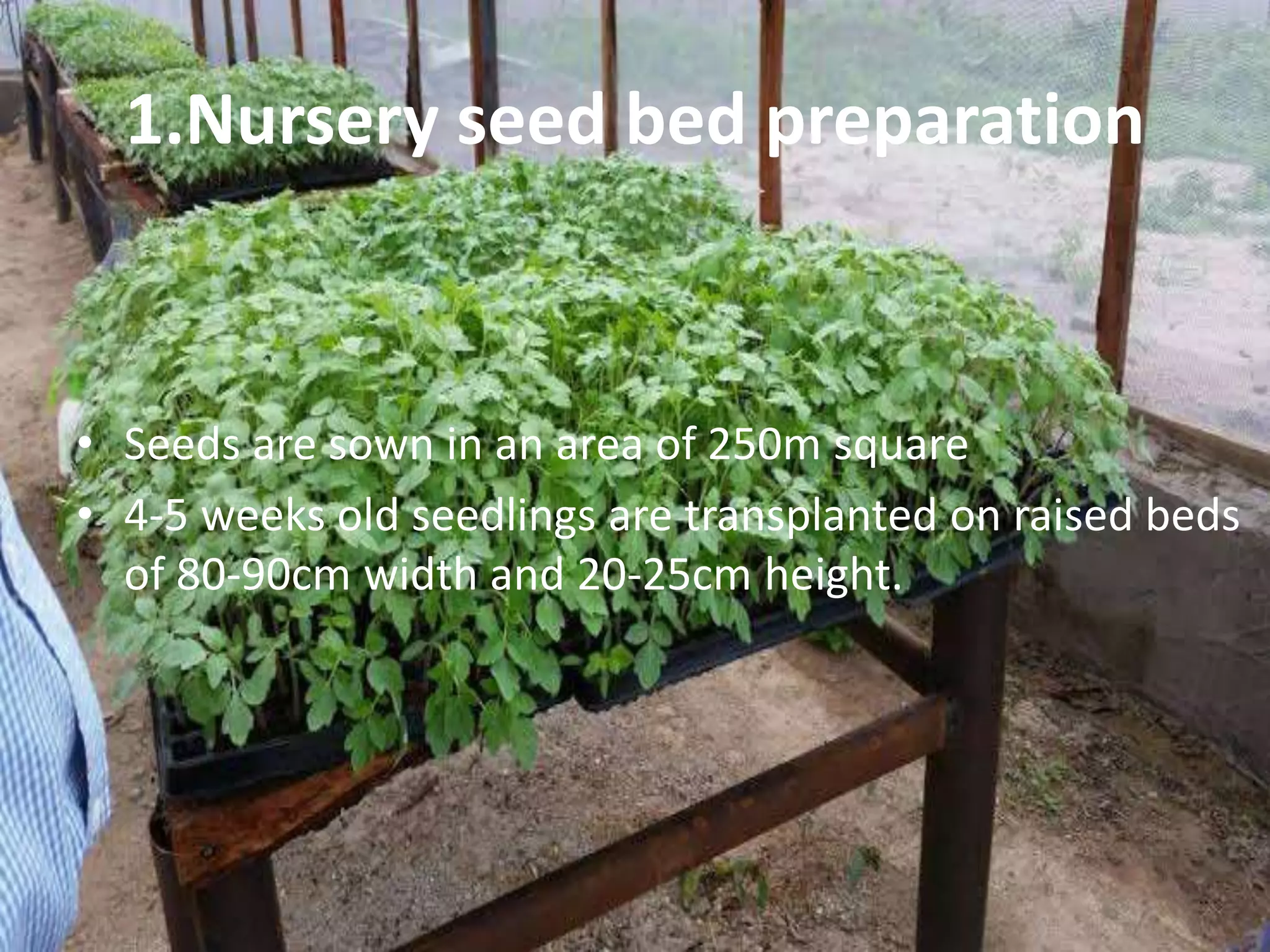
1.Nursery seed bed preparation
• Seeds are sown in an area of 250m square
• 4-5 weeks old seedlings are transplanted on raised beds
of 80-90cm width and 20-25cm height.
2.Land preparation
• Plough the land 4-5 times with sufficient
intervals between two consecutive ploughing
along with the incorporation of FYM.
3.Planting
• Main seasons are Jan-Feb, June-July and
Oct-Nov.
• Seed rate: var-200-250g/ha
Hybrids:100-125g/ha
• It can be grown in all seasons.
• Spacing: 60 x 30-45cm or 75 x 75cm
• Closer spacing results in early and higher
yields.
4.Manures and fertilizers
• FYM: 25-30 tons
• NPK: 115:100:60 kg/ha
• 10kg borax + 5kg Zinc sulphate as a basal
dose.
5.Irrigation
• Summer: 4-5 days interval
• Winter: 8-12 days interval
• Critical stage: Water stress at flowering stage
will adversely affect fruiting and productivity.
• Furrow irrigation is most common
• Drip and sprinkler irrigation are most common
in areas of water shortage.
6.Weed management
• Application of Pendimethalin as a pre-
emergent herbicide
• One hand weeding at 45 DAT
• Mulching with straw or plastic is also effective
and for regulating soil temperature.
7.Training and pruning
• Staking is done to prevent lodging and loss of
fruits by coming in contact with soil.
• It is done by providing individual stack or by
erecting 2-2.5m long poles on either side of
ridges for stretching GI wires.
pruning
• Pruning is followed to improve size, shape and
quality of fruits
• Tomato is subjected to Pinching , lateral
shoots are pinched
to improve bushy
growth.
Growth promoters
Purpose Growth regulators Mode and time of
application
High yield GA Foliar spray of 10ppm
Increased fruit set NAA(0.1ppm) Seedling soaking for 24 hrs
Ripening of fruits Ethrel(1000ppm) Whole plant spray at the
initiation of ripening
Maturity standards
1. Immature green
2. Mature green
3. Turning or breaker
4. Pink/half ripe stage
5. Hard ripe stage
6. Red/over ripe stage
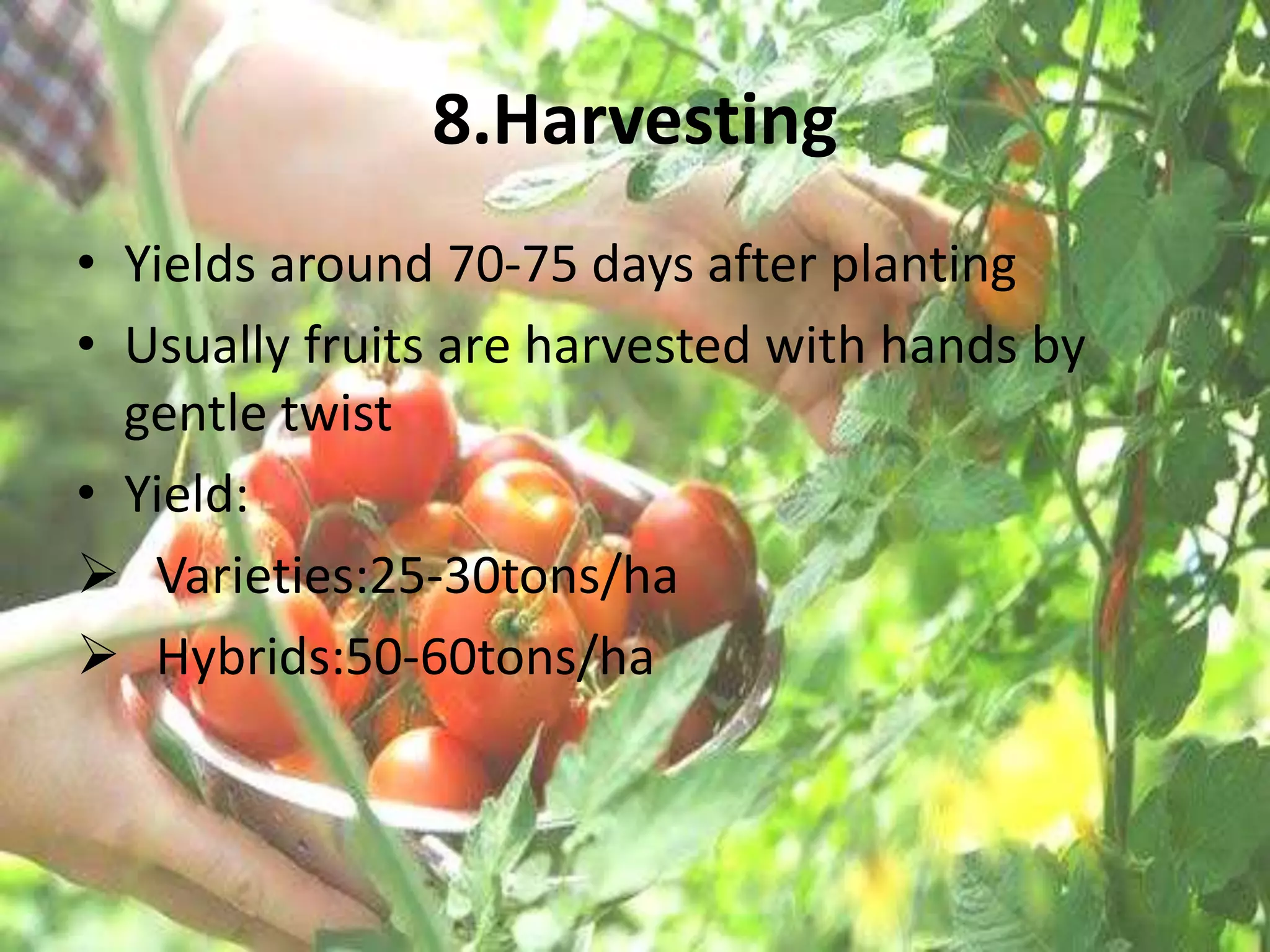
8.Harvesting
• Yields around 70-75 days after planting
• Usually fruits are harvested with hands by
gentle twist
• Yield:
 Varieties:25-30tons/ha
 Hybrids:50-60tons/ha
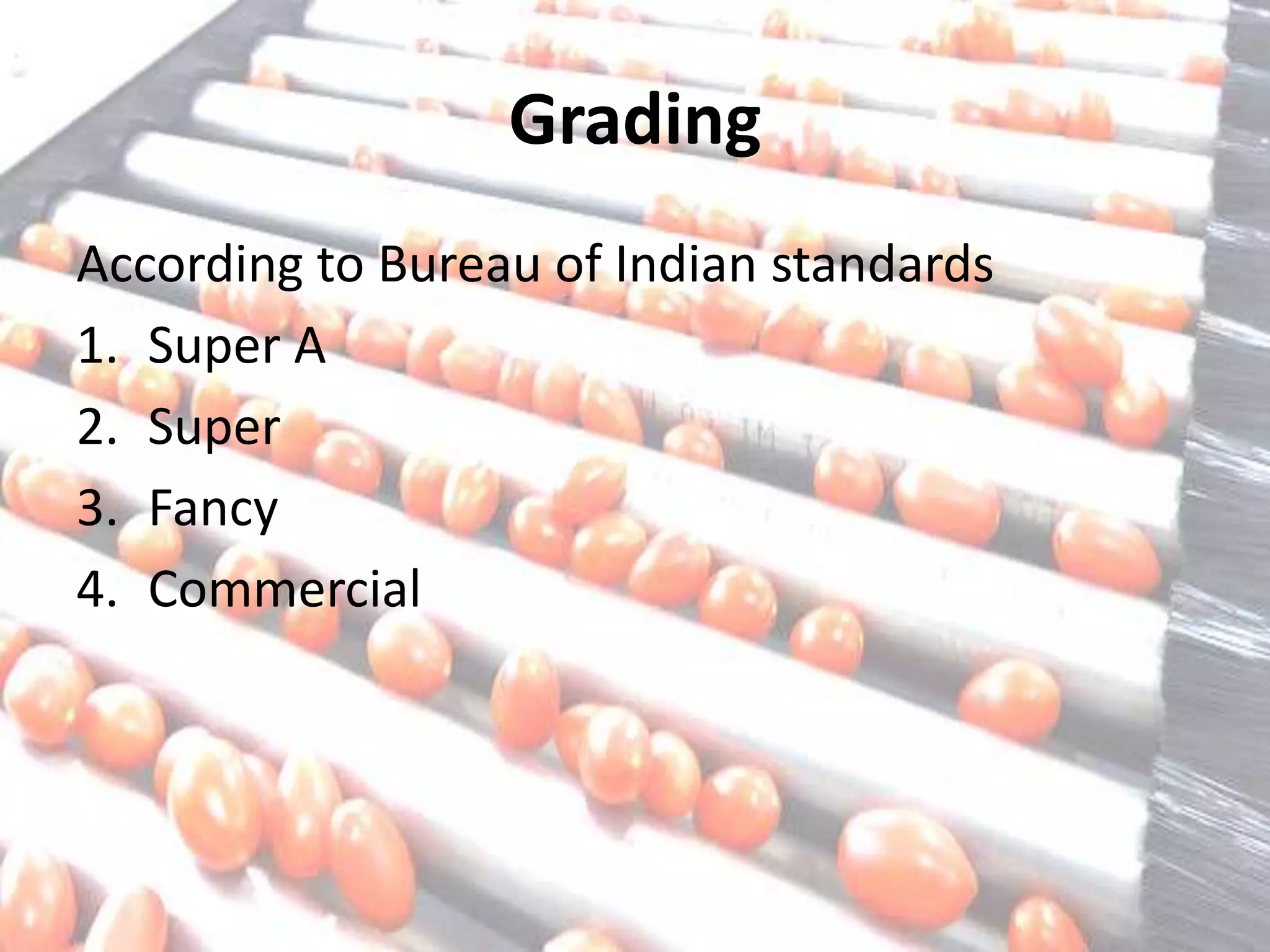
Grading
According to Bureau of Indian standards
1. Super A
2. Super
3. Fancy
4. Commercial
Storage
• It can be stored for 2-4 weeks at 10-13 degree
celcious, when harvested at red and green
stages
Marketing
• Mode of transportation: Road ways
• Optimum matured tomatoes are marketed
usually at local nearby markets
• Pre matured green tomatoes are transported
for distant markets
• For one graded box present market price is
675 Rupees.
Processing
1. Deep red coloured fruits
2. Low PH
3. High TSS
4. High viscosity and consistency
5. Firm and easy peeling
6. Crack resistance
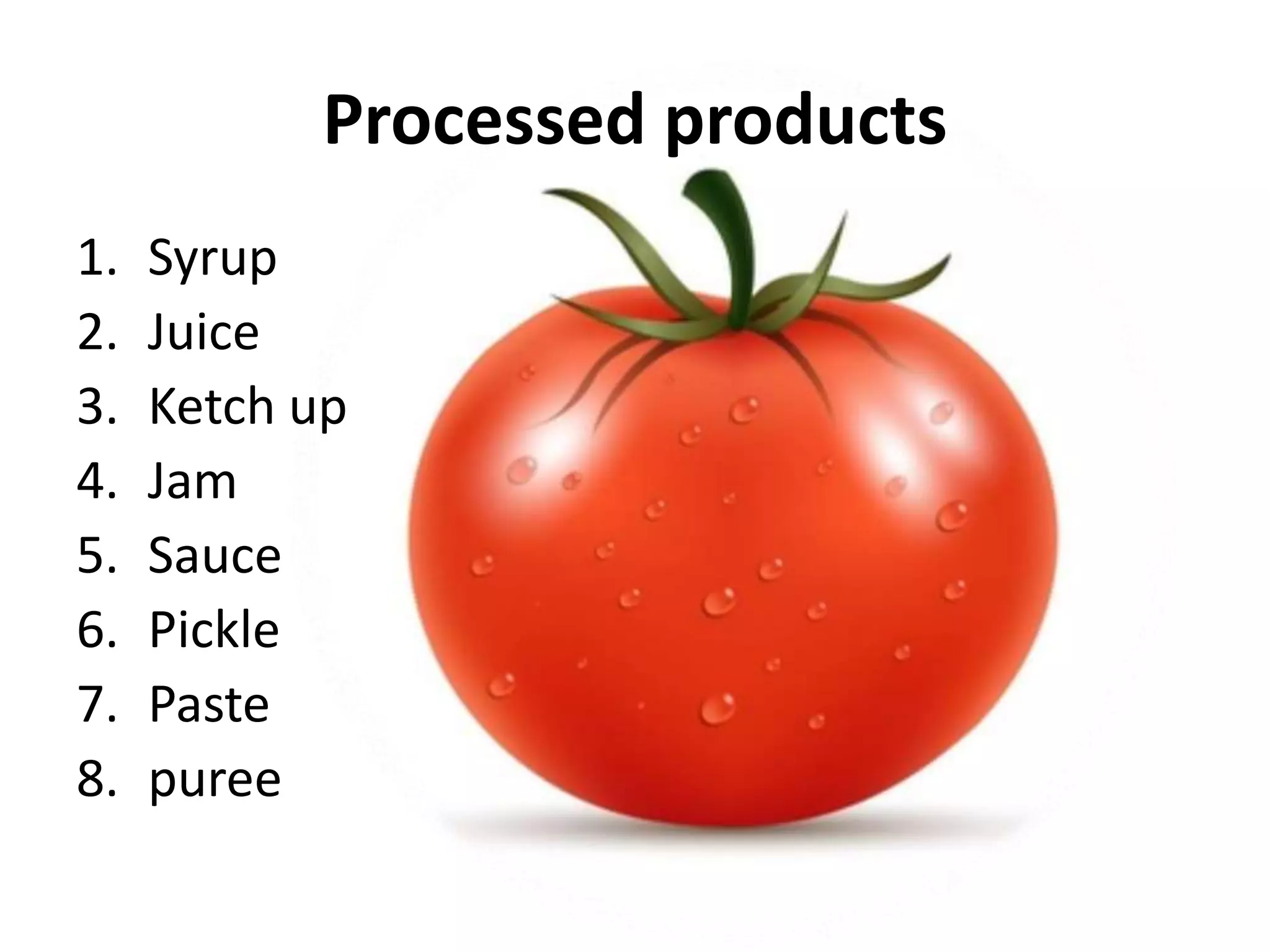
Processed products
1. Syrup
2. Juice
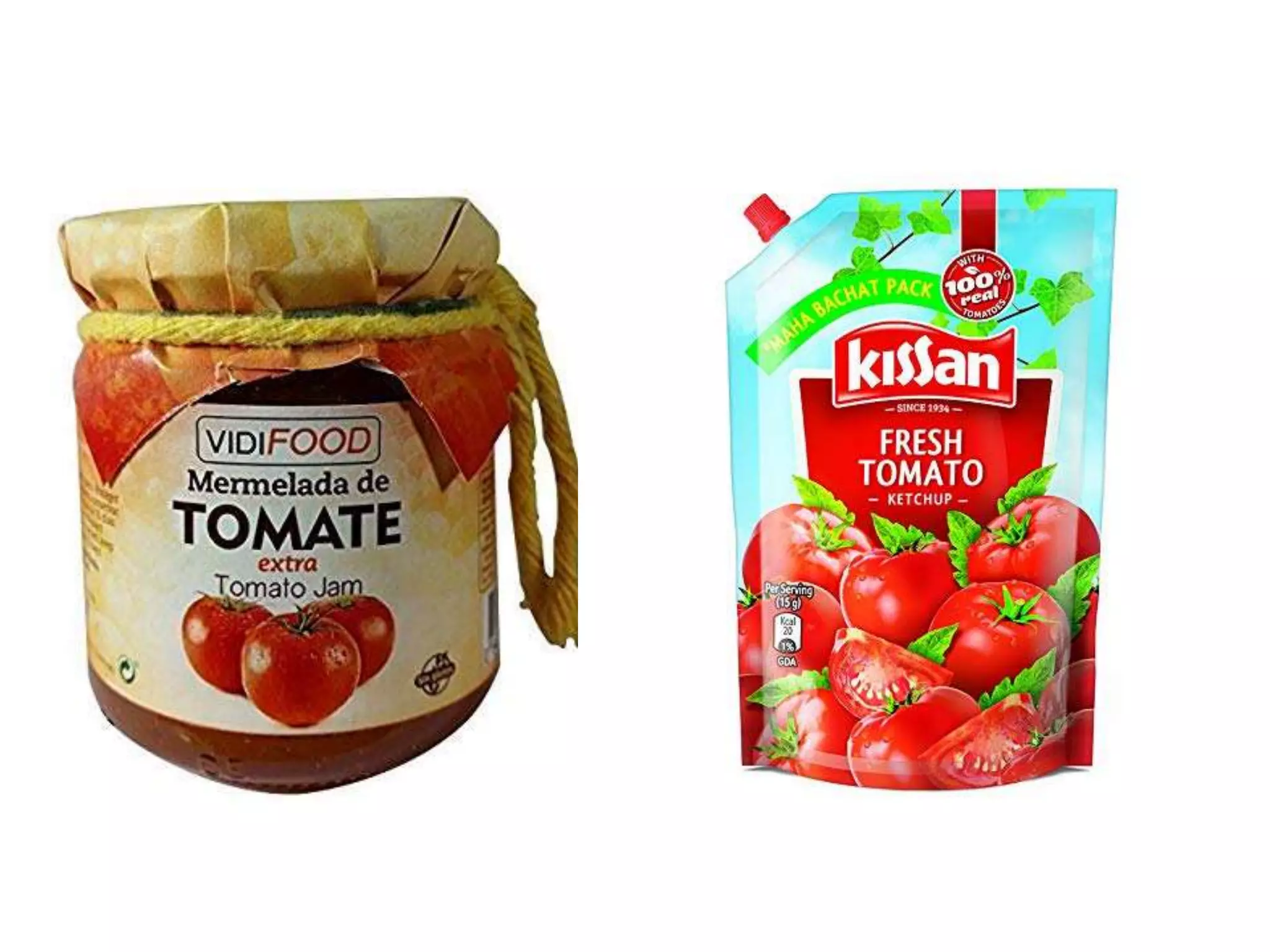
3. Ketch up
4. Jam
5. Sauce
6. Pickle
7. Paste
8. puree
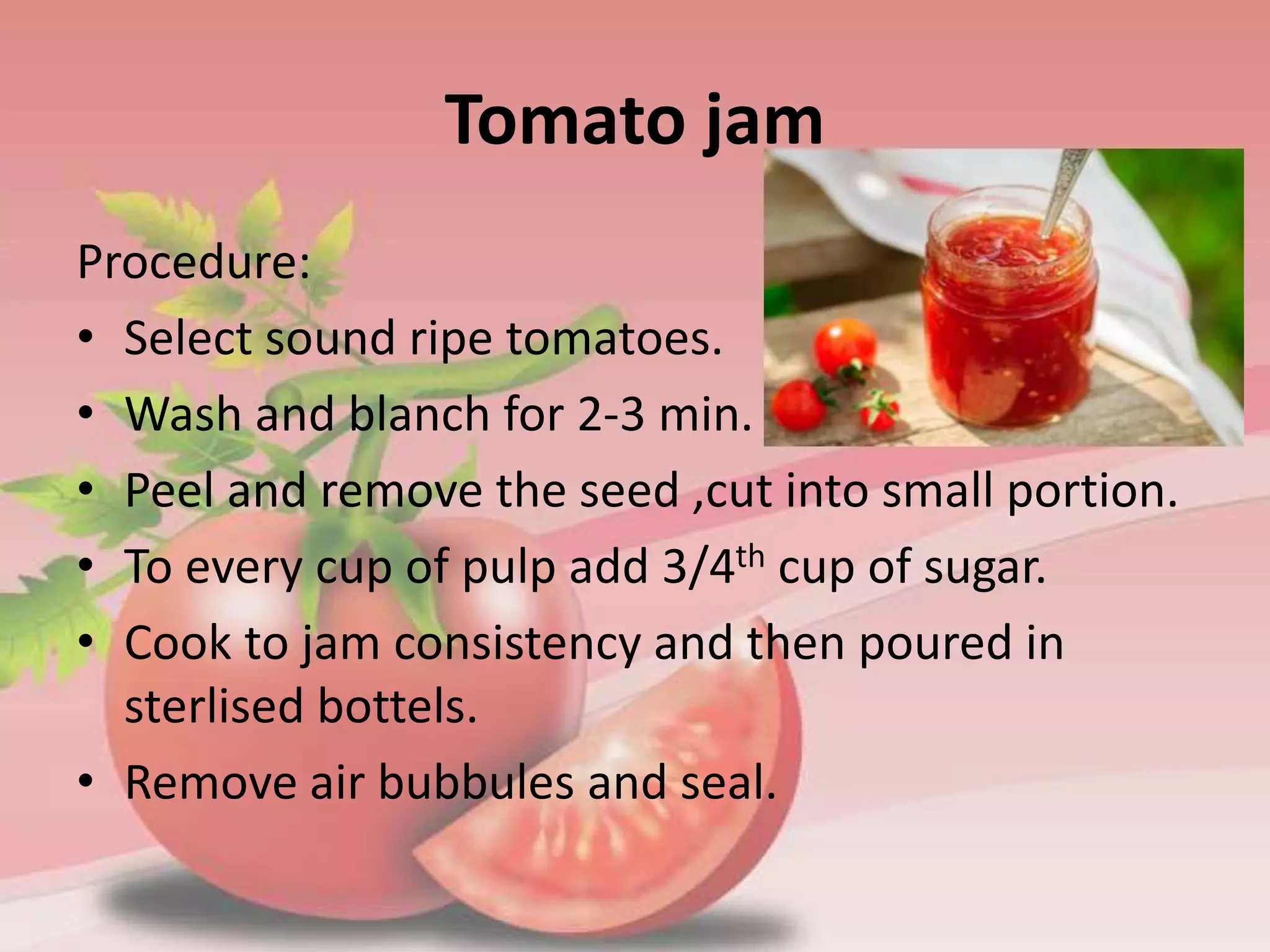
Tomato jam
Procedure:
• Select sound ripe tomatoes.
• Wash and blanch for 2-3 min.
• Peel and remove the seed ,cut into small portion.
• To every cup of pulp add 3/4th cup of sugar.
• Cook to jam consistency and then poured in
sterlised bottels.
• Remove air bubbules and seal.
Sweet tomato candy
Procedure:
• Cut tomato cross wise, remove seeds.
• Boil in water and blanch tomato for 10 min.
• Put tomatoes in caserole.
• Add sugar stir once in while until cook for 30
min.
• Dry it for 3 days.
Tomato ketchup
• Chop the tomatoes ,Garlic and ginger.
• Put in a degchi.
• Cook on a low fire till tender and thick.
• Pass through a sieve.
• Add vinegar, sugar and chilli
powder.
• Cook until thick.
Physiological disorders
1. Fruit cracking
CM: 0.3 to 0.4% Borax
2.Blossom end rot
CM: Calcium chloride
0.5%
3.Sun scald
4.Cat face
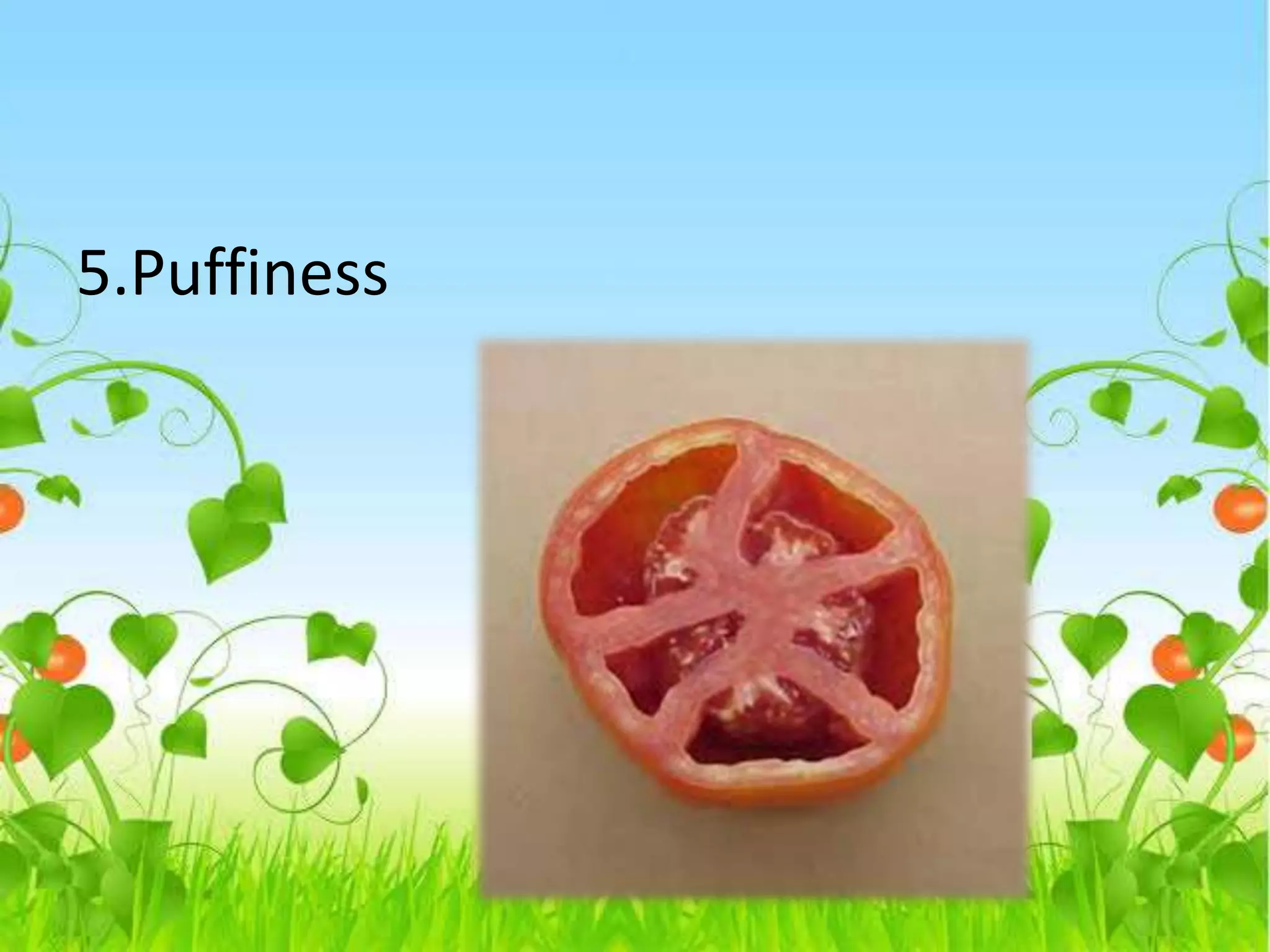
5.Puffiness
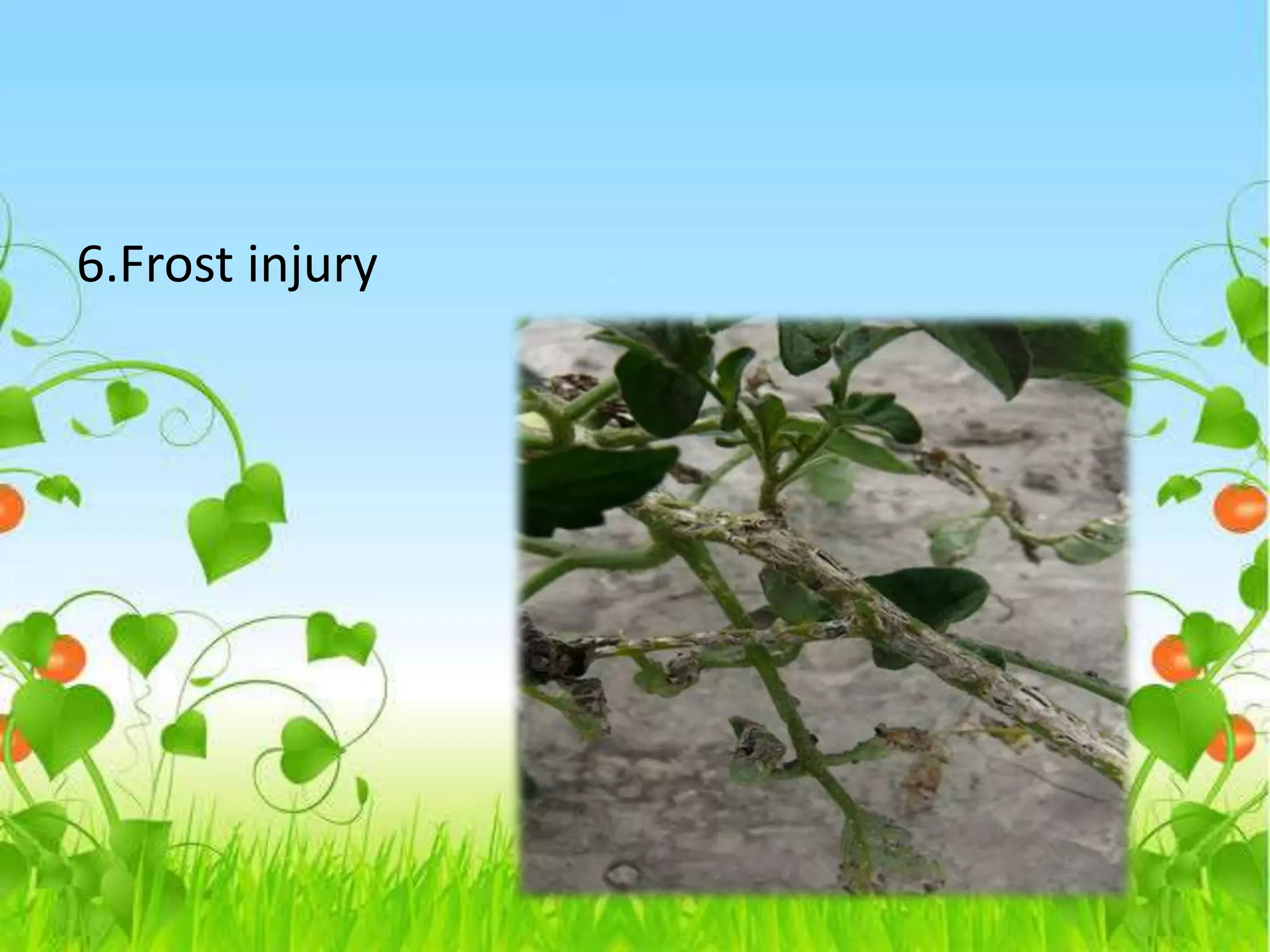
6.Frost injury
Pest of Tomato
• Fruit borer
SN:Helicoverpa armigera
• Larval stage is
destructive
• CM:
Spray carboryl 0.1%
Jassids
SN:Emposca devastance
• Yellowing and curling of
leaves
• CM:
Spray melathion 0.1%
Monocrotophos 0.03%
Hadda beetle
SN: Epilancha
vigintioctopunctata
• Translucent network of
leaf veins
• CM:
Spray melathion 0.1%
Tobaco catterfiller
SN: Spodoptera litura
• Defoliation of leaves
• CM:
Dust carboryl 5% @
25kg /ha
Root knot
nematode
SN: Meloidogyne incognata
 Knot like swelling can be
seen on the roots.
 CM:
Nemagon @20-25kg/ha
Carbofuran@ 25kg/ha
Diseases
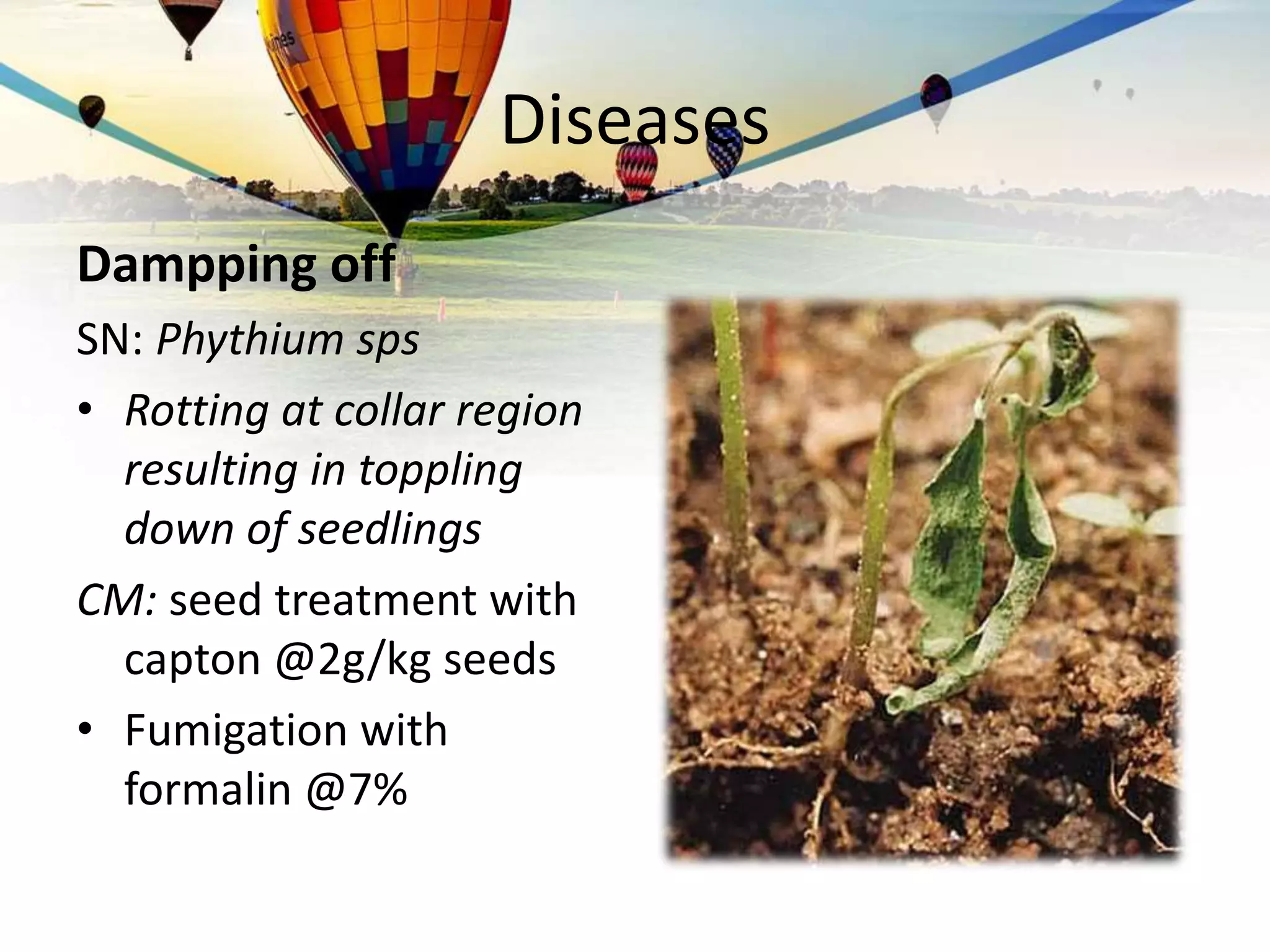
Dampping off
SN: Phythium sps
• Rotting at collar region
resulting in toppling
down of seedlings
CM: seed treatment with
capton @2g/kg seeds
• Fumigation with
formalin @7%
Early blight
SN: Alternaria solani
• Concentric dark brown spots
on leaves
• CM:Seed treatment with
capton 2g/kg seed
• Spray dithane m-45 0.2%
Fusarium wilt
SN: Fusarium oxysporum
 Yellowing of foliage and wilting
of upper leaves
 CM:
 seed treatment with Thiram
@2g/kg seed
 Spray Dithane M-45@ 0.25%
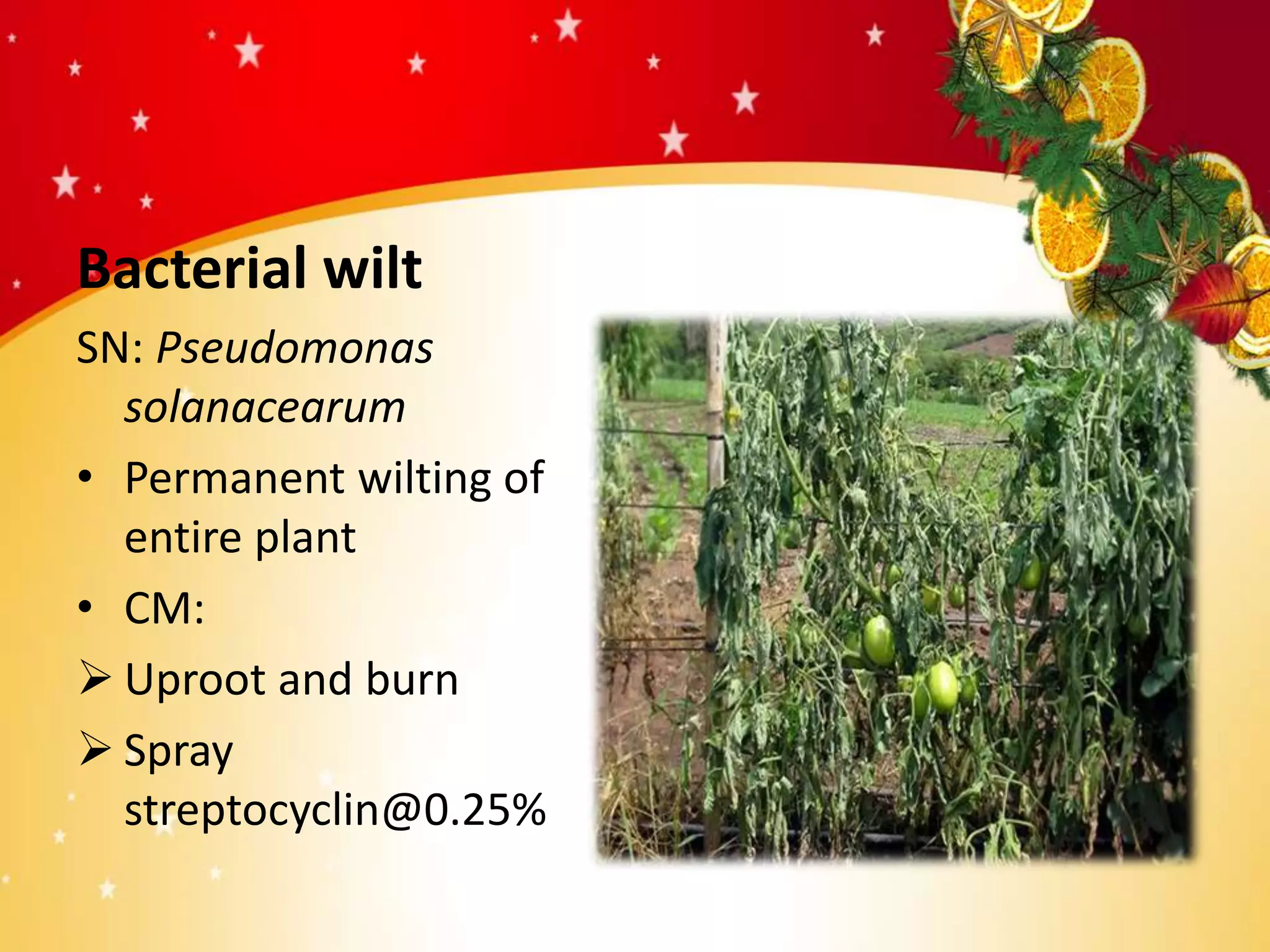
Bacterial wilt
SN: Pseudomonas
solanacearum
• Permanent wilting of
entire plant
• CM:
 Uproot and burn
 Spray
streptocyclin@0.25%
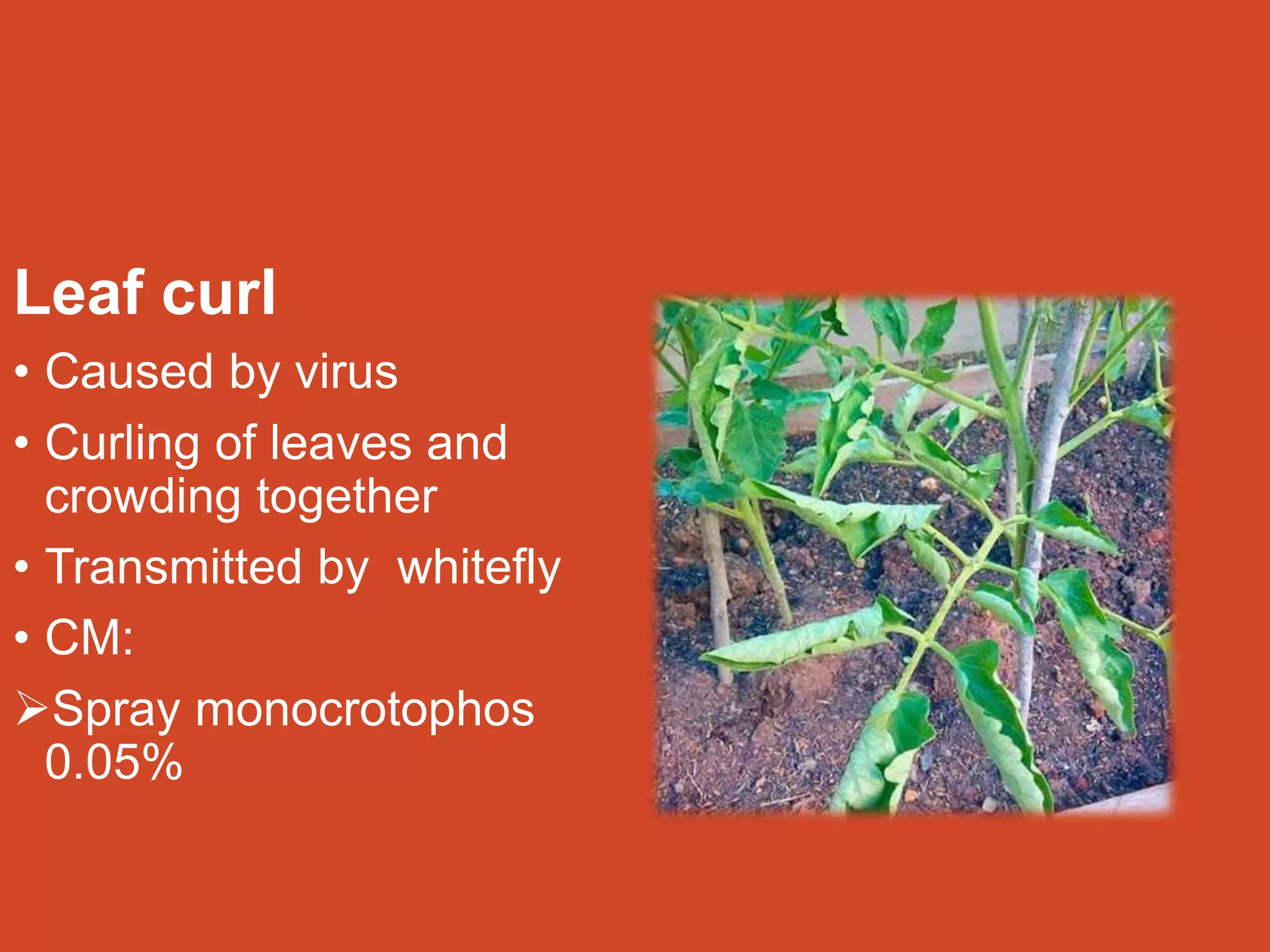
Leaf curl
• Caused by virus
• Curling of leaves and
crowding together
• Transmitted by whitefly
• CM:
Spray monocrotophos
0.05%
Mosaic
Caused By: TMV
• Mottling of leaves
• Stunted growth of plant
• CM:
 Select virus free seeds
Hot water treatment @50*C
for 30 min
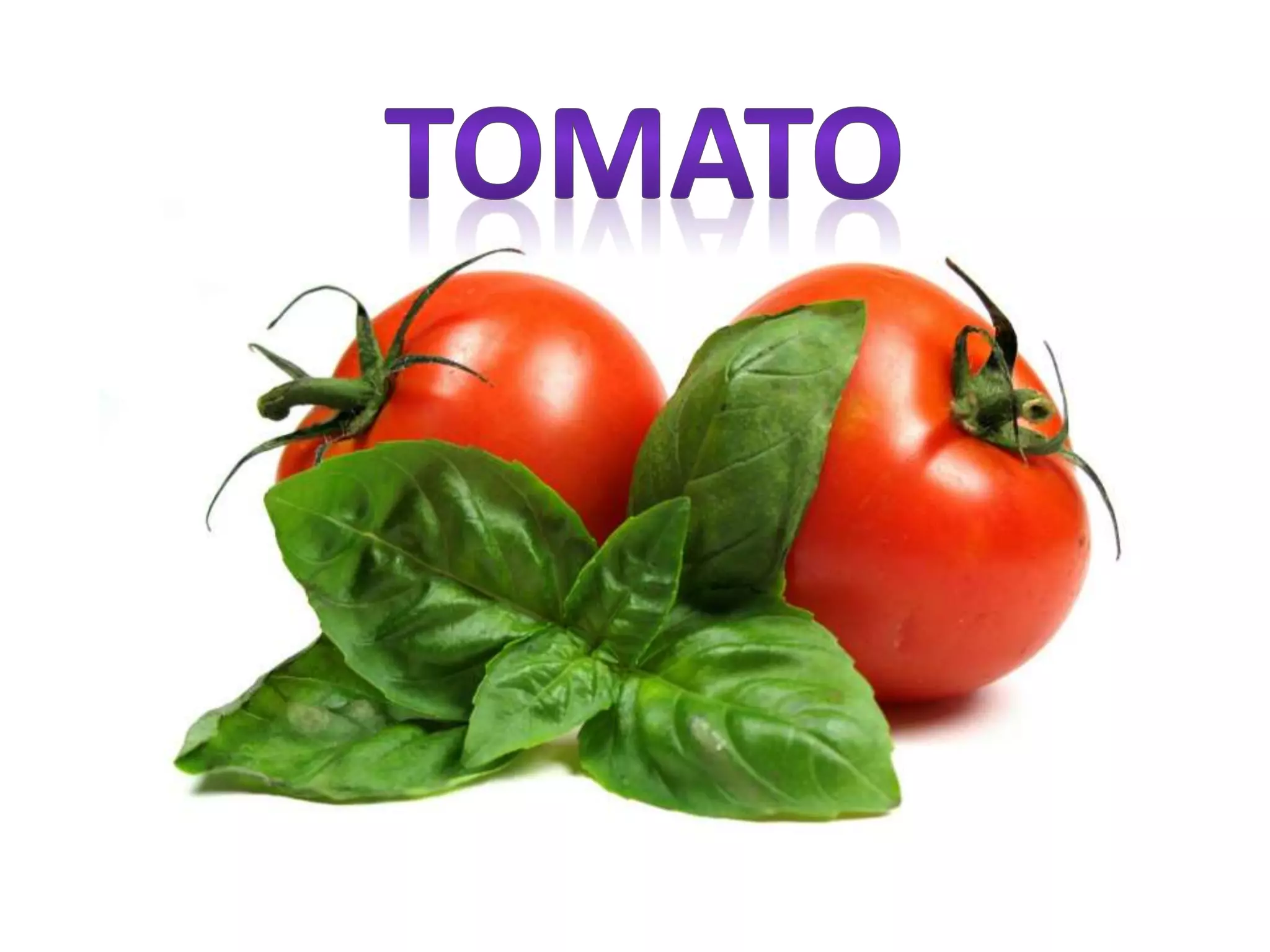
Tomato

Tomato

  • 2.
    Botanical discriptrion • Scientificname: Solanum lycopersicum • Common name: Tomato • Order: Solanales • Family: Solanaceae
  • 3.
    Origin and distribution •Origin: South America • Distribution: Cultivated tomato was brought to Europe by the Spanish in the 16th century and later from Europe to southern and eastern Asia. • In karnataka: Kolar, Belgaum, Mandya, Haveri and Banglore(R).
  • 4.
    Area and production PlaceArea(1000 ha) Production (1000tons) Productivity (Tons/ha) India 767.32 16384.98 21.35 Karnataka 64.25 2034.37 31.66
  • 5.
    Importance and uses •It is reffered as “Poor Man’s orange” • They are rich in minerals like Ca, Na and vitamins like A, B and C • Its soup is good remedy for preventing constipation • Red colour due to Lycopene and Yellow colour is due to carotenes. • Tomato can reduce high blood pressure.
  • 6.
    Botany • Roots: Taproot system • Stem: Erect to prostate • Leaf: Spirally arranged • Leaflets: Ovate to oblong • Flowers: Bisexual • Fruits: Berry • Seeds: Kidney or pear shaped with light brown colour
  • 7.
    Production technology Climate: • Dayneutral plant with optimal temperature of 21 to 28*C during day and 15-20*C during night. • Above 32*C day and Below 12*C night temp affect fruit set adversly. Soil: • Grows well in all kinds of soil. • But well drained fairly fertile soils rich in organic matter are preferred. • PH: 6-7
  • 8.
    Growth habit oftomato 1.Indeterminate type: Terminal buds end with a leafy bud 2.Determinate type: Terminal bud end with floral bud eg: Pusa early dwarf 3.Semi determinate: Growth between determinate and indeterminate. eg: S-12, Roma.
  • 9.
    IIHR Varieties 1.Arka rakshak •F1 hybrid has triple disease resistance to tomato leaf curl, bacterial wilt and early blight.
  • 10.
    IIHR Varieties 2.Arka sourab •Semi determinate • Fruit: Firm and nipple tipped • Yield:300q/ha.
  • 11.
    IIHR Varieties 3.Arka vikas •Tolerant to moisture stress condition • Semi-determinate type • Yield:300q/ha.
  • 12.
    IIHR Varieties 4. Arkaalok • Its also called as BWR-5 • Determinate type • Resistant to bacterial wilt • Fruit : Square and oblong • Yield:350q/ha in 125 days
  • 13.
    IIHR Varieties 5.Arka abha •Tolerant to powdery mildew • Resistant to bacterial wilt. • Semi-determinate type • Yield:350q/ha.
  • 14.
    UASB varieties • Nandi •Vaibhav • Sankranti
  • 15.
    IARI varieties • Pusaearly dwarf • Pusa ruby • Pusa Sadhabahar • Pusa sheetal • Pusa gaurav • Pusa rohini • Kashi amrit
  • 16.
    CULTIVATION 1. Nursery seedbed preparation 2. Field preparation 3. Planting 4. Manures and fertilizers 5. Irrigation 6. Weed management 7. Training and pruning 8. Harvesting
  • 17.
    1.Nursery seed bedpreparation • Seeds are sown in an area of 250m square • 4-5 weeks old seedlings are transplanted on raised beds of 80-90cm width and 20-25cm height.
  • 18.
    2.Land preparation • Ploughthe land 4-5 times with sufficient intervals between two consecutive ploughing along with the incorporation of FYM.
  • 19.
    3.Planting • Main seasonsare Jan-Feb, June-July and Oct-Nov. • Seed rate: var-200-250g/ha Hybrids:100-125g/ha • It can be grown in all seasons. • Spacing: 60 x 30-45cm or 75 x 75cm • Closer spacing results in early and higher yields.
  • 20.
    4.Manures and fertilizers •FYM: 25-30 tons • NPK: 115:100:60 kg/ha • 10kg borax + 5kg Zinc sulphate as a basal dose.
  • 21.
    5.Irrigation • Summer: 4-5days interval • Winter: 8-12 days interval • Critical stage: Water stress at flowering stage will adversely affect fruiting and productivity. • Furrow irrigation is most common • Drip and sprinkler irrigation are most common in areas of water shortage.
  • 22.
    6.Weed management • Applicationof Pendimethalin as a pre- emergent herbicide • One hand weeding at 45 DAT • Mulching with straw or plastic is also effective and for regulating soil temperature.
  • 23.
    7.Training and pruning •Staking is done to prevent lodging and loss of fruits by coming in contact with soil. • It is done by providing individual stack or by erecting 2-2.5m long poles on either side of ridges for stretching GI wires.
  • 24.
    pruning • Pruning isfollowed to improve size, shape and quality of fruits • Tomato is subjected to Pinching , lateral shoots are pinched to improve bushy growth.
  • 25.
    Growth promoters Purpose Growthregulators Mode and time of application High yield GA Foliar spray of 10ppm Increased fruit set NAA(0.1ppm) Seedling soaking for 24 hrs Ripening of fruits Ethrel(1000ppm) Whole plant spray at the initiation of ripening
  • 26.
    Maturity standards 1. Immaturegreen 2. Mature green 3. Turning or breaker 4. Pink/half ripe stage 5. Hard ripe stage 6. Red/over ripe stage
  • 27.
    8.Harvesting • Yields around70-75 days after planting • Usually fruits are harvested with hands by gentle twist • Yield:  Varieties:25-30tons/ha  Hybrids:50-60tons/ha
  • 28.
    Grading According to Bureauof Indian standards 1. Super A 2. Super 3. Fancy 4. Commercial
  • 29.
    Storage • It canbe stored for 2-4 weeks at 10-13 degree celcious, when harvested at red and green stages
  • 30.
    Marketing • Mode oftransportation: Road ways • Optimum matured tomatoes are marketed usually at local nearby markets • Pre matured green tomatoes are transported for distant markets • For one graded box present market price is 675 Rupees.
  • 31.
    Processing 1. Deep redcoloured fruits 2. Low PH 3. High TSS 4. High viscosity and consistency 5. Firm and easy peeling 6. Crack resistance
  • 32.
    Processed products 1. Syrup 2.Juice 3. Ketch up 4. Jam 5. Sauce 6. Pickle 7. Paste 8. puree
  • 33.
    Tomato jam Procedure: • Selectsound ripe tomatoes. • Wash and blanch for 2-3 min. • Peel and remove the seed ,cut into small portion. • To every cup of pulp add 3/4th cup of sugar. • Cook to jam consistency and then poured in sterlised bottels. • Remove air bubbules and seal.
  • 34.
    Sweet tomato candy Procedure: •Cut tomato cross wise, remove seeds. • Boil in water and blanch tomato for 10 min. • Put tomatoes in caserole. • Add sugar stir once in while until cook for 30 min. • Dry it for 3 days.
  • 35.
    Tomato ketchup • Chopthe tomatoes ,Garlic and ginger. • Put in a degchi. • Cook on a low fire till tender and thick. • Pass through a sieve. • Add vinegar, sugar and chilli powder. • Cook until thick.
  • 39.
    Physiological disorders 1. Fruitcracking CM: 0.3 to 0.4% Borax
  • 40.
    2.Blossom end rot CM:Calcium chloride 0.5%
  • 41.
  • 42.
  • 43.
  • 44.
  • 45.
    Pest of Tomato •Fruit borer SN:Helicoverpa armigera • Larval stage is destructive • CM: Spray carboryl 0.1%
  • 46.
    Jassids SN:Emposca devastance • Yellowingand curling of leaves • CM: Spray melathion 0.1% Monocrotophos 0.03%
  • 47.
    Hadda beetle SN: Epilancha vigintioctopunctata •Translucent network of leaf veins • CM: Spray melathion 0.1%
  • 48.
    Tobaco catterfiller SN: Spodopteralitura • Defoliation of leaves • CM: Dust carboryl 5% @ 25kg /ha
  • 49.
    Root knot nematode SN: Meloidogyneincognata  Knot like swelling can be seen on the roots.  CM: Nemagon @20-25kg/ha Carbofuran@ 25kg/ha
  • 50.
    Diseases Dampping off SN: Phythiumsps • Rotting at collar region resulting in toppling down of seedlings CM: seed treatment with capton @2g/kg seeds • Fumigation with formalin @7%
  • 51.
    Early blight SN: Alternariasolani • Concentric dark brown spots on leaves • CM:Seed treatment with capton 2g/kg seed • Spray dithane m-45 0.2%
  • 52.
    Fusarium wilt SN: Fusariumoxysporum  Yellowing of foliage and wilting of upper leaves  CM:  seed treatment with Thiram @2g/kg seed  Spray Dithane M-45@ 0.25%
  • 53.
    Bacterial wilt SN: Pseudomonas solanacearum •Permanent wilting of entire plant • CM:  Uproot and burn  Spray streptocyclin@0.25%
  • 54.
    Leaf curl • Causedby virus • Curling of leaves and crowding together • Transmitted by whitefly • CM: Spray monocrotophos 0.05%
  • 55.
    Mosaic Caused By: TMV •Mottling of leaves • Stunted growth of plant • CM:  Select virus free seeds Hot water treatment @50*C for 30 min