TOPIC – CULTIVATION OF TOMATO
SUBMITTED TO
DR. M.S. RATHI
COLLEGE – J.V.COLLEGE BARAUT
SUBMITTED BY
ANIL KUMAR
ROLL NO – RJ180004243005
CLASS – M.Sc. ( Ag ) HORTICULTURE
 Botanical Name :- Lycoperiscon esculentum
 Family :- Solanaceae
 Origin Centre :- South America
 Chromosome No :- 2n=2x=24
 Edible Part :- Fruit
Origin:- Tomato is originated in Peru of South
America and name of crop came from the
Aztec word “Tomato”. The crop is of recent
origin and first report of tomato was from Italy
in 1544. Later spread was fast and the crop is
grown throughout the length and breadth of
world
 It is amazing
to note the quantum jump in the spread of
tomato during the last four decades. In
India, crop was grown in an area of 36000
ha. during 1960 and present area and
production in the country is 4.58 lakh ha.
and 74.62 lakh tones respectively with
productivity of 16.29 t/ha. Leading
producing states are UP,Karnataka,
Maharashtra, Haryana, Punjab and Bihar.
 Botanical name of tomato is Solanum lycopersicum (lycos
= wolf and persicon = peach).
 Genus Lycopersicon is divided into two subgenera
(A) Eulycopersicon (Red fruited and self compatible)
(B) Eriolycopersicon (Green fruited and self incompatible)
Eulycopersicon includes two species, L.
esculentum(Solanum lycopersicum) with large fruits and
L. pimpinellifolium ( New name Solanum pimpinellifolium)
with small fruits born inclusters.
Eriopersicon mainly consists of wild sp like
L.hirsutum(S.habrochaites), L.peruvianum,(S.
peruvianum) L. pissisi, L. glandulosum, L. cheesmani(S.
cheesmani) etc.
 Rick (1976) divided genus Lycopersicon into following
two groups based on their ability to cross with cultivated
tomato .
Solanum lycopersicum S. pimpinellifolium
L. chessmanii L. hirsutum
 Esculentum complex (crossable with
cultivated tomato) L. esculentum, L.
pimpinelifolium,
L. cheesemani and L. hirsutum
 Peruvianum complex (Not crossable with
cultivated tomato) L. peruvianum, L.
chinense. Solanum lycopersicum S.
pimpinellifolium
L. chessmanii L. hirsutum
 Based on growth habit and fruit characters,
five forms of L. esculentum are identified.
 Communae - Common tomato
 Cerasiformae - Small fruited cherry tomato
 Pyriformae - Pear shaped tomato
 Grandifolium - potato leaved tomato
 Validum - Erect and upright tomato
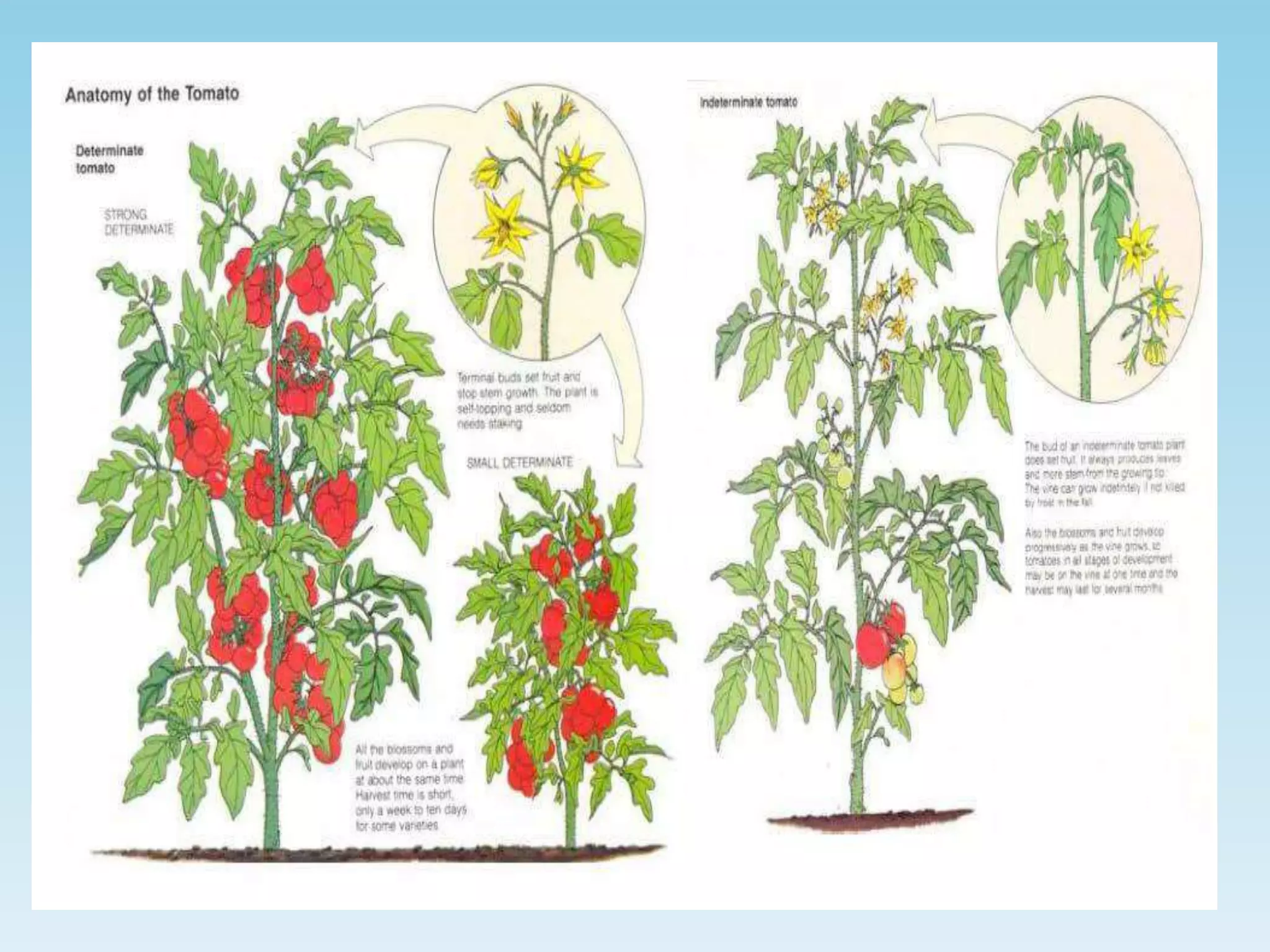
 Tomato is a true diploid with 2n=24. Plant
is annual with herbaceous prostrate stem
having determinate or indeterminate growth
habit. In the determinate growth, terminal
bud ends in a floral bud and further growth
in arrested resulting in dwarf and bushy
stature. In indeterminate growth, terminal
bud is a leafy bud and terminal and lateral
buds continue to grow and there are less
production of flowers and fruits on mains
tem.
Botany :-
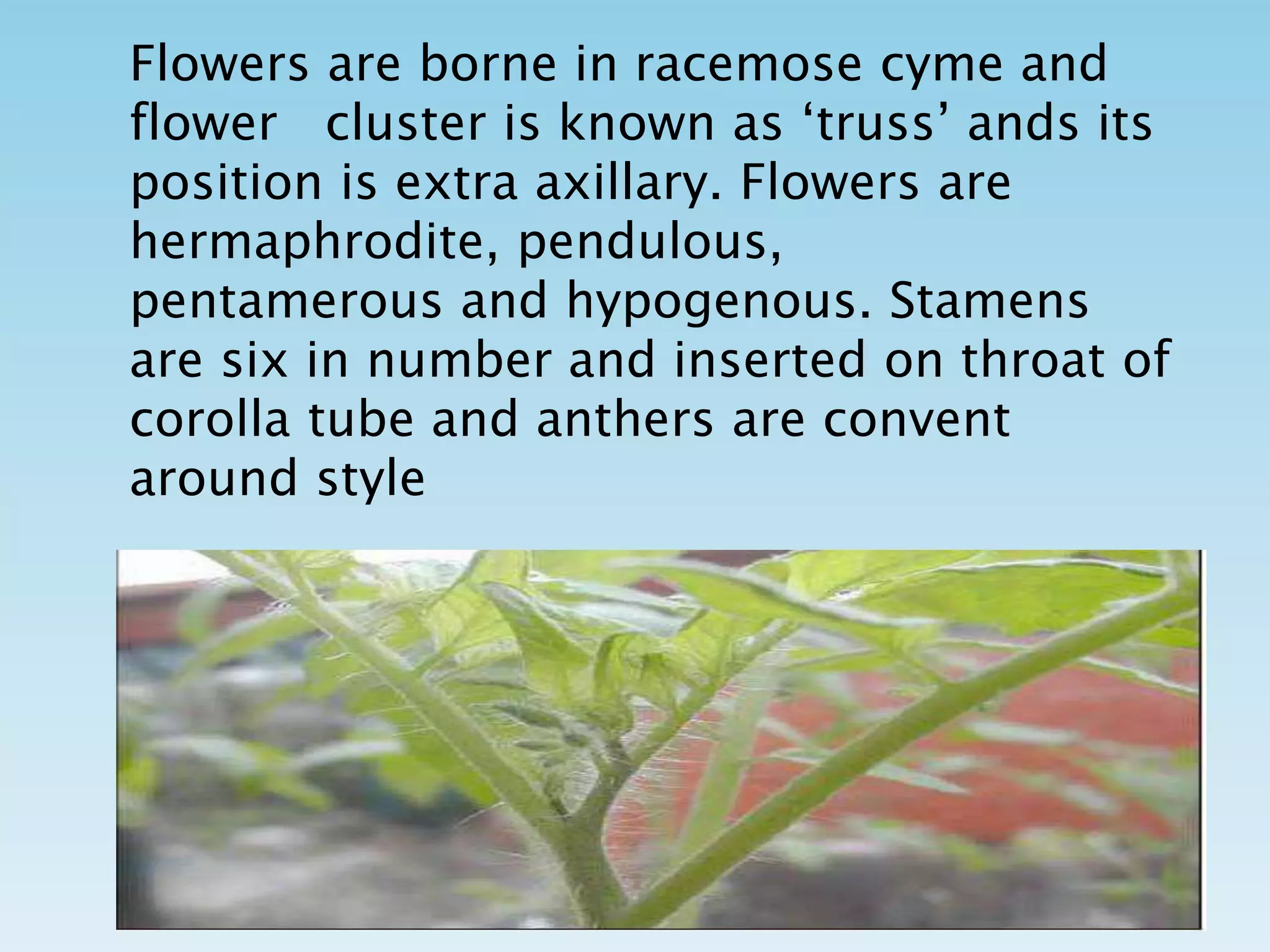
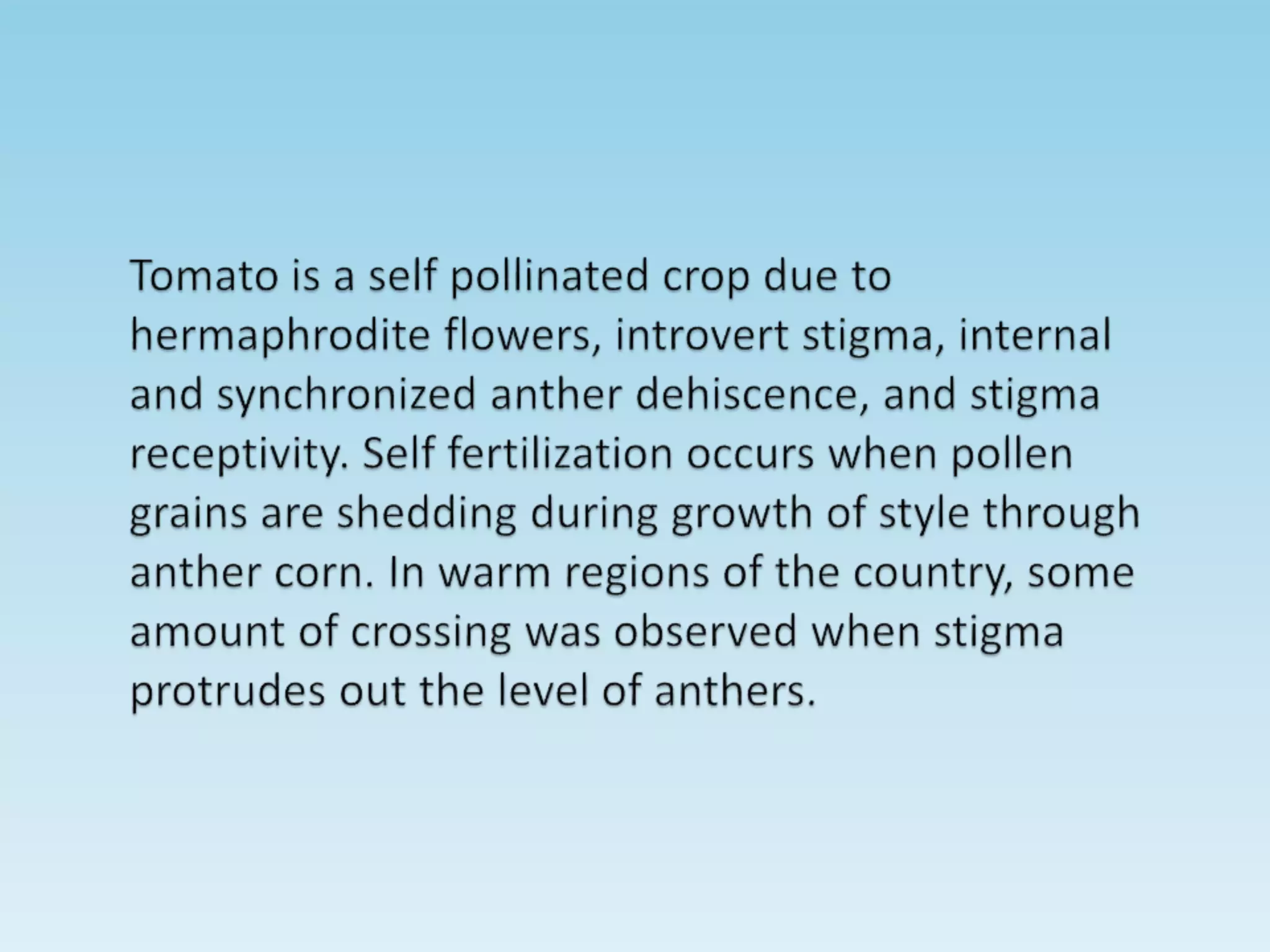
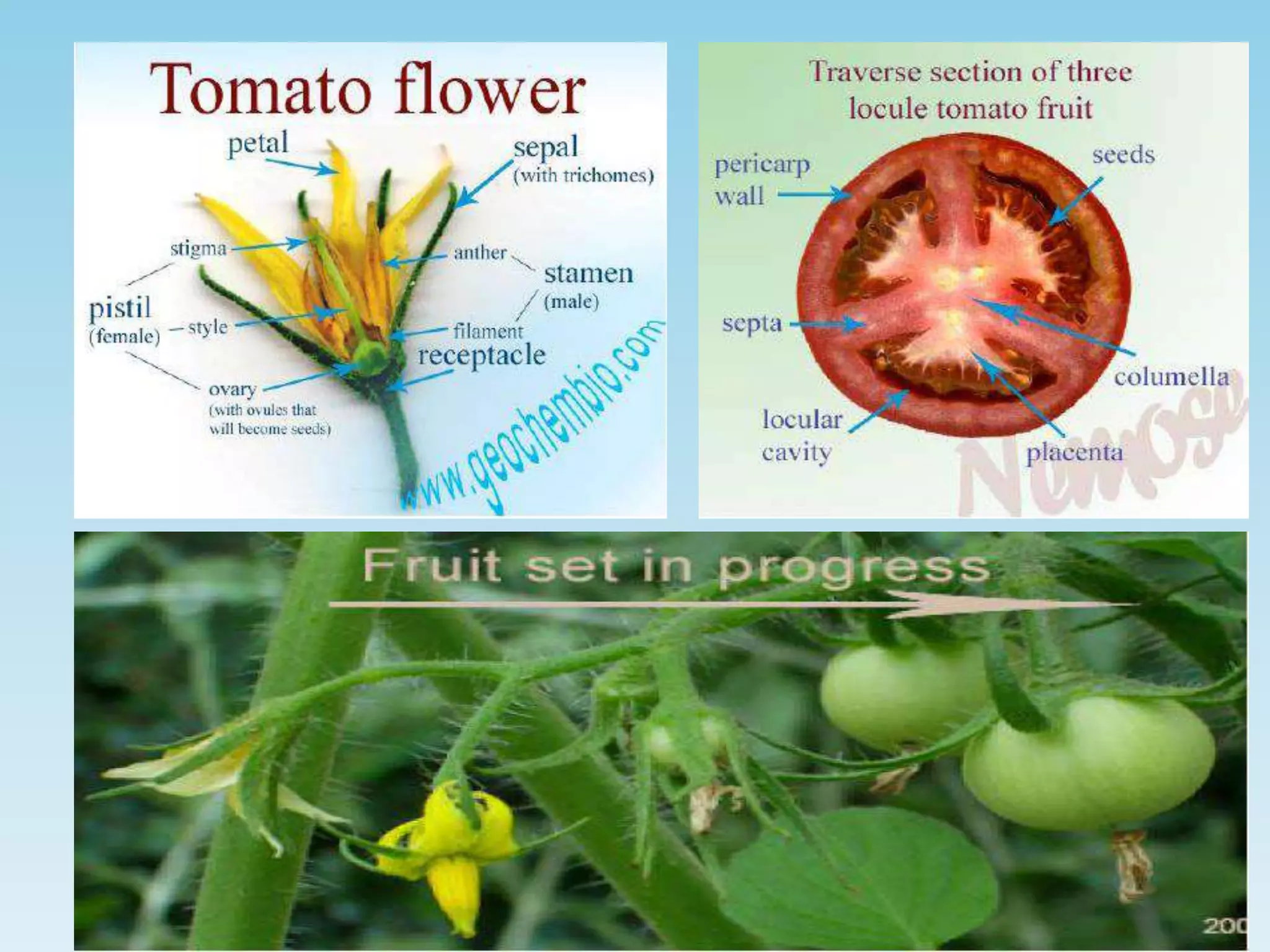
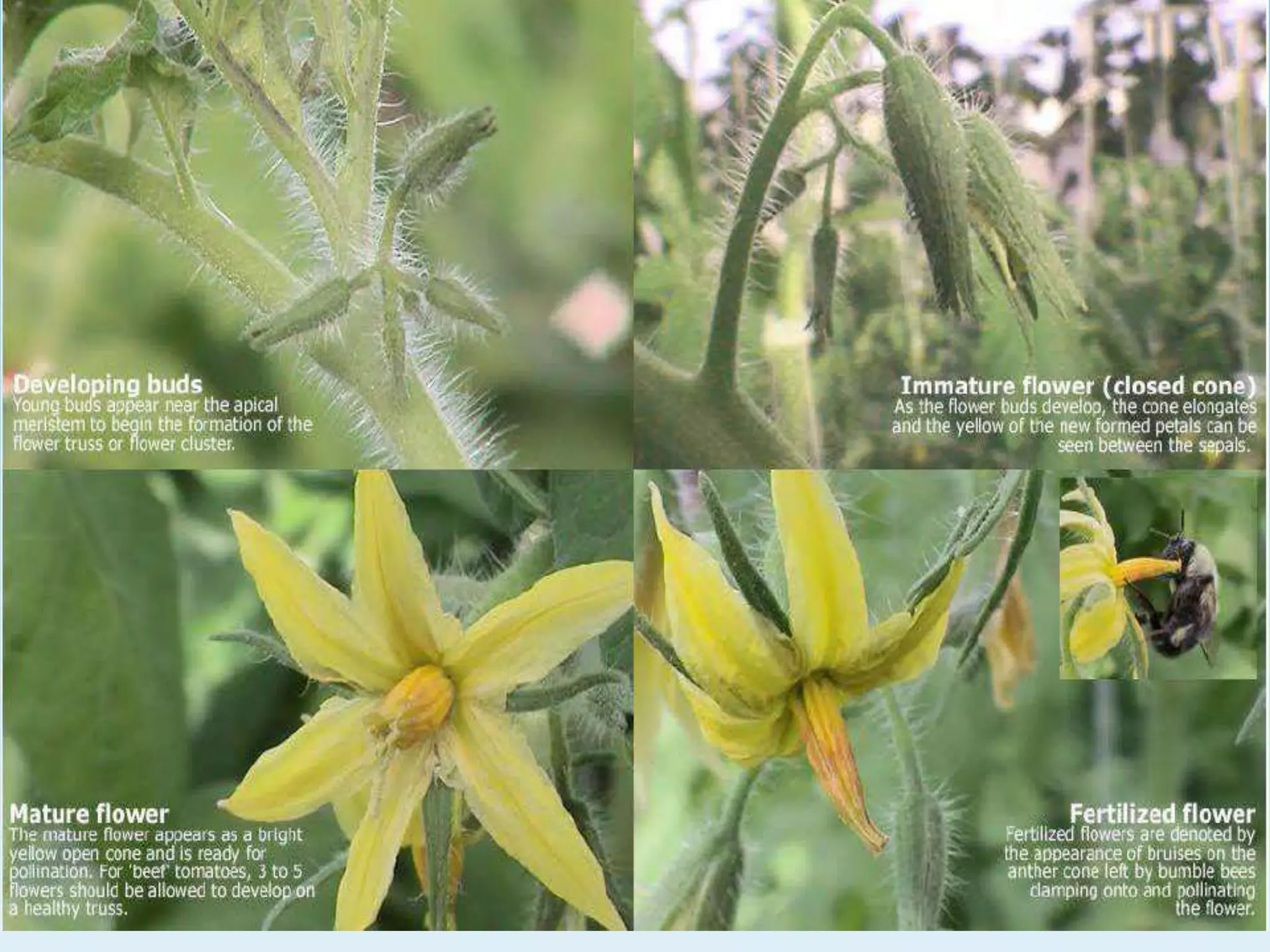
Flowers are borne in racemose cyme and
flower cluster is known as ‘truss’ ands its
position is extra axillary. Flowers are
hermaphrodite, pendulous,
pentamerous and hypogenous. Stamens
are six in number and inserted on throat of
corolla tube and anthers are convent
around style
Varieties
Improved varieties
Arka Saurabh, Arka Vikas, Arka Ahuti, Arka Ashish,
Arka Abha , Arka Alok, HS101, HS102, HS110,
Hisar Arun, Hisar Lalima, Hisar Lalit, Hisar Anmol,
KS.2, Narendra Tomato 1, Narendra Tomato 2,
Pusa Red Plum, Pusa Early Dwarf, Pusa Ruby, Co-1,
CO 2, CO 3, S-12, Punjab Chhuhara, PKM 1, Pusa
Ruby, Paiyur-1, Shakthi, SL 120, Pusa Gaurav, S 12,
Pant Bahar, Pant T3, Solan Gola and Arka Meghali.
F1 hybrids: Arka
Abhijit, Arka Shresta, Arka Vishal, Arka Vardan,
Pusa Hybrid 1, Pusa Hybrid 2, COTH 1 Hybrid
Tomato, Rashmi, Vaishali, Rupali, Naveen,Avinash
2, MTH 4, Sadabahar, Gulmohar and Sonali.
Climatic Requirement :-
The tomato is a
warm-season crop. The crop does well under an
average monthly temperature of 210 C to 230 C.
Temperature and light intensity affect the fruit-
set, pigmentation and nutritive value of the fruit.
Long dry spell and heavy rainfall both shows
detrimental effect on growth and fruiting.
Soil :-
The tomato grows on practically all soils from
light sandy to heavy clay. Light soils are good for
an early crop, while clay loam and silt-loam soils
are well suited for heavy yields. Tomatoes do
best in a soil that has a soil reaction from pH 6.0
to 7.0. If the soil is acidic liming is required.
Seed rate :- For raising the seedlings in
nursery bed 300 - 400 g/ha seeds are required.
Hybrid seeds are very costly so it should be sown
in plastic cups or ice cube tray, which require only
70-90 g.
Time of planting :- Tomato is a day neutral
plant so wildly it found grown in any season. In the
northern plains three crops are taken but in frost
affected area rabi crop is not fruitful. The kharif
crop is transplanted in July, rabi crop in October -
November and zaid crop in February months. In the
southern plains where there is no danger of frost,
The first transplanting is done in Dec.-Jan., Second
June-July Third in September-October depending
on the irrigation facilities available.
1.Seedlings are grown
before one months of transplanting raised beds
of 60-100 cm width and of convenient length.
2. Soil solorization of nursery bed by covering
them with white transparent polythene sheet for
one month should be done in hot summer
months. It will kill the disease causing organisms
like fungus, bacteria, nematode as well as insects
and seeds of weeds.
3.For one m2 of nursery area apply 5kg well
rotten FYM and 20 g of each N, P and K fertiliser,
and also apply 2.5g carbofuran or 200 g of neem
cake and 10-25 g tricoderma.
4.While preparing the nursery beds, neem cake
/castor cake/ neam leaf/ castor leaf/ pongamia
leaf/ calotropis leaf has to be incorporated @
400 g/m2 for protection against nematoads.
5 . After sowing the seeds, mulch with green
leaves and irrigate with a rosecan daily in the
morning. Remove the mulch immediately after
germination of the seeds. Restrict irrigation one
week before transplanting and irrigate heavily on
the previous day of transplanting.
6. Cover the nursery bed with fine nylon net to
escape the damage by virus transmitting insects.
Seed treatment :-
To avoid damping off
disease treats the seed with Tricoderma @ 5-10
g/Kg seed or carbendazim 2g/Kg seed. The
treated seeds are dried in shade for 30 minutes
and then sown sparsely along the lines in ½ cm
depth and then covered by the top soil.
Land preparation :-
Land is prepared to a
fine tilth by thorough ploughing or digging 2 - 3
times. At the last ploughing organic manure and
10 kg carbofuran granules or 200 kg neem cake
has to be applied.
Manuring :-
Apply well rotten farm yard
manure / compost @ 20-25 t/ha at the time of
land preparation and mix well with the soil. A
fertilizer dose of 75:40:25 kg N:P2O5:K2O / ha
may be given. Half the dose of nitrogen, full
phosphorus and half of potash may be applied
as basal before transplanting. One fourth of
nitrogen and half of potash may be applied 20-
30 days after planting. The remaining quantity
may be applied two months after planting.
Transplanting :-
1 . The transplanting is done
in small flat beds or in shallow furrow
depending upon the availability of irrigation.
2. In heavy soil it is usually transplanted on
ridges and during the rains also it is
advantageous to plant the seedlings on ridges.
3. For indeterminate varieties/hybrids, the
seedlings have to be staked using bamboo
sticks of two meter length or planted in broad
ridge of 90 cm width and 15 cm height. The
seedlings are planted in the furrows at a
spacing of 30 cm and the plant is allowed to
spread on the broad ridge.
Spacing :-
The spacing recommended for the
autumn-winter crop is 75 x 60 cm and for the
spring summer crop 75 x 45 cm.
Irrigation :-
Tomatoes need very careful
irrigation that is just sufficient water at the right
time. It is necessary to maintain an even moisture
supply. During summer season, irrigation at
every 5to 7 days interval is necessary, whereas in
winter 10 to 15 days interval is sufficient. A
period of drought followed by sudden heavy
watering during the fruiting period may cause
cracking of fruits.
Weed Control :-
1. There is need of light hoeing during
first four weeks in the field which encourage the
growth but also remove the weeds from the field.
The surface soil is loosened 4 by hand hoeing as
soon as it is dry enough after every irrigation or
shower. All weeds should also be removed in this
process.
2. Mulching with straw, black polythene and many
other materials has been found beneficial in
moisture conservation, in controlling weeds and
some diseases.
Plant protection :-
Insects:-
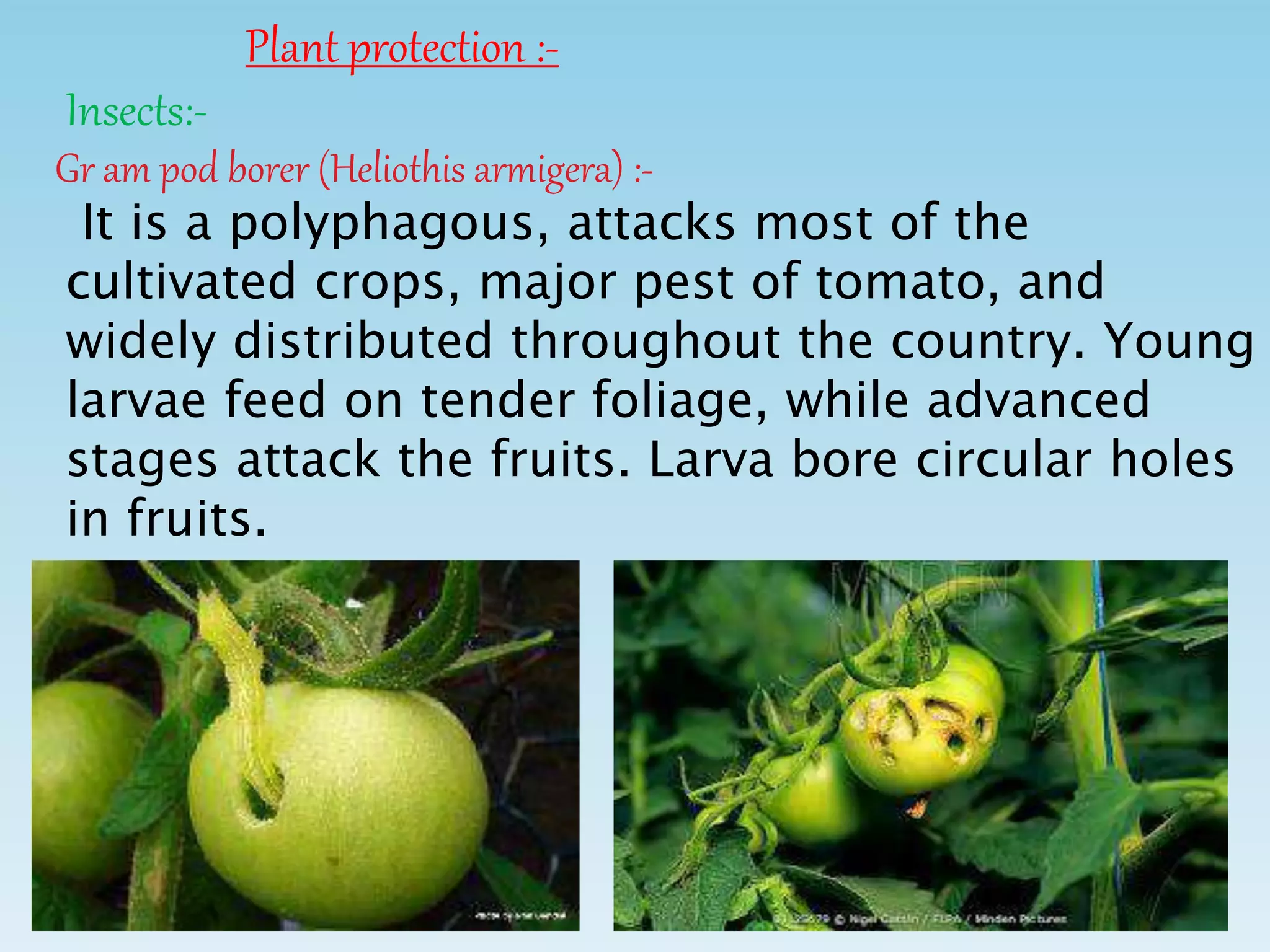
Gr am pod borer (Heliothis armigera) :-
It is a polyphagous, attacks most of the
cultivated crops, major pest of tomato, and
widely distributed throughout the country. Young
larvae feed on tender foliage, while advanced
stages attack the fruits. Larva bore circular holes
in fruits.
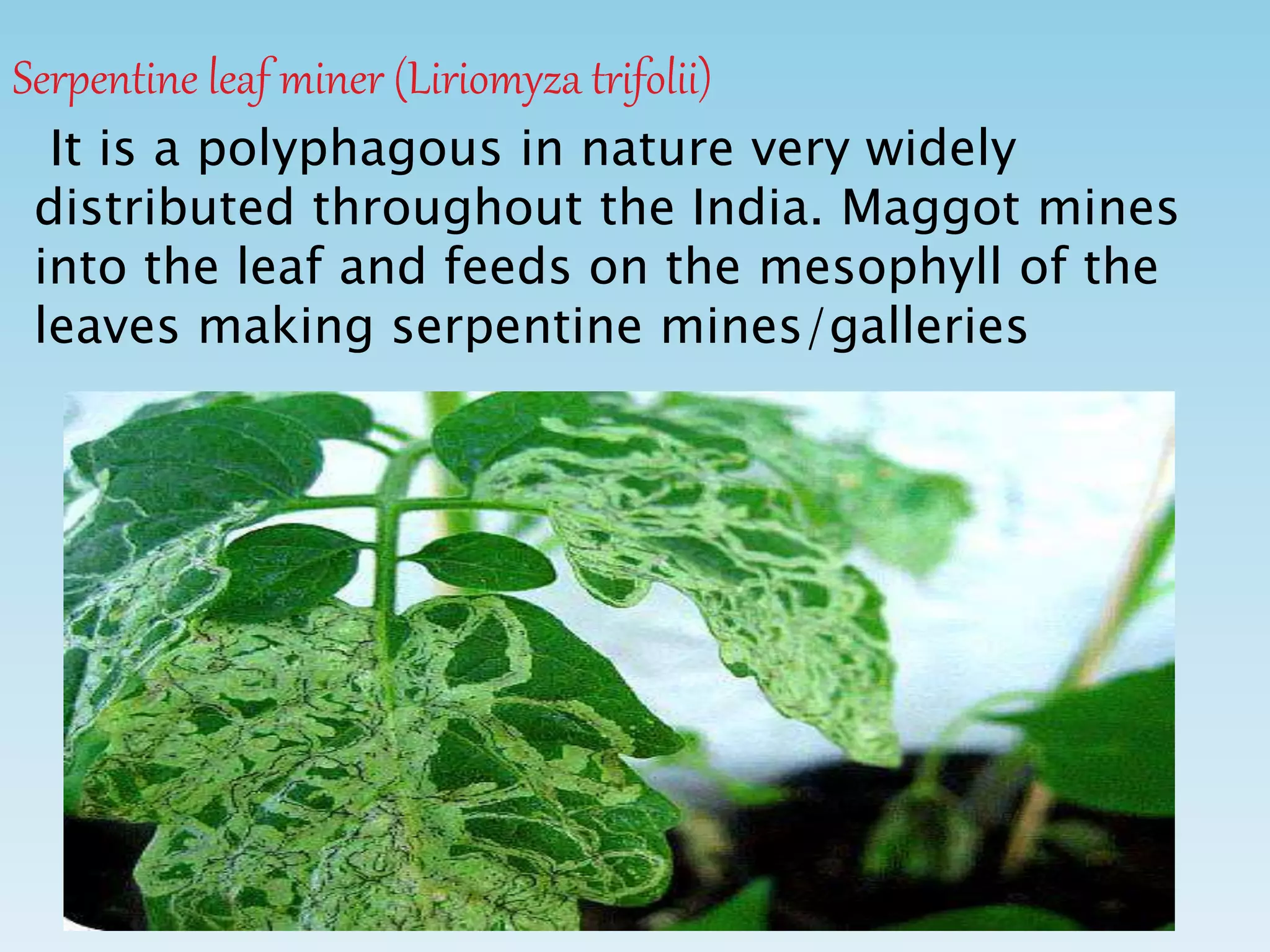
Serpentine leaf miner (Liriomyza trifolii)
It is a polyphagous in nature very widely
distributed throughout the India. Maggot mines
into the leaf and feeds on the mesophyll of the
leaves making serpentine mines/galleries
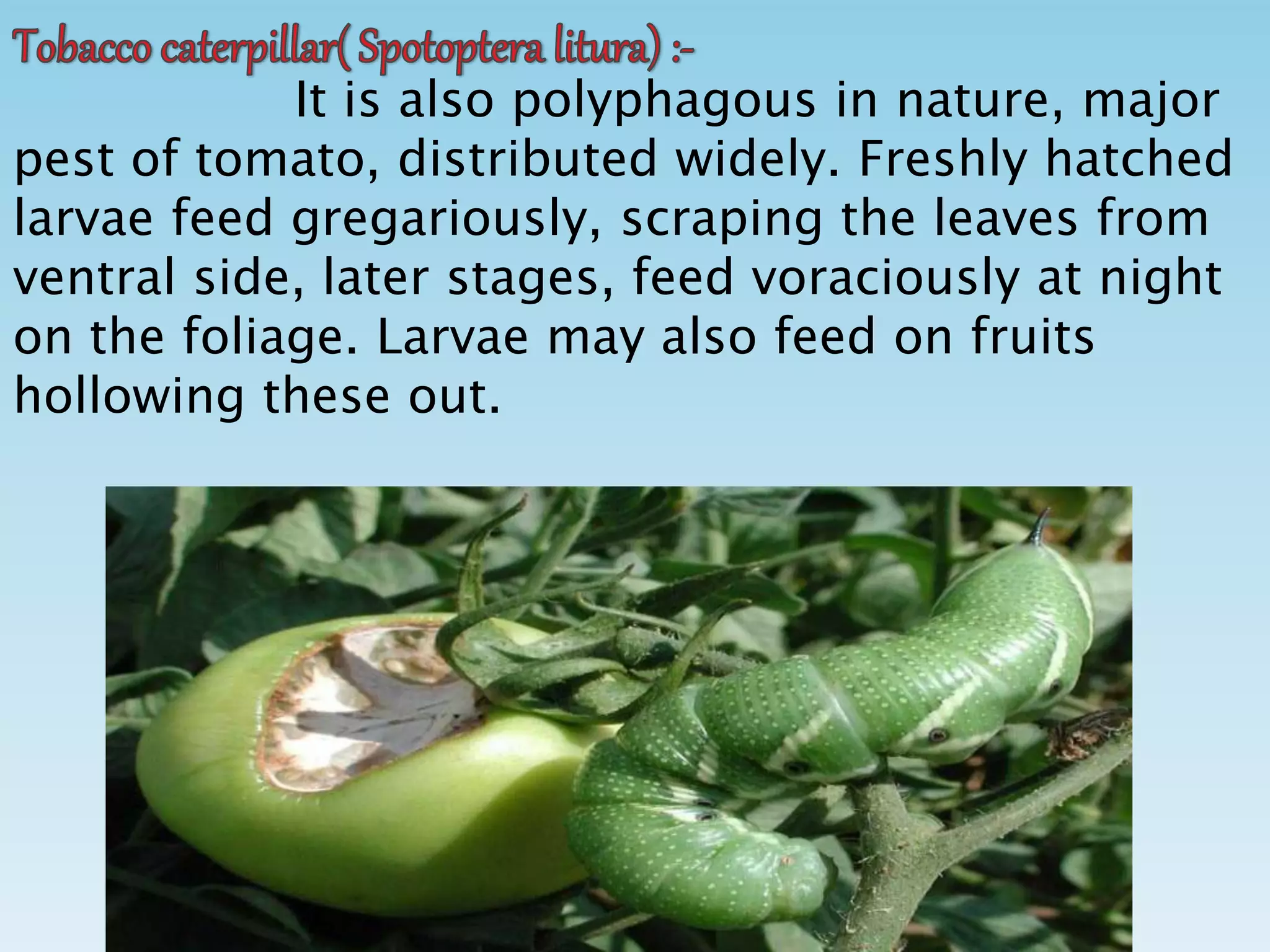
It is also polyphagous in nature, major
pest of tomato, distributed widely. Freshly hatched
larvae feed gregariously, scraping the leaves from
ventral side, later stages, feed voraciously at night
on the foliage. Larvae may also feed on fruits
hollowing these out.
Root-Knot Nematode(Meloidogyne spp). :-
This nematode has wide host range, widespread all
over India,affects most of the vegetable crops,often
tomato, brinjal, okra. Root-knot nematodes are
small, microscopic, males are slender and females
swollen.The most characteristic symptom on the
root is production of root galls.Above ground
symptoms are reduced growth,chlorosis of foliage,
susceptibility to wilting,and reduced fruit
production. Insects Management
Insects Management :-
1. Two rows of marigold for every 16 rows of tomato can be
grown as a trap crop. Marigold flowers attract egg laying of
H. armigera.
2.Spray5%neem seed kernel extract tokill earlystages larvae.
3.Placement of 15-20 bird perches (T shaped) per ha helps
in inviting insectivorous birds. Spray NPV @ 625 LE/ha
during evening hours.
4.Jaggery @ 1 kg, sandovit or Teepol(100 ml) are to be
mixed with NPV on need basis spary 2 ml Endosulfan,
Chlorpyriphos or Quinolphos per litre of water
5.Application of chopped leaves of Pongamia or Crotalaria
reduces disease severity caused by nematode.
6. Farmers of the Andhra Pradesh uses garlic+ chilly extract
and slurry of cow dung + urine for protection against pest
and diseases.
Disease :-
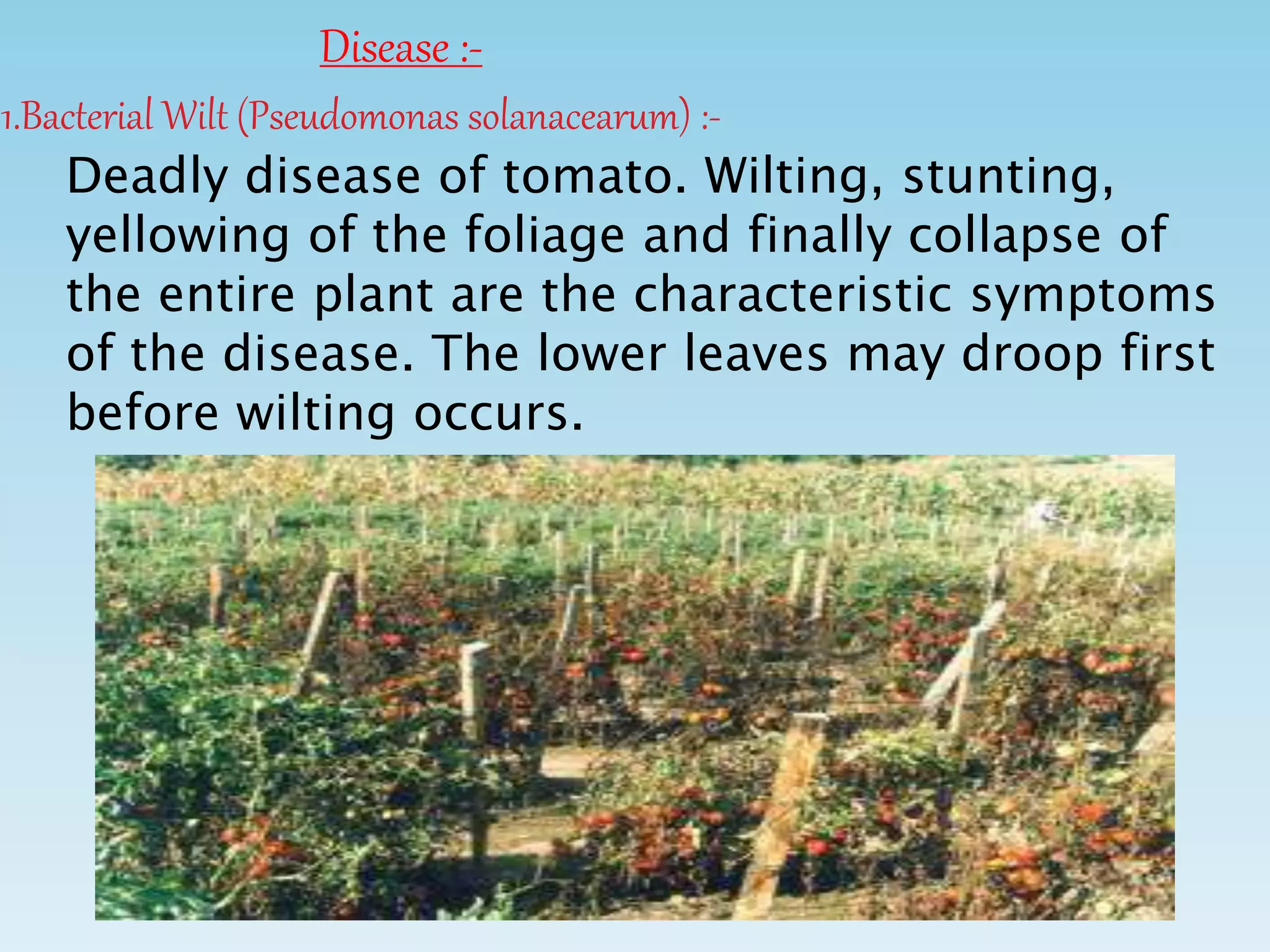
1.Bacterial Wilt (Pseudomonas solanacearum) :-
Deadly disease of tomato. Wilting, stunting,
yellowing of the foliage and finally collapse of
the entire plant are the characteristic symptoms
of the disease. The lower leaves may droop first
before wilting occurs.
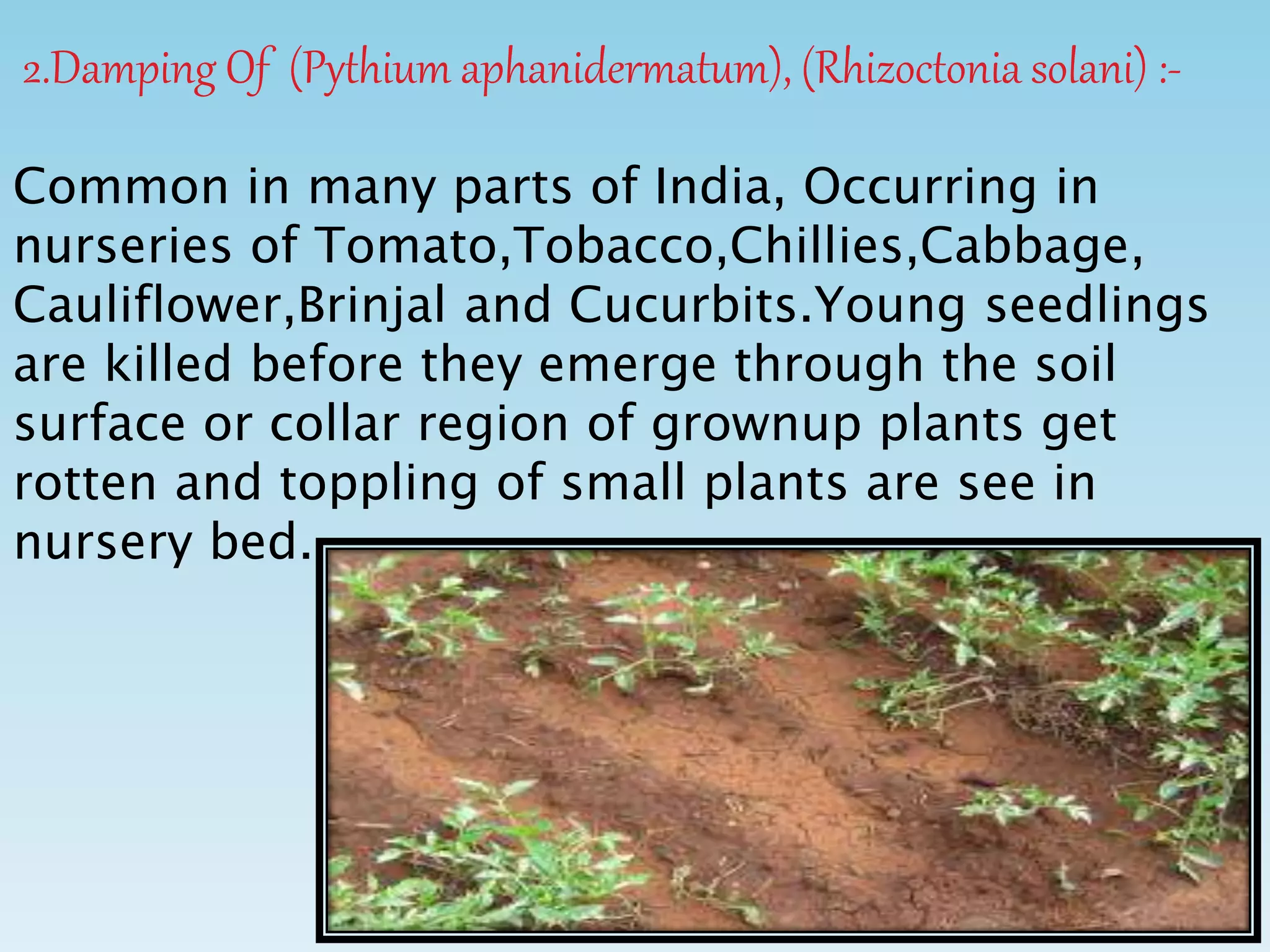
2.Damping Of (Pythium aphanidermatum), (Rhizoctonia solani) :-
Common in many parts of India, Occurring in
nurseries of Tomato,Tobacco,Chillies,Cabbage,
Cauliflower,Brinjal and Cucurbits.Young seedlings
are killed before they emerge through the soil
surface or collar region of grownup plants get
rotten and toppling of small plants are see in
nursery bed.
3. Early Blight (Alternaria solani) :-
Common disease of tomato occurring all over
India. The characteristic leaf spots and blight first
becomes visible as small,isolated, scattered pale
brown spots on the leaf which later on also develop
on stem and fruits. Fully developed spots are
irregular,brown to dark brown in colour, and with
concentric rings inside the spot.In severe attacks
the entire plant may be defoliated.
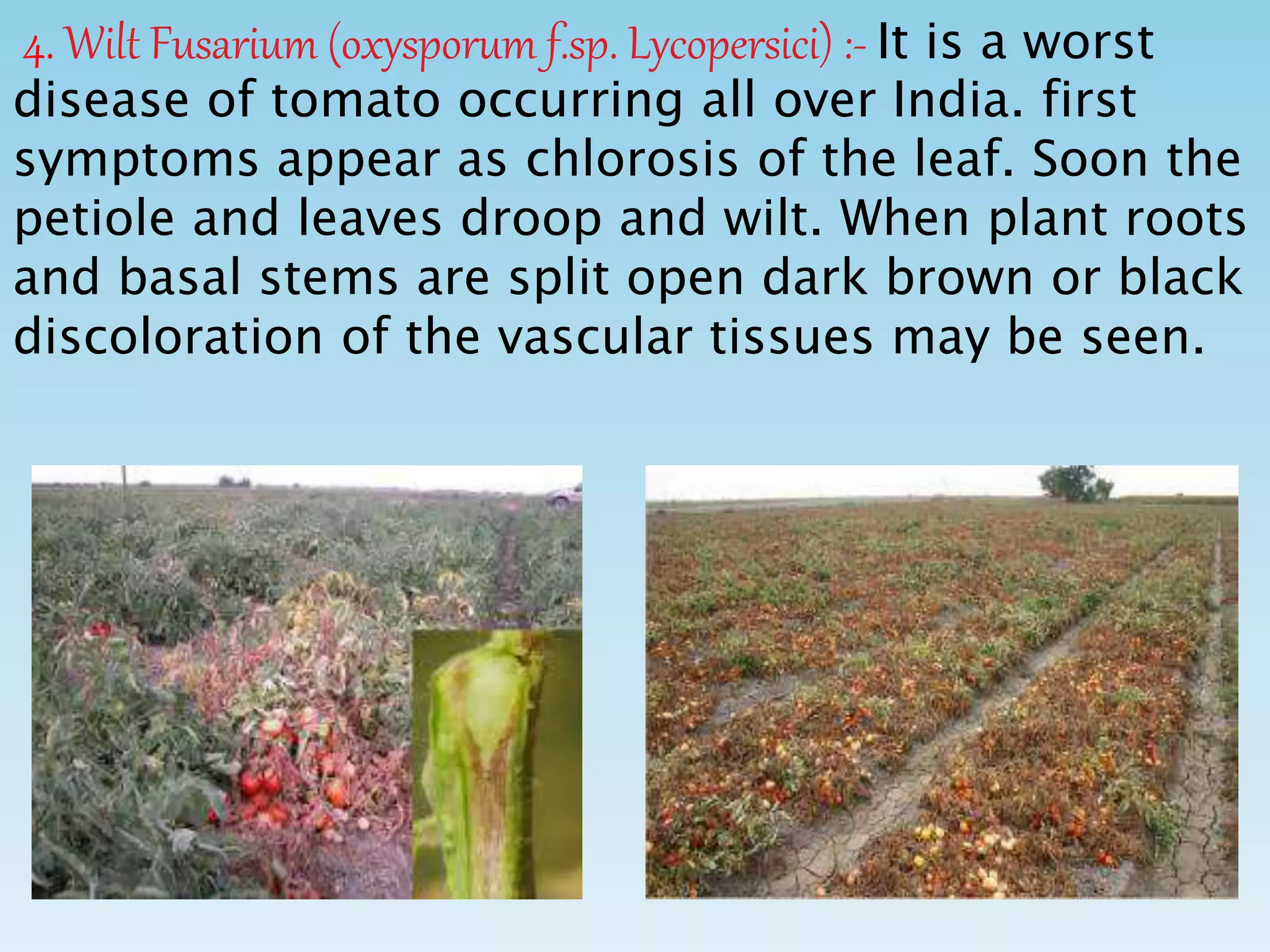
4. Wilt Fusarium (oxysporum f.sp. Lycopersici) :- It is a worst
disease of tomato occurring all over India. first
symptoms appear as chlorosis of the leaf. Soon the
petiole and leaves droop and wilt. When plant roots
and basal stems are split open dark brown or black
discoloration of the vascular tissues may be seen.
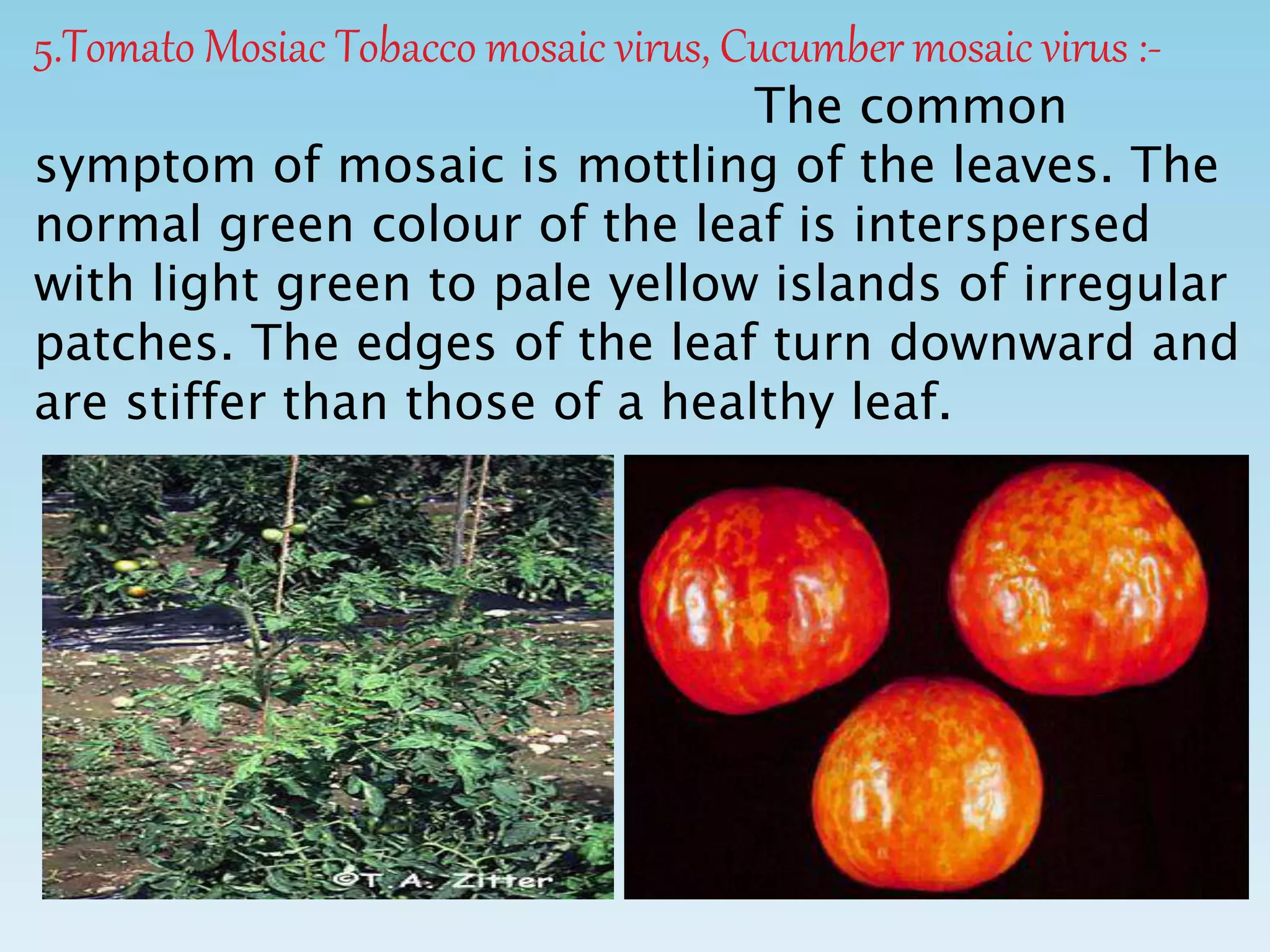
5.Tomato Mosiac Tobacco mosaic virus, Cucumber mosaic virus :-
The common
symptom of mosaic is mottling of the leaves. The
normal green colour of the leaf is interspersed
with light green to pale yellow islands of irregular
patches. The edges of the leaf turn downward and
are stiffer than those of a healthy leaf.
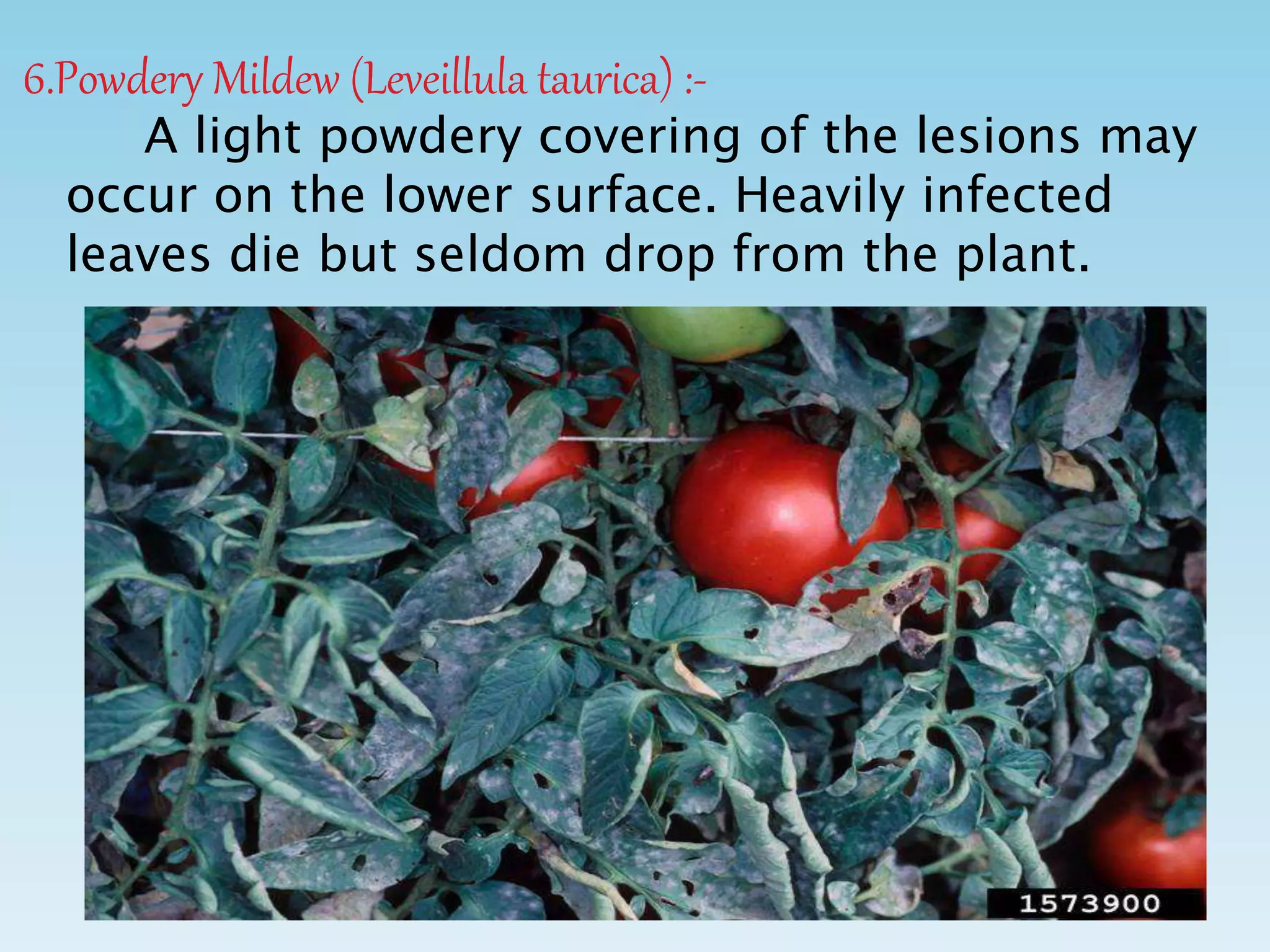
6.Powdery Mildew (Leveillula taurica) :-
A light powdery covering of the lesions may
occur on the lower surface. Heavily infected
leaves die but seldom drop from the plant.
7. Septoria Leaf Blight (Septoria lycopersici) :-
It is a Major disease of tomato
throughout India. In young plants numerous spots
appear on older leaves or on plants with poor
growth. Small, circular spots are first observed as
water soaked areas on the under surface of the
lower leaves. As the spots enlarge, they develop
dark brown marking and sunken, white or grey
centres.
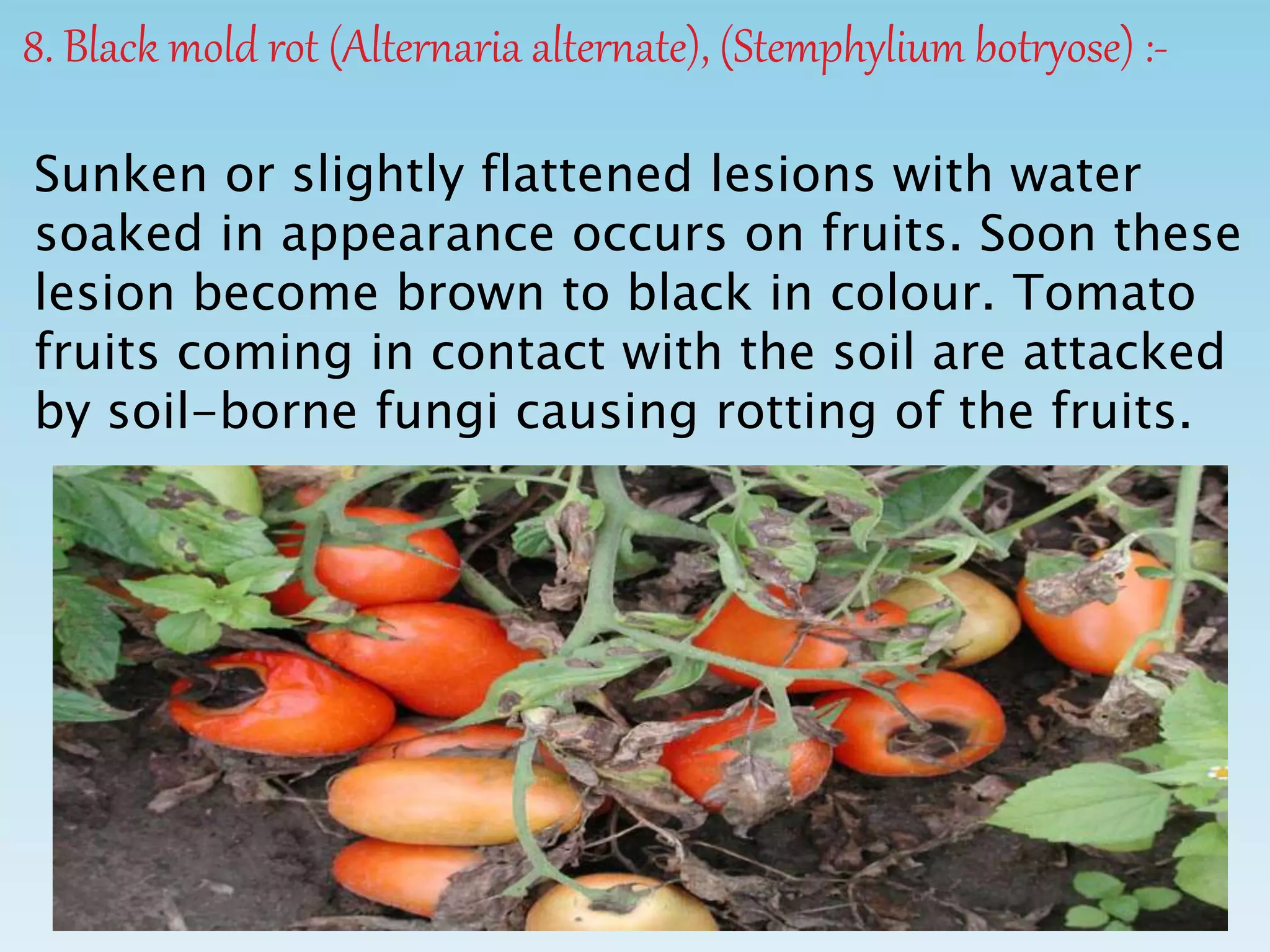
8. Black mold rot (Alternaria alternate), (Stemphylium botryose) :-
Sunken or slightly flattened lesions with water
soaked in appearance occurs on fruits. Soon these
lesion become brown to black in colour. Tomato
fruits coming in contact with the soil are attacked
by soil-borne fungi causing rotting of the fruits.
Disease Management :-
1. Soil solorization or partial sterilisation of the soil
by burning trash on the surface
2. Seed treatment with tricoderma 5-10g or
carbendazim 2g or thirum3 g/Kg seed.
3. Field sanitation
4. Crop rotation with non-solanaceous
5. Providing better drainage, forming raised beds
6. Sanitation and crop rotation reduces the disease
incidence
7. Spraying the plants with a mixture of
Streptocycline 200 ppm and Copper oxychloride 3g
per litre of water gives fairly good control of the
disease.
Harvesting :-
Crop starts yielding by 70 days after planting.
Usually fruits are harvested with hand by a gentle
twist so that the stalk is retained on plant.
Intervals of harvests depend on season and it is
twice in a week during summer and weekly during
winter and rainy days. Harvesting maturity
depends on the purpose whether for fresh market,
processing, long distance transport etc. Following
maturity standards are recognized in tomato:
1. Mature green :-
Fruits fully grown, fruit colour changes from green
to yellowish and cavity filled with seeds
surrounded by gelly like substance. Harvested for
long distance market.
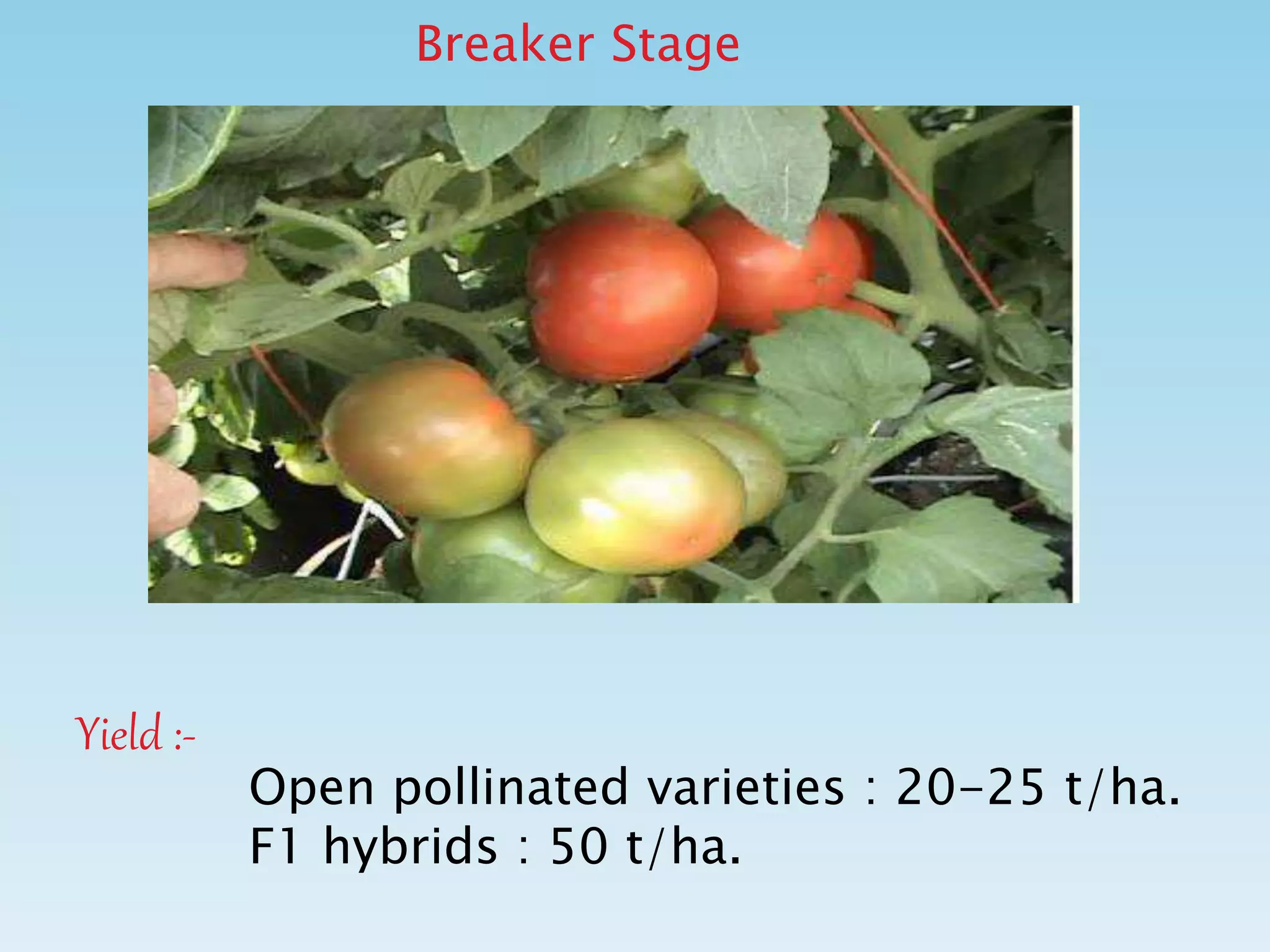
2. Turning or breaker stage:- Fruits
firm, 1/4th portion of fruit changes to pink in
colour, but the shoulder still yellowish green.
Harvested for long distance market.
3. Pink stage:-
3/4th of whole fruit surface turns pink colour.
Harvested for local market.
4. Light red:-
Entire fruit surface is red or pink
but the flesh is firm. Harvested for local market.
5. Red ripe or hand ripe:-
Fully ripened and
coloured. Flesh becomes soft. Harvested for
processing and for seed extraction.
Breaker Stage
Yield :-
Open pollinated varieties : 20-25 t/ha.
F1 hybrids : 50 t/ha.
Physiological disorders :-
Fruit cracking :-
1.Fruit cracking is caused both by genetic
and environmental factors. Following four
types of cracking are noticed tomato.
2. Radial Cracking: Usually seen at ripe
stage and crack radiate from pedicel end
to stylar end.
3. Concentric cracking: Seen around
shoulder of fruit even at green stage.
4. Cuticular: Seen on outer skin of fruit.
5. Burst: Burst occurs at certain points on shoulder
of fruit. Radial and concentric cracking are more
common of which, former ismore damaging. A
long spell of drought followed by sudden
heavyirrigation may cause cracking. Wide variation
in day and night temperatures and high humidity
also cause fruit cracking. Many crack resistant
varieties like Crack Proof, Sioux,Manulucie,Anagha
etc.were developed at various research
organizations. Fruits of crack resistant varieties
have thick pericarp or cuticle and fruit skin with
high elasticity and less acidity. Pectin content in
resistant varieties ranges from 0.8 to 1.6%
compared to 0.54% in susceptible ones. High
pectin concentration makes fruit less rigid and
more pliable.
Blossom Red Rot:- Water soaked spots of one
cm or more appear at point of attachment of petals
and effected portion becomes sunken,leathery and
dark coloured.This is mainly due to reduced soil
moisture supply and high rate of respiration at the
time of fruit development.Deficiency of calcium
also causes this disorder.Balanced irrigation,
cultural practices to conserve soil moisture and
spraying of 0.5% calcium chloride at fruit
development stage are recommended for control of
blossom end rot.
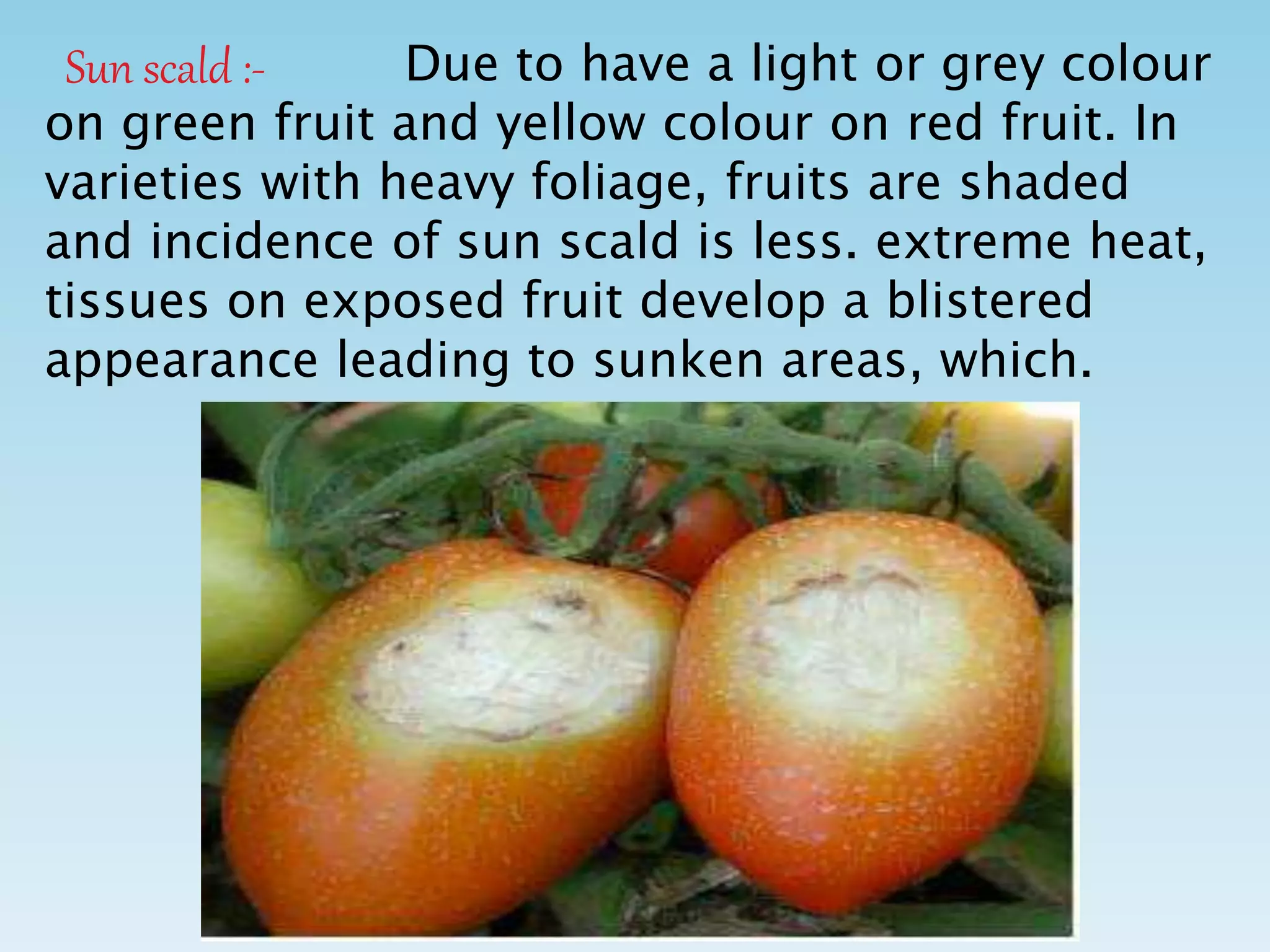
Sun scald :- Due to have a light or grey colour
on green fruit and yellow colour on red fruit. In
varieties with heavy foliage, fruits are shaded
and incidence of sun scald is less. extreme heat,
tissues on exposed fruit develop a blistered
appearance leading to sunken areas, which.
THANK YOU

chaudhary anil kumar

  • 2.
    TOPIC – CULTIVATIONOF TOMATO SUBMITTED TO DR. M.S. RATHI COLLEGE – J.V.COLLEGE BARAUT SUBMITTED BY ANIL KUMAR ROLL NO – RJ180004243005 CLASS – M.Sc. ( Ag ) HORTICULTURE
  • 3.
     Botanical Name:- Lycoperiscon esculentum  Family :- Solanaceae  Origin Centre :- South America  Chromosome No :- 2n=2x=24  Edible Part :- Fruit Origin:- Tomato is originated in Peru of South America and name of crop came from the Aztec word “Tomato”. The crop is of recent origin and first report of tomato was from Italy in 1544. Later spread was fast and the crop is grown throughout the length and breadth of world
  • 4.
     It isamazing to note the quantum jump in the spread of tomato during the last four decades. In India, crop was grown in an area of 36000 ha. during 1960 and present area and production in the country is 4.58 lakh ha. and 74.62 lakh tones respectively with productivity of 16.29 t/ha. Leading producing states are UP,Karnataka, Maharashtra, Haryana, Punjab and Bihar.
  • 5.
     Botanical nameof tomato is Solanum lycopersicum (lycos = wolf and persicon = peach).  Genus Lycopersicon is divided into two subgenera (A) Eulycopersicon (Red fruited and self compatible) (B) Eriolycopersicon (Green fruited and self incompatible) Eulycopersicon includes two species, L. esculentum(Solanum lycopersicum) with large fruits and L. pimpinellifolium ( New name Solanum pimpinellifolium) with small fruits born inclusters. Eriopersicon mainly consists of wild sp like L.hirsutum(S.habrochaites), L.peruvianum,(S. peruvianum) L. pissisi, L. glandulosum, L. cheesmani(S. cheesmani) etc.  Rick (1976) divided genus Lycopersicon into following two groups based on their ability to cross with cultivated tomato .
  • 6.
    Solanum lycopersicum S.pimpinellifolium L. chessmanii L. hirsutum
  • 7.
     Esculentum complex(crossable with cultivated tomato) L. esculentum, L. pimpinelifolium, L. cheesemani and L. hirsutum  Peruvianum complex (Not crossable with cultivated tomato) L. peruvianum, L. chinense. Solanum lycopersicum S. pimpinellifolium L. chessmanii L. hirsutum  Based on growth habit and fruit characters, five forms of L. esculentum are identified.  Communae - Common tomato  Cerasiformae - Small fruited cherry tomato  Pyriformae - Pear shaped tomato  Grandifolium - potato leaved tomato  Validum - Erect and upright tomato
  • 8.
     Tomato isa true diploid with 2n=24. Plant is annual with herbaceous prostrate stem having determinate or indeterminate growth habit. In the determinate growth, terminal bud ends in a floral bud and further growth in arrested resulting in dwarf and bushy stature. In indeterminate growth, terminal bud is a leafy bud and terminal and lateral buds continue to grow and there are less production of flowers and fruits on mains tem. Botany :-
  • 10.
    Flowers are bornein racemose cyme and flower cluster is known as ‘truss’ ands its position is extra axillary. Flowers are hermaphrodite, pendulous, pentamerous and hypogenous. Stamens are six in number and inserted on throat of corolla tube and anthers are convent around style
  • 15.
    Varieties Improved varieties Arka Saurabh,Arka Vikas, Arka Ahuti, Arka Ashish, Arka Abha , Arka Alok, HS101, HS102, HS110, Hisar Arun, Hisar Lalima, Hisar Lalit, Hisar Anmol, KS.2, Narendra Tomato 1, Narendra Tomato 2, Pusa Red Plum, Pusa Early Dwarf, Pusa Ruby, Co-1, CO 2, CO 3, S-12, Punjab Chhuhara, PKM 1, Pusa Ruby, Paiyur-1, Shakthi, SL 120, Pusa Gaurav, S 12, Pant Bahar, Pant T3, Solan Gola and Arka Meghali. F1 hybrids: Arka Abhijit, Arka Shresta, Arka Vishal, Arka Vardan, Pusa Hybrid 1, Pusa Hybrid 2, COTH 1 Hybrid Tomato, Rashmi, Vaishali, Rupali, Naveen,Avinash 2, MTH 4, Sadabahar, Gulmohar and Sonali.
  • 16.
    Climatic Requirement :- Thetomato is a warm-season crop. The crop does well under an average monthly temperature of 210 C to 230 C. Temperature and light intensity affect the fruit- set, pigmentation and nutritive value of the fruit. Long dry spell and heavy rainfall both shows detrimental effect on growth and fruiting. Soil :- The tomato grows on practically all soils from light sandy to heavy clay. Light soils are good for an early crop, while clay loam and silt-loam soils are well suited for heavy yields. Tomatoes do best in a soil that has a soil reaction from pH 6.0 to 7.0. If the soil is acidic liming is required.
  • 17.
    Seed rate :-For raising the seedlings in nursery bed 300 - 400 g/ha seeds are required. Hybrid seeds are very costly so it should be sown in plastic cups or ice cube tray, which require only 70-90 g. Time of planting :- Tomato is a day neutral plant so wildly it found grown in any season. In the northern plains three crops are taken but in frost affected area rabi crop is not fruitful. The kharif crop is transplanted in July, rabi crop in October - November and zaid crop in February months. In the southern plains where there is no danger of frost, The first transplanting is done in Dec.-Jan., Second June-July Third in September-October depending on the irrigation facilities available.
  • 18.
    1.Seedlings are grown beforeone months of transplanting raised beds of 60-100 cm width and of convenient length. 2. Soil solorization of nursery bed by covering them with white transparent polythene sheet for one month should be done in hot summer months. It will kill the disease causing organisms like fungus, bacteria, nematode as well as insects and seeds of weeds. 3.For one m2 of nursery area apply 5kg well rotten FYM and 20 g of each N, P and K fertiliser, and also apply 2.5g carbofuran or 200 g of neem cake and 10-25 g tricoderma.
  • 19.
    4.While preparing thenursery beds, neem cake /castor cake/ neam leaf/ castor leaf/ pongamia leaf/ calotropis leaf has to be incorporated @ 400 g/m2 for protection against nematoads. 5 . After sowing the seeds, mulch with green leaves and irrigate with a rosecan daily in the morning. Remove the mulch immediately after germination of the seeds. Restrict irrigation one week before transplanting and irrigate heavily on the previous day of transplanting. 6. Cover the nursery bed with fine nylon net to escape the damage by virus transmitting insects.
  • 20.
    Seed treatment :- Toavoid damping off disease treats the seed with Tricoderma @ 5-10 g/Kg seed or carbendazim 2g/Kg seed. The treated seeds are dried in shade for 30 minutes and then sown sparsely along the lines in ½ cm depth and then covered by the top soil. Land preparation :- Land is prepared to a fine tilth by thorough ploughing or digging 2 - 3 times. At the last ploughing organic manure and 10 kg carbofuran granules or 200 kg neem cake has to be applied.
  • 21.
    Manuring :- Apply wellrotten farm yard manure / compost @ 20-25 t/ha at the time of land preparation and mix well with the soil. A fertilizer dose of 75:40:25 kg N:P2O5:K2O / ha may be given. Half the dose of nitrogen, full phosphorus and half of potash may be applied as basal before transplanting. One fourth of nitrogen and half of potash may be applied 20- 30 days after planting. The remaining quantity may be applied two months after planting.
  • 22.
    Transplanting :- 1 .The transplanting is done in small flat beds or in shallow furrow depending upon the availability of irrigation. 2. In heavy soil it is usually transplanted on ridges and during the rains also it is advantageous to plant the seedlings on ridges. 3. For indeterminate varieties/hybrids, the seedlings have to be staked using bamboo sticks of two meter length or planted in broad ridge of 90 cm width and 15 cm height. The seedlings are planted in the furrows at a spacing of 30 cm and the plant is allowed to spread on the broad ridge.
  • 23.
    Spacing :- The spacingrecommended for the autumn-winter crop is 75 x 60 cm and for the spring summer crop 75 x 45 cm. Irrigation :- Tomatoes need very careful irrigation that is just sufficient water at the right time. It is necessary to maintain an even moisture supply. During summer season, irrigation at every 5to 7 days interval is necessary, whereas in winter 10 to 15 days interval is sufficient. A period of drought followed by sudden heavy watering during the fruiting period may cause cracking of fruits.
  • 24.
    Weed Control :- 1.There is need of light hoeing during first four weeks in the field which encourage the growth but also remove the weeds from the field. The surface soil is loosened 4 by hand hoeing as soon as it is dry enough after every irrigation or shower. All weeds should also be removed in this process. 2. Mulching with straw, black polythene and many other materials has been found beneficial in moisture conservation, in controlling weeds and some diseases.
  • 25.
    Plant protection :- Insects:- Gram pod borer (Heliothis armigera) :- It is a polyphagous, attacks most of the cultivated crops, major pest of tomato, and widely distributed throughout the country. Young larvae feed on tender foliage, while advanced stages attack the fruits. Larva bore circular holes in fruits.
  • 26.
    Serpentine leaf miner(Liriomyza trifolii) It is a polyphagous in nature very widely distributed throughout the India. Maggot mines into the leaf and feeds on the mesophyll of the leaves making serpentine mines/galleries
  • 27.
    It is alsopolyphagous in nature, major pest of tomato, distributed widely. Freshly hatched larvae feed gregariously, scraping the leaves from ventral side, later stages, feed voraciously at night on the foliage. Larvae may also feed on fruits hollowing these out.
  • 28.
    Root-Knot Nematode(Meloidogyne spp).:- This nematode has wide host range, widespread all over India,affects most of the vegetable crops,often tomato, brinjal, okra. Root-knot nematodes are small, microscopic, males are slender and females swollen.The most characteristic symptom on the root is production of root galls.Above ground symptoms are reduced growth,chlorosis of foliage, susceptibility to wilting,and reduced fruit production. Insects Management
  • 29.
    Insects Management :- 1.Two rows of marigold for every 16 rows of tomato can be grown as a trap crop. Marigold flowers attract egg laying of H. armigera. 2.Spray5%neem seed kernel extract tokill earlystages larvae. 3.Placement of 15-20 bird perches (T shaped) per ha helps in inviting insectivorous birds. Spray NPV @ 625 LE/ha during evening hours. 4.Jaggery @ 1 kg, sandovit or Teepol(100 ml) are to be mixed with NPV on need basis spary 2 ml Endosulfan, Chlorpyriphos or Quinolphos per litre of water 5.Application of chopped leaves of Pongamia or Crotalaria reduces disease severity caused by nematode. 6. Farmers of the Andhra Pradesh uses garlic+ chilly extract and slurry of cow dung + urine for protection against pest and diseases.
  • 30.
    Disease :- 1.Bacterial Wilt(Pseudomonas solanacearum) :- Deadly disease of tomato. Wilting, stunting, yellowing of the foliage and finally collapse of the entire plant are the characteristic symptoms of the disease. The lower leaves may droop first before wilting occurs.
  • 31.
    2.Damping Of (Pythiumaphanidermatum), (Rhizoctonia solani) :- Common in many parts of India, Occurring in nurseries of Tomato,Tobacco,Chillies,Cabbage, Cauliflower,Brinjal and Cucurbits.Young seedlings are killed before they emerge through the soil surface or collar region of grownup plants get rotten and toppling of small plants are see in nursery bed.
  • 32.
    3. Early Blight(Alternaria solani) :- Common disease of tomato occurring all over India. The characteristic leaf spots and blight first becomes visible as small,isolated, scattered pale brown spots on the leaf which later on also develop on stem and fruits. Fully developed spots are irregular,brown to dark brown in colour, and with concentric rings inside the spot.In severe attacks the entire plant may be defoliated.
  • 33.
    4. Wilt Fusarium(oxysporum f.sp. Lycopersici) :- It is a worst disease of tomato occurring all over India. first symptoms appear as chlorosis of the leaf. Soon the petiole and leaves droop and wilt. When plant roots and basal stems are split open dark brown or black discoloration of the vascular tissues may be seen.
  • 34.
    5.Tomato Mosiac Tobaccomosaic virus, Cucumber mosaic virus :- The common symptom of mosaic is mottling of the leaves. The normal green colour of the leaf is interspersed with light green to pale yellow islands of irregular patches. The edges of the leaf turn downward and are stiffer than those of a healthy leaf.
  • 35.
    6.Powdery Mildew (Leveillulataurica) :- A light powdery covering of the lesions may occur on the lower surface. Heavily infected leaves die but seldom drop from the plant.
  • 36.
    7. Septoria LeafBlight (Septoria lycopersici) :- It is a Major disease of tomato throughout India. In young plants numerous spots appear on older leaves or on plants with poor growth. Small, circular spots are first observed as water soaked areas on the under surface of the lower leaves. As the spots enlarge, they develop dark brown marking and sunken, white or grey centres.
  • 37.
    8. Black moldrot (Alternaria alternate), (Stemphylium botryose) :- Sunken or slightly flattened lesions with water soaked in appearance occurs on fruits. Soon these lesion become brown to black in colour. Tomato fruits coming in contact with the soil are attacked by soil-borne fungi causing rotting of the fruits.
  • 38.
    Disease Management :- 1.Soil solorization or partial sterilisation of the soil by burning trash on the surface 2. Seed treatment with tricoderma 5-10g or carbendazim 2g or thirum3 g/Kg seed. 3. Field sanitation 4. Crop rotation with non-solanaceous 5. Providing better drainage, forming raised beds 6. Sanitation and crop rotation reduces the disease incidence 7. Spraying the plants with a mixture of Streptocycline 200 ppm and Copper oxychloride 3g per litre of water gives fairly good control of the disease.
  • 39.
    Harvesting :- Crop startsyielding by 70 days after planting. Usually fruits are harvested with hand by a gentle twist so that the stalk is retained on plant. Intervals of harvests depend on season and it is twice in a week during summer and weekly during winter and rainy days. Harvesting maturity depends on the purpose whether for fresh market, processing, long distance transport etc. Following maturity standards are recognized in tomato: 1. Mature green :- Fruits fully grown, fruit colour changes from green to yellowish and cavity filled with seeds surrounded by gelly like substance. Harvested for long distance market.
  • 40.
    2. Turning orbreaker stage:- Fruits firm, 1/4th portion of fruit changes to pink in colour, but the shoulder still yellowish green. Harvested for long distance market. 3. Pink stage:- 3/4th of whole fruit surface turns pink colour. Harvested for local market. 4. Light red:- Entire fruit surface is red or pink but the flesh is firm. Harvested for local market. 5. Red ripe or hand ripe:- Fully ripened and coloured. Flesh becomes soft. Harvested for processing and for seed extraction.
  • 41.
    Breaker Stage Yield :- Openpollinated varieties : 20-25 t/ha. F1 hybrids : 50 t/ha.
  • 42.
    Physiological disorders :- Fruitcracking :- 1.Fruit cracking is caused both by genetic and environmental factors. Following four types of cracking are noticed tomato. 2. Radial Cracking: Usually seen at ripe stage and crack radiate from pedicel end to stylar end. 3. Concentric cracking: Seen around shoulder of fruit even at green stage. 4. Cuticular: Seen on outer skin of fruit.
  • 43.
    5. Burst: Burstoccurs at certain points on shoulder of fruit. Radial and concentric cracking are more common of which, former ismore damaging. A long spell of drought followed by sudden heavyirrigation may cause cracking. Wide variation in day and night temperatures and high humidity also cause fruit cracking. Many crack resistant varieties like Crack Proof, Sioux,Manulucie,Anagha etc.were developed at various research organizations. Fruits of crack resistant varieties have thick pericarp or cuticle and fruit skin with high elasticity and less acidity. Pectin content in resistant varieties ranges from 0.8 to 1.6% compared to 0.54% in susceptible ones. High pectin concentration makes fruit less rigid and more pliable.
  • 44.
    Blossom Red Rot:-Water soaked spots of one cm or more appear at point of attachment of petals and effected portion becomes sunken,leathery and dark coloured.This is mainly due to reduced soil moisture supply and high rate of respiration at the time of fruit development.Deficiency of calcium also causes this disorder.Balanced irrigation, cultural practices to conserve soil moisture and spraying of 0.5% calcium chloride at fruit development stage are recommended for control of blossom end rot.
  • 45.
    Sun scald :-Due to have a light or grey colour on green fruit and yellow colour on red fruit. In varieties with heavy foliage, fruits are shaded and incidence of sun scald is less. extreme heat, tissues on exposed fruit develop a blistered appearance leading to sunken areas, which.
  • 46.