CONFECTIONERY
INDUSTRY
By:
P. Keerthi
I. Siva Rama Krishna
HISTORY
 Cavemen
 First chocolate factory in the United States was established in
1765.
 Ancient Olmec civilizations of Mexico made the first chocolate
drink.
 Cocoa powder was made in 1828 .
 David Peter and Henry Nestle from Switzerland created the first
milk chocolate in 1876.
 George Smith invented the first Lolly Pop in 1908.
PRODUCTS UNDER
CONFECTIONERY
 Chocolates
 Candies
 Cakes
 Ice creams
 Bakery products
DRIVERS
 Growing gift culture
 Rapid urbanization
 Growing retail market
 Growing income & consumption
 Developing rural sector
 Marketing campaigns
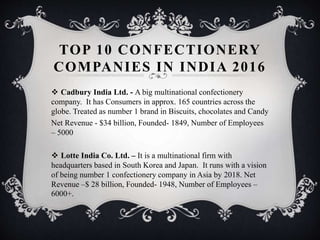
TOP 10 CONFECTIONERY
COMPANIES IN INDIA 2016
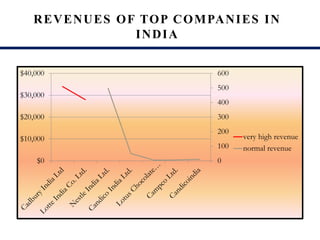
 Cadbury India Ltd. - A big multinational confectionery
company. It has Consumers in approx. 165 countries across the
globe. Treated as number 1 brand in Biscuits, chocolates and Candy
Net Revenue - $34 billion, Founded- 1849, Number of Employees
– 5000
 Lotte India Co. Ltd. – It is a multinational firm with
headquarters based in South Korea and Japan. It runs with a vision
of being number 1 confectionery company in Asia by 2018. Net
Revenue –$ 28 billion, Founded- 1948, Number of Employees –
6000+.
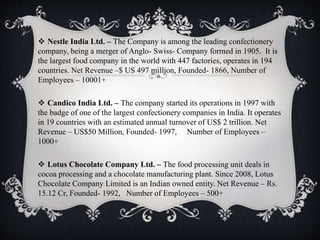
 Nestle India Ltd. – The Company is among the leading confectionery
company, being a merger of Anglo- Swiss- Company formed in 1905. It is
the largest food company in the world with 447 factories, operates in 194
countries. Net Revenue –$ US 497 million, Founded- 1866, Number of
Employees – 10001+
 Candico India Ltd. – The company started its operations in 1997 with
the badge of one of the largest confectionery companies in India. It operates
in 19 countries with an estimated annual turnover of US$ 2 trillion. Net
Revenue – US$50 Million, Founded- 1997, Number of Employees –
1000+
 Lotus Chocolate Company Ltd. – The food processing unit deals in
cocoa processing and a chocolate manufacturing plant. Since 2008, Lotus
Chocolate Company Limited is an Indian owned entity. Net Revenue – Rs.
15.12 Cr, Founded- 1992, Number of Employees – 500+
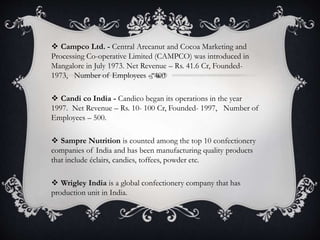
 Campco Ltd. - Central Arecanut and Cocoa Marketing and
Processing Co-operative Limited (CAMPCO) was introduced in
Mangalore in July 1973. Net Revenue – Rs. 41.6 Cr, Founded-
1973, Number of Employees – 400
 Candi co India - Candico began its operations in the year
1997. Net Revenue – Rs. 10- 100 Cr, Founded- 1997, Number of
Employees – 500.
 Sampre Nutrition is counted among the top 10 confectionery
companies of India and has been manufacturing quality products
that include éclairs, candies, toffees, powder etc.
 Wrigley India is a global confectionery company that has
production unit in India.
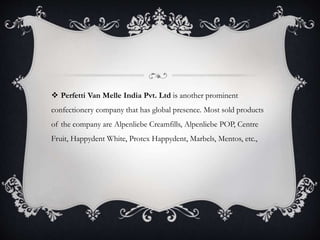
 Perfetti Van Melle India Pvt. Ltd is another prominent
confectionery company that has global presence. Most sold products
of the company are Alpenliebe Creamfills, Alpenliebe POP, Centre
Fruit, Happydent White, Protex Happydent, Marbels, Mentos, etc.,
REVENUES OF TOP COMPANIES IN
INDIA
0
100
200
300
400
500
600
$0
$10,000
$20,000
$30,000
$40,000
very high revenue
normal revenue
MARKETING STRATEGIES
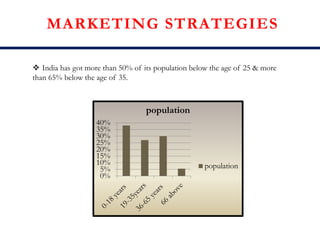
 India has got more than 50% of its population below the age of 25 & more
than 65% below the age of 35.
0%
5%
10%
15%
20%
25%
30%
35%
40%
population
population
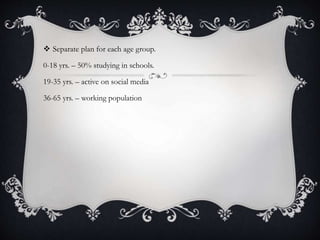
 Separate plan for each age group.
0-18 yrs. – 50% studying in schools.
19-35 yrs. – active on social media
36-65 yrs. – working population
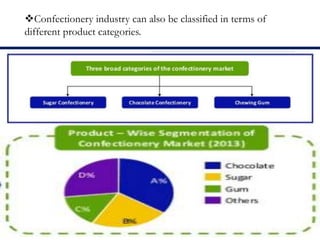
Confectionery industry can also be classified in terms of
different product categories.
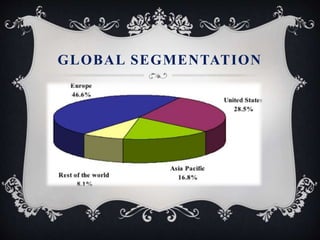
GLOBAL SEGMENTATION
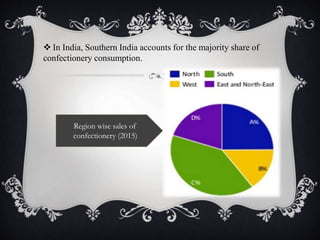
 In India, Southern India accounts for the majority share of
confectionery consumption.
Region wise sales of
confectionery (2015)
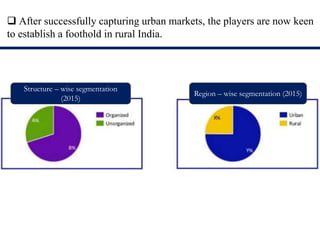
Structure – wise segmentation
(2015)
Region – wise segmentation (2015)
 After successfully capturing urban markets, the players are now keen
to establish a foothold in rural India.
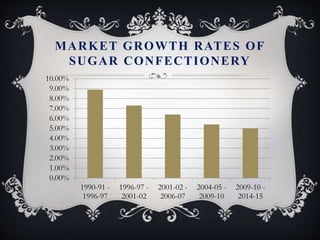
MARKET GROWTH RATES OF
SUGAR CONFECTIONERY
0.00%
1.00%
2.00%
3.00%
4.00%
5.00%
6.00%
7.00%
8.00%
9.00%
10.00%
1990-91 -
1996-97
1996-97 -
2001-02
2001-02 -
2006-07
2004-05 -
2009-10
2009-10 -
2014-15
ADVERTISING IN
CONFECTIONARY INDUSTRY
The only way to create brand salience is through
innovative advertising.
Large confectioneries spend 12 to 13 per cent of their sale
revenue on advertising and brand promotion.
Advertisements need to appeal to all consumers across
age brackets and socio – economic groups.
TARGETING ADULTS
Traditionally, the confectionery companies considered only children
as their target market and confectionaries advertisements were also
always targeted at children.
But stagnancy in he growth rates made the companies rethink their
strategies.
Cadbury was the first company that repositioned its brands for
adults.
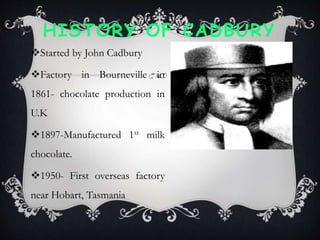
HISTORY OF CADBURY
Started by John Cadbury
Factory in Bourneville in
1861- chocolate production in
U.K
1897-Manufactured 1st milk
chocolate.
1950- First overseas factory
near Hobart, Tasmania
CADBURY INDIA
In India, Cadbury began its operations in 1948 by
importing chocolates.
It today has 5 company-owned manufacturing facilities
& 5 sales offices in 5 metros. The corporate office is in
Mumbai.
Cadbury enjoys a value market share of over 70% - the
highest Cadbury brand share in the world!
Cadbury Dairy Milk is considered the "gold standard" for
chocolates in India.
OBJECTIVES
 To become the World’s Biggest and Best Confectionery Company.
 To make lots of chocolate & improve the quality of their chocolate.
 Have loads of stores worldwide.
 To be an ongoing company & achieve revenue growth of 20% per
year.
 Increase earnings by 15% annually & dividends per share by 7% per
year.
ACHIEVEMENTS
2008- SILVER award for the 'Most Effective Use of
Advertising‘.
2008- Cadbury India has been ranked as the 7th Great
Place to Work and the No. 1 FMCG company in India.
Cadbury Dairy Milk & Bournvita have been declared a
`Consumer Super brand' for 2006-07.
Cadbury India has been ranked 5th in the FMCG sector,
by Business World magazine in 2007.
MARKETING
MIX
4P’S
PLACE
 Produced at the chocolate factory in Bourneville in Birmingham.
 It is then transported to the stockrooms.
 After this Cadbury sells it products to shops
that deal with beverages and confectionery e.g. corner shops,
superstores.
 They then sell it to the general public.
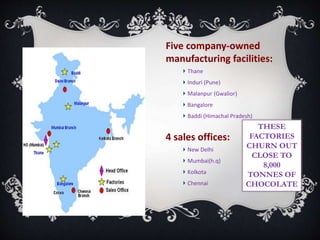
Five company-owned
manufacturing facilities:
Thane
Induri (Pune)
Malanpur (Gwalior)
Bangalore
Baddi (Himachal Pradesh)
4 sales offices:
New Delhi
Mumbai(h.q)
Kolkota
Chennai
THESE
FACTORIES
CHURN OUT
CLOSE TO
8,000
TONNES OF
CHOCOLATE
PRODUCT
Cadbury Dairy Milk is made from Real Chocolate
 Its ingredients include cocoa butter
There is a glass and half full cream dairy milk in every 200
grams of Cadbury dairy milk chocolate
Cadbury buys 65 million liters of fresh milk each year to make
Cadbury dairy milk chocolate
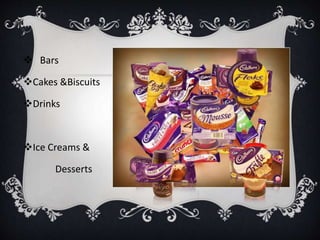
PRODUCT Bars
Cakes &Biscuits
Drinks
Ice Creams &
Desserts
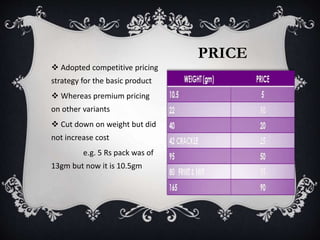
PRICE
 Adopted competitive pricing
strategy for the basic product
 Whereas premium pricing
on other variants
 Cut down on weight but did
not increase cost
e.g. 5 Rs pack was of
13gm but now it is 10.5gm
PROMOTION
 The media mix for any campaign for diary milk comprises of TV, radio, print, OOH
and Internet
 The advertisements are used to create an emotional bonding with the consumers
 The promotions increase brand loyalty, encourage repeat purchases and at the same
time increase market share
 Cadbury spends approximately 45 crore on advertising.
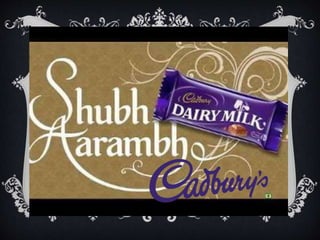
SHUBH AARAMBH
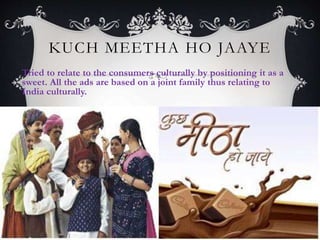
KUCH MEETHA HO JAAYE
Tried to relate to the consumers culturally by positioning it as a
sweet. All the ads are based on a joint family thus relating to
India culturally.
"The obvious part of the communication is the self-
indulgent product and the irresistibility of it
MARKET SEGMENTATION
Geographic segment
Demographic segment
Behavioral segment
Psychographic segment
MARKET SEGMENTATION
GEOGRAPHIC
 Region
 Countries
 Climate
DEMOGRAPHIC
 Age
 Gender
 Family Life cycle
 Income
MARKET SEGMENTATION
PSYCHOLOGICAL
 Attitude Toward The Product
 Life Style
BEHAVIORAL
 Occasions
 Benefits
 Usage rate
STRENGTHS
 World leader -200 CONTRIES
 Powerhouse brands and Products- dairy milk, Bournvita, oreo, &five star.
-some are cash cows for Cadbury.
 Brand name, brand equity and Brand loyalty-
-strong branding over the years
- the brand equity of high.

-comfortable charging a premium product because high brand equity.
Positioning as gift.- CELEBRATIONS
Promotions-“kuch meetha ho jaye” -
excellent brand recall.
Indian connect –emotional marketing .
Placement and distribution –one of the best
FMCG
WEAKNESSES
 few cases-found-cockroaches &rodents in chocolates
 rural distribution
 These are needs to be strengthened.
OPPORTUNITIES
 Rural markets- india village based & high potential to grab
market.
 New Tastes - Indian consumers- like to eat small
chocolates than bars.
THREATS
 Cost and price increase.
 Health consciousness on the rise.
 Decreasing importance of festivals.
 Rising demand of people, growing purchasing power .
CHALLENGES
 Rise in ingredient prices
 Rise packaging costs
 Regulatory challenges
 Fake confectioneries
 Growing health concerns
MY SUGGESTIONS
 Bring out new products for health conscious people.
 Continue to promote itself as substitute to mithai.
 Choco-biscuits should be introduced.
 Should use Indian ads and avoid global ads in India.
 Consider attractive display or its own ‘Chocolate boutique’ (retail
store).
 Special chocolates for Christmas should be introduced e.g. rum,
champagne flavored
 New flavors like strawberry,orange,vanilla etc.
CONCLUSIONS
 There is an immense scope for chocolate industry in India
 Indian chocolate industry is unique mix with extreme consumption
patterns, attitudes, beliefs, income level and spending
 Understanding consumer preferences and demands is the key to
growth
 Pricing, quality , flavors and pack size are some of the important factors
 Economical distribution using proper supply chain management is
necessity
 Brand loyalty should be maintained
confectionery industry

confectionery industry

  • 1.
  • 2.
    HISTORY  Cavemen  Firstchocolate factory in the United States was established in 1765.  Ancient Olmec civilizations of Mexico made the first chocolate drink.  Cocoa powder was made in 1828 .  David Peter and Henry Nestle from Switzerland created the first milk chocolate in 1876.  George Smith invented the first Lolly Pop in 1908.
  • 3.
    PRODUCTS UNDER CONFECTIONERY  Chocolates Candies  Cakes  Ice creams  Bakery products
  • 4.
    DRIVERS  Growing giftculture  Rapid urbanization  Growing retail market  Growing income & consumption  Developing rural sector  Marketing campaigns
  • 5.
    TOP 10 CONFECTIONERY COMPANIESIN INDIA 2016  Cadbury India Ltd. - A big multinational confectionery company. It has Consumers in approx. 165 countries across the globe. Treated as number 1 brand in Biscuits, chocolates and Candy Net Revenue - $34 billion, Founded- 1849, Number of Employees – 5000  Lotte India Co. Ltd. – It is a multinational firm with headquarters based in South Korea and Japan. It runs with a vision of being number 1 confectionery company in Asia by 2018. Net Revenue –$ 28 billion, Founded- 1948, Number of Employees – 6000+.
  • 6.
     Nestle IndiaLtd. – The Company is among the leading confectionery company, being a merger of Anglo- Swiss- Company formed in 1905. It is the largest food company in the world with 447 factories, operates in 194 countries. Net Revenue –$ US 497 million, Founded- 1866, Number of Employees – 10001+  Candico India Ltd. – The company started its operations in 1997 with the badge of one of the largest confectionery companies in India. It operates in 19 countries with an estimated annual turnover of US$ 2 trillion. Net Revenue – US$50 Million, Founded- 1997, Number of Employees – 1000+  Lotus Chocolate Company Ltd. – The food processing unit deals in cocoa processing and a chocolate manufacturing plant. Since 2008, Lotus Chocolate Company Limited is an Indian owned entity. Net Revenue – Rs. 15.12 Cr, Founded- 1992, Number of Employees – 500+
  • 7.
     Campco Ltd.- Central Arecanut and Cocoa Marketing and Processing Co-operative Limited (CAMPCO) was introduced in Mangalore in July 1973. Net Revenue – Rs. 41.6 Cr, Founded- 1973, Number of Employees – 400  Candi co India - Candico began its operations in the year 1997. Net Revenue – Rs. 10- 100 Cr, Founded- 1997, Number of Employees – 500.  Sampre Nutrition is counted among the top 10 confectionery companies of India and has been manufacturing quality products that include éclairs, candies, toffees, powder etc.  Wrigley India is a global confectionery company that has production unit in India.
  • 8.
     Perfetti VanMelle India Pvt. Ltd is another prominent confectionery company that has global presence. Most sold products of the company are Alpenliebe Creamfills, Alpenliebe POP, Centre Fruit, Happydent White, Protex Happydent, Marbels, Mentos, etc.,
  • 9.
    REVENUES OF TOPCOMPANIES IN INDIA 0 100 200 300 400 500 600 $0 $10,000 $20,000 $30,000 $40,000 very high revenue normal revenue
  • 10.
    MARKETING STRATEGIES  Indiahas got more than 50% of its population below the age of 25 & more than 65% below the age of 35. 0% 5% 10% 15% 20% 25% 30% 35% 40% population population
  • 11.
     Separate planfor each age group. 0-18 yrs. – 50% studying in schools. 19-35 yrs. – active on social media 36-65 yrs. – working population
  • 13.
    Confectionery industry canalso be classified in terms of different product categories.
  • 15.
  • 16.
     In India,Southern India accounts for the majority share of confectionery consumption. Region wise sales of confectionery (2015)
  • 17.
    Structure – wisesegmentation (2015) Region – wise segmentation (2015)  After successfully capturing urban markets, the players are now keen to establish a foothold in rural India.
  • 18.
    MARKET GROWTH RATESOF SUGAR CONFECTIONERY 0.00% 1.00% 2.00% 3.00% 4.00% 5.00% 6.00% 7.00% 8.00% 9.00% 10.00% 1990-91 - 1996-97 1996-97 - 2001-02 2001-02 - 2006-07 2004-05 - 2009-10 2009-10 - 2014-15
  • 19.
    ADVERTISING IN CONFECTIONARY INDUSTRY Theonly way to create brand salience is through innovative advertising. Large confectioneries spend 12 to 13 per cent of their sale revenue on advertising and brand promotion. Advertisements need to appeal to all consumers across age brackets and socio – economic groups.
  • 20.
    TARGETING ADULTS Traditionally, theconfectionery companies considered only children as their target market and confectionaries advertisements were also always targeted at children. But stagnancy in he growth rates made the companies rethink their strategies. Cadbury was the first company that repositioned its brands for adults.
  • 22.
    HISTORY OF CADBURY Startedby John Cadbury Factory in Bourneville in 1861- chocolate production in U.K 1897-Manufactured 1st milk chocolate. 1950- First overseas factory near Hobart, Tasmania
  • 23.
    CADBURY INDIA In India,Cadbury began its operations in 1948 by importing chocolates. It today has 5 company-owned manufacturing facilities & 5 sales offices in 5 metros. The corporate office is in Mumbai. Cadbury enjoys a value market share of over 70% - the highest Cadbury brand share in the world! Cadbury Dairy Milk is considered the "gold standard" for chocolates in India.
  • 24.
    OBJECTIVES  To becomethe World’s Biggest and Best Confectionery Company.  To make lots of chocolate & improve the quality of their chocolate.  Have loads of stores worldwide.  To be an ongoing company & achieve revenue growth of 20% per year.  Increase earnings by 15% annually & dividends per share by 7% per year.
  • 25.
    ACHIEVEMENTS 2008- SILVER awardfor the 'Most Effective Use of Advertising‘. 2008- Cadbury India has been ranked as the 7th Great Place to Work and the No. 1 FMCG company in India. Cadbury Dairy Milk & Bournvita have been declared a `Consumer Super brand' for 2006-07. Cadbury India has been ranked 5th in the FMCG sector, by Business World magazine in 2007.
  • 26.
  • 27.
    PLACE  Produced atthe chocolate factory in Bourneville in Birmingham.  It is then transported to the stockrooms.  After this Cadbury sells it products to shops that deal with beverages and confectionery e.g. corner shops, superstores.  They then sell it to the general public.
  • 28.
    Five company-owned manufacturing facilities: Thane Induri(Pune) Malanpur (Gwalior) Bangalore Baddi (Himachal Pradesh) 4 sales offices: New Delhi Mumbai(h.q) Kolkota Chennai THESE FACTORIES CHURN OUT CLOSE TO 8,000 TONNES OF CHOCOLATE
  • 29.
    PRODUCT Cadbury Dairy Milkis made from Real Chocolate  Its ingredients include cocoa butter There is a glass and half full cream dairy milk in every 200 grams of Cadbury dairy milk chocolate Cadbury buys 65 million liters of fresh milk each year to make Cadbury dairy milk chocolate
  • 30.
  • 31.
    PRICE  Adopted competitivepricing strategy for the basic product  Whereas premium pricing on other variants  Cut down on weight but did not increase cost e.g. 5 Rs pack was of 13gm but now it is 10.5gm
  • 32.
    PROMOTION  The mediamix for any campaign for diary milk comprises of TV, radio, print, OOH and Internet  The advertisements are used to create an emotional bonding with the consumers  The promotions increase brand loyalty, encourage repeat purchases and at the same time increase market share  Cadbury spends approximately 45 crore on advertising.
  • 33.
  • 34.
    KUCH MEETHA HOJAAYE Tried to relate to the consumers culturally by positioning it as a sweet. All the ads are based on a joint family thus relating to India culturally.
  • 35.
    "The obvious partof the communication is the self- indulgent product and the irresistibility of it
  • 36.
    MARKET SEGMENTATION Geographic segment Demographicsegment Behavioral segment Psychographic segment
  • 37.
    MARKET SEGMENTATION GEOGRAPHIC  Region Countries  Climate DEMOGRAPHIC  Age  Gender  Family Life cycle  Income
  • 38.
    MARKET SEGMENTATION PSYCHOLOGICAL  AttitudeToward The Product  Life Style BEHAVIORAL  Occasions  Benefits  Usage rate
  • 40.
    STRENGTHS  World leader-200 CONTRIES  Powerhouse brands and Products- dairy milk, Bournvita, oreo, &five star. -some are cash cows for Cadbury.  Brand name, brand equity and Brand loyalty- -strong branding over the years - the brand equity of high. -comfortable charging a premium product because high brand equity.
  • 41.
    Positioning as gift.-CELEBRATIONS Promotions-“kuch meetha ho jaye” - excellent brand recall. Indian connect –emotional marketing . Placement and distribution –one of the best FMCG
  • 42.
    WEAKNESSES  few cases-found-cockroaches&rodents in chocolates  rural distribution  These are needs to be strengthened.
  • 43.
    OPPORTUNITIES  Rural markets-india village based & high potential to grab market.  New Tastes - Indian consumers- like to eat small chocolates than bars.
  • 44.
    THREATS  Cost andprice increase.  Health consciousness on the rise.  Decreasing importance of festivals.  Rising demand of people, growing purchasing power .
  • 45.
    CHALLENGES  Rise iningredient prices  Rise packaging costs  Regulatory challenges  Fake confectioneries  Growing health concerns
  • 46.
    MY SUGGESTIONS  Bringout new products for health conscious people.  Continue to promote itself as substitute to mithai.  Choco-biscuits should be introduced.  Should use Indian ads and avoid global ads in India.  Consider attractive display or its own ‘Chocolate boutique’ (retail store).  Special chocolates for Christmas should be introduced e.g. rum, champagne flavored  New flavors like strawberry,orange,vanilla etc.
  • 47.
    CONCLUSIONS  There isan immense scope for chocolate industry in India  Indian chocolate industry is unique mix with extreme consumption patterns, attitudes, beliefs, income level and spending  Understanding consumer preferences and demands is the key to growth  Pricing, quality , flavors and pack size are some of the important factors  Economical distribution using proper supply chain management is necessity  Brand loyalty should be maintained