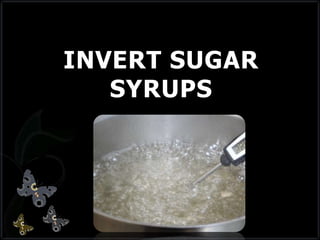
INVERT SUGAR
SYRUPS
INTRODUCTION
Invert sugar syrup is a mixture of glucose and fructose. It is
sometimes referred as artificial honey.
It is obtained by splitting sucrose into these two components.
Invert sugar has a lower water activity than that of sucrose, so it
provides more powerful preserving qualities.
The shelf life of inverts is approximately six months, depending on
storage and climatic conditions.
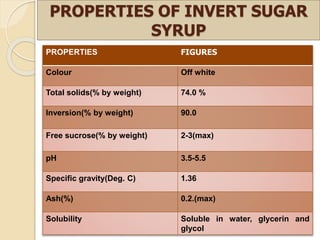
PROPERTIES OF INVERT SUGAR
SYRUP
PROPERTIES FIGURES
Colour Off white
Total solids(% by weight) 74.0 %
Inversion(% by weight) 90.0
Free sucrose(% by weight) 2-3(max)
pH 3.5-5.5
Specific gravity(Deg. C) 1.36
Ash(%) 0.2.(max)
Solubility Soluble in water, glycerin and
glycol
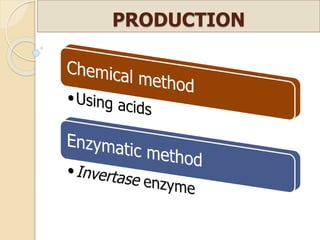
PRODUCTION
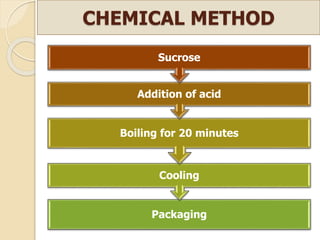
CHEMICAL METHOD
Packaging
Cooling
Boiling for 20 minutes
Addition of acid
Sucrose
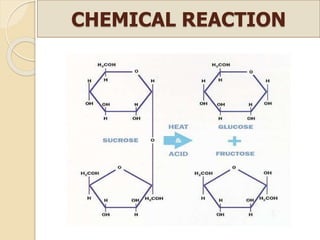
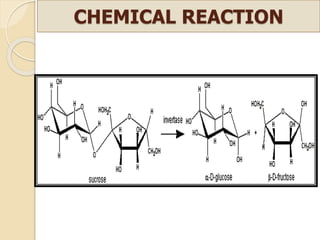
CHEMICAL REACTION
ADVANTAGES
 High sweetening
power.
 Easy handling.
 Act as
preservative.
 Easy weight
control.
 Texturing ability.
DISADVANTAGES
 Low conversion
efficiency.
 High-energy
consumption.
 High cost of production.
 Introduction of
impurities.
 Synthesis of certain bi-
products.
 Yield- 25-30%
 Crystallization can occur
during heating/ cooling.

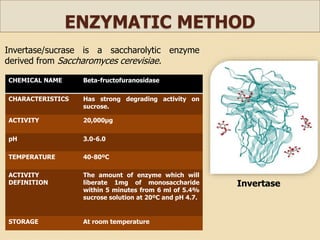
ENZYMATIC METHOD
Invertase/sucrase is a saccharolytic enzyme
derived from Saccharomyces cerevisiae.
Invertase
CHEMICAL NAME Beta-fructofuranosidase
CHARACTERISTICS Has strong degrading activity on
sucrose.
ACTIVITY 20,000µg
pH 3.0-6.0
TEMPERATURE 40-80ºC
ACTIVITY
DEFINITION
The amount of enzyme which will
liberate 1mg of monosaccharide
within 5 minutes from 6 ml of 5.4%
sucrose solution at 20ºC and pH 4.7.
STORAGE At room temperature
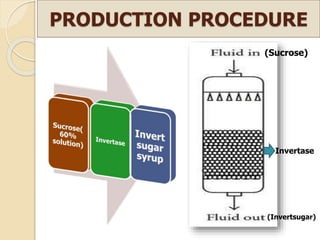
PRODUCTION PROCEDURE
(Sucrose)
(Invertsugar)
Invertase
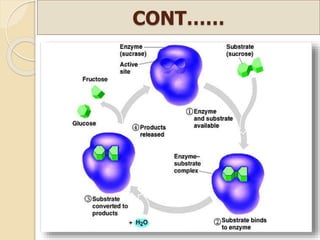
CONT……
CHEMICAL REACTION
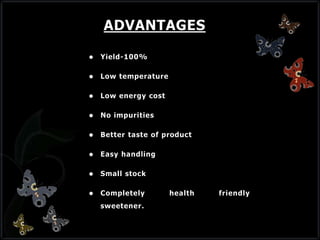
ADVANTAGES
 Yield-100%
 Low temperature
 Low energy cost
 No impurities
 Better taste of product
 Easy handling
 Small stock
 Completely health friendly
sweetener.
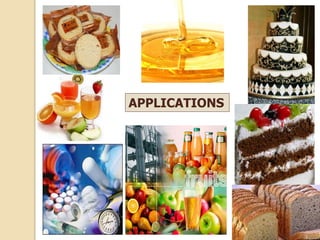
APPLICATIONS
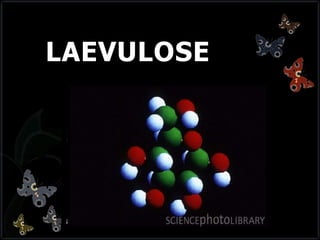
LAEVULOSE
INTRODUCTION
Laevulose/ fructose or Fruit-Sugar is a carbohydrate.
Molecular formula C6H12O6.
It is closely related to ordinary d- glucose.
It is a ketose (simple sugar) contained in most sweet
fruits, honey and starches together with dextrose.
It is called laevulose because it rotates the plane of
polarization towards left.
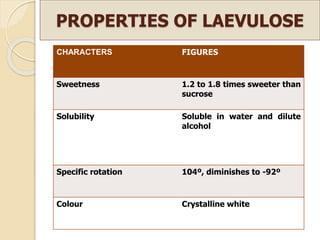
PROPERTIES OF LAEVULOSE
CHARACTERS FIGURES
Sweetness 1.2 to 1.8 times sweeter than
sucrose
Solubility Soluble in water and dilute
alcohol
Specific rotation 104º, diminishes to -92º
Colour Crystalline white
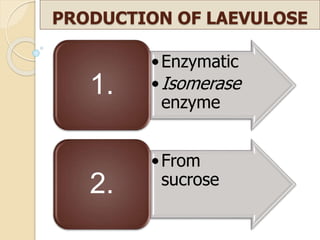
PRODUCTION OF LAEVULOSE
•Enzymatic
•Isomerase
enzyme
1.
•From
sucrose
2.
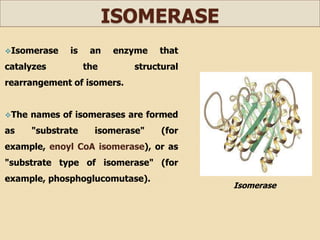
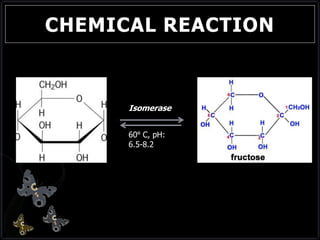
ISOMERASE
Isomerase is an enzyme that
catalyzes the structural
rearrangement of isomers.
The names of isomerases are formed
as "substrate isomerase" (for
example, enoyl CoA isomerase), or as
"substrate type of isomerase" (for
example, phosphoglucomutase).
Isomerase
CHEMICAL REACTION
Isomerase
60º C, pH:
6.5-8.2
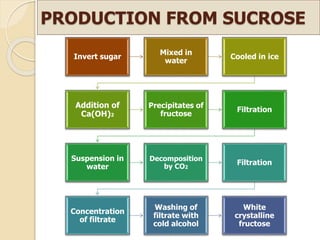
PRODUCTION FROM SUCROSE
Invert sugar
Mixed in
water
Cooled in ice
Addition of
Ca(OH)2
Precipitates of
fructose
Filtration
Suspension in
water
Decomposition
by CO2
Filtration
Concentration
of filtrate
Washing of
filtrate with
cold alcohol
White
crystalline
fructose
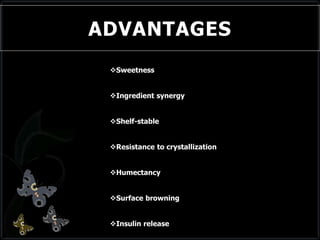
ADVANTAGES
Sweetness
Ingredient synergy
Shelf-stable
Resistance to crystallization
Humectancy
Surface browning
Insulin release
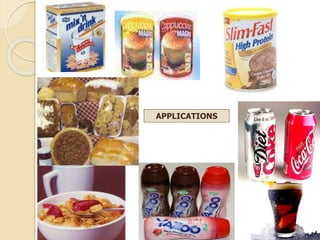
APPLICATIONS
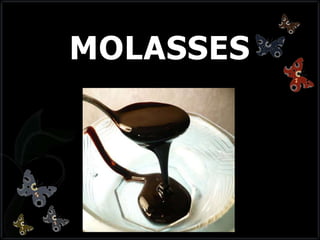
MOLASSES
INTRODUCTION
Molasses is a viscous by-product of the processing of
sugar cane, grapes or sugar beets into sugar.
The quality of molasses depends on the maturity of the
sugar cane or sugar beet, the amount of sugar extracted,
and the method of extraction.
In some parts of the United States molasses is also
known as sweet sorghum, though it is not true molasses.
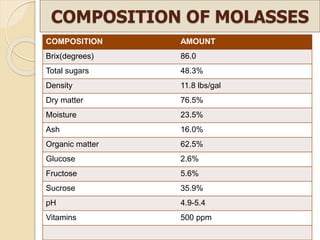
COMPOSITION OF MOLASSES
COMPOSITION AMOUNT
Brix(degrees) 86.0
Total sugars 48.3%
Density 11.8 lbs/gal
Dry matter 76.5%
Moisture 23.5%
Ash 16.0%
Organic matter 62.5%
Glucose 2.6%
Fructose 5.6%
Sucrose 35.9%
pH 4.9-5.4
Vitamins 500 ppm
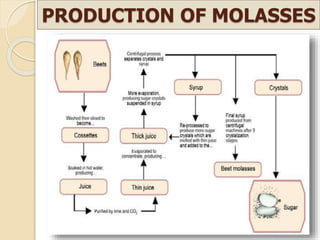
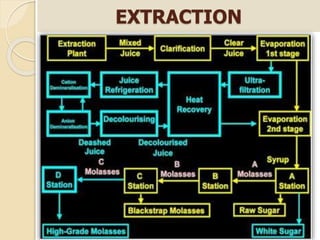
PRODUCTION OF MOLASSES
EXTRACTION
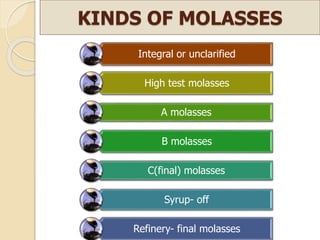
KINDS OF MOLASSES
Integral or unclarified
High test molasses
A molasses
B molasses
C(final) molasses
Syrup- off
Refinery- final molasses
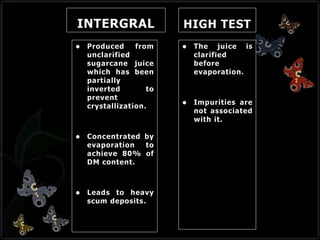
INTERGRAL
 Produced from
unclarified
sugarcane juice
which has been
partially
inverted to
prevent
crystallization.
 Concentrated by
evaporation to
achieve 80% of
DM content.
 Leads to heavy
scum deposits.
HIGH TEST
 The juice is
clarified
before
evaporation.
 Impurities are
not associated
with it.
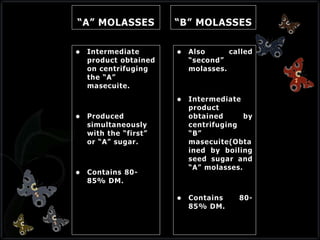
“A” MOLASSES
 Intermediate
product obtained
on centrifuging
the “A”
masecuite.
 Produced
simultaneously
with the “first”
or “A” sugar.
 Contains 80-
85% DM.
“B” MOLASSES
 Also called
“second”
molasses.
 Intermediate
product
obtained by
centrifuging
“B”
masecuite(Obta
ined by boiling
seed sugar and
“A” molasses.
 Contains 80-
85% DM.
“C”MOLASSES
Also known as “final” or “black - strap” molasses and in some countries as
“treacle”.
It is the end product obtained on centrifuging “C” masecuite.
“C” masecuite is prepared by boiling “virgin” sugar crystals (obtained from
syrup crystallization) and “B” molasses.
Contains some amount (approximately 32-42%) sucrose.
SYRUP- OFF
 Also called
“liquor-off” or
“jett”.
 The end product
obtained on
centrifugation
of final refined
masecuite.
 Has 90-92% of
DM.
REFINERY-FINAL
MOLASSES
 Another type of
final molasses.
 Represents less
than 1% of
processed raw
sugar.
 Has similar
composition to
that of the final
“C” molasses.
APPLICATIONS
Used as the base material for fermentation into rum.
Molasses is commonly used in dark brewed beverages like
stout and very heavy dark ales.
Molasses is added to some brands of tobacco used for
smoking through a Middle Eastern water pipe (e.g., hookah,
shisha, narghile, etc).
Blackstrap molasses may also be used as an iron
supplement for those who cannot tolerate the constipation
associated with other iron supplementation.
 An additive in livestock grains.
Paoers written by P. ANDRES, Repetitorium der
Zuckertechnik, Berlin (1953).
 E. MOEBES and L. WIENINGER, Zucker 8
(1955) 170.
The journal of Biological Chemistry NEILANDS,
J.B.,in S.P. COLOWICKAND N.O.KAPLAN (Editors),
Methods in enzymology, Vol. I
http/books.google.co.uk
"http://en.wikipedia.org/w/index.php?title=Molasses&
oldid=453935825
REFERNCES
invert sugar syrup.pptx

invert sugar syrup.pptx

  • 2.
  • 3.
    INTRODUCTION Invert sugar syrupis a mixture of glucose and fructose. It is sometimes referred as artificial honey. It is obtained by splitting sucrose into these two components. Invert sugar has a lower water activity than that of sucrose, so it provides more powerful preserving qualities. The shelf life of inverts is approximately six months, depending on storage and climatic conditions.
  • 4.
    PROPERTIES OF INVERTSUGAR SYRUP PROPERTIES FIGURES Colour Off white Total solids(% by weight) 74.0 % Inversion(% by weight) 90.0 Free sucrose(% by weight) 2-3(max) pH 3.5-5.5 Specific gravity(Deg. C) 1.36 Ash(%) 0.2.(max) Solubility Soluble in water, glycerin and glycol
  • 5.
  • 6.
    CHEMICAL METHOD Packaging Cooling Boiling for20 minutes Addition of acid Sucrose
  • 7.
  • 8.
    ADVANTAGES  High sweetening power. Easy handling.  Act as preservative.  Easy weight control.  Texturing ability. DISADVANTAGES  Low conversion efficiency.  High-energy consumption.  High cost of production.  Introduction of impurities.  Synthesis of certain bi- products.  Yield- 25-30%  Crystallization can occur during heating/ cooling.
  • 9.
    ENZYMATIC METHOD Invertase/sucrase isa saccharolytic enzyme derived from Saccharomyces cerevisiae. Invertase CHEMICAL NAME Beta-fructofuranosidase CHARACTERISTICS Has strong degrading activity on sucrose. ACTIVITY 20,000µg pH 3.0-6.0 TEMPERATURE 40-80ºC ACTIVITY DEFINITION The amount of enzyme which will liberate 1mg of monosaccharide within 5 minutes from 6 ml of 5.4% sucrose solution at 20ºC and pH 4.7. STORAGE At room temperature
  • 10.
  • 11.
  • 12.
  • 13.
    ADVANTAGES  Yield-100%  Lowtemperature  Low energy cost  No impurities  Better taste of product  Easy handling  Small stock  Completely health friendly sweetener.
  • 14.
  • 15.
  • 16.
    INTRODUCTION Laevulose/ fructose orFruit-Sugar is a carbohydrate. Molecular formula C6H12O6. It is closely related to ordinary d- glucose. It is a ketose (simple sugar) contained in most sweet fruits, honey and starches together with dextrose. It is called laevulose because it rotates the plane of polarization towards left.
  • 17.
    PROPERTIES OF LAEVULOSE CHARACTERSFIGURES Sweetness 1.2 to 1.8 times sweeter than sucrose Solubility Soluble in water and dilute alcohol Specific rotation 104º, diminishes to -92º Colour Crystalline white
  • 18.
  • 19.
    ISOMERASE Isomerase is anenzyme that catalyzes the structural rearrangement of isomers. The names of isomerases are formed as "substrate isomerase" (for example, enoyl CoA isomerase), or as "substrate type of isomerase" (for example, phosphoglucomutase). Isomerase
  • 20.
  • 21.
    PRODUCTION FROM SUCROSE Invertsugar Mixed in water Cooled in ice Addition of Ca(OH)2 Precipitates of fructose Filtration Suspension in water Decomposition by CO2 Filtration Concentration of filtrate Washing of filtrate with cold alcohol White crystalline fructose
  • 22.
    ADVANTAGES Sweetness Ingredient synergy Shelf-stable Resistance tocrystallization Humectancy Surface browning Insulin release
  • 23.
  • 24.
  • 25.
    INTRODUCTION Molasses is aviscous by-product of the processing of sugar cane, grapes or sugar beets into sugar. The quality of molasses depends on the maturity of the sugar cane or sugar beet, the amount of sugar extracted, and the method of extraction. In some parts of the United States molasses is also known as sweet sorghum, though it is not true molasses.
  • 26.
    COMPOSITION OF MOLASSES COMPOSITIONAMOUNT Brix(degrees) 86.0 Total sugars 48.3% Density 11.8 lbs/gal Dry matter 76.5% Moisture 23.5% Ash 16.0% Organic matter 62.5% Glucose 2.6% Fructose 5.6% Sucrose 35.9% pH 4.9-5.4 Vitamins 500 ppm
  • 27.
  • 28.
  • 29.
    KINDS OF MOLASSES Integralor unclarified High test molasses A molasses B molasses C(final) molasses Syrup- off Refinery- final molasses
  • 30.
    INTERGRAL  Produced from unclarified sugarcanejuice which has been partially inverted to prevent crystallization.  Concentrated by evaporation to achieve 80% of DM content.  Leads to heavy scum deposits. HIGH TEST  The juice is clarified before evaporation.  Impurities are not associated with it.
  • 31.
    “A” MOLASSES  Intermediate productobtained on centrifuging the “A” masecuite.  Produced simultaneously with the “first” or “A” sugar.  Contains 80- 85% DM. “B” MOLASSES  Also called “second” molasses.  Intermediate product obtained by centrifuging “B” masecuite(Obta ined by boiling seed sugar and “A” molasses.  Contains 80- 85% DM.
  • 32.
    “C”MOLASSES Also known as“final” or “black - strap” molasses and in some countries as “treacle”. It is the end product obtained on centrifuging “C” masecuite. “C” masecuite is prepared by boiling “virgin” sugar crystals (obtained from syrup crystallization) and “B” molasses. Contains some amount (approximately 32-42%) sucrose.
  • 33.
    SYRUP- OFF  Alsocalled “liquor-off” or “jett”.  The end product obtained on centrifugation of final refined masecuite.  Has 90-92% of DM. REFINERY-FINAL MOLASSES  Another type of final molasses.  Represents less than 1% of processed raw sugar.  Has similar composition to that of the final “C” molasses.
  • 34.
    APPLICATIONS Used as thebase material for fermentation into rum. Molasses is commonly used in dark brewed beverages like stout and very heavy dark ales. Molasses is added to some brands of tobacco used for smoking through a Middle Eastern water pipe (e.g., hookah, shisha, narghile, etc). Blackstrap molasses may also be used as an iron supplement for those who cannot tolerate the constipation associated with other iron supplementation.  An additive in livestock grains.
  • 35.
    Paoers written byP. ANDRES, Repetitorium der Zuckertechnik, Berlin (1953).  E. MOEBES and L. WIENINGER, Zucker 8 (1955) 170. The journal of Biological Chemistry NEILANDS, J.B.,in S.P. COLOWICKAND N.O.KAPLAN (Editors), Methods in enzymology, Vol. I http/books.google.co.uk "http://en.wikipedia.org/w/index.php?title=Molasses& oldid=453935825 REFERNCES